
INTRODUCTION
Compression of the portal triad (PT) is the classic method of liver blood flow control (1). Clamping of the AT structures is a frequently performed procedure in liver surgery (2). This method has been mainly associated with the surgical treatment of tumours, trauma, or liver transplantation. However, it can lead to the ischemia-reperfusion injury of inner organs (3). Moreover, it can result in changes in liver blood flow and subsequent tissue damage associated with reperfusion. In fact, tissue damage in local and distant regions affects the outcome of liver surgery. It has been shown that it is related to the duration of hypoxia during the intervention (2).
Apart from that, even a short clamping of the PT can cause stagnation in the portal vein, particularly in the superior and inferior mesenteric veins, thereby reducing visceral outflow (4). In turn, a decrease in blood flow in the intestine can lead to damage to enterocytes and loss of the intestinal barrier because of increased pressure in the microvascular network of intestinal structures (5). Moreover, it can trigger apoptosis of hepatocytes and intestinal cells (6). Previous studies have shown the negative effect of portal vein occlusion on mesenteric blood flow. In addition, it was revealed that such an intervention induces pathological changes in the mesenteric microcirculation and intestinal mucosa at an early stage (7).
The morphological structure of the small intestine is well studied and presented in the literature (8). However, there are insufficient data on changes in the intestine during the period of ligation of the liver PT (9). In fact, the elements of the microvascular system are the most important structures, the location of which can be observed in the submucosa of the small intestine (10). It is well known that 70 % of mesenteric blood flow plays a crucial role in the supply of blood to the mucous and submucosal layers of the small intestine. Moreover, only the remaining portion of the blood flow is dedicated to the muscular and serous layers (11). Therefore, in our work, we examined the morphological changes in the submucosal layer.
The optimal time tolerated (hypoxemia) by the liver during surgery is still controversial. Some reports indicate that the duration of intermittent clamping of the PT (that does not cause clinical complications) is 15 minutes (12). However, there are studies indicating the possibility of continuous clamping of the PT without increasing the risk of complications and risk. The duration of continuous clamping can be up to 90 minutes in the absence of liver pathology or up to 50 minutes in the presence of liver disease (13). Kolahdoozan et al. demonstrated in experiments on animals that the safe time interval for clamping the PT was 30–45 minutes (average) (14).
Up to date, the range of studies reported the detailed effect of PT clamping on liver damage, while pathological changes in the small intestine have not been widely covered yet (4). Nevertheless, it was proved, in the experiments on animal model (in rats), that prolonged clamping of the PT (more than 90 min) increases the risk of death due to the development of multisystem organ damage. Particularly, the lungs, heart and intestines are being damaged too (in addition to the liver) (15). In another study, Sheen-Chen et al. demonstrated significant increase of apoptosis in the small intestine in comparison of 15 minutes of PT clamping and 30 minutes of clamping (6). It has been thought that the development of multi-organ damage is associated with the loss of the intestinal barrier function (16).
Preclinical studies indicated a high risk of damage to the small intestine during clamping of the PT. It has been associated with hypo-perfusion of extra-hepatic structures that lead to the manifestation of bacterial translocation and endo-toxinemia (17,18,19). However, the different modes of PT clamping cannot provide a clear picture for establishing the optimal time interval to prevent irreversible changes in the structure of the small intestine.
Sebe et al. conducted the study on assessing the histological changes of the small intestine during clamping of the PT in rats (10, 20 and 30 minutes). It was determined that significant morphological changes in the structure of the small intestine (especially in the mucous membrane, in addition to the submucosa, muscle and serous layers) appear only after 30 minutes after clamping (20). However, it should be noted that histological materials were taken immediately after performing PT clamping. This circumstance can indicate only about the initial changes after ischemia, so that the main structural tissue damage has not been properly evaluated (after the subsequent period of reperfusion).
In this regard, there is a need for a thorough examination of histological changes in the small intestine in the early and late periods of reperfusion. It can help to investigate the full depth of tissue damage. This study aimed at the determination of the time of occurrence of morphological changes in the small intestine followed by the clamping of the portal triad.
MATERIALS AND METHODS
Ethical issue
The study was carried out in the Laboratory of Experimental Medicine of the NJSC S.D. Asfendiyarov Kazakh National Medical University (KazNMU), Almaty city, the Republic of Kazakhstan. The study was approved by the ethics committee of KazNMU named after S. D. Asfendiyarov (Minutes No. 7 (84) dated 06/10/2019).
Design of the study
The animals were kept in accordance with the international rules “Guide for the Care and Use of Laboratory Animals” (National Research Council, 2011), as well as with the ethical principles of the European Convention for the Protection of Vertebrate Animals Used for Experimental and Other Scientific Purposes (Strasbourg, 2006)
The experimental study was conducted on 94 outbred 12-week-old male Wistar Albino rats weighing 190-220 g. Animals before and after the operation were kept in the Vivarium of the B. Atchabarov Research Institute of Fundamental and Applied Medicine (Kazakhstan, Almaty) with a standard diet and care. Laboratory animals were randomly assigned to the following 4 groups:
Group I - Control group (CG): intestinal tissue was resected for use as a control without any manipulation of the PT (n = 10);
Group II - Interventional group (6-IG): clamping of the PT for 6 minutes (n = 28);
Group III - Interventional group (12-IG): clamping of the PT for 12 minutes (n = 28);
Group IV - Interventional group (24-IG): PT clamping for 24 minutes (n = 28)
Surgical procedures
The intervention on laboratory animals was conducted in the operating unit of the Laboratory of the Atchabarov Research Institute of Fundamental and Applied Medicine (Kazakhstan, Almaty).
Surgical intervention was performed with a pre-shaved surgical field, under general anaesthesia (ketamine 80 mg / kg + xylazine 10 mg / kg) (6). The dose and time of administration of the drugs were recorded in the experiment log. The rats were fixed on the operating table in the supine position on the back.
A midline laparotomy was performed in 6-IG, 12-IG, 24-IG groups. The PT was ligated according to the standard technique (19) for 6, 12 and 24 minutes, depending on the group of laboratory animals. Successfully performed PT clamping was determined and assessed by the detection of congestion in the intra-abdominal organs. Further, the operating wound was sutured in layers. After this, the animals were returned to their cages, with no restrictions in activity. After surgical intervention, as a postsurgical analgesic the animals were given an intramuscular injection of diclofenac sodium (5 mg/kg).
Laboratory animals of the 6-IG, 12-IG, 24-IG groups were withdrawn from the experiment after 3 hours, 6 hours for 4 animals, after 12 hours, 1 day, 3 days and 7 days for 5 animals using cervical dislocation (21).
Histology
For histological examination, 2 cm pieces of the small intestine were taken (22) in the region of the middle third. After this, they were fixed in 10 % neutral formalin. Then, after fixation in formalin, the tissue of the small intestine was held in alcohol of increasing strength, followed by embedding in paraffin (3, 23).
Microtome sections of the small intestine with a thickness of 4 μm were cut, then stained with haematoxylin and eosin, staining was subsequently conducted on each slide. Interpretation of histological materials was carried out by two independent specialists-histologists. Each slide was scored from 0 to 5 according to the scale by Chiu et al., where: Grade 0- normal villi; Grade 1- development of subepithelial space; Grade 2- moderate lifting of subepithelial layer; Grade 3- massive epithelial lifting with a few tips denuded; Grade 4- denuded villi with lamina propria and dilated capillaries; Grade 5, digestion and disintegration of lamina propria with ulceration (24).
Determination of changes in the architectonics of the intestine after clamping of the PT was made by filling the vascular basin of rats with a 0.5 % solution of silver nitrate through the aorta followed by preliminary washing the blood vessels with warm (37 ° C) 0.9 % sodium chloride solution according to previously indicated method (25, 26). The manipulations were carried out under the strict control of a manometer, from which filmy clarified preparations were prepared. The diameter of the lumen of micro-vessels was measured with an ocular ruler “MOV-1-15xU4.2.”. The division value and calibration of the ocular micrometre were determined using an object micrometre (26).
Microscopic analysis of tissue sections from various experimental groups of animals was performed using a Leica DM 2000 binocular light microscope (Leica Microsystems, Wetzlar, Germany) and digital software (Image-Pro plus 6.0; Media Cybernetics, USA).
Statistical analysis
Statistical analysis of the data obtained was carried out using the SPSS software 22 (USA). The arithmetic mean (M) and standard deviation (SD) were calculated. Data were presented as M ± SD. One-way analysis of variance ANOVA was chosen as a statistical test to determine statistical differences within a group. Differences were considered statistically significant if p < 0.05.
RESULTS
Histological evaluation
All laboratory animals were withdrawn from the experiment in accordance with the established protocols of the experiment. In the CG group, data obtained from healthy tissues of the small intestine of laboratory animals were used as a control (to compare with the results of other experimental series). The diameters of arterioles of the small intestine were 34 ± 4 μm, pre-capillaries 15 ± 2 μm, capillaries 5.4 ± 1 μm, post-capillaries 18 ± 2 μm, and the size of the venule lumen was 40 ± 3 μm, respectively.
In the 6-IG group, dilation of capillaries, post-capillaries and venules was observed after 3 hours, which were assessed as statistically significant compared to control values (p < 0.05).
After 6 hours, we observed a significant venous plethora along with a pronounced increase in the calibre of venules (p < 0.05). In addition, we detected the expansion of arterioles and other links of the microvasculature of the small intestine, which was considered statistically significant in comparison with the control indicators. After 12 hours, all the parts of the microvasculature of the small intestine, except for arterioles (p > 0.05), were significantly expanded compared to the control. After 1st day, significant expansion of pre-capillaries, capillaries, post-capillaries and venules (p < 0.05) remains the same (compared to the control’ values). After 3 days, the diameters of micro-vessels of the small intestine, except for arterioles, pre-capillaries and capillaries, tended to be significantly decreased (p < 0.05), compared with the previous observation period obtained 1 day after the intervention. After 7 days, there was a decrease in the diameters of all links of the vascular bed of the small intestine, and it was not statistically significant (p > 0.05).
In the 12-IG group, after clamping the PT for 12 minutes, morphological changes in the microvasculature were recorded at 3, 6, 12 hours, 1, 3, and 7 days after surgery (see Table 2). After 3 hours, the diameter of all chains of the microvasculature was significantly expanded (p < 0.05). After 6 and 12 hours, dilatation remained in all parts of the vascular system (p < 0.05) in comparison with the control group. However, in contrast to the measurements obtained 3 hours after the intervention, a decrease in the diameters of the vascular system was observed (p < 0.05). After 1 day, the expansion of the elements of the vascular bed was also preserved in comparison with the control (p < 0.05). After 3 days, in addition to arterioles and venules, the diameters of the remaining micro-vessels of the small intestine showed a tendency to decrease, which was regarded as statistically significant (p < 0.05). After 7 days, the diameter of all parts of the microcirculatory system of the small intestine decreased in comparison with the indicators obtained 3 days after clamping of the PT. Nevertheless, the decrease in the lumen values of the arterioles and pre-capillaries was without any statistical significance (p > 0.05). It must be noted that compared with 6-minute exposure of the PT clamping, the diameter of the micro-vessels remained expanded during the period of the study.
Table 1.
Diameter of the links of the microvasculature of the small intestine of experimental rats with clamping of the PT for 6 minutes, depending on the observation time (M ± SD) (μm)
| Parts of microcirculatory system | Control | Observation time | |||||
|---|---|---|---|---|---|---|---|
| 3 hours | 6 hours | 12 hours | 24 hours (1 day) | 72 hours (3 days) | 168 hours (7 days) | ||
| Arterioles | 34±4 | 39,4±3,2 | 40±3,1* | 39,8±2,8 | 38,4±2,7 | 35±2,6 | 34,5±2,9 |
| Pre-capillaries | 15±2 | 18,7±1,7 | 19,5±2,5* | 20±2,4* | 20±2,2* | 18±2,1 | 17±2,0 |
| Capillaries | 5,4±1 | 8,3±0,7* | 8,7±0,6* | 8,9±0,5* | 8,8±0,6* | 6,7±0,5 | 6±0,9 |
| Post-capillaries | 18±2 | 27±2,1* | 28±1,7* | 29±2,0* | 28,5±1,8* | 23±1,9* | 21,5±1,8 |
| Venules | 40±3,5 | 60±3,9* | 61±3,4* | 60±3,6* | 58±3,4* | 50±3,2* | 45±3,4 |
Table 2.
Diameters of the links of the microvasculature of the small intestine of experimental rats with clamping of the PT for 12 minutes, depending on the observation time (M ± SD) (μm)
| Parts of microcirculatory system | Control | Observation time | |||||
|---|---|---|---|---|---|---|---|
| 3 hours | 6 hours | 12 hours | 24 hours (1 day) | 72 hours (3 days) | 168 hours (7 days) | ||
| Arterioles | 34± | 42±3,1 | 40,6±2,7 | 41±2,8 | 40±2,7 | 38,3±2, | 36±2,7 |
| Pre-capillaries | 15±2 | 24,5±2,5* | 20±2,2* | 21±2,1* | 22±1,9* | 19,5±1,9* | 17,6±1,6 |
| Capillaries | 5,4±1 | 10,7±0,7* | 9,8±0,5* | 9,9±0,6* | 9,0±1,0* | 8,6±0,7* | 8,2±0,6* |
| Post-capillaries | 18±2 | 32±1,8* | 30±1,8* | 32±1,7* | 33±1,9* | 27,6±1,7* | 26,8±1,5* |
| Venules | 40±3,5 | 66±3,3* | 58±3,4* | 62±3,2* | 61±3,4* | 56±3,2 | 54±3,1* |
In the 24-IG group, after clamping the PT for 24 minutes, morphological changes in the micro-vasculature were recorded 3, 6, 12 hours, 1.3, 7 days after surgery (see Table 3). After 3 hours, a significant maximum expansion of all parts of the vascular bed is observed in comparison with the control values of the small intestine (p <0.05). After 6 and 12 hours, the diameter of the vessels remains significantly dilated (p <0.05) in comparison with the indices of intact animals. However, after 12 hours, a decrease in the measured values was observed (in contrast to the data obtained after 6 hours of clamping the PT). After 1 day, the diameters of the micro-vessels of the small intestine had a statistically significant tendency (p < 0.05) to decrease in comparison with the indicators recorded 12 hours after surgery. However, the values of the post-capillaries remained dilated without differences from the data recorded after 6 hours compared to the control (p < 0.05). After 3 days, the diameter of the microvessels of the small intestine remained significantly enlarged compared to the control values (p < 0.05). After 7 days, the diameter of all parts of the microvasculature of the small intestine was decreased compared with the data obtained after 3 days (p <0.05). Nonetheless, in contrast to 12-minute PT compression, during the same period, vessels remained relatively expanded. The indices of the vascular bed of the small intestine do not return to the initial values during the entire study.
Table 3.
Diameters of the links of the microvasculature of the small intestine of experimental rats with clamping of the PT for 24 minutes, depending on the observation time (M ± SD) (μm)
| Parts of micro-circulatory system | Control | Observation time | |||||
|---|---|---|---|---|---|---|---|
| 3 hours | 6 hours | 12 hours | 24 hours (1 day) | 72 hours (3 days) | 168 hours (7 days) | ||
| Arterioles | 34±4 | 46±3,3* | 44±2,9* | 45±3,0* | 41±2,6* | 40±2,5* | 39±2,4 |
| Pre-capillaries | 15±2 | 28±2,7* | 24,4±2,6* | 22±2,3* | 21±2,0* | 22±1,8* | 21±1,9* |
| Capillaries | 5,4±1 | 12,6±0,6* | 11,2±0,8* | 10±0,7* | 9,5±0,5* | 9,0±0,7* | 8,8±0,6* |
| Post-capillaries | 18±2 | 35±1,9* | 32±1,7* | 31±1,6* | 31±1,8* | 32±2,0* | 30±1,8* |
| Venules | 40±3,5 | 72±3,4* | 68±3,5* | 66±3,4* | 62±3,3* | 61±3,2* | 59±2,9* |
In the 6-IG group, 3 hours after 6 minutes of PT clamping, narrowed areas of arterioles and pre-capillaries with a weakly expressed capillary network were encountered (Fig. 1, A). After 6 hours, significant venous congestion led to the persistence of excessive tortuosity of capillaries, post-capillaries, and venules (Fig. 1, B). Twelve hours later, tortuosity and dilation of arterioles and pre-capillaries were observed along with a sharp depletion of the capillary system (Fig. 1, C). After 1 day, hyper-chromicity and dilation of capillaries, post-capillaries and venules were persisted (Fig. 1, D). After 3 days, dilated pre-capillaries and capillaries were visible and detectable (Fig. 1, E). After 7 days, moderate visibility of the pre-capillaries and capillaries of the serous and muscular membranes was observed (Fig. 1, F),
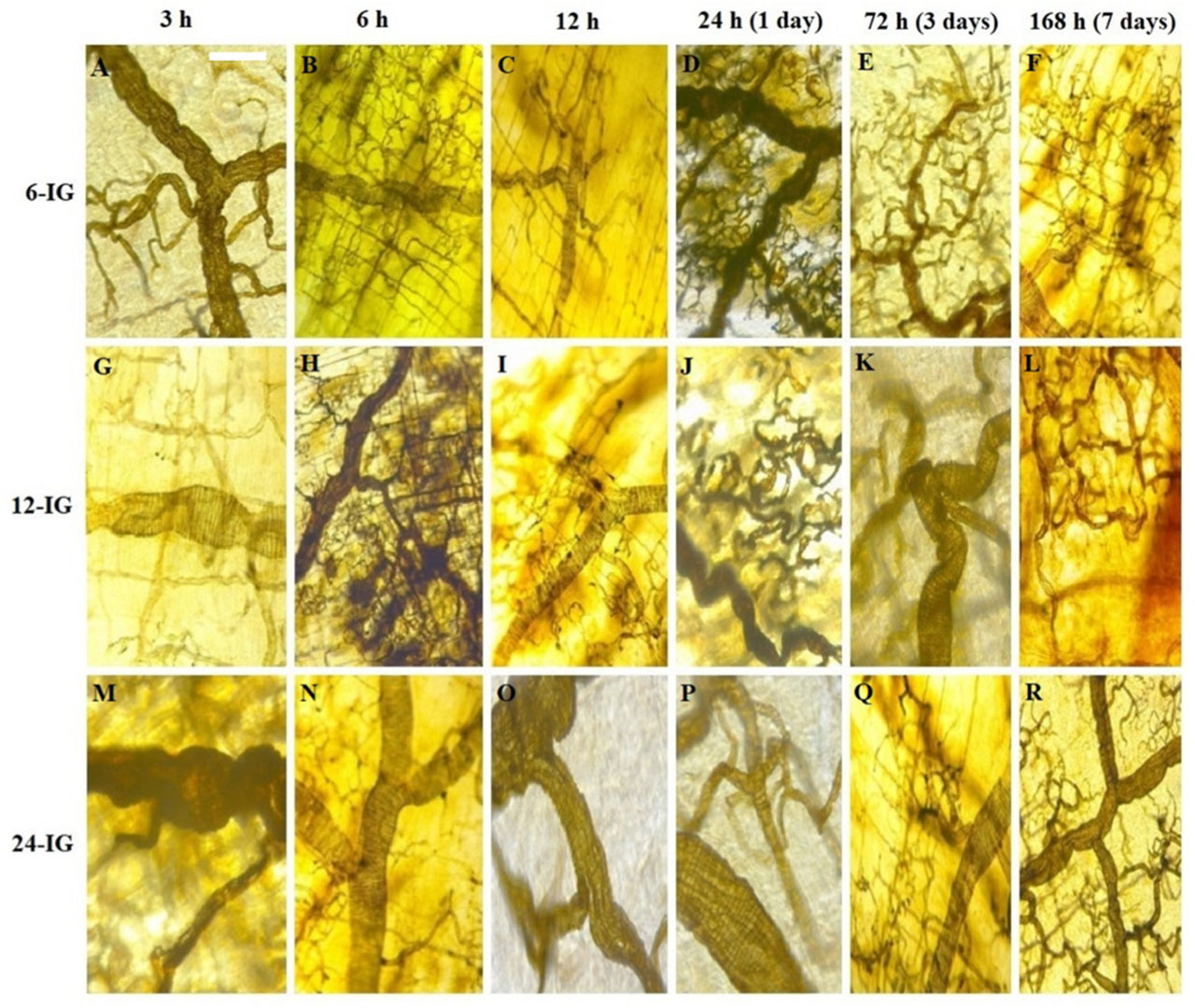
Fig. 1.
Histological picture of small intestine microcirculation in experimental rats during PT clamping for 6, 12 and 24 minutes, depending on the observation time (A, G, M - after 3 hours; B, H, N - after 6 hours; C, I, O - after 12 hours; D, J, P-1 day; E, K, Q - 3 days; F, L, R-7 days). The silver nitrate staining protocol. Magnification ×200, scale bars (white) 100 μm.
In the 12-IG group, 3 hours after acute extrahepatic portal hypertension, the damaged sites showed segmental narrowing of the arterioles and vague capillary network (Fig. 1, G). After 6 hours, there were signs of impaired microvascular permeability (Fig. 1, H). After 12 hours, the post-capillaries and venules remained moderately dilated (Fig. 1, I). After 1 day, the expansion of capillaries, post-capillaries and venules was accompanied by a violation of their permeability with the release of the dyes into the perivascular space (Fig. 1, J). It was confirmed by signs of haemorrhages on the macro specimen. After 3 days, a sharp expansion of the arterioles and pre-capillaries was visible (Fig. 1, K). After 7 days, we observed the expansion of the pre-capillaries and capillaries (Fig. 1, L).
In the 12-IG group, micro-aneurysmal dilatation of the arterioles accompanied by areas of narrowing vessels was detected after 3 hours (Fig. 1, M). After 6 hours, pronounced constriction of arterioles in the area of their origin from the arteries (sphincters) was observed (Fig. 1, N). After 12 hours, there was the uneven expansion of arterioles and pre-capillaries (Fig. 1, O). After 1 day, the arterioles and pre-capillaries of the serous layer were unevenly dilated and arterio-venular anastomoses appeared (Fig. 1, P). After 3 days, the pre-capillaries and the capillary network of the serous and muscular membranes were unevenly stained with silver salts (Fig. 1, Q). Then, after 7 days, there were areas of uneven narrowing of arterioles and pre-capillaries with a defect in filling the capillary network (Fig. 1, R).
In the 12-IG group, 3 hours after 6 minutes of PT clamping, the small intestine was characterized by submucosal dissection (due to oedema). The structure of the muscle and mucous layers was preserved. In the submucosal layer, there were separate solitary lymph vessel covered with columnar epithelium (Fig. 2, A1). After 6 hours: the swelling of the submucosa increased leading to the compression towards the mucous membrane (Fig. 2, B1). After 12 hours: there was a decrease in the oedema of the submucosa with the appearance of lymphoid infiltration of the mucous membrane (Fig. 2, C1). After 1 day: oedema of the parenchyma of the lymphatic follicle was observed (Fig. 2, D1). After 3 days: a slight swelling of the submucosa and dilatation of vessels remained (Fig. 2, E1). After 7 days: the lymphatic vessels near the follicles were dilated (Fig. 2, F1).
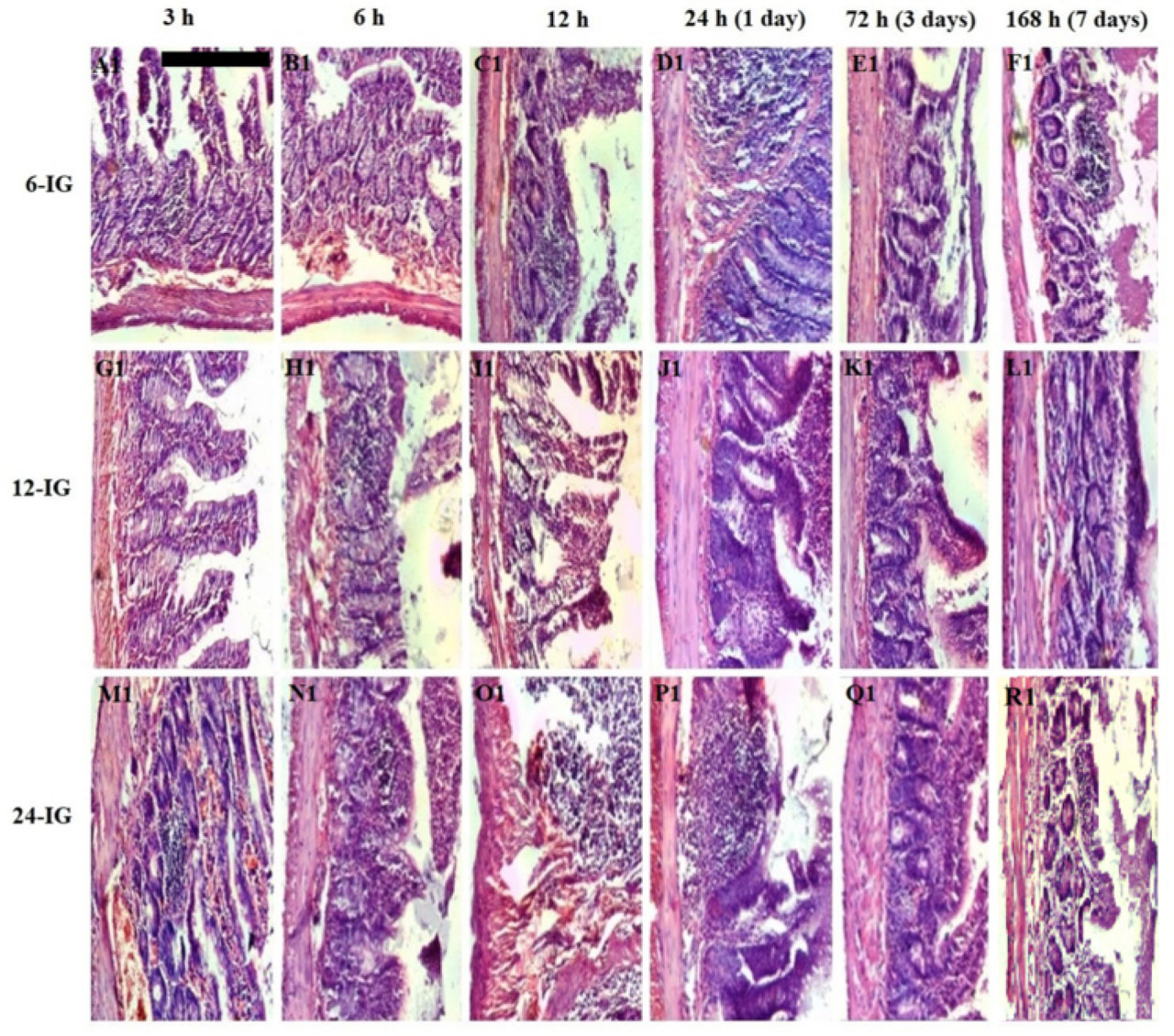
Fig. 2.
Histological picture of small intestine microcirculation in experimental rats during PT clamping for 6,12 and 24 minutes, depending on the observation time (A1, G1, M1 - after 3 hours; B1, H1, N1 - after 6 hours; C1, I1, O1 - after 12 hours; D1, J1, P1 - 1 day; E1, K1, Q1 - 3 days; F1, L1, R1 - 7 days). Hematoxylin-eosin. Magnification ×100, scale bars (black) 100 μm.
In the 12-IG group, 3 hours after acute extrahepatic portal hypertension, loosening of the muscular membrane and submucosa was detected as a result of interstitial oedema and vasodilatation of the villous lamina propria (Fig. 2, G1). After 6 hours: there was an increase in submucosal oedema with marked swelling of the lymphatic vessel (Fig. 2, H1). After 12 hours: we detected the increase of oedema of the muscular membrane and submucosa (Fig. 2, I1). After 1 day: the expansion of the lymphatic capillaries in the mucous layer and submucosa with round-cell infiltration of the mucous membrane of the small intestine was revealed (Fig. 2, J1). After 3 days: the venules of the submucosa of the small intestine remain dilated (Fig. 2, K1). After 7 days: a sharp oedema of the submucosa of the small intestine persists, the vessels remained dilated (Fig. 2, L1).
In the 24-IG group, after 3 hours, there was a sharp vasodilation in the submucosa and the mucous layer of the small intestine. In addition, we observed the oedema of the lymph node with the expansion of the lymphatic capillaries (Fig. 2, M1). After 6 hours: the oedema and vasodilation of the serous layer and submucosa of the small intestine does not undergo significant changes, there is abundant infiltration of the mucous layer (Fig. 2, N1). After 12 hours: there was swelling of the stroma of the Peyer's patch of the small intestine and dilation of the lymphatic vessels (Fig. 2, O1). After 1 day: pronounced oedema of the submucosa of the small intestine with cellular infiltration persisted. The blood vessels were full-blooded, and the lymphatic vessels were dilated. There was oedema of the lymph node parenchyma (Fig. 2, P1). After 3 days: there was a thickening of the muscular membrane due to diffuse oedema, expansion of lymphatic vessels in the submucosa and abundant lymphocytic infiltration of the latter (Fig. 2, Q1). After 7 days: the oedema of the muscular layer of the small intestine decreased. The oedema of the submucosa, on the contrary, remained pronounced with the expansion of the lymphatic vessels (Fig. 2, R1).
DISCUSSION
The aim of this study was to elucidate the dynamics of morphological changes in the small intestine after clamping of the PT to determine the exact time of occurrence of irreversible disorders.
In fact, the PT clamping technique is an effective surgical method aimed at reducing bleeding during liver surgery (6). However, the reperfusion (the restoration of blood flow after a period of ischemia) may put ischemic organs at risk of further cell necrosis, and limit the recovery (27).
To reduce the undesirable consequences of this method, several variants of PT clamping were proposed, including ischemia preconditioning, intermittent clamping, and pharmacological preconditioning (4). However, such methods cannot guarantee undesirable complications. Hence, the determination of a safe interval of time clamping remains very important.
According to the results obtained, it can be assumed that the duration of the compression of the PT had a directly proportional effect on the outcome of the experiment. No fatalities were reported in the 6-IG and 12-IG studies. Mortality among rats of the 12-IG group was 14.3 %. The mortality of rats in the 24-IG group with 24 minutes of PT clamping was 42.8 % (Table 4). Previous studies have shown that 80 % of animals who underwent 120-minute PT clamping died from complications such as respiratory distress (34 %), intestinal complications (28 %), and cardiovascular disorders (18 %) (15).
Table 4.
Mortality of experimental animals in different study groups
| Groups | Experimental model | Operated animals | Lethality of animals (L / N) | Total % | |||||
|---|---|---|---|---|---|---|---|---|---|
| 3h | 6 h | 12 h | 24 h | 72 h | 168 h | ||||
| I | Control | 10/94 | - | - | - | - | - | - | - |
| II | Clamping PT for 6 min | 28/94 | -/4 | -/4 | -/5 | -/5 | -/5 | -/5 | - |
| III | Clamping PT for 12 min | 28/94 | -/4 | -/4 | -/5 | 1/5 | 1/5 | 2/5 | 4/14.3 |
| IV | Clamping PT for 24 min | 28/94 | 1/4 | 1/4 | 2/5 | 2/5 | 3/5 | 3/5 | 12/42.8 |
As the matter of fact, disturbance of microcirculation plays a key role in the cascade of reactions associated with damage to intestinal structures. Microcirculatory damage manifests itself in disruption of the endothelium-dependent dilatation of arterioles, a decrease in blood flow due to the accumulation of leukocytes in capillaries and extravasation of leukocytes and plasma proteins in post-capillary venules (26, 27). In addition, one should remember the importance of oxidative stress and inflammatory reactions in the process of disruption and damage to extrahepatic structures (28).
An earlier study has argued that gastrointestinal perfusion disorders during cardiopulmonary bypass surgery can induce the loss of vascular integrity in the small intestine mucosa and an increase in permeability (with leukocyte infiltration). As a result, bacterial translocation and the entry of endotoxin into the systemic circulation triggers the manifestation of toxic effects and systemic tissue damage (29). In the process of regeneration (after resection), the liver demonstrated a relatively low level of oxidative stress. At the same time, in the intestine, the oxidative damage of proteins is being increased, which contributes to the occurrence of intestinal dysfunction and endotoxin translocation (28). In our study, we observed the effect of hemodynamic disturbance after 6 hours as a result of 12 minutes of PT clamping. The histological evidence of vascular permeability disturbances was obtained. Such morphological changes persisted 1 day after the intervention. It was accompanied by the release of the dye to the perivascular space due to microvascular haemorrhage.
On the other hand, 24 minutes of PT clamping (after 3 days) led to abundant lymphocytic infiltration in the submucosa. These findings showed the development of irreversible morphological changes in the intestinal tissue, depending on the duration of the PT clamping.
In one described clinical case (30), it was indicated that after clamping of the PT in the intestine, there were changes in microcirculation in the serous layer. It was manifested in a decrease in vascular density and perfusion parameters between the initial level and recorded at the end of the operation. The results of video-monitoring demonstrated that dense capillary networks, visible at the initial level, dissipated after occlusion and reperfusion, revealing areas of incorrect perfusion (30). It indicates the appearance of pathological changes. However, according to these data, it is not possible to comprehend the reversibility of changes in the intestinal vessels. Moreover, there are no data on the duration of PT clamping.
In an experiment on rats with PT compression for 90 and 120 minutes, it was proved that necrotizing of mucosal cells manifests on the first day after surgery. Apart from that, the expansion of the spaces between smooth muscle cells in the damaged intestinal wall led to acute oedema of the gastrointestinal tract. In turn, it results in the accumulation of fluid and electrolytic or protein components in the interstitial tissue of the intestinal wall. However, the authors confirmed that on the third postoperative day, the microvilli structure of intestinal epithelial cells was restored (15).
Dello et al. studied the impact of PT clamping (5 and 30 minutes) on intestinal fatty acid binding protein (I-FABP) (a marker of damage to intestinal epithelial cells). It was revealed a significant increase in the concentration of this protein 8 hours after the procedure, which proves damage to the epithelial cells of the small intestines (5). In the context of apoptosis, apoptosis in intestinal crypts was increased significantly 30 min after performing PT clamping (18).
Mechanical stagnation in the hemodynamic of the viscera during the "shutdown" of the liver is known to be the main factor of the damage. Consequently, the pressure in the portal system can rise to 40–50 mm Hg. Art., and the capillaries in the intestinal tissue can undergo hypertensive damage during clamping of the PT (15).
In fact, ischemia with subsequent reperfusion provokes the failure of the mechanisms responsible for the regulation of the width of the lumen of blood vessels, as well as a significant change in the shape and size of the vessels. Since NO is one of the main agents regulating the myogenic tone of the vascular wall, damage to the small intestine can induce the deterioration of endothelial cells and loss of myogenic tone of the mesenteric blood vessels (as a result of NO activity). This feature is especially noticeable at the end of the reperfusion period (31).
We found out that the diameters of the microvasculature vessels tend to return to the initial parameters after clamping the PT for 6 minutes. However, longer periods of clamping of the PT (for 12 and 24 minutes) cannot guarantee the preservation of the restorative function of the vascular wall. Moreover, the expansion of the microvasculature arising in the lumens of the vessels with a sharp swelling of the submucosa becomes irreversible.
Guan et al. carried the study using the model of ischemia-reperfusion syndrome of the small intestine caused by temporary clamping of the mesenteric vessels in a rat. It was revealed that short ischemia with a duration of 15 minutes did not cause complications, while long-term ischemia with a duration of 45–50 minutes was unsafe in terms of preservation of small intestine tissue (32). In another study, a pig was chosen as an animal model to investigate the morphological changes as a result of ischemia. The results of the study showed that irreversible consequences of ischemia-reperfusion syndrome appeared after 4 hours of ischemia with further reperfusion (33). Moreover, the main pathological processes occur predominantly during the reperfusion process. The data obtained undoubtedly indicate the association between the time of ischemia-reperfusion and the duration of this manipulation.
Our experimental study on an animal model showed that changes in the microvasculature and morphological structure of the small intestine directly depend on the duration of acute extrahepatic portal hypertension induced by compression of the PT. We found out that 6-minute clamping of the PT led to the recovery of all control parameters, while a 24-minute clamping led to irreversible changes in the intestinal tissue.
ACKNOWLEDGMENTS
The authors express their gratitude for the administrative and technical support provided by the S.D. Asfendiyarov Kazakh National Medical University.