
INTRODUCTION
Prostate cancer is one of the main medical problems faced by the male population. It is one of the most common neoplasms in men, together with colorectal and bronchopulmonary cancer1,2. Modern prostate cancer therapy is performed according to certain guidelines. Certain treatment methods (monitoring, surgical, and non-surgical treatment) are used for each stage of the disease. Non-surgical treatment may involve radiation therapy, chemotherapy, hormone therapy, external beam radiation therapy, and particle therapy, high-intensity focused ultrasound, or some combination.2
Hormone therapy, which aims to reduce testosterone levels, is indicated by the European Urological Association as the first therapeutic option in patients with prostate cancer and metastatic disease.3 Dependence of the activity od androgen hormons of prostate and seminal vesicles has been known for several centuries. Since prostate cancer originates from the adult epithelium of the prostate, Huggins and Hodges4 in 1941 suggested that this cancer was dependent on the hormonal activity of androgens. Endocrine therapy has no curative effect. About 20–30% of prostate cancers do not respond to endocrine therapy, because the metabolism and activity of these cancer cells is independent of the activity of androgen hormons. Endocrine therapy can be divided into four groups:5 androgen-producing organ ablation (surgical castration - orchiectomy), androgen synthesis inhibition (aminoglutetamide and ketoconazole), hypothalamic and pituitary suppression (gonadotropin-releasing hormone agonists (LHRH agonists) – pharmacological castration) and the inhibition of androgen activity in effector cells (anti-androgens, central and peripheral). Pharmacological blockade is achieved by the use of gonadotropin-releasing hormone (LHRH) agonists6 and / or anti-androgens. Antiandrogens are compounds that inhibit the action of androgens in prostate cancer cells by blocking androgen receptors. Since testicular androgens are eliminated by surgical or pharmacological castration, the action of extrastratestic androgens is suppressed by the administration of various drugs.7 By combining these two modalities of therapy, maximum or total androgen blockade is achieved.8 Drug consumption analysis is a way of quality assurance and is used to monitor and evaluate the use of drugs according to agreed criteria/standards, and if necessary, it recommends a change in practice in order to improve the quality, safety and profitability of prescribed drugs.9
To monitor drug consumption, the World Health Organization (WHO) proposes methodology for anatomical-therapeutic-chemical classification of drugs (ATC) / defined daily dosage (DDD), where drug consumption is expressed as the number of DDD / 1000 inhabitants / day (DID). The ATC / DDD methodology makes it possible to standardize consumption monitoring and to overcome differences in the size of the population for which consumption is monitored. The ATC drugs (Medicinal Products) classification is an internationally accepted classification of drugs (Medicinal Products), where each International Nonproprietary Name (INN) of drug corresponds to a seven-character code divided into five levels of classification.10
The aim of this research is to analyze the use of registered forms of LHRH agonists used in the treatment of locally advanced and metastatic prostate cancer in the last five years to examine trends in prescribing this group of drugs in Serbia whose patients gravitate towards the Urology Clinic at the University Clinical Centre Kragujevac (UCCKG).
MATERIAL AND METHOD
Study design
The study was designed as a retrospective cross-sectional study. The study was conducted in two phases. In the first phase, data were collected on the consumption of LHRH agonists in the period from 2016 to 2021, by inspecting the list of consumption and procurement of drugs at the Urological Clinic of the UCC KG, and data on the number of patients by inspecting the medical histories of the clinic through the health information system. In the second phase, the trend of consumption of LHRH agonists was analyzed, after which the obtained results were compared with the same data for the territory of the Republic of Serbia and the surrounding countries. The analysis of secondary data on the consumption of LHRH agonists from the compared countries (Serbia, Italy, Croatia) was performed through annual reports available with the websites of the National Drug Agencies.11,12,13,14,15
Study population
In the observed period, 1361 patients with a diagnosis of C61 (malignant prostate tumor) were treated at the Clinic of Urology at the UCC Kragujevac. The introduction of LHRH agonists into therapy, a change in the form of the drug or a therapeutic approach is induced by the uro-oncological council of the UCC Kragujevac. The basic criteria for inclusion were patients who were admitted to the Urology Clinic under the diagnosis of malignant prostate tumor (code C61 according to the International Classification of Diseases (ICD)-10). The exclusion criteria were a change in treatment regimen or death during the use of LHRH agonists.
Drug utilization and data processing
To analyze the consumption of LHRH agonists at the Clinic of Urology, the ATC / DDD (anatomical-therapeutic-chemical classification of drugs / defined daily dose) methodology was applied, where the drug consumption was calculated as the number of DDD / 1000 inhabitants / day. No dosage forms from the same ATC group such as buserelin and histrelin have been registered in the Republic of Serbia. According to the WHO ATC / DDD classification (World Health Organization), the DDD for leuprorelin for this dosage form is 0.134 mg, for goserelin 0.129 mg and for triptorelin 0.134 mg11. Data on the number of inhabitants in the region of Šumadija and Western Serbia are taken from the Statistical Yearbook of the Republic of Serbia for each individual year.11,12,13,14,15 ATC classification of drugs (Medicinal Products), which consumption is monitored, shown in Table 1, together with DDD and way of drug administration.
Table 1.
ATC classification of gonadorelina registered forms which is used for treatment od advent tumors prostate in Republic of Serbia
| Mark | Clasification | DDD (1000/day)23 | Method of administration/application |
|---|---|---|---|
| L | Antineoplastic and immunomodulators | ||
| 02 | Endocrinological therapy | ||
| A | Hormones and related drugs | ||
| E | Gonadorelin-releasing hormone analogues | ||
| 02 | Leuprorelin16,17 | 60 mcg | intramuscular / subcutaneous |
| 03 | Goserelin18,19 | 0,129 mg | subcutaneous |
| 04 | Triptorelin20,21,22 | 0,134 mg | intramuscular (i.m.) |
RESULTS
In the period from 2016 to 2020, the Urology Clinic of the UCCKG prescribed all three drugs listed in the ATC classification in the following dosage forms (Table 1). The introduction of LHRH agonists, as well as changed in drug formulation or therapeutic approach is indicated by uro-oncologic consilium of UCC Kragujevac.
The largest share in the number of defined daily doses in all observed years has a preparation containing triptorelin in a dose of 3.75 mg, which is sufficient for therapy for four weeks (Figure 1). Figure 2 presents the consumption of LHRH agonists depending on the formulation (monthly, quarterly and six-month). A preparation containing leuprorelin in a dose of 11.25 mg in the observed period was prescribed only in year 2016. From the end of 2019 and during the year 2020, a significant share in the number of DDD has the preparation of leuprorelin in a dose of 22.5 mg, a form intended for therapy lasting 6 months.
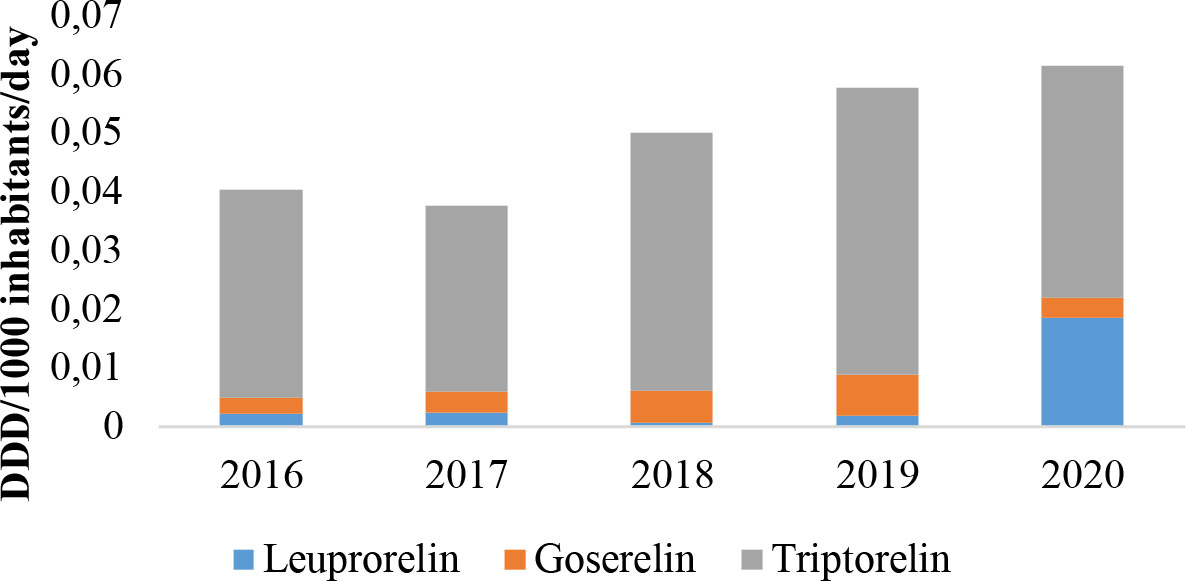
Figure 1.
Consumption of gonadorelin analogues by type of drug by years.
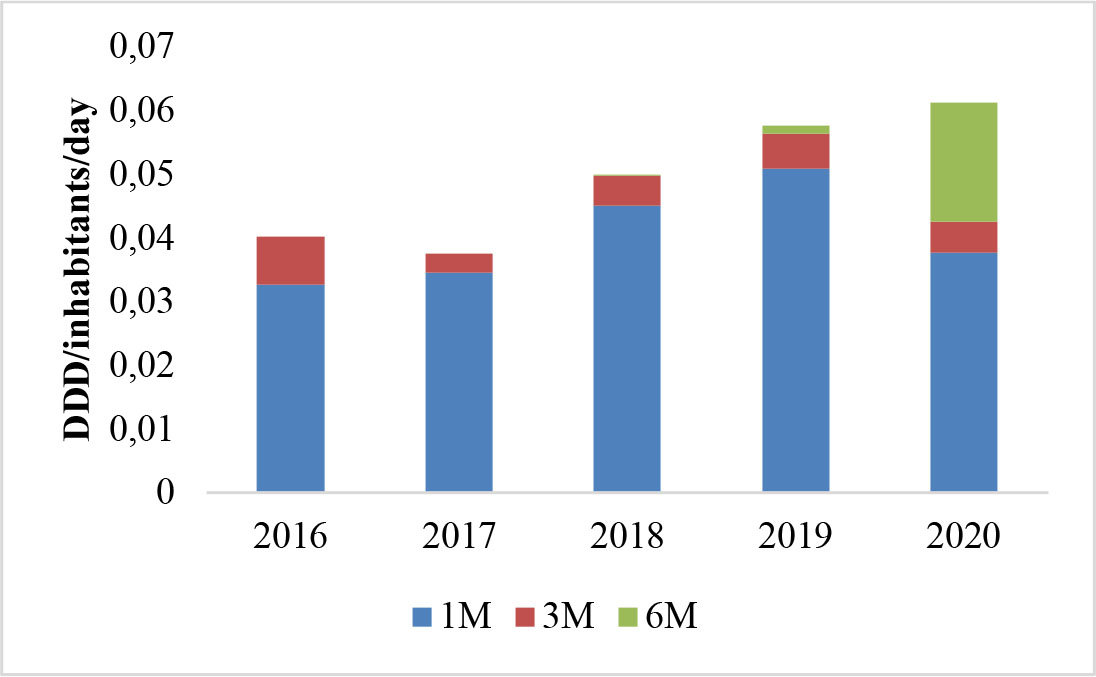
Figure 2.
Consumption of gonadorelin analogues by formulation by year
Table 3. shows the five-year consumption of LHRH agonists in Serbia, Croatia and Italy in relation to the consumption at the Clinic for Urology of the University Medical Center Kragujevac. Consumption is expressed in DDD/inhabitant/day, so it can be stated that consumption in UCC Kragujevac is quite lower compared to consumption in the rest of Serbia. At the same time, the total consumption in Serbia is quite higher in relation to Italy and Croatia, especially in the last observed year 2020.
DISCUSSION
Consumption of LHRH agonists shows a growth trend in the period from 2016 to 2021. This may be due to the increased survival rate of these patients based on current treatment guidelines. A 2020 study by Taiwanese authors from Kuang-Ming Liao et al. has confirmed this, especially when prostate cancer is detected early24. The Medical Research Council25 conducted an important study regarding this problem, and on that occasion it was proven that early treatment of LHRH agonists improves the average survival by three months. In our study, different triptorelin formulations and forms for one-month therapy of all LHRH agonists were mostly used. Table 2 shows the five-year consumption of LHRH agonists in Serbia, Croatia, and Italy relative to the consumption in our study.
Table 2.
Overview of the five-year consumption of all LHRH agonists used, depending on the dose and formulation of the drug
| International Nonproprietary Name – INN formulation | Proprietary name | Dosage | Pharmaceutical formulation | Consumption (DDD/1000/day) |
|---|---|---|---|---|
| leuprorelin (monthly) | Lupron® 3.75 mg/ml | 3.75 mg/ml | Powder and solvent for suspension for injection in a pre-filled syringe | 0,004357974 |
| leuprorelin (q3-month) | Lupron® 11.25 mg/ml | 11.25 mg/ml | Powder and solvent for suspension for injection in a pre-filled syringe | 0,001289482 |
| leuprorelin (q3-month) | Lutrate depo® 22.5mg | 22.5 mg | Powder and solvent for prolonged-release suspension for injection | 0,019165 |
| goserelin (monthly) | Zoladex® | 3.6 mg | Implant, in pre-filled syringe | 0,019552701 |
| goserelin (q3-month) | Zoladex® LA | 10.8 mg | Implant, in pre-filled syringe | 0,002876386 |
| triptorelin (monthly) | Diphereline® 3.75 mg/2 ml | 3.75 mg/2 ml | Powder and solvent for prolonged-release suspension for injection | 0,176707295 |
| triptorelin (q3-month) | Diphereline® 11.25 mg/2 ml | 11.25 mg/2 ml | Powder and solvent for prolonged-release suspension for injection | 0,021587071 |
| triptorelin (q6-month) | Diphereline® 22.5 mg/2 mL | 22.5 mg/2 ml | Powder and solvent for prolonged-release suspension for injection | 0,00096538 |
Table 3.
Comparative data on the consumption of gonadorelin analogues at the Clinic of Urology of the University Medical Center Kragujevac, as well as in Serbia, Croatia and Italy by years.
| International Nonproprietary Name/region | Consumption of LHRH agonists in DDD / 1000 / day ** per year | ||||
|---|---|---|---|---|---|
| 2016 | 2017 | 2018 | 2019 | 2020 | |
| Clinic of Urology, UCC Kragujevac | |||||
| Leuprorelin | 0,0020 | 0,0022 | 0,0005 | 0,0017 | 0,0184 |
| Goserelin | 0,0028 | 0,0037 | 0,0054 | 0,0070 | 0,0035 |
| Triptorelin | 0,0353 | 0,0316 | 0,0441 | 0,0489 | 0,0394 |
| Total | 0,0402 | 0,0375 | 0,0500 | 0,0576 | 0,0613 |
| Serbia12 | |||||
| Leuprorelin | 0,0563 | 0,0720 | 0,0014 | 0,0055 | N/A * |
| Goserelin | 0,1035 | 0,0841 | 0,0832 | 0,0821 | N/A |
| Triptorelin | 0,1927 | 0,2076 | 0,2706 | 0,2817 | N/A |
| Total | 0,3526 | 0,3637 | 0,3552 | 0,3694 | N/A |
| Croatia13 | |||||
| Leuprorelin | 0,5700 | 0,5800 | 0,5900 | 0,7800 | N/A |
| Goserelin | 0,0900 | 0,1100 | 0,1300 | 0,1900 | N/A |
| Triptorelin | 0,0300 | 0,0300 | 0,2300 | 0,2300 | N/A |
| Total | 0,6900 | 0,7200 | 0,9500 | 1,2000 | N/A |
| Italy14 | |||||
| Leuprorelin | N/A | 0,2000 | 0,2000 | 0,2000 | N/A |
| Goserelin | N/A | 0,0000 | 0,0000 | 0,0000 | N/A |
| Triptorelin | N/A | 0,7000 | 0,8000 | 0,8000 | N/A |
| Total | N/A | 0,9000 | 1,0000 | 1,0000 | N/A |
It can be stated that the consumption in UCC Kragujevac is quite lower in relation to the consumption in the rest of Serbia. A possible explanation is that although the UCCKG gravitates to almost 2 million people from the region of Šumadija and Western Serbia, a large number of these patients are treated in a local reference health institution or in specialized institutions for the treatment of oncological diseases in Belgrade. Therefore, the obtained consumption parameters are significantly lower compared to what would be realistic. Total consumption in Serbia is lower compared to Italy and Croatia, especially in 2019.
In all years, the use of triptorelin preparations in different doses is the most common. This can be explained by the results of the study by Myungsun Shim et all. from 2019, which show that triptorelin achieves the lowest mean testosterone level and the highest rate of chemical castration of testosterone (10ng / dl)26. During 2020, the use of leuprorelin preparations increased 10 times compared to the use from 2019, and 35 times compared to the use from 2018. This is also shown by the research conducted in Germany in 2015 by Axel Merseburger et all27., which compared consumption in Germany in relation to Great Britain, France, Italy and Sweden. The justified use of leuprorelin has shown the possibility of significant savings in this segment, which can be allocated to other elements of therapeutic strategies, including new therapeutic innovations.
In general, in the observed period, there is a growing trend in the use of drugs from the group of gonadorelin analogues. Unlike the urology clinic of the UCCKG and Serbia, triptorelin is most often used in Croatia and Italy. In Croatia13, in the range from 2016 to 2019, the total consumption of the observed drugs increased by almost 100%, and only between 2018 and 2019, a difference of 28% appeared. Also, looking at the last year of this research(2019.) we notice that Croatia records higher consumption compared to Italy14 (20%) while in comparison with Serbia, the total number of prescribed drugs from the observed group is almost 4 times higher in Serbia. A study from the year 2011. by S.Lannazo et all28 in Italy showed that leuprorelin 22.5 mg was the most cost-effective option for selecting LHRH agonists in that country. The results of a multicenter study of drug use assessment in prostate cancer therapy in France, Germany, Italy, Spain and the United Kingdom29 indicate a high and growing prevalence of prostate cancer in Europe. The reason for this is the aging of the population, which brings with it high costs. Therefore, it is necessary for the Ministry of Health to be aware of this disease as a priority disease. The results of a national population study in Sweden30 suggest that a threefold increase in LHRH agonist use is associated with a moderate reduction in mortality in men between 65 and 74 years of age with newly diagnosed locally advanced prostate cancer. Recent advances in the formulation of pharmaceutical formulations in the treatment of prostate cancer represent a good opportunity to reduce the cost of therapy.31
The disadvantages of this study relate to the observed group of drugs, since the conciliatory decisions are made on the basis of the recommendations of the European Association of Urology3 (European Association of Urology) so individual variations in prescribing are minimized. In addition, the constant supply of the hospital pharmacy with certain types of LHRH agonists can be an analytical problem in terms of constant use of the prescribed LHRH agonist.
CONCLUSION
It was found that the consumption is lower compared to the consumption of these drugs in Serbia, Croatia and Italy at the same time intervals, for the same observed diagnosis. Despite certain limitations, this evaluation is the first attempt to summarize the available evidence on prescribing LHRH agonists in Serbia. Such studies should provide guidance to medical doctors who should make rational choices regarding the use of LHRH agonists. Monitoring the consumption of drugs is useful from the clinical and pharmacoeconomic aspect and requires the engagement of several experts in this field.