
TABLE 1.
Demographic details of respondents.
| Neurotypical | Neurodivergent | |
|---|---|---|
| Age years (SD) | 43.1 (11.9) | 39.4 (11.4) |
| Gender | ||
| Man | 71 (30.0%) | 78 (20.1%) |
| Woman | 158 (66.7%) | 243 (62.5%) |
| Gender fluid | 0 (0%) | 14 (3.6%) |
| Non-binary | 5 (2.1%) | 41 (10.5%) |
| Other | 1 (0.4%) | 8 (2.1%) |
| Don't want to state | 2 (0.8%) | 5 (1.3%) |
| Reason for attending* | ||
| Researcher | 36 (15.2%) | 51 (13.1%) |
| Clinician or professional | 92 (38.8%) | 87 (22.4%) |
| Self/self-advocate | 20 (8.4) | 278 (71.5%) |
| Caregiver | 120 (50.6%) | 131 (33.7%) |
| Other | 8 (3.4%) | 18 (4.6%) |
| Language preferences | ||
| Identify-first | 36 (15.2%) | 150 (38.6%) |
| Person-first | 98 (56.0%) | 77 (19.8%) |
| Don't mind/don't care | 103 (43.5%) | 162(41.6%) |
| Diagnosis* | ||
| ADHD | - | 243 (62.5%) |
| Autism | - | 225 (57.8%) |
| Specific learning disability | - | 48 (12.3%) |
| Prematurity | - | 14 (3.6%) |
| Genetic syndrome | - | 5 (1.3%) |
| Motor disorder | - | 13 (3.4%) |
| Intellectual disability | - | 3 (0.8%) |
| Other | - | 22 (5.7%) |
| Don't want to state | - | 7 (1.8%) |
TABLE. 2
Endorsement (%) of silent clapping across neurotypical (NT; N = 237) and neurodivergent (ND, N = 389) respondents.
| Strongly Agree | Agree | Neither Agree nor Disagree | Disagree | Strongly Disagree | Statistical test | |||||||
|---|---|---|---|---|---|---|---|---|---|---|---|---|
| NT | ND | NT | ND | NT | ND | NT | ND | NT | ND | |||
| 1 | Silent clapping helps to reduce sensory demands at events | 23.6 | 32.4 | 44.7 | 33.4 | 17.7 | 16.5 | 8.4 | 10.5 | 5.5 | 7.2 | X2 (4, N = 626) = 10.35, p=0.035)* |
| 2 | Silent clapping is effective in showing appreciation/approval | 24.5 | 26.5 | 30.0 | 29.6 | 13.1 | 15.7 | 16.9 | 15.7 | 15.6 | 12.6 | X2 (4, N = 626) = 2.02, p=0.73. |
| 3 | Silent clapping is equally rewarding as applause (traditional clapping) | 16.9 | 19.8 | 16.5 | 15.2 | 14.3 | 15.2 | 26.2 | 26.5 | 26.2 | 23.4 | X2 (4, N = 626) = 1.36, p=0.85 |
| 4 | Silent clapping shows that events are neurodivergent friendly | 25.3 | 25.2 | 33.3 | 29.6 | 23.2 | 23.1 | 9.3 | 11.6 | 8.9 | 10.5 | X2 (4, N = 626) = 1.81, p=0.77 |
| 5 | Silent clapping is respectful to neurodivergent attendees | 29.5 | 28.5 | 29.1 | 30.8 | 24.5 | 23.4 | 9.3 | 9.0 | 7.6 | 8.2 | X2 (4, N = 626) = 0.36, p=0.99 |
| 6 | Neurodivergent people want silent clapping | 2.1 | 5.9 | 11.8 | 17.7 | 71.7 | 46.5 | 9.3 | 16.5 | 5.1 | 13.4 | X2 (4, N = 626) = 40.22, p<0.01** |
| 7 | Neurotypical people want silent clapping | 1.3 | 1.0 | 6.8 | 5.4 | 43.5 | 49.1 | 30.8 | 26.2 | 17.7 | 18.3 | X2 (4, N = 626) = 2.66, p=0.62 |
| 8 | Silent clapping makes events more inclusive | 21.1 | 23.1 | 30.8 | 34.4 | 24.1 | 19.8 | 14.8 | 12.3 | 9.3 | 10.3 | X2 (4, N = 626) = 2.92, p=0.57 |
| 9 | I am bothered by silent clapping | 7.2 | 9.8 | 16.0 | 16.7 | 17.3 | 14.7 | 23.6 | 21.6 | 35.9 | 37.3 | X2 (4, N = 626) = 2.18, p=0.70 |
| 10 | Other attendees are bothered by silent clapping | 5.5 | 6.2 | 20.3 | 17.5 | 57.4 | 58.4 | 13.1 | 13.4 | 3.8 | 4.6 | X2 (4, N = 626) = 1.00, p=0.91 |
| 11 | Presenters are bothered by silent clapping | 6.3 | 5.7 | 14.3 | 13.6 | 52.7 | 58.4 | 19.4 | 16.2 | 7.2 | 6.2 | X2 (4, N = 626) = 2.09, p=0.72 |
| 12 | I am bothered by applause | 2.5 | 9.3 | 11.4 | 23.4 | 15.6 | 13.4 | 29.5 | 29.3 | 41.0 | 24.7 | X2 (4, N = 626) = 34.31, p<0.01** |
| 13 | Other attendees are bothered by applause | 0.8 | 3.1 | 16.0 | 22.6 | 56.1 | 55.0 | 17.3 | 11.6 | 9.7 | 7.7 | X2 (4, N = 626) = 10.73, p=0.03* |
| 14 | Presenters are bothered by applause | 0.4 | 1.0 | 3.8 | 7.5 | 42.6 | 52.7 | 34.2 | 23.9 | 19.0 | 14.9 | X2 (4, N = 626) = 14.06, p=0.01** |
| 15 | Silent clapping is uncomfortable/awkward | 15.2 | 17.2 | 24.1 | 21.3 | 15.2 | 15.2 | 21.9 | 23.7 | 23.6 | 22.6 | X2 (4, N = 626) = 1.11, p=0.89 |
| 16 | Silent clapping should be mandatory at events | 2.1 | 3.6 | 9.3 | 9.5 | 30.4 | 29.0 | 26.2 | 26.7 | 32.1 | 31.1 | X2 (4, N = 626) = 1.23, p=0.87 |
| 17 | Silent clapping will last (be around for a long time) | 13.1 | 18.0 | 32.9 | 29.3 | 30.0 | 27.5 | 13.5 | 13.1 | 10.5 | 12.1 | X2 (4, N = 626) = 3.46, p=0.48 |
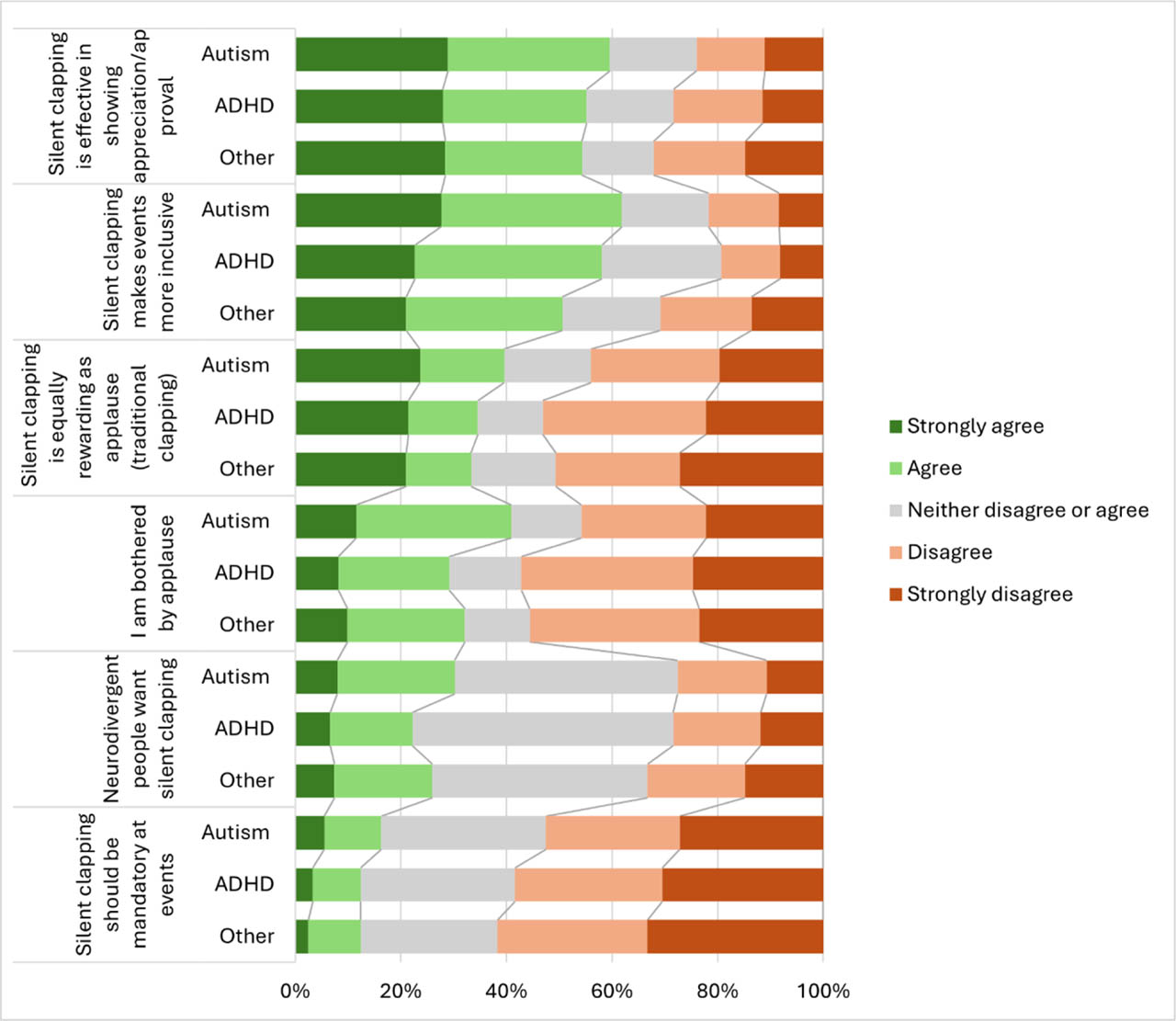
FIGURE 1.
Endorsement of silent clapping for items showing diagnosis as a significant predictor.
TABLE 3.
Most frequently occurring categories from neurodivergent and neurotypical respondents
| Category | Neurodivergent | Neurotypical | ||
|---|---|---|---|---|
| Number | %/172 | Number | %/88 | |
| Need to consider and acknowledge the deaf community | 20 | 12% | 14 | 16% |
| conflicting access needs | 17 | 10% | 17 | 19% |
| Likes applause | 16 | 9% | 8 | 9% |
| Depends on the situation | 14 | 8% | 10 | 11% |
| Support for silent clapping | 11 | 6% | ||
| Silent clapping can be overwhelming (visual stimulation) | 10 | 6% | ||
| Dislike silent clapping | 8 | 5% | 8 | 9% |
| Small step for a small issue | 8 | 5% | 3 | 3% |
| Silent clapping is performative/virtue signally | 7 | 4% | 2 | 2% |
| Applause is OK because its predictable | 7 | 4% | ||
| Benefits to silent clapping | 7 | 4% | 6 | 7% |
| ND people need to adapt | 6 | 4% | ||
| Suggestions and alternatives | 5 | 3% | 13 | 15% |
| Silent clapping is condescending | 3 | 2% | ||
| Silent clapping is stigmatizing | 3 | 2% | ||
| Depends on opinion of neurodivergent people | 5 | 6% | ||