
Introduction
Over recent decades, there have been societal shifts toward recognizing and valuing diversity in human behavior and experience. Where historically, societies and groups have been largely homogenous, increasing globalization and technological advances have led to growing societal diversity (1). At the same time, where there has previously been resistance or only tolerance of diversity in certain sectors of society, various social, economic, and cultural shifts now see that diversity is often actively sought (2).
There is growing recognition of the benefits that diversity may bring to societies' successful functioning and organizational performance (3), and individuals across various spectrums of gender, race, ethnicity, sexuality, and ability are increasingly recognized, acknowledged, and valued within the public sphere. The rise in social media has likely played an integral role in these shifts, providing increased opportunities for self-advocacy, sharing perspectives, and enacting change (4). Today, diverse individuals are empowered to ensure their voices are heard and acknowledged within public discourse, with individuals and groups now holding more power to exert influence over organizations and other sectors, challenging traditional norms of “ways of doing” or “being.” Now, diverse individuals, advocates, and thought leaders play a crucial role in shaping research, policy, and practice.
In recognition of such cultural shifts, largely driven by the efforts of diverse communities, organizations, companies, and events are rapidly adopting strategies and approaches to be, or at least appear to be, inclusive of diversity and responsive to social demands for inclusivity. The reasons for this are likely two-fold, first because there is increasing recognition of the advantages of diversity, and second, because appearing inclusive and responsive is also important for public image (5). Though well-intentioned, the implementation of many approaches is driven by largely untested assumptions that the approaches are beneficial and wanted by the communities they seek to benefit. Indeed, although the rise of social media has allowed individuals to exert influence and challenge the status quo, there are risks that opinions driving the adoption of initiatives may be influenced by a vocal minority, with it being unclear whether these voices represent the majority (6).
One area where this phenomenon might occur is in the context of neurodiversity and the neurodiversity movement. Neurodiversity relates to individuals with various forms of cognitive ability, referring to individuals who have different ways of perceiving and interacting with the world. This movement has been applied most predominantly in the autistic community but is now used in the context of many neurodevelopmental conditions such as Attention-Deficit Hyperactivity Disorder (ADHD). Neurodiversity frames neurodevelopmental conditions as a different neurological function as opposed to a disorder that is inherently negative and needs treatment (7, 8). According to neurodiversity, all forms of viewing and experiencing the world due to neurological ‘otherness’ are valid and valuable, contributing to necessary diversity in society. Within this approach, those who are part of the majority way of perceiving and interacting with the world are referred to as neurotypical, and those with neurological ‘otherness’ (i.e., neurodevelopmental conditions) are referred to as neurodivergent. Similar to other forms of diversity in the human experience, efforts now seek to better accommodate neurological diversity. There are increasing efforts to provide more inclusive spaces, and events such as conferences are seeking to make their events more inclusive for neurodivergent attendees. One initiative that is now commonly implemented is silent clapping, otherwise known as “jazz hands” or “flapplause” which is used in place of traditional applause.
Silent clapping originated in the deaf community to express appreciation and acknowledgment (https://www.handspeak.com/learn/352/). Although the exact origin of silent clapping in the context of neurodivergence is largely unknown, its implementation is growing rapidly, driven by the belief that it would reduce sensory demands for neurodivergent attendees, particularly those who are autistic, in turn creating a more inclusive environment. The topic of silent clapping has received little academic attention, but it has been implemented in both neurodivergent specific events, such as the International Society for Autism Research Conference (9), but also more broadly for general population audiences, such as at the University of Manchester (10) and Oxford University (11), and schools (12), where traditional applause is banned or at least discouraged at events.
Despite its implementation and underlying assumptions, little is known about what neurodivergent and neurotypical individuals think about silent clapping and its usefulness at events. We use silent clapping in the context of neurodivergence as a case example to examine whether the implementation of this strategy aimed at inclusivity is indeed beneficial and wanted by the neurodivergent community. Here, our intention is not to argue against advocates, self-advocacy, or the adoption of changes that benefit diversity and inclusion, which are undoubtedly positive, but rather, we seek to examine whether the strategies that are currently adopted have the intended benefit.
Method
The topic of silent clapping has received little attention from research; however, it is often implemented at events and conferences. For this reason, this study sought to broadly explore what neurodivergent and neurotypical people who attend conferences, with no explicit hypotheses or assumptions. This was an international online anonymous survey. The study analytic process was pre-registered: https://doi.org/10.17605/OSF.IO/BA2DK.
Participants
Participants were neurotypical and neurodivergent adults who self-reported to participate in or attend conferences or events related to neurodivergence. Neurodivergent adults were over the age of 18 years of age and reported having a neurodevelopmental condition according to DSM-5 (13) or ICD-11 (14), genetic syndromes, or being born prematurely (<36 weeks gestation). Here our definition of neurodivergence was broad, including groups where differences in neurological function arise early in development. We used this broad definition given that there is no clear consensus on what constitutes neurodivergence (7). Neurotypical adults were adults without any neurodevelopmental condition or diagnosis. Neurotypical and neurodivergent participants were recruited through social media and networks of the research team. Recruitment was undertaken between October to December 2023.
A total of 699 responses were received. We excluded individuals from the neurodivergent group who did not report having an official diagnosis (n=25) and excluded participants from both neurodivergent and neurotypical groups who reported that they had not previously attended events/conferences related to neurodivergence (n=25 ND and n=9 NT). We also excluded some responses where the reported age was outside of the age range 18 years to 100 years (n=5 ND, n=2 NT) as it was suspected that these were not legitimate responses. Four responses from the neurodivergent group were excluded for multiple reasons (no official diagnosis and not previously attending conferences/events). The final sample thus comprised 626 individuals, 389 who were neurodivergent and 237 who were neurotypical. Respondents represented 24 countries, but most were located in Sweden (n=274, 43.7%), the United Kingdom (n=147, 23.4%), and the United States of America (n=70, 11.2%). Further demographic details are displayed in Table 1.
TABLE 1.
Demographic details of respondents.
| Neurotypical | Neurodivergent | |
|---|---|---|
| Age years (SD) | 43.1 (11.9) | 39.4 (11.4) |
| Gender | ||
| Man | 71 (30.0%) | 78 (20.1%) |
| Woman | 158 (66.7%) | 243 (62.5%) |
| Gender fluid | 0 (0%) | 14 (3.6%) |
| Non-binary | 5 (2.1%) | 41 (10.5%) |
| Other | 1 (0.4%) | 8 (2.1%) |
| Don't want to state | 2 (0.8%) | 5 (1.3%) |
| Reason for attending* | ||
| Researcher | 36 (15.2%) | 51 (13.1%) |
| Clinician or professional | 92 (38.8%) | 87 (22.4%) |
| Self/self-advocate | 20 (8.4) | 278 (71.5%) |
| Caregiver | 120 (50.6%) | 131 (33.7%) |
| Other | 8 (3.4%) | 18 (4.6%) |
| Language preferences | ||
| Identify-first | 36 (15.2%) | 150 (38.6%) |
| Person-first | 98 (56.0%) | 77 (19.8%) |
| Don't mind/don't care | 103 (43.5%) | 162(41.6%) |
| Diagnosis* | ||
| ADHD | - | 243 (62.5%) |
| Autism | - | 225 (57.8%) |
| Specific learning disability | - | 48 (12.3%) |
| Prematurity | - | 14 (3.6%) |
| Genetic syndrome | - | 5 (1.3%) |
| Motor disorder | - | 13 (3.4%) |
| Intellectual disability | - | 3 (0.8%) |
| Other | - | 22 (5.7%) |
| Don't want to state | - | 7 (1.8%) |
Data Collection Material
An online survey was designed for this study to gather participants' experiences and perspectives on silent clapping. The survey was divided into two short sections comprising eight questions. Section one captured questions relating to an individua's neurodiverse status (neurotypical or neurodivergent), the specific neurodivergence an individual has (for example, autism, ADHD), the capacity in which they usually attend events (e.g., as a researcher, clinician, self-advocate) and their preference for person-first (e.g., person with autism) or identify-first (e.g., autistic adult) language. The second section comprised questions relating to silent clapping, including their awareness of silent clapping at events (Yes, No, Maybe), whether silent clapping should be implemented at conferences/events for neurodivergence (Yes always, Yes sometimes, I don't mind/don't care, No) and their level of agreement on 17 items related to silent clapping and applause rated on a five-point Likert scale (1 strongly agree through to 5 strongly disagree). A final open-ended free-text option will be provided for participants to provide any additional comments. All questions (except for the free-text option) are multiple-choice.
Ethical Considerations
This study was completely anonymized, no identifiable personal information was collected, and no intervention was carried out. For these reasons, according to Swedish regulations guiding the conduct of research involving human participants (2003:615), ethical approval was not required for this study. In accordance with the Swedish Ethical Review Authority, we submitted an application for an advisory opinion, and it was deemed that the Authority had no ethical objections to the study (2023-03865-01-442644). Although we included individuals with intellectual disabilities and other conditions, we believed that the risks posed by the study were minimal. The survey was brief, answering the questions posed limited risk and burden, and responses were anonymized. On the other hand, we believe it important to offer a voice to those who have been historically excluded from sharing their opinions.
Procedure
An anonymous online survey was implemented via the Karolinska Institute survey platform. Before commencing the survey, participants were provided with information about the study and its scope, including a reminder that their participation was voluntary and that no identifiable information would be collected.
Analysis
We prepared the data for analysis by creating additional variables. First, within the survey, respondents could select multiple reasons for attending (researcher, clinician, self-advocate/activist, caregiver, etc.), with “other” specified via a free-text response. The free-text responses were examined, and where individual free-text responses aligned with a pre-existing variable, their response was amended. For example, individuals who reported “no” to self-activist/advocate” but who, in the free text, responded that they attended for themselves were recoded to “yes.” Similarly, examination of “other” responses indicated that many respondents were others involved in working with neurodivergent individuals such as teachers. We thus combined these responses with clinicians under a “clinician or professional” variable. Participants could also select from a range of neurodivergent diagnoses; we descriptively report all diagnoses; however, to simplify the statistical analysis, we opted to retain autism and ADHD because of their larger sample sizes but combined all other diagnoses under an “other category.”
Descriptive statistics were first performed to describe the overall sample regarding demographic variables. We also descriptively explored responses to each item by generating frequencies. To examine the overall differences between neurodivergent and neurotypical attendees regarding the endorsement of silent clapping, we conducted a series of Chi-Square tests. Where Chi-Square tests were significant, z-tests with adjustment for multiple comparisons were examined to compare column proportions.
Next, as we were primarily interested in whether silent clapping was wanted and beneficial to neurodivergent individuals, we then conducted analysis within the neurodivergent group to determine if the reason for attendance or diagnostic group influenced the endorsement of silent clapping. As respondents could select multiple reasons for attending and multiple diagnoses, we performed a series of ordinal logistic regressions wherein the reason for attending (researcher, clinician/professional, caregiver, self, or other) and diagnosis (Autism, ADHD, and other) were input as predictors. Due to the smaller number of observations within certain reasons for attending, we combined reasons for attending whereby researcher and clinician/professional were combined, and caregiver and self were combined. The “other” reason for attending was also dropped from the models. To account for age and gender, models were first conducted with these entered as covariates, but they had limited impact on the results and were removed from the final models. Nagelkerke Pseudo-R Squared was used to interpret goodness of fit. Analysis was conducted in R using the MASS package (15).
A content analysis approach (16) was undertaken to analyze qualitative responses to the open-ended question, with responses inductively coded. First, the text responses provided by the respondents were read by the researcher to develop an understanding of the overall content. Due to the nature of responses, each response was considered a meaning unit, which was then further condensed, wherein relevant segments of text were extracted. These condensed meaning units were then assigned a code capturing the meaning unit. Once all coding was completed, the meaning units and codes were re-read and refined. Codes were then combined into categories, where codes were logically grouped together based on similar meanings.
Results
Differences Between Neurodivergent and Neurotypical Endorsement of Silent Clapping
First, we sought to examine whether neurodivergent and neurotypical respondents endorse silent clapping and to determine whether groups differed regarding their endorsement. In general, we found that neurodivergent and neurotypical respondents tended to demonstrate similar endorsement of silent clapping, and there were no significant differences between the two groups regarding whether silent clapping should be used at events (X2 (3, N = 625) = 4.36, p=0.23). Most neurodivergent and neurotypical attendees thought silent clapping should sometimes be used at events and conferences (ND: 40.6%, NT: 46.0%). Less thought that silent clapping should always be used (ND: 18.5%, NT: 16.0%) or that silent clapping should not be used at events (ND: 19.3%, NT: 21.9%). Some also reported not minding or caring (ND: 21.6%, NT: 16.0%).
We then examined whether neurodivergent and neurotypical respondents differed in their endorsement of specific statements about silent clapping and applause (Table 2). Overall perspectives on silent clapping were similar regardless of neurodivergent status; however, statistical significance was observed for five items.
TABLE. 2
Endorsement (%) of silent clapping across neurotypical (NT; N = 237) and neurodivergent (ND, N = 389) respondents.
| Strongly Agree | Agree | Neither Agree nor Disagree | Disagree | Strongly Disagree | Statistical test | |||||||
|---|---|---|---|---|---|---|---|---|---|---|---|---|
| NT | ND | NT | ND | NT | ND | NT | ND | NT | ND | |||
| 1 | Silent clapping helps to reduce sensory demands at events | 23.6 | 32.4 | 44.7 | 33.4 | 17.7 | 16.5 | 8.4 | 10.5 | 5.5 | 7.2 | X2 (4, N = 626) = 10.35, p=0.035)* |
| 2 | Silent clapping is effective in showing appreciation/approval | 24.5 | 26.5 | 30.0 | 29.6 | 13.1 | 15.7 | 16.9 | 15.7 | 15.6 | 12.6 | X2 (4, N = 626) = 2.02, p=0.73. |
| 3 | Silent clapping is equally rewarding as applause (traditional clapping) | 16.9 | 19.8 | 16.5 | 15.2 | 14.3 | 15.2 | 26.2 | 26.5 | 26.2 | 23.4 | X2 (4, N = 626) = 1.36, p=0.85 |
| 4 | Silent clapping shows that events are neurodivergent friendly | 25.3 | 25.2 | 33.3 | 29.6 | 23.2 | 23.1 | 9.3 | 11.6 | 8.9 | 10.5 | X2 (4, N = 626) = 1.81, p=0.77 |
| 5 | Silent clapping is respectful to neurodivergent attendees | 29.5 | 28.5 | 29.1 | 30.8 | 24.5 | 23.4 | 9.3 | 9.0 | 7.6 | 8.2 | X2 (4, N = 626) = 0.36, p=0.99 |
| 6 | Neurodivergent people want silent clapping | 2.1 | 5.9 | 11.8 | 17.7 | 71.7 | 46.5 | 9.3 | 16.5 | 5.1 | 13.4 | X2 (4, N = 626) = 40.22, p<0.01** |
| 7 | Neurotypical people want silent clapping | 1.3 | 1.0 | 6.8 | 5.4 | 43.5 | 49.1 | 30.8 | 26.2 | 17.7 | 18.3 | X2 (4, N = 626) = 2.66, p=0.62 |
| 8 | Silent clapping makes events more inclusive | 21.1 | 23.1 | 30.8 | 34.4 | 24.1 | 19.8 | 14.8 | 12.3 | 9.3 | 10.3 | X2 (4, N = 626) = 2.92, p=0.57 |
| 9 | I am bothered by silent clapping | 7.2 | 9.8 | 16.0 | 16.7 | 17.3 | 14.7 | 23.6 | 21.6 | 35.9 | 37.3 | X2 (4, N = 626) = 2.18, p=0.70 |
| 10 | Other attendees are bothered by silent clapping | 5.5 | 6.2 | 20.3 | 17.5 | 57.4 | 58.4 | 13.1 | 13.4 | 3.8 | 4.6 | X2 (4, N = 626) = 1.00, p=0.91 |
| 11 | Presenters are bothered by silent clapping | 6.3 | 5.7 | 14.3 | 13.6 | 52.7 | 58.4 | 19.4 | 16.2 | 7.2 | 6.2 | X2 (4, N = 626) = 2.09, p=0.72 |
| 12 | I am bothered by applause | 2.5 | 9.3 | 11.4 | 23.4 | 15.6 | 13.4 | 29.5 | 29.3 | 41.0 | 24.7 | X2 (4, N = 626) = 34.31, p<0.01** |
| 13 | Other attendees are bothered by applause | 0.8 | 3.1 | 16.0 | 22.6 | 56.1 | 55.0 | 17.3 | 11.6 | 9.7 | 7.7 | X2 (4, N = 626) = 10.73, p=0.03* |
| 14 | Presenters are bothered by applause | 0.4 | 1.0 | 3.8 | 7.5 | 42.6 | 52.7 | 34.2 | 23.9 | 19.0 | 14.9 | X2 (4, N = 626) = 14.06, p=0.01** |
| 15 | Silent clapping is uncomfortable/awkward | 15.2 | 17.2 | 24.1 | 21.3 | 15.2 | 15.2 | 21.9 | 23.7 | 23.6 | 22.6 | X2 (4, N = 626) = 1.11, p=0.89 |
| 16 | Silent clapping should be mandatory at events | 2.1 | 3.6 | 9.3 | 9.5 | 30.4 | 29.0 | 26.2 | 26.7 | 32.1 | 31.1 | X2 (4, N = 626) = 1.23, p=0.87 |
| 17 | Silent clapping will last (be around for a long time) | 13.1 | 18.0 | 32.9 | 29.3 | 30.0 | 27.5 | 13.5 | 13.1 | 10.5 | 12.1 | X2 (4, N = 626) = 3.46, p=0.48 |
Neurodivergent individuals were more bothered by applause than neurotypical respondents and tended to agree that other attendees were more bothered by applause. Analyses also indicated that neurodivergent and neurotypical respondents also differed regarding whether silent clapping helped reduce sensory demands. However, further investigation showed that this was primarily driven by a larger number of neurodivergent people strongly agreeing with this statement, while a larger number of neurotypical respondents agreed with this statement. Differences between groups were also seen regarding whether neurodivergent people want silent clapping and whether presenters are bothered by silent clapping, but these differences seemed to be driven by a larger number of neurotypical respondents reporting to neither agree nor disagree with the statements.
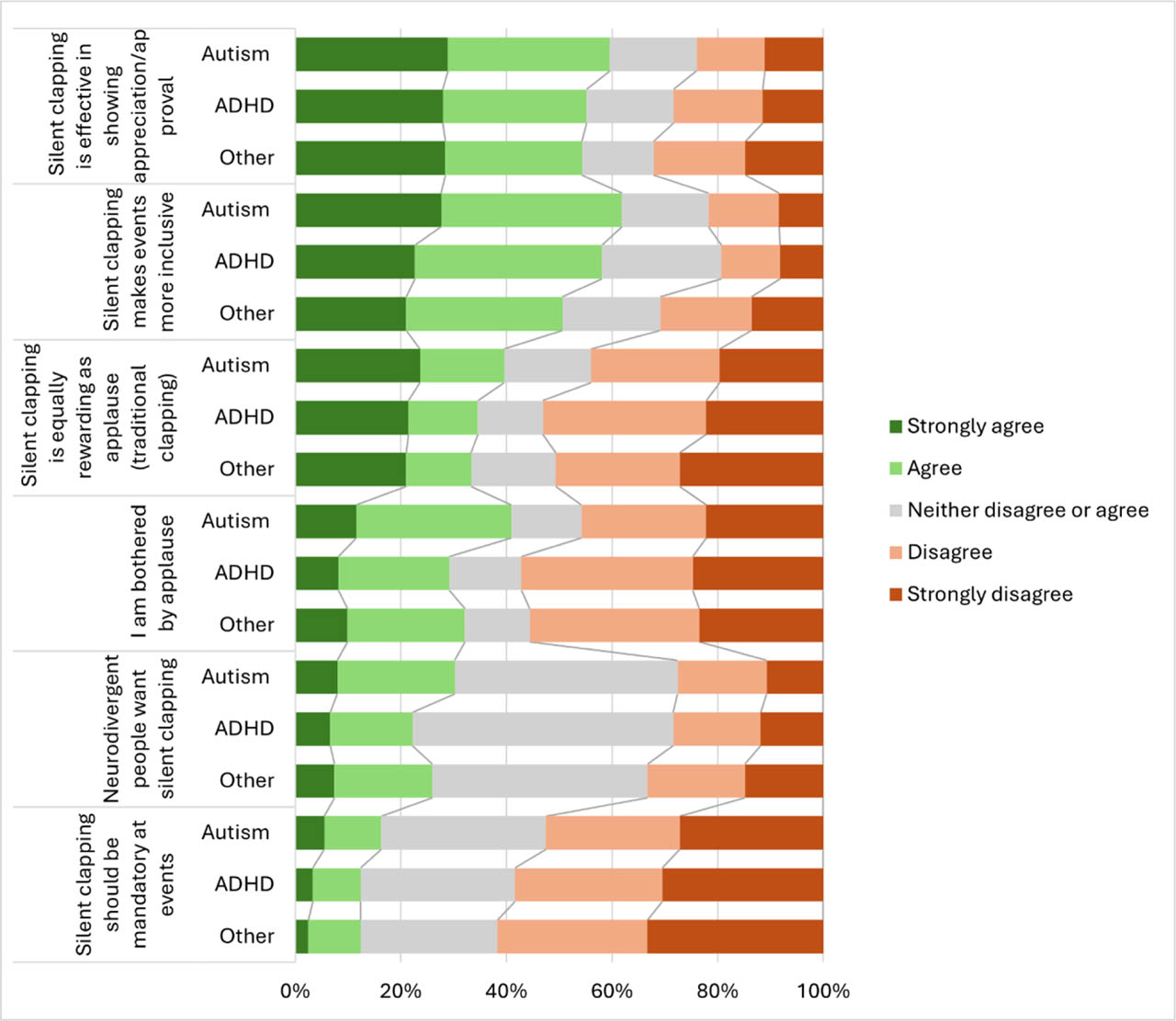
FIGURE 1.
Endorsement of silent clapping for items showing diagnosis as a significant predictor.
Differences within Neurodivergent Groups on Endorsement of Silent Clapping
As our central aim was to examine whether silent clapping was beneficial to neurodivergent groups, we conducted further analysis within the neurodivergent group only to determine whether diagnosis type or reason for attendance conferences or events predicted endorsement of silent clapping using a series of ordinal regression models (parameter estimates are provided in the supplement). Here, only the significant results are discussed.
Being autistic seemed to be the most consistent predictor of endorsement of silent clapping. Identifying as autistic was associated with a greater endorsement that silent clapping makes events more inclusive (p=0.013), should be mandatory at events (p=0.005), and that it is both effective at showing appreciation and approval (p=0.027) and as rewarding as applause (p=0.002) than compared to those who did not identify as autistic. than compared to those who did not identify as autistic. Identifying as autistic was also associated with greater agreement that neurodivergent people want silent clapping (p=0.002) and of being bothered by applause (p=0.002).
Those who attended events in a personal capacity had greater endorsement that Silent clapping helps to reduce sensory demands at events (p=0.038), that it is equally rewarding as applause (p=0.007) effective in appreciation/approval (p=0.032) and will be around for a long time (p=0.044). This group was also less likely to perceive that silent clapping was awkward or uncomfortable (p=0.015). No other effects of neurodivergent status or reason for attending were found.
Qualitative Responses
Qualitative responses were made by 172 neurodivergent individuals (44.8% of all ND responses) and 88 neurotypical responses (36.8% of all NT responses). Table 3 shows the most frequent responses for neurodivergent and neurotypical respondents. Although there appears to be significant overlap between neurodivergent and neurotypical responses, we opted to present the analysis separately to ensure that the voices of the neurodivergent respondents were adequately captured.
TABLE 3.
Most frequently occurring categories from neurodivergent and neurotypical respondents
| Category | Neurodivergent | Neurotypical | ||
|---|---|---|---|---|
| Number | %/172 | Number | %/88 | |
| Need to consider and acknowledge the deaf community | 20 | 12% | 14 | 16% |
| conflicting access needs | 17 | 10% | 17 | 19% |
| Likes applause | 16 | 9% | 8 | 9% |
| Depends on the situation | 14 | 8% | 10 | 11% |
| Support for silent clapping | 11 | 6% | ||
| Silent clapping can be overwhelming (visual stimulation) | 10 | 6% | ||
| Dislike silent clapping | 8 | 5% | 8 | 9% |
| Small step for a small issue | 8 | 5% | 3 | 3% |
| Silent clapping is performative/virtue signally | 7 | 4% | 2 | 2% |
| Applause is OK because its predictable | 7 | 4% | ||
| Benefits to silent clapping | 7 | 4% | 6 | 7% |
| ND people need to adapt | 6 | 4% | ||
| Suggestions and alternatives | 5 | 3% | 13 | 15% |
| Silent clapping is condescending | 3 | 2% | ||
| Silent clapping is stigmatizing | 3 | 2% | ||
| Depends on opinion of neurodivergent people | 5 | 6% | ||
Neurodivergent Responses
Twenty responses referred to the deaf community, primarily highlighting that silent clapping originated in the deaf community and that it was important to acknowledge this. Many respondents also highlighted that silent clapping supports inclusivity not only for neurodivergent people but also for those who are deaf or hard of hearing.
Many responses referred to issues related to conflicting access needs (n=17). Responses raised that silent clapping could benefit some members of the community but not others, with some noting that silent clapping is less inclusive for visually impaired individuals (n=13).
Others shared that silent clapping could be more difficult because of pain or other conditions like rheumatoid arthritis. Related to conflicting access needs were several individuals (n=10) who reported that the visual stimulation of silent clapping could also contribute to becoming overwhelmed “[…] It is important though to remember that silent clapping can be overwhelming for those of us who are hyper-sensitive to visual stimuli such as moving objects which silent clapping has lots of”. One respondent also raised that clapping could be a form of stimming: “I sometimes clap as a part of stimming. If you ban clapping you also ban my stim”. They, however, went on to say that “I would absolutely prefer silent clapping from the large crowd but not at the expense that loud people/stimming people will be excluded. Some can't help themselves”. At the same time, some individuals reported liking applause, particularly as performers or liked the auditory sensation of clapping (n=16) One participant shared:
It's amazing how often I still forget to silent clap despite being told to. This results in me appearing intolerant of neurodiversity, even though it's specifically because of a neurodiverse condition (ADHD) that I have impulsively clapped out loud. It's embarrassing and anxiety-inducing and uncomfortable, so I don't find silent clapping helps reduce sensory overload.
Some responses highlighted that silent applause should depend on the situation or context. For instance, concerts or “loud” events should use applause, while quieter events, such as discussions, would benefit from silent clapping. Indeed, the benefits of silent clapping were highlighted by some respondents, suggesting that it could be a more efficient way of expressing appreciation. Others indicated that the implementation of silent clapping should depend on the type of attendees and presenters:
Yeah!! I think that speaking generally it makes sense for it to be presenter's preference for if silent clapping is mandatory or optional at their specific panel/talk. I'm very pro normalizing silent clapping (I don't personally like to clap and clapping hurts my ears sometimes, so if I can applause in sign and still get my point across, that's really nice. But also, I know that some people feel bad if they don't get to experience clapping even if there's another type of "applause" and I think that if that's important to them they should get to hear it.
Others highlighted that because clapping was predictable, it could be less overwhelming than other loud noises:
Clapping is predictable and therefore not as distressing as other loud noises. It's a social expectation that I actively enjoy engaging in because I know I'm doing the right thing socially. It has a generally predictable volume and length. I love very enthusiastic applause where you are allowed to fully express joy and appreciation outwardly and loudly (whooping, cheering, etc). I often have to minimise or police my physical outward expressions of joy to fit in. Loud applause is also a way to let out any tics, and expend physical movement besides fidgeting.”
Some suggested that neurodivergent people should adapt to their environment or not expect all events adapt to them, for example, by bringing noise-cancelling headphones:
“Not all neurotypicals can adapt to everyone with (neurodivergence). People with (neurodivergence) also have to cope with things that are sensory stressful. You can wear cushioning earplugs or cover your ears.”
Respondents indicated that although silent clapping could be helpful, it was perceived to address only a small issue, while other accommodations could be more useful and impactful. Some suggested that silent clapping was merely “performative” or “virtue signalling” with limited impact, while a few respondents indicated that it could be condescending or stigmatizing, furthering the division between “neurotypical” and “neurodivergent” people. Some individuals also made suggestions and alternatives, for instance, ensuring that individuals were made aware of the requirements at events or using finger-snapping” instead of silent clapping.
Neurotypical Responses
Neurotypical respondents raised similar comments to the neurodivergent respondents. Again, neurotypical respondents raised the need to acknowledge and consider the deaf community (n=16) and raised questions regarding accessibility issues for individuals with conflicting access needs (n=14), which in most cases (n=13) referred to considering the needs of visually impaired individuals. Many suggestions were made (n=11), for example, letting attendees know that silent clapping or clapping would be used or employing alternatives such as “clapping with one open and one closed hand, which dampens the volume.” Similar to neurodivergent respondents, some indicated that silent clapping should depend on the situation (n=11). Some reported specifically liking applause for various reasons (n=8), such as its ability to show appreciation and give energy, with some caregivers reporting that their children found joy from clapping: “My son, 15 yrs, autism, intellectual disability, ADHD etc., LOVES applauses/clapping hands. Neurodivergent is not equal to silent. He would on the contrary feel extremely offended not to clap/or not to receive clapped applause.”
Some also reported specifically disliking silent clapping (n=8), and others reported liking silent clapping (n=4) for various reasons: “I like it. I think it's beautiful”. Some respondents suggested that if neurodivergent people wanted it or found it beneficial, they would support its implementation (n=5):
I am quite neutral as to whether events should propose silent clapping or traditional applause. If the vast majority of neurodivergent people is in favour of silent clapping I think it makes sense to use it in conferences and similar events.
Discussion
Both neurodivergent and neurotypical respondents perceived silent clapping similarly, indicating that, in general, individuals shared similar opinions regarding the implementation of silent clapping at events and conferences focused on neurodivergence. The endorsement of silent clapping seemed mixed with both quantitative and qualitative findings highlighting variability in perceptions and both benefits and drawbacks. On one hand, silent clapping was received relatively positively; participants (regardless of neurotype) thought that silent clapping should be used sometimes, and tended to agree that it was useful, had merit, and was beneficial. On the other hand, a large proportion of individuals (regardless of neurotype), perceived silent clapping to be less rewarding, thought silent clapping should not be mandatory at events, and found it uncomfortable and awkward.
Responses from both neurodivergent and neurotypical respondents highlight several considerations that may not have previously been considered when implementing silent clapping, particularly regarding conflicting access needs. Though silent clapping may reduce sensory demands associated with applause, thus improving inclusivity for subsets of targeted populations, responses highlight that silent clapping may instead act to decrease inclusivity for individuals with different access considerations, such as those who clap for stimming, who are overwhelmed by visual stimulation, or who have visual impairments. It is perhaps not surprising that different sub-groups will report different access needs given the significant variability inherent in neurodivergence between types of neurodivergence, but also within groups. For instance, within the autistic community, individuals may experience both hyper and hypo-sensory processing across different domains (17). This heterogeneity will naturally necessitate different supports and strategies.
Though overall endorsement was largely similar within the neurodivergent groups regardless of diagnostic group membership, being autistic seemed to predict endorsement of silent clapping more than neurotypical or other neurodivergence, such as ADHD. Several potential explanations could be provided for this. First, this observation could reflect the different paradigm in which this group currently appears to operate. The concept of neurodiversity is most pervasive in the context of autism. Neurodiversity places disability as arising from a poor fit between individuals and their environments (8); thus, those aligning with such a movement may be more likely to endorse environmental strategies and initiatives. Second, autistic individuals may be more likely to experience atypical sensory processing than compared to other groups, with atypical sensory processing appearing as part of the diagnostic criteria (13). Evidence has shown that autistic individuals may tend to show hyper-sensitivity in the auditory domain (although they can also be hypo-sensitive in this domain (18)), which may make initiatives that seek to reduce auditory input, such as silent clapping more helpful for this group. On the other hand, however, sensory sensitivities are also commonly associated with ADHD, with more recent evidence suggesting that sensory alterations in ADHD are comparable, or may even exceed, those of the autistic population (19,20,21). There may thus be differences in the impact of sensory alterations between autism and ADHD, or other factors driving the increased endorsement of silent clapping among autistic individuals.
It should be noted that some respondents further highlighted that applause itself is predictable and thus less overwhelming than other unpredictable noises. Others further raised comments regarding the actual impact of silent clapping, with a small proportion of neurodivergent individuals finding it stigmatizing and condescending. Although representing a smaller proportion of responses, these responses do give some indication that other strategies and initiatives may be more helpful and acceptable to different communities and that the implementation of silent clapping alone is insufficient to make events inclusive.
Although requiring additional investigation, the findings at least make clear that a “one size” fits all approach is not suitable and that silent clapping should not be implemented purely for the sake of it. Considerations must be made on an event-by-event basis, considering the needs and desires of presenters and attendees. It is recommended that conferences and events with neurodivergent attendees be designed with input from neurodivergent individuals. Community input may be sought through various means ranging from consultation to co-production, where individuals are actively engaged in the development and design as equals (22). On the whole, our findings seem to suggest that events for autistic individuals might benefit more from implementing silent clapping, but still, community consultation on an event-by-event basis remains important.
There are several limitations associated with this study that must be noted. First, though this research explores a topic of relevance to the neurodivergent community, captures neurodivergent voices via our qualitative question, and employs a neurodiversity-affirmative lens, the authors are neurotypical, which may influence the interpretation of the results. Second, this was a large and anonymous international survey. This enabled a larger sample size to be gathered, which was intended to be as representative as possible of those attending events and conferences focused on neurodivergence. However, the anonymous nature of this survey means that responses could not be validated, and thus, the presence of fraudulent responses cannot be determined. No reimbursement was provided, which may have decreased the likelihood of illegitimate responses, however, their presence cannot be ruled out. Third, though seeking to obtain a broadly representative sample, most respondents were from high-income Western countries, and in particular, almost half of our respondents were from Sweden. The understanding and attitudes towards autism, ADHD, and other neurodivergence can differ across cultures (23,24), and variations in language, terminology, and social norms can influence the movements and pathways surrounding alignment with paradigms such as neurodiversity (25, 26). At the same time, cultural norms towards expressions of appreciation may differ across countries, further complicating the matter. Thus, it is important to note that this study primarily reflects the perspectives from those in Western contexts, and that the perspectives of individuals from other, less represented cultures and contexts may differ. In addition, about 67% of our neurotypical participants and 62% of our neurodivergent participants identified as women. Although previous research has suggested that males/men have a higher prevalence of neurodivergence than females/women, emerging evidence also suggests that female phenotypes may have historically been under-recognised, influencing these prevalence estimates (27). Men/males and women/females may have different perspectives towards the expression of appreciation, and thus the gender of our participants may have also influenced the observed results. Although examining the influence of culture and gender on perspectives toward silent clapping was not within the scope of our study, future research would benefit from exploring these particular nuances. On a related note, statistical analysis necessitated grouping a number of different neurodivergent conditions into an “other” category. However, this also meant that some degree of nuance was lost, and it is possible that representatives of these other conditions held differing views. It is possible that responses, particularly qualitative responses, are likely to represent those who hold strong opinions (either positive or negative) on the topic and may not represent those of the broader neurodivergent and neurotypical population. Finally, as silent clapping has been the subject of little scientific enquiry, this study sought to provide a first initial exploration into this topic. Future research should aim to capture the diversity and nuance of perspectives, including exploration across key factors such as different types of neurodivergence, varying support needs, gender, and cultural contexts.
Based on the findings of this study, we propose that silent clapping may be appropriate, beneficial, and wanted by some neurodivergent people but not all and that there are particular subsets of the neurodivergent population who may more readily benefit from the implementation of silent clapping than others. Rather than the automatic implementation of silent clapping initiatives, consideration should be made for the specific population and nature of the event, ideally in direct consultation with those in attendance or directly impacted.
Notes
[6] Conflicts of interest Conflicts of interest
Bölte discloses that he has in the last 3 years acted as an author, consultant or lecturer for Medice and LinusBio. He receives royalties for textbooks and diagnostic tools from Hogrefe, Kohlhammer, Ernst Reinhard, Liber and UTB. Bölte is partner in NeuroSupportSolutions International AB.
[7] Compliance with ethical standards
This study was completely anonymized, no identifiable personal information was collected, and no intervention was carried out. For these reasons, according to Swedish regulations guiding the conduct of research involving human participants (2003:615), ethical approval was not required for this study. In accordance with the Swedish Ethical Review Authority, we submitted an application for an advisory opinion, and it was deemed that the Authority had no ethical objections to the study (2023-03865-01-442644). Although we included individuals with intellectual disabilities and other conditions, we believed that the risks posed by the study were minimal. The survey was brief, answering the questions posed limited risk and burden, and responses were anonymized. On the other hand, we believe it important to offer a voice to those who have been historically excluded from sharing their opinions. Before commencing the survey, participants were provided with information about the study and its scope, including a reminder that their participation was voluntary, and that no identifiable information would be collected.