
TABLE 1.
The main results of previous articles about the relationship between CB and SIB
| Article | Research type | Population | Main results |
|---|---|---|---|
| Hay & Meldrum (2010) (38) | Cross-sectional |
|
|
| Schneider et al. (2012) (17) | Cross-sectional |
|
|
| Elgar et al. (2014) (18) | Cross-sectional |
|
|
| Thomas et al. (2017) (40) | Cross-sectional |
| 1.1% comorbidity between CB victims and NSSI, and 9.9% between cyberbullies and NSSI among adolescents |
| Fridh et al. (2019) (30) | Cross-sectional |
| Significant association between SIB and CB among students who involved in any mental distress in the last 12 months |
| Nguyen et al. (2020) (28) | Cross-sectional |
| CB was significantly associated with SIB among adolescents |
| Eyuboglu et al (2021) (29) | Cross-sectional |
| Significant increasing of SIB among adolescents who involved in CB – among only victims, only perpetrators and both as well |
| Faura-Garcia et al. (2021) (31) | Cross-sectional |
|
|
| John et al. (2022) (27) | Longitudinal |
| The prevalence of SIB was significantly higher both in the only traditional and in the only cyberbullying groups, than the nonbullied group, and the highest was among both traditional and CB group |
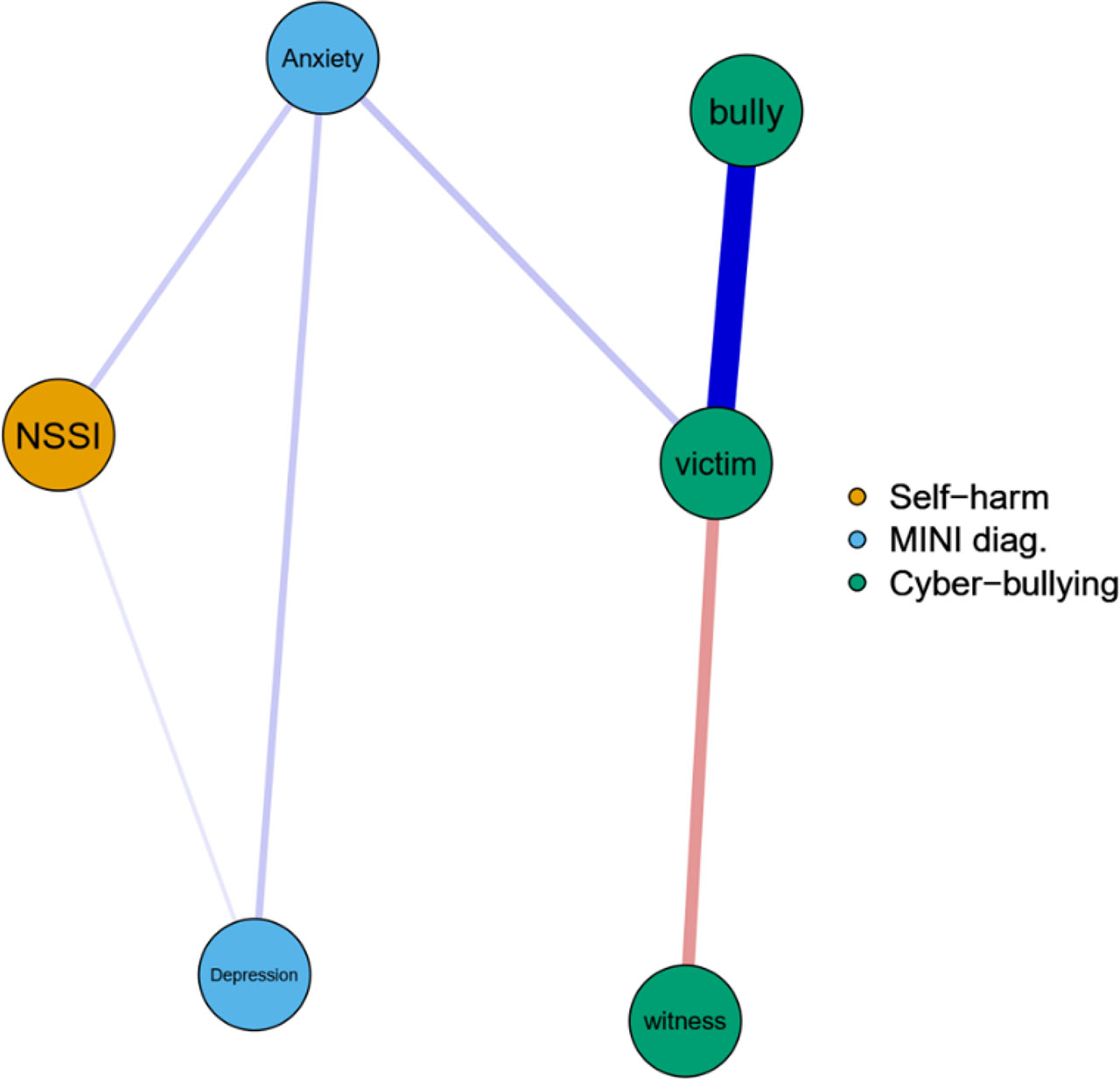
FIGURE 1.
Association between NSSI, mental disorders (i.e., anxiety, depression), and CB (victim, bully, and witness groups).
Note: Anxiety = anxiety disorders (according to MINI diagnosis), Depression = depressive disorders (according to MINI diagnosis), NSSI = nonsuicidal self-injury, bully = CB perpetrators, victim = CB victims, witness = CB witnesses.
TABLE 2.
The proportion of the five CB groups.
| No NSSI | NSSI | |
|---|---|---|
| Not involved | 24 | 22 |
| Bully | 0 | 1 |
| Victim | 5 | 16 |
| Bully & victim | 5 | 15 |
| Witness | 11 | 20 |
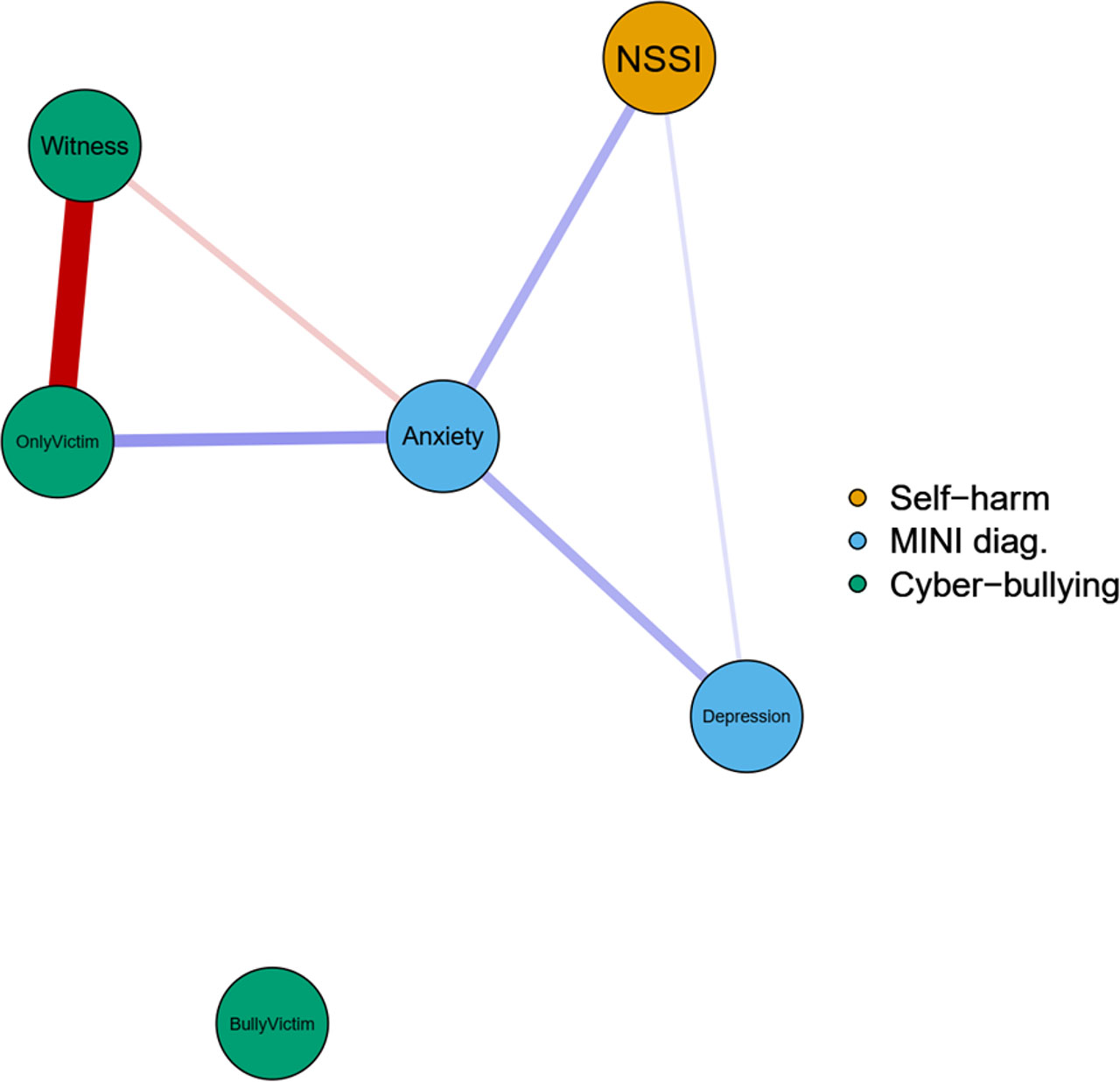
FIGURE 2.
Association between NSSI, mental disorders (i.e., anxiety, depression), and cybervictimization.
Note: OnlyVictim = CB victims, BullyVictim = both CB victims and bullies, Witness = CB witnesses, Anxiety = anxiety disorders (according to MINI diagnosis), Depression = depressive disorders (according to MINI diagnosis), NSSI = non-suicidal self-injury.