
Background
Nonsuicidal self-injury
Self-injurious behavior (SIB) can be conceptualized as as a spectrum, with nonsuicidal self-injury (NSSI) at one end—where individuals directly and deliberately hurt themself without suicidal intent—and suicide attempts (SA) at the other end—which involve actions carried out with an intent to die, and are considered a form of suicidal behavior (1,2,3). Additional terminology can be found in the literature that describe similar phenomenon as NSSI, such as deliberate self-harm, self-injury, self-harm, self-cutting, self-mutilation and parasuicide (2). Deliberate self-harm (DSH) is a broader construct that may or may not include suicidal intent and self-poisoning; the definition often depends on the specific article or measurement tool used (2). In the case of SIB, the focus is generally on physical self-harm, excluding self-poisoning. However, the distinction between suicidal and non-suicidal intent is not always made in SIB research: only NSSI explicitly excludes suicidal intent; whereas other terms are more permissive in this regard (2, 4). Providing clear definitions and delineations of these concepts is essential, as they represent overlapping but distinct phenomena, each with unique clinical and research implications.
NSSI was included in the Diagnostic and Statistical Manual of Mental Disorders, 5th Edition’s (DSM-5) chapter “Conditions for Further Study” in 2013 as a separate category for the first time (5). According to the DSM-5, the definition of NSSI is that it must have occurred 5 or more days in the last year, and the function of the NSSI has to be either to get relief from a negative feeling, to resolve an interpersonal conflict, or to achieve a positive emotional state (5). Immediately before the self-harm, negative feelings/thoughts or interpersonal difficulties or a preoccupation with the behavior which is hard to control, or thinking about the self-injury must also occur. In addition, the DSM-5 excludes socially sanctioned behaviors, like tattoos and piercings (5).
NSSI typically begins during adolescence, with lifetime prevalence rates peaking in this age group (6,7,8,9,10). The estimated lifetime prevalence of NSSI is approximately 20% among adolescents, 13.4% among young adults, and 5.5% among adults (7, 11). The age of onset of NSSI behavior is often between 12 and 14 years (10).
Cyberbullying
Cyberbullying (CB) is a type of bullying where the harassment takes place on any electronic communication interface (e.g., phone call, messages) or online (e.g., on Facebook, TikTok, Instagram, YouTube, online games) (12, 13). Kowalski (2014) defined CB as “the use of electronic communication technologies to bully others” (12). In this type of harassment, there is a wide range of methods, given the various electronic devices available (12). CB could be an anonymous harassing phone call or message, inciting a quarrel in online comments, receiving hurtful images, etcetera (12,13,14).
CB has many similarities with traditional bullying, such as the repetitive tendency, the aggressiveness, and the display of power between the individuals (12). Moreover, in half of the cases, the same person is bullied in both ways (12, 15,16,17,18). The most important difference between CB and traditional bullying is the potential for anonymity, which is absent in traditional bullying, but often present in CB (12, 15). The circle of perpetrators has thus widened, as people who would not dare to hurt others face-to-face can now be anonymous bullies (12). Another negative aspect of anonymity is that bullying can become more severe online, as the perpetrator does not immediately see the effect of their harassment on the victim (19). Since the bullies cannot see their victims, cyber victims can also differ from traditional harassment victims (15, 20).
The lifetime prevalence of CB is 10–20% among adolescents, but there are big differences among the populational samples (12, 16, 19, 21,22,23,24). There are two meta-analyses on the prevalence of CB which show 3–5% CB perpetrators and 7–13% cybervictimization rates (25, 26). Previous studies have found that the prevalence of CB is higher among girls than boys (15, 18, 20, 22,23,24, 27). In addition, most of these studies found that while girls exposed to more verbal harassment and CB than boys, boys experience more physical bullying than girls (15, 20, 22), while other studies found no significant gender difference (28), or they even found that boys are more likely to be perpetrators than girls (29, 30), and one study found a higher prevalence of CB among boys than girls (31).
Adolescents, who engaged in CB (as both victims and perpetrators) experience more emotional stress and have a greater risk for school-related and mental health problems (20, 32,33,34). Moreover, CB increases the risk of suicidal behavior, since adolescents who report CB are more likely to report suicidal ideation, plans, and attempts (18, 22, 33, 35). Kodish et al. (2016) found that all types of bullying were significantly associated with a higher risk of suicide, and that depressive symptoms amplified this relationship (35).
Association between self-injury and CB
The associations between CB and SIB have only in the past decade begun to attract the interest of researchers, and two systematic reviews and meta-analyses were completed on this topic (36, 37). Heerde and Hemphill (2019) meta-analyzed the relationship between both traditional bullying and CB and DSH among adolescents (36). They found 27 studies that provided data on this topic among 11–19-year-old adolescents, but only four studies reported data on CB (36). Both traditional bullying and CB showed a significant negative association with DSH, both in bullying perpetration and victimization (36). John et al. (2018) meta-analyzed the relationship between self-harm, suicide, and CB among people younger than 25 years old (37). They found similar results to Heerde and Hemphill, although they did report a significant negative association between CB and suicidal behavior, as well (37). In their analysis, 26 independent studies were involved, and 11 provided data on cybervictimization and SIB (37).
As can be seen in the meta-analyses described above, only a few studies have examined the relationship between CB and SIB (36, 37). Some of the studies found a significant negative association between CB and SIB (17, 20, 38, 39), whereas others found this negative correlation when the CB occurred with traditional bullying (27). Table 1 shows the main results of the articles which examined the correlations between CB and SIB.
TABLE 1.
The main results of previous articles about the relationship between CB and SIB
| Article | Research type | Population | Main results |
|---|---|---|---|
| Hay & Meldrum (2010) (38) | Cross-sectional |
|
|
| Schneider et al. (2012) (17) | Cross-sectional |
|
|
| Elgar et al. (2014) (18) | Cross-sectional |
|
|
| Thomas et al. (2017) (40) | Cross-sectional |
| 1.1% comorbidity between CB victims and NSSI, and 9.9% between cyberbullies and NSSI among adolescents |
| Fridh et al. (2019) (30) | Cross-sectional |
| Significant association between SIB and CB among students who involved in any mental distress in the last 12 months |
| Nguyen et al. (2020) (28) | Cross-sectional |
| CB was significantly associated with SIB among adolescents |
| Eyuboglu et al (2021) (29) | Cross-sectional |
| Significant increasing of SIB among adolescents who involved in CB – among only victims, only perpetrators and both as well |
| Faura-Garcia et al. (2021) (31) | Cross-sectional |
|
|
| John et al. (2022) (27) | Longitudinal |
| The prevalence of SIB was significantly higher both in the only traditional and in the only cyberbullying groups, than the nonbullied group, and the highest was among both traditional and CB group |
As shown in Table 1, most definitions of SIB either do not specify whether there was suicidal intent in the behavior, or they are not separated and therefore could be included in the category of SA (17, 18, 27,28,29,30, 38). Only a few studies on the relationship between NSSI and CB exist, but they show significant comorbidity between the two phenomena (31, 40).
Dorol-Beauroy-Eustache and Mishara (2021) completed a systematic review about the risk and protective factors for suicidal behavior and SIB among children and adolescents involved in CB (41). They found 29 articles on this topic and formulated 10 risk and 10 protective factors which moderated and mediated the relationship between the phenomenon (41). Among the risk factors, some mental health problems, such as substance abuse and depressive symptoms were reported, along with autism spectrum disorders (41).
Previous studies have primarily focused on individuals directly involved in CB as victims or perpetrators and much less is known about the psychological correlates among those who witness such behavior. Witnessing cyberbullying may also be associated with emotional distress and maladaptive coping, including NSSI. Understanding this association is particularly relevant during adolescence, a developmental period characterized by increased peer sensitivity and emotional vulnerability. By exploring the link between witnessing CB and NSSI, the present study aims to contribute to a more comprehensive understanding of the broader impact of cyberbullying on youth mental health.
Hypotheses
Based on the foregoing literature, our hypotheses were:
1) The prevalence of NSSI is significantly higher among those who are involved in CB (whether perpetrators, victims, or bystanders) than among those who are not involved in CB.
2) Depressive disorders mediate the association between NSSI and CB among perpetrators.
3) Anxiety disorders mediate the association between NSSI and CB among victims.
4) The prevalence of NSSI is significantly higher among CB perpetrators and victims than among those who merely witness CB.
Methods
Ethics
This study began after the ethical permission of the Medical Research Council’s Committee on Scientific and Research Ethics, Hungary. The ethical permission numbers are 42020-4/2019/EKU and IV/8167-3/2020/EKU—before and after the outbreak of the Severe Acute Respiratory Syndrome Coronavirus 2 (SARS-CoV-2), respectively. Study anonymity and our code-decode system (including the rules for breaking the anonymity code in case of the risk of acute suicide) were explained, and that the consent of the participants in the study could be withdrawn at any time without giving reasons. After the provision of detailed written and oral information, the adolescents and their parents signed informed consents. In the case of an acute risk of suicide based on a structured psychiatric diagnostic interview, the parents and adolescents were informed and referred to a child and adolescent psychiatrist within 24 hours.
Participants and data collection
Data collection was conducted in secondary and vocational schools of Hungary. Our study employed a cross-sectional design and was conducted with a Hungarian convenience sample of adolescents. Our research group is known for its involvement in school-based mental health prevention programs. Several schools contacted us to request participation in such programs. Data were collected in three cities: Bábolna (located in western Hungary), Kiskunhalas (located in central-southern Hungary), and Budapest (the capital of Hungary, located in central Hungary). Each school was visited twice to collect data. In these schools, students whose parents and they themselves provided consent to participate prior to the prevention program constituted our sample. Participants were recruited between June 5, 2019, and September 23, 2022. Inclusion criteria were that participants had to be aged 13–18 years, speak Hungarian, and be able to read the questionnaires and answer all the questions. One exclusion criterion was the inability to complete the self-administered questionnaires for any reason.
Data collection started June 5, 2019. The students completed the questionnaire and the interview during class time at their schools in 50–55 minutes. On March 11, 2020, the SARS-CoV-2 pandemic broke out, and it was forbidden to go personally to schools due to safety regulations. We had to modify our data collection process and completely switch to online data collection. When relaxed SARS-CoV-2 pandemic regulations made it possible to visit the schools in person again, we continued our data collection personally.
Measures
Inventory of Statements About Self-injury
To measure NSSI, we used the Hungarian-translated and validated version (42) of the Inventory of Statements About Self-injury (ISAS), developed by Klonsky and Glenn (2009) (43). The ISAS is a self-report questionnaire that assesses behaviors and functions of self-injury in two sections. Among the introduction, the questionnaire defines NSSI as a deliberate and direct damage to the person’s own body, without suicidal intent. The first part asks about the frequency of 12 different NSSI behaviors, and there is also a 13th option to write in a behavior not previously listed. The second part assesses the 13 most frequent NSSI functions using 39 items on a 3-point Likert scale (not relevant, somewhat relevant, very relevant). The questionnaire ends with two optional open-ended questions, in which the person can write whether there is another reason or motivation for NSSI not mentioned in the questionnaire (43).
From the first part of the ISAS, we collected demographic data on the occurrence and prevalence of NSSI (e.g., the last time of self-harm and number of self-harm acts during the lifetime). Klonsky and Glenn divided the second part (i.e., the 13 functions of NSSI) into two factors for exploratory factor analysis: 1) interpersonal functions, in which the NSSI is socially empowered, and 2) intrapersonal functions, in which the NSSI is self-empowered. Both factors have excellent internal consistency, with a coefficient alpha of .88 for the interpersonal and .80 for the intrapersonal factors (43).
The Hungarian translation of the ISAS was created by Reinhardt et al. (2022) (42). They validated the questionnaire with 1,015 14–20-year-old Hungarian high-school students (66.1% girls, M = 16.81 years, SD = 1.42) and obtained good reliability results. They used the same two-factor analyses as Klonsky and Glenn and demonstrated excellent internal consistency, as well, with the following Cronbach alphas: .84 for the intrapersonal and .82 for the interpersonal factors (42).
Cyberbullying questionnaire
We define CB in this manuscript as a type of bullying in which the harassment occurs through any electronic communication channel (e.g., phone call, text messages) or online platforms (e.g., on Facebook, TikTok, Instagram, YouTube, online games). We measured CB with a self-report questionnaire developed by Demetrovics and Zsila (2018) (44). The questionnaire starts with a definition by Robert S. Tokunaga of CB as any behavior carried out electronically by individuals or groups with the intent to cause harm or inconvenience to others (45). The first two questions measure the frequency of CB during the past year (in the role of victim or bully separately). The third question queries how many different forms and roles of CB a person got involved in or not during the past year. This question is answered with a Likert-scale for all eight possible forms of behavior, defined by Domonkos (2014) (46). We identified five groups of roles: 1) victim (involved only as a victim), 2) bully (involved only as a perpetrator), 3) both victim and bully, 4) witness (involved as a bystander), and 5) none of these (44).
Mini International Neuropsychiatric Interview – Kid
Depression and anxiety disorders were measured with version 7.0.2 of the Hungarian version of the Mini International Neuropsychiatric Interview – Kid (MINI-KID) (47), a structured diagnostic interview to help in making DSM-5 psychiatric diagnoses for children and adolescents aged 6–18 years (48,49,50). Sheehan et al. (48,49,50) developed the MINI-KID and investigated the concurrent validity and reliability, while Balázs et al. (47) developed the Hungarian version of the MINI-KID. The interrater and test-retest reliability of both the original English and the Hungarian versions of the MINI-KID were adequate, the criterion validity was acceptable, and the sensitivity and the specificity in the majority of examined disorders was reported as very good or good (47).
Statistical analysis
Statistical analyses were conducted in R (version 3.5.1; R Foundation for Statistical Computing, Vienna, Austria). To test Hypotheses 1 and 4, chi-squared tests were used with an α-level of .05.
To examine Hypotheses 2 and 3, which focused on the multivariate associations among bullying involvement, emotional and behavioral indicators, and contextual variables, we estimated regularized psychological networks. These models provide an analytical framework for capturing complex interrelationships without specifying independent, dependent, or mediator variables in advance (51, 52). Given the mixed variable types (interval/ratio and nominal) in our dataset, we used mixed graphical models (MGMs) (56, 57), which estimate conditionally dependent associations between nodes.
To reduce false-positive edges that may arise from chance patterns in the sample, we applied LASSO regularization (67) with expected Bayesian information criterion (EBIC) model selection (68), a combination shown to perform well in recovering true network structures (69,70,71). Edge stability was assessed with 1,000 bootstrap samples, for which we report confidence intervals and the proportion of bootstrap estimates that were non-zero (non0), acknowledging that regularization biases estimates toward zero (58). For further methodological background, see Győri et al. (2022) (72).
The bullying (CB) variable included five categories: bully, victim, bully and victim, witness, and none. Because only one participant reported being a bully only, this category was merged with the bully and victim group. To distinguish victimization from perpetration, we estimated two networks. In the first network, victims could include those who were also bullies. In the second network, we included only children who were victims but not bullies. In both networks, the combined bully and victim category and the witness category were retained.
Results
Sample
Altogether, 183 participants provided written informed consent. Due to dropouts (i.e., those who stopped participating or were not available for data collection despite their prior consent, for instance were missing from school or did not respond to calls) and missing data, overall, 119 participants were included in our analysis (female 70%, male 30%, age M = 15.73, SD = 1.17). It is important to emphasize that our sample is a convenient sample; therefore, from this point onwards, we refer to non-representative prevalence when reporting the results of our research. In our sample, the overall prevalence of NSSI and CB were 62.18% and 61.34%, respectively.
Testing the hypotheses
The prevalence of NSSI was significantly higher among those who were involved in CB, compared to those who were not involved in CB, χ2(1) = 5.62, p = 0.02. Thus, our first hypothesis was confirmed. Table 2 shows the proportion of the five CB groups (i.e., Not Involved, Bully, Victim, Bully & Victim, and Witness) involved and not involved in NSSI. Our network model, where we grouped together the only victim and the bully and/or victim variables, suggested that the association between CB and NSSI was mediated by anxiety. More specifically, being a victim was associated with being diagnosed with anxiety, ORnon0 = 1.36, CI95non0[0.55, 2.40], prop0 = 0.23, and anxiety disorder was directly related to NSSI, ORnon0 = 1.25, CI95non0[0.54, 2.32], prop0 = 0.29. By contrast, depression was not directly related to CB, only to anxiety, ORnon0 = 1.12, CI95non0[0.49, 2.03], prop0 = 0.29 (Figure 1). Hence, the association between CB and NSSI was either mediated by anxiety alone or by mixed anxiety-depressive disorder. Consequently, our second hypothesis was not supported. We found that 27.4% of the adolescents involved in CB were both victims and perpetrators, and only one adolescent was only a perpetrator without being a victim. When we combined those who were involved as both CB victims and perpetrators, we saw again that depression did not have a mediating effect. However, anxiety disorders mediated the relationship between CB and NSSI among this combined (Bully & Victim) sample.
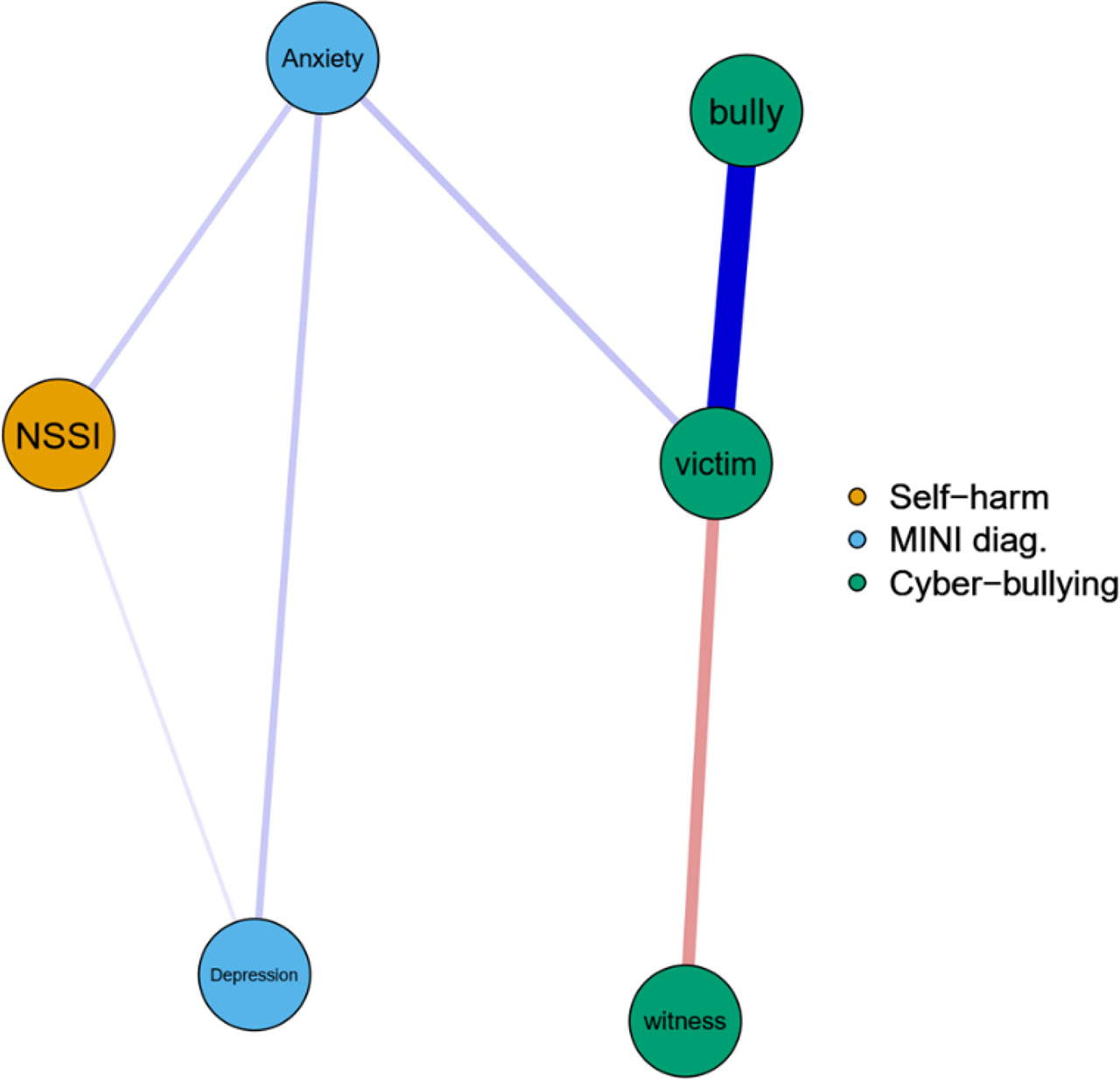
FIGURE 1.
Association between NSSI, mental disorders (i.e., anxiety, depression), and CB (victim, bully, and witness groups).
Note: Anxiety = anxiety disorders (according to MINI diagnosis), Depression = depressive disorders (according to MINI diagnosis), NSSI = nonsuicidal self-injury, bully = CB perpetrators, victim = CB victims, witness = CB witnesses.
TABLE 2.
The proportion of the five CB groups.
| No NSSI | NSSI | |
|---|---|---|
| Not involved | 24 | 22 |
| Bully | 0 | 1 |
| Victim | 5 | 16 |
| Bully & victim | 5 | 15 |
| Witness | 11 | 20 |
In the second network, where we considered only those children who were victims but not bullies, victimization (from either witnessing or being a bully) was positively related to anxiety. Victimization (from either witnessing or being a bully) was positively related to anxiety, ORnon0 = 1.47, CI95non0[0.70, 2.56], prop0 = 0.30, which, in turn, was positively associated with NSSI, ORnon0 = 1.25, CI95non0[0.55, 2.33], prop0 = 0.29. Depression mediated, again, only the direct effect of anxiety, ORnon0 = 1.13, CI95non0[0.55, 1.96], prop0 = 0.32 for the first path, and ORnon0 = 0.87, CI95non0[0.41, 1.67], prop0 = 0.62 for the second path (Figure 2). Thus, our third hypothesis was confirmed: Anxiety disorders mediated the association between NSSI and cybervictimization. Finally, our fourth hypothesis was not fulfilled: The prevalence of NSSI was not significantly higher among CB perpetrators and victims compared to witnesses, χ2(1) = 0.68, p = 0.41.
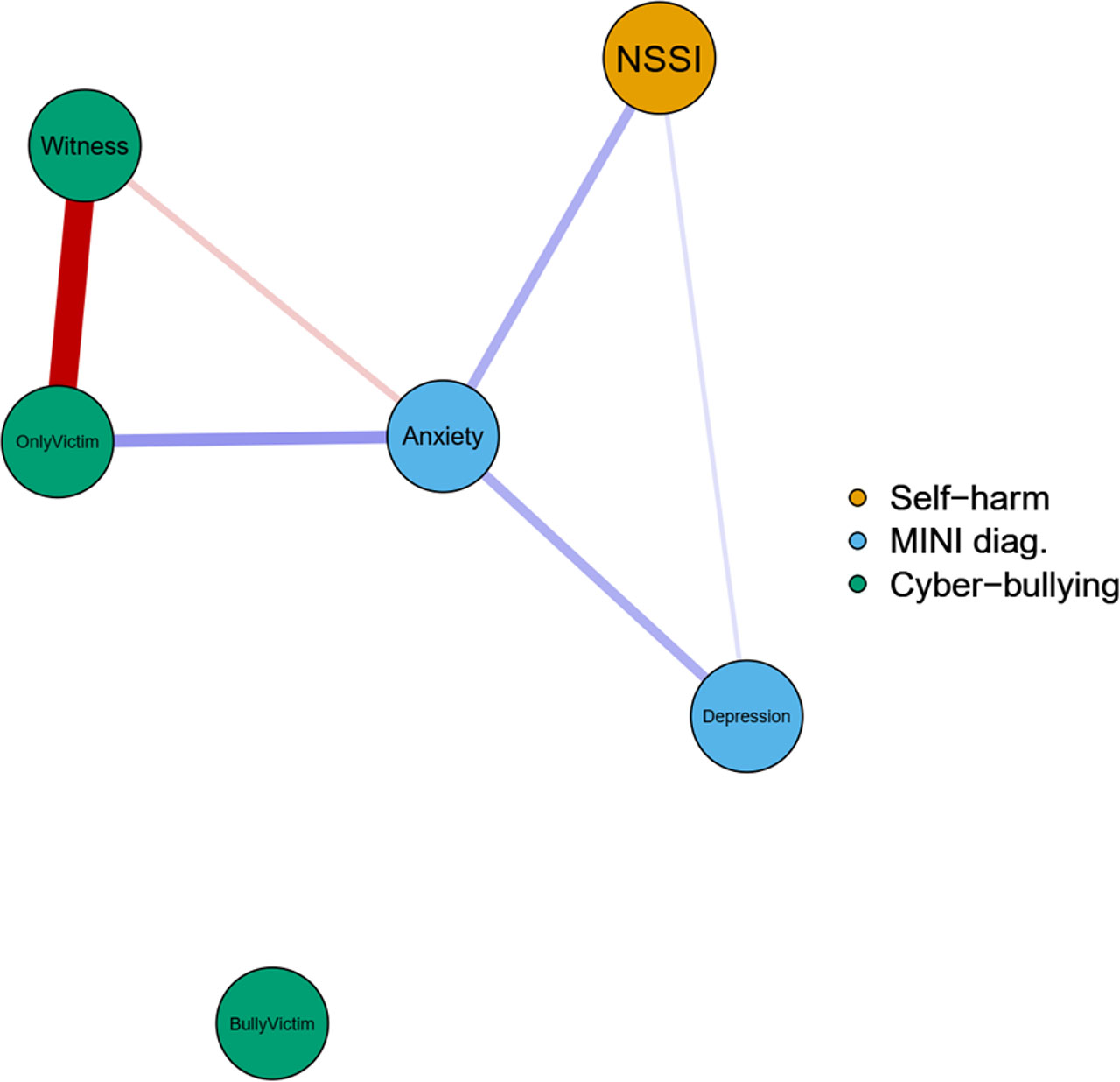
FIGURE 2.
Association between NSSI, mental disorders (i.e., anxiety, depression), and cybervictimization.
Note: OnlyVictim = CB victims, BullyVictim = both CB victims and bullies, Witness = CB witnesses, Anxiety = anxiety disorders (according to MINI diagnosis), Depression = depressive disorders (according to MINI diagnosis), NSSI = non-suicidal self-injury.
Discussion
Although several previous studies have examined the association between cyberbullying and self-harm, most did not distinguish nonsuicidal self-injury (NSSI) from deliberate self-harm (DSH) that may include suicidal intent. The present study aims to focus specifically on NSSI as defined by DSM-5 criteria. Our study includes not only perpetrators and victims but also witnesses of cyberbullying—an aspect largely neglected in previous research.
Our results show that both NSSI and CB are common behaviors among adolescents, which is in line with previous studies (72,73,74). Adolescence is a developmentally vulnerable period characterized by biological change, high levels of emotional distress, an increase in risky behaviors, and increased interpersonal stress (75, 76), which can lead to engaging in unhealthy coping mechanism, like NSSI and CB. Moreover, the prefrontal cortex—responsible for decision making and impulse control—is still immature in this age-group, so these individuals more easily engage in impulsive behaviors (77, 78).
Confirming our first hypothesis, the adolescents who engaged in CB—whether victims, perpetrators, or witnesses—reported a higher prevalence of NSSI than the adolescents who did not engage in CB, a finding in line with previous studies that suggested a higher frequency of SIB and NSSI among CB victims and perpetrators (31, 36, 37, 40). This study is the first, to our knowledge, to examine the association between witnessing cyberbullying and NSSI. Previous research findings showed that witnessing CB was positively related to internalizing symptoms and suicidal ideation (79, 80), and both internalizing symptoms and suicidal ideation has significantly correlated with NSSI (1, 6, 81), although no previous research had examined the relationship between witnessing CB and NSSI. These results call attention to the necessity of including adolescents witnessing CB in both NSSI research and prevention projects.
Although previous studies had highlighted the mediating role of negative emotions and depression in the relationship between CB and NSSI (38, 82,83,84), in our study, depression was not a mediator, while anxiety and mixed anxiety-depression symptoms were found to be highly significant mediators between CB perpetrators and NSSI. Being a perpetrator can cause significant interpersonal stress, and NSSI can be a way to deal with this stress (85,86,87,88). According to general strain theory, stressful and tense social relationships and events can pressure people into externalizing and internalizing aggression (38, 83, 89). Some previous research had described that adolescents engaging in CB experienced more negative emotions, whereas the outcome—whether it segued into self-harm or not—was influenced by the quality of the individual’s friendships (83). Another influence might also have been depression, which was not found to be a mediating factor in our study; deviant peer affiliation has played an important role in how cyber harassment develops (90).
Supporting our third hypothesis, anxiety mediated the relationship between cybervictimization and NSSI, cohering with previous findings (31, 77, 84, 91). The way adolescents saw themselves and their relationships with others might have an impact, and due to victimization, there were negative perceptions which could lead to NSSI (31, 85, 92,93,94). Another explanation could pertain to emotional reactivity, which refers to how quickly and intensely a person reacts to an emotion (95). When emotional reactivity is high, the person experiences negative emotions easily and intensely, and this can lead to psychological distress (86, 95). Engaging in CB for a long time can lead to rumination and negative emotions, and difficulties in emotion regulation might lead to a higher level of emotional reactivity (86). There is also a potential biological explanation: The prefrontal cortex is immature in adolescence, therefore adolescents more easily engage in impulsive and hostile behaviors upon exposure to stress (77). Being a victim of CB can cause significant stress, therefore adolescents engage relatively more often in NSSI (77). Again, cybervictimization can lead to higher interpersonal pressure, and NSSI can be a coping mechanism to deal with this stress (83, 87, 96, 97), triggering a vicious circle, where increasing anxiety worsens interpersonal relationships and performance among peers, leading to more bullying, both traditional and CB (84).
We note another interesting finding that almost all of those involved in bullying were involved in both roles; only one individual was only a perpetrator and not a victim. Some previous studies had highlighted that CB is characterized by high reciprocity, therefore it is common to play more than one role (82).
Compared to the majority of previous studies, which focused on the association between cyberbullying and self-harm, and did not clarify whether there was suicidal intent or not, the current study examined NSSI as defined by DSM-5 criteria. Furthermore, we included not only perpetrators and victims but also witnesses of cyberbullying, which had hardly been examined before. Moreover, by applying psychological network analysis, we were able to model complex interrelations among these variables rather than simple linear effects. Our findings suggest that anxiety, rather than depression, mediates the association between cyberbullying and NSSI, thereby refining existing knowledge on the emotional mechanisms linking these phenomena. Furthermore, we expand the cultural and geographical scope of the literature, which is dominated by North American and East Asian data. Our study provides original data from Hungarian adolescents, a Central European population underrepresented in NSSI–CB research.
Our results need to be interpreted in the light of our study’s limitations. During the SARS-CoV-2 pandemic, we collected our data online, and there were more dropouts during online data collection, making it more difficult to reach participants in this way. Also, our study should be considered preliminary because of its small sample size. We would like to highlight that our results are based on a cross-sectional study design; therefore, we cannot draw conclusions about causality. A longitudinal study that focuses on potential mediating effects would be required to provide evidence for a causal relationship between NSSI and CB. Finally, self-report questionnaires were used for the assessment of NSSI and CB.
Clinical significance
In summary, our results draw attention to the high prevalence of NSSI and CB among adolescents. Adolescence is a particularly vulnerable age period; therefore, it is crucial to pay attention to young people, both in terms of prevention and intervention. Moreover, the current study highlights the need for a greater focus on CB witnesses because they are also involved in NSSI. NSSI prevention strategies should include adolescents who are both involved in CB and who witness CB. Finally, future research should also focus on predictive risk factors of NSSI and CB.
Notes
[4] Contributed by Author contributions
Conceptualization, methodology, data collection, and writing the manuscript: BFF, DG, LOH, PG, NK, and JB; formal analysis: DK; supervision: JB; and project administration: BFF, DG, and PG. All authors have read and agreed to the published version of the manuscript.
[5] Ethical approval statement
The study was conducted in accordance with the Declaration of Helsinki, and the protocol was approved by the Ethical Committee of the Medical Research Council, Hungary (ETT-TUKEB; protocol number: 54023-5/2018/EKU, IV/8167-3/2020/EKU, date of approval: 18.11. 2018).
[6] Informed consent statement
All participants gave their written informed consent for inclusion before they participated in the study.
Acknowledgement
For their careful data collection and entry, we thank our Eötvös Loránd University students: Hedvig Árvai, Rita Bajka, Orsolya Bányácski, Lili Baranyai, Lili Bárdosi, Dorka Börzsei, Bianka Brezóczki, Klaudia Buda, Krisztina Csórián, Boglárka Deák, Blanka Ehrenberger, Brigitta Farkas, Nóra Habermajer, Hanga Halász, Anett Hernádi, Luca Hilt, Réka Horváth, Nikolett Hőgye, Dorka Kovács, Lilla Kovács, Orsolya Kovács, Andrea Kővári, Zsolt Langer, Boglárka Lázár, Beáta Majos, Gitta Markó, Veronika Mészáros, Ingrid Mitró, Alkioné Nagy, Bettina Nagy, Anna Tekla Olchváry, Anna Papp, Veronika Péteri, Borbála Pulay, Lilla Rea, Nóra Sólyom, Rebeka Szőke, Kornél Vajsz, Máté Várvédy, Katinka Vécsey, Kornélia Zimányi, and Luca Zsombéki.