
TABLE 1.
Demographic information of the included participants. Means ± standard deviation.
| Children w/ TS | Siblings w/o TS | Controls | p-values | |
|---|---|---|---|---|
| N | 18 | 24 | 20 | n/a |
| Age | 11.9 ± 1.9 | 10.3 ± 1.8 | 10.4 ± 1.8 | 0.016 |
| Sex (M / F) | 13/5 | 12/12 | 10/10 | 0.277 |
| IQ1 | 103.9 ± 12.4 | 107.1 ± 10.1 | 113.5 ± 10.3 | 0.026 |
| Comorbidity2 | 4 (22.2%) | 2 (8.3%) | 0 | n/a |
| Medication3 | 3 (16.7%) | 0 | 0 | n/a |
| ADHD-RS4 | 22.4 ± 15.3 | 13.9 ± 9.9 | 9 ± 7.9 | 0.001 |
| YGTSS5 | 26.1 ± 14.1 | n/a | n/a | n/a |
| Total Tic Severity Score6 | 18.6 ± 8.8 | n/a | n/a | n/a |
| CY-BOCS | 1.0 ± 2.3 | 0 | 0 | >0.05 |
1 Two-tailed p-values that represent the value across all three groups. See the text for p-values between groups.
13 Anti-tic or ADHD medication: Two participants received noradrenaline reuptake inhibitors (atomoxetine) and one received neuroleptics (risperidone, aripiprazole);
16 YGTSS w/o impairment; TS: Tourette Syndrome, ADHD: Attention-deficit/hyperactivity disorder, OCD: Obsessive compulsive disorder, ASD: Autism spectrum disorder, ADHD-RS: Attention-deficit/hyperactivity disorder Rating Scale, YGTSS: Yale Global Tic Severity Scale, CY-BOCS: Children’s Yale-Brown Obsessive-Compulsive Scale.
TABLE 2.
Purdue Pegboard Task results.
| Purdue Pegboard | Children w/ TS | Siblings w/o TS | Controls | p-value1 | 2 |
|---|---|---|---|---|---|
| Dominant hand | 12.9 ± 2.2 | 13.5 ± 1.9 | 13.9 ± 2.0 | 0.189 | 0.057 |
| Non-dominant hand | 12.6 ± 2.2 | 12.6 ± 2.0 | 13.2 ± 1.8 | 0.345 | 0.037 |
| Bimanual | 10.7 ± 1.9 | 10.7 ± 1.4 | 11.0 ± 1.4 | 0.914 | 0.003 |
| Assemble | 30.7 ± 5.4 | 30.2 ± 5.7 | 33.1 ± 5.3 | 0.175 | 0.059 |
| Total | 66.9 ± 9.2 | 67,0 ± 9.8 | 71.2 ± 8,8 | 0.176 | 0.059 |
TABLE 3.
Correlations between parent reported ADHD-RS and Purdue Pegboard scores across all groups.
| Purdue Pegboard | Pearson Correlation | p-value1 |
|---|---|---|
| Dominant hand | -0.39 | 0.002 |
| Non-dominant hand | -0.25 | 0.050 |
| Bimanual | -0.26 | 0.039 |
| Assemble | -0.36 | 0.004 |
| Total | -0.39 | 0.002 |
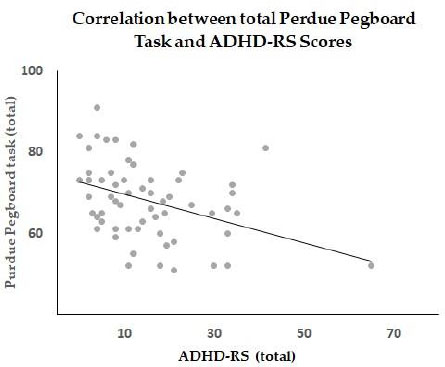
FIGURE 1.
The Correlation between total Perdue Pegboard task and Attention-Deficit/Hyperactivity Disorder-Rating Scale (ADHD-RS) scores: Children with lower ADHD-RS scores performed better on the Perdue Pegboard task than children with higher scores. An inverse correlation was found across groups between total Perdue Pegboard task performance and total parent-reported ADHD-RS scores (r60 = -0.392, p = 0.002).