
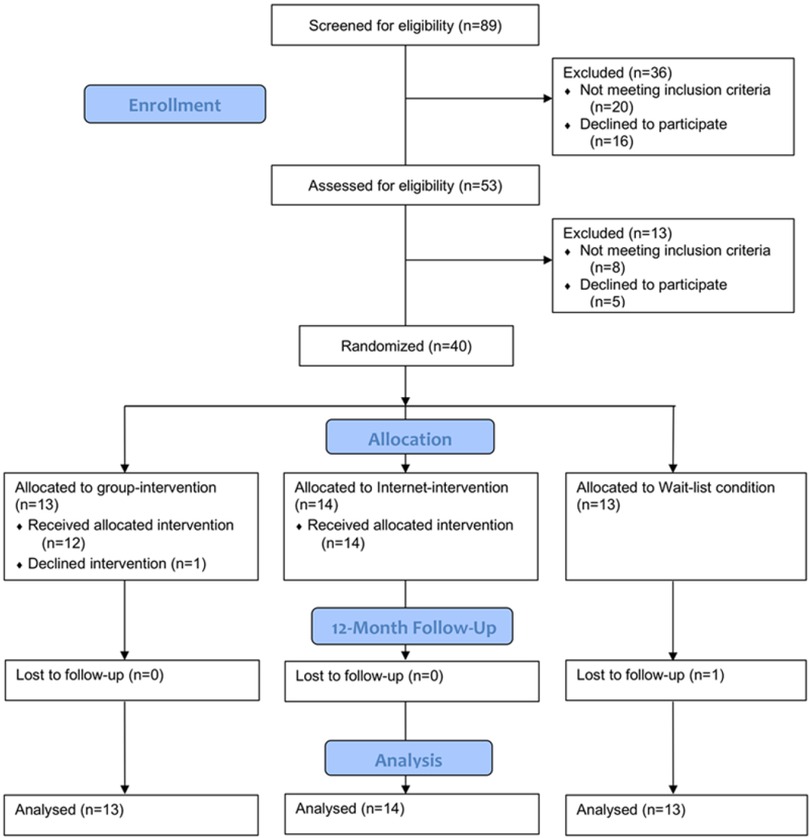
Figure 1
Flow of participants through study
Table 1
Parent and child characteristics
| Group-SAPP (n=13) | Internet-SAPP (n=14) | Wait-list (n=13) | p-valuec | |
|---|---|---|---|---|
| Parent characteristics | ||||
| Female (n) | 100% (13) | 93% (13) | 85% (11) | .52 |
| Mean age (SD) | 41.4 (4.7) | 41.1 (4.5) | 41.4 (3.9) | .98 |
| > 2-year post-secondary education | ||||
| 69% (9) | 93% (13) | 92% (12) | .28 | |
| Contact psychiatry | ||||
| No current or previous (n) | 38% (5) | 50% (7) | 31% (4) | .68 |
| Current (n) | 8% (1) | 0% (0) | 15% (2) | |
| Previous (n) | 54% (7) | 50% (7) | 54% (7) | |
| Psychiatric status | ||||
| Anxious (STAI-S>42)a | 46% (6) | 43% (6) | 77% (10) | .18 |
| Worried (PSWQ>48)b | 92% (12) | 71% (7) | 92% (12) | .46 |
| Child characteristics | ||||
| Girl (n) | 62% (8) | 71% (10) | 31% (4) | .09 |
| Mean age (SD) | 9.0 (2.0) | 9.4 (2.4) | 9.6 (2.2) | .73 |
| Living situation | ||||
| Both guardians (n) | 100% (13) | 57% (8) | 85% (11) | .04 |
| Lone guardian (n) | 0% (0) | 14% (2) | 0% (0) | |
| Alternating (n) | 0% (0) | 29% (4) | 15% (2) | |
| Any mental health contact | ||||
| No current or previous (n) | 92% (12) | 93% (13) | 85% (11) | .68 |
| Current (n) | 8% (1) | 0% (0) | 0% (0) | |
| Previous (n) | 0% (0) | 7% (1) | 15% (2) |
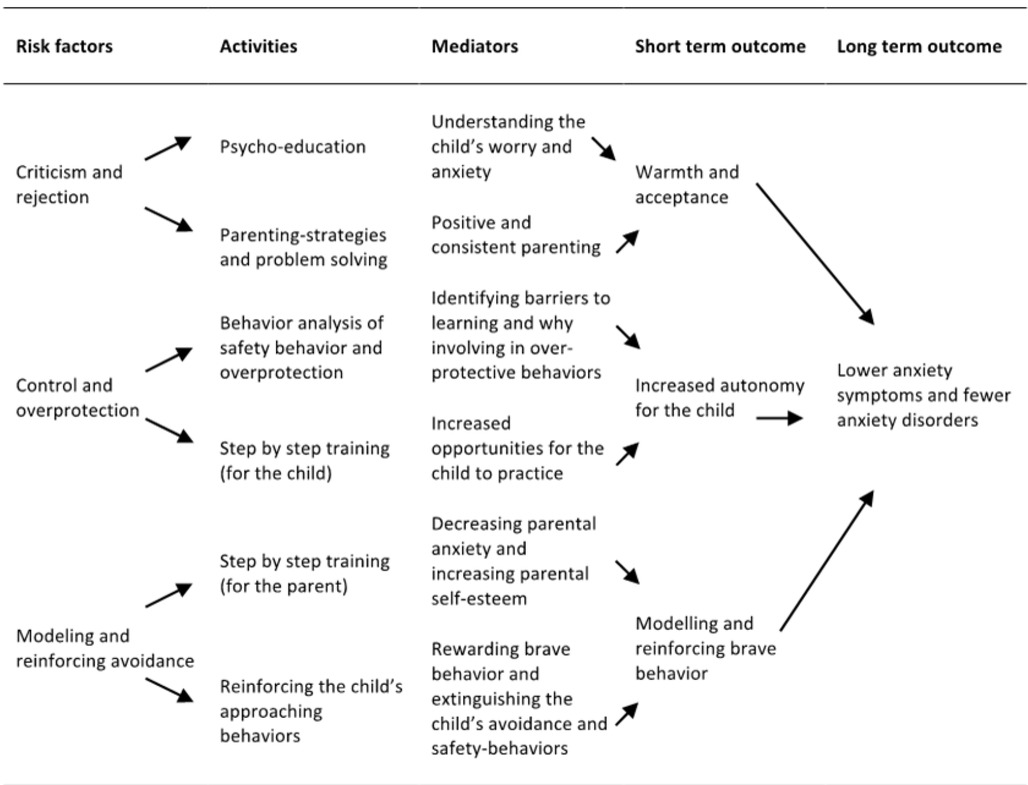
Figure 2
Theoretical model of the intergenerational transmission of anxiety
Table 2
Brief summary of session content of the SAPP
| Session/module | Content |
|---|---|
| 1. Introduction | In groups, participants were presented to each other and the course leader introduced the guidelines of the parent training intervention. In the Internet version, the platform was introduced, including describing how the participant receive feedback on home assignments and how they may communicate with the psychologist using text massages within the platform. The first session/module was then dedicated to parenting and psychoeducation of anxiety, including the physical, emotional and cognitive aspects of anxiety, and the cognitive behavioral formulation on how avoidance may increase anxiety and create problems in the long perspective. |
| 2. Behavior analysis | Focus on behavior analysis. Parents learned how to understand and evaluate behavior within a CBT-perspective by analyzing a situation, the activated behavior, and its consequences. Much time was spent on the parents working with their own examples. |
| 3. Training stairs | The so called “training stairs” are introduced. Parents learned how to divide challenging situations or problems into small steps to increase the probability of overcoming the problem through structured training. Parents were also encouraged to create training stairs relevant to their own situation. |
| 4. Anxious parenting | Devoted to parental behavior specifically relevant to anxious parents. Especially, overprotective behavior (such as limiting child autonomy, and exaggeratedly protecting the child of criticism and negative feelings) and behavior which assist the child’s avoidance were examined. Parents were encouraged to work with behavior analyses to identify and understand overprotective behavior in their own life. |
| 5. Training stairs | The training stairs were revisited. This time, parents were encouraged to think about how to use this strategy to help their child in challenging situations, or as a mean for the child to learn something new. |
| 6. Problem solving | A structured problem-solving method were introduced. Parents were then encouraged to think of one area where they could implement the strategy in their family, and together with their child explore structured problem solving. |
| 7. Positive parenting | Two parenting strategies were presented. The first involved the parent spending time alone with their child with the instruction to let the child choose activity and to only follow the child with interest without giving any instruction. The second strategy encouraged the parent to train the ability to prepare, instruct and reward the child in situations of shifting/stopping activities. |
| 8. Plan ahead | The parents planned how to use the strategies learned in the next three months. |
Table 3
Continuous outcomes of children’s and parents’ health and behaviors (means, standard deviations, and within group effect sizes)
| Group-SAPP | Internet-SAPP | Waitlist | ||||||||||
|---|---|---|---|---|---|---|---|---|---|---|---|---|
| Pre | Post | 12- month | Effect size Pre-FU | Pre | Post | 12- month | Effect size Pre-FU | Pre | Post | 12- month | Effect size Pre-FU | |
| Measure | M (SD) | M (SD) | M (SD) | d | M (SD) | M (SD) | M (SD) | d | M (SD) | M (SD) | M (SD) | d |
| OP | 38.5 (10.2) | 35.3 (10.1) | 29.4 (11.6) | 0.98 | 32.0 (8.1) | 25.9 (7.1) | 24.6 (8.4) | 0.79 | 32.4 (9.7) | 27.8 (9.6) | 26.8 (9.6) | 0.60 |
| STAI-S | 45.3 (10.4) | 37.6 (9.5) | 39.6 (9.3) | 0.54 | 41.1 (10.4) | 35.7 (7.6) | 36.9 (11.8) | 0.39 | 49.5 (11.1) | 43.8 (10.2) | 41.2 (9.3) | 0.78 |
| PSWQ | 61.3 (8.9) | 56.3 (9.7) | 57.2 (10.4) | 0.46 | 53.4 (11.6) | 49.5 (10.5) | 45.1 (10.5) | 0.85 | 58.7 (8.9) | 57.3 (10.0) | 57.2 (9.0) | 0.15 |
| BBQ | 40.7 (21.8) | 45.5 (26.2) | 52.8 (18.7) | 0.65 | 45.7 (13.9) | 48.2 (13.3) | 55.9 (13.9) | 0.55 | 45.8 (20.1) | 50.1 (17.0) | 45.0 (18.7) | -0.04 |