
Table 1
Overview of the Cool Kids Social Enhanced Program
| Session number | Participants | Session content | Homework practice tasks |
|---|---|---|---|
| S-1 | T, Y, P | - Rapport building - Psychoeducation - Worry scale - SMART goals | - Complete “Getting to know anxiety” |
| S-2 | T, Y, P | - Continue rapport building - Introduce link between thoughts & feelings - Introduce attention training - Review parent goals | - Attention training - Linking thoughts and feelings |
| S-3 | T, Y, P | - Introduce cognitive restructuring (detective thinking) - Introduce rewards | - Attention training continued - Detective thinking - Rewards menu |
| S-4 | T, Y, P | - Detective thinking to cost - Introduce avoidance - Introduce behavioral experiments - Conduct in session experiment | - Detective thinking incl. cost - 2-4 planned experiments should be implemented - Attention training continued |
| S-5 | T, P | - Parenting an adolescent with SAD | - Changing my response as a parent - Continue detective thinking - Continue experiment practice - Attention training continued |
| S-6 | T, Y, P | - Introduce safety traps - Review experiments - Introduce experiments to reduce safety behaviors - Conduct in session experiment - Introduce task focused attention | - Conduct 2-4 planned experiments that focus on undoing safety traps - Continue detective thinking - Task attention practice |
| S-7 | T, Y, P | - Review safety trap experiments and task-focused attention - Conduct the video-feedback experiment - Introduce the importance of obtaining an accurate self-perception - Obtaining accurate self-perception using feedback - Conduct additional in session experiments | - Implement min. 2-4 planned experiments using feedback in the recording form - Daily experiment practice - Use detective evidence sheet as supplement to the experiments - Continue task-focus attention training |
| S-8 | T, Y, P | - Review and revise experiments that utilize feedback - Introduce post-event processing (detective thinking AFTER a situation) - Introduce cost experiments - Conduct in-session exposure (including an extra challenge experiment) | - Daily experiment practice (incl. min. 2-4 planned extra challenge experiments) - Post-event detective thinking - Continue task-focus attention training |
| S-9 | T, Y, P | - Review and revise extra challenge experiments and post-event detective thinking - In session experiments - Troubleshooting experiments [PARENT ONLY] - Optional MODULE: Dealing with teasing and bullying | - Daily experiments (including large experiments) - Continue task-focus attention training - Parent task: complete the reviewing foals worksheet - Optional module: Role play new ways of interacting with bullies |
| S-10 | T, Y, P | - Review of goals - Maintenance of gains/setbacks - Future plans | - Continue to practice skills |
| Booster | T, Y,P | - Focusing on maintaining and continuing the progress. - Advise possible further help. | - Continue to practice skills |
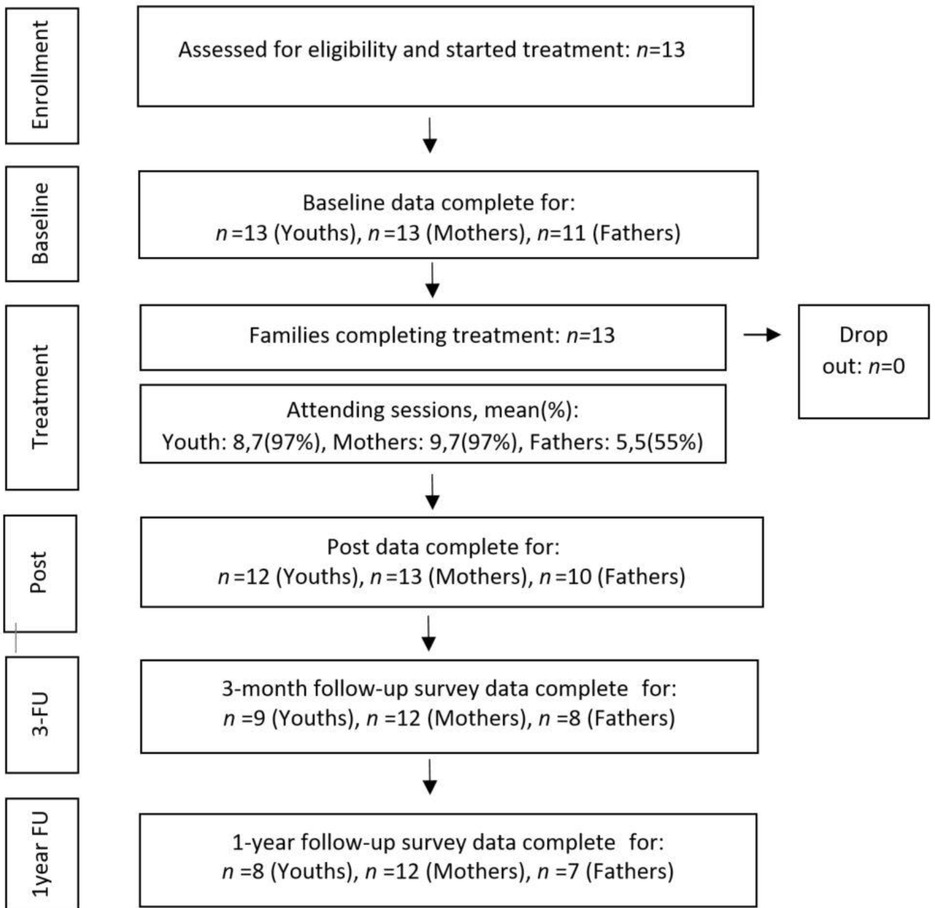
Figure 1
Flow Diagram of Response and Completion Rate
Table 2
Treatment Satisfaction at Post-Intervention
| Not True | Partly True | Certainly True | ||
|---|---|---|---|---|
| The treatment helped me/my child | Youth | 0 | 3 (25%) | 9 (75%) |
| Mother | 0 | 4 (31%) | 9 (69%) | |
| Father | 0 | 3 (33%) | 7 (67%) | |
| We feel better in the family now than before treatment | Youth | 3 (25%) | 6 (50%) | 3 (25%) |
| Mother | 0 | 4 (31%) | 9 (69%) | |
| Father | 0 | 2 (20%) | 8 (80%) | |
| If a friend needed similar help, I would recommend the | Youth | 0 | 11 (92%) | 1 (8%) |
| treatment | Mother | 0 | 0 | 13 (100%) |
| Father | 0 | 1 (10%) | 9 (90%) | |
| I trusted the therapist | Youth | 0 | 2 (17%) | 10 (83%) |
| Mother | 0 | 0 | 13 (100%) | |
| Father | 0 | 1 (10%) | 9 (90%) | |
| The therapist had an understanding of my worries and issues | Youth | 0 | 3 (25%) | 9 (75%) |
| After treatment I felt like being with my friends more | Youth | 2 (16%) | 5 (42%) | 5 (42%) |
| The treatment helped me (the parent) | Mother | 0 | 2 (15%) | 11 (85%) |
| Father | 1 (10%) | 2 (20 %) | 7 (70%) | |
| I have been given enough information about the purpose | Mother | 0 | 1 (8%) | 12 (92%) |
| and course of treatment prior to the start | Father | 0 | 2 (20%) | 8 (80%) |
| During the treatment I managed to change my behavior | Mother | 0 | 3 (23%) | 10 (77%) |
| towards my child in a positive way | Father | 0 | 1 (10%) | 9 (90%) |
| During the treatment I got a better understanding of my | Mother | 0 | 0 | 13 (100%) |
| child’s psychological well-being | Father | 0 | 1 (10%) | 9 (90%) |
| The treatment made me/my child feel worse | Youth | 11 (92%) | 1 (8%) | 0 |
| Mother | 13 (100%) | 0 | 0 | |
| Father | 10 (100%) | 0 | 0 | |
| The treatment made me (the parent) feel worse | Mother | 13 (100%) | 0 | 0 |
| Father | 10 (100%) | 0 | 0 |
Table 3
Mean Scores, Standard Deviations and Effect-Sizes
| Outcome | Respondent | Baseline | Post intervention | 3 month follow-up | 1 year follow-up | Baseline - post intervention: effect size | Post - 1 year follow-up: effect size |
|---|---|---|---|---|---|---|---|
| ADIS-IV: CSR on SAD | CSR rating* | 6.23 (0.44) n = 13 | 5.58 (0.79) n = 12 | 4.77 (1.83) n = 13 | - | d = 1.02 | d = 0.59 |
| SCAS total | Youth | 53 (16.81) n = 13 | 35.33 (13.74) n = 12 | 37.22 (13.09) n = 9 | 39 (22.09) n = 8 | d = 1.15 | d = -0.21 |
| Mother | 48.46 (15.03) n = 13 | 34.85 (16.09) n = 13 | 30.08 (13.92) n = 12 | 33.83 (21.32) n = 12 | d = 0.87 | d = 0.05 | |
| Father | 43.09 (10.27) n = 11 | 34.7 (16.57) n = 10 | 25.5 (7.93) n = 8 | 29.71 (15.51) n = 7 | d = 0.62 | d = 0.31 | |
| SCAS social phobia | Youth | 12.77 (3.24) n = 13 | 8.75 (3.44) n = 12 | 9.44 (3.09) n = 9 | 9.63 (4.34) n = 8 | d = 1.2 | d = -0.23 |
| subscale | Mother | 14.23 (2.52) n = 13 | 11.77 (3.52) n = 13 | 10.92 (4.14) n = 12 | 10.75 (4.29) n = 12 | d = 0.80 | d = 0.26 |
| Father | 13.36 (2.01) n = 11 | 11.6 (3.06) n = 10 | 10.88 (3.44) n = 8 | 10.43 (1.72) n = 7 | d = 0.69 | d = 0.45 | |
| CALIS total | Youth | 19.46 (5.64) n =13 | 13.67 (6.75) n = 12 | 14.56 (5.46) n = 9 | 16.88 (10.09) n = 8 | d = 0.93 | d = -0.39 |
| Mother | 37.69 (8.45) n = 13 | 30 (10.65) n = 13 | 25.17 (13.13) n = 12 | 26.08 (13.21) n = 12 | d = 0.80 | d = 0.33 | |
| Father | 35.27 (9.26) n = 11 | 31.4 (9.72) n = 10 | 22.75 (7.05) n = 8 | 27.29 (13.59) n = 7 | d = 0.41 | d = 0.36 | |
| MFQ | Youth | 12.62 (7.18) n = 13 | 9.67 (7.29) n = 12 | 9.22 (7.16) n = 9 | 12.5 (9.15) n = 8 | d = 0.41 | d = -0.35 |
| Mother | 9.62 (6.45) n =13 | 8.23 (7.01) n = 13 | 7.08 (8.34) n = 12 | 7.33 (6.96) n = 12 | d = 0.21 | d = 0.13 | |
| Father | 6.55 (3.56) n = 11 | 4.8 (3.39) n = 10 | 4.63 (4.60) n = 8 | 3.29 (2.36) n = 7 | d = 0.50 | d = 0.50 | |
| SEQ total | Youth | 59.62 (11.33) n = 13 | 69.25 (14.45) n = 12 | 69.11 (14.08) n = 9 | 63.88 (20.29) n = 8 | d = 0.75 | d = -0.32 |
| SAFE | Youth | 91.62 (16.19) n = 13 | 78.5 (12.99) n = 12 | 75.33 (18.70) n = 9 | 73.63 (16.13) n = 8 | d = 0.89 | d = 0.34 |
| CATS total | Youth | 34.46 (20.56) n = 13 | 22.08 (17.07) n = 12 | 22.44 (20.30) n = 9 | 26.13 (23.53) n = 8 | d = 0.65 | d = -0.20 |
| FAQ self-focus | Youth | 17.38 (4.05) n = 13 | 13.92 (3.70) n = 12 | 13.89 (5.09) n = 9 | 14.75 (6.23) n = 8 | d = 0.89 | d = -0.17 |
| FAQ external focus | Youth | 14.38 (2.47) n =13 | 13.67 (1.67) n = 12 | 13 (3.16) n = 9 | 14.25 (3.65) n = 8 | d = 0.34 | d = -0.22 |
| PTQ | Youth | 36.92 (11.94) n =13 | 27.75 (13.46) n = 12 | 23.67 (16.48) n = 9 | 23.75 (17.38) n = 8 | d = 0.72 | d = 0.26 |
| DASS anxiety | Mother | 3.38 (5.20) n = 13 | 1.69 (2.78) n = 13 | 2.92 (3.68) n = 12 | 3.17 (3.97) n = 12 | d = 0.41 | d = -0.43 |
| DASS depression | Mother | 6.08 (10.77) n = 13 | 2.92 (3.88) n = 13 | 4.67 (7.34) n = 12 | 4.25 (6.22) n = 12 | d = 0.39 | d = -0.26 |
| DASS stress | Mother | 8.38 (7.7) n =13 | 8.38 (6.97) n = 13 | 7.67 (8.05) n = 12 | 8.5 (7.70) n = 12 | d = 0.0 | d = -0.02 |
| DASS anxiety | Father | 1.64 (3.56) n = 11 | 1.6 (2.76) n = 10 | 0.38 (0.74) n = 8 | 0.14 (0.38) n = 7 | d = 0.01 | d = 0.68 |
| DASS depression | Father | 3.27 (8.66) n = 11 | 4.4 (6.88) n = 10 | 5.75 (8.53) n = 8 | 2.86 (2.85) n = 7 | d = -0.14 | d = 0.27 |
| DASS stress | Father | 4.09 (4.74) n = 11 | 4.7 (4.37) n = 10 | 4.25 (3.11) n = 8 | 2.29 (2.63) n = 7 | d = -0.13 | d = 0.64 |
Table 4
Estimated Slopes (Change) from Baseline- to Post Intervention and Post Intervention to 1-Year Follow-Up
| Outcome | Respondent | Baseline to post intervention β [95% CI] | Post intervention to 1-year follow-up β [95% CI] |
|---|---|---|---|
| SCAS total | Youth | -1.44 [-1.78, -1.10]*** | 0.08 [-0.15, 0.30] |
| Mother | -1.18 [-1.59, -0.77]*** | 0.02 [-0.13, 0.17] | |
| Father | -0.82 [-1.41, -0.23]** | 0.04 [-0.16, 0.24] | |
| SCAS social phobia subscale | Youth | -0.29 [-0.41, -0.17]*** | 0.02 [-0.04, 0.08] |
| Mother | -0.21 [-0.33, -0.09]*** | -0.01 [-0.05, 0.03] | |
| Father | -0.14 [-0.28, -0.00]* | -0.02 [-0.06, 0.02] | |
| CALIS total | Youth | -0.44 [-0.60, -0.27]*** | 0.06 [-0.06, 0.18] |
| Mother | -0.71 [-1.12, -0.31]*** | -0.05 [-0.19, 0.09] | |
| Father | -0.54 [-1.00, -0.08]* | -0.05 [-0.25, 0.16] | |
| MFQ | Youth | -0.28 [-0.45, -0.10]** | 0.07 [-0.01, 0.14] |
| Mother | -0.12 [-0.33, 0.09] | 0.00 [-0.06, 0.06] | |
| Father | -0.11 [-0.27, 0.05] | -0.02 [-0.07, 0.03] | |
| SEQ total | Youth | 0.74 [0.42, 1.05]*** | -0.07 [-0.24, 0.09] |
| SAFE | Youth | -1.07 [-1.50, -0.64]*** | -0.09 [-0.25, 0.06] |
| CATS total | Youth | -1.02 [-1.39, -0.65]*** | 0.11 [-0.06, 0.27] |
| FAQ - self focus | Youth | -0.30 [-0.42, -0.17]*** | 0.01 [-0.07, 0.08] |
| FAQ - external focus | Youth | -0.08 [-0.18, 0.02] | 0.01 [-0.04, 0.06] |
| PTQ | Youth | -0.76 [-1.18, -0.34]*** | -0.05 [-0.18, 0.09] |
| DASS anxiety | Mother | -0.08 [-0.23, 0.06] | 0.04 [0.00, 0.08] |
| DASS depression | Mother | -0.16 [-0.41, 0.09] | 0.05 [-0.02, 0.12] |
| DASS stress | Mother | -0.01 [-0.26, 0.25] | 0.02 [-0.07, 0.10] |
| DASS anxiety | Father | - | - |
| DASS depression | Father | 0.10 [-0.10, 0.30] | -0.02 [-0.11, 0.07] |
| DASS stress | Father | 0.05 [-0.14, 0.24] | -0.04 [-0.10, 0.02] |