
1. Introduction
A major dynamically growing trend in construction is high bay racked warehouses. Their principal structural components are frames consisting of high reinforced concrete columns on which steel girders are laid. For economic reasons, the main load-bearing frames are spaced as much as 12.0 m apart. Consequently, the wind load transmitted via the enclosure panels to the columns becomes a significant factor. The columns are rigidly fixed in the foundations and their connection with the steel structure is practically of the hinged type, but allowing horizontal displacement. The use of static models with elastic constraints, limiting the displacements of the column's upper joint, introduces the arbitrariness of assuming the stiffness of the constraints, the way of considering the effects of wind action on the building's opposite surface, and so on. With the current state of knowledge, it seems safest to treat such columns as corbel columns loaded with a relatively weak vertical force – a reaction from the roof girder – and a horizontal load (wind pressure).
2. Basic observations and comments
Previously, standard PN-B-03264 (2002) was used in Poland. The standard recommended that the slenderness (l0/h) of the columns should not exceed 30. For example, for height h=60 cm, the buckling length l0 should not exceed 0.6 m•30=18 m, which, in the case of corbel columns, comes down to the condition that the column length lcol≤9.0 m. In high bay warehouses, the heights of the columns are much greater and their slenderness considerably exceeds the former recommendations. There is no such slenderness limitation in the current European standard EN 1992-1-1 (2004), and very slender members can be designed, but one should properly take into account the resulting second-order effects (see, e.g., Klempka and Knauff, 2005; Knauff, 2022).
Second-order effects in static load calculations are taken into account by rejecting the structural system solidification assumption. In other words, the internal forces are calculated taking into account the values of the displacements they induce. As regards an elastic system with invariable stiffness, this comes down to a relatively simple iterative process. In the first step, internal forces and the displacement they generate are determined. In general, both moments and axial and shearing forces can be considered (Aristizabal-Ochoa, 2007). In the next step, the additional moments generated by the displacements are taken into account. The computations can be terminated when the moment increments are infinitesimally small and it is certain that their sequence is convergent.
This procedure becomes more complex when subsequent changes in moment values entail changes in the stiffness of the cross sections. Additional difficulties arise when it is necessary to take into account changes in stiffness over time – rheological phenomena. All these problems must be addressed in the case of reinforced concrete structures.
Standard EN 1992-1-1 (2004) is the main source of information for designers as regards determination of second-order effects. It presents two approximate calculation methods: a nominal stiffness method and a nominal curvature method. How to use the methods and their basic relationships are described in quite detail. Also, an outline of the use of the general method and recommendations concerning its use are given. The description contained in the standard is rather general, requiring much inventiveness from the designer in its use.
The source of the two approximate methods is an analysis of the ultimate strain of a beam with constant stiffness EI, axially compressed with force N, pinned at both its ends – the Euler model (Fig. 1) (Timoshenko and Gere, 1961).
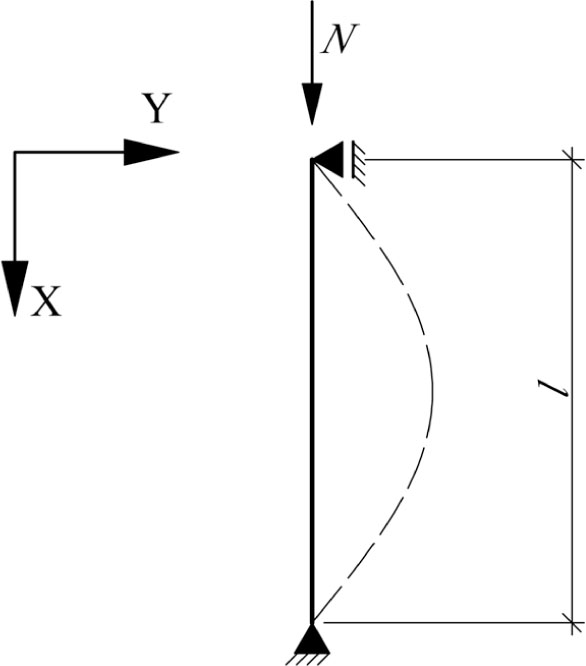
Figure 1:
Basic Euler model.
For the above system, one can write a similar relation as when determining deflections in beam under bending with moment M (1).
This is a homogenous differential equation of the second order, which can be expressed as follows: The general solution of this equation has the form: In the considered case, the boundary conditions are y(x=0) = y(x=l) = 0, resulting in an equation with unknowns A and B (note: constants A, B, C, … have the character of “local variables” and when recalled in the subsequent equations, assume other values): Equations (4) and (5) form the so-called indeterminate system. Either A = B = 0, which means that the beam will not deform, or the system's main determinant is equal to 0 and there will be an infinite number of equations. But in a nontrivial case, the following must hold true: Function sinus equals zero when α=π. Thus, one gets k•l=π. Taking into account (3), one can calculate critical force NB: The solutions of equation (2) have the form: The modified form of equation (7) constitutes a basis for the nominal stiffness method and that of equation (8) a basis for the nominal curvature method.It should be noted that in the Euler problem, there are no horizontal loads acting on the beam and affecting the displacements of its axis and, therefore, the curvature. Generalized solutions for a beam with constant stiffness were presented by Yoo and Lee (2011).
2.1. Nominal stiffness method
This method is also called a multiplicative method because the ultimate value of bending moment MEd is determined by multiplying 1st order moment M0Ed by a coefficient mainly dependent on a ratio of buckling (Euler) force NB to design column compressing force NEd according to relation (9).
The above form means that the sequence of successive moment (eccentricity) increments is geometric progression β=1 or the one very close to it: β∈ 〈0.82;1.23〉.The determination of nominal stiffness EI, constant for the whole column and independent of the stress intensity level, is key in this method (hence its name). Several applications of the method are proposed in the literature on the subject, (e.g., Tikka and Mirza, 2008; Bonet et al., 2011). They have been found useful, but only for not too slender columns loaded with a constant moment and an axial force. The current standard provides a relation expressed by equation (10).
where Kc is a coefficient dependent on the influences of cracking, creep, etc., Ecd is the design E-modulus of the concrete, Ic is the concrete's section moment of inertia, Es is the E-modulus of steel, and Is is the moment of inertia of steel.In the case of columns rectangular in cross section, with the overall reinforcement ratio ρ=ρ1+ρ2 and a symmetric reinforcement (ρ1=ρ2), equation (10) assumes the following form:
where Ecm is the concrete's mean E-modulus, b is the width of the cross section, d is the effective height of the cross section, and a is the distance between the reinforcement's center of gravity and the nearest edge (the other symbols are explained in the text).As a result, one gets:
If wind pressure is the horizontal load causing bending, one can assume that the effective creep coefficient φef≈0. Coefficient k1=√fck/20 results from the scaling of the test results of concrete with characteristic compressive strength fck relative to C20/25 concrete class and it has an empirical character. Similar is the case of parameter k2=n λ/170≤0.2, which takes into account column slenderness λ and the degree of loading with the axial force: n=NEd/(Acfcd) (where Ac is the concrete cross-sectional area and fcd is the concrete's design compressive strength).The use of this method for the analysis of horizontally loaded columns raises several questions and doubts enumerated below.
1) According to equation (9), the whole first-order moment M0Ed is subject to multiplication. Actually, its part, which stems from the action of the horizontal force, does not change as the beam's axis displaces (only the moment associated with the eccentricity of vertical force NEd changes). At significant magnitudes of the horizontal forces, this can lead to significant overdimensioning of the column.
2) The column's nominal stiffness defined by equation (11) takes into account the increase in stiffness due to the presence of a large compressive zone in the cross section, especially at high slenderness ratios, only to a small degree. This stems from parameter k2 in the equation. For example, for parameter λ=100, k2=0.2 is obtained for both n=0.35, at which the steel in the tension zone yields, and n=0.8, at which a large cross-sectional zone determines the load capacity. This leads to underestimated results for slender columns highly stressed by the vertical force.
3) Another doubt concerns the design length for corbel columns, defined as l0=2l. It was introduced solely, so that the buckling force, regardless of the column support mode, could be calculated from equation (7). But force NB itself stems from the form of equation (1). In the case when a horizontal load occurs, the form of this equation is already different.
Because of all the above reservations, the use of the nominal stiffness method becomes highly debatable in some cases.
2.2. Nominal curvature method
This method is also called additive. This is so called because of the structure of the basic equation:
Owing to the fact that (as opposed to the multiplicative method) the first-order moment is distinguished, one can isolate the moment induced by wind from the one resulting from displacement of the place of action of the vertical force. But problems arise when analyzing the relation for the second-order eccentricity. The latter mainly depends on the curvature and the buckling length. The theoretical basis is the Euler solution in form (8). It is assumed that B=e2 and this eccentricity occurs at half of the column's height. The generalization consists in replacing l by l0. In this way, the axis curvature κ=1/r is interrelated with e2. The value of the latter can be calculated from the relation: where fyd is the design yield strength of the reinforcement steel and c is a coefficient dependent on the curvature distribution (usually amounting to 10).If one disregards the influence of creep (Kφ=1), the relative force n will be weaker than nbal (Kr=1), and so, the relative curvature κd will be always the same (15), and the relative eccentricity will depend exclusively on (l0/d)2 (16).
The above fact and the strongly emphasized influence of l0/d raise doubts as they do not find confirmation in building practice. The curvature correction stemming from the influence of the axial force on curvature is assumed to have the form: This form of the formula means that the force–curvature relationship is linearized and reaches its maximum value at n=nbal and zero when n=nu. The assumption that for n<nbal, the curvature remains constant and for n>nbal, it decreases so quickly raises serious doubts.In the literature, one can find several references to this method applied in engineering design (e.g., Bond et al., 2006; Mosley et al., 2007) and to other conceptions concerning a way of determining the maximum curvature in a cross section. Connections between the maximum curvature and deformations not in the reinforcement, but in the outer fibers of concrete under compression are described by Barros et al. (2010).
3. Usage of the general method
This method has no connection whatsoever with the assumptions made in the simplified methods. Its idea was most fully described in CEB/FIP Manual (1978). In Poland, the method was presented in outline by Knauff et al. (2006) and in a much more extended form by Pędziwiatr (2019) and Pędziwiatr and Musiał (2023). It consists in solving the equation:
This entails the following:1) the determination of the relationship between bending moment and stiffness for a given value of the axial force;
2) the solution of the differential equation. In the adopted approach, it is changed into a difference equation, and solutions (beam axis displacements y(xi)) in selected column cross sections are obtained. On this basis, one can determine the current moment paths and solve the difference equation again. This procedure ends when the differences between the results (moment values) in successive steps are already infinitesimally small or if the sequence of the results becomes divergent – the column fails under the set configuration of load, geometry, and reinforcement.
For determining the moment–stiffness relationship or the moment–curvature relationship in a second-order analysis, the standard recommends the following relation for stress in concrete:
where fcm is the mean compressive strength of the concrete. The coefficients occurring in equation (19) are defined by the following relations: where Ecm is the mean E-modulus of the concrete and ɛc1 is the strain corresponding to the largest deformation. It is convenient to write equation (19) in the form with the highlighted variable ɛc representing strains in the concrete: Table 1 gives values of the parameters which make it possible to use relation (22) for a large group of concrete grades. However, the form of this equation is problematic, leading to quite complicated relations for the value of force in the concrete. It is much convenient to replace this formula with its polynomial approximation. This is illustrated in Fig. 2 for C30/37 concrete.Table 1:
Basic parameters of concrete grades.
| Grade | C30 | C35 | C40 | C45 | C50 | C55 | C60 | C70 | C80 | C90 |
|---|---|---|---|---|---|---|---|---|---|---|
| fcm [MPa] | 38 | 43 | 48 | 53 | 58 | 63 | 68 | 78 | 88 | 98 |
| ɛc1 [‰] | 2.2 | 2.25 | 2.3 | 2.4 | 2.45 | 2.5 | 2.6 | 2.7 | 2.8 | 2.8 |
| Ecm [GPa] | 32 | 34 | 35 | 36 | 37 | 38 | 39 | 41 | 42 | 44 |
| A | 0.884 | 0.830 | 0.766 | 0.713 | 0.670 | 0.633 | 0.602 | 0.552 | 0.501 | 0.471 |
| B | −0.207 | −0.198 | −0.189 | −0.174 | −0.167 | −0.160 | −0.148 | −0.137 | −0.128 | −0.128 |
| C | −0.025 | −0.059 | −0.104 | −0.120 | −0.146 | −0.167 | −0.167 | −0.189 | −0.213 | −0.243 |
| k | 1.945 | 1.868 | 1.761 | 1.712 | 1.641 | 1.583 | 1.566 | 1.490 | 1.403 | 1.320 |
| ηmax | 1.591 | 1.556 | 1.522 | 1.458 | 1.429 | 1.280 | 1.154 | 1.037 | 1.000 | 1.000 |
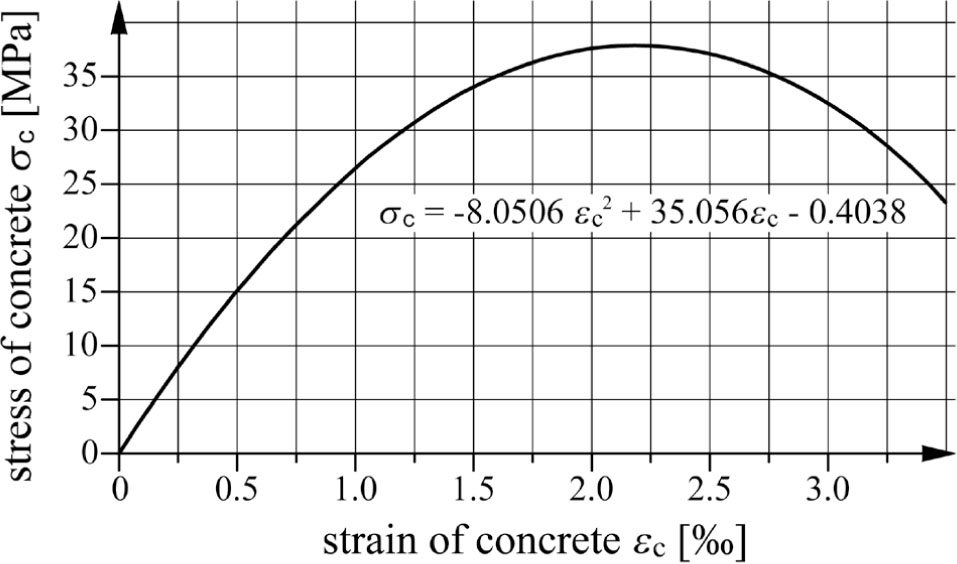
Figure 2:
σc=σc (ɛc) diagram for C30/37 concrete with equation approximating this relation.
One can use relation σc=σc(ɛc) to determine the force in the compressed concrete for all the stress intensity levels. Then the relations between the moment value and the beam axis curvature can be determined.
It is convenient to use nondimensional quantities, whereby much higher universality of the results can be achieved. The following denotations and relations were assumed for the parameters (the axial force, the bending moment, and the relative curvature, respectively):
To plot the κd=f(m) curve, one must determine this relation for a given value of n at changing values of strain ɛc in the concrete in the cross section's outer fibers. The initial value is ɛc=ɛc,min, which perfectly matches the axially compressed cross section. The subsequent values increase gradually up to ɛcu1. When calculating the successive values of κd and m, one uses the equation for the equilibrium of forces and moments and the law of flat sections. Steel yield is taken into account at appropriate stress intensity levels when strain ɛs in the steel reaches plastic strain ɛpl=fyd/Es. Exemplary results of such calculations are presented in Table 2.Table 2:
Exemplary results of κd=f(m) relation determination for n=0.8, concrete C30/37, ρ1=ρ2=1%.
| ɛc | ɛd | ɛs1 | ɛs2 | nc | ns1 | ns2 | m | m/κd | κd | Notes |
|---|---|---|---|---|---|---|---|---|---|---|
| [‰] | [‰] | [‰] | [‰] | [−] | [−] | [−] | [−] | [−] | [−] | |
| 0.456 | 0.456 | 0.456 | 0.456 | 0.715 | 0.043 | 0.043 | 0.000 | 181.5 | 0.00000 | whole cross section compressed (part 1 in figs 3 and 4) |
| 0.490 | 0.422 | 0.428 | 0.484 | 0.715 | 0.040 | 0.045 | 0.011 | 181.5 | 0.00006 | |
| 0.600 | 0.315 | 0.341 | 0.574 | 0.714 | 0.032 | 0.054 | 0.047 | 181.4 | 0.00026 | |
| 0.700 | 0.222 | 0.265 | 0.657 | 0.714 | 0.025 | 0.061 | 0.079 | 181.1 | 0.00043 | |
| 0.800 | 0.131 | 0.192 | 0.739 | 0.713 | 0.018 | 0.069 | 0.110 | 180.7 | 0.00061 | |
| 0.900 | 0.043 | 0.121 | 0.822 | 0.712 | 0.011 | 0.077 | 0.140 | 180.2 | 0.00078 |
| ɛc | ɛd | ɛs1 | ɛs2 | nc | ns1 | ns2 | m | m/κd | κd | Notes | |
|---|---|---|---|---|---|---|---|---|---|---|---|
| [‰] | [−] | [‰] | [‰] | [−] | [−] | [−] | [−] | [−] | [−] | ||
| 0.951 | 1.100 | 0.086 | 0.864 | 0.711 | 0.008 | 0.081 | 0.155 | 179.9 | 0.00086 | ɛs1<ɛpl, ɛs2<ɛpl | cross section with tension zone (part II in figs 3 and 4) |
| 0.960 | 1.091 | 0.080 | 0.872 | 0.711 | 0.007 | 0.081 | 0.158 | 179.7 | 0.00088 | ||
| 1.000 | 1.053 | 0.051 | 0.905 | 0.711 | 0.005 | 0.085 | 0.169 | 178.2 | 0.00095 | ||
| 1.100 | 0.973 | −0.031 | 0.987 | 0.711 | −0.003 | 0.092 | 0.194 | 171.7 | 0.00113 | ||
| 1.300 | 0.855 | −0.220 | 1.148 | 0.713 | −0.021 | 0.107 | 0.236 | 155.2 | 0.00152 | ||
| 1.500 | 0.775 | −0.436 | 1.306 | 0.719 | −0.041 | 0.122 | 0.271 | 139.8 | 0.00194 | ||
| 1.700 | 0.718 | −0.669 | 1.463 | 0.726 | −0.062 | 0.137 | 0.301 | 127.2 | 0.00237 | ||
| 2.000 | 0.660 | −1.030 | 1.697 | 0.738 | −0.096 | 0.159 | 0.341 | 112.6 | 0.00303 | ||
| 2.200 | 0.634 | −1.271 | 1.853 | 0.746 | −0.119 | 0.173 | 0.365 | 105.1 | 0.00347 | ||
| 2.400 | 0.615 | −1.504 | 2.010 | 0.753 | −0.141 | 0.188 | 0.386 | 98.9 | 0.00390 | ||
| 2.600 | 0.601 | −1.727 | 2.167 | 0.759 | −0.161 | 0.203 | 0.405 | 93.5 | 0.00433 | ||
| 2.605 | 0.601 | −1.733 | 2.171 | 0.759 | −0.162 | 0.203 | 0.405 | 93.4 | 0.00434 | ||
| 2.650 | 0.600 | −1.770 | 2.208 | 0.762 | −0.165 | 0.203 | 0.407 | 92.2 | 0.00442 | ɛs2≥ɛpl | |
| 2.700 | 0.599 | −1.808 | 2.249 | 0.766 | −0.169 | 0.203 | 0.410 | 90.9 | 0.00451 | ||
| 2.900 | 0.598 | −1.948 | 2.415 | 0.779 | −0.182 | 0.203 | 0.416 | 85.8 | 0.00485 | ||
| 3.100 | 0.600 | −2.063 | 2.584 | 0.790 | −0.193 | 0.203 | 0.419 | 81.2 | 0.00516 | ||
| 3.355 | 0.607 | −2.172 | 2.802 | 0.800 | −0.203 | 0.203 | 0.419 | 75.8 | 0.00553 | ||
| 3.400 | 0.608 | −2.194 | 2.841 | 0.800 | −0.203 | 0.203 | 0.417 | 74.6 | 0.00559 | R*) | |
| 3.500 | 0.610 | −2.239 | 2.926 | 0.800 | −0.203 | 0.203 | 0.414 | 72.1 | 0.00574 | ||
The independent variable in the calculations is ɛc. The strain (ɛd) of the least compressed fibers (if the cross section is compressed) or the relative height (ξ) of the compression zone is determined on the basis of the equilibrium-of-forces condition, whose particular form depends on the stage of stressing. Thanks to the law of flat sections, one can calculate the strains in the reinforcement – ɛs1, ɛs2 – and the corresponding forces – ns1, ns2. The force in the compressed concrete is calculated by integrating σc=σc(ɛc) over ζ within the limits ζ=0 to ζ=ξ, having previously written relation ɛc=ɛc(ζ) stemming from the law of flat sections. In the next step, using the equilibrium conditions, one can calculate the value of relative moment m corresponding to determined strain ɛc. Relative curvature κd is calculated from appropriate relation (26) when the whole cross section is compressed or (27) when a tension zone appears in the cross section.
On the basis of the calculation results, one can draw graphs as the ones shown in Figs 3 and 4. The relation of the type shown in Fig. 4 is used for further calculations aimed at determining the displacements of the column axis. Equation (18) can be written in the form: Function F(m) in (28) is represented by the relations shown in Fig. 4. By replacing the differential equation with a difference equation, one gets: One should follow the procedure:1) divide the column using points (the more points there are, the higher the solution precision),
2) determine the value of relative moment m in each of the points,
3) calculate the relative curvature on the basis of appropriate relations (see Fig. 4),
4) determine displacements wi – according to (29) with the boundary conditions taken into account,
5) in successive points, calculate moment increments NEdwi and the corresponding nondimensional quantities, and
6) calculate new moment values and repeat the procedure.
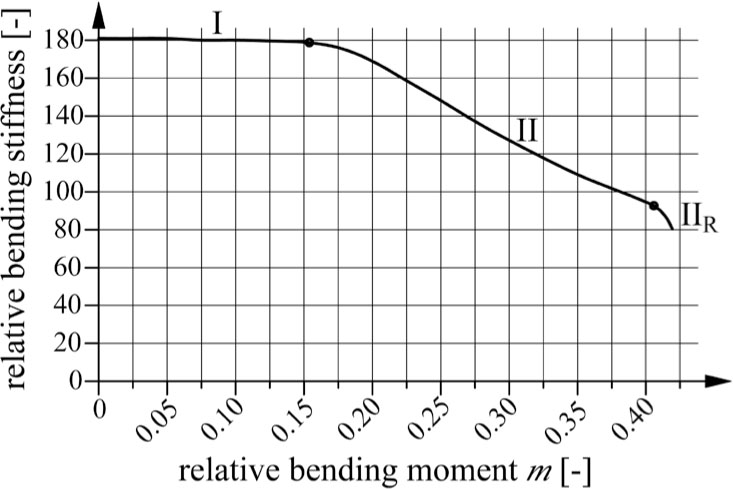
Figure 3:
Relative stiffness-relative moment diagram.
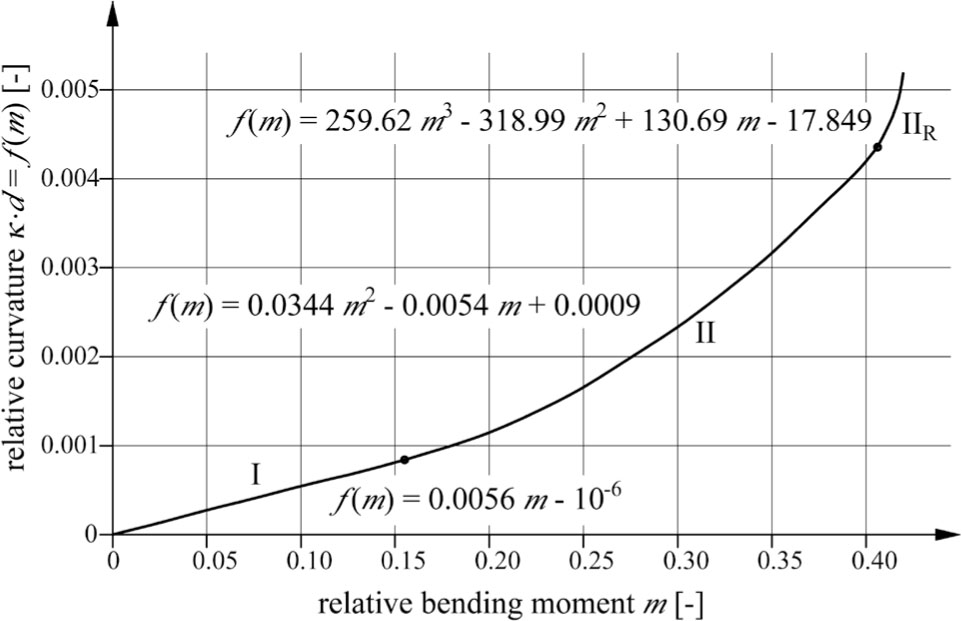
Figure 4:
Relative curvature κd=f(m) versus relative moment for n=0.8, concrete C30/37, ρ1=ρ2=1%.
Figure 5a shows a corbel beam. In point 0, the displacement and the angle of rotation are equal to zero. This leads to the following two relations: w0=0, w1=w−1. The forms of equation (29) in the particular points are as follows:
–
–
–
–
Table 3 shows an exemplary iteration sequence illustrating the presented procedure. The column is rigidly fixed in the bottom node. It is 6.0 m high and its effective cross-sectional height amounts to d=h-a=0.5 m. The relative axial force value amounts to n=0.5, and the relative value of the first-order moment varies linearly from 0.25 in the fixing to zero at the free end. Seven consecutive cross sections spaced li=1 m apart are distinguished in the column. The number of the iteration step is given in the first column of the table. For the initial state, the values of relative curvatures κd, horizontal displacements wi, and moment increments Δmi=n(w6-wi) induced by the displacements were determined one by one in all the selected cross sections. Six iterations were performed. The last column shows the relative moment increments in the successive iteration steps. In the considered case, the sequence is decreasing very quickly. Taking into account second-order effects, the relative moment is m=0.2766. The increment relative to initial value m0=0.25 amounts to about 11%.
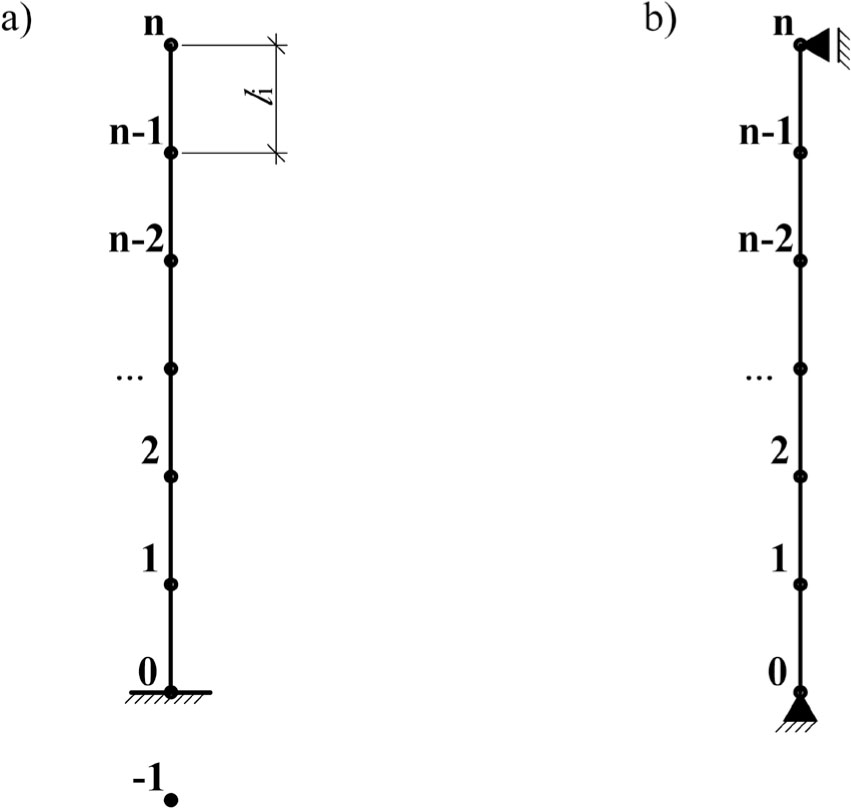
Figure 5:
Beam division taking fixing conditions into account: a) corbel column, b) pin-supported column.
Table 3:
Exemplary results of iterative determination of 2nd order moment for 6.0 m high column.
| Iteration | Quantity [−] | Cross section no. | Moment increment [%] | ||||||
|---|---|---|---|---|---|---|---|---|---|
| 0 | 1 | 2 | 3 | 4 | 5 | 6 | |||
| 0 | m0 | 0.2500 | 0.2083 | 0.1667 | 0.1250 | 0.0833 | 0.0417 | 0.0000 | |
| κd | 0.0022 | 0.0016 | 0.0011 | 0.0007 | 0.0004 | 0.0002 | 0.0000 | ||
| w | 0.0000 | 0.0022 | 0.0076 | 0.0151 | 0.0240 | 0.0337 | 0.0438 | ||
| Δm | 0.0219 | 0.0208 | 0.0181 | 0.0144 | 0.0099 | 0.0051 | 0.0000 | ||
| 1 | m | 0.2719 | 0.2291 | 0.1848 | 0.1394 | 0.0933 | 0.0467 | 0.0000 | 8.760 |
| κd | 0.0025 | 0.0019 | 0.0013 | 0.0008 | 0.0005 | 0.0002 | 0.0000 | ||
| w | 0.0000 | 0.0025 | 0.0088 | 0.0177 | 0.0282 | 0.0396 | 0.0515 | ||
| Δm | 0.0258 | 0.0245 | 0.0213 | 0.0169 | 0.0117 | 0.0060 | 0.0000 | ||
| 2 | m | 0.2758 | 0.2328 | 0.1880 | 0.1419 | 0.0950 | 0.0476 | 0.0000 | 1.417 |
| κd | 0.0026 | 0.0019 | 0.0013 | 0.0008 | 0.0005 | 0.0002 | 0.0000 | ||
| w | 0.0000 | 0.0026 | 0.0091 | 0.0182 | 0.0290 | 0.0407 | 0.0529 | ||
| Δm | 0.0265 | 0.0252 | 0.0219 | 0.0174 | 0.0120 | 0.0061 | 0.0000 | ||
| 4 | m | 0.2766 | 0.2336 | 0.1887 | 0.1425 | 0.0954 | 0.0478 | 0.0000 | 0.048 |
| κd | 0.0026 | 0.0019 | 0.0013 | 0.0008 | 0.0005 | 0.0002 | 0.0000 | ||
| w | 0.0000 | 0.0026 | 0.0091 | 0.0183 | 0.0291 | 0.0409 | 0.0532 | ||
| Δm | 0.0266 | 0.0253 | 0.0221 | 0.0175 | 0.0121 | 0.0061 | 0.0000 | ||
| 5 | m | 0.2766 | 0.2336 | 0.1887 | 0.1425 | 0.0954 | 0.0478 | 0.0000 | 0.009 |
| κd | 0.0026 | 0.0019 | 0.0013 | 0.0008 | 0.0005 | 0.0002 | 0.0000 | ||
| w | 0.0000 | 0.0026 | 0.0091 | 0.0183 | 0.0291 | 0.0409 | 0.0532 | ||
| Δm | 0.0266 | 0.0253 | 0.0221 | 0.0175 | 0.0121 | 0.0061 | 0.0000 | ||
| 6 | m | 0.2766 | 0.2336 | 0.1887 | 0.1425 | 0.0954 | 0.0478 | 0.0000 | 0.002 |
| κd | 0.0026 | 0.0019 | 0.0013 | 0.0008 | 0.0005 | 0.0002 | 0.0000 | ||
| w | 0.0000 | 0.0026 | 0.0091 | 0.0183 | 0.0291 | 0.0409 | 0.0532 | ||
| Δm | 0.0266 | 0.0253 | 0.0221 | 0.0175 | 0.0121 | 0.0061 | 0.0000 | ||
| 7 | m | 0.2766 | 0.2337 | 0.1887 | 0.1425 | 0.0954 | 0.0478 | 0.0000 | 0 |
It is important to pay careful attention during the successive iterations. Too early termination of the iteration process may turn out to be a wrong decision. Table 4 shows fragments of the iteration for a 12.0-m-high column with maximum first-order moment m0=0.18. Up to iteration 14, the moment increments slightly decreased. But after iteration 14, the tendency changed. The eccentricity increments began to gradually increase. This meant that the column failed. This was due to the fact that a load level was reached at which the increment in column curvature significantly accelerated.
Table 4:
Exemplary results of iterative determination of 2nd order moment for 12.0 m high column.
| Iteration | Quantity [−] | Cross section no. | Moment increment [%] | ||||||||
|---|---|---|---|---|---|---|---|---|---|---|---|
| 0 | 1 | 2 | 3 | . | 9 | 10 | 11 | 12 | |||
| 0 | m | 0.18 | 0.165 | 0.15 | 0.135 | . | 0.045 | 0.03 | 0.015 | 0 | |
| κd | 0.001 | 0.001 | 0.001 | 0.001 | . | 0.000 | 0.000 | 0.000 | 0.000 | ||
| w | 0.000 | 0.001 | 0.005 | 0.010 | . | 0.065 | 0.077 | 0.089 | 0.101 | ||
| Δm | 0.051 | 0.050 | 0.048 | 0.046 | . | 0.018 | 0.012 | 0.006 | 0.000 | ||
| 1 | m | 0.231 | 0.215 | 0.198 | 0.181 | . | 0.063 | 0.042 | 0.021 | 0.000 | 28.10 |
| κd | 0.002 | 0.002 | 0.001 | 0.001 | . | 0.000 | 0.000 | 0.000 | 0.000 | ||
| w | 0.000 | 0.002 | 0.007 | 0.015 | . | 0.103 | 0.122 | 0.140 | 0.159 | ||
| Δm | 0.080 | 0.079 | 0.076 | 0.072 | . | 0.028 | 0.019 | 0.009 | 0.000 | ||
| 2 | m | 0.260 | 0.244 | 0.226 | 0.207 | . | 0.073 | 0.049 | 0.024 | 0.000 | 12.59 |
| κd | 0.002 | 0.002 | 0.002 | 0.002 | . | 0.000 | 0.000 | 0.000 | 0.000 | ||
| w | 0.000 | 0.002 | 0.009 | 0.019 | . | 0.129 | 0.152 | 0.175 | 0.199 | ||
| Δm | 0.099 | 0.098 | 0.095 | 0.090 | . | 0.035 | 0.023 | 0.012 | 0.000 | ||
| 3 | m | 0.279 | 0.263 | 0.245 | 0.225 | . | 0.080 | 0.053 | 0.027 | 0.000 | 7.60 |
| κd | 0.003 | 0.002 | 0.002 | 0.002 | . | 0.000 | 0.000 | 0.000 | 0.000 | ||
| w | 0.000 | 0.003 | 0.010 | 0.022 | . | 0.148 | 0.175 | 0.201 | 0.228 | ||
| Δm | 0.114 | 0.113 | 0.109 | 0.103 | . | 0.040 | 0.027 | 0.013 | 0.000 | ||
| . | . | . | . | . | . | . | . | . | . | . | |
| 7 | m | 0.323 | 0.306 | 0.287 | 0.265 | . | 0.095 | 0.063 | 0.032 | 0.000 | 2.56 |
| κd | 0.003 | 0.003 | 0.003 | 0.002 | . | 0.000 | 0.000 | 0.000 | 0.000 | ||
| w | 0.000 | 0.003 | 0.013 | 0.028 | . | 0.196 | 0.230 | 0.265 | 0.300 | ||
| Δm | 0.150 | 0.148 | 0.144 | 0.136 | . | 0.052 | 0.035 | 0.018 | 0.000 | ||
| . | . | . | . | . | . | . | . | . | . | ||
| 11 | m | 0.347 | 0.330 | 0.310 | 0.287 | . | 0.103 | 0.069 | 0.035 | 0.000 | 1.52 |
| κd | 0.004 | 0.004 | 0.003 | 0.003 | . | 0.001 | 0.000 | 0.000 | 0.000 | ||
| w | 0.000 | 0.004 | 0.015 | 0.032 | . | 0.224 | 0.264 | 0.304 | 0.344 | ||
| Δm | 0.172 | 0.170 | 0.165 | 0.156 | . | 0.060 | 0.040 | 0.020 | 0.000 | ||
| . | . | . | . | . | . | . | . | .. | . | . | |
| 15 | m | 0.365 | 0.348 | 0.327 | 0.303 | . | 0.110 | 0.073 | 0.037 | 0.000 | 1.17 |
| κd | 0.004 | 0.004 | 0.004 | 0.003 | . | 0.001 | 0.000 | 0.000 | 0.000 | ||
| w | 0.000 | 0.004 | 0.017 | 0.036 | . | 0.248 | 0.291 | 0.336 | 0.380 | ||
| Δm | 0.190 | 0.188 | 0.182 | 0.172 | . | 0.066 | 0.044 | 0.022 | 0.000 | ||
| 16 | m | 0.370 | 0.353 | 0.332 | 0.307 | . | 0.111 | 0.074 | 0.037 | 0.000 | 1.32 |
| κd | 0.005 | 0.004 | 0.004 | 0.003 | . | 0.001 | 0.000 | 0.000 | 0.000 | ||
| w | 0.000 | 0.005 | 0.018 | 0.038 | . | 0.258 | 0.303 | 0.349 | 0.395 | ||
| Δm | 0.197 | 0.195 | 0.188 | 0.178 | . | 0.068 | 0.046 | 0.023 | 0.000 | ||
| 17 | m | 0.377 | 0.360 | 0.338 | 0.313 | . | 0.113 | 0.076 | 0.038 | 0.000 | 1.96 |
4. Examples and comparisons
To examine the differences between the results yielded by the approximate methods and the ones obtained using the general method, calculations were carried out assuming the following: concrete C30/37 (fck=30 MPa), steel with fyk=500 MPa, and reinforcement ratio ρ1=ρ2=1%. Four corbel columns with heights l=6.0,8.0,10.0,12.0 m were considered. To increase the generality of the results, the nondimensional parameters relative axial force n, relative first-order moment m0, relative curvature κd, and moment increment md induced by second-order effects were used. Results for three stress intensity levels induced by axial force n=0.1,0.5,0.8 are given in the examples. At these levels of relative force n, the maximum values of moment mRd can be determined from the equilibrium equations whose specific form depends on the assumed concrete model:
a) The nonlinear model from the general method
– For n=0.1, the steel in the compression zone is not utilized and the equilibrium-of-forces condition has the form of a quadratic equation with regard to ξ:
The solution is ξ=0.149. After determining the appropriate strains and forces, one gets the maximum moment mRd=0.233.– For n=0.5, both the steels can be utilized, but mRd=0.381 is reached just before the yielding of the steel in the compression zone at ɛc=3.10‰.
– For n=0.8, both the steels can be utilized, but mRd=0.419 is reached just before the yielding of the steel in the compression zone at ɛc=3.10‰.
b) The simplified model
– For n=0.1, the steel in the compression zone is not utilized, the equilibrium-of-forces condition has the form (31), and the relative resistance to bending is calculated from equation (32).
If the bilinear model were used, mRd =0.232 would be obtained.– For n=0.5, both the steels are utilized, the equilibrium-of-forces condition has the form (33), and the relative resistance to bending mRd calculated from (32) amounts to 0.3329.
– For n=0.8, only the steel in the compression zone is utilized, relative effective height ξeff of the compression zone amounts to 0.5967, and relative bending strength mRd=0.2637.
4.1. Nominal stiffness method
The results of the calculations based on the nominal stiffness method are presented in Tables 5 and 6. Ratio NB/NEd was calculated from equation (12) and mEd/m0Ed from relation (9).
Table 5:
Selected calculation results for different column heights l and relative forces n, obtained using nominal stiffness method.
| Quantity | n=0.1 | n=0.5 | n=0.8 | |||||||||
|---|---|---|---|---|---|---|---|---|---|---|---|---|
| l [m] | 6.0 | 8.0 | 10.0 | 12.0 | 6.0 | 8.0 | 10.0 | 12.0 | 6.0 | 8.0 | 10.0 | 12.0 |
| l0 [m] | 12 | 16 | 20 | 24 | 12 | 16 | 20 | 24 | 12 | 16 | 20 | 24 |
| λ | 75 | 100 | 125 | 150 | 75 | 100 | 125 | 150 | 75 | 100 | 125 | 150 |
| k2 | 0.044 | 0.059 | 0.073 | 0.088 | 0.2 | 0.2 | 0.2 | 0.2 | 0.2 | 0.2 | 0.2 | 0.2 |
| NB/NEd | 7.76 | 4.60 | 3.10 | 2.26 | 2.45 | 1.38 | 0.88 | 0.61 | 1.53 | 0.86 | 0.55 | 0.38 |
| mEd/m0Ed | 1.15 | 1.29 | 1.49 | 1.82 | 1.71 | 3.70 | - | - | 2.93 | - | - | - |
At light vertical loads (n=0.1), the moment increment due to second-order effects obviously depends on the column height, ranging from 1.15 to 1.82. When the load is increased to n=0.5, it becomes necessary to exclude 10- and 12-m-high columns as they would fail – NB/NEd<1.0. The maximum column height at n=0.8 is 6.0 m.
Table 6:
Results of calculations of maximum 1st order moment m0ED,max for different column heights l and relative forces n done acc. to standard stiffness method.
| Quantity | n=0.1 | n=0.5 | n=0.8 | |||||||||
|---|---|---|---|---|---|---|---|---|---|---|---|---|
| l [m] | 6.0 | 8.0 | 10.0 | 12.0 | 6.0 | 8.0 | 10.0 | 12.0 | 6.0 | 8.0 | 10.0 | 12.0 |
| mEd/m0Ed | 1.15 | 1.29 | 1.49 | 1.82 | 1.71 | 3.70 | - | - | 2.93 | - | - | - |
| m0ED,max | 0.202 | 0.180 | 0.156 | 0.127 | 0.195 | 0.09 | - | - | 0.086 | |||
Table 5 shows the values of maximum first-order moment m0ED,max which can act on the column at set l and n combinations. The moment was calculated as an appropriate mRd divided by mEd/m0Ed. If this moment is interpreted as, for example, the effect of wind action via the curtain walls on the column, it turns out that even at n=0.1, the use of columns with l=12.0 m is dubious. At n=0.5, only a less than 8.0-m-high column can carry considerable horizontal loads.
4.2. Nominal curvature method
Similar calculations as the one above were performed using the nominal curvature method. The main results of the calculations are presented in Table 7. Equations (14)–(17) were used in the calculations. Moment increments were calculated from (34) and the value of m0ED,max from (35).
Table 7:
Selected calculation results for different column heights l and relative forces n, obtained using nominal curvature method.
| Quantity | n=0.1 | n=0.5 | n=0.8 | |||||||||
|---|---|---|---|---|---|---|---|---|---|---|---|---|
| l [m] | 6.0 | 8.0 | 10.0 | 12.0 | 6.0 | 8.0 | 10.0 | 12.0 | 6.0 | 8.0 | 10.0 | 12.0 |
| l0 [m] | 12 | 16 | 20 | 24 | 12 | 16 | 20 | 24 | 12 | 16 | 20 | 24 |
| Kr | 1.0 | 1.0 | 0.669 | |||||||||
| d/r0 =κ0 d | 4.83·10−3 | |||||||||||
| d/r=κd | 4.83·10−3 | 3.23·10−3 | ||||||||||
| Δm | 0.028 | 0.049 | 0.077 | 0.111 | 0.139 | 0.247 | 0.386 | 0.556 | 0.149 | 0.265 | 0.413 | 0.595 |
| m0ED,max | 0.204 | 0.183 | 0.155 | 0.121 | 0.194 | 0.086 | - | - | 0.104 | - | - | - |
The results (Table 7) are very similar to the ones obtained using the nominal stiffness method, practically regardless of the column height l and the cross section stress intensity level n. In both methods, the deciding factor was the ratio l0/d.
4.3. General method
The results of the iterative calculations described in Section 3 are presented in Table 8. The table contains appropriate values of maximum moment m0ED,max induced by the horizontal force, assuming that the load-bearing capacity is determined using the concrete strain model in the form of equation (19). The value denoted as m*0ED,max corresponds to the typically adopted simplified dimensioning assumptions. Differences between m*0ED,max and m0ED,max are significant only at n=0.8. At this stress intensity level, the compression zone is extensive and its load-bearing capacity begins to play a decisive role. The mean concrete strength fcm used in equation (19) is much higher than the design concrete compressive strength fcd.
Table 8:
Selected calculation results for different column heights l and relative forces n, obtained using general method.
| Quantity | n=0.1 | n=0.5 | n=0.8 | |||||||||
|---|---|---|---|---|---|---|---|---|---|---|---|---|
| l [m] | 6.0 | 8.0 | 10.0 | 12.0 | 6.0 | 8.0 | 10.0 | 12.0 | 6.0 | 8.0 | 10.0 | 12.0 |
| m0ED,max | 0.22 | 0.215 | 0.205 | 0.195 | 0.32 | 0.28 | 0.23 | 0.17 | 0.33 | 0.27 | 0.19 | 0.13 |
| m*0ED,max | 0.22 | 0.21 | 0.205 | 0.195 | 0.29 | 0.26 | 0.22 | 0.17 | 0.24 | 0.18 | 0.16 | 0.12 |
Table 8. Selected calculation results for different column heights l and relative forces n, obtained using general method.
4.4. Discussion of results
Table 9 contains the calculated maximum moments induced by the horizontal load, at which, as the calculations show, the column fails. The results calculated using the nominal curvature method, the nominal stiffness method, and the general method are presented in row 1, row 2, and row 3, respectively. As regards the two simplified methods, the results are similar in all the considered cases. Also, for l≤8.0 m and n=0.1, they are not much different from the results yielded by the general method. The differences become significant at the column heights of 10.0 and 12.0 m. At the height of 10.0 m, they exceed 30% and at 12.0 m, they exceed 50%. When the column's stress intensity level increases to n=0.5, it is found that the considered columns can be designed only up to a height of 8.0 m on the basis of calculations done using the approximate methods. At this column height, the difference in favor of the general method is already very substantial, amounting to almost 190%. Moreover, calculations done using the general method yield considerable values of m*0ED,max also for 10.0- and 12.0-m-high columns. When the vertical load reaches n=0.8, the approximate methods can be used for up to 6.0-m-high columns. Whereas when the general method is used, positive values of maximum moment m*0ED,max are obtained also for columns of heights 8.0, 10.0, and 12.0 m.
5. Conclusions
For some time now, a dynamic development of the branch of construction connected with the design and building of high bay racked warehouses has been observed. The basic load-bearing member of such structures is a frame consisting of high, slender, reinforced concrete columns and a lightweight steel girder forming the girt of the frame. Because of the height of the columns and the increasing spacing of the frames, the load acting on the column as a result of wind pressure on the curtain walls of a high bay warehouse becomes a critical factor.
For the safe and at the same economical design of such columns (and their foundations), the second-order effects occurring in this case must be precisely determined. In practice, simplified methods implemented in computer programs are used for this purpose. Most often, the nominal stiffness method is employed. But as demonstrated in this paper, this is an incorrect approach when horizontal forces occur. A somewhat better solution is to use the nominal curvature method, where one can distinguish a part of the first-order moment which is not subject to unwarranted increase.
It is characteristic of the two methods that the calculation results very significantly depend on (l0/d)2. The use of a fictional value of design length l0 in a situation when horizontal loads occur is a source of a significant overestimate of the second-order effects. The error increases with column height and the stress intensity level induced by the vertical force. Calculations done in this paper show that the benefits stemming from the use of the general method amount to as much as 200%. Only for l≤8.0 m and n=0.1, the differences between the results yielded by the approximate methods and the general method, respectively, are slight.
The general method is much more labor intensive, requiring a relative moment-relative curvature relation for the given axial force value, reinforcement ratio, and concrete grade to be derived. Moreover, the iterative process, consisting in tracking the sequence of strain increments, is time-consuming. However, in the case of very slender columns, the benefits stemming from the use of general methods are very substantial. As part of further work, one can try to create detailed algorithms to be implemented in relevant computer programs.