
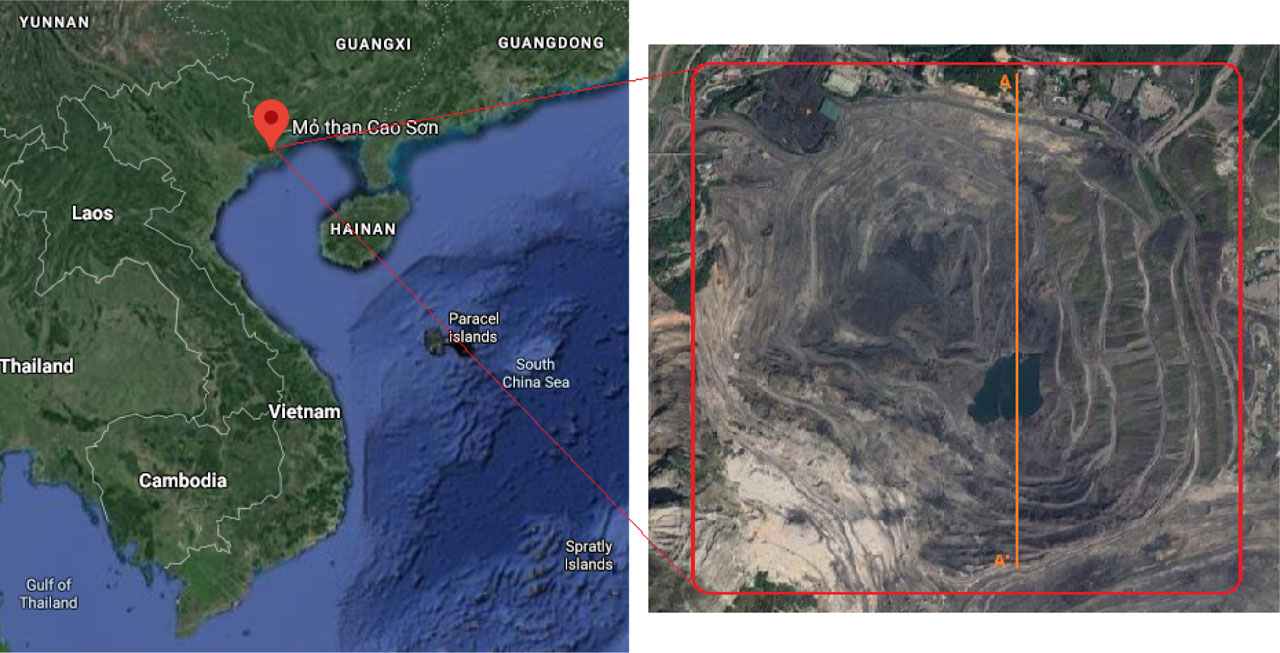
Figure 1
Location of the Cao Son open pit coal mine [37].
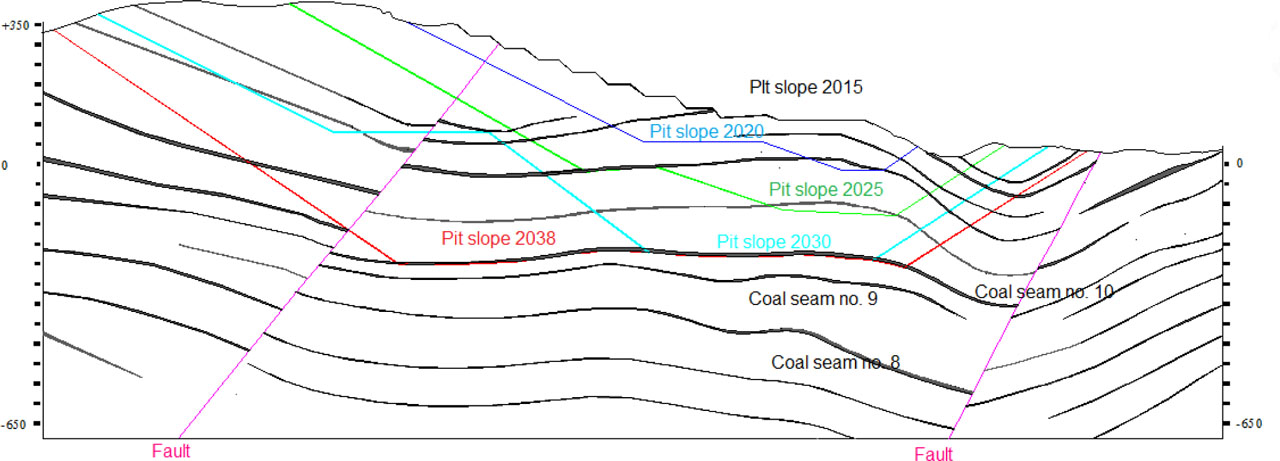
Figure 2
Exploitation plan in the region of Cao Son and Khe Cham II–IV in the North–South cross section (A–A′).
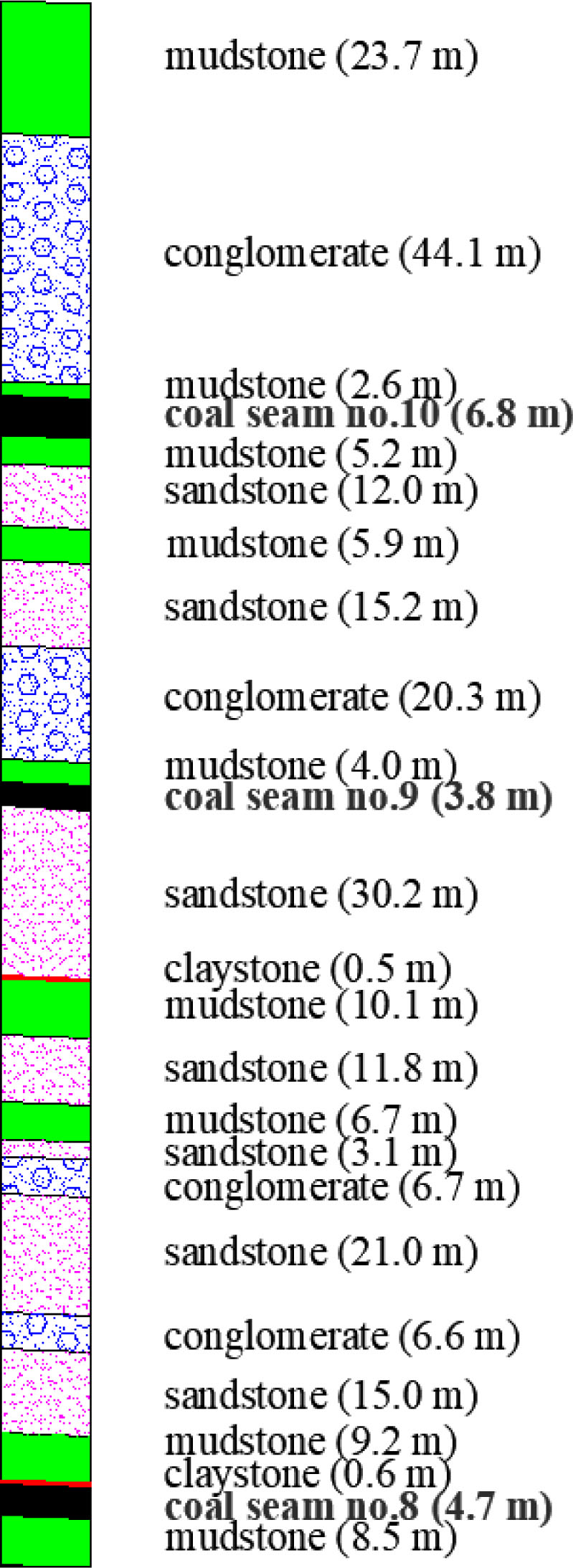
Figure 3
Fragmental lithology and distribution of rock mass at the site study.
Table 1
Mechanical properties of rock mass in the studied region [33].
| Type of rock mass | Bulk modulus K (GPa) | Shear modulus G (GPa) | Cohesion c (MPa) | Fiction angle φ (°) | Tensile strength σt (MPa) | Density ρ (kg/m3) |
|---|---|---|---|---|---|---|
| Mudstone | 2.31 | 1.54 | 1.87 | 30 | 1.34 | 2620 |
| Claystone | 2.23 | 1.34 | 2.05 | 26 | 1.14 | 2600 |
| Anthracite | 2.17 | 1.36 | 2.14 | 27 | 1.22 | 1500 |
| Conglomerate | 4.76 | 3.57 | 3.23 | 28 | 2.27 | 2510 |
| Sandstone | 3.91 | 2.46 | 3.56 | 28 | 1.96 | 2600 |
Table 2
Strength parameters of the fault in the studied region [33].
| Strength parameters | Friction angle (°) | Cohesion (kPa) | Tensile strength (kPa) |
|---|---|---|---|
| Value | 12–20 | 3.4–4.4 | 0 |
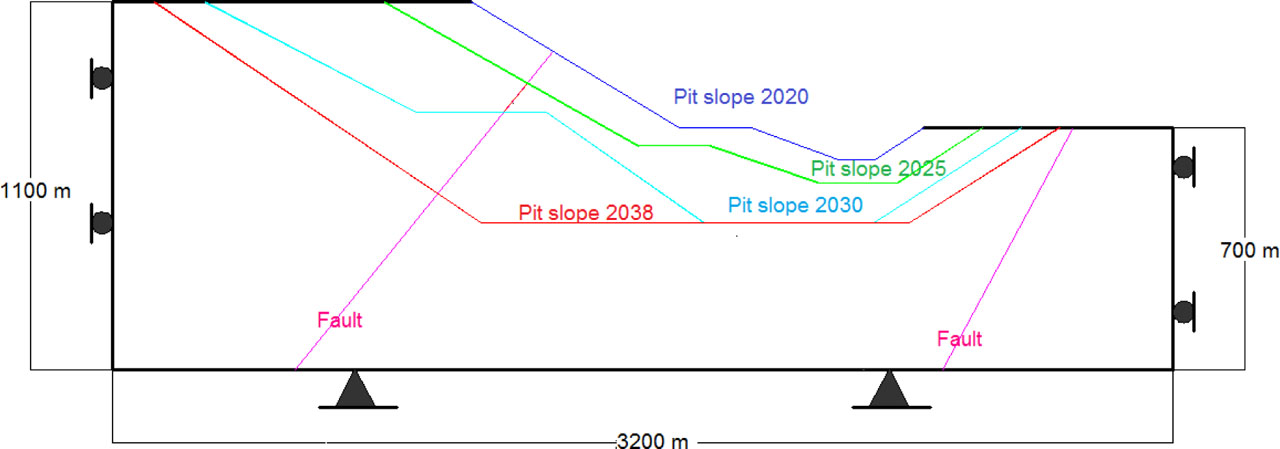
Figure 4
Simplified 2D model geometry.
Table 3
Hypotheses for calculating thickness of the caved zone.
| Author, year | Thickness of caved zone |
|---|---|
| Peng and Chiang, 1984 [38] | (2–10)t |
| Bai et al., 1995 [39] | 100t/(c1g+c2) |
| Mazurkiewicz et al., 1997 [40] | t/(kr−1) |
| Heasley, 2004 [41] | (10–18)t |
| Biliński, 2005 (simplified) [42] | (nkst)/(0.05Rc0.5+0.02) |
| Wang et al., 2017 [43] | (3–4)t |
[i] t – thickness of coal seam,
[ii] c1, c2 – constants dependent on the compressive strength of roof rocks,
[iii] kr – bulking factor for geological and mining conditions in Polish mines (1.15–1.5),
[iv] n – coefficient of intensity of movements in the area of destressed rock mass, n = 2 in the case of full caved longwall mining,
[v] ks – compressibility factor of gob, ks = 0.8 for the caved zone,
[vi] Rc – weighted average compressive strength of roof rocks
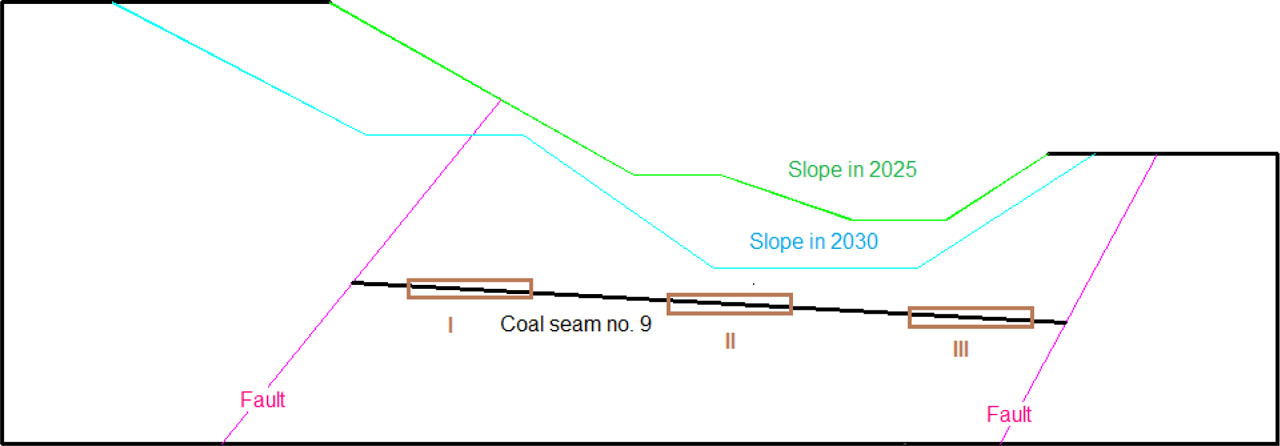
Figure 5
Calculation variants due to pit slope stages and monitoring points on the slope surface.
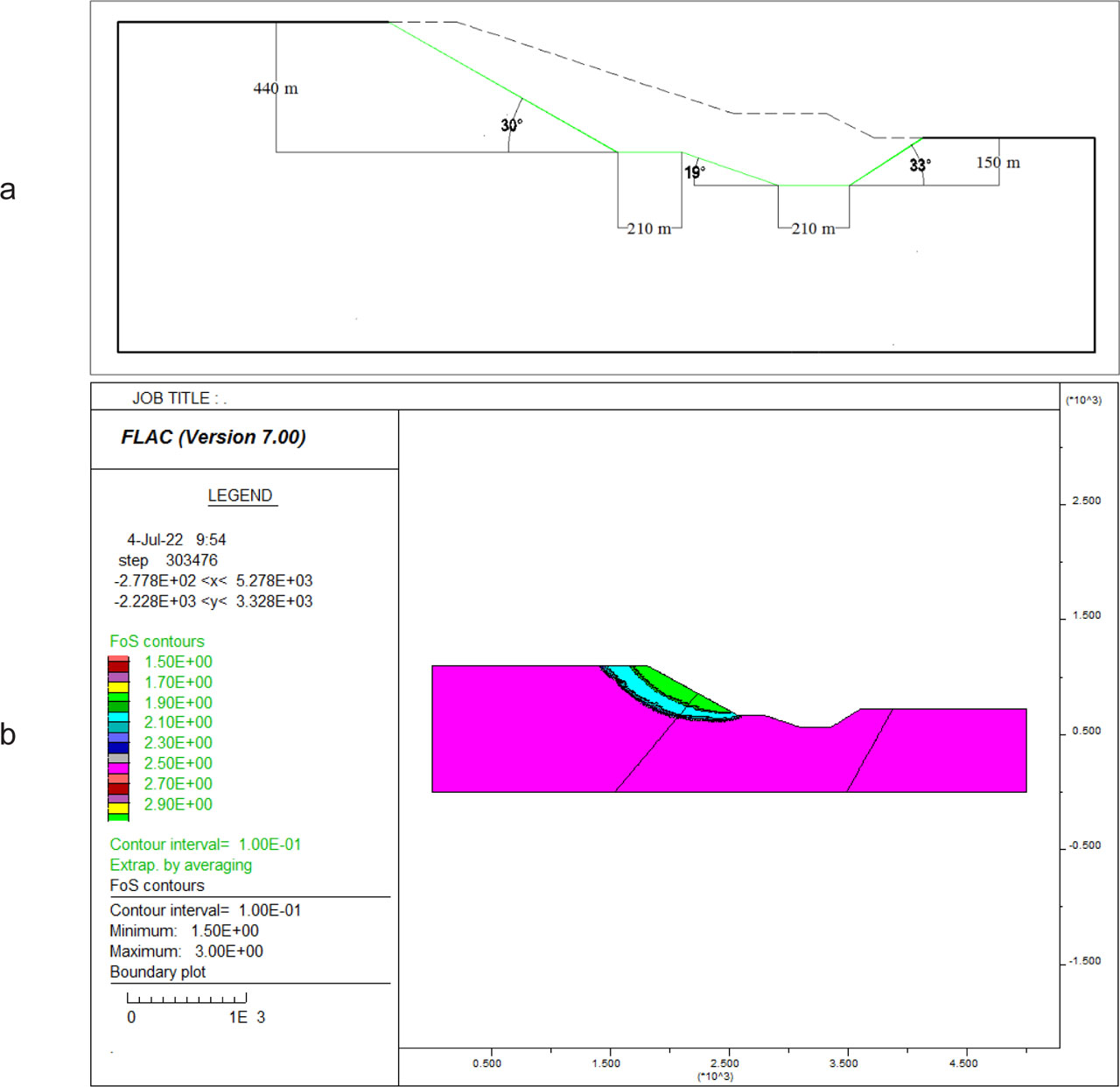
Figure 6
Pit slope in 2025: (a) scheduled geometry, (b) FoS contours and slope failure surfaces.
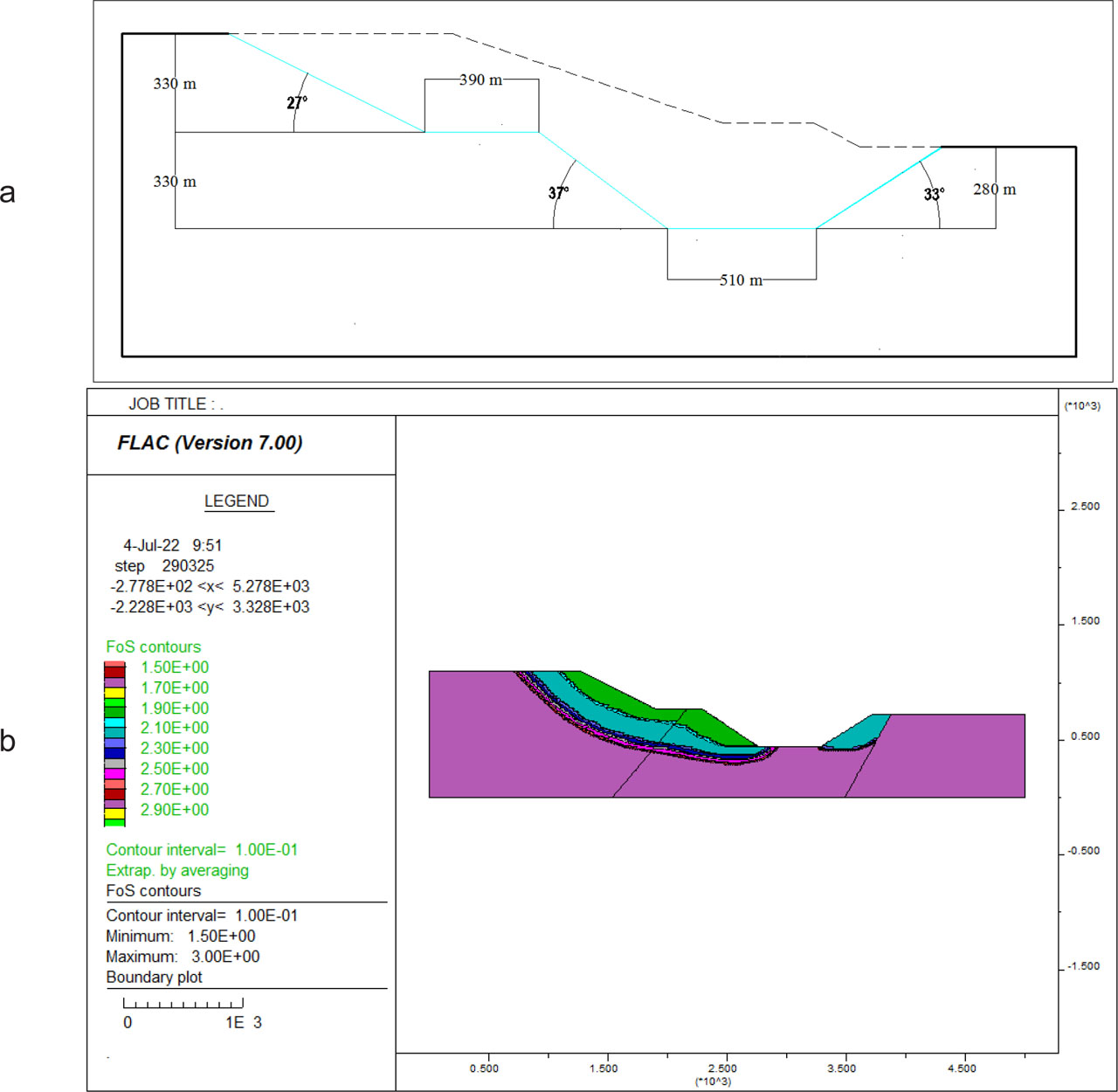
Figure 7
Pit slope in 2030: (a) scheduled geometry, (b) FoS contours and slope failure surfaces.
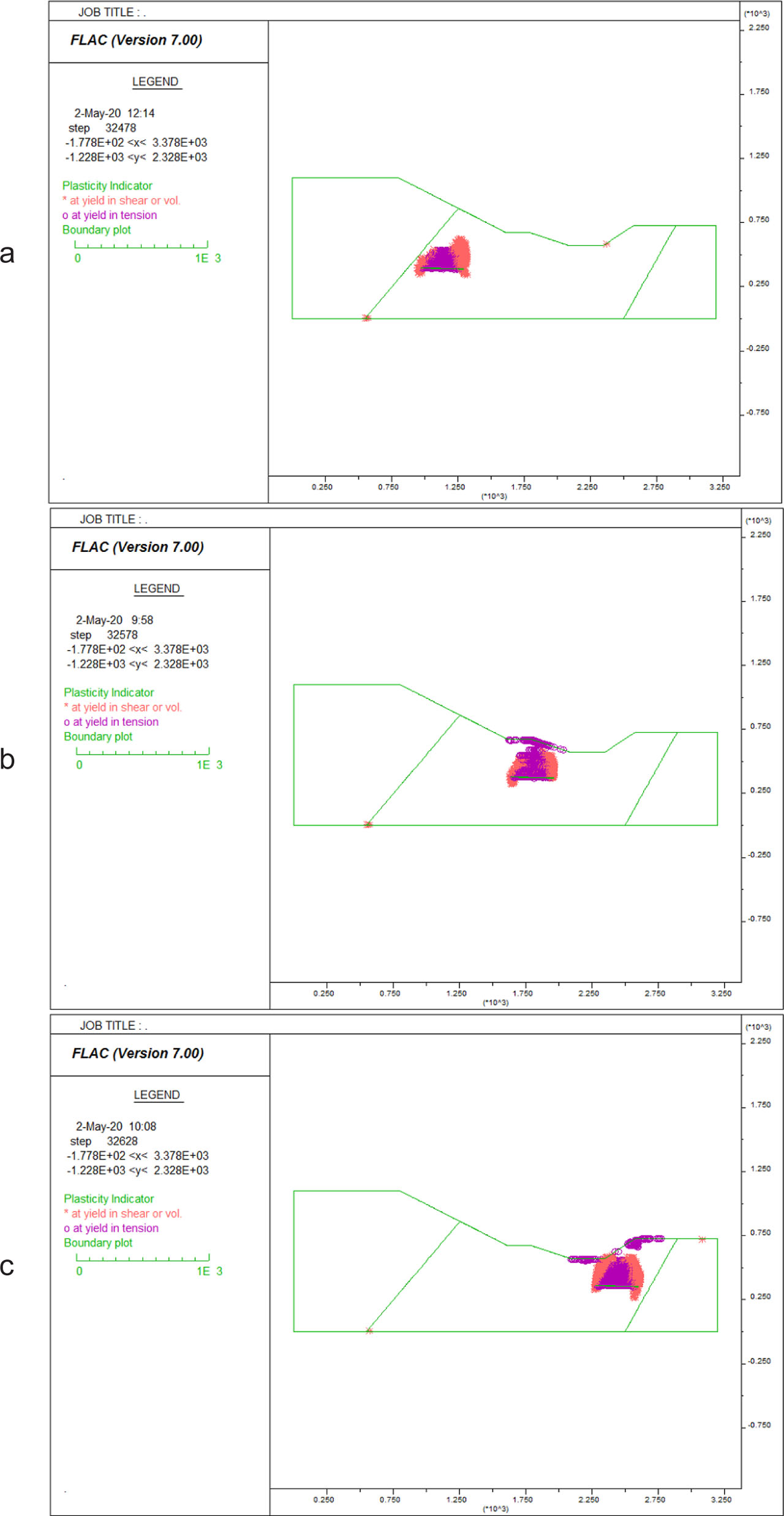
Figure 8
Failure zone induced by UG operation by 2025: (a) scenario I, (b) scenario II, (c) scenario III
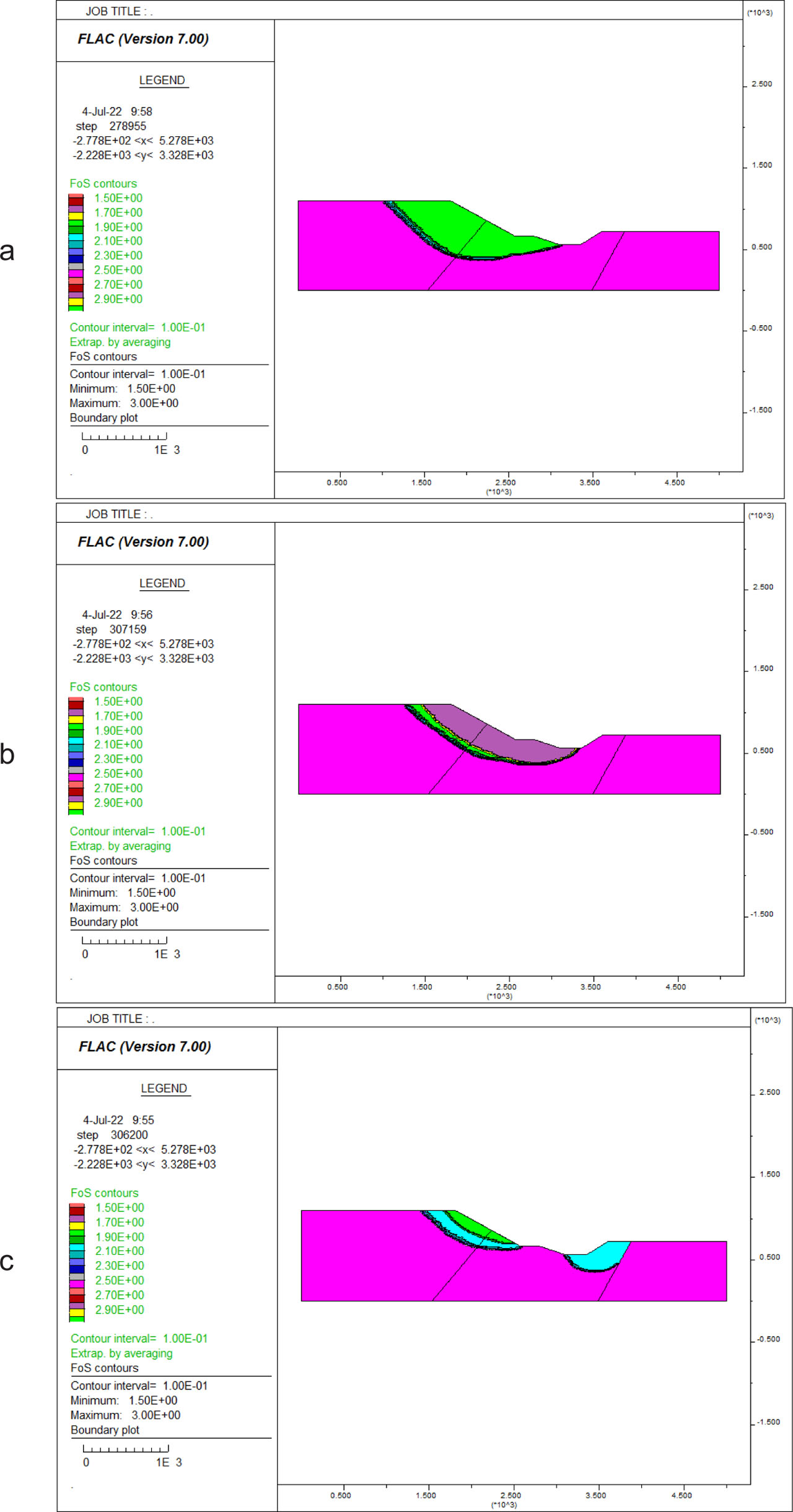
Figure 9
FoS values for defferent scenarios of UG operation by 2025: (a) scenario I, (b) scenario II, (c) scenario III.
Table 4
Change of FoS value and size of the slope failure surface with different scenarios of UG operation by 2025.
| Slope in 2025 | FoS value Size of the slope failure surface | |||
|---|---|---|---|---|
| Before UG | After UG | |||
| Scenario I | Scenario II | Scenario III | ||
| Left slope wall | 1.75–2.0 | 1.75–2.0 Increased | 1.5–1.75 Increased | 1.75–2.0 - |
| Right slope wall | >2.5 | >2.5 - | >2.5 - | 2.0–2.25 Increased |
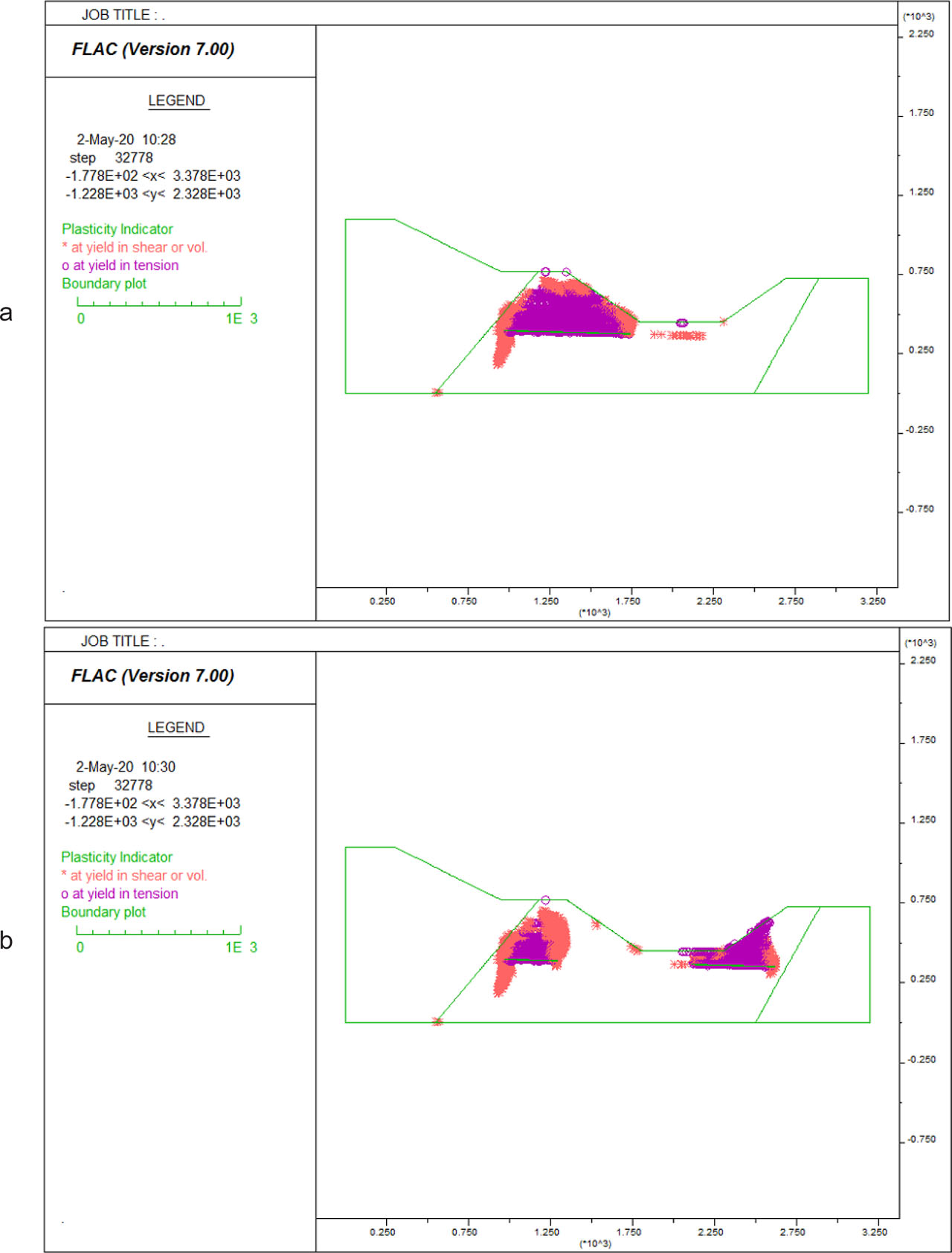
Figure 10
Failure zone induced by UG operation by 2030: (a) scenario IV, (b) scenario V.