
1. Introduction
Ferrofluids, also known as magnetic fluids, are colloidal suspensions of nano-sized ferromagnetic particles stably dispersed in a carrier liquid. For most applications, it is absolutely essential that the ferrofluids must be very stable with regard to temperature and in the presence of magnetic field. The agglomeration of particles is avoided by some surfactant coating. Ferrofluids have wide range of practical applications, which include treatment of ulcers and brain tumors, destroying cancer cells, sealing of computer hard disc drives, cooling down of loudspeakers, noiseless jet printing system, etc. (Rosensweig [18], Odenbach [7, 8]).
The study of thermal convection in ferrofluids has gained much importance in recent decades. Finlayson [2] studied the convective instability of ferromagnetic fluids and explained the concept of thermomechanical interactions in ferrofluids. Lalas and Carmi [5] investigated the thermoconvective stability of ferrofluids without considering buoyancy effects. Rosensweig et al. [17] investigated experimentally the penetration of ferrofluids in a Hele-Shaw cell. For further details on the subject of ferroconvection, one may refer to Sekar et al. [20,21], Sekar and Vaidyanathan [19], Gupta and Gupta [3], Shliomis [26], Vaidyanathan et al. [29], Rahman and Suslov [16], Nataraj and Bhavya [6], Prakash [9,10,12], and Prakash et al. [15].
These researchers have performed their analysis by considering ferroconvection as a single diffusive system with heat as an only diffusive component. Since ferrofluids are mostly suspensions of magnetic salts in an organic carrier, it is equally important to study the convective instability in double diffusive systems, which is also known as ferrothermohaline convection configurations. Several researchers have contributed to the development of this problem. Vaidyanathan et al. [30,31] analyzed the ferrothermohaline instability problem in porous and nonporous medium, respectively, for stationary as well as oscillatory modes by using linear stability theory. Sekar and Raju [24] studied the effect of sparse distribution pores in thermohaline convection in a micropolar ferromagnetic fluid. Sunil et al. [27] investigated thermosolutal convection in a ferrofluid layer heated and soluted from below in the presence of uniform vertical magnetic field and obtained exact solutions for the case of two free boundaries. Sekar et al. [22] have analyzed ferrothermohaline convection in a rotating medium heated from below and salted from above and have shown that stationary mode of convection is more favorable in comparison to oscillatory mode of convection. The effect of rotation on ferromagnetic fluid heated and soluted from below saturating a porous medium was investigated by Sunil et al. [28]. Sekar et al. [23] performed a linear analytical study of Soret-driven ferrothermohaline convection in an anisotropic porous medium. Sekar and Murugan [25] studied the stability analysis of ferrothermohaline convection in a Darcy porous medium with Soret and magnetic field–dependent viscosity effects.
Since for a double diffusive ferroconvection problem, the exact solutions in closed form are not possible for the cases where at least one of the boundaries is rigid, in order to facilitate the experimentalists and numerical analysts with better estimates of the complex growth rate of an arbitrary oscillatory motion of neutral or growing amplitude, the problem of obtaining its upper bounds has its own importance. Initially, Banerjee et al. [1] and Gupta et al. [4] had derived the bounds for the complex growth rate of arbitrary oscillatory perturbations in some thermohaline convection problems. Later, this problem was extended to triply diffusive convection by Prakash et al. [13]. Recently, Prakash [9, 10] has also derived the upper bounds for the complex growth rates in some ferromagnetic convection problems in porous/nonporous medium. Prakash and Gupta [11] have extended his work to ferromagnetic convection with rotation and magnetic field–dependent viscosity. Recently, Prakash et al. [14] also derived the upper bounds for complex growth rates in ferromagnetic convection in a rotating porous medium.
In the present communication, as a further step, we have derived the upper bounds for the complex growth rate of a disturbance in ferrothermohaline convection in a ferrofluid layer heated and soluted from below in the presence of a uniform vertical magnetic field by using linear stability theory.
2. Mathematical Formulation of the Problem
A ferromagnetic Boussinesq fluid layer of infinite horizontal extension and finite vertical depth, heated and salted from below, has been considered. The lower (z=0) and upper (z=d) boundaries are, respectively, maintained at temperatures T0 and T1 (<T0) and concentrations C0 and C1 (<C0). A uniform magnetic field H acts along the vertical direction, which is taken as the z-axis (see Figure 1).
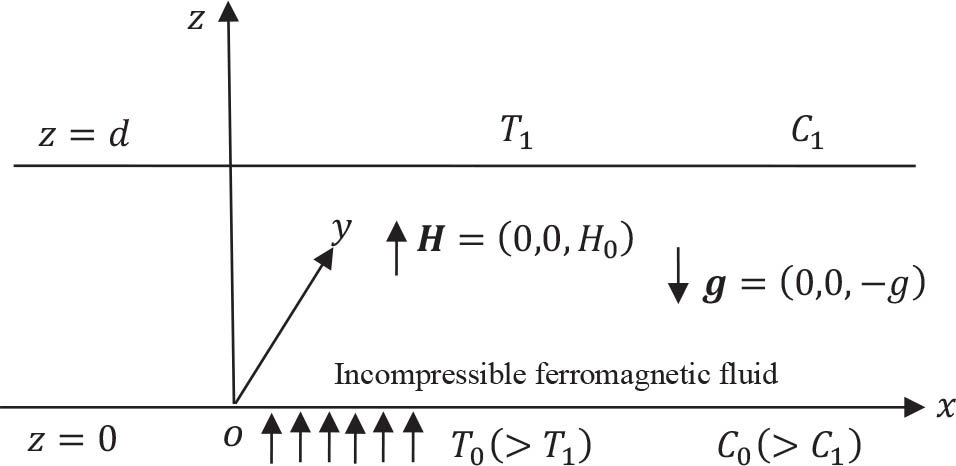
Figure 1
Geometrical configuration of the problem.
The mathematical equations governing the flow of the ferromagnetic fluid for the above model were given by Sunil et al. [27].
where q, t, p, H, B, μ, g= (0,0-g) denote the velocity, time, pressure, magnetic field, magnetic induction, coefficient of viscosity, and acceleration due to gravity, respectively. CV,H is the heat capacity at constant volume and magnetic field, μ0 is the magnetic permeability, T is the temperature, C is the solute concentration, M is magnetization, K1 is thermal conductivity, K′1 is the solute conductivity, and ΦT and ΦC are the viscous dissipation containing second-order terms in velocity. ΦT and ΦC, being small of second order, may be neglected.The equation of state is given by
where ρ is the fluid density, ρ0 is the reference density, α is the coefficient of volume expansion, and α‘ is an analogous solvent coefficient of expansion.In Eq. (2), the viscosity is assumed to be isotropic and independent of the magnetic field.
Maxwell's equations, for a nonconducting fluid, with no displacement currents, are given by
Further, the relation between B and H is expressed as
It is assumed that magnetization is aligned with the magnetic field intensity and depends on the magnitude of magnetic field, temperature, and salinity, so that
and the linearized magnetic equation of state is given byIn the above equation, M0 = M(H0, T0, C0) is magnetization when the magnetic field is H0, temperature is T0, and the concentration is C0. χ = (∂M/∂C)H0, T0 is magnetic susceptibility, K2 = (∂M/∂C) H0, T0 is the pyromagnetic coefficient, K3 = (∂M/∂C) H0, C0 is the salinity magnetic coefficient, H is the magnitude of H, and M is the magnitude of M.
The basic state is assumed to be static and is given by
where is the unit vector in the z direction.Only the spatially varying parts of H0 and M0 contribute to the analysis, so that the direction of the external magnetic field is unimportant and the convection is the same whether the external magnetic field is parallel or antiparallel to the gravitational force (Finlayson [2]).
Now, the stability of the system is analyzed by perturbing the basic state. The perturbed state is given by
where q′ = (u′, v′, w′), ρ′, p′, θ′, ϕ′, H′, and M′ are infinitesimal perturbations in velocity, density, pressure, temperature, concentration, magnetic field intensity, and magnetization. Using Eq. (11) into Eqs (1)–(9) and using the basic state solutions, we obtain the following linearized perturbation equations: where we have assumed K2β′d≪(1+χ)H0, K3β′d≪(1+χ)H0. Eq. (6b) means that we can write H′=∇ (Φ1′–Φ2′), where Φ1′ is the perturbation magnetic scalar potential and Φ2′ is the perturbation magnetic scalar potential analogous to solute.Now, following Finlayson [2] and Sunil et al. [27] and using the normal mode technique by assuming to all quantities describing the perturbation a dependence on x, y, and t of the form
where kx and ky are the wave numbers along x and y directions, respectively, and is the resultant wave number, nn is a complex constant in general, and nondimentionalizing the variables by setting we obtain the following nondimensional equations (dropping the asterisks for convenience):In the above equations, z is a real independent variable such that 0≤z≤1, D is differentiation with respect to z, a2 is square of the wave number, Pr>0 is Prandtl number, Pr′>0 is Prandtl number analogous to the solute, σ is the complex growth rate, R>0 is thermal Rayleigh number, Rs>0 is the concentration Rayleigh number, M1>0 is the ratio of magnetic force due to temperature fluctuation to the gravitational force, M2′>0 is the ratio of thermal flux due to magnetization to magnetic flux, M1′>0 is the ratio of magnetic flux due to concentration fluctuation to the gravitational force, M2′>0 is the ratio of mass flux due to magnetization to magnetic flux, M4>0 and M4′>0 are nondimensional parameters, M5>0 is the ratio of concentration effect on magnetic field to pyromagnetic coefficient, M3>0 is the measure of nonlinearity of magnetization, σ= σr+iσi is a complex constant in general, such that σr and σi are real constants, and as a consequence, the dependent variables w(z)= wr(z)+ iwi(z), θ(z)= θr(z)+ iθi(z), Φ(z)= Φr(z)+ iΦi(z), and Φ1(z)= Φ1r(z)+ i Φ1i(z) are the complex valued functions of the real variable z, such that wr(z), wi(z), θr(z), θi(z), ϕr(z), ϕi(z), Φ1r(z), Φ1i(z), Φ2r(z), and Φ2i(z) are the real valued functions of the real variable z.
Since M2 and M2′ are of very small order (Finlayson [2]), they are neglected in the subsequent analysis, and therefore, Eqs (24) and (25) takes the forms
respectively.The boundary conditions are given by
(both the boundaries are free) (both the boundaries are rigid).It may further be noted that Eqs (23) and (26)–(31) describe an eigenvalue problem for σ and govern thermosolutal ferromagnetic convection in ferrofluid layer heated and salted from below.
3. Mathematical Analysis
We now derive the upper bounds for the complex growth rate of the arbitrary oscillatory motions of neutral or growing amplitude for the cases of free and rigid boundaries separately, respectively, in the form of following theorems:
Theorem 1
If R>0, Rs>0, M1′>0,1-(1/M5) <0, Pr′>0, σr≥0, and σi≠0, then a necessary condition for the existence of a nontrivial solution (w, θ, ϕ, Φ1, Φ2, σ) of Eqs (23) and (26)–(29) together with the boundary conditions in Eq. (30) is that
Proof
Multiplying Eq. (23) by w* (the superscript * here denotes the complex conjugation) throughout and integrating the resulting equation over the vertical range of z, we get
Using Eqs (26)–(29) and the boundary conditions in Eq. (30), we can write
Combining Eqs (32)–(36), we get
Integrating the various terms of Eq. (37) by parts, for a suitable number of times and making use of the boundary conditions in Eq. (30) and the equality
where =w (n=1,2) or ψ=θ,ϕ,Φ1,Φ2 (n=1), we obtainEquating the imaginary parts of both sides of Eq. (39) and cancelling σi (≠0) throughout from the resulting equation, we get
Now, multiplying Eq. (26) by Φ1* and integrating over the vertical range of z, we get
which implies that and thus,Upon using a similar procedure, Eq. (27) yields
Combining the inequalities in Eqs (41) and (42), we get
Now, multiplying Eq. (29) by its complex conjugate and integrating over the vertical range of z for an appropriate number of times and using the boundary conditions in Eq. (30), we obtain
Since σr≥0 , it follows from Eq. (45) that
Using the inequalities in Eqs (44) and (46) in Eq. (40), we get
which clearly implies thatThis completes the proof of the result.
The above theorem, from the physical point of view, states that the complex growth rate of an arbitrary oscillatory motion of neutral or growing amplitude in ferrothermohaline convection, for the case of free boundaries, must lie inside a semicircle in the right half of the σrσi-plane, whose center is at the origin and
Theorem 2
If R>0, Rs>0, M1>0, M1′>0, 1-M5>0, Pr>0, Pr′>0,. σr≥0, and σi≠0, then a necessary condition for the existence of a nontrivial solution (w, θ, ϕ, Φ1, Φ2, σ) of Eqs (23) and (26)–(29) together with the boundary conditions in Eq. (31) is that
Proof
Multiplying Eq. (23) by w* throughout and integrating the resulting equation over the vertical range of z, we get
Using Eqs (28) and (29), we can write
andCombining Eqs (48)–(50), we obtain
Integrating the various terms of Eq. (51) by parts, for an appropriate number of times and making use of the boundary conditions in Eq. (31) and equality in Eq. (38), we obtain
Equating the imaginary parts on both sides of Eq. (52) and dividing the resulting equation by σi (≠0), we get
Now multiplying Eq. (28) by its complex conjugate and integrating over the vertical range of z by parts, for a suitable number of times, by making use of the boundary conditions in Eq. (31) and then by equating the real parts on both sides, we obtain
Since σr≥0, it follows from Eq. (54) that
Combining the inequalities in Eqs (42) and (55), we obtain
On similar lines, from the inequalities in Eqs (43) and (46), we obtain
Now imaginary part of
Further, imaginary part of
Multiplying Eq. (29) by ϕ* and integrating the resulting equation by parts, for an appropriate number of times over the vertical range of z, and then from the imaginary part of the final equation, we obtain
Thus, utilizing the inequalities in Eqs (58)–(60) in Eq. (53), we finally obtain
which clearly implies thatThe above theorem may be stated, from a physical point of view, as: the complex growth rate of an arbitrary oscillatory perturbation of growing amplitude in ferrothermohaline convection, for the case of rigid boundaries, must lie inside the region represented by the inequality in Eq. (61).
Note: It may be noted that the parametric value M5, which represents the ratio of salinity effect on magnetic field to pyromagnetic coefficient, varies between 0.1 and 0.5 for most of the ferrofluids which are formed by changing ferric oxides and carrier organic fluids like kerosene, alcohol, hydrocarbon, etc. (Finlayson [2] and Gupta and Gupta [3]), so that the condition 1-M5>0, and hence, 1-(1/M5) <0 remain valid.
4. Conclusion
The linear stability theory has been used to derive the bounds for the complex growth rates in ferrothermohaline convection heated and salted from below in the presence of a uniform vertical magnetic field. Further, the results derived herein involve only dimensionless quantities and are wave number independent; thus, the present results are of uniform validity and applicability.
Acknowledgment
We extend our sincere thanks to the reviewers for their useful comments and suggestions, which helped us to bring the paper in the present form.