
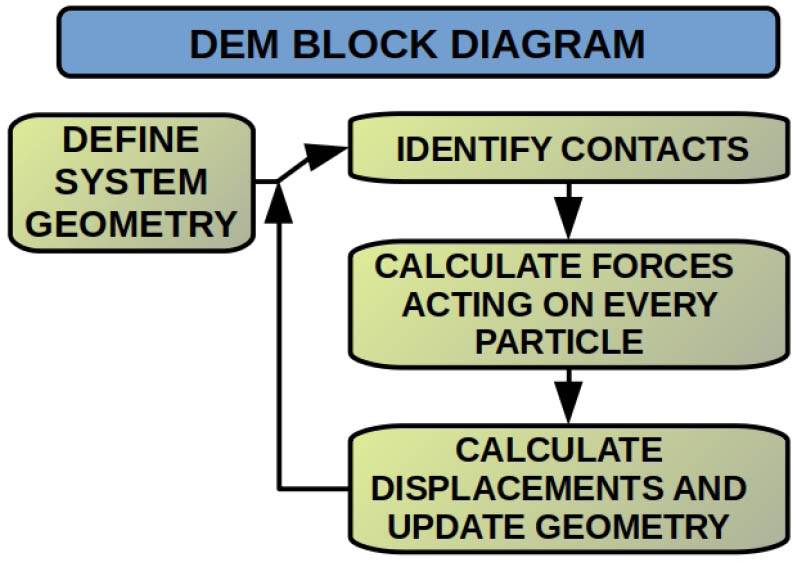
Figure 1
The scheme of DEM simulation (after O’Sullivan 2011).
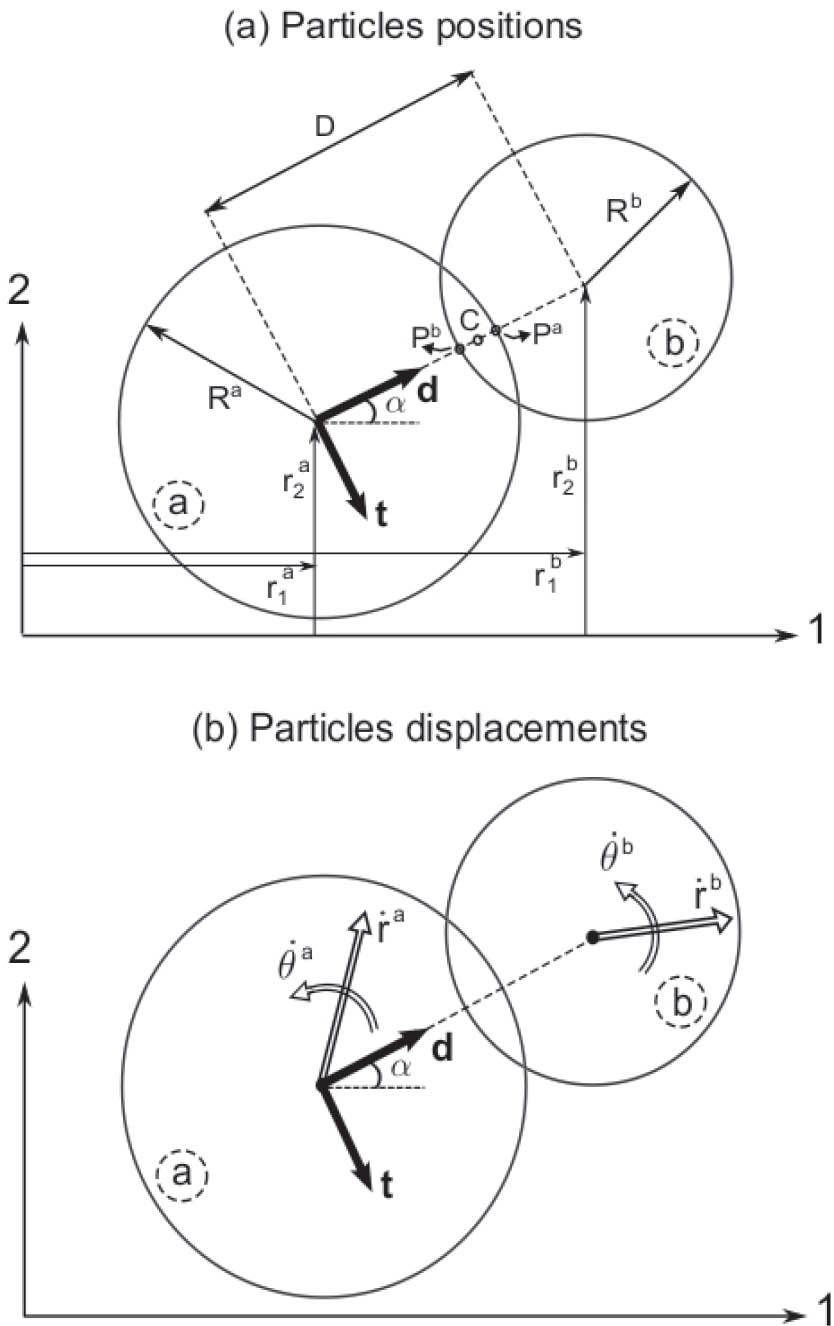
Figure 2
The interaction of the two particles by the force–displacement law. The figure is redrawn from Ferdowsi (2014). Particles a and b of radii Ra and Rb are at a distance D with overlap C. Pa and Pb are the points of intersection of the line connecting the disc centres with the boundaries of the discs; d and t are unit vectors. Derivatives of r and θ stand linear damping and rotational damping, respectively.
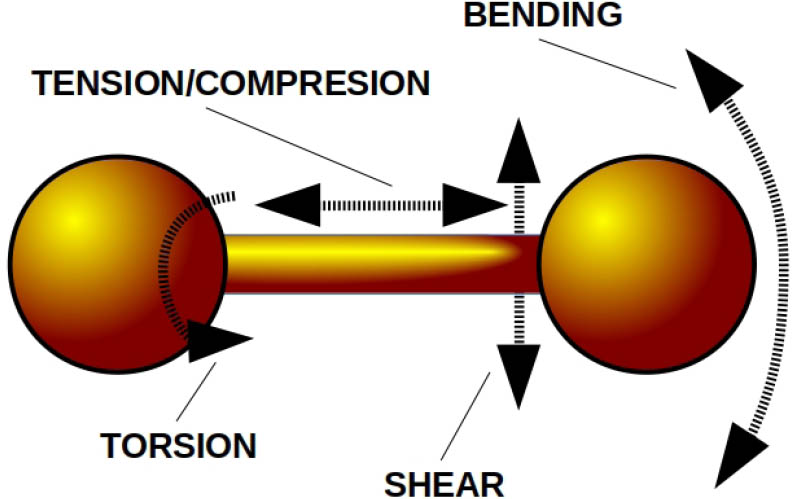
Figure 3
Forces and moments between the particles bonded through rotational elastic-brittle bonds (Abe et al. 2014).
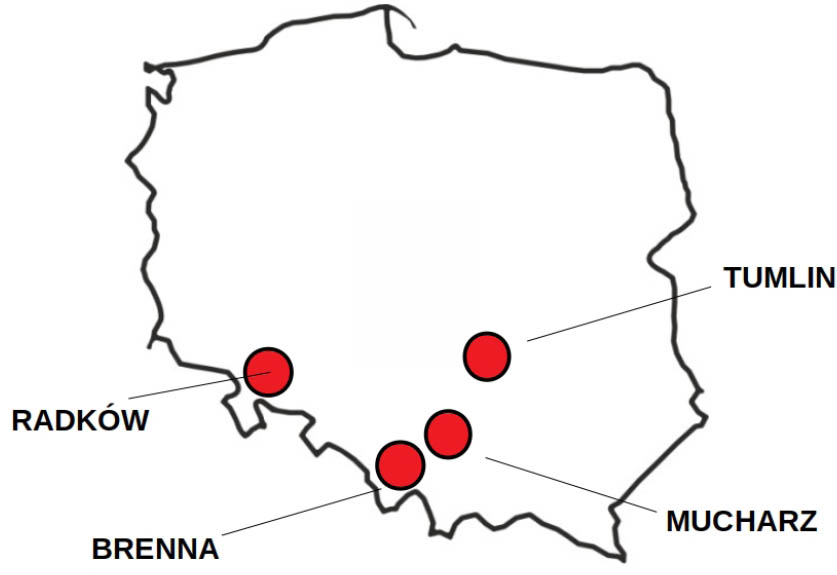
Figure 4
Location of the active quarries on the map of Poland from which the tested sandstones originated.
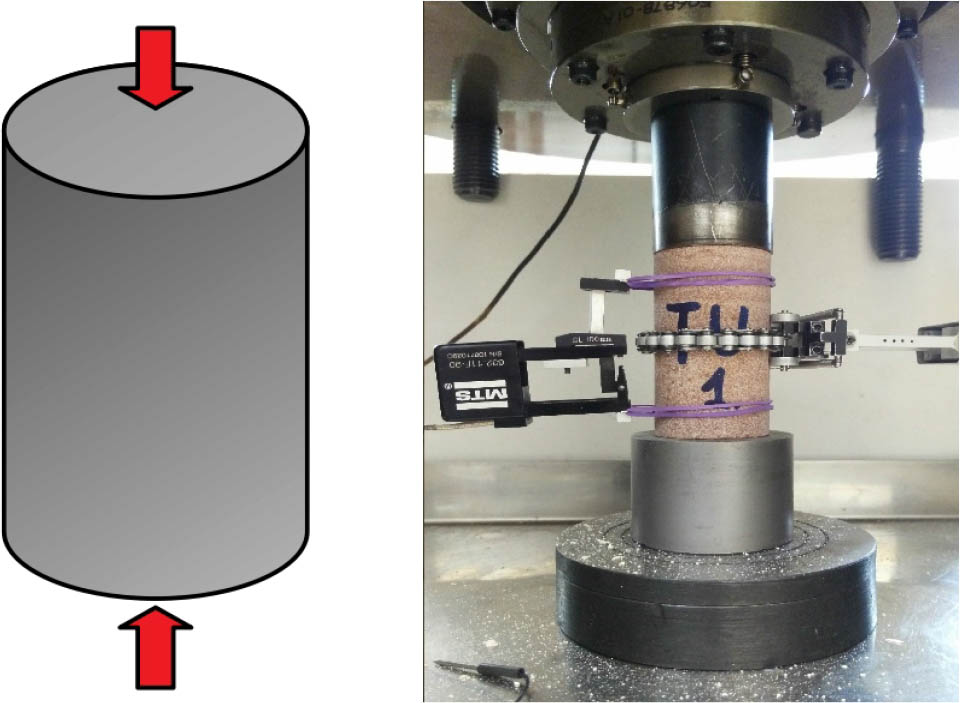
Figure 5
Schematic representation of the uniaxial compression test. Sample is compressed from the top and bottom until failure. On the left – simplified scheme of the test, on the right – laboratory experiment.
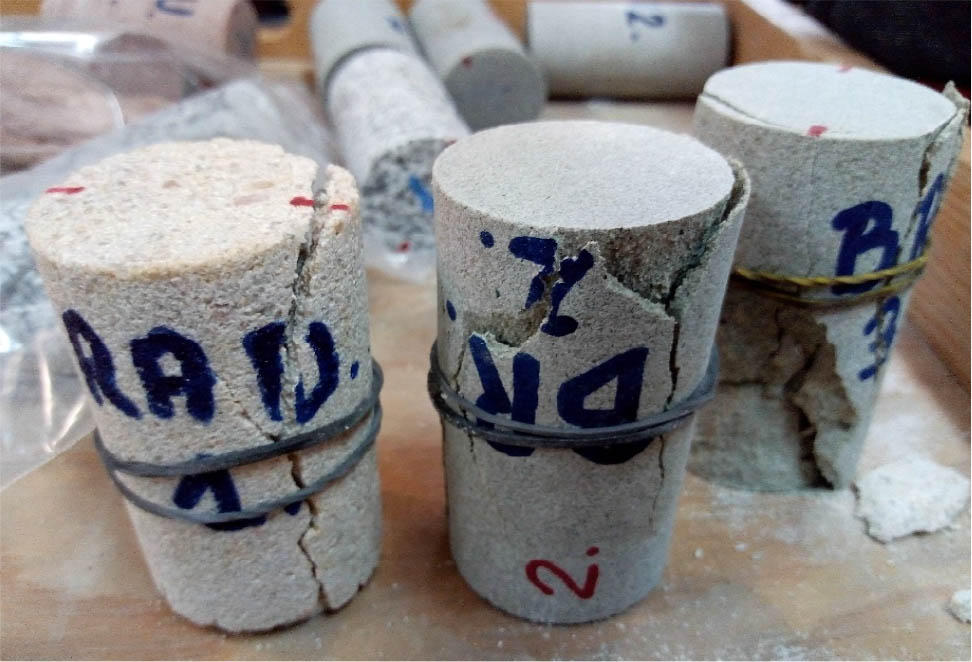
Figure 6
Cracked samples after uniaxial compression test.
Table 1
Range of results of geomechanical laboratory tests (mean values in brackets).
| Lithological type | ρ (kg/m3) | UCS (MPa) | E (GPa) | ν (−) |
|---|---|---|---|---|
| Gogula sandstones from Brenna | 2391 – 2444 (2429) | 99 – 107 (102) | 20.2 – 21.8 (20.8) | 0.21 – 0.25 (0.22) |
| Krosno sandstones from Mucharz | 2627 – 2668 (2655) | 138 – 153 (143) | 26.6 – 31.8 (29.2) | 0.18 – 0.23 (0.19) |
| Joint sandstones from Radków | 2119 – 2172 (2142) | 55 – 60 (58) | 22.5 – 24.9 (23.4) | 0.20 – 0.29 (0.24) |
| Sandstones from Tumlin | 2355 – 2480 (2448) | 115 – 128 (123) | 26.2 – 29.4 (27.4) | 0.22 – 0.28 (0.25) |
Table 2
Detailed parameters of numerical models of sandstones.
| Sandstone 1 Brenna | Sandstone 2 Mucharz | Sandstone 3 Radków | Sandstone 4 Tumlin | |
| Sample geometry | Cylinder: height – 75 mm; radius – 18.75 mm | Cylinder: height – 75 mm; radius – 18.75 mm | Cylinder: height – 75 mm; radius – 18.75 mm | Cylinder: height – 75 mm; radius – 18.75 mm |
| Particles radii | 0.25 – 2.0 mm | 0.25 – 0.5 mm | 0.25 – 1.0 mm | 0.125 – 0.5 mm |
| Particles density | 2429 kg/m3 | 2655 kg/m3 | 2142 kg/m3 | 2448 kg/m3 |
| Initial number of particles | 82,266 | 339,324 | 150,653 | 1,155,851 |
| Initial number of bonds | 297,847 | 821,488 | 500,024 | 3,831,657 |
| Time step | 1.23×10⁻⁵s | 8.32×10⁻⁶s | 1.06×10⁻⁵s | 5.14×10⁻⁶s |
| Parameters of bonds : - Young's modulus Eb (MPa) - Poisson's ratio vb (dimensionless) - cohesion cb (MPa) - tangent of internal friction angle φb (dimensionless) | Eb = 5 284 MPa vb = 0.25 cb = 13.59 MPa tan φb = 1.0 | Eb= 50 258 MPa vb= 0.25 cb = 205.33 MPa tan φb = 1.0 | Eb = 12 492 MPa vb = 0.25 cb = 21.19 MPa tan φb = 1.0 | Eb = 15 144 MPa vb = 0.25 cb = 44.7 MPa tan φb = 1.0 |
| Stroke rate | 0.2 mm/s | 0.2 mm/s | 0.2 mm/s | 0.2 mm/s |
| Computational time | 287 min | 667 min | 335 min | 1440 min |
| Number of processors | 92 | 228 | 93 | 320 |
Table 3
Comparison of failure patterns in DEM modeling (initial model, and model just after the failure - view of bonds between particles) and in laboratory (laboratory failure).
| Type | Initial numerical model | Numerical failure | Laboratory failure |
|---|---|---|---|
| Brenna sample BR2 | 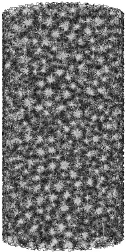 | 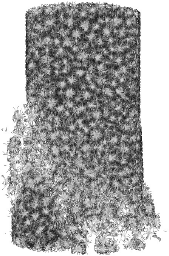 | 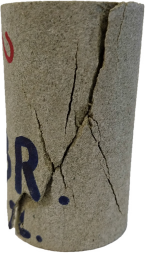 |
| Mucharz sample MU1 | 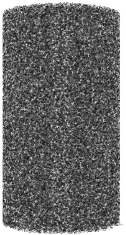 | 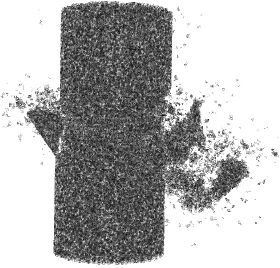 | 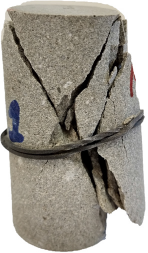 |
| Radków sample RAD1 | 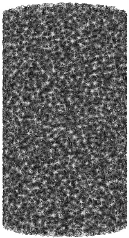 | 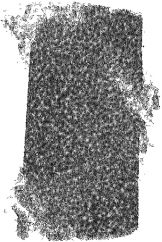 | 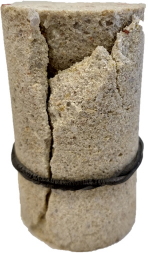 |
| Tumlin sample TU2 | 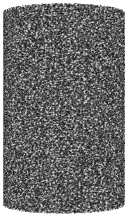 | 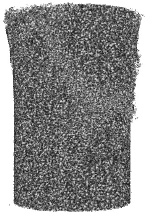 | 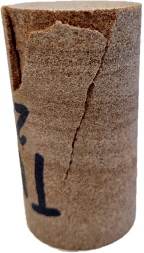 |
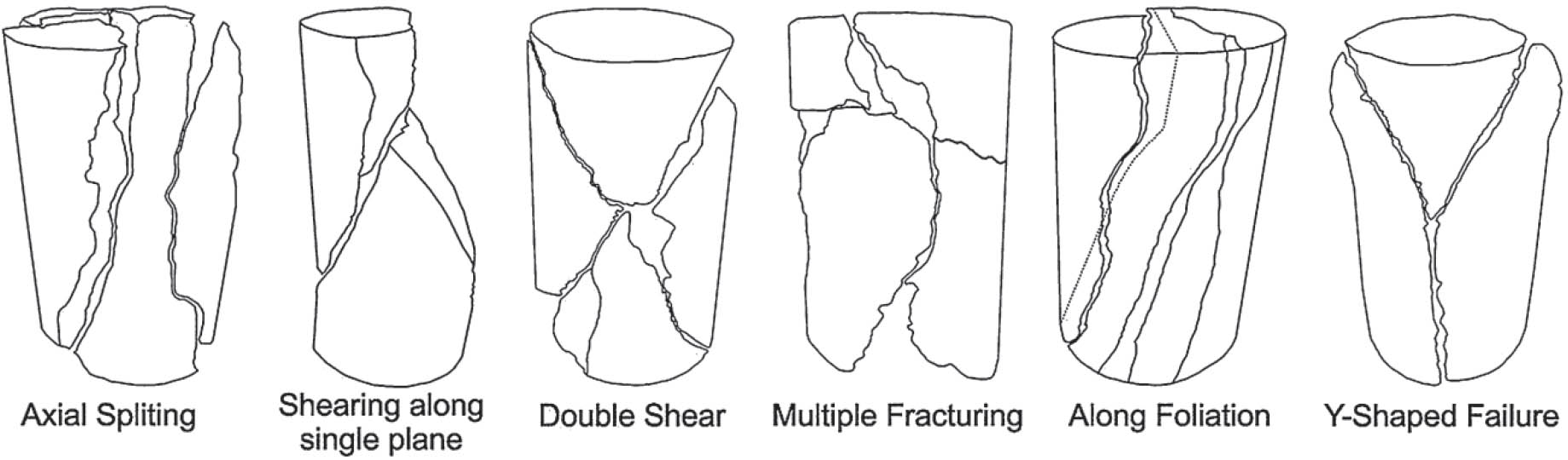
Figure 7
Schematic representation of different possible failure patterns of the sample under uniaxial compression extracted and proposed by Basu et al. (2013).
Table 4
Comparison between crucial macroscopic parameters used for model calibration. ‘Sim’ stands for simulation result and ‘lab’ stands for result from the laboratory experiment.
| Selected test | E (GPa) | UCS (MPa) | ez cr (%) | ν (−) |
|---|---|---|---|---|
| Brenna sample BR2 | Sim: 20.8 Lab: 20.5 | Sim: 98 Lab: 99 | Sim: 0.51 Lab: 0.52 | Sim: 0.21 Lab: 0.25 |
| Mucharz sample MU1 | Sim: 29.2 Lab: 31.8 | Sim: 136 Lab: 138 | Sim: 0.47 Lab: 0.49 | Sim: 0.19 Lab: 0.23 |
| Radków sample RAD1 | Sim: 23.4 Lab: 22.8 | Sim: 61 Lab: 60 | Sim: 0.28 Lab: 0.29 | Sim: 0.21 Lab: 0.20 |
| Tumlin sample TU2 | Sim: 27.4 Lab: 26.2 | Sim: 118 Lab: 115 | Sim: 0.46 Lab: 0.51 | Sim: 0.26 Lab: 0.22 |
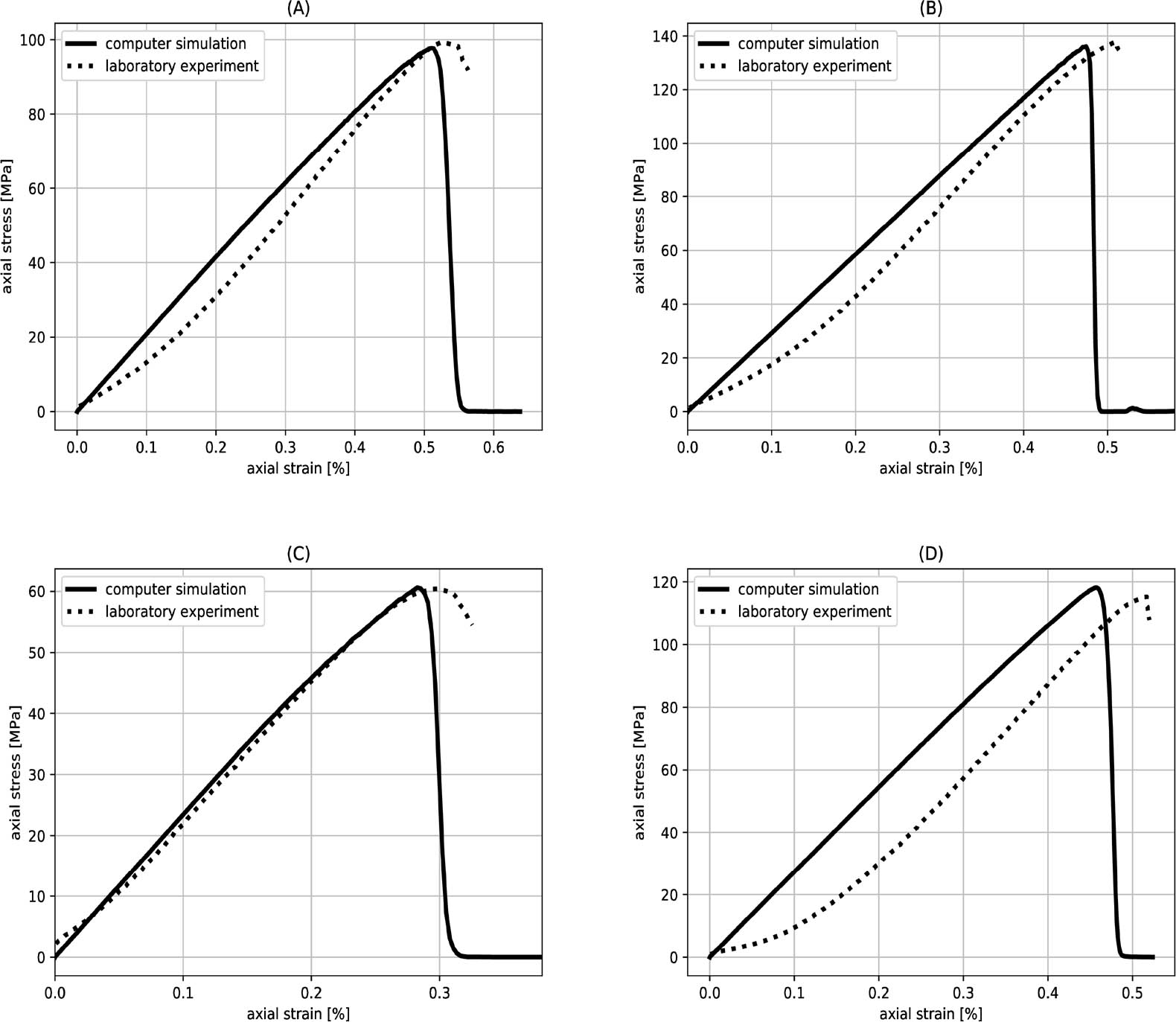
Figure 8
Comparison between numerical and laboratory stress-strain curves for selected samples: (A) Brenna BR2, (B) Mucharz MU1, (C) Radków RAD1 and (D) Tumlin TU2.
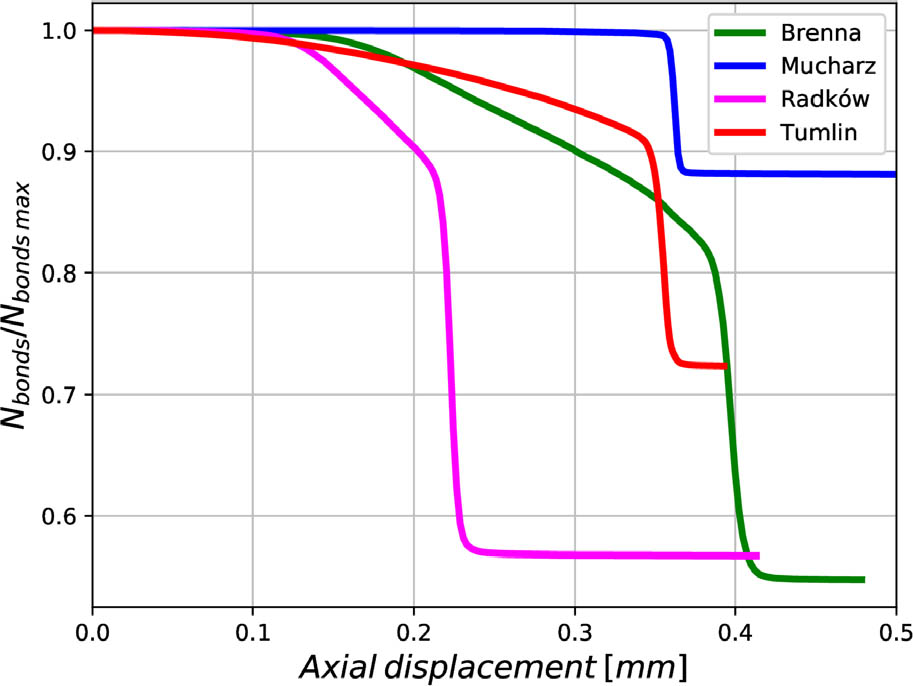
Figure 9
Scaled number of bonds Nbonds/Nbonds max (number of bonds divided by maximum number of bonds) inside the sample as a function of axial displacement for all four types of sandstones.
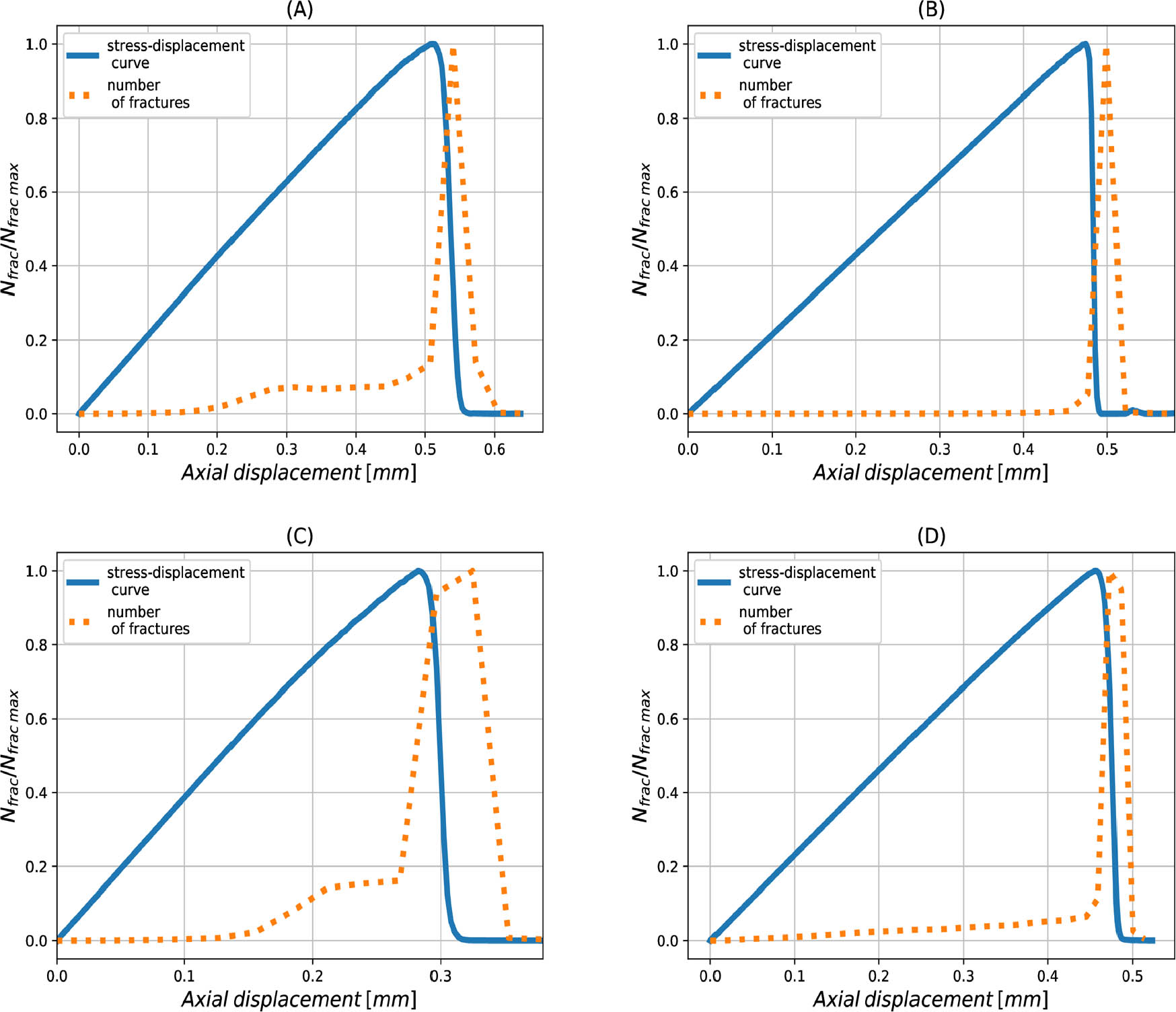
Figure 10
Scaled number of fractures (Nfrac/Nfrac max-number of fractures divided by maximum number of fractures) as a function of axial strain with the stress–strain curve in the background: (A) Brenna, (B) Mucharz, (C) Radków, (D) Tumlin.
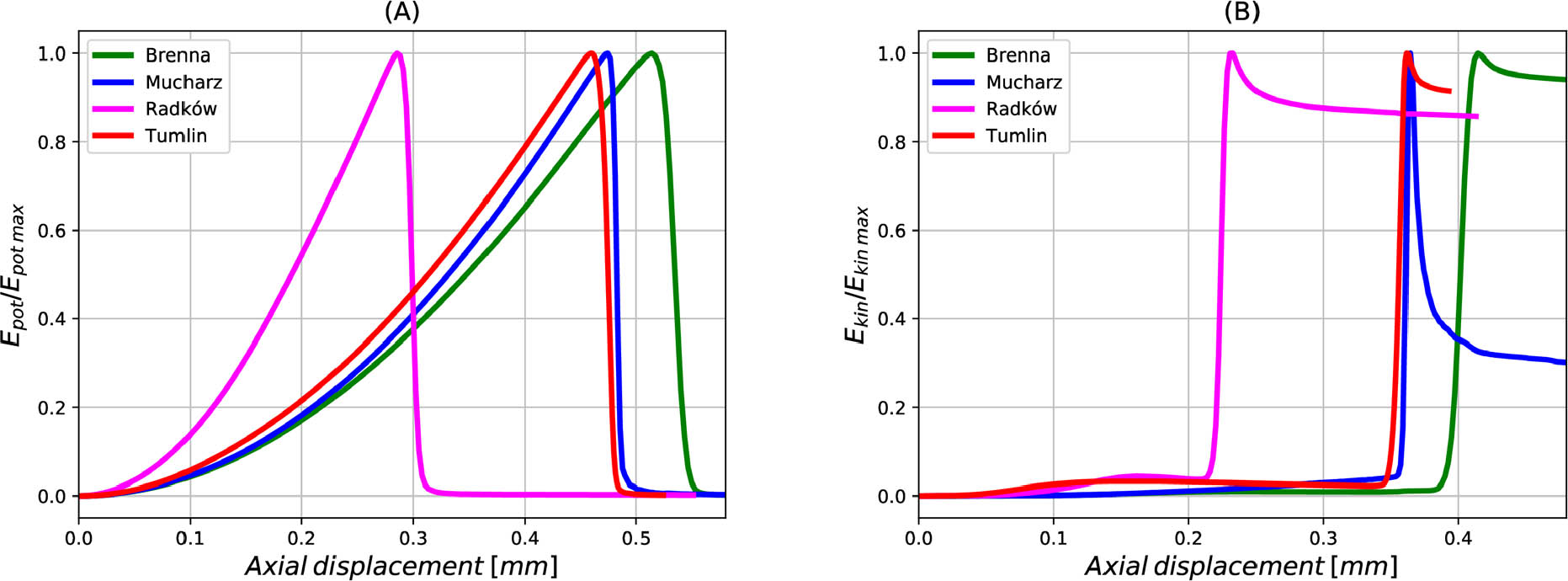
Figure 11
(A) Scaled potential energy of bonds Epot/Epot max and (B) scaled kinetic energy Ekin/Ekin max for all four types of sandstones.
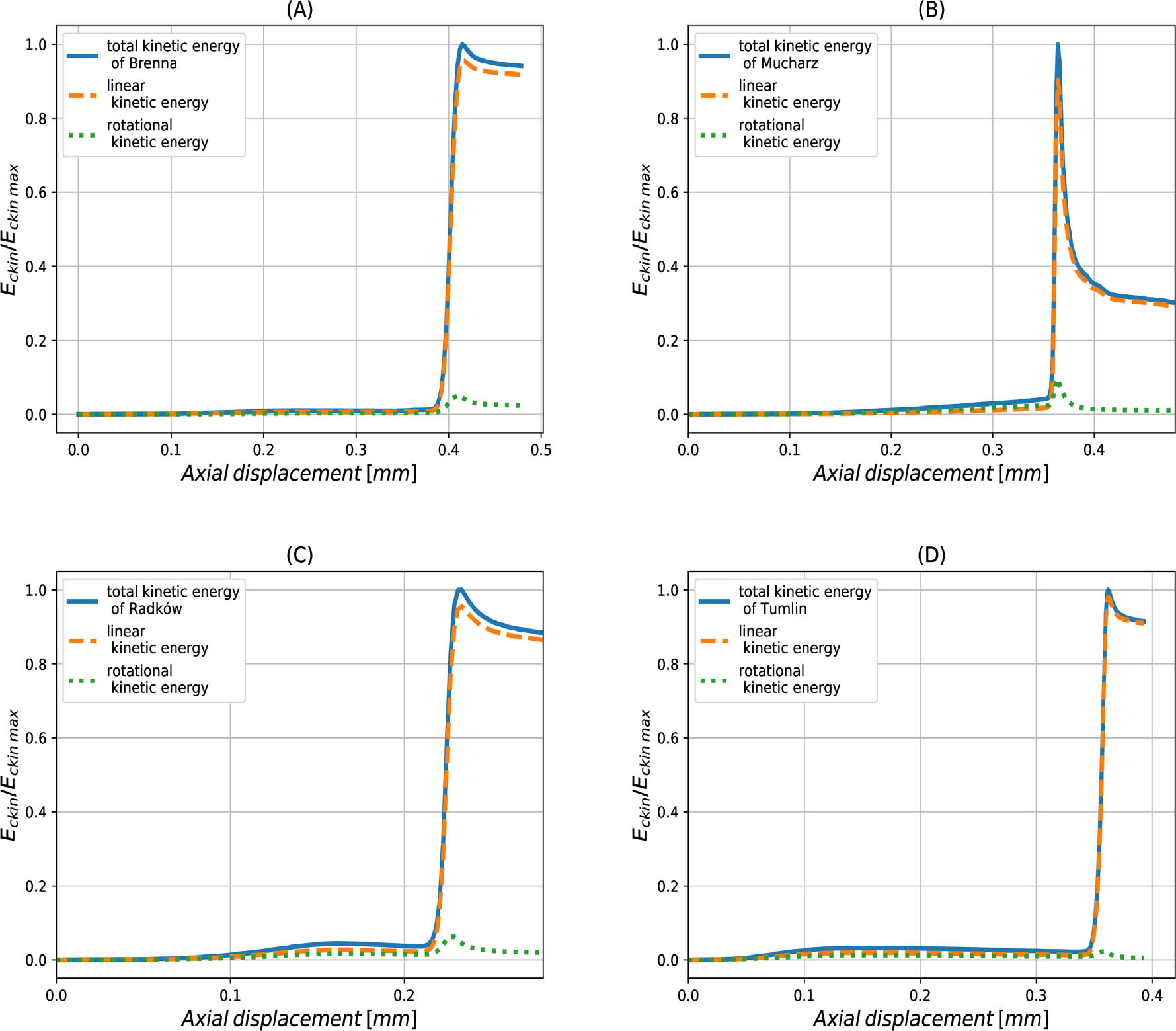
Figure 12
Comparison between two scaled different components of kinetic energy (Eckin/Eckin max – kinetic energy divided by maximum kinetic energy) plotted as a function of strain: (A) Brenna, (B) Mucharz, (C) Radków, (D) Tumlin.
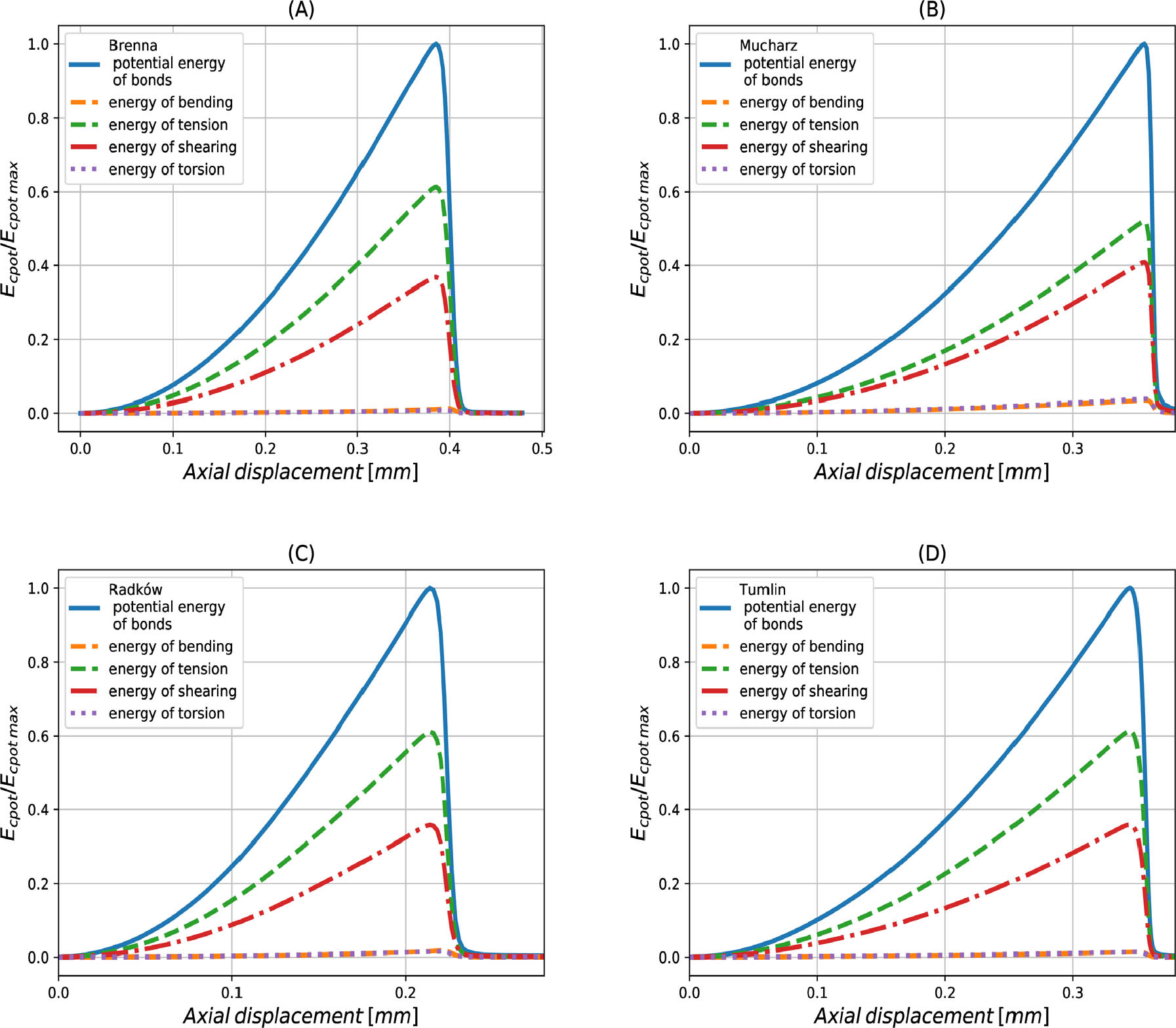
Figure 13
Four different components of scaled potential energy of bonds (Ecpot/Ecpot max – potential energy of bonds divided by maximum potential energy of bonds) plotted together: (A) Brenna, (B) Mucharz, (C) Radków, (D) Tumlin.
Table 5
Number of grains after failure.
| Total number of grains | Number of the smallest grains | Number of middle grains | Number of the biggest grains | |
| Brenna | 19,888 | 19,879 | 8 | 1 |
| Mucharz | 23,384 | 23,377 | 4 | 3 |
| Radków | 33790 | 33,764 | 14 | 12 |
| Tumlin | 152,953 | 152,944 | 8 | 1 |
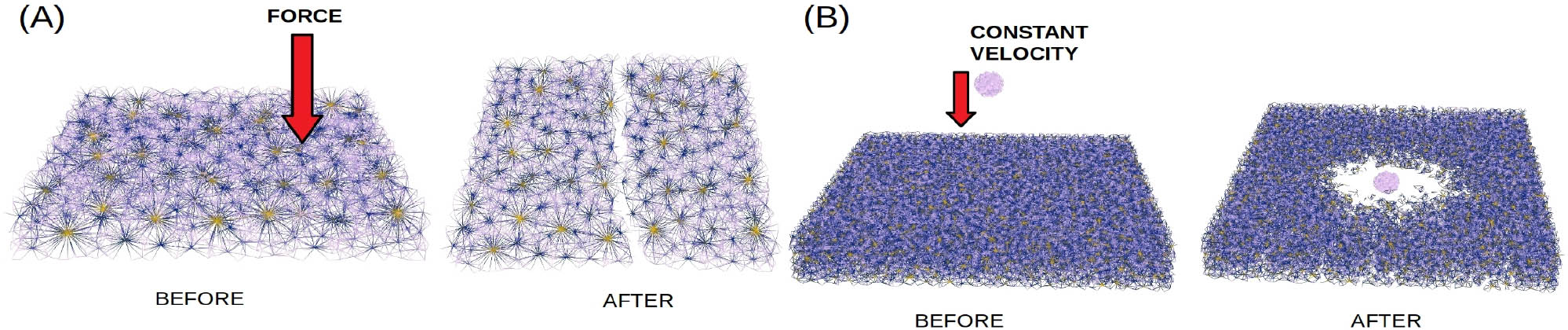
Figure 14
Exemplary presentation of the numerical slab after two different tests: (A) failure resistance test, (B) impact resistance test. View of bonds.
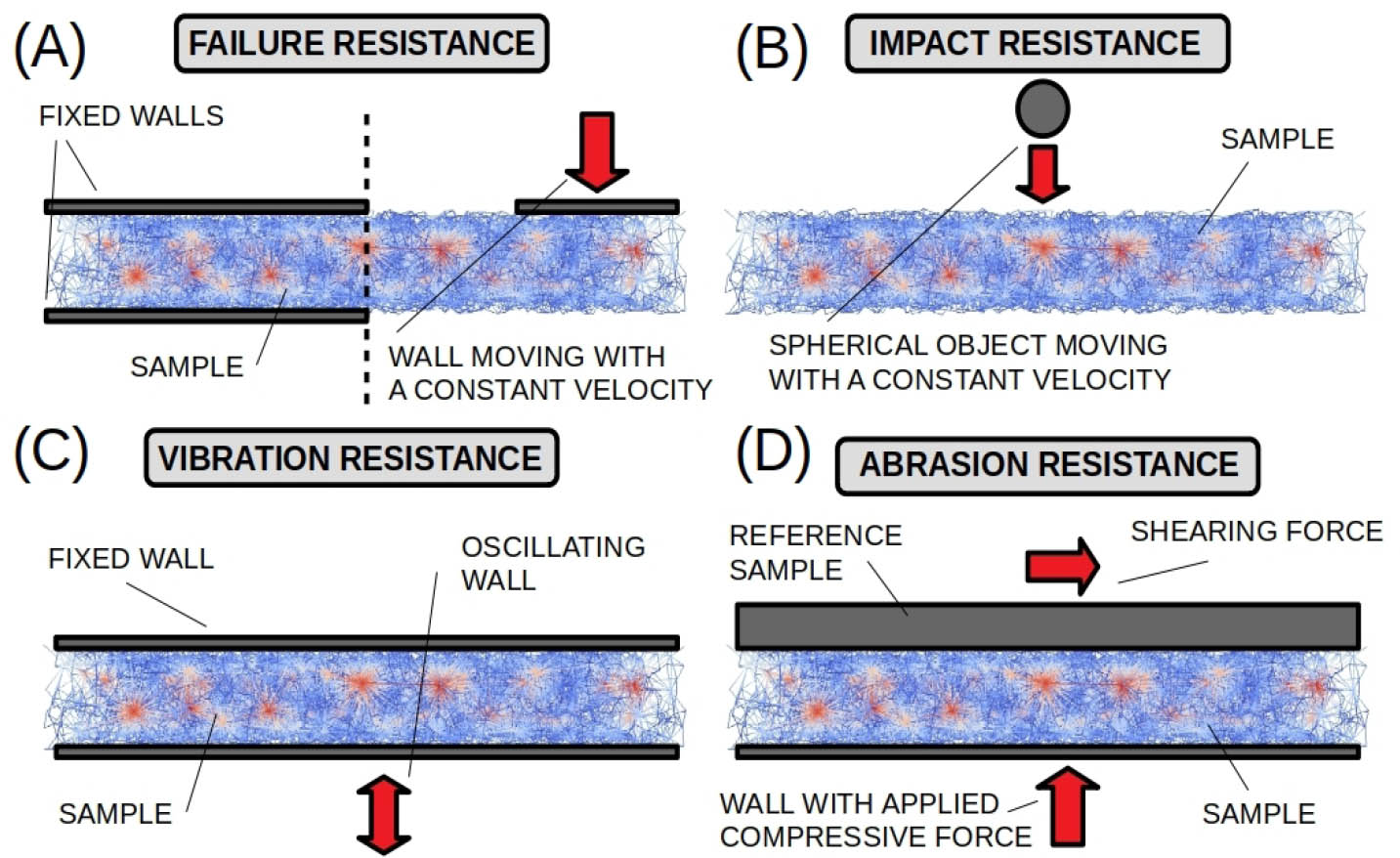
Figure 15
Schematic representation of all four tests: (A) failure resistance test, (B) impact resistance test, (C) vibration resistance test and (D) abrasion resistance test. View of the cross-section of the numerical slab.
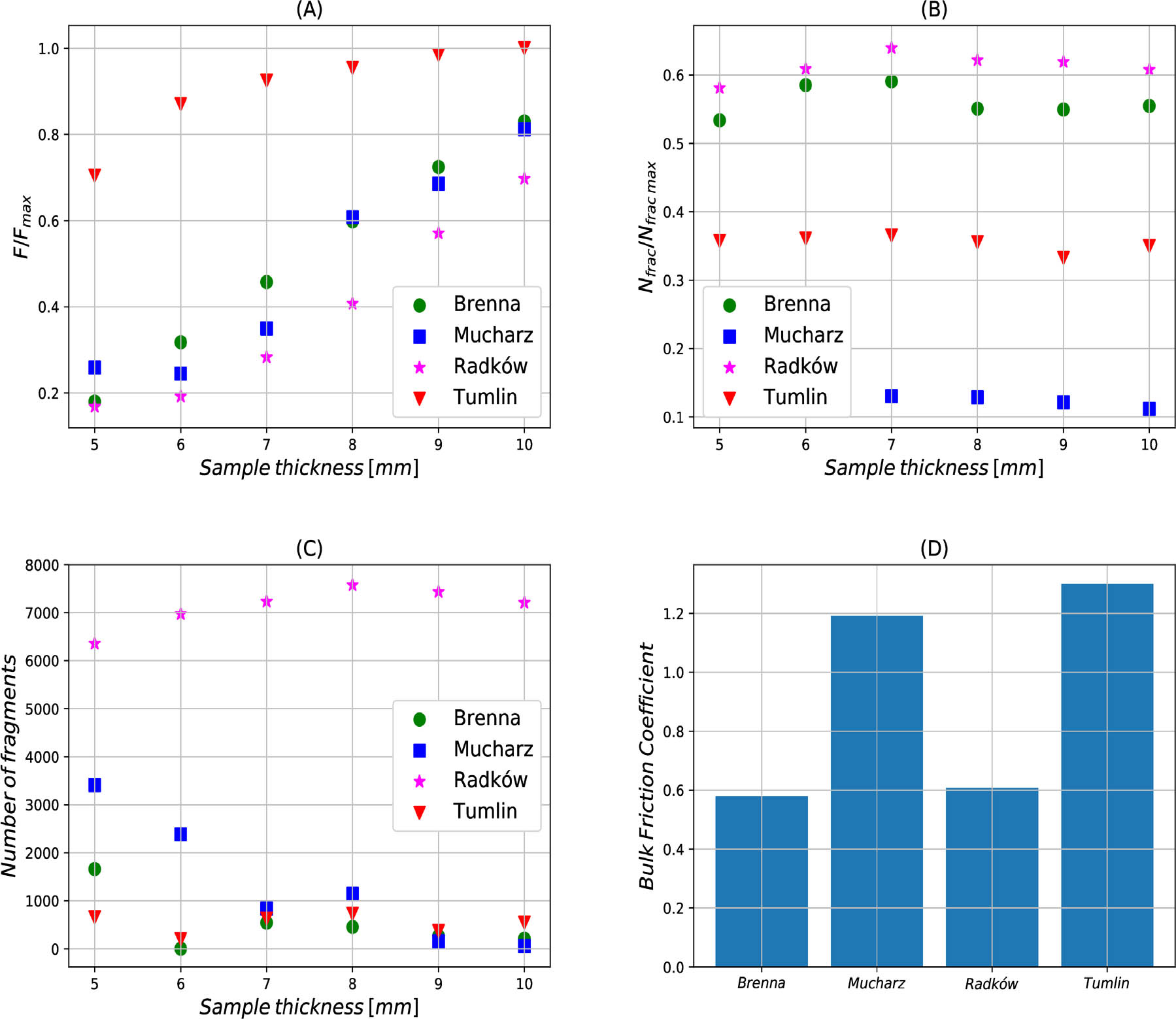
Figure 16
Results of all four tests: (A) failure resistance test, dependence between scaled maximum force F/Fmax (force divided by maximum force) and sample thickness; (B) impact resistance test, dependence between scaled number of fractures Nfrac/Nfrac max (number of fractures divided by maximum number of fractures) which appeared in the sample after the test and sample thickness; (C) vibration resistance test, number of fragments into which the sample has fallen apart as a function of sample thickness; (D) abrasion resistance test, bulk friction coefficient of the sandstone.
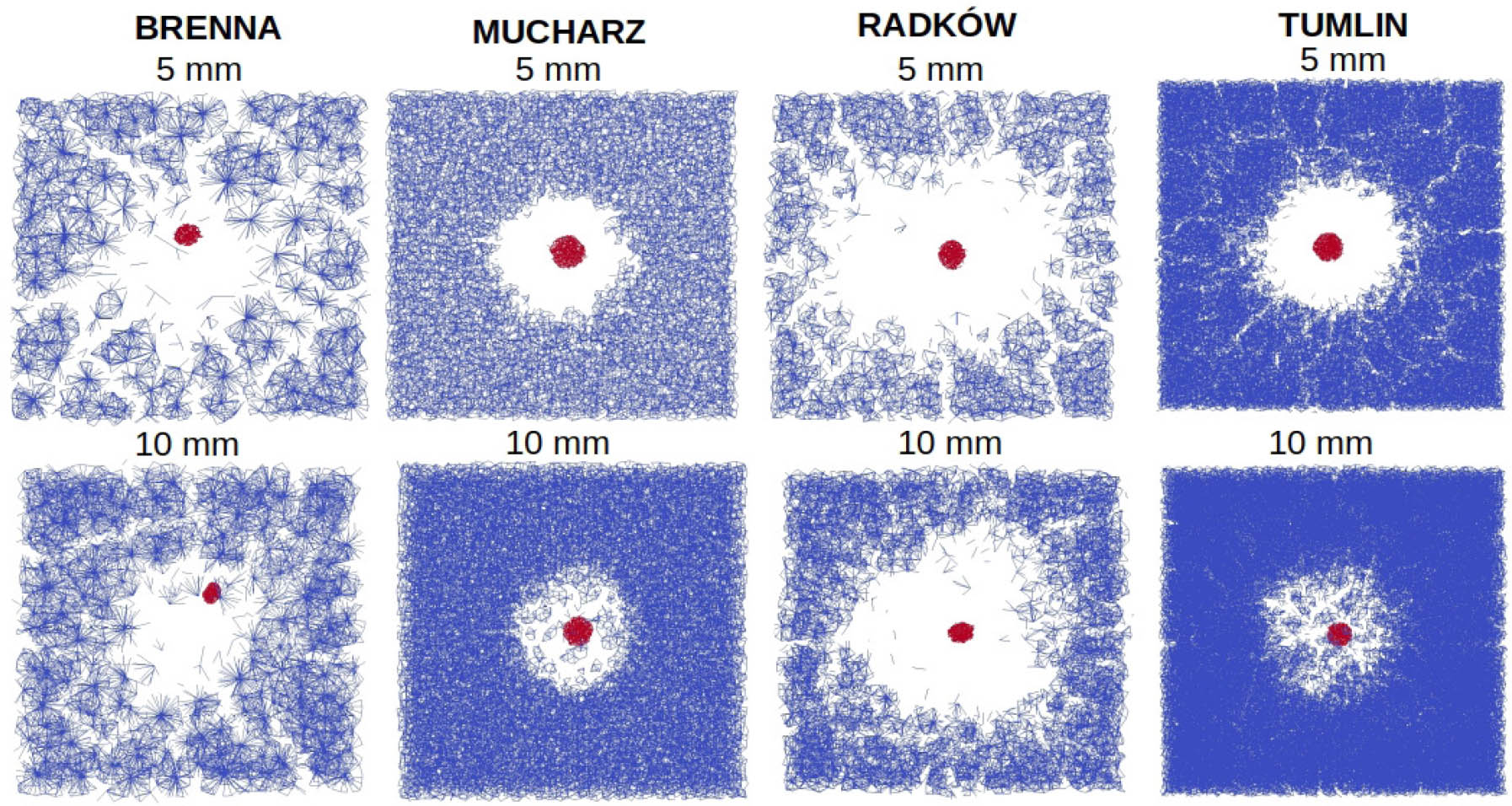
Figure 17
Network of fractures which appeared in the sample after impact resistance test. View of bonds.