
1. Introduction
Agriculture is a fundamental sector, both an art and a science, that provides food materials, ensures food supplies and provides reliable access to affordable, nutritious food. However, agricultural production is subject to a higher degree of uncertainty (Kyriazi et al., 2023), strongly dependent on varying weather conditions from season to season and from year to year. In addition, various economic and socio-political factors can influence farmers' decisions to adjust their techniques, resources and practices to meet specified constraints. Under these circumstances, agricultural management uses smart techniques, with interconnected networks, cognitive abilities and automation based on agricultural mechanization and machinery. These elements form a new applied science known as “Agricultural Cybernetics” (Huang & Zhang, 2021), an analytical tool, which studies the feedback and derived concepts in control and communication for crop growth, production management and agricultural machinery, supported by sensors and computers that monitor and adjust farming processes (Zhang, 2024). Building upon this foundation, Agricultural Cybernetics conceptualizes crop production as a nonlinear, feedback-regulated system in which farmers monitor crop conditions relative to yield objectives and implement controllable interventions to maintain desired system performance (Zhang, 2024). Within this regulatory framework, artificial intelligence and digital twins enhance system observability and decision-making through autonomous learning and predictive modeling (Zhou & Chen, 2023). When integrated with intelligent agricultural robotics capable of sensing environmental conditions, processing data and executing adaptive actions (Rovira-Más, 2023), Agricultural Cybernetics contributes to the broader development of self-regulating autonomous systems characteristic of the ongoing Cybernetic Revolution (Leonid & Anton, 2015). Agricultural Cybernetics should not be equated with agricultural automation or smart farming technologies aimed primarily at productivity gains or mechanized operations such as selective fumigation, since automation reflects operational enhancement rather than a comprehensive regulatory theory of agricultural systems (Montes & Ribeiro, 2023). It is also not reducible to the use of artificial intelligence, digital twins, or intelligent robotic platforms, which support Cybernetic systems but do not define their fundamental feedback and control principles (Zhou & Chen, 2023; Rovira-Más, 2023). Likewise, it does not simply refer to agro-economic informatization or macro-level governance infrastructures (Juraev, 2021). Within the broader context of the Cybernetic Revolution, the feedback and control framework defined above situates agricultural development within wider processes of systemic coordination and purposive regulation (Zhang, 2024; Leonid & Anton, 2015). This paper examines the origins and structural development of Agricultural Cybernetics, tracing its evolution from mechanized production systems to contemporary digitally integrated and sustainability-oriented agricultural frameworks. This transformation does not constitute a mere technological intensification; instead, it reflects the application of Cybernetic principles of regulation and decision-making, as articulated by Norbert Wiener, within increasingly complex agricultural systems. By situating technological innovation within broader economic and environmental constraints, the study interprets modern agriculture as a progressively adaptive and systemically organized production structure. Despite the growing body of literature on digital agriculture and Cybernetic applications, a systematic historical account of the structural origins and evolution of Agricultural Cybernetics as a regulatory paradigm remains absent from the scholarly discourse. In order to systematically examine the structural transformation of agriculture from mechanized production systems to the era of Agricultural Cybernetics, this study addresses the following research questions. First, do long-term productivity trends from 1960 to 2023 reveal structural patterns consistent with the transition from traditional mechanization to increasingly regulated and technologically integrated agricultural systems? Second, does the observed divergence between real farm output growth and value-added volatility reflect rising systemic complexity in agricultural production? Third, do shifts in land allocation, yield performance and production dynamics between major crops such as wheat and barley indicate a broader structural reorientation aligned with technological and Cybernetic developments? Finally, to what extent do the empirical patterns presented in the data support the conceptualization of agriculture as an increasingly observable and controllable system under the broader framework of the Cybernetic Revolution? The remainder of the paper is organized as follows. Section 2 analyzes the evolution of agricultural industrialization and examines the roles of technological advancement and production practices in shaping agricultural specialization. Section 3 investigates the emergence of Agricultural Cybernetics in the post-World War II period. Section 4 examines the technological and institutional developments associated with the digitalization and sustainability transition of 1970 – 2000. Section 5 explores the convergence of AI, IoT and Cybernetic frameworks in shaping contemporary global food systems from 2000 to the present. Section 6 presents the empirical analysis and Section 7 discusses the corresponding conclusions and policy implications. To address these research questions, the study adopts a structured historical–conceptual review approach. The synthesis relies on the selective integration of foundational works on mechanization, agribusiness and Cybernetics, complemented by recent interdisciplinary literature on digital agriculture, sustainability transitions and artificial intelligence applications. Priority was given to contributions that introduced major conceptual advances in agricultural organization or provided empirical evidence of long-term structural transformation. This integrative approach brings together intellectual history, theoretical interpretation and quantitative evidence within a coherent analytical structure.
2. The Evolution of Agricultural Industrialization Before 1945
The industrialization of agriculture prior to World War II laid the structural foundations for the large-scale mechanized systems that would expand further in the post-war period. In the interwar and wartime periods, agricultural policy increasingly emphasized output expansion to meet domestic and military demands, supported by scientific research and institutional structures such as agricultural extension services linked to land-grant colleges (Nourse, 1927). This period saw the ‘Food-will-win-the-war’ campaigns that significantly enhanced agricultural production, setting the stage for a move toward greater self-sufficiency in Europe, contrasting with the continued push for productivity in the U.S. due to falling prices and high fixed obligations. Although mechanization preserved the sequential structure of farming operations, it increased production scale and operational efficiency, thereby reinforcing structural distinctions between agricultural and industrial labor (Brewster, 1950). The concept of industrialization for agricultural development emerged as a critical strategy to integrate agriculture with broader economic sectors. This approach involved creating forward and backward linkages that not only supported agricultural modernization but also economic growth through the development of industries related to agricultural processing and marketing. Decentralization played a crucial role in distributing the benefits of this growth more evenly, thereby preventing the concentration of economic gains in urban centers, which was particularly significant in developing countries (Bredo, 1959). By the mid-1940s, the industrialization of agriculture had led to an increase in the size of commercial farms and a more pronounced degree of commodity specialization. These developments expanded the scale and interdependence of agricultural production, increasing the need for coordination across input supply, processing and distribution systems. This evolution was driven by economic forces that made manufactured inputs more affordable and labor less central to farming operations. This period witnessed the general growth of the large-scale production units that resembled factories in their operation, fundamentally changing the landscape of animal farming. The transition from traditional to industrialized agricultural practices involved not just technological changes but also significant shifts in ownership and contractual relationships within the sector (Rhodes, 1993). The developments in this sector reflect broader trends in technology, economics and social organization, highlighting the complex interrelations between agriculture and other sectors of the economy. By the mid-twentieth century, agriculture had become increasingly embedded in industrial and market structures, establishing the structural conditions that would later support more advanced forms of systemic coordination.
2.1. Evolution and Economic Impact on Agricultural Forecasting
The development of agricultural forecasting during this period represents one of the earliest attempts to introduce systematic information processing into farming decisions, a process that prefigures the observability and control principles at the core of Agricultural Cybernetics. Agricultural forecasting evolved from localized empirical observation toward increasingly formalized statistical analysis. Initially, predictions in agriculture were based on personal experiences and immediate observations, which, although useful, often lacked precision and broader applicability. Over time, the adoption of statistical methods to examine historical data had greatly improved the precision of agricultural forecasts. These developments allowed for the identification of trends and anomalies, making forecasting not only more reliable but also more valuable in strategic agricultural planning (Taylor, 1924). Subsequent economic analyses have demonstrated the sensitivity of agricultural markets to broader macroeconomic variables, including energy prices and input costs. Research demonstrates that fluctuations in oil prices directly influence the costs associated with agricultural production, particularly in areas such as transportation and processing. This sensitivity to oil prices underlined the need for agricultural forecasts to consider a wide array of economic factors to predict food price trends accurately (Baumeister et al., 2014). Inflation also plays a significant role in agricultural economics, impacting both the cost of agricultural inputs and the prices of agricultural products. The interplay between inflation and agricultural prices illustrates a cyclical dynamic where rising costs in agriculture can contribute to broader economic inflation. This complex relationship necessitates a forecasting approach that accounts for both agricultural and non-agricultural economic conditions to guide policy and production decisions effectively (Hathaway et al., 1974). Furthermore, the influence of monetary policy on agricultural economics is profound. Studies have shown that changes in the money supply can significantly impact nominal agricultural prices. These relationships illustrate the expanding recognition that agricultural price movements are embedded within broader monetary and macroeconomic dynamics (Barnett et al., 1983). Additionally, historical economic analyses have provided insights into long-term trends affecting agricultural markets. Recognition of these factors contributed to more structured approaches to anticipating market conditions and informing production decisions (Babson, 1911). These developments reflect a gradual progression from reactive prediction toward more systematic monitoring of interconnected economic variables, thereby laying important conceptual foundations for later feedback-oriented and regulatory approaches in agricultural systems.
2.2. Integration of Financial Markets and Agricultural Indices
The growing entanglement of agricultural production with global financial systems introduced new dimensions of uncertainty and risk that could no longer be managed through localized decisions alone, pointing toward the need for the kind of systemic regulatory frameworks that Agricultural Cybernetics would later provide. The periods before and after World War II marked a critical turning point in the integration of agricultural markets with global financial systems, emphasizing the strategic role of financial policy in managing agricultural risk. Initially, the focus was on preventing short-term trade shocks from leading to economic crises similar to the Great Depression. Innovative ideas such as Keynes’s proposal for a world currency tied to a commodity price index aimed to stabilize commodity prices and, by extension, global trade earnings (Larson et al., 2004). Although this specific proposal was not adopted, it opened the path for mechanisms like compensatory financing, which the International Monetary Fund started offering in 1963 to cushion countries from unexpected declines in export earnings. In the scholarly discourse on market stabilization, it has been posited that the effects of price stabilization depend significantly on the source of market instability, whether from supply or demand sides. The theoretical frameworks suggest that while producers benefit from price stabilization in instances of supply-side instability, consumers gain when the instability is demand driven. Moreover, the potential for redistributive compensation highlights the net benefits of stabilization in either scenario (Gomez et al., 2019). Despite these advancements, the utilization of market-based risk frameworks, such as crop or price insurance, remains limited, especially among small-scale farmers in developing economies. The primary barriers include a lack of insurable assets and the incomplete nature of agricultural risk markets. However, the potential benefits of integrating these markets are manifold. They range from buffering income shocks, thus reducing transient poverty, to supporting government safety nets during systemic crises (Larson et al., 2004). In recent decades, digital transformation has further deepened the integration of agricultural markets. Contemporary digital innovations are revolutionizing agricultural market structures through three key mechanisms: strengthening direct producer and consumer connections, optimizing price discovery processes and minimizing transactional friction. E-commerce platforms exemplify this transformation by eliminating intermediary layers, allowing farmers to capture greater value from their products while simultaneously reducing consumer prices by up to 25% (Tumibay et al., 2016; Zhang et al., 2021). These platforms also mitigate food waste through enhanced demand forecasting, though their effectiveness depends on overcoming digital literacy barriers through cooperative-led training initiatives. Mobile-based market information systems have created new opportunities in developing contexts by reducing informational asymmetries and improving price transparency. Indian smallholders utilizing mobile market services experience approximately 15% income gains on average through reduced price volatility (Mittal & Tripathi, 2009), while Kenyan farmers leverage combined mobile-FM systems to improve market timing for some goods (Mukhebi et al., 2008). Such innovations demonstrate how real-time information flows can compensate for physical infrastructure limitations. Market accessibility follows clear spatial patterns, with each additional farmers’ market within a 5 km radius boosting local participation (Shi & Hodges, 2016). Digital tools like MarketMaker amplify this effect when properly managed, however, their impact remains constrained by the persistent rural-urban digital divide in internet penetration in parts of Africa (Deichmann et al., 2016). Over time, the emphasis has shifted from stabilizing national agricultural incomes towards a broader understanding of risk management, moving away from interventionist policies which were often seen as barriers to economic growth. The historical backdrop provided by the industrial revolution underscores the critical support agriculture provided to industrial growth, emphasizing the sector’s resilience despite natural constraints like climate and soil (O’Brien, 1977). This interdependence between agriculture and broader economic sectors continues to shape policy design and the structuring of financial instruments, reflecting a transition toward increasingly coordinated and system-oriented agricultural frameworks.
2.3. Comprehensive Evolution of Early 20th Century Agricultural Practices 1900 - 1940
The structural transformations in agricultural marketing, labor organization and farm scale during the early twentieth century established the organizational foundations upon which more advanced forms of systemic coordination, central to Agricultural Cybernetics, would later develop. The early twentieth century constituted a period of profound transformation in agricultural practices, characterized by structural changes in marketing systems, labor organization and farm scale. It marked a departure from traditional to increasingly specialized and systematized approaches in both farm production and agricultural marketing. Livingston (1920) observed that agricultural marketing was undergoing a transformation similar to what agricultural production had experienced fifty years earlier. A professor might have overseen all aspects of agricultural production, but year by year, it was divided into specific areas, each managed by so many technical experts. The marketing landscape became increasingly complex during this period. Livingston highlighted a prevailing sentiment among businessmen that farmers entering the marketing sphere were committing both a moral and economic transgression. This resistance was notable, considering that these same business entities often engaged in multiple business ventures, benefiting from the entire field of agricultural operations. During World War I, the British government adopted drastic measures to secure food production, as detailed by Sheail (1973). The government, driven by a desperate need to boost food production, announced an increase in arable land use. This policy shift led farmers to transform lands into producing fields, changing the landscape and the nature of agricultural labor. The war not only redefined land use but also the labor dynamics, as traditional agricultural labor pools were depleted by military drafts. This shortage was somewhat mitigated by innovative labor policies, including the employment of women and soldiers in agriculture, which were pivotal in maintaining the nation’s food supply during the crisis. Furthermore, Carver (1911) contributed to the redefinition of farming scale, arguing that the size of a farm should not be measured by its acreage but by the nature of its operations and labor usage. He argued that a large-scale farm could operate on limited acreage if it employed a substantial supervised labor force, whereas a medium-scale farm might rely primarily on family labor supported by mechanization. This framework reflected broader trends toward more intensive and supervised agricultural practices, increasingly associated with economic viability and competitive advantage. These developments range from diversification in agricultural marketing and education to shifts in wartime labor and land policies and evolving conceptions of farm scale. Despite their analytical distinction, these developments were closely related and shaped the foundations of modern agriculture.
3. Transformation and Technological Determinism in Post-WWII Agriculture: The Rise of Agribusiness and Cybernetics 1945–1970
The structural conditions established by pre-war agricultural industrialization (characterized by mechanization, commodity specialization and growing market interdependence) provided the foundation upon which the post-war emergence of agribusiness and Cybernetics would fundamentally reshape the organization of agricultural production. Following World War II, agriculture underwent structural changes driven by industrialization and Cybernetic thinking. During the post-World War II period, the United States underwent a transformation in its agricultural sector, significantly influenced by technological innovation and evolving political ideologies. This period marked the genesis of “agribusiness,” a term introduced by Davis in 1955 during a conference attended by numerous corporate executives, government policymakers and academics. Davis’s introduction of agribusiness was strategically timed to advocate for a pivot from traditional agricultural practices to a model where farming was connected to industrial processes and entrepreneurial strategies (Hamilton, 2014). This model emphasized efficiency and profitability to support large-scale operations. Davis’s vision for agribusiness was not just an economic proposal but a political notion, designed to reshape the agricultural ‘map’ and follow a market-driven approach. He argued that the future of agriculture should leverage technological advancements to achieve integrated business structures, thereby ensuring stable profits and reducing governmental interference in market dynamics (Hamilton, 2014). Parallel to the rise of agribusiness was the development of Cybernetics, a field that emerged from the scientific endeavors of the war and was quickly adapted to various civilian applications, including agriculture. Cybernetics, founded by Norbert Wiener, introduced a systematic approach to managing complex systems through principles of control and communication. This methodology was particularly suited to agriculture, where managing the multifaceted dynamics of large-scale operations became increasingly crucial (Thomakos & Xidonas, 2023). As introduced in Section 1, Agricultural Cybernetics applied these principles to optimize farming processes and enhance productivity and efficiency (Huang, 2021). As agribusiness incorporated Cybernetic principles, the agricultural sector began to resemble an industrial complex where every element of production was under control. This adaptation paved the way for the adoption of new technologies such as automated machinery, advanced pesticides and, later, genetic engineering techniques, which further propelled the industrialization of agriculture. The application of Cybernetics streamlined agricultural operations and supported the agribusiness model. It enabled large-scale farms to manage their resources more effectively, predict market trends and adjust production processes (Huang & Zhang, 2021). Critics across regions argued that the evolution of agribusiness, enhanced by the Cybernetic framework, destroyed the environment and undermined the social fabric of local communities, prioritizing profit over people and leading to a loss of biodiversity and local farming culture (Hamilton, 2014). Moreover, the concept of agribusiness and the professional and academic principles of Agricultural Cybernetics became key reference points and foundations of a global shift toward a consumer-driven and technologically advanced food production system, as observed in numerous analogous cases. This change had consequences not only for the structure of agricultural production but also for global food security, environmental sustainability and socio-economic dynamics within farming communities (Thomakos & Xidonas, 2023).
3.1. Post-War Industrial Growth and Its Impacts on Agriculture
The post-World War II era marked significant transformations in global agriculture, influenced by industrialization, economic policies and technological innovations. The rapid spread of globalization affected even the most remote areas, altering agricultural methods across both developed and developing nations. This period highlighted the excessive energy consumption by industrial nations (Ehrenfeld, 2003). In the United States, the decades following the war saw a decline in productivity growth, a stark contrast to the earlier years. This slowdown was attributed to multiple factors including the rising costs of environmental regulations and energy price shocks. The period from 1947 to 1986 saw productivity growth decrease dramatically from 2.9% to just 1.1%, reflecting broader structural adjustments and the increasing burden of compliance with stringent environmental standards (Ehrenfeld, 2003). Meanwhile, China’s economic growth was driven by liberal market reforms and a strategic shift away from collective farming to a market-oriented agricultural framework. This shift began with the “rural household responsibility system” in the 1980s, which significantly boosted agricultural output and rural incomes, laying the groundwork for China’s rapid industrialization and urbanization (Wei et al., 2017). The integration of scientific approaches into agriculture during this period was also noteworthy. Farms became complex ecosystems managed through scientific knowledge, blending disciplines such as meteorology, botany and animal behavior to optimize production. This scientific integration was crucial in managing the biological processes of modern agriculture (Fitzgerald et al., 2018). Critically, the industrial growth of agriculture raised concerns over sustainability and social impact issues. The movement toward sustainable agriculture gained momentum, advocating for practices that strengthen local ecosystems and communities. This approach underscored not only food production but also the reconsideration of natural and social capital, aiming to rebuild local food systems that were ecologically and socially beneficial (Boody & DeVore, 2006). These facets illustrate the complex interplay between economic growth, environmental sustainability and social equity in the post-war agricultural landscape. The need for a balanced approach in agricultural policy and practice was evident, one that harmonizes efficiency with ecological integrity and community well-being. Parallel to the American context, the United Kingdom during World War II also experienced significant shifts in agricultural policy and labor deployment. The early 20th century marked a pivotal period in agricultural transformation in the UK, driven by technological advancements and urgent policy responses to wartime needs. Prior to and during World War I, the UK faced a severe agricultural crisis, producing only about one third of the food it needed, with the rest being imported. This situation deteriorated significantly in 1915 when submarine warfare threatened these vital imports, compelling the British government to radically alter its agricultural policies (Sheail, 1973). The government urged farmers to significantly increase the cultivation of cereals and potatoes. By 1915, farmers expanded wheat cultivation nearly to 150,000 hectares. However, the abrupt change in crop rotation led to soil degradation and increased weed infestation, creating a cycle of diminishing returns. In order to address these challenges, large areas were left to fallow, reflecting a strategic retreat from intensive cultivation to preserve soil fertility, while emerging technological innovations began reshaping agricultural practices.
3.2. The Evolution and Impact of Transportation on Agricultural Specialization
Since the end of World War II, the U.S. agricultural landscape underwent significant adjustments, characterized by substantial increases in productivity and a decisive shift towards specialization. These changes were driven by capital investments, reducing reliance on extensive farm labor and arable land and enabling a transition from diversified farming to specialization in specific products. By 1974, more than half of total farm sales were from specialized agricultural counties, up from 23 percent in 1949, highlighting a marked trend towards specialization in response to evolving market demands (Winsberg, 1982). The development of transportation was pivotal in these agricultural transformations. Since the invention of the wheel and axle, transportation technology, from rails to GPS-integrated systems, revolutionized how agricultural goods are moved and marketed. The rise of personal vehicle use post-World War II reshaped urban expansion, directly impacting agricultural land use and commodity transportation. This increase in personal vehicle use also led to heightened environmental concerns, especially air pollution from vehicle emissions, which affected agricultural sustainability (Lachman et al., 2013). An excellent illustration of transportation’s impact on agriculture is provided by the refrigerator car, which transformed the transportation of perishable goods, allowing for longer-distance transport and expanding the market reach for agricultural products. This advancement enabled farmers to respond to broader market demands and adjust their production strategies accordingly (Jesness, 1931). Technological changes in transportation not only improved logistics but also influenced the geographic distribution of agricultural activities, significantly affecting the profitability and viability of agricultural practices. Reliable transportation systems were critical for delivering agricultural products from farms to markets. Technological improvements in transportation reduced costs and improved logistical operations of farm outputs, influencing the regional development of agriculture (Nichols, 1969). The period from 1949 to 1974 revealed diversification in the types of agricultural commodities that dominated specific regions, influenced by technological advancements in transportation and shifts in consumer demand. For example, dairy specialization predominated in the Northeast, reflecting regional demands and infrastructure capabilities. Conversely, regions such as the Mountain farm production region specialized in cattle due to environmental constraints such as water scarcity, despite the lower carrying capacity of its ranges (Winsberg, 1982). Moreover, the field of logistics evolved significantly, recognizing its critical role in linking various aspects of agricultural production from procurement to delivery. The logistics industry’s growth facilitated reductions in distribution costs, significantly impacting the competitiveness of agricultural goods in the market (Allen, 1997).
3.3. Integration and Evolution in Post-WWII Agricultural Practices
Reflecting on the agricultural landscape post-World War II, a profound transformation in agricultural productivity, technology and economic policy is evident, marking a dynamic period of adaptation and structural change. Post-World War II agricultural developments were significantly influenced by technological advancements and labor policies, particularly in the cotton industry. The demand for cotton soared during the war, leading to a shift in production practices. The Department of Agriculture (USDA), reversing previous scarcity programs, urged farmers to maximize production to meet both military and civilian needs. This resulted in a prosperity revival for Cotton Belt landowners, paralleled by an improved income for workers due to doubled cotton prices (Grove, 2000). Despite these advancements, the sector continued to rely heavily on manual labor, requiring up to 140 hours per acre, except in certain US regions such as Texas and Oklahoma where less labor was needed. This reliance underscored the persistent challenge of labor shortages, exacerbated by the migration of workers to industrial jobs, which forced many southern farmers to reduce rather than expand their plantings. The agricultural sector also faced uncertainty and the necessity for adaptive strategies. Historical analysis highlights cases that reshaped agriculture, such as the Great Depression, World War II, the introduction of hybrid seeds in the 1950s, the commodity boom of the early 1970s, the energy crisis of the late 1970s and the debt crisis of the early 1980s (Just, 2001). Each of these occasions demanded adjustments in agricultural practices and policies. Moreover, the post-war period marked the importance of accurate economic measurement. Alston (2018) introduced the concept of “factology,” highlighting the need for a deeper understanding of how agricultural data is created and used. This reflection was born from the perspective that data are actually constructs that require careful consideration and validation, especially when used to shape or reshape policies and economic decisions in agriculture. These changes highlight a period of significant evolution in agriculture characterized by technological advances, changes in labor dynamics and a new understanding of the importance of economic data. This era not only transformed agricultural practices but also set the stage for future policy debates and technological innovations in the sector. On the other hand, as agribusiness began to redefine the agricultural landscape, it also set the stage for the global ‘Green Revolution’, which would later have various consequences for agricultural productivity. The political and economic perspectives of the time often characterized the ‘family farm’ not only as an economic unit but also as a barrier against communism, enhancing the viability of small-scale farming during the Cold War (Hamilton, 2014). Baumert (2017) advocates for the potential of small-scale farming, particularly in terms of sustainability and community empowerment. The same author further contends that large-scale farming can also contribute positively to sustainable development. This involves empowering local communities with the skills necessary for effective participation in land negotiations and advocating for sustainable land management practices (Baumert, 2017). Moreover, Spielmann et al. (2011) call for a reevaluation of what constitutes large, medium or small-scale farming, suggesting that the scale should be defined not by the size of the land but by the nature of labor and management practices. Under this framework, a large-scale farm could be a technologically advanced operation managed by a team of professionals, while a medium-scale farm could be a family venture that successfully integrates modern machinery with traditional farming practices (Spielmann et al., 2011). This multidimensional framework of agricultural evolution during the post World War II period reveals the dynamic between large-scale agribusiness driven by technological advancements and small-scale farming oriented towards sustainability and community building. Both forms of agriculture coexist within a complex framework influenced by technological variances, political ideologies and economic growth strategies.
3.4. Small-Scale and Large-Scale Farming - Post-WWII
Building on the structural transformations outlined above, this section examines more specifically how the coexistence of small-scale and large-scale farming shapes the prospects for a sustainable and productive global food system, with particular reference to global development goals and food security imperatives. More specifically, small-scale farms can effectively participate in market-oriented farming, fostering rural development and the ‘end of poverty’ according to SDG 1 of the UN Agenda, in contrast to large-scale land investments which tend to concentrate economic benefits away from rural areas, disregarding opportunities for inclusive growth and sustainable development (Baumert, 2017). The large-scale agricultural investment framework as discussed (Zhan et al., 2015) reiterates the need for immediate investment in agriculture in order to meet the growing global food demand by 2050. While the role of small-scale farmers is vital, the scale of investment required to sustain global food security and economic growth in developing regions necessitates larger and more sustained corporate involvement. This perspective reflects a trend where corporate interests driven by rising commodity prices and food security concerns of importing countries have led to increased agricultural investments, often ignoring the real contributions and outcomes of smaller farms (Zhan, 2015). Conversely, Lininger (2011) noted that small-scale farming can significantly contribute to environmental stewardship and maintain biodiversity, in contrast to commercial agricultural production. Moreover, Lindsay et al. (2008) examined the community dynamics and challenges faced by small-scale farmers, emphasizing the importance of fostering social capital through networks and shared experiences to enhance sustainable practices and community resilience. Their work highlights the critical role of community engagement and participatory decision-making in aligning agricultural practices with broader social and environmental goals. The dialogue between small-scale and large-scale agricultural practices is not merely a matter of economic efficiency and growth but also encompasses social and environmental dimensions. The future of global agriculture may well depend on finding a balance that leverages the strengths of both small-scale sustainability and large-scale investment efficiencies. This balance is indispensable for addressing the challenges of global food security, economic development and environmental sustainability in the face of increasing population pressures, climate change and the prevailing energy crisis.
4. Technological Transition and Sustainability Foundations in Agriculture 1970–2000
4.1. Early Technological Integration in Agriculture
The agribusiness model and Cybernetic frameworks that emerged in the post-war period transformed the organizational architecture of agriculture, creating the institutional and technological preconditions for the digitalization and sustainability transition that would define the period from 1970 to 2000. This period marked a decisive structural transition in agricultural development. It encompassed the early integration of technological innovations, the post-war application of Cybernetic frameworks and the gradual evolution from traditional to controlled agricultural environments. The advancing role of digital technologies in farming practices and the emergence of adoption barriers further shaped the trajectory of agricultural modernization in developing regions. In the era of digital transformation and climate change, agriculture entered a new phase marked by the integration of cutting-edge technological innovations alongside an emphasis on sustainability. Cybernetics, which originated in the control of technological systems and engineering, played a vital role in enhancing agricultural productivity and sustainability. Huang & Zhang (2021) described how control processes in agriculture, facilitated by Cybernetics, optimize resource use and minimize environmental impact. The deployment of artificial intelligence and machine learning in agriculture introduced multidimensional changes towards predictive and efficient farming methods. Thomakos & Xidonas (2023) argued that despite advances in AI, human intuition, creativity and insight remain indispensable. AI’s true value in agriculture lies in its potential to augment human decision-making, especially in interpreting complex environmental data for informed management decisions. This integration of technology and human judgment proved crucial for effectively navigating the unpredictable nature of agricultural environments. On the policy front, the sustainability discourse that would later culminate in the United Nations Sustainable Development Goals (SDGs) of 2015 began to take shape during this period. Janker & Mann (2020) broadened the concept of sustainability, including social equity and economic viability along with environmental issues. This perspective on sustainability advocates for a multidimensional approach in agriculture, combining environmental awareness and socioeconomic development. This framework ensures that technological innovations and changes support balanced development and can serve current and future generations. The convergence of technological innovations such as Cybernetics and AI presented a landscape where technology and policymaking needed to evolve to address the challenges of modern agriculture and implement vital sustainability targets. It is necessary for the rapidly growing technologies in farming to not only achieve efficiency and productivity but also to advance sustainability goals, ensuring that agricultural practices are both innovative and sustainable.
4.2. Post-WWII Cybernetics and Agricultural Innovations
Although this section sits within the 1970 – 2000 framework of Section 4, it provides necessary retrospective context by tracing the post-war origins of Cybernetic thinking in agriculture, as these developments directly shaped the technological and institutional transitions of the period under examination. The period following World War II marked remarkable developments in the technological landscape, affecting various domains, including agriculture. The redefinition of the Cybernetic paradigm introduced new frameworks for understanding and engaging with complex systems, which had profound implications for agricultural practices and technological advancements. Cybernetics, emerging prominently in the post-war era, transformed the understanding of human-machine interactions. Initially conceptualized to enhance control and communication across biological organisms and mechanical systems, Cybernetics evolved to include a wide array of applications beyond mere mechanistic interactions (Triclot, 2018). This field provided new methodologies for addressing the complexities of living organisms and their interactions with machines, offering novel analytical perspectives on agricultural automation and efficiency. The Soviet Union’s approach to agricultural specialization in the post-Stalin era illustrates a distinct application of centralized planning influenced by Cybernetic principles. The drive towards efficient specialization and inter-enterprise coordination reflected a Cybernetic influence on the optimization of resource allocation and production outcomes (Gray, 1979). This period saw a strategic reallocation of resources, enhancing the production capabilities of Soviet farms under a guided, systematic approach consistent with Cybernetic control systems. In the United States, the discourse around Cybernetics and information theory fostered a broader understanding of technological integration across human activities, including agriculture. The exploration of these subjects served to clarify the role of automation and control systems in modern farming practices, shaping the way tasks were mechanized and managed across agricultural landscapes (Kline, 2017). Moreover, the historical impact of farm machinery, viewed through a Cybernetic lens, underscored the transformation in agricultural labor and productivity. The adoption of farm machinery not only evolved traditional farming methods but also reshaped the socio-economic structure within rural communities. This mechanization led to increased production efficiencies, altering the dynamics of labor and the broader economic viability of the farming sector (Johnson, 1950). These post-war changes, driven by Cybernetic insights and technological advancements, marked a pivotal transition in agricultural methodologies. The integration of Cybernetic principles into agricultural systems facilitated improved control mechanisms, more effective resource use and a deeper understanding of complex agricultural ecosystems. As such, the legacy of Cybernetics continued to shape agricultural practices, directing them towards more innovative and sustainable trajectories.
4.3. Evolving Paradigms in Agriculture: From Traditional to Controlled Environments
Agricultural practices have undergone profound transformations from traditional methods to more controlled and industrialized systems. FitzSimmons (1986) examined the industrialization of agriculture, noting how this process entailed increased labor productivity, mechanization and crop specialization facilitated by technological advancements. This progression was typically characterized by a departure from labor-intensive approaches towards systems heavily dependent on technology and capital. Benke and Tomkins (2017) presented vertical farming as a radical innovation in agriculture, leveraging controlled-environment agriculture (CEA) to optimize space and resources. This model employs multi-level structures to boost crop production without extensive land occupation, incorporating advanced systems for water recycling and climate regulation to maximize operational efficiency and reduce environmental impacts. Vertical farming exemplifies a movement towards sustainability, addressing urban food demands and reducing the carbon footprint associated with conventional farming methods. Gómez (2019) further expanded on the benefits of CEA, emphasizing its role in urban agriculture where space is limited and the demand for local food production is high. Controlled environments enabled precise management of cultivation conditions, stimulating plant growth and optimizing resource efficiency. This approach supported sustainable agricultural production by enabling year-round cultivation in adverse climates and reducing reliance on natural weather conditions. Brooks (1991) examined the socio-economic impacts of transitioning agricultural systems in Eastern and Central Europe from controlled, state-driven production methods to market-oriented systems. This transition highlighted the challenges and adjustments required in moving from a highly regulated agricultural framework to one that is more responsive to market pressures and economic imperatives. Olhager and Selldin (2007) offered insight into the broader implications of market dynamics on manufacturing and, by extension, on agriculture. They argued that aligning production systems with market demands was crucial for achieving profitability and sustainability, underscoring the need for agricultural systems to respond to evolving economic environments. The progression from conventional to modern agricultural practices has been defined by a growing emphasis on efficiency, sustainability and market responsiveness. These developments reflect a broader trend towards industrialization and systemic regulation within the sector, aiming to meet the growing global demands for food in an ecologically sound and economically viable manner.
4.4. Integration of Advanced Technologies in Agricultural Practices
The contemporary landscape of agricultural technology reflects a pronounced shift towards digital technologies, as evidenced in studies by Li et al., (2023) and Litzenberg (1982). Li et al., (2023) focused on the adoption of smart agriculture technologies among cotton farmers, utilizing the Deconstructive Theory of Planned Behavior to analyze various motivational factors that influence this shift. The research highlighted that while farmers recognize the practical benefits of smart agriculture technologies, concerns about associated risks impede their willingness to fully embrace these advancements. Furthermore, the study reveals that influences within agricultural communities tend to have a more complex impact on technology adoption. In other words, leaders play a crucial role in guiding and facilitating the adoption of new technologies. Additionally, the availability of information channels is pivotal in enhancing farmers’ confidence and ability to use smart technologies effectively. Litzenberg (1982) examined the transformative role of computer technology in agricultural education during the preceding fifteen years. The increased accessibility of computers, coupled with a growing demand for computer literacy among agricultural economics students, had significantly influenced the curriculum and teaching methods. Technological advancements, such as the miniaturization of computer hardware and the reduction in computing costs, have made these tools more accessible, enhancing the scope and quality of educational outputs. This accessibility allows a more efficient approach to teaching through data processing and analysis, preparing communities and higher education students for the continuously evolving agricultural market. Both studies illustrate the critical role of technology in reshaping the agricultural sector. The former examines the direct application of smart technologies in farming practices, highlighting the dynamics between risk, utility and influence, while the latter illustrates how educational practices have evolved in response to technological advancements, emphasizing the need for current and future agricultural professionals to become early adopters of these new tools. While policy and sustainability debates dominated agricultural discourse, the 1980s also marked the pressing demand for digital transformation at the educational and managerial level. The introduction and integration of microcomputers into the agricultural sector represented a significant technological leap. By the late 20th century, agricultural economics classrooms at institutions such as OSU were leveraging microcomputers to teach data analysis and decision modeling. This technological empowerment allowed students to engage directly with agribusiness and production, applying their skills to address intricate financial challenges through improved data management and scenario analysis (Litzenberg, 1982). This evolution of policy and technology illustrates a critical narrative in agricultural history. While these policies were reactive, aimed at short-term food security, the technological advancements brought about a proactive approach in education and management, pursuing long-term sustainability and operational efficiency. The transition from batch to interactive processing in educational settings not only improved the decision-making capabilities of future generations but also reflected broader structural movements towards more dynamic and responsive agricultural practices (Litzenberg, 1982).
4.5. Technological Leap and Barriers to Adoption in Developing Countries
The post-1970 era witnessed a fundamental transformation in agriculture, driven by digitalization and the urgent need to address global food security in the context of climate change. Advanced technologies such as IoT and UAVs have become instrumental in optimizing resource allocation and bridging communication gaps between stakeholders (Khan et al., 2021). For example, IoT-enabled sensors provided real-time data on soil moisture and crop health, cutting water waste by up to 30% (Khan et al., 2021). However, institutional barriers in developing nations impede technology adoption, necessitating policy reforms to comply with SDG targets (Hubert et al., 2010). By 2050, agricultural production must increase by 47%, while drastically curtailing greenhouse gas emissions by 50% to achieve sustainability goals (Hunter et al., 2017). Vertical farming exemplifies this dual imperative, leveraging hydroponics and AI to achieve carbon-neutral production in urban areas (Van Gerrewey et al., 2021). The EU’s Green Deal further reinforced this transition, with zero-residue farming emerging as a viable alternative to organic methods, particularly in regions where conventional practices prove inadequate (Scuderi et al., 2021). Nevertheless, despite the proven efficacy of modern agricultural technologies — such as autopilot tractors, Variable Rate Technology and IoT-based irrigation systems — adoption rates remain critically low in developing regions (Rehman et al., 2016). A decisive determinant in this context is market accessibility. Damania et al. (2017) found that Nigerian farmers using modern techniques achieved 40% higher returns only when transport costs to markets were below $0.10/km. This illustrates a self-reinforcing cycle, since smallholders lack capital to invest in technology without guaranteed market access, while inadequate infrastructure perpetuates persistently low productivity levels. Exacerbating this dynamic, in Malaysia, only 22% of farmers adopt smart technologies due to risk aversion and insufficient technical training (Shariff et al., 2022). Institutional support, such as subsidies for blockchain-enabled supply chains (Sharma et al., 2022), could break this self-reinforcing pattern by linking farmers directly to urban markets.
5. The Cybernetic Revolution and Smart Agriculture: Digital Integration, Sustainability and Global Food Systems 2000-Present
5.1. Reconceptualizing Agricultural Sustainability: Integrating Climate-Smart and Digital Agriculture
The technological and institutional foundations of the 1970 – 2000 period created the preconditions for the convergence of digital technologies, Cybernetic applications and climate adaptation strategies that define the contemporary era of Agricultural Cybernetics. The period from 2000 to the present, represents the most technologically intensive phase of agricultural development. It is defined by the reconceptualization of sustainability frameworks, the alignment of agricultural policies with global SDG imperatives and the systematic integration of digital technologies and Cybernetic applications into crop management. The emerging dilemmas of smart farming and the broader convergence of climate adaptation strategies with the advancing Cybernetic Revolution have further shaped the future of global food systems. The concept of agricultural sustainability has evolved from ideological debates to measurable system indicators, yet its operationalization remains challenging (Hansen, 1996). Historically, soil organic matter management exemplifies this evolution, initially dismissed during the mineralist period between 1840 and 1940, before being later recognized as vital for nutrient cycling and carbon sequestration (Manlay et al., 2007). Modern sustainability frameworks must integrate quantitative criteria, such as resilience thresholds and time trends, while addressing stakeholder-specific needs (Hansen, 1996). This also aligns with Cybernetic approaches in farming systems. For instance, linear control models for phosphorus dynamics in Taiwanese pig and corn systems demonstrate how feedback mechanisms stabilize outputs when resource maximization threatens equilibrium (Liao & Lin, 2000). Such system-oriented metrics bridge the divide between theoretical sustainability goals and practical farm level decision-making. The late 20th and early 21st centuries witnessed profound structural transformations in agricultural practices, driven by digitalization and climate challenges. Precision agriculture emerged post 1970, leveraging IoT, sensors and deep learning to optimize resource allocation and monitor crops in real-time, reducing operational costs by up to 12% and improving spraying accuracy by around 20% (Padhiary, 2025; Hoque et al., 2025). Concurrently, blockchain technology strengthened data security and threat detection in agricultural supply chains, addressing cybersecurity risks in digital farming systems (Rajababu et al., 2025). These innovations align with the Sustainable Development Goals, particularly in promoting climate-resilient practices (Streimikis & Balezentis, 2020). Climate change adaptation has become central to agricultural research, underscoring the need for systemic transformations beyond marginal adjustments (Howden et al., 2007). In Australia, autonomous adaptation historically sufficed, but projected climatic shifts now necessitate planned changes, including advanced breeding techniques and gene editing to develop climate-resistant crops (Henry, 2020; Anwar et al., 2013). Similarly, European policies such as the Farm-to-Fork Strategy advocate for reduced GHG emissions through innovation, minimal tillage and organic farming (Puertas et al., 2023).
Farmers' awareness of environmental impacts has grown, yet remains predominantly confined to visible, spatially localized effects. Education and extension services are therefore essential to bridge this gap, as demonstrated in Bangladesh, where infrastructure improvements and soil fertility management increased adoption rates of sustainable practices (Rahman, 2003). Collaborative marketing strategies further reinforce these efforts by linking local farms to global markets, promoting inclusivity and sustainability (Padhiary & Roy, 2025). The convergence of AI, IoT and robotics signals a new era of predictive farming. Machine learning algorithms now forecast yields, detect pests and optimize planting schedules, enabling proactive responses to climatic variability (Padhiary, 2025). Vertical farming and controlled-environment agriculture (CEA) exemplify this transition, maximizing operational efficiency in urban settings (Benke & Tomkins, 2017; Gomez et al., 2019). However, disparities persist, since the smallholders in Malawi and Zambia diversify livelihoods under rainfall stress, while subsidy policies inadvertently discourage resilience (Lipper et al., 2020). Future strategies must therefore prioritize inclusive innovation. As Howden et al. (2007) argue, systemic adaptation requires integrating climate risks with market dynamics and policy frameworks. The UNDP highlights blockchain and AI for transparent supply chains (Zhang, 2021), while Henry (2020) advocates gene-edited crops to harness biodiversity. These advancements, coupled with appropriate agricultural policies, can reconcile large-scale efficiency with small-scale sustainability (Baumert, 2017; Zhan et al., 2015), ensuring food security despite population growth and environmental degradation.
5.2. Aligning SDGs with Agricultural Policies: The Role of Digital Technologies
A further dimension of the present review, according to Streimikis and Balezentis (2020), concerns the connection between agriculture and environmental health, which highlights the potential for agriculture to affect positively or negatively the global natural ecosystems. Specific SDGs such as SDG 15, which focuses on life on land, SDG 13, which addresses climate action and SDG 3, which pertains to human well-being, are directly impacted by agricultural practices. A compelling illustration of the above is the technological transformation of the agricultural sector, as highlighted by the initiatives of the UNDP (Mordt et al., 2013). These technologies, including AI, blockchain and IoT, are instrumental in developing more sustainable, transparent agricultural systems and effective business models. For instance, blockchain technology improves traceability in the food supply chain, enabling clearer insights into production practices and ensuring that they meet sustainability standards. AI and IoT can optimize the utilization of resources such as water and fertilizers, minimizing the environmental footprint of farming practices and supporting the achievement of SDG targets related to sustainable resource management (Xing & Wang, 2024). Zhang (2021) examined the environmental and social issues associated with the pursuit of higher agricultural productivity. These include the roles of agriculture in deforestation, biodiversity loss and significant contributions to greenhouse gas emissions. The analysis centers on the importance of developing and implementing sustainable agricultural indicators that can guide and measure the impact of farming practices, ensuring they contribute positively to both environmental health and social welfare. This approach aligns with SDG 12, which addresses responsible consumption and production, a framework essential for sustaining the livelihoods of current and future generations, by promoting agricultural practices that are both productive and sustainable (Zhang, 2021). Spielmann et al. (2011) examined how historical agricultural practices, particularly in arid climatic zones and diverse ecosystems, provide valuable lessons for modern sustainable agriculture. Such practices, involving strategies such as water management and soil conservation, mitigated environmental impacts. The synergy between SDGs, technological innovations and the lessons from historical agricultural practices offers a robust framework for advancing agricultural sustainability, creating a pathway towards a more resilient, productive and equitable agricultural future that ensures both food security and the sustained viability of the agricultural sector, consistent with the broader imperatives of global sustainable development. The practical implementation of these frameworks increasingly depends on the systematic deployment of digital technologies, whose role in transforming modern agricultural systems is examined in detail below. IoT-based systems enable continuous, remote monitoring of environmental parameters including soil moisture, temperature, humidity and crop conditions. This information is transmitted to cloud platforms, enabling automated decision-making regarding irrigation, fertilization and pest control (AshifuddinMondal & Rehena, 2018; Zhao et al., 2008). Smart agriculture infrastructure is increasingly grounded in multi-layered IoT architectures comprising user interfaces, application platforms, wireless communication, sensor networks and object-level interactions. This facilitates seamless integration from field to digital platform (Xu, Gu, & Tian, 2022). Applications range from greenhouse climate management and vertical farming to aerial vehicles and intelligent agricultural machinery capable of autonomous sowing, spraying and harvesting (Naresh & Munaswamy, 2019; Xu et al., 2022). Through these platforms, farmers gain real-time oversight over processes that previously relied on manual intervention. However, challenges persist regarding system scalability and data governance, which necessitate the development of standardized regulatory frameworks (Farooq et al., 2020). AI enriches this digital ecosystem by processing large volumes of agricultural data for predictive analytics and informed decision-making. From identifying diseases through image analysis to estimating yields based on weather and soil conditions, AI enables targeted interventions that minimize resource waste and improve productivity (AlZubi & Galyna, 2023). In particular, smart greenhouses employ AI-driven management systems to maintain optimal cultivation conditions while reducing energy and water consumption. Similarly, AI integrated with drones and robotics supports accurate seed placement, weed detection and harvest quality control (Jaiganesh et al., 2017; Raju & Vijayaraghavan, 2020). In large urban regions and countries such as Japan, China and the U.S., digital agricultural platforms already incorporate government and research data, offering farmers intelligent advisory services on crop selection, weather risks and market trends (Yan-e, 2011). Despite these rapid technological advancements, barriers to adoption persist, including high infrastructure costs, limited digital literacy and fragmented systems. A sustainable transition thus requires both technical innovation and collaborative frameworks among sector specialists, including agronomists, data scientists and policymakers, in order to ensure equitable access and integration of AI and IoT across diverse agricultural contexts (Li et al., 2016).
5.3. Cybernetic Applications in Crop Management and Control
The implementation of Cybernetic frameworks in agriculture introduces valuable methodologies for optimizing crop management and production control. Building on the foundational definition presented in Section 1, Cybernetic frameworks interpret agricultural systems as feedback-driven processes, enabling adaptive strategies that align system responses with environmental variability. Through simulation models and control theory, agronomists can adaptively calibrate practices such as irrigation, planting density and fertilization based on prevailing cultivation conditions, leading to increased yields with reduced costs (Huang et al., 1996). In line with this, Cybernetic models have been applied to the management of residual resources, such as phosphorus in integrated farming systems, demonstrating how the regulation of inputs and outputs supports sustainability and sustained productivity (Liao & Lin, 2000). Furthermore, Cybernetic thinking informs the design of system components that interact through optimized flows of data and energy, as illustrated in automated spray systems that use PWM-based servo control for targeted delivery of agricultural inputs (Huang & Zhang, 2021). Such systems allow for predictive simulations of equipment behavior and facilitate accurate management of agrochemical applications, minimizing waste and improving operational efficiency. Beyond operational integration, Cybernetics underpins a strategic reorientation of agriculture toward sustainability and resilience. Projects like ’Synergistic Agro-Cybernetics’ demonstrate how IoT-enabled networks integrate environmental decision-making in real-time, supporting ecological equilibrium and equitable resource allocation (Vardhan et al., 2023). The broader digitalization framework of agriculture integrates Cybernetic logic into entire value chains, contributing to circular production models and repositioning agriculture as a central vector of socioeconomic development (Lazović, 2020). This trajectory aligns with predictions that future innovations will be characterized by self-regulating systems, capable of autonomously selecting optimal operating modes, constituting a core dimension of the wider Cybernetic Revolution (Grinin, 2015). At the core of these systems lies the application of machine learning and optimization algorithms that enhance yield forecasting and balance economic and environmental constraints (Pal et al., 2025). Even highly specific challenges, such as crop disease detection, are now addressed through Cybernetic IoT frameworks coupled with deep learning architectures such as GANs, enabling diagnostic accuracy and real-time assessment (Rathinam et al., 2021). Ultimately, Cybernetics in agriculture has progressed from theoretical modeling to full system integration, reshaping how farmers interact with crops, data and agricultural ecosystems.
5.4. Smart Farming's Sustainability Dilemma and the Double Bind of Agricultural Industrialization
Modern technological developments, including precision farming tools such as automated irrigation, soil sensors and variable-rate fertilization, have reshaped agriculture into a more efficient and conservation-oriented system, contributing to diminished input dependency and improved crop performance in water-scarce environments (Xing & Wang, 2024; Lang-Koetz et al., 2010). Gene-editing technologies, such as CRISPR/Cas, when combined with digital platforms, accelerate the breeding of resilient crops while minimizing external inputs, forming part of a broader movement toward circular resource use where digital monitoring reduces waste and environmental pressure (Rohn et al., 2014). In parallel, the integration of green economy principles into agricultural and industrial policy frameworks underlines the internalization of environmental costs and the advancement of technologies that support ecological stability and sustained economic resilience (Mikhno et al., 2021). As energy consumption and material use continue to exacerbate climate change and ecosystem degradation, efficiency-oriented practices and life-cycle design strategies emerge as indispensable tools for curtailing emissions and resource strain (Shah et al., 2021). Digital technologies further support sustainable agricultural systems by strengthening decision-making and promoting more intelligent resource allocation: big data platforms boost productivity while enabling ecological monitoring and supply chain optimization (Duncan et al., 2021), while conversational AI offers small-scale farmers access to weather updates and agronomic advisory services, facilitating well-informed decisions and mitigating losses (Kansal et al., 2023). Additionally, the global uptake of conservation agriculture practices remains constrained, not only due to financial barriers but also to knowledge gaps and insufficient support networks (Knowler & Bradshaw, 2007). In this context, the nexus between resource efficiency and social equity becomes increasingly salient. Emerging discussions on environmental human rights highlight the importance of technological accessibility and environmental accountability in ensuring equitable development (Deineko et al., 2021). Finally, the communicative interface between humans and digital systems assumes a pivotal role in shaping sustainable behaviors and orienting innovation toward global societal needs (Hutchby, 2013; de Mon et al., 2021).
These technological and societal imperatives must be understood against the backdrop of a profound structural reorientation currently reshaping the global agricultural sector, with the number of farms projected to decline from around 660 million in 2020 to 620 million by 2030, reflecting consolidation into large-scale operations (Erenstein et al., 2021). While this trend improves productivity - modern intensive systems yield 300% more than conventional methods, it exacerbates socio-ecological trade-offs (Troughton, 2014), accelerating deforestation across an area surpassing South America's size (Despommier, 2013) and threatening rural stability through the loss of smallholder livelihoods, particularly in developing regions where the majority of households depend on farming (Erenstein et al., 2021). To tackle these structural challenges, Agricultural Cybernetics must advance beyond efficiency maximization to integrate scalable production with environmental and social resilience. In this context, transformative frameworks underscore the importance of participatory regional solutions. For instance, Education for Sustainable Development programs have empowered farmers to adopt AI-driven precision agriculture, cutting pesticide use by 45% in pilot studies (Gebhard et al., 2015). Similarly, blockchain-based supply chain transparency and plant growth-promoting rhizobacteria hydroponics (Van Gerrewey et al., 2021) demonstrate how technological synergy can reduce ecological footprints. Vertical farming exemplifies this potential, with projections suggesting it could meet half of the urban food demand by 2050 (Despommier, 2013), provided innovation is decentralized through well-established extension services (Allahyari & Sadeghzadeh, 2020). Beyond technological solutions, policy coherence remains equally imperative: while the EU Green Deal aims to reconcile scale and sustainability through agroecology, structural biases persist as 75% of Common Agricultural Policy funds still favor industrial operations (Gargano et al., 2021). Hybrid models such as zero-residue farming (Scuderi et al., 2022), which minimize emissions without requiring a full organic transition, offer a viable and comprehensive solution. The CAP 2023–2030 aligns with this vision, positioning digital tools and agroecological transition as pillars of carbon neutrality (Scuderi et al., 2014). The path forward necessitates integrating Cybernetic advancements, AI, blockchain and closed-loop systems with inclusive policies and educational frameworks. For example, machine learning algorithms can optimize inputs for smallholders in Malawi (Zilberman et al., 2017), while blockchain ensures equitable market access. Ultimately, the tension between consolidation and sustainability cannot be resolved through technology alone. A systemic approach, combining Agricultural Cybernetics, policy reform and community-level empowerment, is indispensable to balance productivity with ecological integrity. As the CAP 2023–2030 and the EU Green Deal illustrate, the future of farming lies not in selecting between scale and sustainability, but in fostering innovation at their convergence.
5.5. Climate Change, Digital Transformation and the Future of Agricultural Systems
The agricultural sector faces unprecedented challenges as climate change intensifies global disparities in productivity. By 2030, CO2 fertilization is projected to increase yields in temperate zones by 12% on average, while arid regions such as South Asia may experience 20% declines in irrigated yields due to water scarcity (Bruinsma, 2003; Alexandratos & Bruinsma, 2012). This growing ‘yield gap’ deepens global inequalities. This is particularly evident as around 80% of oil crop production growth since 1990 has been concentrated in just three crops - oil palm, soybeans and rapeseed, marginalizing conventional staples such as sesame and groundnuts in low-income regions (Alexandratos & Bruinsma, 2012). In response, adaptive strategies have emerged, though they remain insufficiently coordinated. Vertical farming offers urban resilience by enabling up to 15 annual crop cycles with 95% less water (Mir et al., 2022), yet its high energy demands limit scalability. Conversely, agroecological systems, such as those in Italy, demonstrate that biodiversity-based farming can raise incomes by 30% while diminishing input dependency (Gargano et al., 2021). Policymakers must therefore champion context-specific solutions, ranging from drought-resistant GMOs for African agriculture to low-cost hydroponics for highly urbanized Asian centers (Mir et al., 2022). Simultaneously, digital and Cybernetic innovations are reconfiguring agricultural value chains, evolving from mere productivity tools to strategic frameworks for systemic change (Lazović, 2020). Rooted in principles first formalized by Wiener and von Neumann (François, 1999), modern Cybernetic applications include self-regulating vertical farms that address land scarcity through closed-loop hydroponics (Maheshwari, 2021). This development reflects broader historical patterns: whereas 18th-century mechanization concentrated agricultural production (Caradonna, 2017), today’s autonomous systems (such as AI-driven irrigation) distribute decision-making while improving resource efficiency (Grinin, 2015). Nevertheless, adoption barriers persist, particularly in developing economies where most farms operate on less than two hectares (Ruttan, 1999). To avoid deepening inequalities, digital solutions must balance scalability with accessibility, ensuring that technologies such as blockchain-enabled traceability (Lazović, 2020) do not further disadvantage smallholder producers. Historically, agricultural systems have alternated between intensive and regenerative paradigms, a pattern evident since the soil depletion crises of Mesopotamian monocultures (Caradonna, 2017). The 21st century demands a synthesis of these approaches to meet dual imperatives: feeding a projected population of around 10 billion by 2050 while substantially curtailing emissions (Maheshwari, 2021). Cybernetic agriculture presents one viable pathway, as demonstrated by Taiwanese models where real-time residual monitoring reduced chemical inputs by 40% without undermining yields (Liao & Lin, 2000). Agroecological systems complement these advances by leveraging soil organic matter for ecosystem services, exemplified by Italian multifunctional farms that achieve upwards of 30% higher incomes through biodiversity-oriented practices (Gargano et al., 2021). These innovations align with Ruttan’s (1999) sustainability transition framework, which highlights the need for adaptive institutions and reinforced urban-rural linkages. As Grinin (2015) argue, the final phase of the Cybernetic Revolution, spanning 2050 to 2060, could culminate in fully autonomous food systems, provided that technological progress is paired with equitable governance models that foster inclusive growth. By integrating climate adaptation strategies, digital transformation and historical insights, the agricultural sector can navigate the tensions between productivity and sustainability. The convergence of Cybernetic precision and policy innovation offers a reliable roadmap for a food system capable of meeting the demands of a changing planet.
6. Data
To further enrich the historical and theoretical context examined above, the following section reveals the empirical evidence and supporting datasets used in the study. The data provide an overview of agricultural development and productivity dynamics across the 20th and 21st centuries, illustrating the shifts that shaped the transition from traditional mechanized farming to the modern era of Agricultural Cybernetics. So, we illustrate the evolution of agricultural output from 1960 to 2023. The data used in our analysis are drawn from official and publicly accessible sources, specifically FAOSTAT (Food and Agriculture Organization Statistics) and FRED (Federal Reserve Economic Data). These databases provide comprehensive statistics covering various fields and dimensions of agricultural performance, including production levels, cultivated area and yields. We analyze the data across three periods: from 1960 to 2023, from 1990 to 2023 and from 2000 onward. The results of this investigation are presented in the following tables and figures.
Table 1 provides a historical overview of annual growth rates for key agricultural indicators over the period 1960–2023, encompassing U.S. farm output performance, global production trends for barley and wheat and U.S. market valuations for these two grains. Real farm output VA averaged an annual growth of 4.355%, yet this figure came with significant volatility — standard deviation at 15.941, with year-to-year changes ranging from −43.329% to +61.331%. By contrast, physical output (QT) followed a more consistent trajectory, growing by 1.786% annually with relatively modest variability (std: 4.116). This disparity suggests that while the physical productivity of farms remained largely stable, economic value was far more vulnerable to external shocks such as price fluctuations, input costs, or trade dynamics. On the global front, wheat consistently demonstrated stronger performance compared to barley across all measured dimensions. Wheat yields improved at a mean rate of 2.091%, slightly surpassing barley's 1.667% and with less variability (standard deviation of 5.304 compared to 7.419). Similarly, total wheat production expanded more rapidly, posting average annual growth of 2.285%, as opposed to barley's 1.471%. Land allocation further reinforced this trend: while the area planted with wheat increased marginally (0.150% per year), barley acreage saw a gradual decline (−0.184%), highlighting a long-term shift in cultivation preferences favoring wheat. Economic trends for these crops in the U.S. underscore their susceptibility to market dynamics. Barley's market value showed a negligible average annual growth of 0.281%, accompanied by high volatility (std: 17.258), with values swinging between −44.391% and +44.220%. Wheat, on the other hand, achieved more robust average gains (1.473% annually), though it too faced considerable price fluctuations (std: 13.460), ranging from −27.463% to +45.989%.
Table 2 extends this analysis to the period 1990–2023 and, despite covering a different timeframe, reveals consistent structural patterns with Table 1. The average yearly growth rate for real farm production VA was 3.590%, yet was marked by significant volatility, with a standard deviation of 12.958 and values fluctuating between −26.760% and +28.220%. On the other hand, farm output QT grew more modestly and consistently at 1.322%, with much lower variability (std: 3.060). This contrast indicates that while physical productivity experienced relatively steady gains, the economic performance of agriculture was heavily influenced by external market forces such as input costs, global trade dynamics and commodity price swings. On the global scale, wheat consistently surpassed barley across nearly every indicator. The average growth in wheat yield was 1.123%, compared to 1.018% for barley. Furthermore, wheat yield showed less year-to-year variation (std: 3.756) than barley (6.608). Production trends echoed this pattern, with wheat growing at 1.043% annually on average, whereas barley production declined slightly at −0.278%. In terms of land use, the area under wheat cultivation showed a slight negative growth (−0.112%), but barley's decline was sharper (−1.344%), underscoring a gradual global reallocation of arable land favoring wheat over barley. Market values for barley and wheat in the U.S. displayed pronounced fluctuations. The value of barley declined on average by −0.929% annually, accompanied by high volatility (std: 18.072), with extremes ranging from −29.400% to +44.220%. Wheat prices, while also volatile, had a slightly better performance with a smaller average decline of −0.276% and a standard deviation of 14.405, oscillating between −27.463% and +45.989%.
Table 2:
Growth Statistics from 1990
| Real Farm Output (US) | Barley (World) | Wheat (World) | Value (US) | (US) | |||||||
|---|---|---|---|---|---|---|---|---|---|---|---|
| Statistic | VA | QT | Area | Yield | Production | Area | Yield | Production | Barley | Wheat | Wheat |
| Count | 33 | 33 | 33 | 33 | 33 | 33 | 33 | 33 | 33 | 33 | 62 |
| Mean | 3.590 | 1.322 | −1.344 | 1.018 | −0.278 | −0.112 | 1.123 | 1.043 | −0.929 | −0.276 | 1.473 |
| Std Dev | 12.958 | 3.060 | 3.987 | 6.608 | 8.380 | 2.312 | 3.756 | 5.203 | 18.072 | 14.405 | 13.460 |
| Min | −26.760 | −4.072 | −12.857 | −9.645 | −18.216 | −4.264 | −4.729 | −7.106 | −29.400 | −27.463 | −27.463 |
| 25% | −4.574 | −0.531 | −2.968 | −3.222 | −5.574 | −1.957 | −2.109 | −1.992 | −14.121 | −9.396 | −7.134 |
| Median | 2.114 | 1.304 | −1.233 | 1.094 | −0.351 | 0.249 | 0.488 | 0.646 | −2.308 | −2.850 | −0.146 |
| 75% | 13.352 | 2.906 | 0.810 | 3.952 | 5.680 | 1.559 | 3.788 | 3.226 | 9.981 | 8.285 | 10.441 |
| Max | 28.220 | 9.150 | 6.336 | 16.678 | 17.292 | 3.977 | 10.982 | 15.399 | 44.220 | 45.989 | 45.989 |
Table 3 provides a comprehensive overview of annual growth rates for key agricultural indicators from 2000 to 2023. The metrics cover U.S. farm output (both value-added and quantity), global barley and wheat production (including area, yield and total production) and the U.S. market values for barley and wheat. The data reveal several critical patterns. U.S. farm output showed a divergence between value-added (VA) and quantity (QT) growth. Although the value added grew at an average rate of 2.093%, it exhibited extreme volatility with a standard deviation of 9.834, ranging from −16.518% to +21.972%. In contrast, the real farm quantity grew more steadily at 0.922% on average with lower volatility (std: 2.557), suggesting that while physical productivity remained relatively stable, economic returns were subject to significant fluctuations, likely driven by external factors such as commodity prices, trade policies, or input costs. Wheat yields increased at an average annual rate of 1.315%, slightly outpacing barley's 1.301% and exhibited significantly lower volatility (standard deviation: 4.077 vs. 6.706). Wheat production also grew more rapidly, with a mean annual growth rate of 1.479% compared to barley's 0.806%, reflecting its higher agricultural prioritization. The area dedicated to wheat remained relatively stable (0.129% mean growth), while barley cultivation area declined (−0.559% mean growth), underscoring a shift in global agricultural priorities toward wheat. The economic valuation of these crops in the U.S. displayed significant volatility for both barley and wheat. The value of barley experienced an average annual decline of −0.390% but with extreme fluctuations (std: 20.461), ranging from −29.401% to +44.221%. Wheat values showed marginal growth (0.113% mean) but similar volatility (std: 15.106), with values ranging from −24.592% to +45.990%. This suggests that both crops are highly sensitive to market forces, though wheat's stronger production performance may buffer some of its economic volatility. The table highlights wheat's resilience as a global staple crop, with more stable yields and production growth compared to barley. Barley's shrinking cultivation area, coupled with greater volatility in both yield and economic value, suggests its increasingly marginal role in agriculture. Meanwhile, the U.S. farm sector demonstrates a disconnect between steady physical productivity growth and highly variable economic returns, pointing to the influence of non-productivity factors on farm profitability. These trends underscore the need for targeted policies to stabilize vulnerable sectors such as barley while capitalizing on the consistent performance of wheat to ensure global food security. The extreme ranges in growth rates across all metrics emphasize the agricultural sector's exposure to external shocks, necessitating strategies for risk mitigation and long-term resilience.
Table 3:
Growth Statistics (2000)
| Real Farm Output | Barley (World) | Wheat (World) | Value (US) | |||||||
|---|---|---|---|---|---|---|---|---|---|---|
| Statistic | VA | QT | Area | Yield | Production | Area | Yield | Production | Barley | Wheat |
| Count | 23 | 23 | 23 | 23 | 23 | 23 | 23 | 23 | 23 | 23 |
| Mean | 2.093 | 0.922 | −0.559 | 1.301 | 0.806 | 0.129 | 1.315 | 1.479 | −0.390 | 0.113 |
| Std Dev | 9.834 | 2.557 | 3.897 | 6.706 | 8.577 | 2.194 | 4.077 | 5.406 | 20.461 | 15.106 |
| Min | −16.518 | −3.758 | −12.858 | −9.645 | −18.217 | −4.264 | −3.871 | −7.106 | −29.401 | −24.592 |
| 25% | −4.608 | −0.764 | −1.742 | −3.496 | −4.114 | −0.965 | −2.126 | −1.398 | −15.608 | −9.670 |
| Median | 0.111 | 0.799 | −0.201 | 1.284 | 0.307 | 0.376 | 0.489 | 0.646 | −1.025 | −2.479 |
| 75% | 10.505 | 2.655 | 1.653 | 4.661 | 6.728 | 1.471 | 3.927 | 3.704 | 13.071 | 9.061 |
| Max | 21.972 | 6.015 | 6.336 | 16.679 | 17.292 | 3.978 | 10.983 | 15.399 | 44.221 | 45.990 |
The three figures tracking farm output, barley and wheat from 1960 to 2023, combined with the growth statistics from 2000 onward, reveal significant trends and disparities in agricultural productivity and economic performance. Over this period, US farm output demonstrated a notable divergence between value-added (VA) and quantity (QT) growth. While real farm output QT grew at a stable average rate of 0.922%, VA exhibited much higher volatility, with a mean growth of 2.093% but extreme fluctuations ranging from −16.518% to +21.972%. This suggests that while agricultural productivity improved steadily, external economic factors — such as commodity price swings, trade policies, or input cost variations — had a pronounced impact on the sector's economic returns. Globally, wheat consistently outperformed barley in both yield and production growth. Wheat yields grew at an average rate of 1.315%, with peaks exceeding 10% annually, while barley yields, though similar in mean growth (1.301%), displayed far greater volatility, including sharp annual declines of nearly −10%. This discrepancy may reflect differing levels of investment in wheat versus barley, as wheat is a staple crop with greater food security implications. Furthermore, wheat production expanded at a faster rate (1.479%) compared to barley (0.806%), reinforcing its dominance in global agriculture. The contraction in barley cultivation area (−0.559%) alongside marginal growth in wheat area (+0.129%) further underscores shifting agricultural priorities, likely driven by changing dietary demands and market incentives. The economic valuation of these crops in the US also followed divergent paths. Barley's real value experienced an average annual decline of −0.390%, with extreme fluctuations between −29.401% and +44.221%, indicating high market instability. In contrast, wheat values saw modest growth (0.113%) but with similarly wide swings, suggesting that both crops are subject to volatile market forces, possibly linked to biofuel demand, export policies, or climate-related supply shocks. The higher volatility in barley's value may also reflect its narrower use cases compared to wheat, which benefits from broader food and industrial applications. Technological and policy factors likely played a key role in these trends. The relative stability of wheat yields points to successful adoption of high-yield varieties, precision farming techniques and robust supply chains. Barley's more erratic performance may indicate lagging innovation or greater susceptibility to adverse weather, emphasizing the need for targeted research into climate-resilient barley strains. Meanwhile, the US farm sector's disconnect between steady QT growth and volatile VA growth highlights the influence of non-productivity factors — such as energy prices, labor costs and subsidy structures, on farm profitability.
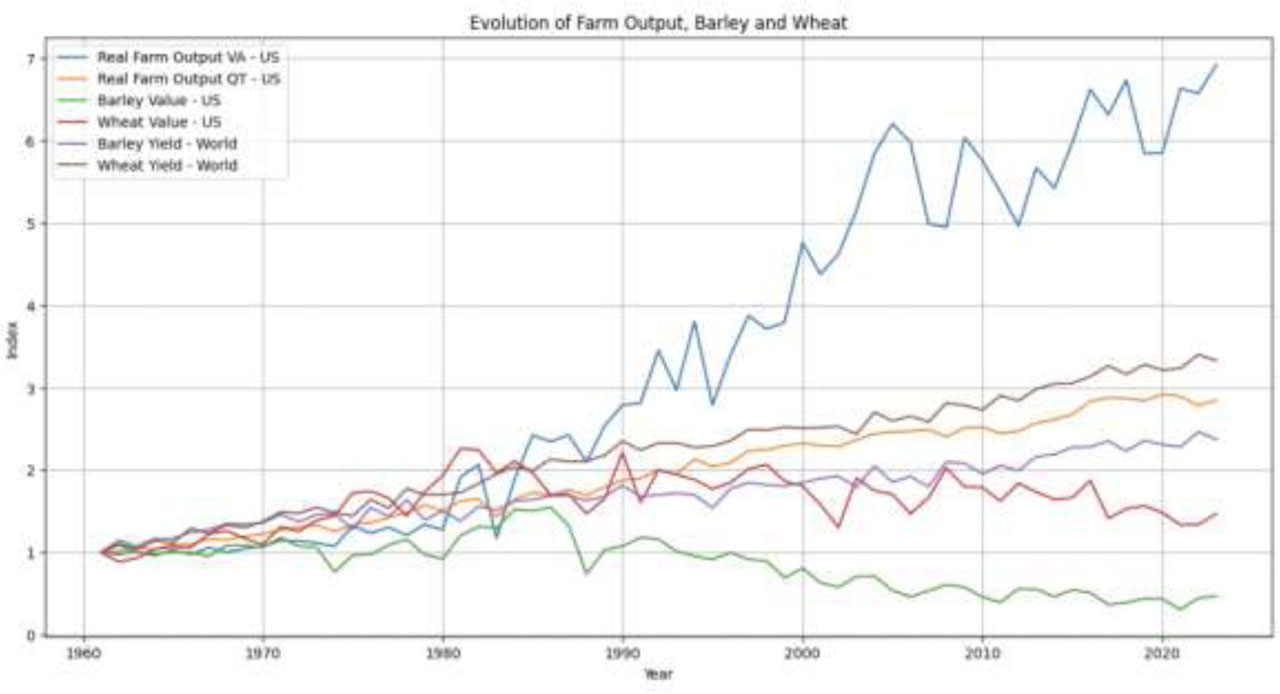
Figure 1:
Evolution of Farm Output, Barley and Wheat - 1960
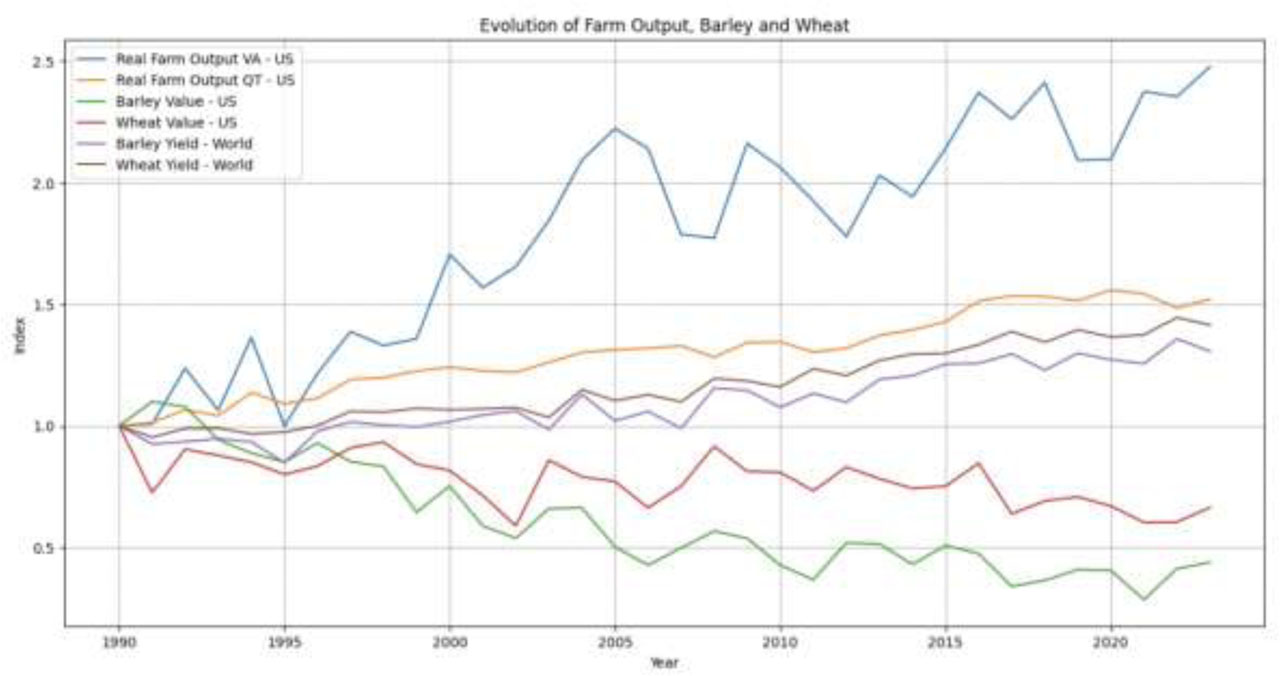
Figure 2:
Evolution of Farm Output, Barley and Wheat - 1960
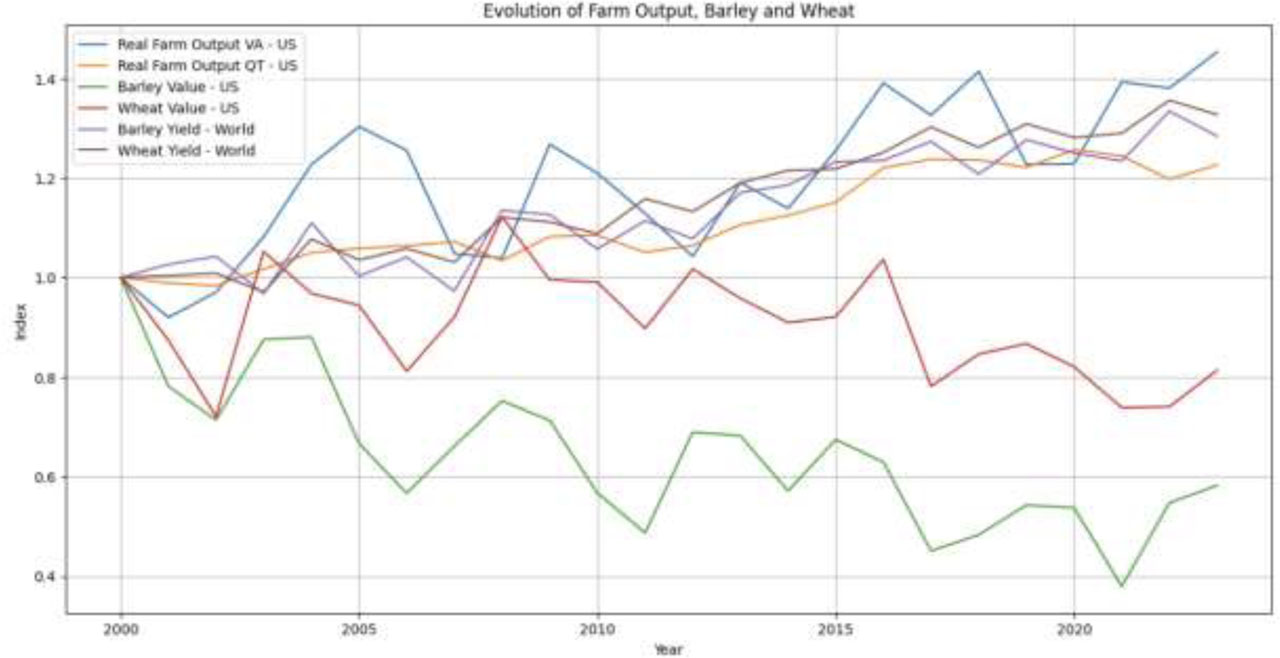
Figure 3:
Evolution of Farm Output, Barley and Wheat - 2000
7. Conclusion
The present study examined the historical and structural evolution of Agricultural Cybernetics within a comprehensive analytical perspective. The findings suggest that Agricultural Cybernetics does not emerge merely as a technological derivative of mechanization or digital innovation, but rather as a gradual structural transition in the organizational and regulatory architecture of agricultural production. From the phase of industrial intensification and agribusiness consolidation to the contemporary integration of digital infrastructures and sustainability-oriented practices, agriculture appears to have progressively incorporated elements of coordination, feedback and systemic adjustment. The empirical analysis covering the period 1960–2023 furnishes corroborating evidence for this interpretation. While physical agricultural output demonstrated sustained growth over time, value-added displayed greater volatility, indicating that productivity expansion proceeded alongside increasing economic complexity. In addition, the structural reallocation observed between major crops such as wheat and barley reflects broader realignments in land use, yield prioritization and institutional orientation. These developments point toward a structural evolution that extends beyond marginal technological improvement and relates more closely to changes in the way agricultural systems were organized, evaluated and integrated within market structures. Within this framework, Agricultural Cybernetics may be interpreted as a regulatory paradigm that prioritizes observability, controllability and systemic coordination. The progressive incorporation of feedback mechanisms, digital monitoring capacities and coordinated production–market interactions situates agricultural development within the wider processes associated with the Cybernetic Revolution. Agriculture, therefore, increasingly operated within a structured environment where technological, institutional and economic dimensions converged in determining production dynamics. The implications of this analysis are simultaneously analytical and policy-relevant. Sustained output growth alone does not necessarily guarantee stability or enduring resilience. The evidence presented in this study highlights the importance of strengthening regulatory coherence, transparency and adaptive capacity within agricultural systems, particularly under conditions of climatic variability and market uncertainty. In this context, further analytical attention should be directed toward the interplay between technological integration and institutional frameworks in shaping the long-term evolution of agricultural systems. The four-period framework developed in this study makes possible a historically grounded analysis that traces the structural conditions under which Cybernetic regulation became progressively embedded in agricultural systems, connecting mechanization-era foundations to contemporary digital integration and providing a coherent basis for interpreting the long-term trajectory of Agricultural Cybernetics.