
1. Introduction
The minimum wage is the lowest legally permitted amount that an employer must pay an employee for work performed within a specific period (e.g., per hour, per day, or per month). Its purpose is to protect workers from exploitation, ensure a decent standard of living, and reduce social inequalities.
The basic definition of the minimum wage is: the minimum amount of money that law or a collective agreement man dates as a payment to workers for their work, irrespective of their productivity or the terms of their contract (ILO, 1970).
The objectives of the minimum wage system should be:
– To protect workers against under-income.
– Ensuring dignified living standards.
– Promoting fair competition among companies (preventing “downward wage competition”).
– To lower poverty and social exclusion.
– To stabilise the economy by increasing the purchasing power of the population.
There are several types of minimum wages: statutory minimum wages (e.g., Slovenia, France, Germany, Spain, Poland, etc.), which are set by law; agreed minimum wages, determined through collective agreements between employers and trade unions (e.g., Scandinavia, Italy, Austria, etc.), and sectoral or occupational minimum wages, which differ by industry and represent a hybrid system, such as a statutory minimum combined with a strong collective agreement (Germany, France, Belgium, etc.), or a minimum wage by industry or region (Switzerland, Japan, Canada, etc.).
The concept of the minimum wage has developed from the need for social justice, decent living standards for workers, and poverty prevention. It was first introduced in New Zealand and then spread to Australia, the UK, the US, France, and, gradually, to nearly every part of the world — today, it is also supported by international legislation and organisations such as the ILO. And if the main reasons for the introduction of the minimum wage in New Zealand, Australia and the UK were primarily to protect workers from exploitation (women and young people who often received lower wages), to prevent poverty among employees, and to promote social justice and stability at a time of rapid industrialisation, the introduction of the minimum wage in the US was also partly racially motivated (to prevent unfair competition in the labor market by African-Americans).
After World War II, the idea of the minimum wage began to spread quickly across Europe, Latin America, and Africa, often as part of social reforms, counter-revolutionary measures, or a requirement for economic aid. As early as 1928, the ILO adopted the first recommendation on the minimum wage, and in 1970, Convention no. 131 called on states to establish a minimum wage system (ILO, 1970).
Today, more than 90% of the world's countries have some form of statutory minimum wage. In the EU, this has become a matter of social policy coordination – a directive on adequate minimum wages was adopted in 2022 (European Commission, 2022).
2. Literature Review
Regarding the concept of the minimum wage, two common misconceptions exist: the first is that the minimum wage is the “invention of socialism,” and the second is that the minimum wage was first introduced in the United States to protect white workers from unfair competition by African Americans. In fact, New Zealand was the first country in the world to legally implement a minimum wage in 1894. The minimum wage was established by the Industrial Conciliation and Arbitration Act 1894, which created compulsory arbitration in industrial disputes and established minimum wages through special tribunals (Anderson, 2009; ILO, 1992).
The main reasons for introducing the minimum wage in New Zealand were (Brosnan and Wilkinson, 1988):
– Protection of workers from exploitation – especially women and young people, who often received lower wages.
– Preventing poverty among employees – ensuring a decent standard of living.
– Reducing industrial disputes – the law introduced a system of arbitration intended to decrease the need for strikes.
– Promoting social justice and stability during rapid industrialisation.
As previously mentioned, New Zealand was the first country to establish a mandatory minimum wage by law through arbitration tribunals. The next country to implement a minimum wage was Australia, which soon followed New Zealand with the renowned 1907 Harvester Case (Ex parte H.V. McKay), where Judge Henry Bournes Higgins declared that a “fair wage” should be “sufficient to sustain the worker and his family in a humble but dignified life”. This marked the official introduction of a standard of living as a criterion for determining the minimum wage (Macintyre, 2009).
These two countries were followed by Great Britain. In 1909, the Trade Boards Act was passed, which set minimum wages in industries such as the textile sector, where many workers, especially women, were paid very poorly (Rubery, 1978).
The Fair Labour Standards Act (FLSA), as part of President Franklin D. Roosevelt's New Deal reforms, introduced the minimum wage in 1938. The initial federal minimum wage was $0.25 per hour (Grossman, 1978). It should be noted that the introduction of the minimum wage was also racially motivated, particularly in the southern United States, as Roosevelt had to align the law with the interests of influential white labour unions, notably the American Federation of Labour (AFL). In the American South, many black workers were willing to accept lower wages because they were systematically excluded from trade unions, had less access to education, and faced employment discrimination; white trade unionists often pressured the government to implement a minimum wage to reduce competition from black workers, who were perceived as a “cheap labour threat” (Bernstein, 2001).
Thus, it turned out that some advocates of the minimum wage were openly motivated by the desire to protect white workers from competition from black and immigrant workers. Which, in practice, meant that the law (Sowell, 2004):
– Excluded many black workers, as it did not cover agriculture and domestic work, where many African-Americans worked.
– Indirectly hindered the employment of less skilled workers, who were often precisely black workers.
2.1. The concept of Minimum Wage in Totalitarian Countries
The Fascist regime of Benito Mussolini (1922–1943) did not specifically introduce a statutory minimum wage in a liberal-democratic sense. Still, it established a corporate system where wages were agreed between the state union and employers, under the control of the state, with the key features cited by De Grand (1995):
In 1926, the regime banned independent trade unions and introduced state-controlled trade unions.
– Wages and working conditions were determined within corporate councils (corporazioni), which were supposed to replace class struggle with “harmony between classes”.
– Wages were formally “agreed” but actually set from the top down, often with the aim of keeping labour costs low and supporting a state-controlled economy.
The Nazi regime under Adolf Hitler (1933–1945) did not establish a minimum wage but completely abolished free collective bargaining and trade union organisation, where it was vital (Evans, 2005):
– In 1933, the trade union movement was dissolved and replaced by the German Workers' Front (Deutsche Arbeitsfront – DAF).
– Salaries were determined by the state or DAF, often locally, through so-called work honorary books (Arbeitsbuch).
The main aim was maximum production and minimal workers' autonomy – the Nazis promoted the “people's community” (Volksgemeinschaft), aiming for “harmony” between worker and employer without class struggle.
Wages were regulated, but not necessarily in the form of minimum rates – the real objective was to prevent strikes and maximise control over the workforce.
In the Soviet Union (1922–1991), there was a minimum wage, but within the central planning system, the entire wage structure was determined by the state. The minimum wage was officially introduced in 1928 with the start of the first five-year plan, aiming to promote work and reduce disparities among workers. However, the wage system was strictly hierarchical – varying across industries, professions, regions, and so on, where market forces did not influence wages but were part of social and ideological engineering (e.g., encouraging industrial labour, punishing “parasitism”). Although wages varied, they were formally justified by the “social utility of work” (Gregory and Stuart, 2001; Davies, 1998).
2.2. International Expansion of the Concept of Minimum Wage after World War II
After World War II, Europe's reconstruction was closely linked to the development of the welfare state. The minimum wage became an important tool to ensure social security and stability.
Countries such as France (1950) and the Netherlands (1969) introduced statutory minimum wages as part of measures to prevent poverty and promote a fairer distribution of income. For example, France introduced SMIG in 1950, which was later renamed SMIC (Salaire Minimum Interprofessionnel de Croissance), where the minimum wage is regularly adjusted for inflation and economic growth (Bouchet-Valat and Ponthieux, 2012).
The minimum wage became an integral part of Europe's social protection system after World War II, often in response to economic instability and workers' social demands (Esping-Andersen, G. 1990).
The United States and the Anglo-Saxon world employed the concept of the minimum wage as a strategy against poverty and communism. Thus, although the minimum wage has existed since 1938 (the Fair Labour Standards Act), it became a broader social policy tool after the war. During the Cold War, it also became a tool in the ideological fight against communism—an indicator that capitalism can ensure justice without a planned economy. Over time, the minimum wage became an instrument to reduce poverty, especially in urban and racially diverse communities, or as Howell (2005) wrote: “After the war, increasing the minimum wage was a political tool to stabilise capitalism and reduce disparities that socialism would exploit to its advantage.”
Following the independence of many countries in Asia, Africa, and Latin America in the 50s and 60s, newly established governments often introduced minimum wage legislation, but without effective monitoring. The minimum wage was frequently a symbol of political modernisation. Yet, in practice, it had little impact on working conditions, largely because of the high volume of informal work and weak institutions. In developing countries, the minimum wage often failed to make a real difference because of low compliance with legislation and a lack of supervision (ILO, 1981).
In socialist countries after World War II, the concept of the minimum wage differed significantly from that in capitalist countries. It was based on the ideas of social equality, worker protection, and the provision of a basic standard of living within a planned economy. In these nations (e.g., the Soviet Union, Yugoslavia, and Czechoslovakia), the minimum wage was set administratively within the state planning system. Its aim was not to stimulate the labour market or to protect against poverty in the traditional sense, nor was it a reflection of market forces, but rather a planning category designed to provide a living minimum corresponding to the social function of work, primarily serving to:
– Ensure the worker's basic survival.
– Prevent social inequalities.
– Motivate labour within a socialist moral context.
The minimum and maximum wages were relatively close. In most socialist countries, the difference between the lowest and highest wages could not exceed ratios of 1:3 or 1:5, so wage ratios in the Soviet Union were tightly regulated, with the idea that no one could be significantly richer than another solely because of their position (Gregory, 2004). The minimum wage in socialist countries was primarily defined as a means of maintaining social equality, rather than as a safeguard against unemployment (Kornai, 1992).
Since employment was a constitutional right, it was nearly impossible for an individual to be without work. Therefore, there was no typical need for a minimum wage as a protection mechanism against unemployment, and unemployment did not exist in Yugoslavia in the traditional sense, so the minimum wage did not carry the same meaning as in the West (Woodward, 1995).
2.3. Weaknesses of the minimum wage
However, while the concept of the minimum wage has many benefits for workers, setting it too high can harm the entire economy and, ultimately, the workers it aims to protect.
One common criticism is that if the minimum wage approaches or exceeds 60% of the average wage, it can reduce motivation for education, extra effort, or promotion, as the differences between less and more demanding jobs become too small. This can demotivate productive workers and degrade work quality. Neumark and Wascher (2008) argued that when the gap between the minimum and average salary becomes too narrow, the logic of work motivation is disrupted, diminishing interest and initiative to progress or undertake more challenging tasks.
Economic research also frequently highlights that a very high minimum wage can decrease demand for low-skilled workers, as employers cannot justify higher labour costs. This issue particularly impacts young, less experienced, and marginalised groups. Raising the minimum wage has a statistically significant negative impact on the employment of young people and less skilled workers, as the cost of employing them increases (Card in Krueger, 1995).
Likewise, raising the minimum wage without adequate oversight encourages employers to turn to the informal sector, especially in countries with high labour costs and weak institutional frameworks (ILO, 2016). Therefore, if the minimum wage is set too high relative to the productivity of certain sectors, particularly in services or small businesses, companies may begin hiring illegally to avoid additional costs. This diminishes the state's tax revenues and undermines labour rights.
Among the negative effects of a (too) high minimum wage, it is also important to mention its impact on inflation and prices, as well as on labour market rigidity. An increase in the minimum wage often leads to higher prices in sectors heavily reliant on low-wage workers, which can generate inflationary pressures (Lemos, 2008). Consequently, higher minimum wages can raise costs for businesses, which may pass them on to consumers through higher prices for goods and services. This phenomenon, known as cost inflation, can diminish the purchasing power of the population. Additionally, (too) high minimum wages create rigidity in adjusting labour costs, which can harm a company's ability to adapt during times of crisis (OECD, 2015). A high minimum wage can reduce labour market flexibility and prevent companies from swiftly adjusting labour costs during economic fluctuations, potentially leading to more layoffs or reduced hiring during recessions.
The 2019 increase in Spain's minimum wage led to a notable decrease in hours and employment among low-paid groups (Bank of Spain, 2020). In Spain, the minimum wage was significantly increased by 22% in 2019 (from €736 to €900 gross per month). Although many workers welcomed the measure, it also had adverse effects on the labour market, especially in regions with lower productivity and among young and low-skilled workers. Analyses indicate that employment fell in certain sectors. There was also an uptick in part-time work and employment in the informal (grey) sector.
The comparatively high minimum wage in France limits opportunities for youth employment and results in minimal remuneration gaps, hindering upward mobility, the OECD found (2019). France has a long-standing tradition of a high statutory minimum wage (SMIC). In 2024, the gross minimum wage is around €1,766 per month, approximately 60% of the average wage. This narrow gap between minimum and average wages discourages taking on responsibility or pursuing further education. Due to high labour costs, companies are less likely to hire young people and beginners, leading to long-term youth unemployment.
However, the minimum wage can also cause problems in the opposite direction; the ILO (2023) notes that it has not provided Argentina with a minimum standard of living for a long time, as inflation is rapidly eroding its value. Argentina is a clear example of how inflation and political instability undermine the effectiveness of the minimum wage. Although the government regularly increases the nominal minimum wage, real purchasing power is falling quickly, with inflation exceeding 100% per year (2023–2024). As a result, the minimum wage becomes symbolic and can no longer guarantee a decent livelihood. Additionally, there are frequent large-scale protests by trade unions because the minimum wage does not keep pace with the rising cost of living.
3. Data & Methodology (Bold)
The minimum wage in Slovenia is a legal requirement that specifies the lowest amount an employer must pay to a full-time employee. The regulation is based on the Minimum Wage Act and is supplemented by collective agreements, government regulations, and legislative amendments.
3.1. Legal Regulation
Therefore, the minimum wage in Slovenia is outlined in:
– Minimum Wage Act (ZMinP),
– The provisions of the Employment Relationships Act (ZDR-1) concerning payments,
– Decrees issued by the Government of the Republic of Slovenia, which set the minimum wage each year.
Article 2 is especially important: A full-time employee is entitled to a salary at least equal to the minimum wage (ZMinP). The minimum wage was first introduced in 1995, when it was established in the then Employment Relationships Act. The special Minimum Wage Act (ZMinP) was enacted in 2010, when the minimum wage was recognised as an independent right. In 2020, a significant reform was implemented, whereby most wage supplements (such as those for night work and public holiday work) were excluded from the minimum wage, requiring the basic wage, excluding supplements, to be at least equal to the minimum wage.
The amount of the minimum wage is determined each year in January, considering:
– growth in the cost of living (inflation),
– economic conditions,
– productivity and wage developments in the country.
As of 2020, the minimum wage must be at least 20% higher than the minimum living costs calculated by the Statistical Office of the Republic of Slovenia or the Institute for Economic Research.
3.2. Minimum Wage Trends in Slovenia
Table 1:
Overview of the minimum wage in Slovenia by year (gross minimum wage in September from 2006 to 2024 inclusive) and factors that influenced the changes
| Year | Minimum Wage | Notes |
|---|---|---|
| 2006 | 538.53 | |
| 2007 | 566.53 | |
| 2008 | 589.19 | |
| 2009 | 597.43 | |
| 2010 | 734.25 | Minimum Wage Act adopted |
| 2011 | 748.10 | |
| 2012 | 763.06 | |
| 2013 | 783.66 | |
| 2014 | 789.15 | |
| 2015 | 790.73 | |
| 2016 | 790.73 | |
| 2017 | 804.96 | |
| 2018 | 842.79 | |
| 2019 | 886.63 | Preparation for legislative change |
| 2020 | 940.58 | Exclusion of supplements from the minimum wage |
| 2021 | 1024.24 | |
| 2022 | 1074.73 | High inflation |
| 2023 | 1203.36 | Significant growth due to price increase |
| 2024 | 1253.90 | Adjustment for inflation and costs |
However, the shift of the minimum wage towards the average wage is more concerning, as the ratio of the minimum wage to the average wage has been steadily decreasing.
Since 2006, when the ratio of the gross minimum wage to the gross average wage was 1: 2.2, or the minimum gross wage was 45.52% of the average gross wage (EUR 538.53 minimum wage, EUR 1183 average wage), this ratio has fallen to 1: 1.91 in 2024, meaning the minimum gross wage is now 52.94% of the average gross wage (EUR 1253.90 minimum wage, EUR 2389 average wage).
Table 2:
Comparison of the Minimum Wage, the Average Wage, and the Ratio between them
| Year | Minimum Gross Wage | Average Gross Wage | Average Net Wage | Ratio |
|---|---|---|---|---|
| 2006 | 538,53 | 1183 | 743 | 2,1967207 |
| 2007 | 566,53 | 1284 | 834 | 2,266429 |
| 2008 | 589,19 | 1391 | 894 | 2,3608683 |
| 2009 | 597,43 | 1440 | 933 | 2,4103242 |
| 2010 | 734,25 | 1494 | 973 | 2,0347293 |
| 2011 | 748,1 | 1524 | 990 | 2,0371608 |
| 2012 | 763,06 | 1525 | 991 | 1,9985322 |
| 2013 | 783,66 | 1523 | 1000 | 1,9434449 |
| 2014 | 789,15 | 1541 | 1008 | 1,952734 |
| 2015 | 790,73 | 1556 | 1010 | 1,9678019 |
| 2016 | 790,73 | 1584 | 1031 | 2,0032122 |
| 2017 | 804,96 | 1627 | 1061 | 2,0212184 |
| 2018 | 842,79 | 1682 | 1095 | 1,9957522 |
| 2019 | 886,63 | 1749 | 1133 | 1,972638 |
| 2020 | 940,58 | 1856 | 1212 | 1,9732505 |
| 2021 | 1024,24 | 1969 | 1277 | 1,922401 |
| 2022 | 1074,73 | 2023 | 1319 | 1,8823332 |
| 2023 | 1203,36 | 2221 | 1461 | 1,8456655 |
| 2024 | 1253,9 | 2389 | 1545 | 1,9052556 |
However, the ratio is even less favourable when we compare net wages, because average gross wages are taxed more than the minimum gross wages. Additionally, average gross wages already include bonuses (such as those for years of service or less favourable working hours, etc.), whereas the minimum wage does not. It should also be noted that minimum wage bonuses have been mandatory since 2022 and have increased the minimum wage by at least the bonus for years of service, which ranges from 3 to 5% for a worker with 10 years of service and from 6 to 10% for a worker with 20 years of service. Therefore, when comparing a worker with 20 years of service—one earning the minimum wage and the other earning an average wage—the real ratio in 2024 is not 1.902, but approximately 1.8 (assuming the lowest seniority bonus of 3%). In effect, the minimum wage already constitutes about 56% of the average wage.
However, since Slovenia still offers several tax-free wage bonuses, it would be more accurate to consider the worker's total income rather than just wages. This is because a worker earning the minimum wage is entitled to the same financial allowances for lunch and travel expenses as a worker earning the average wage—which is a unique feature in Slovenia and essentially functions as a social correction—thus impacting the actual reduction of the wage gap between the minimum and average wages. Furthermore, workers at the same company receive the same annual and winter holiday bonuses, which further influences the salary ratio. As a result, the overall remuneration difference between two workers within the same company is effectively diminished.
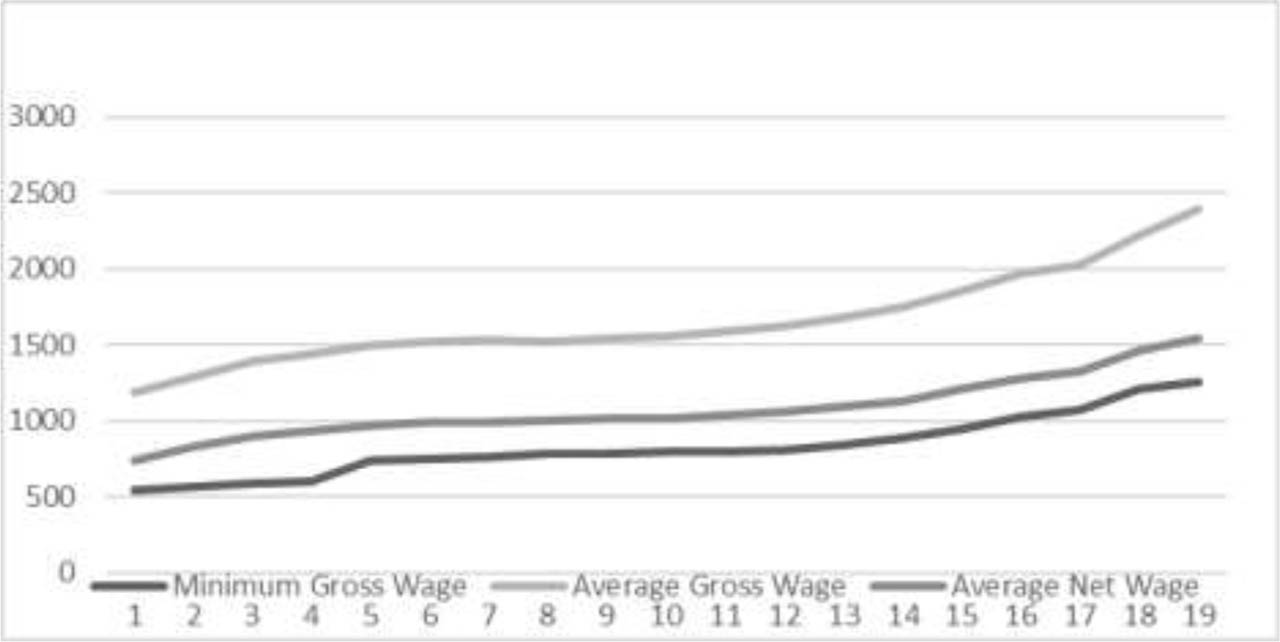
Graph 1:
Movement of Minimum (Gross) and Average Wage (Net, Gross) without Bonuses
Source: own
Thus, in Slovenia, we are already dangerously close to the magic 60%, which poses a risk given the weaknesses in the minimum wage outlined in Chapter 2.
4. Conclusion
The minimum wage acts as a social corrective, protecting workers from earning too little and ensuring a basic, decent standard of living, helping to stabilise the economy to some degree. However, it also has drawbacks, especially if it is set too high, if the ratio between the average and minimum wage is low, or if the minimum wage grows faster than the average wage annually. Nonetheless, many theorists have largely overlooked perhaps the most significant disadvantage of a high minimum wage. That is, in my view, the fact that the minimum wage often prevents certain groups from entering the labour market, even if they are willing to work for less than the set minimum (particularly those groups whose work prevents them from earning even the minimum wage but who wish to be independent of state aid in the labour market).
In Slovenia, however, given the movement of the minimum wage towards the average wage, there is a risk that it will lead the country into equilibrium, as it is growing much faster than the average wage. Between 2006 and 2024, the minimum wage increased at an average annual rate of 1.045, while the average gross wage grew by 1.037 annually. Therefore, during this period, the minimum wage rose approximately 2.33 times, and the average wage about 2.03 times. Another important point is that the growth of the minimum wage in Slovenia exceeds productivity growth, meaning other wages in the economy do not keep pace, resulting in an increasing number of workers earning the minimum wage. Employers, especially in low-added-value sectors, do not raise wages for other workers.
Therefore, it is not surprising that, according to the Gini coefficient, Slovenia consistently ranks among the countries with the lowest income inequality. If a pessimistic scenario is projected over a longer period, such as 40 years (the full length until retirement), the outlook appears quite disastrous, assuming the trend persists and we move toward a socialist redistribution model. The generation entering the labour market would, after 40 years of service, experience a ratio between the average gross wage and the minimum wage of only 1.41 to 1, meaning the minimum wage would reach nearly 71% of the average net wage. Such a situation would spell economic decline and threaten competitiveness. In that context, who would still find it worthwhile to pursue education or to be diligent, hardworking, and innovative?
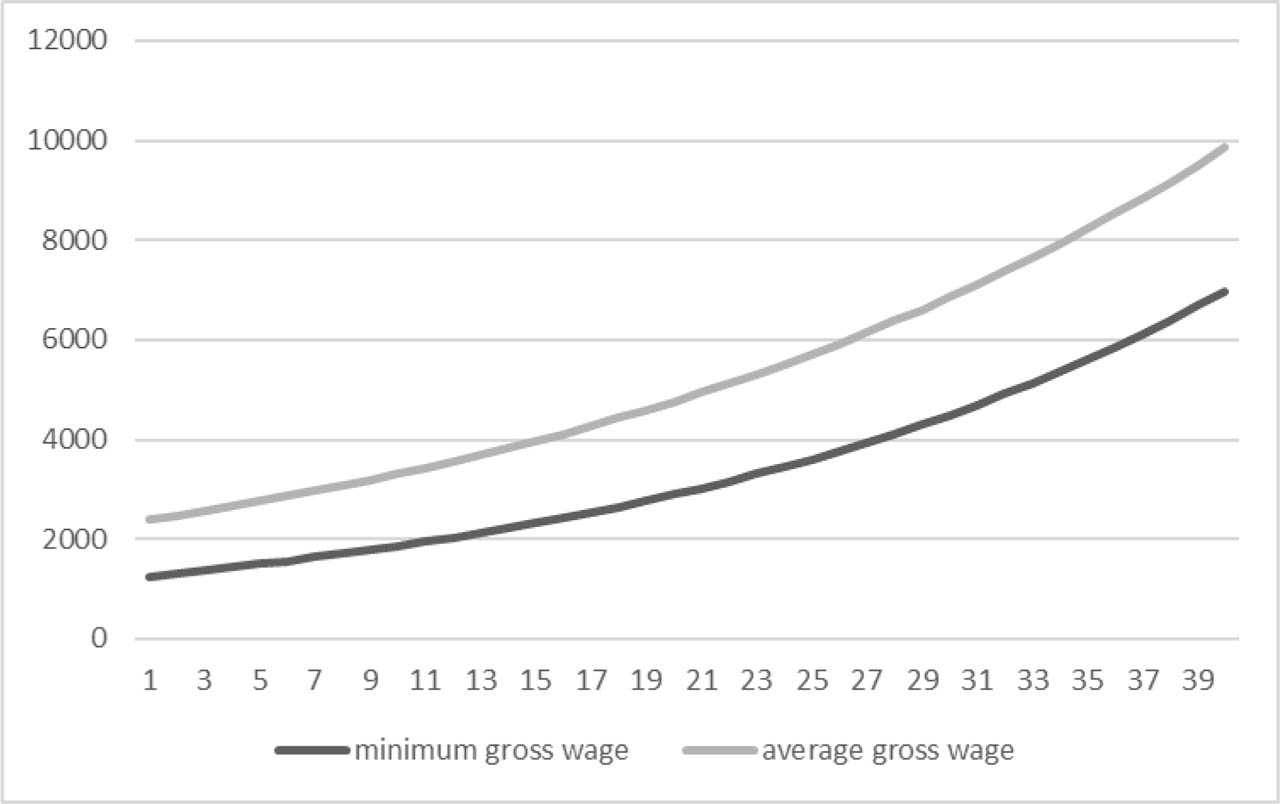
Graph 2:
Black Scenario if the Growth of the Minimum and Average Wages Continues at the Same Pace
Source: own
However, if the previously mentioned supplements are taken into account, this ratio of the minimum gross wage rises to approximately 80% of the average wage, which already amounts to an almost complete levelling.
Nevertheless, to maintain a reasonable ratio between the minimum and average gross wages, it might be sensible to tie the minimum wage to a percentage of the gross wage, for instance, by legally stipulating that it should not fall below 50% or exceed 55% of the average.
Action must be taken because, if this trend continues, a subtle slide into socialist equilibrium will harm the country and reduce the living standards of all citizens. It will also necessitate even more “imported” cheap labour, while educated, productive, and ambitious workers will flee to countries where their worth is recognised.