
1. Introduction
The connection between Croatia and China goes back to the distant past. This chapter begins by reviewing the development of the ancient Silk Road to the contemporary Belt and Road Initiative. It then presents three examples from different historical periods that illustrate the development of the relationship between the two countries. The first example is from the 13th century, the second from the end of the 1980s and the beginning of the 1990s, and the last example from 2019. The analysis will also cover the agreements that the Republic of Croatia and the People's Republic of China have signed since the independence of the Republic of Croatia, all in the context of the Belt and Road Initiative.
Among the approximately 200 countries in the world, only a small number form the backbone of social movements and direct other countries to the path of prosperity and development. Setting long-term goals and the policies that implement those goals are important to all of humanity and have a global impact. One of these countries is the People's Republic of China. The People's Republic of China is one of the most populous and most significant countries in the world, with an extraordinary history. The relations of the People's Republic of China towards all social problems and social movements have a global impact and consequences for other countries. The positions it advocates and the criteria it is guided by shape the politics of other countries, all the initiatives it advocates and implements are a reason for other countries to investigate the consequences of such activities on society and other countries. The People's Republic of China has historically recognized the importance of connecting with other areas and countries with the aim of mutual collaboration and cooperation.
Starting with the Silk and Road, which was not only a trade network within which trade and cooperation took place, but much more than that, such as the encouragement of multiculturalism and social cooperation. The diversity of the population in these areas contributed to the spread and exchange of knowledge, cultures, ideas, and beliefs, all of which influenced the people and their lives, and led to the development of learning and culture centers. Science and art, as well as entrepreneurship and technology, were exchanged on that route, and religions, cultures, and languages were intertwined (UNESCO, 2024). There is no doubt that the Silk and Road does not only represent a trade route from East to West, but it also enabled the creation of links between societies across Asia, Africa, and Europe, from East Asia to Great Britain, from Scandinavia to Madagascar. The various flows of people, products and ideas created by the Silk and Road have shaped history and a whole range of cultures (British Museum, 2024). It can be said that the contemporary successor of the Silk Road is the Belt and Road Initiative (BRI), or as it can be seen in the literature, the One Belt and One Road Initiative or the New Silk Road, which represents a modern proposal for cooperation between countries in several sectors; from infrastructural projects to satellite networks. The Belt and Road Initiative (BRI) is the largest infrastructural initiative ever proposed by a country, which was proposed in 2013 by Chinese President Xi Jinping.
The connection and relationship between the Republic of Croatia and the People's Republic of China dates back to the distant past, as far as the 13th century, when Marco Polo traveled to China. Marco Polo, although born in Venice in 1254, found his family roots on the island of Korčula in the Republic of Croatia (Orlić, 2013). It is indisputable that the Polo-Depolo family comes from the island of Korčula (visitkorcula, 2024). Marco Polo derives his importance also from the fact that he lived approximately 17 years in China, where he was appointed a local official during the Yuan Dynasty (1271–1368) in the city of Yangzhou, the economic center of Jiangsu Province (Xinhua, 2024). In his honor, there is today a Marco Polo Memorial Center in Yangzhou. We can say that 700 years ago, Marco Polo transferred the advanced techniques, materials, and products that China had at that time to Europe and the world, which represents an important moment for global development. Croatia's awareness of the importance of the cultural-historical-economic cooperation between Croatia and China is based, among other things, on the aforementioned past experiences which represent a significant foundation for current and future relations between Croatia and China, as they show that two nations, albeit from different climates and with different circumstances, can contribute to mutual prosperity, and more than that – contribute to progress for the whole world.
The modern history of relations between the People's Republic of China and the Republic of Croatia begins with the recognition of the Republic of Croatia by the People's Republic of China on April 27, 1992, and the establishment of diplomatic relations began on May 13, 1992. Since its independence, Croatia has signed a total of 66 international treaties and international acts with China. Analyzing the mentioned acts, it can be said that in the period up to 2000, 21 of them were signed, 19 from 2000 to 2009, 24 from 2010 to 2020, and 2 from 2020 to the present. The above-mentioned simple indicators speak in favor of continuous collaboration in improving relations between the two countries, especially in the economic field. A complete chronological overview of the signed agreements with the date of their recognition according to the Ministry of Foreign and European Affairs of the Republic of Croatia (MVEP) from 2024 is given in Appendix 1 at the end of this paper.
An excellent example of the connection and quality of the relations between the two countries is the organization of the aforementioned 16+1 Summit called “Building Bridges of Openness, Innovation and Partnership”, which took place in Dubrovnik in April 2019, and had around 600 participants (Balkan Insight, 2024). The 16+1 format has existed since 2012, and it represents Chinese cooperation with 16 Central and Eastern European countries, which include 11 members of the European Union. It is an example of an innovative approach to regional cooperation (Grieger, 2018). Such a format supports the activities of the BRI because its goal is to encourage economic cooperation between the members of the format, of which the Republic of Croatia is a member, with the crown of Croatian activity manifested in the already mentioned organization of the Dubrovnik Summit.
Despite the above-mentioned, according to Oehler-Sinca (2017), the Republic of Croatia belongs to the group of countries that are followers in the context of the intensity of cooperation within the 16+1 format. The 16+1 format throughout the historical period of activity showed dynamics and different approaches to the intensity of cooperation, so some members left the format. In contrast, others joined, for example, Greece in 2019 as part of the Dubrovnik Summit.
On that occasion, the Croatian and Chinese Prime Ministers visited the construction site of the Pelješki Bridge, which represents the first and the most significant project that a Chinese company carried out in the European Union at that time. The importance of the event is supported by the fact that the Chinese Prime Minister came to Croatia with 250 people, and during his visit, he held meetings and spoke with the Prime Minister, the President of the State, and the President of the Parliament. He signed six interstate agreements in Zagreb, and another four in Dubrovnik, of which it is worth noting the signing of a protocol allowing the sale of dairy products on the Chinese market, and a memorandum of agreement was also signed in which the Chinese side expressed interest in investing in certain areas. Cooperation is emphasized in the field of railway transportation, seaports, sports, education, and new technologies.
As a part of the Summit, the Economic Forum, organized by the Croatian Chamber of Commerce and the Ministry of Economy of the Republic of Croatia, was held. This was the most significant business gathering of this format ever, with more than a thousand participants. Participants included 130 large companies, more than 360 small and medium-sized enterprises, and over a hundred parties from the financial sector, agencies, startups, and others. At the Summit, the web platform of the Ministry of Economy of the Republic of Croatia was officially put into operation, which opened an access point as a mechanism for medium and small businesses within the 16+1 initiative.
Under the action of the mentioned format, there are very successful and some less successful examples of the progress of cooperation between countries, and Croatia is classified as a successful example, especially with an emphasis on the successful Dubrovnik Summit. The status and development of BRI in the Republic of Croatia can be assessed as a level of medium intensity, with some excellent examples of cooperation, which will be described in more detail in the following chapters. Comparing the status of BRI with that of other comparable countries, there are examples of more intensive cooperation, as well as those with much worse cooperation. Of course, the status of each country, and therefore Croatia's, is determined by different economic and political factors, so the participation of different countries is not expected to be of the same intensity.
2. Impact of the Belt and Road Initiative on economic ties between the PR of China and the Republic of Croatia
2.1. China-Croatia trade
The economic relations between Croatia and China are characterized by cooperation, primarily in the trade of goods. Accordingly, Table 1 presents the exchange of goods during the reporting period 2019 – 2023. The data presented indicate continuous growth in imports from the People's Republic of China over the observed years, with the highest growth in 2021. Croatian exports also peaked in 2021; however, in all other years, exports declined compared to the previous year. When observing only the period until October 2024, growth was recorded in comparison with the same period in the previous year. On average, imports were 11.4 times higher than exports during the observed periods. Improvement should be observed selectively, focusing on specific sectors, i.e. types of goods. Consequently, Graph 1 presents the five most exported types of goods to China in 2023.
Table 1.
China-Croatia bilateral trade in goods from 2019 to 2023 (million US dollar)
| Year | Total | Growth rate (%) | Export | Growth rate (%) | Import | Growth rate (%) |
|---|---|---|---|---|---|---|
| 2019 | 1540 | 0.2 | 1400 | 5.2 | 140 | −31.6 |
| 2020 | 1710 | 10.6 (11.04) | 1570 | 12.2 (12.14) | 140 | −4.2 (0) |
| 2021 | 2320 | 35.9 (35.67) | 1980 | 26.2 (26.11) | 340 | 147 (142.86) |
| 2022 | 2410 | 4.8 (3.88) | 2250 | 14.8 (13.64) | 160 | −53.3 (52.94) |
| 2023 | 2530 | 5.2 (4.98) | 2400 | 6.6 (6.67) | 140 | −13.6 (12.50) |
| 2024 Jan–Oct | 2400 | 12.7 | 2190 | 7.8 | 210 | 91 |
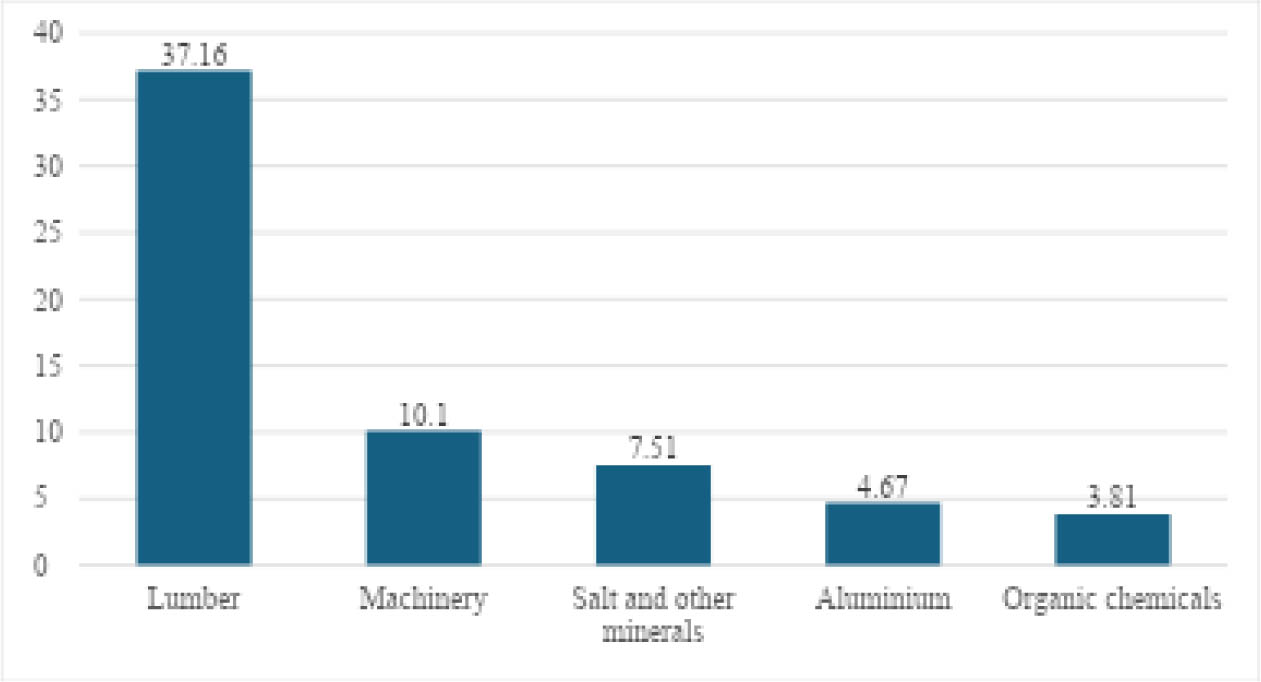
Graph 1.:
The number of exports of the five most important products from Croatia to the People's Republic of China in 2023 (in millions of US dollars)
The structure of the goods predominantly exported to the People's Republic of China in 2023 includes lumber (37 million USD), followed by various machinery (10 million USD) and other minerals, aluminum, and organic chemicals. These values are modest; however, the specified indicator should be interpreted in the context of Croatia's significantly smaller economy compared to China's. Given the size of the Chinese economy, Croatia cannot fulfill the demand for its products in China.
Nevertheless, despite specified facts, it is possible to increase current export values. To enhance trade efficiency, it is essential to address and remove obstacles that interrupt trade flows. A good example of a successful agreement between the two sides on removing trade barriers can be found in the agricultural sector. According to data from the Ministry of Foreign and European Affairs (MVEP, 2024), cooperation is successful in the agricultural sector, particularly in the export of dairy products to the People's Republic of China. The harmonization process started in 2014 and was completed in 2020 through the Harmonization model of certificates of veterinarian and public health requirements for dairy products between the Ministry of Agriculture of Croatia and the Administration of Customs of the People's Republic of China (GACC). Consequently, export of these types of products to the People's Republic of China was enabled herewith. During a visit of a GACC delegation to Croatia, after two years of negotiations, “Protocol on inspection, quarantine and sanitary requirements for aquaculture products exported from Croatia to China”was harmonized and signed between the Croatian Ministry of Agriculture and GACC, which enables the export of tuna to the Chinese market. It is important to state the need for further regulation harmonization for other products to facilitate their export to the People's Republic of China.
In November 2019, an agreement of cooperation in the field of geographical origin labels and their protection was signed between the EU and China. As a result, 96 European products with origin labels in China and 100 Chinese products with origin labels in the EU are protected from imitation and misappropriation. The decision to sign the Agreement was made by the EU Council in July 2020 and was signed in September 2020, coming into force in March 2021. Over the following four years, the Agreement will be expanded to another 350 geographical indications from both sides. Croatia wants to protect mandarins from Neretva, Kulen sausage from Baranja, prosciutto from Dalmatia, prosciutto from Drniš, prosciutto from Istria, and “Dingač” wine under this framework. The Agreement also includes a mechanism for additional inclusion of other indications of geographical origin.
The connection between the two countries, established through the BRI, should be evaluated as a long-term benefit of these initiatives. Although financial results may not be visible instantly, they represent a pledge and a basis for improvement of future economic relations. This represents yet another benefit of the BRI and is proof of the necessity to continue intense communication on trade flows. Considering the import of goods from the People's Republic of China to Croatia in 2022, products of semiconductors and electrical batteries are pointed out. These figures highlight the facts about the need for products that form a foundation of today's sustainable and green development, both in Croatia and globally. Such products can be delivered by the People's Republic of China at any moment considering its role of leadership in the production of state products globally. In this context, the BRI provides additional momentum to trade, thereby improving the conditions for green development by facilitating the trade of essential goods.
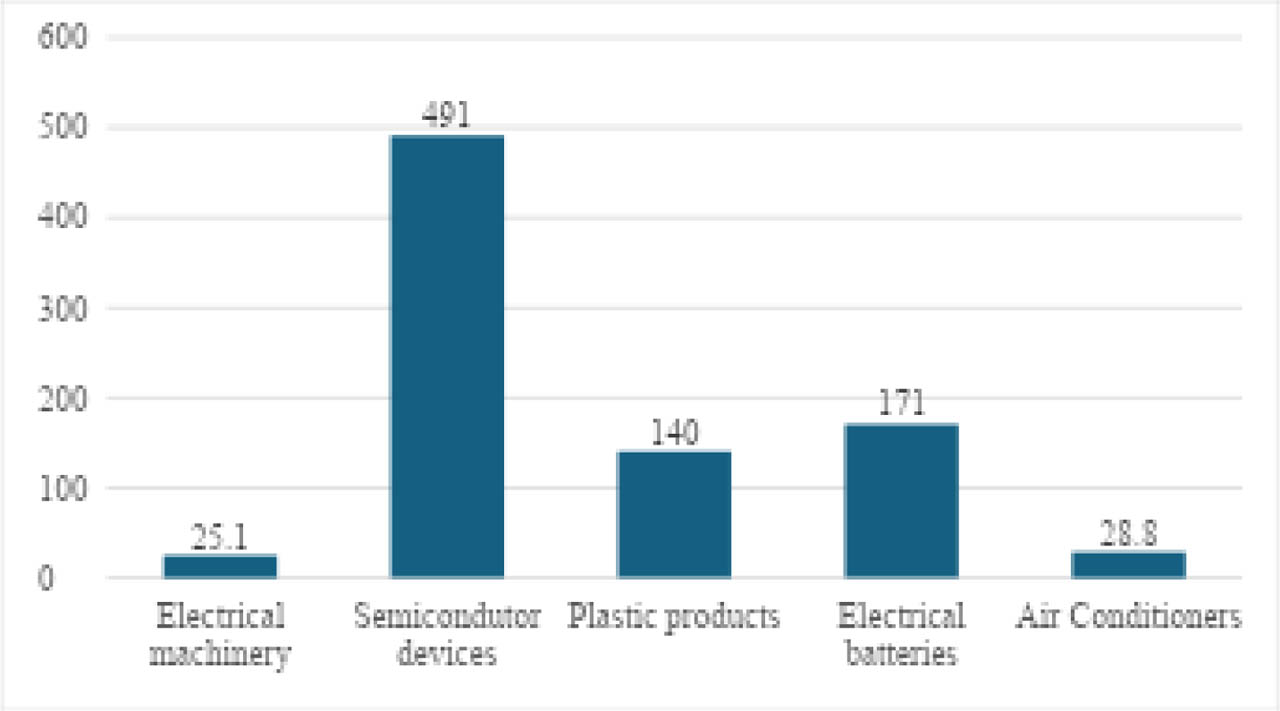
Graph 2.:
Percentage growth of exports from the People's Republic of China to Croatia by products in 2022
Unlike the trade of goods, which is limited by Croatia's production capacities, the trade in services represents an area where Croatia can contribute more significantly to bilateral cooperation. In particular, tourism stands out as a key sector. Croatian touristic products are among the most renowned and recognized in the world, with rich cultural-historical heritage and fascinating natural scenery. Therefore, BRI serves as a foundation for the development of tourist products in the Chinese market. The following table presents the number of arrivals and overnight stays of Chinese tourists in Croatia from 2021 to 2024.
Table 2.:
Number of arrivals and overnight stays of Chinese tourists in Croatia (2021 – September 2024)
| Reporting Period | 2021. | Growth Rate | 2022. | Growth Rate | 2023. | Growth Rate | I.–IX. 2024 | Growth Rate |
|---|---|---|---|---|---|---|---|---|
| Tourist Arrivals | 11 911 | −49,3% | 34 342 | +188% | 177 363 | +416% | 186 488 | +56% |
| Overnight Stays | 37 968 | −17,6% | 92 851 | +144% | 267 002 | +187% | 279 374 | +45% |
According to the previous data, it is evident that there has been a significant increase in arrivals and overnight stays of Chinese tourists in Croatia in the observed period, except for 2021, when a sharp decline in arrivals and overnight stays was recorded due to the impact of the COVID-19 pandemic in 2020, when strict international travel restrictions were in place. The further increase is a confirmation of the growing trend of the attractiveness of Croatia for citizens of the People's Republic of China. This is a strong indicator of the positive international relations between the two countries and the effectiveness of ongoing efforts to strengthen ties through the BRI. Further proof of Croatia's appeal is provided by the following graph, which illustrates the changes in the number of overnight stays after the reopening of the economy post-pandemic. The data clearly shows that the demand is consistent, and despite unfavorable circumstances, Chinese tourists want to come and visit Croatia.
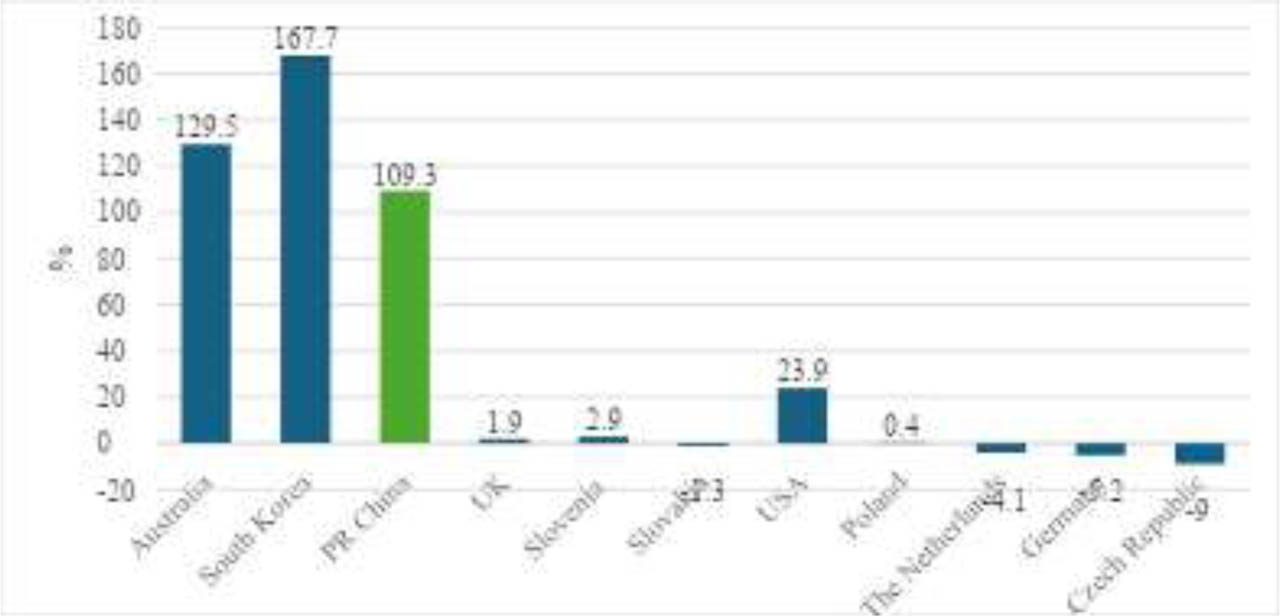
Graph 3.:
Rates of change in tourist overnight stays in Croatia by country in the 2022/2023 season
2.2. China-Croatia investment
Graph 4 presents investments from the People's Republic of China to the Republic of Croatia from 2012 to 2023. Ascending trends are evident, particularly between 2017 and 2020, and especially even more so after 2022. These developments can be attributed to Croatian activities within the BRI framework. Notably, Croatian representatives were actively involved in BRI forums in 2017 and 2019, during which one of the goals was to encourage FDI. One can conclude that BRI contributed positively and significantly to FDI from China to Croatia. To further clarify the scale of Chinese investments, a brief overview of specific examples follows.
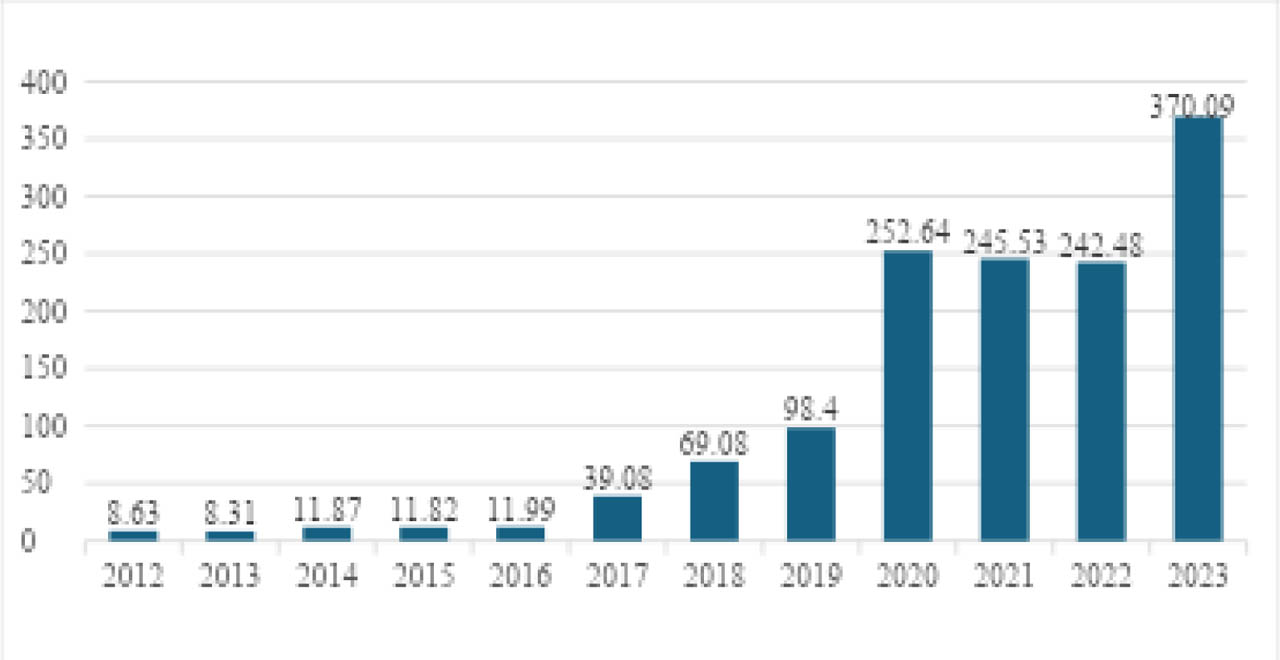
Graph 4.:
The total amount of foreign direct investment from the People's Republic of China to Croatia between 2012 and 2023 (in millions of US dollars)
Source: https://www.statista.com/statistics/865584/china-total-outward-fdi-stock-to-croatia/
In Jakovlje County, at the end of 2021, a new factory was built to produce aircraft parts (Airbus, Boeing, and Rolls-Royce) and began operating. This is a significant investment in Croatia by the company FACC Solutions with headquarters in Austria, valued at €33 million. The majority stake of FACC Solutions is owned by the Chinese corporation AVIC (Aviation Industry Corporation of China), which consists of about a hundred companies and employs 450,000 people. AVIC acquired FACC in 2009 and became its majority owner.
Considering indirect investments in the tourist sector, the “Gardens of Sun” hotels from Dubrovnik stand out. The German Chinese investment fund ADC GmBH took over the hotel in December 2016, which exited the Carlson corporation and its 51.3% share in Rezidor Hotel Group and is currently a member of The Leading Hotels of the World. Another example includes the investment by the Chinese company HNA Tourism Group, which finalized, in 2016, the acquisition of the hotel chain Rezidor, whose majority owner is Arenaturist, a chain of hotels and resorts in Croatia.
The cooperation between Croatian and Chinese companies is particularly active in the port and shipbuilding sectors, where several successful partnerships are distinguishable. The existing container terminal in the Port of Rijeka (Adriatic Gate Container Terminal) has been successfully cooperating with the Chinese shipbuilding company COSCO and introduced in October 2019 a new intermodal service, which is crucial for the port, Rijeka's traffic direction, and the entire country. The transport chain connecting overseas and railway transport from the People's Republic of China through the Port of Piraeus and the Port of Rijeka to Budapest and Belgrade places the Port of Rijeka in a unique position as the only transshipment port in the northern Adriatic.
The contract of the Port of Ploče and the Chinese CNBM for the bulk cargo terminal was signed in September 2014, as part of a wider project for the construction and equipping of the terminal and Port Ploče, following the public-private partnership model. As a concessionaire, Port of Ploče is responsible for the procurement of transshipment equipment. Whilst CNBM is in charge of building and developing equipment at this terminal. The contract is valued at €30 million, and the terminal was officially opened in February 2019. In 2018, a Chinese company acquired 75% of the shares of Luka Zadar LLC and obtained a concession for management of the terminal until 2039. Chinese partners recognized Luka Zadar as a strategic asset due to its efficiency, goods transported through the Port of Zadar reached their destination eight days faster compared to northern European ports. To Chinese partners, Zadar represents an important project in the scope of the BRI. “
It is also noteworthy to mention the cooperation between Atlanska plovidba d.d. and Chinese partners. Two bulk carriers with a deadweight of 82,000 tons were ordered from the shipyard Jiangsu Hantong Ship Heavy Industry Co., Ltd., and were delivered in 2023 and 2024. Additionally, from the same shipyard, three more bulk carriers with a deadweight of 63,500 tons were ordered and are scheduled for delivery in 2026 and 2027. The contract was signed in 2024. During 2022 and 2023, seven regular dockings were carried out at the CSSC Chengxi shipyard, while COSCO Shipyard conducted one docking in 2022.
Among the significant Chinese investments in Croatia, the largest project is the Senj Wind Park, which commenced in 2018. The Chinese company Norinco International acquired 76% of the shares in the company Energija Projekt for €32 million and built 39 large turbines, valued at €160 million, with a capacity of 4 MW each and a yearly production capacity of 530 million kWh. The wind park, located between Senj and Brinje, was completed in December 2021 and became the largest wind park in Croatia. Furthermore, one of the investments in the automotive industry came from Camel Group, which invested in “Rimac Automobili” in 2017. In return, Rimac Automobili announced in mid-February 2021 its expansion into key Asian markets by extending its international network of sales partners to Kingsway Group, a company specializing in the distribution of luxury cars and yachts in the People's Republic of China. Thanks to this partnership, a luxury showroom of “Rimac Automobili” was opened in Shanghai.
The most well-known and largest project delivered in Croatia by Chinese companies is the construction of the Pelješac Bridge by China Road and Bridge Corporation (CRBC). Construction of the Pelješac Bridge was declared the project of utmost strategic importance for Croatia, with a total value of €420 million. Of this, 85% or €357 million was financed through EU Funds. The bridge spans 2.4 kilometers in length and reaches a height of 55 meters, with four traffic lanes. The contract between the Chinese company and the Croatian roads company was signed in April 2018 in Dubrovnik. The bridge was completed at the end of January 2022 and opened to traffic in July 2022. This project represents an example of high-quality and high standards in conducting the work on a high-class level. For Croatia, it represents a unique national project that permanently connects two previously separated parts of the country, making Croatia's territory unified. Moreover, the Pelješac Bridge is also a significant achievement for the entire EU and its territory. On the basis of the excellent work of the CRBC company and gained references, in 2023, the same company signed a contract with the Croatian Roads company in Split for the construction of the connecting road junction at Vučevica on the highway A1 and the state road DC8. The project includes the construction of the tunnel Kozjak, which implies services of Chinese companies covering a length of 6.85 km in total. The value of the contract is €74.6 million (excluding VAT).
Other projects include the construction of a water purifier in the Rijeka agglomeration, which was executed by the Chinese company China Energy Engineering Group Jiangsu Power Design Institute, and the construction of a pipeline for water distribution from Hrmotine to Stinica, which was built by the Norinco Company.
In the opposite direction, it is important to mention some of the key Croatian investments in the People's Republic of China. Croatian company ALTPRO, in partnership with its Chinese counterpart, is actively promoting and selling its products in the Chinese market. The most important project is that with ALTPRO's M sensors, the company takes part in the construction of the metro in the Chinese city of Wuhu, with an investment valued at $300 million USD. The project was coordinated by the companies Bombardier and CRRC, and a new monorail line was completed in 2021. For this project, ALTPRO manufactured the first sensor for detecting trains on the light city railway, representing a step forward and an example of innovative products. In addition, the Croatian company Končar – measurement transformers signed in 2005 a contract with the Chinese company TBEA - Shenyang Transformer Group to establish a joint company named TBEA Končar (Shenyang) Instrument Transformers Co. Ltd. This company manufactures high voltage transformers from 123 to 750 kilovolts, utilizing Končar's know-how. Končar holds a 27% share in the venture. TBEA is a corporation with 16 subsidiaries and the largest manufacturer of energetic transformers in the People's Republic of China, which makes this company an essential player in this sector. Over the past six years, Končar Group has exported goods and services to China valued at €3.3 million. It is also important to highlight cooperation between the Croatian company DOK-ING and the Chinese company XCMG. In 2020, they founded a joint venture named XCMG DOK-ING Robotics Co. Ltd. This new company manufactures robotic systems and equipment for special purposes. DOK-ING contributes its proven technology for robotics, while XCMG brings production capacities and market expertise. Another significant Croatian investment is the expansion of the Infobip company into the Chinese market. Infobip established subsidiaries in Shenzhen, Beijing, Shanghai, and Hangzhou with the main goal of helping local companies and start-ups expand into international markets. Infobip's first office in China was opened in Shenzhen in 2014 (Wang & Miao, 2024).
An important institution that supports the implementation of the BRI is the Asian Infrastructure Investment Bank (AIIB). The Republic of Croatia joined AIIB on December 17, 2021, with a subscription of 5 million dollars, representing 0.0052% of the total capital and 1,424 votes, which is a share of 0.1261% of the total number of votes. AIIB focuses on sustainable green infrastructure and innovation as the main objectives of its activities. The bank's role is to finance projects that enable the given goal. AIIB is a multilateral developmental bank focused on the development of Asia but with members from all over the world. An important feature of the bank is its adaptability in achieving unique business solutions that help clients' business activities. The bank's operations have a local, regional, and global character with an emphasis on sustainability (AIIB, 2024). Funding opportunities within this institution give an additional incentive to the success of the implementation of projects within the framework of the BRI.
3. Review of challenges and recommendations according to the BRI in Croatia
The example of the Republic of Croatia shows how BRI can be useful for the community, as well as for all sides involved. In the past period, a whole series of projects and promotions of mutual cooperation was carried out, from the Chinese as well as from the Croatian side. BRI is a long-term platform for the cooperation of the People's Republic of China and all countries that participate in the platform. The Republic of Croatia is an active part of this initiative.
3.1. Placing Croatia-China cooperation on BRI within the broader context of China-EU relations
Possibilities and suggestions based on strategic plans for the relationship between the Republic of Croatia and the People's Republic of China should first be placed in a broader context. The broader context implies the fact that the Republic of Croatia is a full member of the European Union with all its rights and obligations arising from it. Croatia, as a member of the Eurozone and of the Schengen area, is an example of strong national integration into European flows. In this regard, the Croatian legislative framework must follow the standards and norms set at the level of the European Union. The positions of the European Union are taken into account when coordinating bilateral standpoints, so the relationship between the European Union and the People's Republic of China is important. The European Union is monitoring the relationship with the People's Republic of China as partner, rival, and competitor (Dura & Vandermeeren, 2024). The People's Republic of China is an important trade and economic partner of the European Union, the second largest after the USA. The People's Republic of China is also the largest source of imports and a significant supplier of goods to the European Union market.
From all previously mentioned, it follows that the relationship between the two world powers is intertwined and complex, which represents certain obstacles on one side, but, even more importantly, on the other side, also represents potential opportunities. It is important to note that the People's Republic of China is one of the key global actors in dealing with global challenges such as climate change and environmental protection, food security, and health protection issues, so it can be concluded that the direction of the future world movement also depends on this relationship. The current state of the frame of trade determinants between the European Union and the People's Republic of China is quite dynamic. The solution for diversity of the legal and economic system is continuous communication and adoption of legal acts and norms, which facilitates the exchange of goods.
3.2. Cooperation on tourism should be further promoted
The activity in which improvement can happen the fastest and most prominently is tourism. The analysis showed that a Croatian tourist product is extremely interesting for Chinese tourists and China is very attractive as a destination for Croats, not only because of the Great Wall of China, but also because of the many beauties it can offer all over the country. Indeed, the population of the Republic of Croatia represents an extremely small body of potential tourists, and this number cannot influence the movement of the Chinese tourism sector;. However, touristic activity has a much wider range of benefits than just tourism itself. Collaboration exists in that area, and one of the examples is also within the framework of the PR China-CEEC mechanism, where the Republic of Croatia is engaged in the work of the Center for cooperation in tourism, which is based in Budapest under the Ministry of Foreign Affairs and Trade of the Republic of Hungary. Its work is supported by a national coordinating team from the Central and Eastern European countries that joined the initiative. The cooperation has an extended network of partners in the business sphere in Europe and the People's Republic of China.
As part of the initiative, the Marko Polo Tourism Award is presented each year. The Marko Polo Tourism Award was launched in 2018 in Dubrovnik at the suggestion of the Croatian side, with the aim of creating and awarding the best joint product for the Chinese market in Central and Eastern Europe (Ministry of Foreign and European Affairs of the Republic of Croatia, 2024).
One of the most significant obstacles to a significant arrival of Chinese tourists in Croatia is the large geographical distance. The mentioned problem can be easily solved by introducing a direct airline between Croatia and China. Such a step would be beneficial in many ways, not only for the development of tourism but also for the overall development of the economy.
3.3. Tapping great potentials in other important areas
Transport infrastructure
There is considerable room for improvement in the economic performance of both sides, especially for infrastructural projects, i.e., with capital projects where large capacities and experience are important. Each country has its own advantages that it can provide to another country, albeit countries can be significantly different and incomparable according to fundamental economic determinants.
It can be said that the BRI in the Republic of Croatia has a whole range of possibilities. One of the most significant possibilities is within the framework of cooperation on the construction of infrastructural facilities or projects in the railway industry, for which there is a high demand in Croatia. Recommendations for intensifying cooperation in the mentioned area should certainly be viewed from a broader prism of the possibilities and presentation of the quality of work of companies that are interested in doing business in Croatia. Possible significant cooperation is also visible in seaport activities and shipbuilding. Specific experiences each side possesses can offer multiple benefits to both parties.
The foundations for the future progress of BRI in the Republic of Croatia can be laid based on past performances. Chinese companies in the Republic of Croatia, but also in the entire European Union, gained additional momentum and confirmation of quality by the construction of the Pelješki Bridge in the Republic of Croatia. The mentioned project of the Chinese company that was successfully executed and carried out at the highest world level shows an example where both sides can and should be satisfied, but it should also serve as an example of what future collaboration should look like. After the aforementioned pioneering project, Chinese companies responded to other infrastructure tenders in the Republic of Croatia as well, e.g., to railway infrastructure projects (the Hrvatski Leskovac-Karlovac railway, where two Chinese companies were among the 15 bidders - a contractor from the European Union was finally selected).
A potential significant obstacle in obtaining infrastructural tenders in the Republic of Croatia is represented by the situation in which a part of the project is funded by the European Union. Particularly, if the project is even partially financed with European funds, the European Union introduced an item in the legislative framework according to which Chinese companies have special treatment. Such a position of Chinese companies depends on finding a solution at the European Union-PR China level.
Green energy
One of the most significant opportunities is provided in the area of green energy (renewable energy sources). PR China, as one of the leaders of technological development in that area, and on the other side, the Republic of Croatia, which needs the implementation of the latest green industrial solutions to solve the issue of preserving its own natural resources and protect itself from environmental pollution, which requires highly developed technological solutions that Chinese companies possess.
High-tech sector
Furthermore, the possibility of cooperation exists in the production of high-value products (an excellent example is the cooperation between Croatian company DOK-ING and Chinese partners). As one of the possibilities, cooperation between companies with advanced technological development and new technologies stands out (an excellent example of a Croatian company is Infobip). Analyzing the state of BRI's involvement in the Croatian economy, it can be said that sometimes quantity is not as important as quality. In fact, extremely high-quality projects that are done in the Republic of Croatia represent the best foundation for even more significant future cooperation, as well as an example to other countries that, with a positive approach, the cooperation between the two countries brings benefits to society as a whole despite the smaller coverage.
Knowledge cooperation
The transfer of knowledge and acquired experience represents an important possibility for future cooperation because the knowledge-based industry is an unavoidable factor of growth and development. In that context, the exchange of knowledge on the example of the development of special economic zones is another possibility, and that's all in order to promote the efficiency of the economy and deepen the cooperation between the two countries.
4. Conclusion
The historical, cultural, and economic connection between the Republic of Croatia and the People's Republic of China goes far back in the past. Contemporary relations between the two countries are characterized by stability and mutual respect. The Belt and Road initiative represents the possibility of strengthening relations between the two countries, and the analysis in this paper showed the positive impact of the BRI on the Croatian economy. The Republic of Croatia is a member of the initiative and participated in forums organized within the framework of its activities. Active engagement of the Republic of Croatia and within the 16+1 format additionally strengthens the connection between the two countries and provides additional opportunities for economic, cultural, and social growth. The idea of the Belt and Road Initiative has been completed with the possibility of financing within the Silk Road Fund and the Asian Infrastructure Investment Bank (AIIB), of which the Republic of Croatia is also a member since 2021. Availability of financial resources provides an additional opportunity for financing future project activities and is a potentially important part of the implementation of project activities.
The cooperation within the framework of the BRI so far represents a quality foundation for deepening future cooperation based on the needs found on one side and the possibilities that can be found on the other side, to mutual satisfaction. Actual geopolitical instabilities must be viewed through the prism of time. Namely, the BRI initiative has a long-term character and as such is not subject to short- and medium-term turbulences, so it can be stated that the cooperation between the two countries within the framework of this initiative has a positive sign. It mainly comes to light if it is studied from the aspect of needs and possibilities, and the space for cooperation exists in infrastructural projects (especially railway), port management and shipbuilding, and renewable energy sources, which includes the entire chain of green infrastructure and energy products, high technology and innovation, and science and education.
Appendices
Appendix 1.: List of international treaties and international acts concluded between the Republic of Croatia and People's Republic of China (the) with date of conclusion
| International treaties and international acts | Date of conclusion |
|---|---|
| Joint Communique on the establishment of diplomatic relations between the Republic of Croatia and the People's Republic of China | 13.05.1992. |
| Agreement between the Government of the Republic of Croatia and the Government of the People's Republic of China on Trade and Economic Cooperation | 27.10.1992. |
| Protocol on consultations between the Ministry for Foreign Affairs of the Republic of Croatia and the Ministry for Foreign Affairs of the People's Republic of China | 07.06.1993. |
| Agreement on maritime transport between the Government of the Republic of Croatia and the Government of the People's Republic of China | 07.06.1993. |
| Agreement on cultural and educational cooperation between the Government of the Republic of Croatia and the Government of People's Republic of China | 07.06.1993. |
| Agreement between the Government of the Republic of Croatia and the Government of People's Republic of China concerning the encouragement and reciprocal protection of investments | 07.06.1993. |
| Joint statement of the Republic of Croatia and the People's Republic of China | 07.06.1993. |
| Protocol from the first session of the Joint Croatian-Chinese inter-governmental council on economic and trade cooperation | 15.09.1993. |
| Agreement on scientific and technological cooperation between the Government of the Republic of Croatia and the Government of the People's Republic of China | 11.04.1994. |
| Programme on co-operation in the fields of culture and education between the Government of the Republic of Croatia and the Government of the People's Republic of China for the years 1995, 1996 and 1997 | 16.09.1994. |
| Agreement between the Government of the Republic of Croatia and the Government of the People's Republic of China for the avoidance of double taxation and the prevention of fiscal evasion with respect to taxes on income | 09.01.1995. |
| Agreement on mutual exemption of visas between the Government of the Republic of Croatia and the Government of the People's Republic of China for holders of diplomatic and service passports | 09.01.1995. |
| Treaty on cooperation in the domain of aquaculture between the Ministry for Science and Technology of the Republic of Croatia and the State Commission for Science of the People's Republic of China | 10.09.1995. |
| Consular convention between the Republic of Croatia and the People's Republic of China | 05.02.1996. |
| Succession treaties between the Republic of Croatia and the People's Republic of China | 27.08.1996. |
| Agreement on cooperation between the Ministry for Interior Affairs of the Republic of Croatia and the Ministry of Public Security of the People's Republic of China | 26.02.1997. |
| Agreement on founding of inter-governmental Croatian-Chinese scientific and technological co-operation committee between the Government of the Republic of Croatia and the Government of the People's Republic of China | 06.10.1997. |
| Protocol from the fourth session of the Croatian-Chinese inter-governmental council on economic and trade cooperation | 13.11.1997. |
| Programme on co-operation in the fields of culture and education between the Government of the Republic of Croatia and the Government of the People's Republic of China for the years 1998, 1999 and 2000 | 27.02.1998. |
| Protocol from the first session of the Croatian-Chinese inter-governmental council on scientific and technological cooperation between the Republic of Croatia and the People's Republic of China | 18.05.1998. |
| Protocol from the second session of the Croatian-Chinese inter-governmental council on economic and trade cooperation | 09.11.1999. |
| Agreement on Cooperation in the Field of Tourism between the Government of the Republic of | 29.05.2000. |
| Croatia and the Government of the People's Republic of China Programme on co-operation in the fields of culture and education between the Government of the Republic of Croatia and the Government of the People's Republic of China for the years 2001, 2002 and 2003 | 07.11.2000. |
| Agreement between the Government of the Republic of Croatia and the Government of Hong Kong (SAR), Special Administrative Region of the People's Republic of China, on Air Traffic | 07.06.2002. |
| Article 9 (>Avoidance of Double taxation<) of the Agreement between the Government of the Republic of Croatia and the Government of Hong Kong (SAR), Special Administrative Region of the People's Republic of China, on Air Traffic | 07.06.2002. |
| Memorandum of understanding between the Ministry of Health and Social Welfare of the Republic of Croatia and State Administration of Tradicional Chinese Medicine of the People's Republic of China in the Field of Tradicional Medicine | 21.06.2004. |
| Plan of Cooperation between the Ministry of Health and Social Welfare of the Republic of Croatia and the Ministry of Health of the People's Republic of China in the Field of Health and Medicine for the Years 2004–2006 | 21.06.2004. |
| Programme on Co-operation in the Fields of Culture and Education between the Government of the Republic of Croatia and the Government of the People's Republic of China for the Years 2004, 2005 and 2006 | 14.10.2004. |
| Memorandum of Understanding on Cultural Cooperation between the Government of the Republic of Croatia and the Government of the Hong Kong Special Administrative Region of the People's Republic of China | 18.10.2004. |
| Memorandum of Understanding between the Ministry of Economy, Labour and Entrepreneurship of the Republic of Croatia and the National Development and Reform Commission of the People's Republic of China on the Co-operation of Small and Medium-sized Enterprises | 26.05.2005. |
| Joint Statement on the Establishment of Partnership in General Co-operation between the Republic of Croatia and the People's Republic of China | 26.05.2005. |
| Protocol of the Second Session of the Committee for Scientific and Tehnological Cooperation between the Republic of Croatia and the People's Republic of China | 23.11.2005. |
| The Cooperation Agreement on Agriculture between the Ministry of Agriculture, Forestry and Water Management of the Republic of Croatia and the Ministry of Agriculture of the People's Republic of China | 01.09.2006. |
| Memorandum of Understanding on Cooperation between the Office of Attorney General of the Republic of Croatia and the Supreme People's Procuratorate of the People's Republic of China | 25.10.2006. |
| Programme on Co-operation in the Field of Culture between the Government of the Republic of Croatia and the Government of the People's Republic of China for the years 2008–2010 | 14.05.2008. |
| Plan of Action between the Ministry of Health and Social Welfare of the Republic of Croatia and the Ministry of Health of the People's Republic of China in the Field of Health and Medical Science for the years 2009–2012 | 20.06.2009. |
| Agreement between the Government of the Republic of Croatia and the Government of the People's Republic of China on Economic Cooperation | 20.06.2009. |
| Air service Agreement between the Government of the Republic of Croatia and the Government of the People's Republic of China | 20.06.2009. |
| Protocol of the 4 th Session of the Croatian-Chinese Scientific and Technological Cooperation Committee | 03.11.2009. |
| Programme of Co-operation in the Field of Culture between the Government of the Republic of Croatia and the Government of the People's Republic of China for the years 2011–2013 | 02.11.2010. |
| Memorandum of Understanding between the Diplomatic Academy of the Ministry of Foreign Affairs and European Integration of the Republic of Croatia and China Foreign Affairs of the People's Republic of China | 10.05.2011. |
| Protocol of the 5th Session of the Croatian-Chinese Scientific and Technological Cooperation Committee | 19.09.2011. |
| Memorandum of Understanding between the Ministry of the Economy of the Republic of Croatia and the Ministry of Commerce of the People's Republic of China on Cooperation in the Field of Mutual Investments | 18.05.2012. |
| Memorandum of Understanding between the Ministry of Entrepreneurship and Crafts of the Republic of Croatia and the Ministry of Commerce of the People's Republic of China on preparing the | 02.11.2012. |
| Study on the Establishment of Croatian - Chinese Economic and Technological Zone Program of Cooperation in the Field of Education between the Ministry of Science, Education and Sports of the Republic of Croatia and the Ministry of Education of the People's Republic of China for the period 2013–2016 | 15.03.2013. |
| Protocol of the 6th Session of the Croatia-China Scientific and Technological Cooperation Committee | 18.12.2013. |
| Plan of cooperation between the Ministry of Health of the Republic of Croatia and the National Health and Family Planning Commission of the People's Republic of China in the field of health and medicine for the period 2014 – 2017 | 25.02.2014. |
| Action Plan between the Ministry of Agriculture of the Republic of Croatia and the Ministry of Agriculture of the People's Republic of China on Cooperation in the Field of Agriculture for the 2015–2016 | 21.01.2015. |
| Protocol of the 7th Session of the Croatia-China Scientific and Technological Cooperation Committee | 15.06.2015. |
| Programme of Cooperation in the Field of Culture between the Government of the Republic of Croatia and the Government of the People's Republic of China for the years 2016 – 2020 | 11.04.2016. |
| Memorandum of Understanding (MOU) On Port and Harbour Industrial Park Cooperation Between The National Development and Reform Commission of the People's Republic of China And The Ministry of Economy, Small and Medium Entrepreneurship and Crafts of the Republic of Croatia | 05.11.2016. |
| Minutes of the 11th Session of the Joint Croatian-Chinese Commission on Economic Cooperation | 16.03.2017. |
| Action Plan between the Ministry of Agriculture of the Republic of Croatia and the Ministry of Agriculture of the People's Republic of China on Cooperation in the Field of Agriculture for the 2017–2018 | 31.03.2017. |
| Memorandum of Understanding between the Government of the Republic of Croatia and the Government of the People's Republic of China on cooperation within the framework of the | 14.05.2017. |
| Silk Road Economic Belt and the 21st Century Maritime Silk Road Initiative Memorandum of Understanding between the Ministry of the Interior of the Republic of Croatia and the Ministry of Public Security of the People's Republic of China on cooperation during the tourist season | 12.09.2017. |
| Protocol of the 8th Session of the Croatia-China Scientific and Technological Cooperation Committee | 12.12.2017. |
| Program of Cooperation in the Field of Education between the Ministry of Science and Education of the Republic of Croatia and the Ministry of Education of the People's Republic of China for the period 2018 – 2022 | 07.07.2018. |
| Plan of cooperation between the Ministry of Health of the Republic of Croatia and the National Health Commission of the People's Republic of China in the field of health and medicine for the period 2018 – 2020 | 07.07.2018. |
| Memorandum of Understanding between the Ministry of Tourism of the Republic of Croatia and the Ministry of Culture and Tourism of the People's Republic of China on Cooperation in the Field of Tourism | 19.09.2018. |
| Protocol between the Ministry of Agriculture of the Republic of Croatia and the General Administration of Customs of the People's Republic of China on Veterinary and Public Health Requirements for Dairy Products to be Exported from Croatia to China | 10.04.2019. |
| Memorandum of Understanding between the Ministry of Economy, Entrepreneurship and Crafts of the Republic of Croatia and the Ministry of Commerce of the People's Republic of China on the Establishment of a Joint Investment Cooperation Working Group to the Joint Commission on Economic Cooperation | 10.04.2019. |
| Memorandum of Understanding between the Central State Office for Sport of the Republic of Croatia and the General Administration of Sport of the People's Republic of China on cooperation in the field of sport | 10.04.2019. |
| Memorandum of Understanding between the Ministry of Science and Education of the Republic of Croatia and the Ministry of Science and Technology of the People's Republic of China on joint funding of research and development projects | 10.04.2019. |
| Memorandum of Understanding between the Ministry of Tourism of the Republic of Croatia and the Ministry of Culture and Tourism of the People's Republic of China on cooperation in the field of special forms of tourism | 10.04.2019. |
| Plan of Cooperation between the Ministry of Health of the Republic of Croatia and the National Health Commission of the People's Republic of China in the field of health and medicine for the period 2022 – 2024 | 28.06.2022. |
| Agreement between the Government of the Republic of Croatia and the Government of the Special Administrative Region of the People's Republic of China for the Elimination of Double Taxation with respect to Taxes on Income and on Capital and the Prevention of Tax Evasion and Avoidance | 24.01.2024. |
[i] Source: Ministry of Foreign and European Affairs (2024)