
1. Introduction
One of the most important issues for African economies is job creation, especially given rapid population growth and high unemployment among young people. The continent’s working-age population is expected to be more than 1 billion by 2030, but economic opportunities have lagged behind. Although the macroeconomic policy proposal for growth is oriented towards trade liberalization and reform of the financial sector, very little empirical work exists on the link between merchandise trade and employment. This article investigates the effect of merchandise trade on labour market creation in eight African countries over (2000–2024), including Nigeria, Cameroon, Egypt, Ghana, Kenya, Rwanda, South Africa, and Morocco.
The chosen countries have varying economic systems, and trade and labor relations in the African continent. For example, Nigeria and South Africa are larger economies with more developed industries, while Rwanda and Cameroon are smaller agricultural ones. As pointed out in Figure 1, over the last two decades merchandise trade in these countries has registered an increase of major importance. This expansion is due to globalization, economic reformation and the success of projects like the African Continental Free Trade Area (AfCFTA). Much, however, depends on the channels and mediating factors, such as on domestic production capacity, access to finance, labor market flexibility, and political stability, through which expanded trade creates employment.
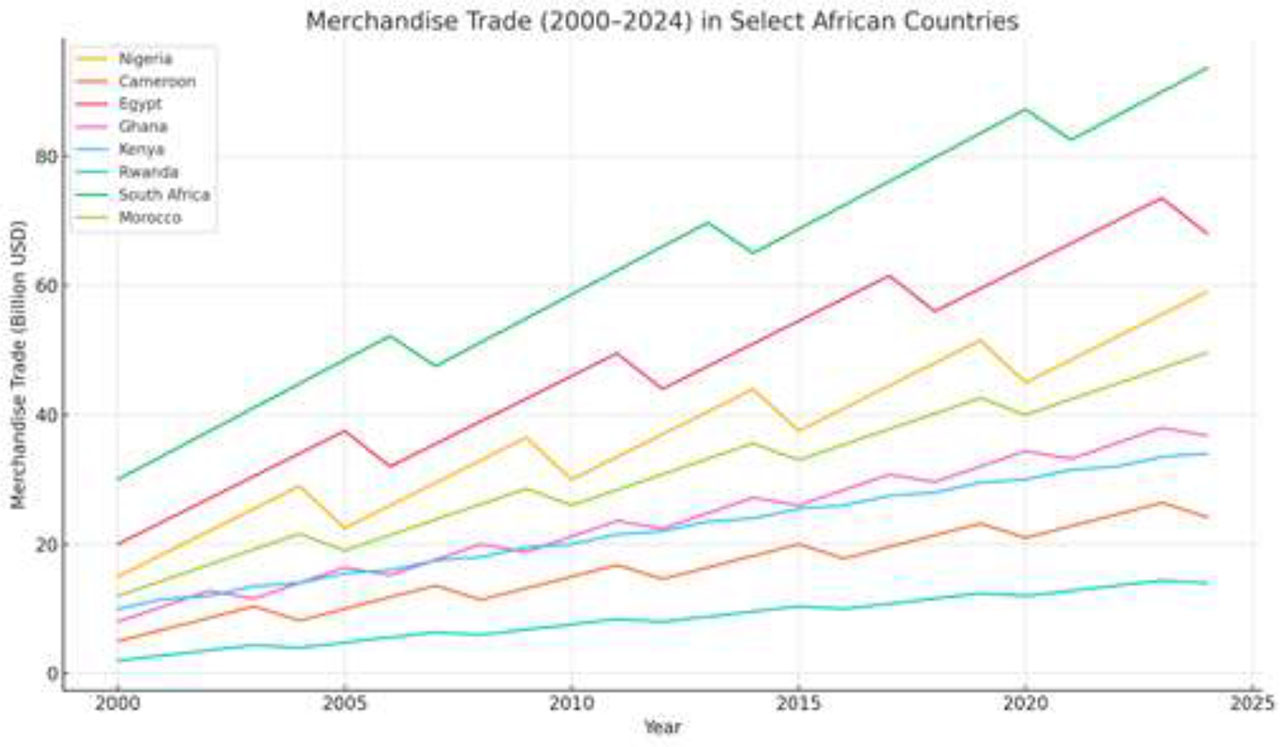
Figure 1:
Trend of merchandise trade (in billions of USD) from 2000 to 2024
2. Literature Review
A number of empirical analyses have examined the contribution of international trade and investment to promote growth and employment. Krugman (1994) and Sachs and Warner (1995) contended that on average, a 1% increase in trade openness leads to a 0.5–0.9% increment in GDP per capita in the long run, as a result of enhanced efficiency and innovation. In East Africa, Alemu (2016) noted that 10% growth of exports was associated with a 1.8% growth of the labor intensive industries such as manufacturing and services.
But it isn’t always a good relationship. Bai, others (2012 are instances in which greater foreign penetration of trade displaced domestic production and increased unemployment in the manufacturing sector by as much as 2.4 percentage points in West African countries that had underdeveloped domestic industries. Likewise, Rodrik (2018) argued that trade benefits do not automatically translate into labor market gains in the absence of supporting policies such as credit access, skills upgrading and infrastructure investment. For example, the Trade-Emp elasticity was stronger for countries with high credit-to-GDP ratios (> 40%) than for those with ratios < 20%.
The literature also underscores the case for African-specific trade and labor policy design in the light of the above. Intra-African trade and small and medium-sized enterprises (SMEs) are needed to help to combat the high unemployment rates in Africa (UNCTAD 2025). Rakotondrazaka (2025) also examined the impact of digital trade on employment generation especially in ITC-intensive sectors.
In a gender-disaggregated analysis, Gachoki and Mwang’ombe (2024) demonstrated that trade liberalization had positive effects on female employment in the East African Community, although sectoral differences and policy gaps moderated the results. Similarly, Abdulyekeen and Oyebamiji (2024) showed that trade liberalization’s effect on labor dynamics in Sub-Saharan Africa depends heavily on the strength of institutions and governance quality.
Using data from 1990–2019, Timmer et al. (2024) highlighted that export expansion contributed significantly to income and employment in Sub-Saharan Africa through backward linkages in input–output channels. However, evidence from the second-hand clothing industry suggests that trade can generate both positive and negative employment effects depending on the nature of the import (Humana People to People, 2024).
From a methodological standpoint, panel data models such as the Arellano and Bond (1991) dynamic GMM estimator have been widely employed to disentangle the complex interactions among trade, governance, and labor market outcomes. Despite increased scholarly attention on Africa’s evolving trade patterns, few studies have explicitly focused on merchandise trade’s impact on employment, especially using recent (2000–2024) data and incorporating moderating variables like political instability (Abdulyekeen & Oyebamiji, 2024; World Bank, 2021).
This study addresses this gap by analyzing the influence of merchandise trade and domestic private sector credit on employment generation in selected African countries, while controlling for political instability. In fragile economies, even modest gains in trade and finance access can be offset by high political risk, which increases investor uncertainty and weakens job creation. By accounting for these political-institutional variables, this research provides a more nuanced and policy-relevant understanding of the pathways through which trade flows and financial resources translate or fail to translate into tangible labor market improvements.
This issue is pressing, as the creation of jobs is a central concern in African development, where the population of young people is increasing rapidly and unemployment remains high (World Economic Forum, 2025; World Bank, 2025). Moreover, this study breaks with the conventional paradigm centered on GDP and concentrates on labor as an immediate and socially prominent development outcome. By empirically analyzing the cross-linkages between finance, trade, and governance on employment, the research contributes to policy debates regarding how financial sector development and economic liberalization can be made more inclusive and effective.
The research contributes to the economics literature through its multi-dimensional empirical framework that combines trade openness, financial development, and institutional stability to capture labor market performance. It also enhances the understanding of country heterogeneity across Africa via the use of fixed effects models. The findings are intended to support evidence-based policy design focused on domestic credit reforms and foreign trade negotiations, thereby channeling economic structures toward employment creation goals a matter that has received too little empirical attention in African contexts.
3. Data & Methodology
3.1. The paper seeks to answer the following questions
Does increased merchandise trade lead to higher employment in African economies?
To what extent does political instability mitigate or amplify the impact of trade and credit on employment creation?
The study uses two econometric methods fixed effect model as the main model while Ordinary Least Square (OLS) Model is used as comparison model to help identify the sources of variation in the data.
The model specification is shown as follows:
Equation 1: Model Specification
Where: Yi,t is the dependent variable (Job creation for country i, at time t; Xi,t is the parameter of interest (merchandise trade for country i, at time t; X′i,t represents the control variables; αi is the time invariant characteristics while εi,t is the idiosyncratic error term.Equation 2: OLS equation
Job_creationit is the employment to population ratio (for country i and year t)
merch_tradeit is the sum of merchandise exports and imports (for country i and year t), and X′i,t represents the control variable. While μ-Error term
Numerous research posits that OLS models are susceptible to endogeneity problems, as we still believe that the covariance (Job_creation, μI) ≠ 0. Hence, the fixed effect model was further used in this study to overcome this problem.
Equation 3: Fixed Effect Model
3.2. Data
This study uses secondary data from World Bank World Development Indicators (WDI) for the period 2000 to 2024 for the eight African countries with a sample size of 200. The primary sources of data are World Bank World Development Indicators (WDI) for merchandise trade, employment, credit to the private sector, and inflation. World Governance Indicators (WGI) for political stability.
Table 1:
Variable Description
| No. | Variable | Description |
|---|---|---|
| 1 | Labor_force | Number of employed persons (in millions) in each country per year |
| 2 | Merch_trade | Sum of merchandise exports and imports as % of GDP |
| 3 | Credit_private | Domestic credit to private sector as % of GDP |
| 4 | Pol_Stability | Index measuring perceived likelihood of political instability and/or violence |
| 5 | GDP_pc_current | Real GDP per capita (constant 2015 US$) |
| 6 | Inflation | Annual percentage change in consumer prices |
| 7 | Job_creation | Proportion of working-age population engaged in the labor market |
| 8 | FDI | Foreign direct investment, net inflows (BoP, current US$) |
The next section outlines regressions on merchandise trade, domestic credit to private sector, the political stability, and job-creation dynamics in eight African countries over 25 years. Two models are also estimated: an Ordinary Least Squares (OLS) regression and a Fixed Effects (FE) panel regression.
The aim is to ascertain if and how international trade and financial access affect employment creation, vis-à-vis political factors, and dynamic labor market dynamics.
Table 2:
Descriptive statistics of the regression
| Variable | Obs | Mean | Std. dev. | Min | Max |
|---|---|---|---|---|---|
| job_creation | 200 | 58.30141 | 14.15568 | 36.798 | 80.282 |
| merch_trade | 200 | 40.12748 | 14.95618 | 12.71246 | 93.19966 |
| credit_pri~e | 200 | 38.12144 | 36.13675 | 7.248348 | 142.422 |
| pol_Stabil~y | 200 | 26.26943 | 15.1236 | 2.415459 | 52.83019 |
From Table 2, the sample size is 200, with four variables and the mean and standard deviation as shown.
3.3. Regression Results of the OLS
Column (1) of Table 3 provides the OLS regression coefficients. This model predicts job creation from merchandise trade, domestic credit to private sector, and political stability, under the assumption that each country-level observation is independent and identically distributed.
OLS results are presented with a positive, but not statistically significant coefficient on merchandise trade (0.0632), a significant and negative coefficient on domestic credit to private sector (−0.248, p<0.01), a significant negative coefficient on political stability (−0.145, p<0.05), and a constant of 69.03, significant at the 1% level.
3.3.1. Limitations of OLS
While the OLS models provide some initial impressions, they are constrained by not being able to account for unobservable time-invariant country-specific attributes and have potential for a potential overstating of significance due to omitted variable bias (e.g., the surprising negative impact of political stability on employment above-mentioned), and at the same time both inability to tap dynamic relationships such as the effect of earlier level of employment support the use of a Fixed Effects model.
3.3.2. Results of the Fixed effect (F.E)
Column (2) of Table 3 shows the Fixed Effects regression results. This approach accounts for country-specific fixed effects by comparing within-country changes over time. It also includes a lagged dependent technical variable in order to account for the dynamic aspect of job creation.
In the Fixed Effects model, merchandise trade is now statistically significant and positively related to job creation (0.0746, p<0.01), domestic credit to the private sector is still negative and significant but with diminished magnitude (−0.0429, p<0.01), political stability now becomes positive and significant effect (0.0725, p<0.01), lagged job creation becomes significant (0.305, p<0.01). For the constant 37.16 is significant at 1% level.
Fixed Effects is better as it eliminates unobserved time-invariant country-specific effects by demeaning, which reduces bias from the confounding and at the same time, mitigate omitted variable bias from the reversal of political stability coefficient observed in OLS estimates, and addresses employment dynamics by adding a lags of the dependent variable to remove labor market autocorrelation over time.
Figure 2:
Main findings of OLS and fixed effects
| (1) | (2) | |
|---|---|---|
| OLS | Fixed Effe~s | |
| Merchandise trade ~) | 0.0632 (0.0600) | 0.0746*** (0.0179) |
| Domestic credit to~o | −0.248*** (0.0232) | −0.0429** (0.0179) |
| Political Stabilit~ | −0.145** (0.0577) | 0.0725*** (0.0222) |
| lag_job_creation | 0.305*** (0.0343) | |
| Constant | 69.03*** (2.175) | 37.16*** (2.290) |
| Observations | 200 | 199 |
The contrast between OLS and Fixed Effects models is indicative of the need for adequate modeling of panel data. OLS recommends unrealistic patterns erroneously indicating not only negative influence of political stability and strongly negative impact of credit, but, perhaps more importantly, the Fixed effects model, that includes control for unobserved heterogeneity and dynamic effects, suggest a much more credible, and policy-relevant overview.
The findings of the FE model indicate that within African countries growing merchandise trade and improvements in political stability are associated with more jobs. The effect of private sector credit, while still negative, seems more heterogeneous and less restrictive than the sample statistic from the OLS model. In addition, this prolonged effect of job creation in consecutive periods is supported by the strong significance of the lagged dependent variable.
This supports the above claim that Fixed Effects models are more appropriate to be used when analyzing employment effects of macroeconomic measures for multiple countries over time.
4. Conclusion
There are indications that trade in goods could strongly contribute to employment in African economies, provided it is underpinned by sound internal credit markets and political stability.
Policy relevance Policymakers in Kenya, Ghana, and Nigeria will find that the importance of these findings lies in the optimization of trade policy alongside labor policy. Rwanda and Cameroon can take a page from the increasing institutional good to use trade for equitable development.
The paper fills a gap by offering new empirical evidence on African trade and employment relationships, using a sound econometric model and new panel data. Further research might extend this analysis by using disaggregated trade data (e.g., high-tech versus low-tech goods) and assessing the sectoral implications for employment.
The inter-relationship between trade in goods, private sector credit, and job creation is multifaceted and Janus-faced, more so when it involves political limbo. This is still a question that is germane research-wise, if one takes into account the three core areas of economic development, financial transformation and governance, necessary to understanding and solving, the dynamics of the job creation process in the developing.
4.1. Merchandise Trade and Economic Growth
Merchandise trade is one major contributor to GDP Growth as it increases trade in goods, services, productivity and innovation (Bhattacharya & Admino, 1998). The role of the relationship between trade and growth is directly influenced by foreign direct investment (FDI) and trade policy among others that serve to augment the growth enhancing effects of increased flows of trade (Bhattacharya & Admino, 1998).
The absence of any real sort of customs data, especially in currency unions, is at best a real problem for getting T in a reliable measure of trade. Such situation destroys the effective analysis and policy development in the economy (Grigoli, 2007).
4.2. Domestic Credit to Private Sectors
There is, for example, a balance that needs to be reached in the provision of domestic credit to the private sector, which is important for domestic development by allowing businesses to extend, innovate and absorb more labour (Beck et al., 2006). Under conditions of macroeconomic stability, including low inflation and more moderate interest rates, the impact of credit on growth and employment is even stronger (Beck et al., 2006).
4.3. Political Risk and Credit Allocation
Political risk may have a significant impact on cŕedit allocation by increasing the risk premium and discouraging investment (Beckt a l., 2006). Additionally, institutional and political motivators such as corruption and government stability are critical to foreign investment inflows and domestic credit availability (Beck et al., 2006).
4.4. Political Instability and Employment t Generation
Political instability exerts too much adversity on economic operations generating an inefficient turnout in investment and little job creation (Ali, 2024). On the other hand, political institutional stability promotes investor’s confidence and a favourable climate for economic expansion and employment creation (Beck et al., 2006).