
Introduction
The Benin–Nigeria Shield exposed in Nigeria comprises rocks that are commonly grouped into the Migmatite Gneiss Complex, Schist Belts, and Pan-African granitoids [1,2,3]. The pyroxene gneiss which forms part of the basement cover in southeast Nigeria belongs to the Migmatite Gneiss Complex and has a reported age of 2062.4 ± 0.4 Ma from single zircon evaporation method [4]. These rocks outcrop in places such as the Okorotong, Bebi, Bogene, and Abado areas of Obudu (Figure 1). Lithologically, the rocks are mesocratic and coarse-grained with minor leucocratic bands appearing in some places. Ekwueme and Kröner [4] suggested the pyroxene gneiss may have originated from a metagreywacke or granodiorite protolith; Ugwuonah et al. [5], however, termed the rock a meta quartz diorite. The rocks have experienced high-grade metamorphism up to granulite facies [4,5,6]. This work aims to study the mineral chemistry obtained from an electron microprobe analyzer (EMPA) in order to distinguish the different mineral phases and thus infer their petrological significance.
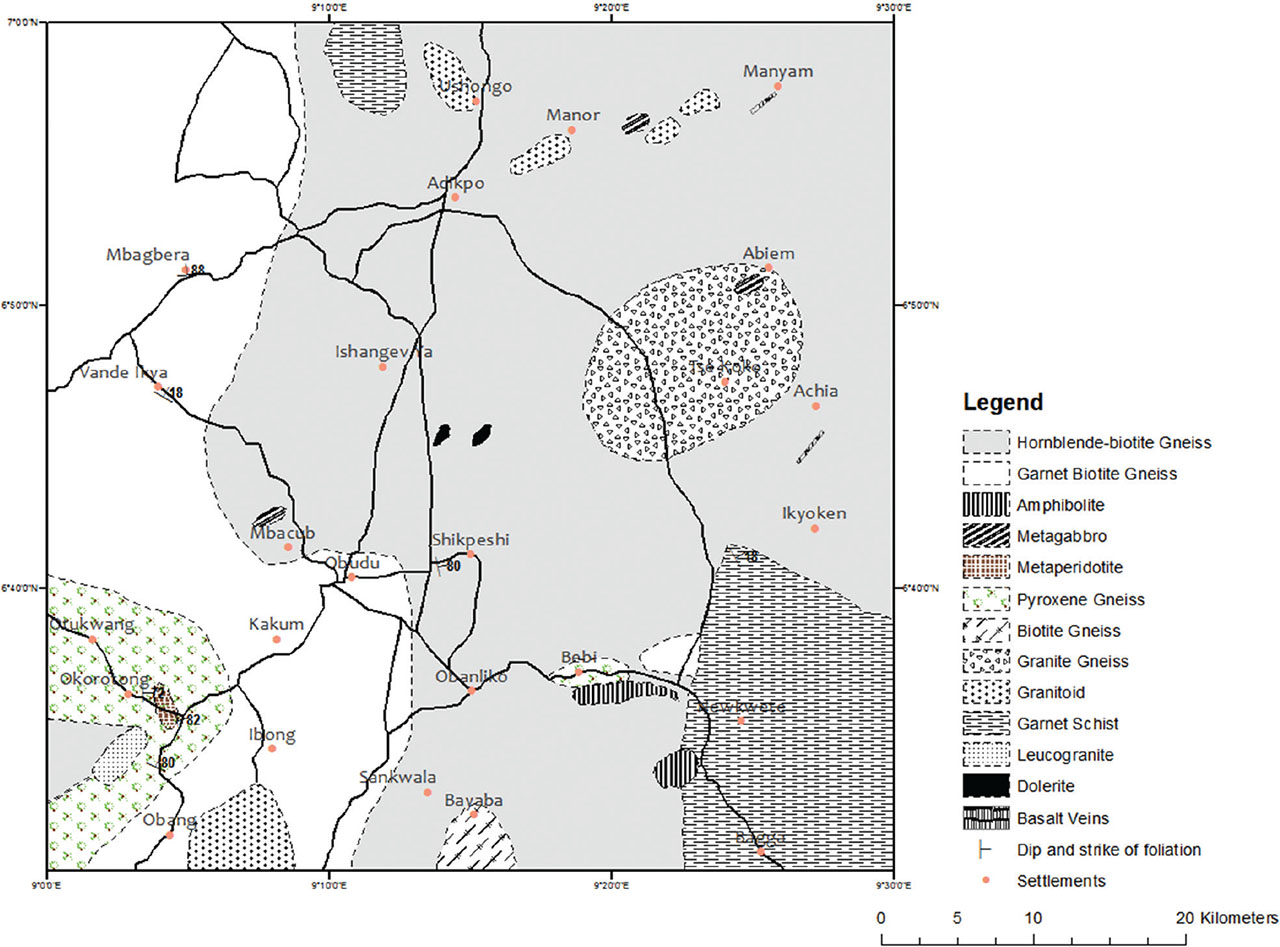
Figure 1:
Geologic map of Obudu Plateau.
Geological setting
The pyroxene gneiss which outcrops at Obudu is one of the rock types in the area (Figure 1). Other rocks occurring in the area include migmatite gneisses, granitic gneisses, amphibolites, and meta-ultramafics which have subsequently been intruded by granitoids and other unmetamorphosed rocks. These rocks, which form part of the basement cover in southeast Nigeria, have experienced at least three episodes of deformation [7]. Some of the rocks have been dated with ages of Paleoproterozoic, Neoproterozoic, and Pan African [4, 8]. The Nigerian basement complex is part of the Trans Sahara Orogenic belt and is situated within the reactivated region resulting from the collision of the West African craton and the Congo craton [3].
Materials and methods
The petrography of samples collected from the pyroxene gneiss was ascertained using a petrographic microscope at the Department of Geology, University of Calabar. Electron microprobe analyses were subsequently performed on two polished samples using a CAMECA SX FIVE FE at Ruhr Universität, Bochum, Germany. Analyses were performed using LTAP, TAP, LPET, PET, and LLIF crystals on five wavelength dispersive spectrometers at 15KV accelerating voltage, 15nA beam current, and 5μm probe diameter. Ten elements (Si, Al, Fe, Ca, Na, K, Ti, Cr, Mn, Mg) were quantitatively analyzed using natural and synthetic minerals as standards. The concentrations were calculated using the PAP matrix correction factors.
Results and discussion
Petrography
These rocks are weakly foliated, and, in some locations, metamorphic segregation is observed as irregular banding. One of the thin sections (IA5) was cut through a leucosome band. In terms of texture, the rocks are coarse-grained and exhibit deformation structures such as fractures, pinch and swell structures, and augens. Mineralogically, the rock contains the assemblage plagioclase + orthopyroxene + clinopyroxene + biotite + quartz ± k-feldspar ± amphibole. Accessory phases include ilmenite, magnetite, apatite, pyrite, and zircons. A slight alignment of minerals is observed under the microscope. Plagioclase is the dominant mineral in the matrix (40%–50% vol) and contains inclusions of quartz and apatite. K-feldspar is only present in the leucosome, where it is associated with plagioclase, quartz, and orthopyroxene. Hematite occurs as exsolved laths in ilmenite (Figure 2).
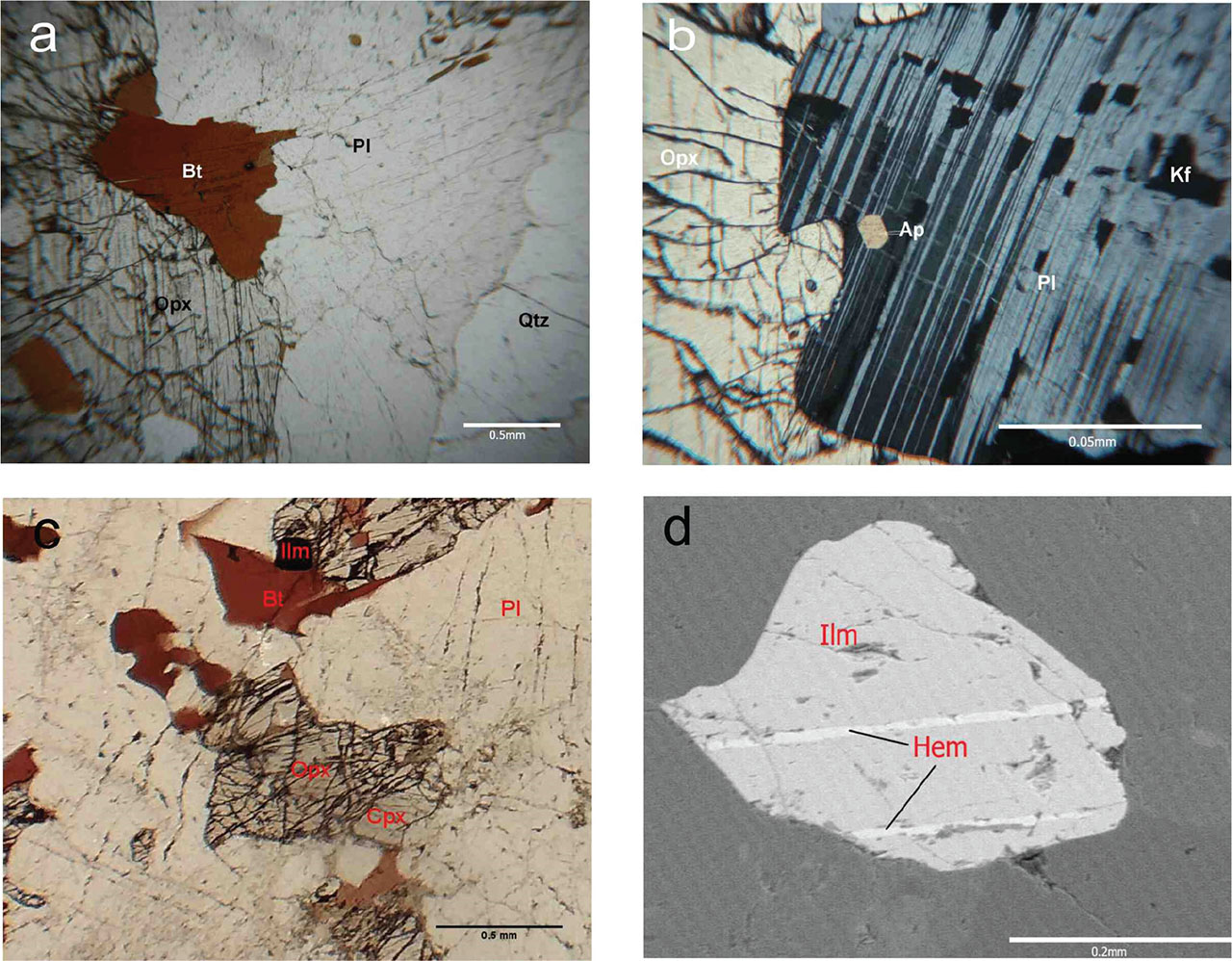
Figure 2:
Photomicrograph of pyroxene gneiss showing (a) mineral association of orthopyroxene + plagioclase+ biotite + quartz in sample IA5 (PPL); (b) Antiperthite texture in plagioclase of IA5 and apatite inclusion (XPL); (c) Mineral assemblage in sample IA3 showing clinopyroxene occurring alongside orthopyroxene (PPL); (d) BSE image of exsolved laths of hematite in ilmenite in sample IA3.
Mineral chemistry
Feldspar
The sodic plagioclase andesine (An30 to An37) with less than 4% orthoclase content occurs in the pyroxene gneiss. In the leucocratic band where antiperthite occurs, the exsolved laths are orthoclase-rich (Or 93 – 95, Ab4 – 6, An0.1 – 0.4) and occur within sodic-rich plagioclase of similar composition (An35) as the matrix plagioclase.
K-feldspar, where it occurred, had a similar composition to the exsolved laths in the antiperthite (Or 91, Ab9, An0.3). (Table 1, Figure 3).
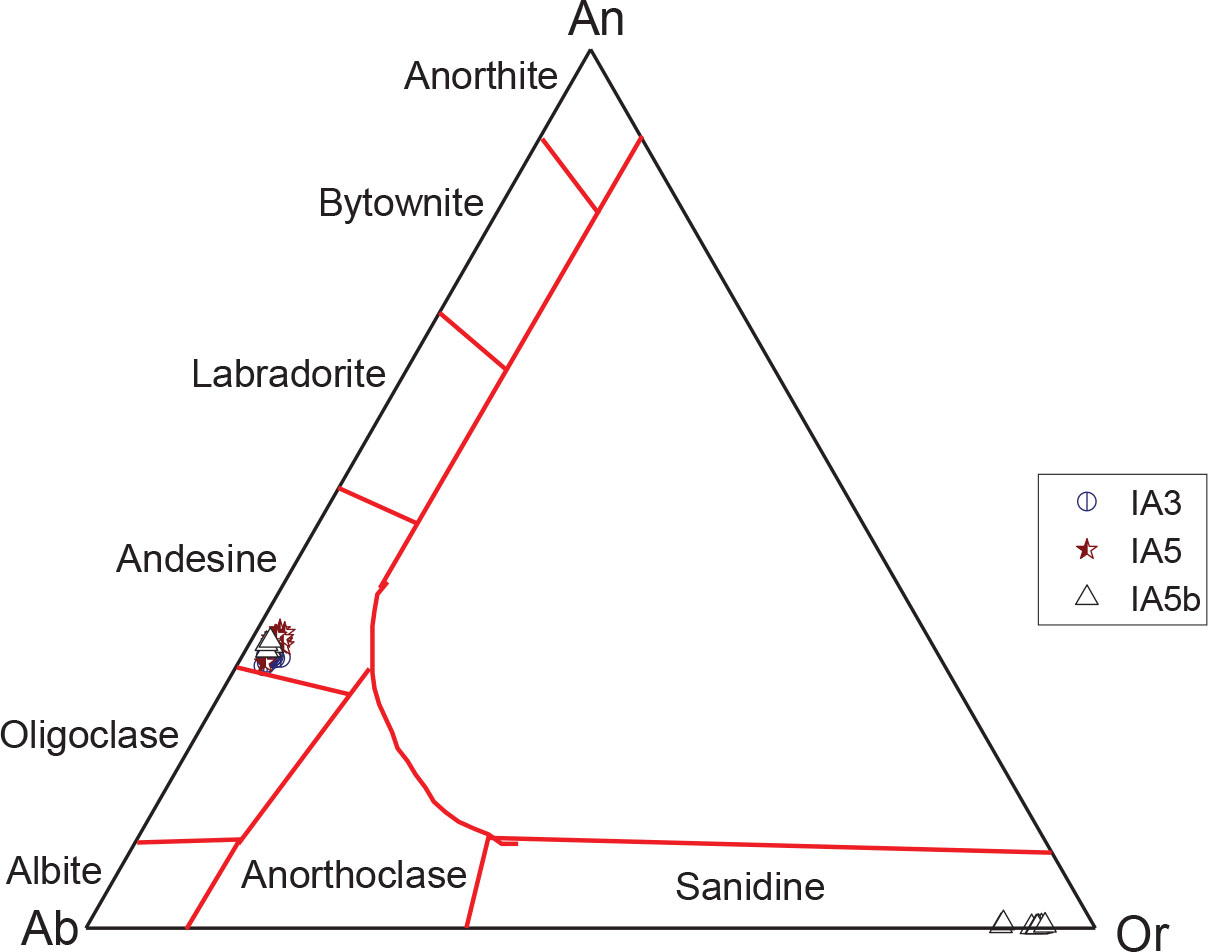
Figure 3:
An-Ab-Or plot for the pyroxene gneiss of Obudu showing andesine as the main plagioclase.
Table 1:
Representative chemical composition (wt%) and atom per formula unit of plagioclase based on 8 oxygen. (sample IA3/5).
| Sample | IA3 | IA5 | ||||||||
|---|---|---|---|---|---|---|---|---|---|---|
| Wt% | 1 | 2 | 3 | 4 | 5 | 1 | 2 | 3 | 4 | 5 |
| SiO2 | 60.55 | 60.58 | 60.57 | 60.48 | 60.44 | 60.13 | 60.07 | 60.20 | 59.91 | 60.95 |
| Al2O3 | 25.33 | 25.02 | 25.12 | 25.43 | 25.55 | 25.75 | 25.18 | 25.17 | 25.49 | 24.90 |
| FeO* | 0.09 | 0.09 | 0.11 | 0.10 | 0.11 | 0.02 | 0.05 | 0.05 | 0.10 | 0.07 |
| CaO | 6.31 | 6.48 | 6.67 | 6.36 | 6.55 | 6.82 | 6.75 | 6.72 | 6.91 | 6.24 |
| Na2O | 7.40 | 7.67 | 7.47 | 7.49 | 7.65 | 7.45 | 7.32 | 7.43 | 7.41 | 7.66 |
| K2O | 0.68 | 0.50 | 0.40 | 0.55 | 0.43 | 0.35 | 0.53 | 0.62 | 0.39 | 0.46 |
| Total | 100.36 | 100.34 | 100.35 | 100.41 | 100.73 | 100.52 | 99.90 | 100.19 | 100.20 | 100.29 |
| apfu | ||||||||||
| Si | 2.692 | 2.690 | 2.694 | 2.686 | 2.673 | 2.668 | 2.684 | 2.681 | 2.667 | 2.709 |
| Al | 1.327 | 1.309 | 1.317 | 1.331 | 1.332 | 1.347 | 1.326 | 1.321 | 1.337 | 1.304 |
| Fe3+ | 0.000 | 0.000 | 0.000 | 0.000 | 0.001 | 0.000 | 0.000 | 0.000 | 0.000 | 0.000 |
| Fe2+ | 0.003 | 0.003 | 0.004 | 0.004 | 0.003 | 0.001 | 0.002 | 0.002 | 0.004 | 0.003 |
| Ca | 0.301 | 0.308 | 0.318 | 0.303 | 0.310 | 0.324 | 0.323 | 0.320 | 0.330 | 0.297 |
| Na | 0.638 | 0.661 | 0.644 | 0.645 | 0.656 | 0.641 | 0.634 | 0.641 | 0.640 | 0.660 |
| K | 0.038 | 0.028 | 0.023 | 0.031 | 0.024 | 0.020 | 0.030 | 0.035 | 0.022 | 0.026 |
| Total | 5.000 | 5.000 | 5.000 | 5.000 | 5.000 | 5.000 | 5.000 | 5.000 | 5.000 | 5.000 |
| End Member Fractions (mol%) | ||||||||||
| An | 30.77 | 30.91 | 32.26 | 30.93 | 31.33 | 32.92 | 32.72 | 32.15 | 33.26 | 30.21 |
| Ab | 65.30 | 66.27 | 65.43 | 65.91 | 66.21 | 65.09 | 64.23 | 64.33 | 64.51 | 67.12 |
| Or | 3.93 | 2.82 | 2.31 | 3.16 | 2.46 | 1.99 | 3.06 | 3.52 | 2.23 | 2.67 |
Orthopyroxene
The orthopyroxene is hypersthene, as seen in Figure 4 and Table 2. XMg = 0.56–0.62.
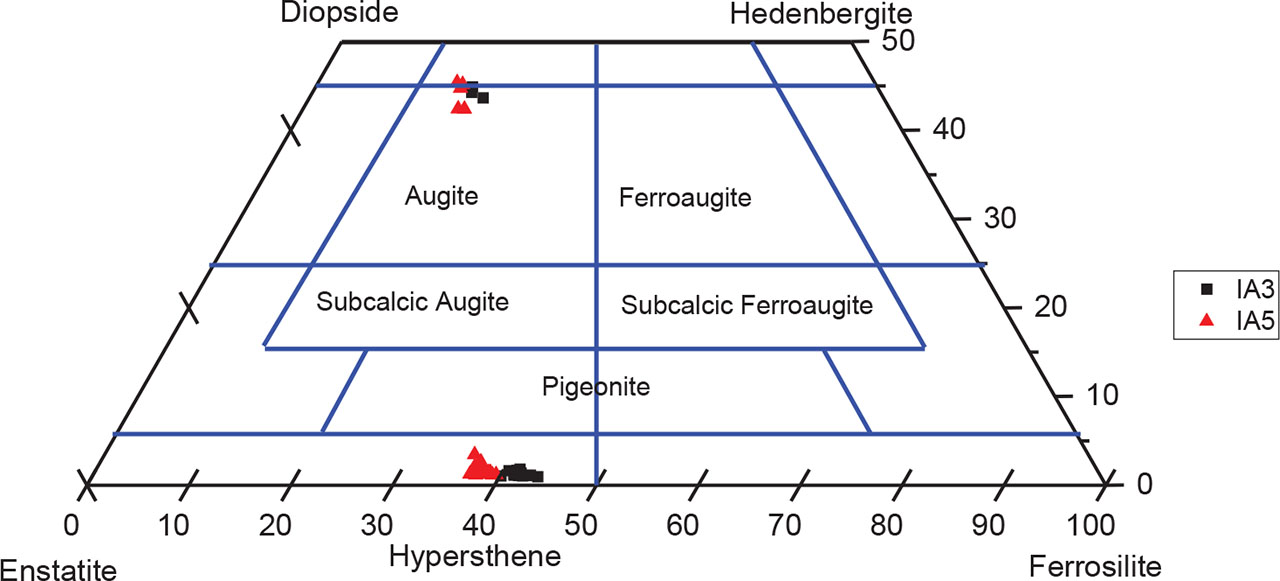
Figure 4:
Pyroxene triangular diagram showing the occurrence of hypersthene and augite in the pyroxene gneiss.
Table 2:
Representative chemical composition (wt%) and atom per formula unit (apfu) of orthopyroxene based on 6 oxygen. (sample IA3/5).
| Sample | IA3 | IA5 | ||||||||
|---|---|---|---|---|---|---|---|---|---|---|
| Wt% | 1 | 2 | 3 | 4 | 5 | 1 | 2 | 3 | 4 | 5 |
| SiO2 | 51.68 | 51.86 | 52.20 | 52.05 | 52.20 | 52.94 | 52.82 | 52.87 | 52.98 | 52.98 |
| TiO2 | 0.10 | 0.09 | 0.05 | 0.11 | 0.09 | 0.08 | 0.10 | 0.09 | 0.08 | 0.10 |
| Al2O3 | 0.87 | 0.85 | 0.92 | 0.77 | 0.80 | 0.49 | 0.58 | 0.53 | 0.57 | 0.64 |
| Cr2O3 | 0.02 | 0.01 | 0.00 | 0.03 | 0.00 | 0.05 | 0.10 | 0.05 | 0.05 | 0.08 |
| FeO* | 25.46 | 25.42 | 24.74 | 25.07 | 26.72 | 24.49 | 22.65 | 23.40 | 23.30 | 23.15 |
| MnO | 0.66 | 0.64 | 0.61 | 0.64 | 0.76 | 0.69 | 0.61 | 0.63 | 0.61 | 0.59 |
| MgO | 19.69 | 19.83 | 20.38 | 20.03 | 18.94 | 20.89 | 21.07 | 21.49 | 21.23 | 21.35 |
| CaO | 0.82 | 0.64 | 0.51 | 0.80 | 0.46 | 0.57 | 1.69 | 0.73 | 0.85 | 1.04 |
| Na2O | 0.00 | 0.02 | 0.01 | 0.03 | 0.01 | 0.00 | 0.05 | 0.00 | 0.04 | 0.04 |
| K2O | 0.00 | 0.01 | 0.00 | 0.00 | 0.01 | 0.03 | 0.01 | 0.00 | 0.01 | 0.00 |
| Total | 99.32 | 99.37 | 99.43 | 99.54 | 99.99 | 100.23 | 99.67 | 99.80 | 99.72 | 99.99 |
| apfu | ||||||||||
| Si | 1.971 | 1.975 | 1.979 | 1.976 | 1.990 | 1.989 | 1.985 | 1.985 | 1.992 | 1.985 |
| Ti | 0.003 | 0.003 | 0.002 | 0.003 | 0.003 | 0.002 | 0.003 | 0.002 | 0.002 | 0.003 |
| Al | 0.039 | 0.038 | 0.041 | 0.035 | 0.036 | 0.022 | 0.026 | 0.024 | 0.025 | 0.028 |
| Cr | 0.001 | 0.000 | 0.000 | 0.001 | 0.000 | 0.001 | 0.003 | 0.001 | 0.001 | 0.003 |
| Fe3+ | 0.013 | 0.007 | 0.000 | 0.008 | 0.000 | 0.000 | 0.000 | 0.000 | 0.000 | 0.000 |
| Fe2+ | 0.799 | 0.802 | 0.785 | 0.788 | 0.852 | 0.770 | 0.712 | 0.735 | 0.733 | 0.725 |
| Mn | 0.021 | 0.021 | 0.020 | 0.020 | 0.025 | 0.022 | 0.019 | 0.020 | 0.020 | 0.019 |
| Mg | 1.119 | 1.126 | 1.152 | 1.134 | 1.076 | 1.170 | 1.181 | 1.203 | 1.190 | 1.192 |
| Ca | 0.033 | 0.026 | 0.021 | 0.033 | 0.019 | 0.023 | 0.068 | 0.029 | 0.034 | 0.042 |
| Na | 0.000 | 0.001 | 0.001 | 0.002 | 0.001 | 0.000 | 0.004 | 0.000 | 0.003 | 0.003 |
| Total | 4.000 | 4.000 | 4.000 | 4.000 | 4.000 | 4.000 | 4.000 | 4.000 | 4.000 | 4.000 |
| XMg | 0.58 | 0.58 | 0.59 | 0.59 | 0.56 | 0.60 | 0.62 | 0.62 | 0.62 | 0.62 |
| End Member Fractions (%) | ||||||||||
| Wo | 1.70 | 1.32 | 1.07 | 1.67 | 0.97 | 1.18 | 3.47 | 1.50 | 1.76 | 2.13 |
| En | 56.98 | 57.40 | 58.85 | 57.77 | 55.28 | 59.61 | 60.22 | 61.15 | 60.80 | 60.85 |
| Fs | 41.32 | 41.28 | 40.08 | 40.57 | 43.75 | 39.22 | 36.31 | 37.36 | 37.44 | 37.02 |
Clinopyroxene
The clinopyroxene is also magnesium-rich (XMg = 0.70–0.74). In terms of wollastonite, enstatite, and ferrosilite, the range is Wo42 – 45, En39 – 42, Fs14 – 17. It plots in the field of augite (Figure 4, Table 3).
Table 3:
Representative chemical composition (wt%) and atom per formula unit (apfu) of calcic amphibole and clinopyroxene based on 23 oxygen and 6 oxygen, respectively. (sample IA3/5)
| Amphibole | Clinopyroxene | ||||||||
|---|---|---|---|---|---|---|---|---|---|
| Sample | IA3 | IA3 | IA5 | ||||||
| Wt% | 1 | 2 | 3 | 4 | 5 | 1 | 2 | 1 | 2 |
| SiO2 | 42.71 | 42.70 | 42.86 | 41.79 | 43.34 | 52.67 | 52.74 | 53.24 | 52.89 |
| TiO2 | 2.59 | 2.39 | 2.06 | 2.49 | 2.48 | 0.16 | 0.13 | 0.07 | 0.16 |
| Al2O3 | 11.11 | 10.57 | 10.77 | 11.40 | 10.51 | 1.49 | 1.39 | 1.44 | 1.50 |
| Cr2O3 | 0.13 | 0.05 | 0.06 | 0.10 | 0.08 | 0.00 | 0.02 | 0.08 | 0.08 |
| FeO* | 14.09 | 15.61 | 15.77 | 15.84 | 15.30 | 9.41 | 10.37 | 9.66 | 9.17 |
| MnO | 0.11 | 0.15 | 0.15 | 0.16 | 0.15 | 0.31 | 0.30 | 0.31 | 0.32 |
| MgO | 11.58 | 11.30 | 11.01 | 10.55 | 11.46 | 13.66 | 13.42 | 14.27 | 14.30 |
| CaO | 11.42 | 11.18 | 11.51 | 11.48 | 11.29 | 21.48 | 20.74 | 20.17 | 19.95 |
| Na2O | 1.35 | 1.53 | 1.01 | 1.22 | 1.35 | 0.41 | 0.48 | 0.36 | 0.41 |
| K2O | 1.61 | 1.37 | 1.43 | 1.55 | 1.33 | 0.00 | 0.00 | 0.00 | 0.00 |
| Total | 96.70 | 96.86 | 96.63 | 96.58 | 97.29 | 99.59 | 99.58 | 99.60 | 98.76 |
| apfu | |||||||||
| Si | 6.382 | 6.379 | 6.414 | 6.296 | 6.427 | 1.972 | 1.980 | 1.991 | 1.991 |
| Ti | 0.291 | 0.269 | 0.231 | 0.282 | 0.277 | 0.004 | 0.004 | 0.002 | 0.004 |
| Al | 1.956 | 1.861 | 1.900 | 2.024 | 1.836 | 0.066 | 0.062 | 0.063 | 0.066 |
| Cr | 0.016 | 0.005 | 0.007 | 0.011 | 0.010 | 0.000 | 0.000 | 0.002 | 0.002 |
| fe3 | 0.326 | 0.555 | 0.548 | 0.448 | 0.518 | 0.012 | 0.006 | 0.000 | 0.000 |
| Fe2+ | 1.435 | 1.394 | 1.426 | 1.548 | 1.379 | 0.283 | 0.319 | 0.302 | 0.289 |
| Mn | 0.013 | 0.019 | 0.019 | 0.020 | 0.019 | 0.010 | 0.009 | 0.010 | 0.010 |
| Mg | 2.581 | 2.517 | 2.456 | 2.371 | 2.534 | 0.762 | 0.751 | 0.796 | 0.802 |
| Ca | 1.829 | 1.790 | 1.845 | 1.854 | 1.794 | 0.861 | 0.834 | 0.808 | 0.804 |
| Na | 0.391 | 0.442 | 0.293 | 0.356 | 0.390 | 0.030 | 0.035 | 0.026 | 0.030 |
| K | 0.306 | 0.262 | 0.273 | 0.297 | 0.251 | ||||
| Total | 15.527 | 15.493 | 15.411 | 15.506 | 15.434 | 4.000 | 4.000 | 4.000 | 4.000 |
| XMg | 0.59 | 0.56 | 0.55 | 0.54 | 0.57 | 0.72 | 0.70 | 0.72 | 0.74 |
| End Member Fractions (mol%) | |||||||||
| Wo | 44.90 | 43.66 | 42.40 | 42.44 | |||||
| En | 39.74 | 39.31 | 41.75 | 42.33 | |||||
| Fs | 15.36 | 17.03 | 15.85 | 15.22 | |||||
Calcic–Amphibole
The calcic amphibole occupies about 1% volume in the studied samples and can be classified as tschermakite according to the classification scheme of Leake et al. [9]. XMg = 0.56–0.59 (Figure 5).
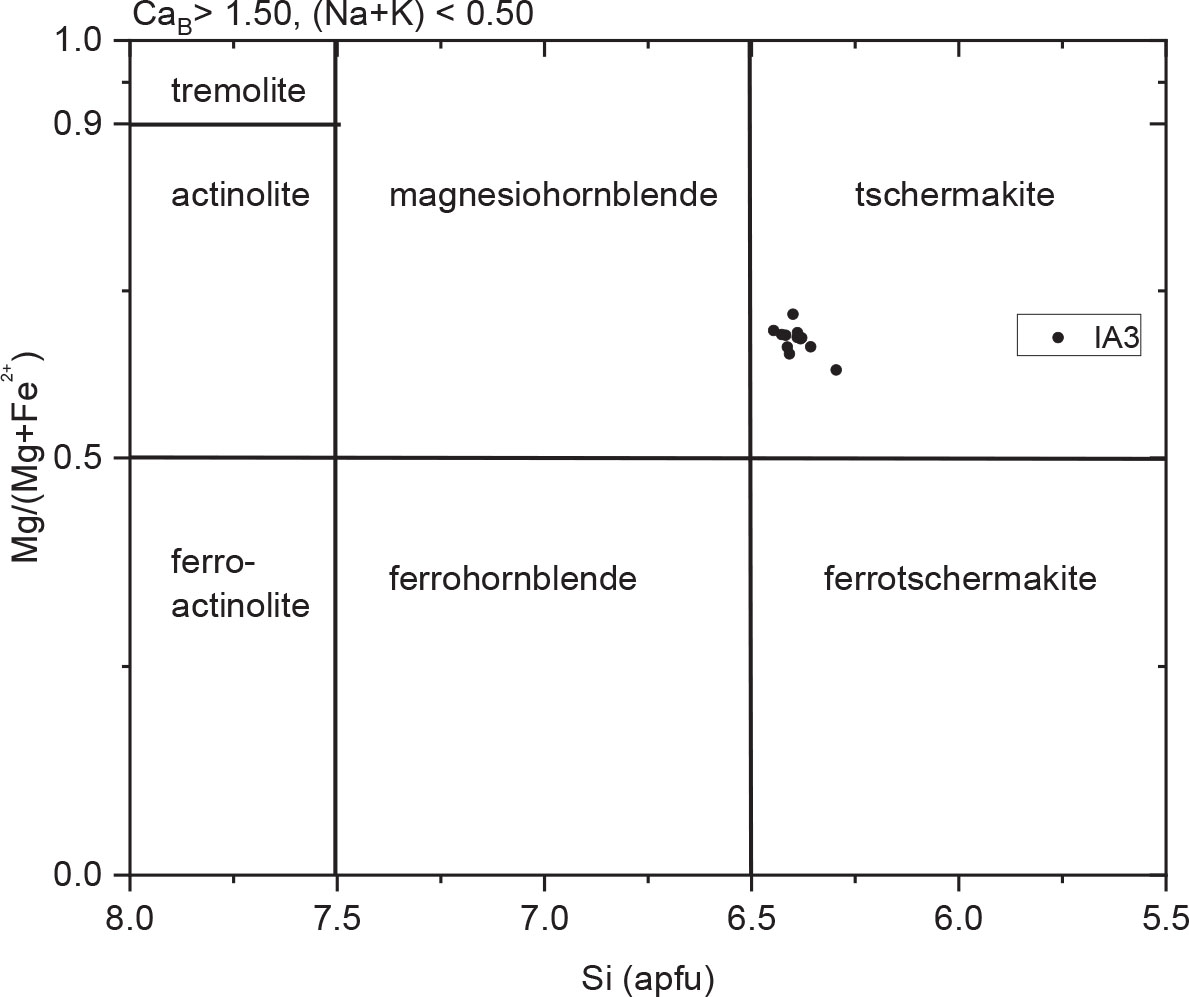
Figure 5:
Si Vs Mg/(Mg +Fe2+) diagram for amphiboles from sample IA3 shown as tschermakite.
Biotite
The biotite in the samples is Mg-rich (XMg = 0.58–0.69) and has Ti content of 0.5–0.6 p.f.u. for both samples. Matrix XMg values are lower than values for biotite adjacent to orthopyroxene (Table 4).
Table 4:
Representative chemical composition (wt%) and atom per formula unit (apfu) of biotite based on 22 oxygen (sample IA3/5).
| Sample | IA3 | IA5 | |||||||
|---|---|---|---|---|---|---|---|---|---|
| Remarks | Core adjacent Opx | Rim adjacent Opx | Matrix 1 | Matrix 2 | Inclusion | Rim adjacent Opx | Core adjacent Opx | Matrix 1 | Matrix 2 |
| SiO2 | 36.65 | 36.42 | 35.82 | 35.79 | 37.68 | 38.06 | 37.54 | 37.34 | 37.29 |
| TiO2 | 5.05 | 4.80 | 5.18 | 5.07 | 5.54 | 5.27 | 5.15 | 5.80 | 5.88 |
| Al2O3 | 14.87 | 13.94 | 13.99 | 14.03 | 14.18 | 14.39 | 14.36 | 14.23 | 13.87 |
| Cr2O3 | 0.04 | 0.04 | 0.05 | 0.07 | 0.45 | 0.44 | 0.40 | 0.44 | 0.41 |
| FeO* | 14.65 | 16.62 | 16.40 | 16.81 | 12.74 | 12.19 | 13.12 | 13.69 | 13.67 |
| MnO | 0.01 | 0.09 | 0.11 | 0.06 | 0.03 | 0.05 | 0.04 | 0.07 | 0.04 |
| MgO | 13.81 | 13.23 | 12.27 | 12.66 | 14.80 | 15.45 | 15.12 | 14.26 | 14.04 |
| CaO | 0.00 | 0.00 | 0.02 | 0.00 | 0.07 | 0.00 | 0.01 | 0.07 | 0.00 |
| Na2O | 0.03 | 0.03 | 0.03 | 0.04 | 0.11 | 0.05 | 0.05 | 0.11 | 0.04 |
| K2O | 9.37 | 9.34 | 9.42 | 9.34 | 9.50 | 9.64 | 9.67 | 9.41 | 9.63 |
| Total | 94.49 | 94.51 | 93.28 | 93.86 | 95.09 | 95.53 | 95.47 | 95.41 | 94.87 |
| apfu | |||||||||
| Si | 5.519 | 5.547 | 5.535 | 5.504 | 5.591 | 5.601 | 5.563 | 5.550 | 5.580 |
| Ti | 0.572 | 0.550 | 0.602 | 0.586 | 0.618 | 0.584 | 0.574 | 0.648 | 0.661 |
| Al | 2.640 | 2.504 | 2.548 | 2.543 | 2.480 | 2.497 | 2.509 | 2.493 | 2.447 |
| Cr | 0.005 | 0.005 | 0.006 | 0.009 | 0.053 | 0.052 | 0.047 | 0.052 | 0.049 |
| Fe2+ | 1.845 | 2.117 | 2.119 | 2.162 | 1.581 | 1.500 | 1.626 | 1.702 | 1.711 |
| Mn | 0.002 | 0.011 | 0.014 | 0.008 | 0.003 | 0.006 | 0.005 | 0.008 | 0.005 |
| Mg | 3.099 | 3.003 | 2.825 | 2.901 | 3.273 | 3.388 | 3.338 | 3.159 | 3.132 |
| Ca | 0.000 | 0.000 | 0.003 | 0.000 | 0.011 | 0.000 | 0.001 | 0.011 | 0.000 |
| Na | 0.009 | 0.007 | 0.009 | 0.013 | 0.031 | 0.013 | 0.015 | 0.031 | 0.012 |
| K | 1.800 | 1.816 | 1.857 | 1.832 | 1.799 | 1.810 | 1.828 | 1.783 | 1.839 |
| Total | 15.491 | 15.560 | 15.519 | 15.557 | 15.439 | 15.452 | 15.507 | 15.437 | 15.436 |
| XMg | 0.63 | 0.59 | 0.57 | 0.57 | 0.67 | 0.69 | 0.67 | 0.65 | 0.65 |
Other minerals
The TiO2 content of the ilmenite in this rock varies from 41.9 wt% to 49.9 wt%, while the FeO content of the ilmenite varies from 46.99 wt% to 52.96 wt%. Hematite microprobe data yields 89.64 wt% to 90.36 wt% FeO with about 1.79 wt% TiO2 occurring in the exsolved lamella. In contrast, magnetite had a FeO content of 92.60 wt%.
Petrological significance
Rocks of intermediate to mafic composition, such as andesite, diorite, basalt, and gabbro, when metamorphosed at high metamorphic grade, are usually marked by the appearance of certain minerals. The appearance of orthopyroxene in a rock with typical metabasite composition defines the onset of granulite facies metamorphism. The typical assemblage of such rocks at granulite facies include orthopyroxene + clinopyroxene + plagioclase ± hornblende ± garnet ± biotite ± quartz ± rutile ± ilmenite [10]. At higher pressures above 7 kbar, the distinctive assemblage is plagioclase + augite + garnet, while at lower pressures between 5–7 kbar, the typical assemblage is plagioclase + augite + hypersthene [11].
During the transition from the amphibolite to the granulite facies, hydrous phases such as amphibole decrease in modal amount with increasing temperature, by the reaction:
As observed in the pyroxene gneiss, hornblende is completely absent from sample IA5 and is only about 1% vol in sample IA3. Also, the orthopyroxene and plagioclase occupy more than 60% volume of the rock. This suggests that pyroxene gneiss had attained granulite facies metamorphism.
At the beginning of granulite facies metamorphism, during anatexis, orthoclase is formed by the reaction:
The orthoclase and orthopyroxene produced from the dehydration reaction of biotite will enter into the melt phase and be preserved in the rock as leucocratic quartzofeldspathic bands called leucosomes. This explains the presence of orthoclase only in the leucocratic bands of IA5, where it is associated with orthopyroxene and minor biotite. Anhydrous mafic granulites form at temperatures above 850 °C, but in the presence of water-rich fluids, mafic rocks can undergo partial melting and granulites will form at temperatures below 750 °C [11]. Geothermometric calculations based on hornblende and plagioclase geothermometer by Holland and Blundy [12] gave temperatures of 690–740 °C at 5.2 kbar [5]. Although these low values fall within the temperature and pressure values for migmatitic pyroxene granulites, it has been interpreted as post-peak reequilibration. The exsolution of ilmenite to ilmenite + titanohematite (Figure 2d) occurs due to slow cooling or retrogressive metamorphism [13] and is a further indication of retrogressive metamorphism.
Conclusions
The pyroxene gneiss has the mineralogic assemblage of plagioclase + clinopyroxene + orthopyroxene characteristic of metabasites that attained granulite facies metamorphism at pressures below 7 kbar. The presence of migmatitic structures attests to the presence of H2O-rich fluids during metamorphism and ensuing lower peak metamorphic temperature. Mineral chemistry data shows that the rock is Mg-rich, as XMg values vary from 0.54–0.74 across the Fe-Mg minerals.
Acknowledgements
The authors are indebted to Prof. Sumit Chakraborty of the Institute of Geology, Mineralogy and Geophysics at the Ruhr University, Bochum, Germany for accepting IA as a guest researcher at the institute and for use of EMPA.