
What is new? What is important?
Real-world data on how quickly risk-specific absolute LDL-C thresholds are reached with PCSK9 inhibitors remain scarce. In 45 patients at high or very high cardiovascular risk, LDL-C fell by a median of 66.9% and 41 patients (91%) reached the threshold after a median of 5 months. Threshold attainment was mainly associated with up-titration of the PCSK9 inhibitor rather than changes in oral lipid-lowering therapy, and no clinically relevant hepatic or muscular toxicity was attributed to PCSK9 inhibitors. These findings provide a practical reference for planning lipid reassessment after PCSK9 inhibitor initiation and underline the importance of access to these agents.
1. INTRODUCTION
Elevated low-density lipoprotein cholesterol (LDL-C) represents an important causal risk factor and the most critical therapeutic target for atherosclerotic cardiovascular disease (ASCVD) [1]. According to the World Health Organization, an estimated 19.8 million people died from cardiovascular (CV) disease in 2022, with stroke and myocardial infarction as main contributors [2]. The global prevalence of hypercholesterolemia and high LDL-C was recently reported at 43% based on data published over the last 20 years [3]. The global burden attributed to high LDL-C, measured by deaths and disability-adjusted life-years, increased by more than 41% in absolute terms between 1990 and 2019 [4], with data from 2021 suggesting a continued rise of more than 45% worldwide [5].
The benefits of LDL-C reduction are directly related to the magnitude of the reduction and the time spent at LDL-C goal. Each 1 mmol/l reduction in LDL-C was associated with a 23% reduction in major CV events in primary prevention, regardless of age [6]. Since cumulative exposure to LDL-C is recognized as a key driver of ASCVD, several therapeutic strategies aimed at achieving a robust and sustained reduction in LDL-C can be used in clinical practice to decrease ASCVD risk [7,8].
Treatment of hypercholesterolemia includes oral agents, such as statins and ezetimibe, and injectables such as monoclonal antibodies and small interfering ribonucleic acid (siRNA) therapies targeting proprotein convertase subtilisin/kexin type 9 (PCSK9) expression in the liver [9]. PCSK9 inhibitors are particularly useful in patients who do not respond to or cannot tolerate statins, or who have a genetic predisposition to high cholesterol [10]. Alirocumab and evolocumab, PCSK9 monoclonal antibodies, showed a favorable efficacy and safety profile in the pivotal ODYSSEY and FOURIER trials, where LDL-C reductions of 50% to 60% were associated with significantly lower CV event rates [8,10,11,12,13,14]. Twice-yearly inclisiran, a siRNA that inhibits the synthesis of PCSK9, demonstrated significant LDL-C reduction by 43% to 52% in clinical trials [15,16], with a general safety profile [17].
Although PCSK9 inhibitors have been demonstrated to be effective in reducing LDL-C in clinical trials, real-world evidence varies considerably across studies. Reported LDL-C reductions ranged between 33 to 65%, with greater reduction in monoclonal antibodies [18,19,20,21] compared to inclisiran [22]. The attainment of LDL-C threshold in clinical practice was considerably lower than in clinical trials, with rates ranging widely from 15% to 88% [12,20,21,23,24]. Data on the time needed to reach the risk-specific absolute LDL-C threshold in clinical practice also vary across studies [20,22,24,25]. Furthermore, the predictors of LDL-C response to lipid-lowering therapy are incompletely characterized, with data pointing to baseline LDL-C, real-world adherence, high-intensity statin, and female sex [12,22]. Together, these observations highlight a gap between efficacy in trials and effectiveness in practice.
In the light of the expanding therapeutic landscape for hypercholesterolemia, we aimed to characterize the effectiveness and safety of injectable PCSK9 inhibitors in patients at primary and secondary prevention of ASCVD aiming to achieve the risk-specific absolute LDL-C threshold, with the description of the magnitude of LDL-C reduction, the time needed to reach it, and the response predictors to treatment.
2. MATERIALS AND METHODS
2.1. Study Design and Population
A retrospective cohort study with individual data recording was conducted in an adult population (≥18 years) referred for the management of hypercholesterolemia in the outpatient clinic of the Centre of Diabetes, Nutrition and Metabolic Diseases, Emergency Clinical County Hospital in Cluj-Napoca, Romania. The study is reported according to the STROBE guidelines for observational cohort studies.
The records of 45 consecutive patients diagnosed with hypercholesterolemia according to 2019 European Society of Cardiology (ESC)/ European Society of Atherosclerosis (EAS) guideline [26] newly initiated on PCSK9 inhibitors between August 2020 and January 2026 were included in the analysis. All patients were treated with PCSK9 inhibitors (alirocumab 75 mg or 150 mg, evolocumab 140 mg administered every 2 weeks, and inclisiran 284 mg administered at baseline, at 3 months and every 6 months thereafter) in combination with statins (atorvastatin or rosuvastatin) and/or ezetimibe, unless not tolerated. Alirocumab and evolocumab injections were self-administered subcutaneously by patients in the abdomen. Inclisiran was administered subcutaneously in the abdomen by a nurse in the outpatient clinic. All PCSK9 inhibitors costs were reimbursed by the Romanian National Health Insurance House.
2.2. Data Collection
For patients newly initiated on PCSK9 inhibitors, data were collected from the outpatient records at two specific timepoints: baseline (the moment PCSK9 was initiated) and the moment the patient achieved the established LDL-C threshold or the lowest LDL-C close to LDL-C threshold if the patient did not achieve LDL-C threshold, up to 1st August 2026. The following data were recorded: demographic (age, sex), clinical (weight, body mass index), lifestyle factors (smoking status), comorbidities, lipid-lowering medication, biochemical parameters, adverse drug reactions to PCSK9 inhibitors, treatment discontinuation and reason for it, follow-up duration. Comorbidities included established clinical or subclinical ASCVD (cerebrovascular, coronary, peripheral artery diseases, and other locations) diagnosed according to 2019 ESC/EAS guideline [26], diabetes mellitus and its chronic microvascular complications (neuropathy, retinopathy, nephropathy) diagnosed according to American Diabetes Association criteria [27], arterial hypertension, familial hypercholesterolemia diagnosed according to Dutch Lipid Clinic Network Score [28], and non-familial hypercholesterolemia diagnosed according 2019 ESC/EAS guideline [26]. Biochemical data included complete fasting lipid panel (LDL-C, total cholesterol, HDL-cholesterol, triglycerides), serum creatinine with the CKD-EPI estimated glomerular filtration rate, transaminases, total creatine kinase (CK). LDL-C was calculated using the Sampson equation [29].
Adverse drug reactions were recorded when explicitly documented by the physician as temporally associated with the initiation or continuation of PCSK9 inhibitor therapy and considered likely related to the medication based on clinical and laboratory presentation and exclusion of other causes. In addition, data on changes in lipid-lowering therapy, and major acute cardiovascular events were recorded. Statin and ezetimibe intolerance were determined based on patient-reported symptoms (muscle pain, weakness, or fatigue) with or/without elevation of total CK, that resolved or improved after dose reduction or discontinuation [30]. Patients with partial intolerance continued the maximally tolerated statin dose and/or ezetimibe in combination with PCSK9 inhibitor. Patients with complete intolerance received no oral therapy.
2.3. Cardiovascular Risk Stratification
Participants were retrospectively stratified into cardiovascular risk categories using a single framework for all patients: the 2019 ESC/EAS guideline [26], with 10-year risk estimated by SCORE2/SCORE2-OP as recommended by the 2021 ESC prevention guidelines [31] and endorsed, with unchanged LDL-C targets, by the 2025 ESC/EAS focused update [7]. The very high-risk category comprised patients previously diagnosed with ASCVD, diabetes mellitus with target-organ damage, or a calculated SCORE2/SCORE2-OP estimate in the very high-risk range, with an absolute LDL-C threshold of <55 mg/dL. The high-risk category comprised of patients with diabetes mellitus without target-organ damage, markedly elevated single risk factors, moderate chronic kidney disease, or a SCORE2/SCORE2-OP estimate in the high-risk range, with an absolute LDL-C threshold of <70 mg/dL. Although the guidelines also recommend a reduction of at least 50% from untreated baseline LDL-C in high and very high-risk categories, this criterion could not be applied since the patients were already on lipid-lowering treatment, and untreated values were not retrievable. Therefore, the LDL-C threshold refers only to the risk-specific absolute LDL-C values, not to the complete ESC/EAS goal. The remaining patients were categorized as moderate-to-low risk, with an LDL-C threshold of <100 mg/dL.
2.4. Lipid-Lowering Medication
Consistent with the observational, retrospective study design, all individual prescribing decisions remained at the treating physician’s discretion, according to national protocols for initiating PCSK9 inhibitors for primary or secondary prevention of ASCVD. Statin type and intensity, PCSK9 inhibitor type and dose, and ezetimibe were recorded and reported at baseline and at first visit when LDL-C threshold was achieved.
2.5. Statistical Analysis
No sample size calculation was performed; all available patients were included. Statistical analysis was performed using R software, version 4.5.3. Continuous variables are presented as mean ± standard deviation (SD) when normally distributed, or as median (Q1; Q3) when the normality assumption was not met after applying Shapiro-Wilk test. Comparisons between independent groups were performed using independent samples Student's t-test when the distribution was normal, or the Mann-Whitney U test when the distribution was not normal. Paired comparisons between baseline and threshold attainment values were performed using paired-samples t-test for parametric variables or Wilcoxon signed-rank test for non-parametric variables. Categorical variables were summarized as n (%) and group comparisons were performed using Fisher’s exact test. Paired categorical comparisons were performed using the McNemar exact test for binary variables. For paired categorical variables with more than two categories, the Stuart-Maxwell test was used.
Time to first documented LDL-C threshold attainment (the first measurement below the risk-specific threshold) was described using Kaplan-Meier methods in all 45 patients; patients without documented attainment were censored at their last available follow-up. Median time and cumulative attainment at 3, 6, 12 and 24 months are reported with 95% confidence intervals, and duration of follow-up as median (Q1; Q3). The percentage reduction of LDL-C was calculated for each patient as (baseline LDL-C – follow-up LDL-C)/ baseline LDL-C X 100. To allow comparison with fixed-timepoint studies, LDL-C was additionally recorded at standardized time points after PCSK9 inhibitor initiation: the measurement closest to 3, 6, 12, 18 and 24 months, within a ± 4-week window (measurement outside the window were treated as missing). LDL-C at the last available visit was also recorded. The value used in the primary analysis (first LDL-C at threshold attainment or, for patients not reaching threshold, the lowest value) is reported as best achieved LDL-C. Baseline and follow-up values were compared with the Wilcoxon signed-rank test. Fixed-time-point threshold attainment is the proportion of patients at threshold at the measurement taken in the window among patients with a measurement. The Kaplan-Meier estimate is instead the cumulative probability of first documented attainment by that time among all 45 patients. Analyses were performed on available cases, and reasons for missing values were recorded.
Predictors of LDL-C reduction were assessed in an exploratory analysis using a linear regression model adjusted for age, sex, baseline LDL-C, diabetes mellitus, high-intensity statin therapy and ezetimibe use at follow-up; the overall contribution of each predictor was assessed using type II ANOVA. High-intensity statin was defined as atorvastatin ≥40 mg and rosuvastatin ≥20 mg. All p-values were nominal and unadjusted. Missing data were not imputed; analyses were based on available data.
3. RESULTS
3.1. Baseline characteristics
The records of 45 patients treated with PCSK9 inhibitors for primary or secondary prevention of ASCVD were evaluated. Demographic and baseline characteristics are presented in Table 1.
Table 1.
Demographic and baseline characteristics of the study population.
| Variables | Overall (n = 45) | Very high CV risk (n = 39) | High CV risk (n = 6) | p-value |
|---|---|---|---|---|
| Men, n (%) | 18 (40%) | 14 (36%) | 4 (67%) | 0.199 |
| Age, years (mean ± SD) | 57.4 ± 13.6 | 60.6 ± 10.9 | 36.8 ± 12.0 | <0.001 * |
| Weight, kg (mean ± SD) | 82.8 ± 15.7 | 83.5 ± 16.3 | 78.8 ± 11.7 | 0.508 |
| Body mass index, kg/m2 (mean ± SD) | 29.1 ± 5.2 | 29.6 ± 5.2 | 25.7 ± 4.5 | 0.084 |
| Current smoking, n (%) | 6 (13%) | 6 (15%) | 0 (0%) | 0.576 |
| ASCVD, n (%) | 28 (62%) | 28 (72%) | 0 (0%) | 0.002 * |
| Diabetes mellitus, n (%) | 22 (49%) | 22 (56%) | 0 (0%) | 0.022 * |
| Arterial hypertension, n (%) | 35 (78%) | 35 (90%) | 0 (0%) | <0.001 * |
| Obesity, n (%) | 19 (42%) | 19 (49%) | 0 (0%) | 0.032 * |
| Familial hypercholesterolemia, n (%) | 24 (53%) | 18 (46%) | 6 (100%) | 0.023 * |
Thirty-nine patients (87%) were included in the very high CV risk group. In a hierarchical, mutually exclusive classification, 28 had established ASCVD, 7 diabetes mellitus with target-organ damage or major risk factor, 2 familial hypercholesterolemia plus a major risk factor, and 2 a SCORE2/SCORE2-OP estimate in the very-high-risk range. Comorbidities overlapped (Table 1): several patients with ASCVD had atherosclerosis in more than one territory (coronary 21, cerebrovascular 6, peripheral artery 4, other locations 4), and 18 patients in this group had familial hypercholesterolemia.
The group of high CV risk consisted of 6 patients; all diagnosed with familial hypercholesterolemia and no additional risk factors. Also, they were much younger. No patients were classified as moderate-to-low CV risk.
3.2. Follow-up
3.2.1. Cholesterol lowering medication
The oral and injectable lipid-lowering medication is presented in Table 2. During follow-up, 4 patients were newly initiated on statin, 3 patients changed the type of statin, 8 patients reduced the dose of statin, and 2 patients stopped statin treatment. The number of patients administering any statin increased from 35 to 37. Combinations of statins with ezetimibe were used in 20 patients at baseline compared to 18 patients at follow-up assessment. A total of 8 patients at baseline and 6 patients at follow-up received neither statin nor ezetimibe, owing to statin and/or ezetimibe intolerance. Overall, none of the changes in the oral lipid-lowering medication reached statistical significance.
Table 2.
Oral and injectable lipid-lowering medication at baseline (the moment when the PCSK9 inhibitor was initiated) and at follow-up assessment.
| Variables | Baseline (n = 45) | Follow-up (n = 45) | p-value |
|---|---|---|---|
| Oral lipid-lowering medication, n (%) | N/A | N/A | N/A |
| None | 8 (18%) | 6 (13%) | 0.754 |
| Any statin | 35 (78%) | 37 (82%) | 0.688 |
| High-dose atorvastatin | 14 (31%) | 12 (27%) | 0.625 |
| Moderate- or low-dose atorvastatin | 2 (4%) | 6 (13%) | 0.219 |
| High-dose rosuvastatin | 16 (36%) | 14 (31%) | 0.625 |
| Moderate- or low-dose rosuvastatin | 3 (7%) | 5 (11%) | 0.625 |
| Ezetimibe | 22 (49%) | 20 (44%) | 0.727 |
| Any statin plus ezetimibe | 20 (44%) | 18 (40%) | 0.625 |
| Injectable PCSK9 inhibitor, n (%) | N/A | N/A | N/A |
| Alirocumab 75 mg | 35 (78%) | 25 (56%) | 0.002 * |
| Alirocumab 150 mg | 1 (2%) | 11 (24%) | 0.002 * |
| Evolocumab 140 mg | 6 (13%) | 6 (13%) | 1.000 |
| Inclisiran 284 mg | 3 (7%) | 3 (7%) | 1.000 |
By contrast, the use of PCSK9 inhibitors shifted significantly during the study observation. The proportion of patients receiving alirocumab 150 mg increased significantly from baseline to the follow-up moment, in parallel with the marked decrease in alirocumab 75 mg use due to dose up-titration. The use of evolocumab and inclisiran remained unchanged.
3.2.2. Biochemical parameters
The biochemical parameters measured in the study group are presented in Table 3. LDL-C, total cholesterol, and triglycerides significantly decreased between baseline and follow-up assessment. Based on the best value achieved, LDL-C decreased by a median of 66.9% (55.7%; 77.9%), corresponding to a median absolute reduction of 96 (56; 136) mg/dL. In three patients, LDL-C did not decrease; in two of these the statin dose has been reduced during follow-up, and the third showed a rise despite up-titration of alirocumab. LDL-C values at baseline and at best value achieved are presented in Figure 1. HDL-C, transaminases, estimated glomerular filtration rate and total CK showed no significant change, while fasting blood glucose significantly decreased.
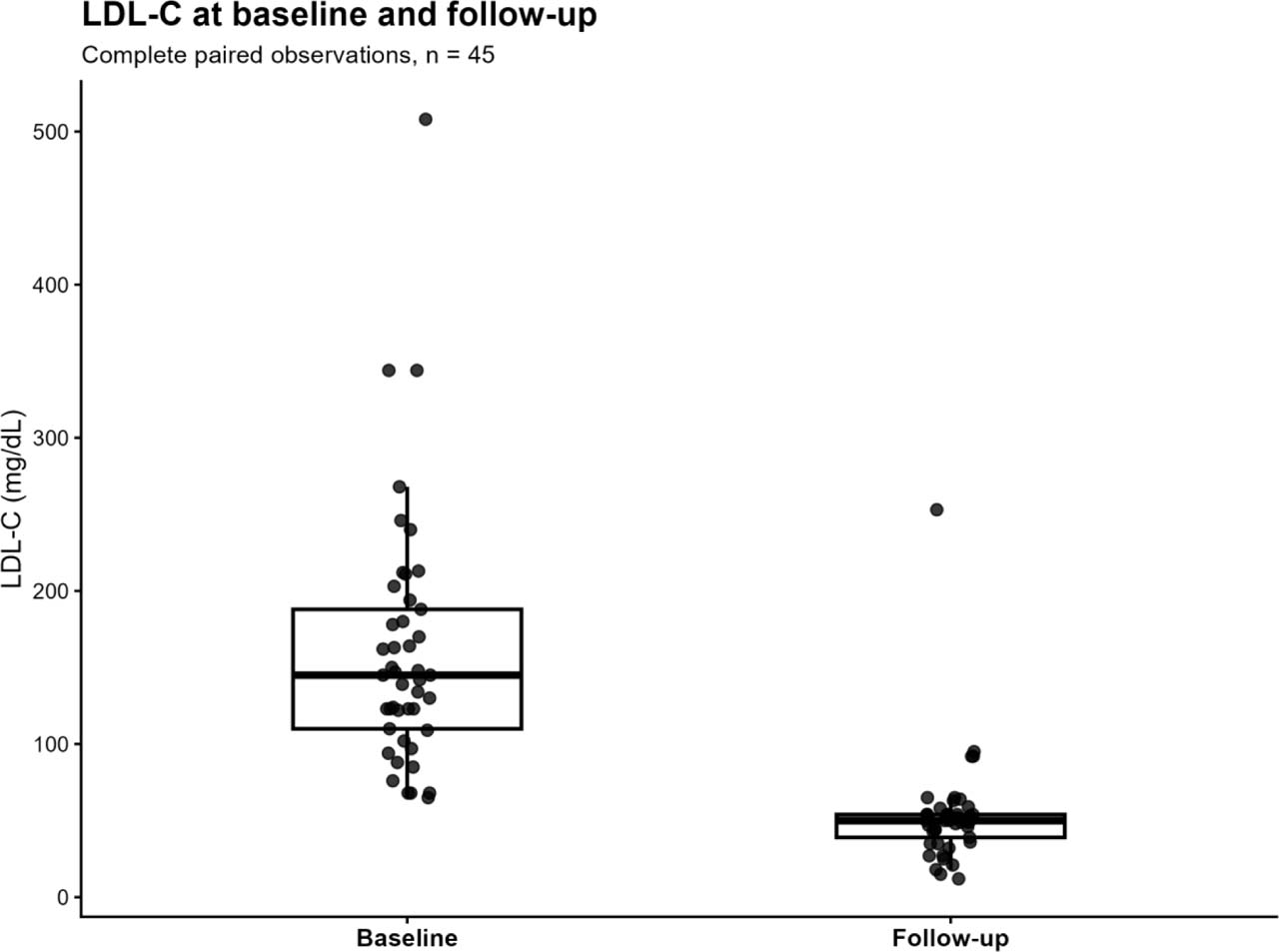
Figure 1.
LDL-C values at baseline (the moment when the PCSK9 inhibitor was initiated) and at the best achieved value at follow-up (first value at threshold or, for patients not reaching threshold, the lowest value).
Table 3.
Biochemical parameters at baseline and at follow-up.
| Variables | Baseline (n = 45) | Follow-up (n = 45) | p-value |
|---|---|---|---|
| Lipid profile | N/A | N/A | N/A |
| LDL-C, mg/dL | 145 (110; 188) | 50 (39; 54) | <0.001 * |
| Total cholesterol, mg/dL | 219 (186; 284) | 120 (110; 134) | <0.001 * |
| HDL-cholesterol, mg/dL | 48 (42; 56) | 48 (42; 55) | 0.920 |
| Triglycerides, mg/dL | 148 (105; 190) | 105 (74; 155) | <0.001 * |
| Transaminases | N/A | N/A | N/A |
| AST, IU/L | 26 (21; 34) | 25 (21; 31) | 0.907 |
| ALT, IU/L | 27 (18; 40) | 27 (20; 40) | 0.536 |
| Estimated glomerular filtration rate, mL/min/1.73 m2 | 84.5 ± 19.9 | 82.5 ± 20.8 | 0.342 |
| Fasting glycemia, mg/dL | 105 (91; 124) | 96.7 (88; 112) | 0.011 * |
| Total CK, IU/L (n = 19) | 97 (76; 124.5) | 97 (75; 123) | 0.955 |
3.2.3. Time to first documented LDL-C threshold attainment
During the study period, 41 (91%) of the 45 patients achieved the risk-specific absolute LDL-C threshold at some point during follow-up. The median time to first documented attainment was 5 months (95% confidence interval, 3–7 months; Figure 2). The cumulative proportion of patients with documented attainment was 40.4% at 3 months, increased to 61.9% at 6 months, 76.2% at 12 months and 94.0% at 24 months. Although most of the patients obtained LDL-C threshold attainment within the first year of treatment, a subset of patients required a considerably longer titration time, with the maximum of 26 months.
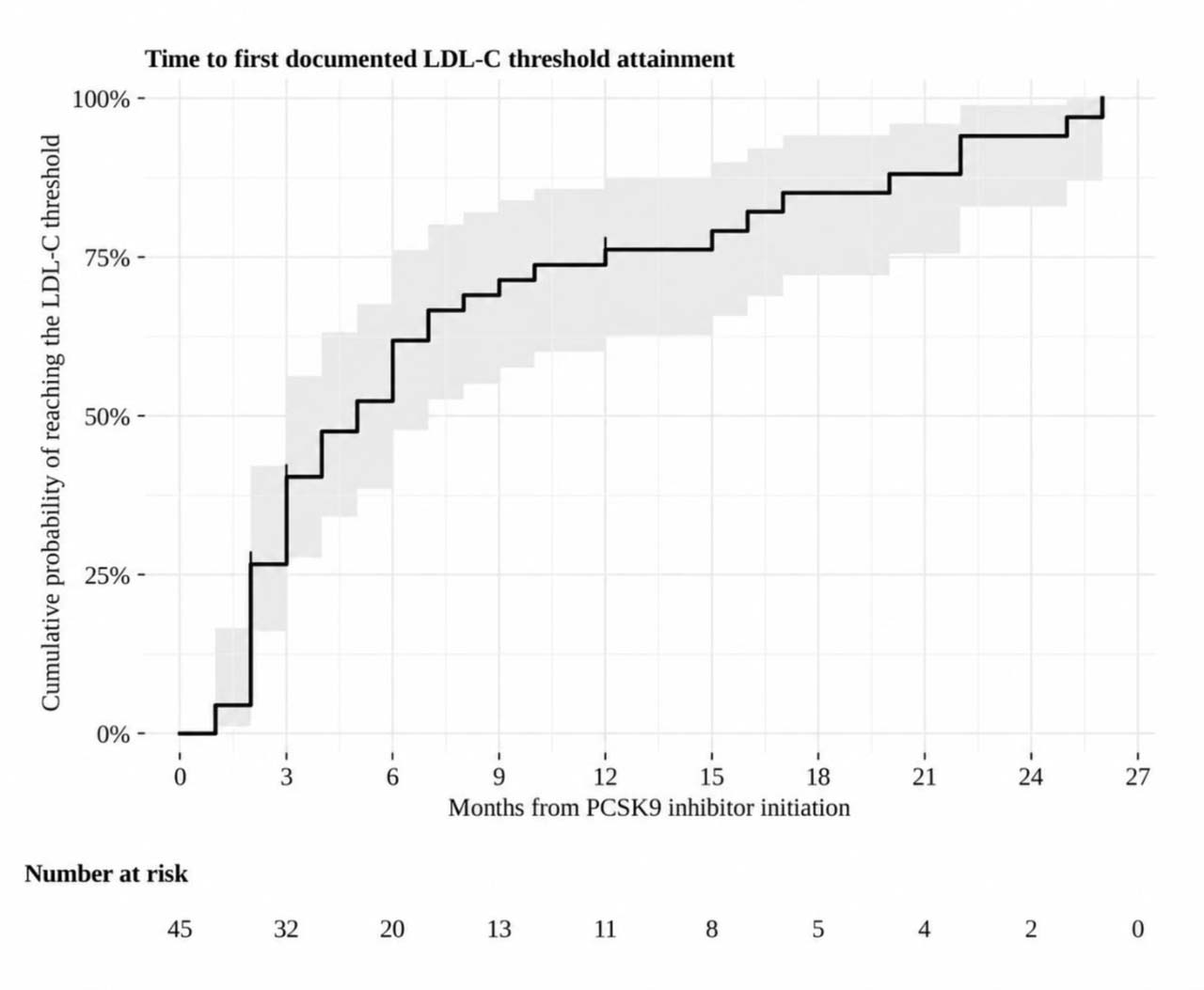
Figure 2.
Cumulative proportion of patients reaching first documented attainment of risk-specific absolute LDL-C threshold, described using Kaplan-Meier methods (n=45; four patients not reaching the threshold were censored at their last available follow-up). Shaded area: 95% confidence interval. Numbers at risk are shown below the plot. Threshold attainment at fixed time points is shown in Table 4.
3.2.4. LDL-C change at standardized time points after PCSK9 inhibitor initiation
A 3-month value was available for 42 patients (93.3%) and a 6-month value for 38 patients (84.4%). A median of 4 (2; 5) post-baseline LDL-C values per patient were available at the predefined time points (165 of 187 expected values, 88.2%). At 3 months, the LDL-C reduction was 54.4% vs. 66.7% for the best-achieved value (n = 42, p = 0.002). Threshold attainment was 52.4% vs. 92.9% (p < 0.001). This exceeds the Kaplan-Meier cumulative attainment at 3 months (40.4%) because the 3 months window extends to about 4 months (cumulative attainment at 48% at 4 months), and also because dominators differ (42 patients with a measurement). At 6 months, the reduction was 59.2% vs. 70.8% (n = 38, p = 0.002). Threshold attainment was 50.0% vs. 97.4% (p < 0.001). The median follow-up for the entire cohort was 34 (12; 49) months. The results are summarized in Table 4.
Table 4.
LDL-cholesterol at standardized time points after initiation of the PCSK9 inhibitor and best achieved value.
| Variables | Baseline | At time point | p-value |
|---|---|---|---|
| 3 months (n = 42) | N/A | N/A | N/A |
| LDL-cholesterol, mg/dL | 140 (109; 186) | 62 (49; 82) | < 0.001 * |
| Below threshold, n (%) | – | 22 (52%) | – |
| 6 months (n = 38) | N/A | N/A | N/A |
| LDL-cholesterol, mg/dL | 148 (123; 201) | 54 (36; 108) | < 0.001 * |
| Below threshold, n (%) | – | 19 (50%) | – |
| 12 months (n = 34) | N/A | N/A | N/A |
| LDL-cholesterol, mg/dL | 146 (123; 201) | 76 (48; 97) | < 0.001 * |
| Below threshold, n (%) | – | 13 (38%) | – |
| 18 months (n = 28) | N/A | N/A | N/A |
| LDL-cholesterol, mg/dL | 148 (123; 206) | 62 (51; 80) | < 0.001 * |
| Below threshold, n (%) | – | 10 (36%) | – |
| 24 months (n = 23) | N/A | N/A | N/A |
| LDL-cholesterol, mg/dL | 142 (116; 187) | 63 (48; 76) | < 0.001 * |
| Below threshold, n (%) | – | 13 (57%) | – |
| Last follow-up † (n = 45) | N/A | N/A | N/A |
| LDL-cholesterol, mg/dL | 145 (110; 188) | 60 (48; 92) | < 0.001 * |
| Below threshold, n (%) | – | 19 (42%) | – |
| Best achieved ‡ (n = 45) | N/A | N/A | N/A |
| LDL-cholesterol, mg/dL | 145 (110; 188) | 50 (39; 54) | < 0.001 * |
| Below threshold, n (%) | – | 41 (91%) | – |
Values are median (Q1; Q3) unless otherwise stated. n = number of patients with an available LDL-cholesterol value at each time point; LDL = low-density lipoprotein; PCSK9 = proprotein convertase subtilisin/kexin type 9. Risk-specific absolute LDL-cholesterol threshold: < 55 mg/dL for very high and < 70 mg/dL for high cardiovascular risk. Of the 7 missing 6-month values, 6 were not available in the records and 1 was not yet due at the end of data collection.
3.3. Predictors of LDL-C percentage reduction
We performed an exploratory linear regression analysis to identify possible predictors of the percentage reduction in LDL-C during the study observation. Table 5 shows that in multivariable analysis (R2 = 0.270; adjusted R2 = 0.155; p = 0.050), baseline LDL-C made the largest contribution, followed by age, although neither reached statistical significance. Diabetes mellitus, sex, high-intensity statin therapy and ezetimibe use at follow-up did not contribute significantly. No statistically significant predictor was detected in this exploratory analysis, which was underpowered to detect modest association.
Table 5.
Linear regression analysis of predictors of the percentage LDL-C reduction.
| Predictor | β (95% CI) | F (1, 38) | p-value | ηp2 |
|---|---|---|---|---|
| Baseline LDL-C, per 1 mg/dL | 0.09 (−0.003 to 0.19) | 3.86 | 0.057 | 0.092 |
| Age, per 1 year | 0.64 (−0.05 to 1.32) | 3.54 | 0.068 | 0.085 |
| Diabetes mellitus | −13.17 (−30.98 to 4.64) | 2.24 | 0.143 | 0.056 |
| Male sex | 6.72 (−10.27 to 23.72) | 0.64 | 0.428 | 0.017 |
| High-intensity statin at follow-up | −6.28 (−21.20 to 8.64) | 0.73 | 0.400 | 0.019 |
| Ezetimibe at follow-up | 5.15 (−11.25 to 21.55) | 0.40 | 0.529 | 0.011 |
3.4. Adverse events
During treatment, one patient developed type 2 diabetes mellitus and one patient died because of an acute cardiovascular event, both from the very high CV risk group. Mild elevation in AST (9 patients at baseline vs. 6 patients at threshold attainment) and ALT (9 patients at baseline vs. 10 patients at threshold attainment) were observed, none of them exceeding three times the upper limit of normal values. Mild elevation of total CK were found in 3 out of 19 patients at baseline and 6 out of 19 patients at threshold attainment, with values below five times the upper limit of normal values. Two patients reported transitory mild injection-site reactions. None of these patients discontinued the treatment. No patients permanently discontinued PCSK9 inhibitor therapy during follow-up.
4. DISCUSSION
In this real-world, single-center analysis, PCSK9 inhibitors reduced LDL-C by a median of 54.4% reduction at 3 months and 59.2% reduction at 6 months, with approximately half of the patients at threshold at these time points; the best achieved reduction was 66.9% at a median of 5 months after treatment initiation. No clinically relevant hepatic or muscular toxicity was attributed to PCSK9 inhibitors, although the study was not designed to assess safety.
Although the effectiveness and favorable safety profile of PCSK9 inhibitors has been evaluated in clinical trials, real-world evidence shows considerable heterogeneity across studies investigating monoclonal antibodies and siRNA therapies targeting PCSK9. The best achieved LDL-C reduction of 66.9% found in our study is above the upper range of previously reported real-world reduction (33 to 65%) [10,18,19,20,21,22] and the reduction demonstrated in different clinical trials involving alirocumab (44 to 63%) [11], evolocumab [19,32] and inclisiran [15,16]. This is expected since selecting the most favorable of repeated measurements overestimates the treatment effect. On the other hand, the fixed-timepoint reductions of 54–59% are consistent with those reported in the pivotal randomized trials, for example approximately 59% with evolocumab at 48 weeks in FOURIER and 52% with inclisiran in ORION-10 and ORION-11 [15,32]. They are also consistent with other real-world cohorts previously mentioned. The magnitude of LDL-C response might reflect the composition of our study population, which mostly attained the LDL-C threshold on PCSK9 inhibitor and had already been lowered by treatment with statin and/or ezetimibe. Comparison with data from real-world studies might be influenced by baseline LDL-C heterogeneity, timing of lipid profile revaluation and concomitant oral lipid-lowering medication. The lower rate of threshold attainment at fixed time points highlights the gap between LDL-C lowering and threshold achievement in routine clinical practice.
A distinct aspect of our study is the evaluation of the time to first documented attainment of the risk-specific absolute LDL-C threshold recommended by ESC/EAS guidelines, an outcome scarcely reported in real-world settings. Most of our patients obtained LDL-C threshold attainment within the first few months of treatment, which provides a practical reference for clinicians when setting expectations and planning follow-up. In real-world studies, a 58% reduction was obtained within 3 months in the European HEYMANS study [25], while in Asia-Pacific HALES a median change of −60.8% from baseline was observed at 6 months [33]. Evolocumab and alirocumab reduced LDL-C by 65%, sustained over 19 months [10]. Real-world inclisiran studies reported reductions ranging from 36% at 6 months [34] to 42.7–45.6% with concomitant statin treatment and 37.5% as monotherapy in a meta-analysis [22].
The considerable variability in time until threshold attainment, with 5 patients requiring between 22 and 26 months, underscores the challenges in real-world settings of long-term lipid management, including treatment response, suboptimal adherence or gradual dose up-titration rather than a delayed response to PCSK9 inhibitors. Similar variability was observed across real-world studies due to inconsistent LDL-C measurement schedules ranging from 3 to 12 months [33], differences in baseline LDL-C, as well as inter-individual variability in response to PCSK9 inhibitor, particularly in patients receiving inclisiran in which data regarding time until LDL-C threshold was achieved was scarcely reported [22].
A meta-analysis evaluating inclisiran in real-world cohorts reported that lower LDL-C at baseline was associated with a greater percentage reduction [22]. High interindividual variability in LDL-C reduction was found in the German Inclisiran Network, where concomitant statin treatment was associated with a more effective LDL-C lowering [35]. Similarly, a prospective PCSK9 registry identified statin co-therapy, first-line use, longer treatment duration, older age and male sex as predictors of greater LDL-C reduction [18]. Taken together, determinants of the response to PCSK9 inhibitors differ across populations, with baseline LDL-C and background statin treatment the most consistent modifying factors.
Changes in oral lipid-lowering treatment followed a heterogeneous pattern rather than uniform up-titration. More patients used high-intensity than moderate- or low-intensity statins, with a similar distribution between atorvastatin and rosuvastatin. Interestingly, 49% of patients newly initiated on evolocumab in the HEYMANS study and 59% of patients from a national registry in Slovenia received no background lipid-lowering therapy [25]. Similar to our findings, a prospective registry study from Italy reported a lower proportion of patients, at 17%, not administering oral lipid-lowering therapy [21]. Data from clinical trials indicated a significantly higher number of patients receiving statins and/or ezetimibe, with percentages ranging from 84% to 99% [32]. These data suggest that the use of PCSK9 inhibitors in real-world settings might be associated with a discontinuation of lipid-lowering therapy administered orally [22].
In contrast, the use of PCSK9 inhibitors shifted significantly mainly through up-titration of alirocumab from 75 mg to 150 mg. Our results suggest that attainment of the LDL-C threshold was associated with PCSK9 inhibitor dose titration rather than with changes in background oral lipid-lowering medication. Clinical trials indicate that increasing the alirocumab dose from 75 to 150 mg every 2 weeks further reduces LDL-C [36]. In real-world settings, up-titration rates were close to those in clinical trials, but patients were rarely started on the 150 mg dose. The lack of a control group in clinical practice may have influenced interpretation and introduced confounders such as adherence and background therapy adjustments [37,38].
No clinically relevant hepatic or muscular events attributed to PCSK9 inhibitors were reported in our study, although some patients presented with mild elevations of transaminases and total CK levels, consistent with findings from other real-world studies [39]. However, several reports found higher rates of adverse events, including musculoskeletal and flu-like symptoms and local injection-site reactions, with some of these symptoms leading to PCSK9 inhibitor discontinuation [36,39]. Given the small cohort, the retrospective ascertainment of adverse events and the incomplete CK measurements, our findings cannot establish a general safety profile. Although fasting glycemia decreased significantly at threshold attainment, one patient who had impaired fasting glucose at baseline was diagnosed with type 2 diabetes during follow-up; this was not controlled for concurrent changes in antidiabetic medication. Evidence suggests that PCSK9 inhibitors do not increase the risk of new-onset diabetes [17,40,41], or may be associated with a lower risk than other lipid-lowering therapies [42].
One patient from the very high CV risk group died because of acute cardiovascular event. Our study was neither designed nor powered to assess CV outcomes, and a single event cannot be interpreted in either direction. Major cardiovascular events were infrequent, ranging across real-world studies from no event to 25% [12,18,20,43]. PCSK9 inhibitors have been considered safe in real-world practice, not only in clinical trials [11,32],and in patients with ASCVD [15,44].
This study has several limitations. First, it is a retrospective, single-center design and the small sample size may limit the generalization of the findings. Our cohort from a tertiary clinic was mostly very high risk, with a high proportion of familial hypercholesterolemia, and mainly treated with alirocumab under Romanian reimbursement conditions. Therefore, our findings may not apply to all PCSK9-targeting therapies, particularly inclisiran. Second, all individual prescribing decisions (including changes in statin type and dose) and biochemical investigations were performed at the treating physician’s discretion and according to national protocols for initiating PCSK9 inhibitors. Measurements of LDL-C were obtained during routine care, so the timing of LDL-C assessment was not protocol-driven, and some values were missing at each time point; thus, the reported time reflects first documented attainment and depends on testing frequency. Furthermore, the safety assessment was limited because adverse events were determined retrospectively from clinical records, and total CK was measured only when clinically indicated, with paired values in 19 patients; missing data were not imputed. Third, the sample size limited the power to detect predictors for LDL-C reduction; the multivariable model included six predictors in 45 patients and was therefore underpowered. This analysis should be regarded as exploratory and hypothesis-generating, and confirmed in larger, prospective studies. Finally, the ≥ 50% LDL-C reduction criterion was not assessed.
5. CONCLUSION
In this real-world, single-center study of patients at high and very high cardiovascular risk, mainly treated with alirocumab, mostly on top of statin and/or ezetimibe, PCSK9 inhibitor treatment was associated with a significant reduction in LDL-C of 54–59% at 3 and 6 months, and most patients reached the risk-specific absolute LDL-C threshold at least once after a median of 5 months. No adverse events were attributed to PCSK9 inhibitors other than mild injection-site reactions.
Acknowledgements
The authors received no assistance from persons who do not meet the criteria for authorship. This research received no external funding. Conflicts of interest for all authors are declared
Notes
[13] Declaration of interest:
D.M.C. reports honoraria for lectures and other support from AstraZeneca, Sanofi, Medtronic, Novartis, Worwag, Amgen, and Novo Nordisk. G.I. reports honoraria for lectures, advisory board participation, and other support from Novo Nordisk, Boehringer Ingelheim, AstraZeneca, Eli Lilly, Servier, Viatris, Zentiva, Worwag, and Sanofi. A.E.C. reports honoraria for lectures, advisory boards, and other support from Novo Nordisk, Servier, Boehringer Ingelheim, Medtronic, Eli Lilly, Viatris, AstraZeneca, Berlin Chemie Menarini, and Sanofi. C.B. reports honoraria for lectures, advisory boards and other support and fees from AstraZeneca, Bayer, Boehringer Ingelheim, Eli Lilly, Novo Nordisk, Medtronic, Sanofi, Amgen, Novartis, and Worwag. A.B., C.M., A.R. and D.M.T. have nothing to declare in relation to the development of the present manuscript. None of the companies listed above had any role in the design of the study, in the collection, analysis or interpretation of the data, in writing the manuscript or in the decision to publish the results.
[14] Contributed by Author Contributions
Conceptualization: D.M.C., C.M. and C.B.; methodology: D.M.C., A.B., C.M., G.I., D.M.T. and A.E.C.; software: D.M.T.; validation: C.B., A.R., A.B. and G.I.; formal analysis: D.M.T., D.M.C., A.R., A.B. and C.M.; investigation: D.M.C., G.I., A.E.C. and C.B.; resources: D.M.C., G.I. and A.E.C.; data curation: D.M.C., A.B., D.M.T. and C.M.; writing—original draft preparation: D.M.C., D.M.T. and A.B.; writing—review and editing: A.R., G.I., A.E.C. and C.B.; visualization: A.R., A.B., C.M. and A.E.C.; supervision: C.B., A.R. and D.M.C.; project administration: D.M.C. All authors have read and agreed to the published version of the manuscript.
[15] Ethical Approval and Informed Consent
The study was conducted in accordance with the Declaration of Helsinki and its subsequent amendments and was approved by the Ethics Committee of the Emergency Clinical County Hospital Cluj-Napoca, Romania (approval no. 3942 of 29 January 2026). Because of the retrospective design of the study, which used anonymized data already collected during routine clinical care, the Ethics Committee waived the requirement for specific informed consent. No potentially identifiable patient information or images are included in this manuscript.
[16] Data Availability Statement
The data that support the findings of this study are available from the corresponding author upon reasonable request. The data are not publicly available because they contain information that could compromise the privacy of the participants.
[17] Use of Artificial Intelligence-Assisted Technologies
During the preparation of this work the authors used Claude (Anthropic, accessed from August to October 2026) to improve the language and structure of the text. No AI-assisted technology was used to generate, analyze or interpret the study data. The authors have reviewed and edited the output and take full responsibility for the content of this publication.
Abbreviations
- ALT
alanine aminotransferase
- ASCVD
atherosclerotic cardiovascular disease
- AST
aspartate aminotransferase
- CK
creatine kinase
- CV
cardiovascular
- CKD-EPI
Chronic Kidney Disease Epidemiology Collaboration
- EAS
European Atherosclerosis Society
- eGFR
estimated glomerular filtration rate
- ESC
European Society of Cardiology
- HDL-C
high-density lipoprotein cholesterol
- IU
international units
- LDL-C
low-density lipoprotein cholesterol
- PCSK9
proprotein convertase subtilisin/kexin type 9
- SCORE2
Systematic Coronary Risk Evaluation 2
- SD
standard deviation
- siRNA
small interfering ribonucleic acid