
What is new? What is important?
This retrospective series quantifies, using Bland-Altman analysis, the discordance between the Bazett and Framingham QT-correction formulas and its dependence on heart rate in a hospitalized internal medicine population
In an exploratory diabetic subgroup analysis, peripheral neuropathy (DN4 ≥4) was associated with higher QTcB values, a finding that requires confirmation in larger cohorts.
QT prolongation in this population is predominantly acquired and reversible after correction of underlying metabolic and pharmacological causes
INTRODUCTION
Prolongation of the QT interval is a well-recognized electrocardiographic abnormality associated with an increased risk of malignant ventricular arrhythmias, particularly torsades de pointes (TdP) and sudden cardiac death [1,2]. Accurate identification and interpretation of QT prolongation are therefore critical in clinical practice, especially in hospitalized patients who are frequently exposed to multiple precipitating factors.
QT interval duration reflects the interplay of ventricular depolarization and repolarization and is influenced by numerous physiological and pathological conditions. While congenital long QT syndrome (LQTS) is a rare channelopathy [3], acquired QT prolongation is far more common, particularly among hospitalized internal medicine patients, who are often elderly, multimorbid, and exposed to polypharmacy [4]. QT assessment frequently relies on Bazett's formula (QTcB = QT/√RR), which overestimates QTc at higher heart rates and underestimates it at lower rates, potentially causing misclassification [5,6]. We selected the Framingham formula as a comparator for its linear correction model and validation in general adult populations; other formulas such as Fridericia's or Hodges' may perform differently across heart rate ranges [11].
The relative contribution of clinical, biological, and pharmacological factors to QT prolongation in internal medicine remains insufficiently characterized, and its reversible nature has not been fully explored [7,8]. We therefore conducted a retrospective study to: (i) quantify the discordance between Bazett and Framingham correction and its heart-rate dependence; (ii) describe clinical, biological, and pharmacological determinants of QT prolongation; (iii) identify factors associated with QTcF-confirmed prolongation; and (iv) evaluate its reversibility.
MATERIALS AND METHODS
Study design and setting
We conducted a retrospective, single-center, descriptive, and analytical study at the Internal Medicine Department of the University Hospital of Ben Arous over an 8-year period (January 1, 2016 to December 31, 2023).
Patient selection
All consecutive patients admitted who underwent routine 12-lead ECG at admission were retrospectively screened for QT interval prolongation.
Inclusion criteria: age ≥15 years; prolonged corrected QT interval by Bazett formula (QTcB >450 ms in men and QTcB ≥460 ms in women), per the 2009 AHA/ACCF/HRS recommendations [9]. Because inclusion required QTcB prolongation, the study population is enriched for Bazett-defined QT prolongation; this selection strategy is a methodological limitation for the comparison between Bazett and Framingham formulas and is discussed further below.
Exclusion criteria: ventricular or supraventricular arrhythmias interfering with reliable QT determination; intraventricular conduction delays with QRS duration >120 ms; acute coronary syndrome; poor-quality ECG recordings; isolated QT prolongation not confirmed on subsequent recordings.
Data collection
Comprehensive data were collected from medical records, including demographics, comorbidities, family history of sudden cardiac death, and current medications. Drug-induced QT prolongation risk was classified using the CredibleMeds database [10]. Peripheral neuropathy in diabetic patients was assessed using the DN4 questionnaire (DN4 ≥4 defined peripheral neuropathy).
Electrocardiographic analysis
Standard 12-lead digital ECGs (Cardioline 100L) were recorded at 25 mm/s and 10 mV/mm. The QT interval was measured manually in the lead with the longest QT and clearest T wave (typically lead II) using the tangent method by one of four attending physicians from the department; formal inter- and intra-observer reproducibility was not assessed. QTc was calculated using Bazett's formula (QTcB = QT/√RR) and the Framingham formula (QTcF = QT + 0.154 × [1 − RR]). Prolonged QTc intervals were re-evaluated after correction of the underlying cause in most patients, or within 72 hours when no reversible cause was identified, accounting for the overall mean follow-up interval of 4.1 days (Results). Normalization on the follow-up ECG was assessed using Bazett's correction (QTcB).
Laboratory measurements
Baseline data included serum electrolytes (potassium, sodium, calcium, chloride, phosphorus, magnesium), fasting glucose, arterial blood gas parameters (pH, bicarbonate), renal function (creatinine clearance by CKD-EPI formula), and lipid profile. Arterial pCO2 was not recorded, precluding construction of a complete acid-base panel.
Statistical analysis
Data analysis was performed using SPSS version 27. Quantitative variables are expressed as mean ± standard deviation. Student's t-test (or Welch's t-test when variances were unequal) was used for approximately normally distributed continuous variables, and the Mann-Whitney U test was used for skewed variables (age, serum calcium, and fasting glucose); Pearson's chi-square or Fisher's exact test was used for categorical variables. Agreement between QTcB and QTcF was assessed using Bland-Altman analysis (mean bias and 95% limits of agreement), and the relationship between heart rate and the QTcB−QTcF discrepancy was assessed by linear regression and Pearson correlation. Multivariable logistic regression for QTcF-confirmed prolongation included serum bicarbonate, age, creatinine clearance, ischemic stroke, hypertension, and beta-blocker use, entered simultaneously (Enter method); because serum bicarbonate was available in only 96 of 277 patients (34.7%), this model was restricted to complete cases (n=96: 33 QTcF-confirmed, 63 isolated QTcB). Variance inflation factors (VIF) were computed on centered predictors to assess multicollinearity. Model fit was assessed using the Hosmer-Lemeshow test and Nagelkerke's pseudo-R2. In the diabetic subgroup, the association between peripheral neuropathy (DN4 ≥4) and QTcB severity was assessed using linear regression with continuous QTcB as the dependent variable, adjusted for age. The same analysis was repeated with QTcF as the dependent variable. These additional analyses were performed using Python (statsmodels). Results are expressed as odds ratios (OR) or regression coefficients (β) with 95% confidence intervals (CI). A two-sided p-value <0.05 was considered statistically significant.
Ethical considerations
The study was conducted in accordance with the principles of the Declaration of Helsinki. Ethical approval was obtained from the Ethics Committee of the University Hospital of Ben Arous (reference not applicable, retrospective design). Given the retrospective nature of the study, individual informed consent was waived by the Ethics Committee in accordance with national guidelines for retrospective observational research.
RESULTS
Study population
A total of 277 patients with QTcB prolongation were included. The mean age was 59.2 ±17.2 years (range 15–97), with a slight female predominance (150 women, 54.2%). Diabetes mellitus was present in 148 patients (53.4%) and hypertension in 121 (43.9%). Other comorbidities included dyslipidemia (22.7%), ischemic stroke (9.7%), thyroid disease (7.6%), and coronary artery disease (6.5%). A family history of sudden cardiac death was reported in 1.1% of patients.
Among the 148 diabetic patients, mean fasting glucose was 11.1 mmol/L and mean HbA1c was 9.2%, reflecting suboptimal glycemic control. Peripheral neuropathy (DN4 ≥4) was present in 21 diabetic patients (14.2%). Autonomic dysfunction was identified in 15 patients (10.1%), including gastroparesis (6.1%) and erectile dysfunction (4.0%).
A total of 132 patients (47.6%) were receiving at least one medication with known or potential QT-prolonging risk. The most commonly implicated agents were azithromycin (n=68), famotidine (n=29), furosemide (n=21), and beta-blockers (n=22). In 48 patients (17.3%), QT-prolonging medications were discontinued before ECG assessment (Table 1).
Table 1.
QT-prolonging medications in the study population (n=277)
| Drug category | Drug (n) | CredibleMeds risk class |
|---|---|---|
| Macrolides | Azithromycin (68) | Known |
| Fluoroquinolones | Levofloxacin (6); Ciprofloxacin (4); Ofloxacin (4) | Known / Possible |
| Antimalarials | Hydroxychloroquine (5) | Known |
| Antiarrhythmics | Disopyramide (2); Amiodarone (2) | Known |
| Antifungals | Fluconazole (1) | Known |
| Beta-blockers | Various (22) | Conditional |
| Loop diuretics | Furosemide (21) | Conditional |
| H2 antagonists | Famotidine (29) | Conditional |
| SSRIs | Fluoxetine (6) | Conditional |
| Thiazides | Hydrochlorothiazide (4); Indapamide (2) | Conditional |
Bland-Altman comparison of QTcB and QTcF and impact of correction formula
All 277 patients met inclusion criteria based on Bazett correction. When reassessed using the Framingham formula, QT prolongation was confirmed in only 78 patients (28.1%). Because all patients were preselected on the basis of QTcB prolongation, this 28.1% confirmation rate reflects the performance of the Framingham correction specifically within a Bazett-enriched population; it should not be interpreted as the prevalence of QT prolongation in an unselected hospitalized population, nor as direct proof that Framingham is generally superior to Bazett. Mean QTcB was significantly higher than mean QTcF (475.6 ±24.1 ms vs. 443.9 ±24.7 ms; paired t-test p<0.001). A Bland-Altman analysis showed a mean bias of +31.7 ms (SD 18.9 ms; 95% limits of agreement: −5.3 to +68.7 ms) (Figure 1). This discrepancy was strongly correlated with heart rate (Pearson r=0.92, p<0.001), increasing from a mean of +3.6 ms at heart rate <70 bpm to +27.1 ms at 70–90 bpm, +46.2 ms at 90–110 bpm, and +64.4 ms at >110 bpm. QTcF was confirmed in 38 women (25.3%) and 40 men (31.5%). A significant association between female sex and QTcB prolongation was observed (p<0.001) but was not confirmed using Framingham correction (p=0.40); given the strong heart-rate dependence demonstrated by our Bland-Altman analysis, and the well-documented higher resting heart rate in women, this is consistent with (though not fully proven by, in the absence of a sex-stratified heart-rate model) heart-rate-dependent overcorrection by Bazett's formula in women.
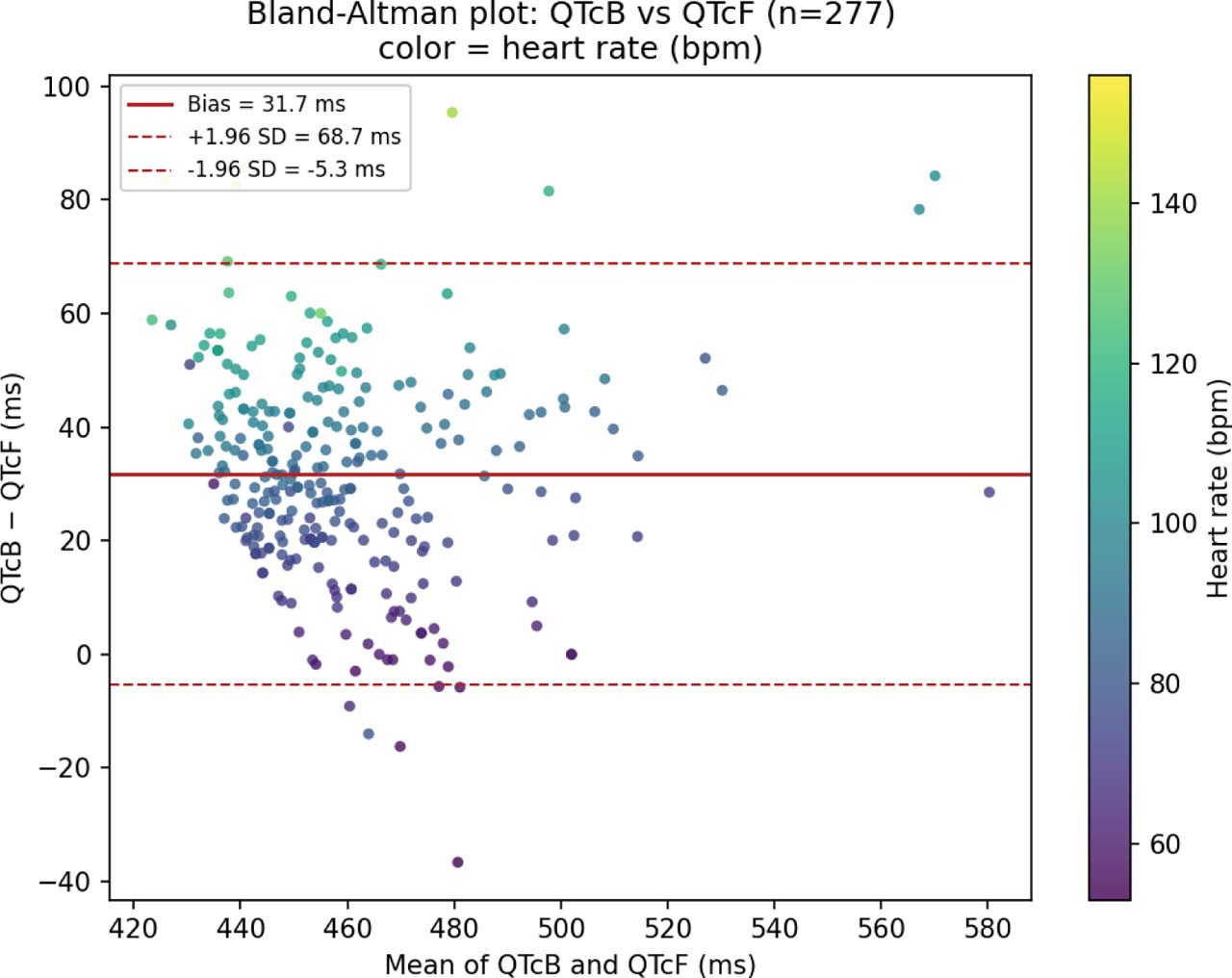
Figure 1.
Bland-Altman plot comparing QTcB and QTcF corrections (n=277). Mean bias +31.7 ms (SD 18.9 ms; 95% limits of agreement: −5.3 to +68.7 ms). Point color indicates heart rate (bpm); the discrepancy between formulas increased markedly with heart rate (r=0.92, p<0.001), confirming heart-rate-dependent overcorrection by Bazett's formula.
Acid-base and biological characterization
Serum bicarbonate concentration was 21.4 ±3.6 mmol/L in the isolated-QTcB group (n=63 with available data) versus 23.1 ±4.4 mmol/L in the QTcF-confirmed group (n=33). Arterial pH (7.47 ±0.04 in both groups), serum chloride (100.6 ±5.7 vs. 100.1 ±6.6 mmol/L), and serum potassium (3.90 ±0.62 vs. 3.97 ±0.67 mmol/L) did not differ meaningfully between groups. Arterial pCO2 was not recorded in this dataset, so a complete acid-base panel and a formal classification of metabolic alkalosis could not be constructed. Serum bicarbonate values were available in only 96 of 277 patients (34.7%), which limits the precision and representativeness of any bicarbonate-based analysis.
Bivariate analysis of QTc degree
Age was positively correlated with QTcF duration (Spearman ρ=0.175; p=0.004) but not with QTcB. Hypertension and ischemic stroke were each associated with higher QTcF (p=0.02); ischemic stroke was also associated with higher QTcB (p=0.05). Electrolyte disturbances overall were associated with higher QTcB (p=0.02), and individually, hypokalemia with higher QTcB (p=0.03), while hypocalcemia, hypomagnesemia, and hypophosphatemia were each associated with higher QTcF (p<0.05 for all); diabetic ketoacidosis was also associated with higher QTcF (p=0.01). Beta-blocker use (p=0.003) and hydroxychloroquine use (p=0.03) were associated with higher QTcF; the hydroxychloroquine finding concerns the continuous QTcF value and is distinct from its non-significant association with QTcF-confirmed status (Table 2, p=0.28).
Table 2.
Univariate analysis: variables associated with QTcF-confirmed QT prolongation
| Variable | Isolated QTcB (n=199) | QTcF-confirmed (n=78) | p-value |
|---|---|---|---|
| Age (years) | 57.8 ±17.2 | 62.9 ±11.9 | 0.005 |
| Female sex | 112 (56.3%) | 38 (48.7%) | 0.32 |
| Hypertension | 75 (37.7%) | 46 (59.0%) | 0.002 |
| Ischemic stroke | 14 (7.1%) | 13 (16.7%) | 0.03 |
| Dyslipidemia | 39 (19.6%) | 24 (30.8%) | 0.07 |
| Beta-blocker use | 8 (4.5%) | 14 (18.0%) | <0.001 |
| Hydroxychloroquine | 2 (1.0%) | 3 (3.9%) | 0.28 |
| Creatinine clearance (ml/min) | 82.5 ±33.3 | 72.5 ±34.8 | 0.02 |
| Serum potassium (mmol/L) | 3.9 ±0.6 | 4.0 ±0.7 | 0.42 |
| Serum calcium (mmol/L) | 2.2 ±0.2 | 2.2 ±0.4 | 0.13 |
| Fasting glucose (mmol/L) | 10.8 ±7.7 | 12.2 ±8.1 | 0.07 |
[i] Age was compared using Welch's t-test (unequal variances); serum calcium and fasting glucose were compared using the Mann-Whitney U test given their skewed distributions; all other continuous variables were compared using Student's t-test and categorical variables using the chi-square or Fisher's exact test, as appropriate.
Analysis of QTcF-confirmed QT prolongation
In univariate analysis comparing patients with QTcF-confirmed prolongation (n=78) versus isolated QTcB prolongation (n=199), significant associations were found for older age (62.9 ±11.9 vs. 57.8 ±17.2 years; p=0.005), hypertension (59% vs. 37.7%; p=0.002), ischemic stroke (16.7% vs. 7.1%; p=0.03), beta-blocker use (18% vs. 4.5%; p<0.001), and reduced creatinine clearance (72.5 ±34.8 vs. 82.5 ±33.3 ml/min; p=0.02) (Table 2).
In multivariable logistic regression restricted to the 96 patients with complete data for all model covariates (33 QTcF-confirmed, 63 isolated QTcB), no variable reached conventional statistical significance (overall model likelihood-ratio p=0.027; Nagelkerke pseudo-R2=0.191; Hosmer-Lemeshow test p>0.10, indicating adequate calibration). Serum bicarbonate (OR=1.121; 95% CI: 0.991–1.268; p=0.069) and hypertension (OR=2.522; 95% CI: 0.875–7.275; p=0.087) showed borderline, non-significant associations with QTcF-confirmed prolongation; age, creatinine clearance, ischemic stroke, and beta-blocker use were not associated with the outcome after adjustment (Table 3). Variance inflation factors for all six predictors were below 1.5 after centering, excluding multicollinearity as an explanation for the wide confidence intervals observed, which more likely reflect the limited sample size (33 events for 6 predictors).
Table 3.
Multivariable logistic regression for QTcF-confirmed QT prolongation — complete-case analysis (n=96: 33 QTcF-confirmed, 63 isolated QTcB)
| Variable | OR | 95% CI | p-value |
|---|---|---|---|
| Serum bicarbonate (mmol/L) | 1.121 | 0.991–1.268 | 0.069 |
| Hypertension | 2.522 | 0.875–7.275 | 0.087 |
| Ischemic stroke | 1.598 | 0.303–8.438 | 0.581 |
| Beta-blocker use | 4.661 | 0.460–47.272 | 0.193 |
| Age (years) | 0.998 | 0.963–1.034 | 0.924 |
| Creatinine clearance (ml/min) | 0.996 | 0.981–1.012 | 0.642 |
Reversibility of QT prolongation
A follow-up ECG was performed in all patients (median delay 3 days, IQR 2–5 days; mean 4.1 days, reflecting a right-skewed distribution with a small number of longer delays up to 60 days). QTcB normalized in 189 patients (68.2%), temporally associated with metabolic correction and/or withdrawal of QT-prolonging medications, although a direct causal relationship cannot be established given the retrospective design and non-standardized, often simultaneous interventions. Of all 277 patients, 169 (61.0%) had electrolyte disturbances at baseline and ultimately showed reversible QT prolongation; 93 (33.6%) had been receiving QT-prolonging medications.
Persistent QT prolongation was observed in 88 patients (31.7%) and was significantly associated with higher baseline glycemia (12.0 ±7.8 vs. 10.8 ±7.8 mmol/L; p=0.04), elevated bicarbonate levels (23.5 ±3.5 vs. 21.2 ±4.0 mmol/L; p=0.008), reduced creatinine clearance (p=0.003), and continued exposure to QT-prolonging medications. Two patients (0.7%) exhibited persistent marked QT prolongation (QTcB >480 ms) in the absence of identifiable acquired causes, which may raise clinical suspicion for congenital LQTS; however, this observation alone does not establish the diagnosis, and further evaluation — including repeat ECG assessment, detailed family history, and genetic testing where appropriate — would be required.
Diabetic subgroup analysis
In this exploratory analysis of the diabetic subgroup (n=148), peripheral neuropathy (DN4 ≥4, present in 21 patients) was associated with a mean QTcB value 15.8 ms higher than in patients without neuropathy (age-adjusted 95% CI: 4.7–27.0 ms; p=0.006; linear regression). Age itself was not associated with QTcB in this subgroup (p=0.42). With QTcF as the dependent variable, the association was not statistically significant (β=9.5 ms; 95% CI: −2.9 to 21.9; p=0.13).
DISCUSSION
In this retrospective series of 277 patients hospitalized in an internal medicine department with QT interval prolongation, we describe the clinical, biological, and pharmacological determinants of QT prolongation, quantify the discrepancy between Bazett and Framingham correction in this population, and assess its reversibility. In an exploratory subgroup analysis, diabetic peripheral neuropathy was associated with higher QTcB values.
QT correction formula and case definition
The marked discrepancy between Bazett- and Framingham-defined QT prolongation observed in our cohort is consistent with the well-recognized, heart-rate-dependent overcorrection by Bazett's formula [6,9,11], now directly quantified in our population by Bland-Altman analysis. These findings reinforce cautious interpretation of QTcB values and, when feasible, use of alternative formulas for risk stratification in tachycardic patients. The disappearance of sex differences after Framingham correction likely reflects this same heart-rate dependence, given the higher resting heart rate typically observed in women.
Clinical and demographic determinants
Age was positively correlated with QTcF duration, consistent with age-related decline in repolarization reserve, myocardial fibrosis, altered ion channel expression, and reduced autonomic flexibility [12,13]. Hypertension and ischemic stroke were significantly associated with QTcF prolongation, reflecting structural remodeling and autonomic dysregulation respectively, particularly involving the insular cortex [14,15].
Pharmacological contributions
Nearly half of patients (47.6%) were receiving at least one QT-prolonging medication. Beta-blocker use was associated with QTcF prolongation, likely reflecting heart rate-dependent effects and confounding by indication. Hydroxychloroquine was associated with higher QTcF values in bivariate analysis (p=0.03), consistent with its known inhibitory effects on the rapid component of the delayed rectifier potassium current (IKr) [16,17], but not with QTcF-confirmed status (Table 2, p=0.28), likely reflecting the small number of exposed patients (n=5) and the distinct nature of the two comparisons (see Results).
Metabolic and biological determinants
Electrolyte abnormalities were among the most consistent contributors. Hypokalemia was associated with higher QTcB, while hypocalcemia, hypomagnesemia, and hypophosphatemia were associated with higher QTcF, consistent with established electrophysiological principles [18,19,20]. Diabetic ketoacidosis was significantly associated with higher QTcF, likely through direct metabolic effects, electrolyte shifts, and autonomic dysfunction.
Serum bicarbonate
Serum bicarbonate showed only a non-significant trend toward association with QTcF-confirmed prolongation (univariate p=0.053; adjusted OR=1.121, p=0.069, n=96), but was significantly associated with persistence of QT prolongation at follow-up (p=0.008). As bicarbonate alone does not establish metabolic alkalosis, and arterial pCO2 was not recorded, we regard this association as hypothesis-generating, warranting confirmation in prospective studies with complete acid-base characterization before any clinical application.
Reversibility and dynamic nature of QT prolongation
QT prolongation normalized in most patients, temporally associated with correction of underlying causes, supporting the predominantly acquired and dynamic nature of QT prolongation in this setting; however, interventions were not standardized and often simultaneous, precluding causal inference. Persistence was associated with higher glycemia, bicarbonate, renal impairment, and continued drug exposure (Results). Two patients (0.7%) had persistent marked prolongation without an identifiable cause, which may raise suspicion for congenital LQTS but would require further evaluation to confirm.
Diabetic subgroup and autonomic dysfunction
Peripheral neuropathy (DN4 ≥4) was associated with higher QTcB values after age adjustment (Results), possibly reflecting the role of diabetic autonomic neuropathy in prolonging ventricular repolarization through impaired vagal tone and relative sympathetic predominance [23,24]. However, this finding was based on a small subgroup (n=21) and was not significant with QTcF; it should therefore be considered exploratory and requires confirmation in a larger diabetic cohort.
Study limitations
This retrospective, single-center study has several limitations. The Bazett-based inclusion criterion prevents assessment of the true diagnostic performance of Bazett versus Framingham correction in an unselected population, and the 28.1% Framingham-confirmation rate should not be read as a general prevalence estimate. Arterial pCO2 was not recorded, precluding a complete acid-base panel. Blinding and inter-/intra-observer reproducibility of QT measurement were not assessed, and the absence of Holter-based recording adds further measurement variability. The diabetic subgroup analysis was exploratory, based on a small number of patients with neuropathy (n=21), and adjusted only for age. Prospective, multicenter studies with complete acid-base and heart-rate data are needed to confirm these findings.
CONCLUSIONS
i) Bazett's correction formula overestimates QT prolongation compared with the Framingham formula in a manner that is strongly and near-linearly dependent on heart rate, as directly quantified by Bland-Altman analysis (bias +31.7 ms overall, ranging from +3.6 ms at heart rate <70 bpm to +64.4 ms at >110 bpm); reliance on Bazett alone, particularly in tachycardic patients, may lead to misclassification and unnecessary alarm.
ii) QT prolongation in hospitalized internal medicine patients is frequent, multifactorial, and predominantly acquired, normalizing in the majority of patients following correction of metabolic disturbances and withdrawal of QT-prolonging agents, although this study cannot establish direct causality for this reversibility.
iii) In an exploratory subgroup analysis, diabetic peripheral neuropathy (DN4 ≥4) was associated with higher QTcB values (+15.8 ms after age adjustment), but not significantly with QTcF; this finding requires confirmation in a larger diabetic cohort.
iv) An association between serum bicarbonate and QTcF-confirmed prolongation, suggested by univariate analyses, did not reach significance after complete-case multivariable adjustment (available in only 34.7% of the cohort) and should be regarded as exploratory, warranting confirmation in prospective studies with complete acid-base characterization. Systematic QTc reassessment using appropriate formulas, with vigilance for persistent cases potentially representing congenital LQTS, remains essential in this high-risk population.
Acknowledgements
The authors thank the medical and nursing staff of the Internal Medicine Department of the University Hospital of Ben Arous for their support in data collection.
Notes
[5] Funding:
This research did not receive any specific grant from funding agencies in the public, commercial, or not-for-profit sectors.
[6] Ethics approval and consent to participate:
The study was conducted in accordance with the principles of the Declaration of Helsinki. Ethical approval was obtained from the Ethics Committee of the University Hospital of Ben Arous. Individual informed consent was waived by the Ethics Committee given the retrospective nature of the study, in accordance with national guidelines for retrospective observational research.