
What is new / What is important
In a cohort of older heart failure outpatients in Indonesia, over 95% had polypharmacy and 73% had moderate-to-severe potentially inappropriate medication (PIM) exposure under Beers Criteria 2023. Both exposures showed directional associations with worse cognitive category on MoCA-INA; adjusted estimates were statistically inconclusive, consistent with a hypothesis-generating study. Education was independently protective and HFrEF was robustly associated with greater cognitive vulnerability, highlighting the need for integrated medication review and routine cognitive screening in heart failure care.
1. Introduction
Heart failure (HF) is increasingly recognized as a systemic syndrome that extends beyond the myocardium, with cognitive impairment emerging as a frequent and clinically consequential comorbidity. Cognitive deficits in HF have been linked to poorer self-care, medication non-adherence, recurrent hospitalization, and reduced quality of life. Older adults are particularly vulnerable because aging-related neurodegeneration and vascular changes may interact with HF-related cerebral hypoperfusion and neurohormonal dysregulation.
Polypharmacy is common in HF due to multimorbidity and guideline-directed multidrug regimens. While appropriate combination therapy improves outcomes, increasing medication burden may also raise the risk of drug-drug interactions, adverse drug reactions, and prescribing cascades. Polypharmacy has been associated with cognitive decline in community and clinical cohorts. Importantly, medication count alone may be an incomplete marker; the appropriateness of medications, especially exposure to PIMs, may be more proximal to neurocognitive harm.
The American Geriatrics Society (AGS) Beers Criteria provide an evidence-based framework to identify PIMs in older adults, with the most recent update published in 2023. PIMs, including anticholinergics, sedative-hypnotics, and certain cardiovascular and analgesic agents, can adversely affect cognition through central nervous system effects, orthostatic hypotension, delirium, and falls. Long-term exposure to such drug classes has been linked to cognitive and physical decline.
In Indonesia, the Montreal Cognitive Assessment Indonesian version (MoCA-INA) has demonstrated validity for cognitive screening in older adults. Yet, studies integrating MoCA-INA with structured medication appropriateness evaluation using Beers-2023 criteria in older HF outpatients are scarce. This study aimed to examine the association between polypharmacy, Beers-2023 PIM exposure, and cognitive function among older HF outpatients and to estimate independent effects using multivariable proportional-odds ordinal regression. Given the cross-sectional design and sample size calculated for prevalence estimation, multivariable findings are considered hypothesis-generating.
2. Materials and Methods
2.1. Study design and setting
We conducted an observational analytic cross-sectional study at the cardiology outpatient clinic of a tertiary teaching hospital in Medan, North Sumatra, Indonesia (August to October 2025). This report adheres to the STROBE guideline for cross-sectional studies.
2.2. Participants
Eligible participants were outpatients aged 60 years or older with a physician diagnosis of heart failure, receiving treatment for at least 1 month, and clinically stable. Written informed consent was obtained from all participants before enrollment. Exclusion criteria were: (1) severe hearing or speech impairment preventing interview, (2) previously diagnosed severe cognitive disorder such as severe dementia, Alzheimer’s disease, or delirium, and (3) recent recovery from acute stroke or other severe neurological condition.
Heart failure phenotype was classified based on left ventricular ejection fraction (LVEF) measured by transthoracic echocardiography, abstracted from the most recent available echocardiographic report within 12 months prior to enrolment. HFrEF was defined as LVEF ≤40%, HFmrEF as LVEF 41–49%, and HFpEF as LVEF ≥50%, consistent with current ESC heart failure guidelines. Classification was performed by the attending cardiologist and confirmed from the medical record at the time of enrolment.
2.3. Sampling and sample size
The minimum sample size was estimated using the Lemeshow formula for unknown population proportion (p=0.50, Z=1.96, d=0.10), yielding 97 participants; a 10% attrition buffer raised the target to 107. Consecutive non-probability sampling was used. The sample was designed to estimate prevalence with acceptable precision; multivariable analyses should therefore be considered exploratory and hypothesis-generating.
2.4. Measures
Cognitive function (outcome)
Cognitive function was assessed face-to-face using MoCA-INA version 7.1 (total score 0 to 30), categorized as normal (26 to 30), mild cognitive impairment (18 to 25), and mild to moderate dementia (10 to 17). MoCA-INA was administered by a trained research medical student under the direct supervision of the attending consultant or resident on duty on the day of assessment. Assessors were blinded to participants' medication data, polypharmacy category, and PIM burden at the time of cognitive assessment to minimise measurement bias.
Polypharmacy (exposure)
Medication count was abstracted from medical records and categorized as non-polypharmacy (fewer than 5), polypharmacy (5 to 9), and hyperpolypharmacy (10 or more).
Potentially inappropriate medications (exposure)
PIM exposure was evaluated using the AGS Beers Criteria 2023, categorized as none (0), mild (1), moderate (2), and severe (3 or more).
Covariates
Demographic covariates included age (continuous, years), sex, and years of formal education (continuous). Clinical covariates included HF phenotype (HFpEF, HFmrEF, HFrEF), duration of HF (continuous, months), and the Age-Adjusted Charlson Comorbidity Index (ACCI), categorized as moderate (3 to 4) or high (5 or more).
2.5. Statistical analysis
All statistical analyses were conducted using dedicated statistical computing software. Descriptive statistics were reported as mean±SD, median (min, max), or n (%). Bivariate associations were examined using Spearman’s ρ and the Kruskal–Wallis test. Proportional-odds ordinal logistic regression was used to estimate adjusted odds ratios (aORs) and 95% confidence intervals (CIs) across three sequential models: Model 1 (polypharmacy plus covariates), Model 2 (PIM burden plus covariates), and Model 3 (both exposures simultaneously). Model fit was evaluated using AIC, BIC, McFadden pseudo-R2, and Nagelkerke pseudo-R2. Collinearity was assessed by variance inflation factors (VIF); values of 5 or above were considered indicative of meaningful collinearity. The proportional odds assumption was evaluated using a Brant-style score test. Statistical significance was set at two-sided p<0.05.
2.6. Ethics
Ethical approval was granted by the Health Research Ethics Committee, Universitas Sumatera Utara (No. 618/KEPK/USU/2025; 16 July 2025). Written informed consent was obtained from all participants in accordance with the Declaration of Helsinki.
3. Results
3.1. Participant flow
Of 110 patients who met eligibility criteria and consented, 3 were excluded after initial screening (1 with newly confirmed severe dementia, 1 with acute delirium, and 1 with severe hearing impairment), yielding a final analytic sample of 107 participants. The complete enrolment and exclusion process is illustrated in Figure 1.
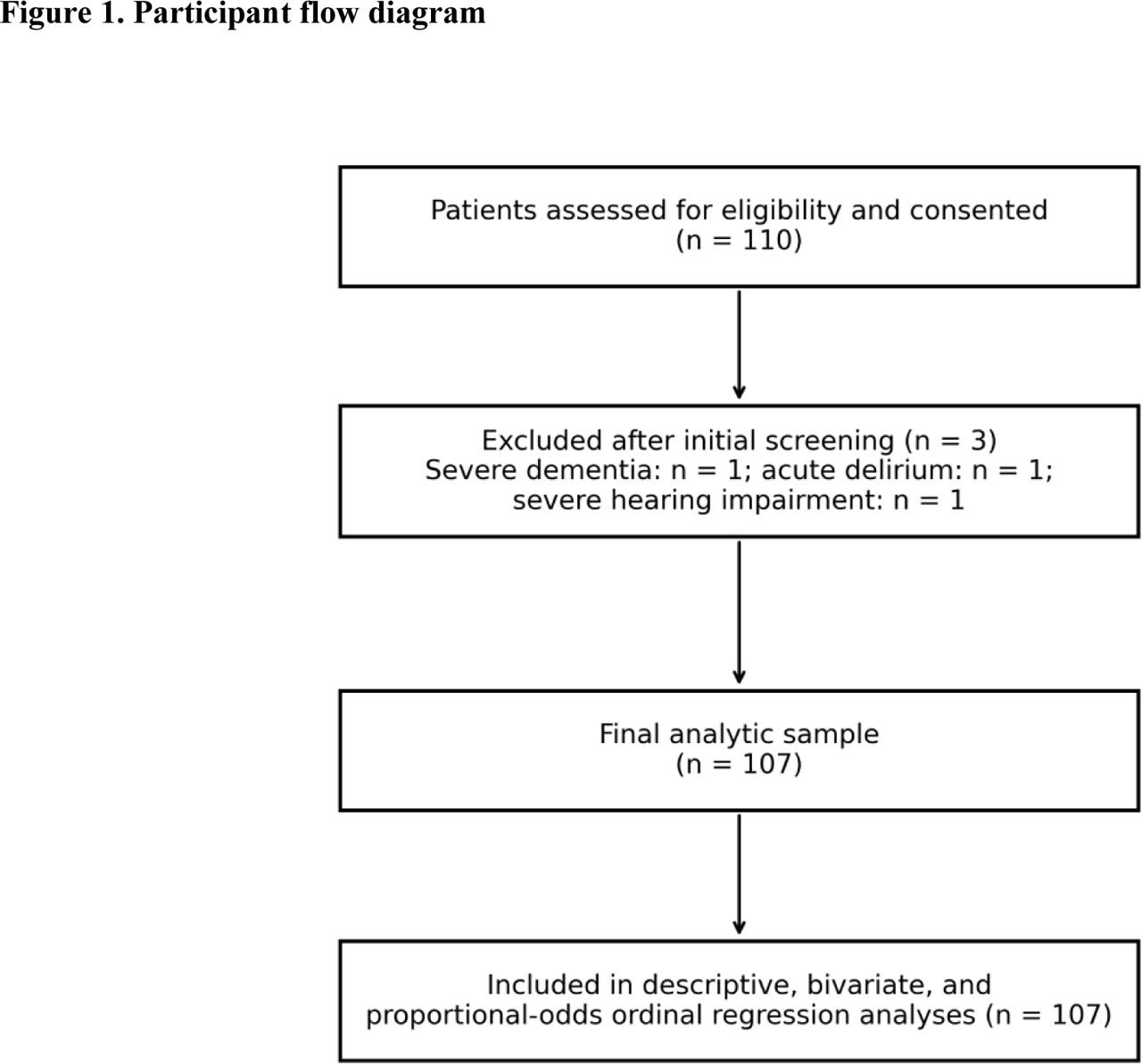
Figure 1.
Participant flow from eligibility assessment to final analytic sample.
3.2. Participant characteristics
The mean age was 67.6±6.2 years: 43 (40%) aged 60 to 65, 26 (24%) aged 66 to 70, and 38 (36%) aged above 70 years. Females accounted for 59 (55%) participants. Mean education was 12.1±3.1 years. HFpEF predominated (81, 76%), followed by HFrEF (18, 17%) and HFmrEF (8, 8%). ACCI category was moderate in 79 (74%) and high in 28 (26%). Full characteristics are presented in Table 1.
Table 1.
Participant characteristics (n=107)
| Variable | Value |
|---|---|
| Age (years), mean ± SD | 67.6 ± 6.2 |
| Age category – 60 to 65 years, n (%) | 43 (40) |
| Age category – 66 to 70 years, n (%) | 26 (24) |
| Age category – Above 70 years, n (%) | 38 (36) |
| Female sex, n (%) | 59 (55) |
| Education (years), mean ± SD | 12.1 ± 3.1 |
| HF duration (months), median (min, max) | 34 (2, 46) |
| HF phenotype – HFpEF, n (%) | 81 (76) |
| HF phenotype – HFrEF, n (%) | 18 (17) |
| HF phenotype – HFmrEF, n (%) | 8 (8) |
| ACCI category – Moderate (3 to 4), n (%) | 79 (74) |
| ACCI category – High (≥5), n (%) | 28 (26) |
| Polypharmacy category – Non-polypharmacy (<5 medications), n (%) | 5 (5) |
| Polypharmacy category – Polypharmacy (5 to 9 medications), n (%) | 77 (72) |
| Polypharmacy category – Hyperpolypharmacy (≥10 medications), n (%) | 25 (23) |
| PIM burden – None (0 PIMs), n (%) | 8 (8) |
| PIM burden – Mild (1 PIM), n (%) | 21 (20) |
| PIM burden – Moderate (2 PIMs), n (%) | 36 (34) |
| PIM burden – Severe (≥3 PIMs), n (%) | 42 (39) |
| Cognitive category – Normal (MoCA-INA 26 to 30), n (%) | 13 (12) |
| Cognitive category – MCI (MoCA-INA 18 to 25), n (%) | 83 (78) |
| Cognitive category – Mild to moderate dementia (MoCA-INA 10 to 17), n (%) | 11 (10) |
[i] Abbreviations: ACCI, Age-Adjusted Charlson Comorbidity Index; HF, heart failure; HFpEF, heart failure with preserved ejection fraction; HFmrEF, heart failure with mildly reduced ejection fraction; HFrEF, heart failure with reduced ejection fraction; MCI, mild cognitive impairment; MoCA-INA, Montreal Cognitive Assessment–Indonesian version; PIM, potentially inappropriate medication; SD, standard deviation.
3.3. Medication burden and PIM exposure
Only 5 (5%) participants were in the non-polypharmacy group; polypharmacy was present in 77 (72%) and hyperpolypharmacy in 25 (23%). Using Beers-2023 criteria, 8 (8%) had no PIM exposure, while 21 (20%), 36 (34%), and 42 (39%) had mild, moderate, and severe PIM exposure, respectively.
A descriptive breakdown of PIM drug classes is provided in Supplementary Table S4. The most prevalent Beers-flagged class was antiplatelet agents (aspirin for primary/secondary prevention; n=73, 68.2%), followed by first-generation antihistamines (n=23, 21.5%) and short-acting calcium channel blockers (nifedipine immediate-release) (n=17, 15.9%). CNS-active agents with established neurocognitive risk (benzodiazepines, gabapentin, and SSRIs) were present in 2.8%, 6.5%, and 2.8% of participants, respectively. Anticholinergic and sedative drug classes in aggregate were identified in approximately one-third of participants (33.6%).
3.4. Cognitive function profile
Mean MoCA-INA score was 22.0±3.3. Cognitive categories were: normal 13 (12%), mild cognitive impairment 83 (78%), and mild to moderate dementia 11 (10%). Domain-level scores indicated greatest impairment in delayed recall (mean 1.87±1.39 of 5) and visuospatial/executive function (mean 3.13±1.12 of 5), while naming (2.98±0.14) and orientation (5.78±0.63) were relatively preserved (Table 2).
Table 2.
MoCA-INA domain scores (n=107)
| Domain (maximum score) | Mean ± SD |
|---|---|
| Visuospatial/executive (0 to 5) | 3.13 ± 1.12 |
| Naming (0 to 3) | 2.98 ± 0.14 |
| Attention (0 to 6) | 4.58 ± 1.24 |
| Language (0 to 3) | 2.19 ± 0.92 |
| Abstraction (0 to 2) | 1.28 ± 0.70 |
| Delayed recall (0 to 5) | 1.87 ± 1.39 |
| Orientation (0 to 6) | 5.78 ± 0.63 |
| Total MoCA-INA (0 to 30) | 21.97 ± 3.31 |
3.5. Bivariate associations
Cognitive category showed a positive monotonic correlation with polypharmacy level (Spearman ρ=0.276; p=0.004) and with PIM burden level (ρ=0.264; p=0.006). Group differences in MoCA-INA scores were significant across polypharmacy strata (Kruskal–Wallis H=6.353; p=0.042) and did not reach statistical significance across PIM burden strata (H=6.434; p=0.092). Cognitive-category distributions are presented in Figures 2 and 3, corresponding frequencies and MoCA-INA medians are provided in Tables 4A and 4B, and MoCA-INA score distributions are shown in Supplementary Figures S1 and S2.
Table 3.
Fully adjusted proportional-odds ordinal logistic regression, Model 3 (n=107)
| Predictor | aOR | 95% CI | p-value |
|---|---|---|---|
| Polypharmacy category (per-level increase) | 2.88 | 0.82 to 10.08 | 0.10 |
| PIM burden (per-level increase) | 1.70 | 0.91 to 3.20 | 0.10 |
| Age (per 1-year increase) | 1.09 | 1.00 to 1.19 | 0.06 |
| Female sex (vs male) | 1.20 | 0.42 to 3.45 | 0.74 |
| Education (per 1-year increase) | 0.82 | 0.68 to 0.99 | 0.04 |
| HF duration (per 1-month increase) | 1.00 | 0.96 to 1.04 | 0.98 |
| High ACCI (≥5) vs moderate | 2.71 | 0.76 to 9.60 | 0.12 |
| HFrEF vs HFpEF | 6.10 | 1.25 to 29.87 | 0.03 |
| HFmrEF vs HFpEF | 2.24 | 0.31 to 16.01 | 0.42 |
[i] Higher aOR values indicate higher odds of a worse cognitive category. Model fit: AIC=134.7; BIC=164.1; McFadden R2=0.234; Nagelkerke R2=0.368. Abbreviations: ACCI, Age-Adjusted Charlson Comorbidity Index; AIC, Akaike information criterion; aOR, adjusted odds ratio; BIC, Bayesian information criterion; CI, confidence interval; HF, heart failure; HFpEF, heart failure with preserved ejection fraction; HFmrEF, heart failure with mildly reduced ejection fraction; HFrEF, heart failure with reduced ejection fraction; PIM, potentially inappropriate medication.
Table 4A.
Cognitive category by polypharmacy strata
| Category | n | Normal, n (%) | MCI, n (%) | Dementia, n (%) | MoCA-INA median (min, max) |
|---|---|---|---|---|---|
| Non-polypharmacy (<5 medications)a | 5 | 4 (80) | 1 (20) | 0 (0) | 26 (20, 27) |
| Polypharmacy (5 to 9 medications) | 77 | 8 (10) | 62 (81) | 7 (9) | 23 (10, 28) |
| Hyperpolypharmacy (≥10 medications) | 25 | 1 (4) | 20 (80) | 4 (16) | 22 (15, 26) |
Table 4B.
Cognitive category by Beers-2023 PIM burden strata
| Category | n | Normal, n (%) | MCI, n (%) | Dementia, n (%) | MoCA-INA median (min, max) |
|---|---|---|---|---|---|
| None (0 PIMs) | 8 | 4 (50) | 4 (50) | 0 (0) | 25 (21, 27) |
| Mild (1 PIM) | 21 | 4 (19) | 16 (76) | 1 (5) | 23 (12, 28) |
| Moderate (2 PIMs) | 36 | 4 (11) | 26 (72) | 6 (17) | 23 (10, 28) |
| Severe (≥3 PIMs) | 42 | 1 (2) | 37 (88) | 4 (10) | 22 (15, 26) |
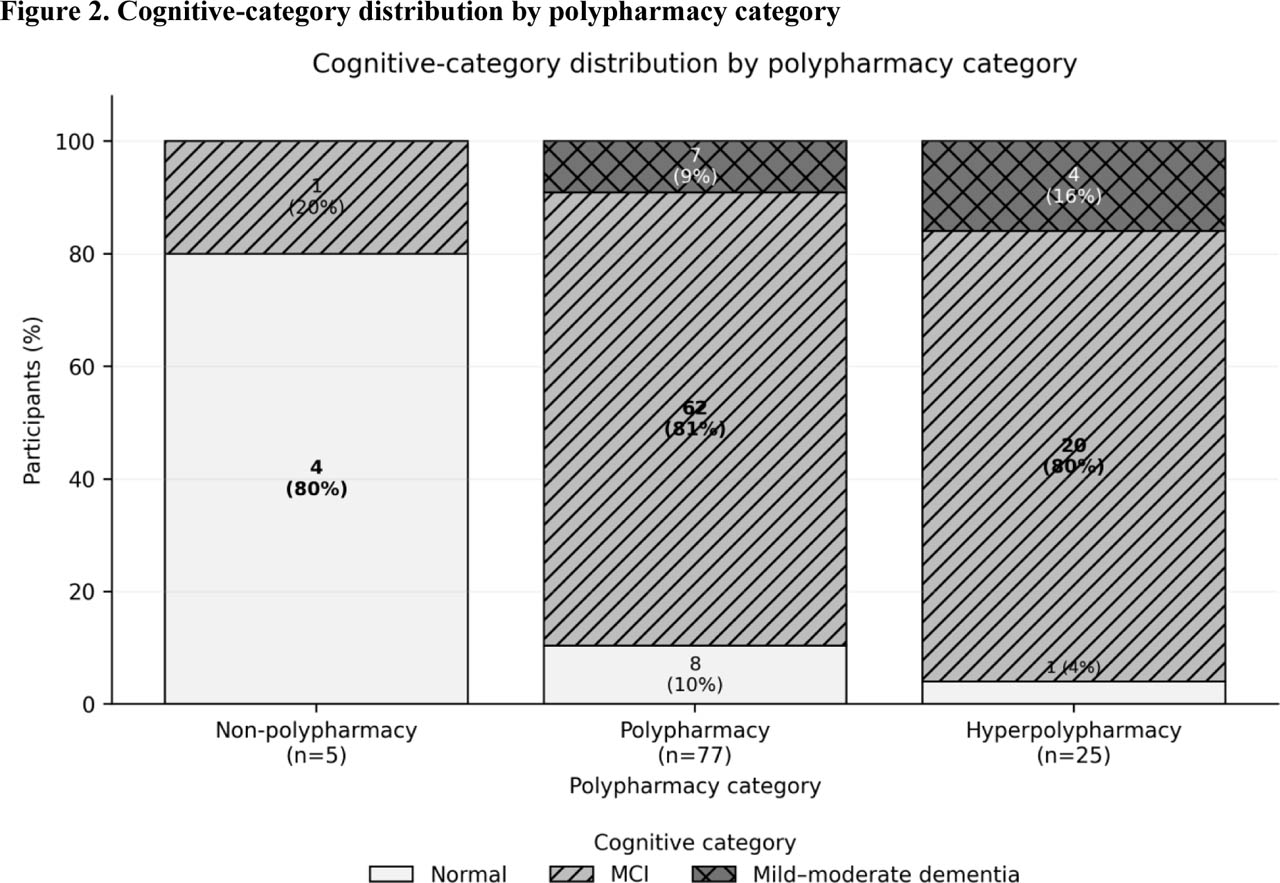
Figure 2.
Stacked bars use both direct labels and hatch patterns so categories remain distinguishable without color.
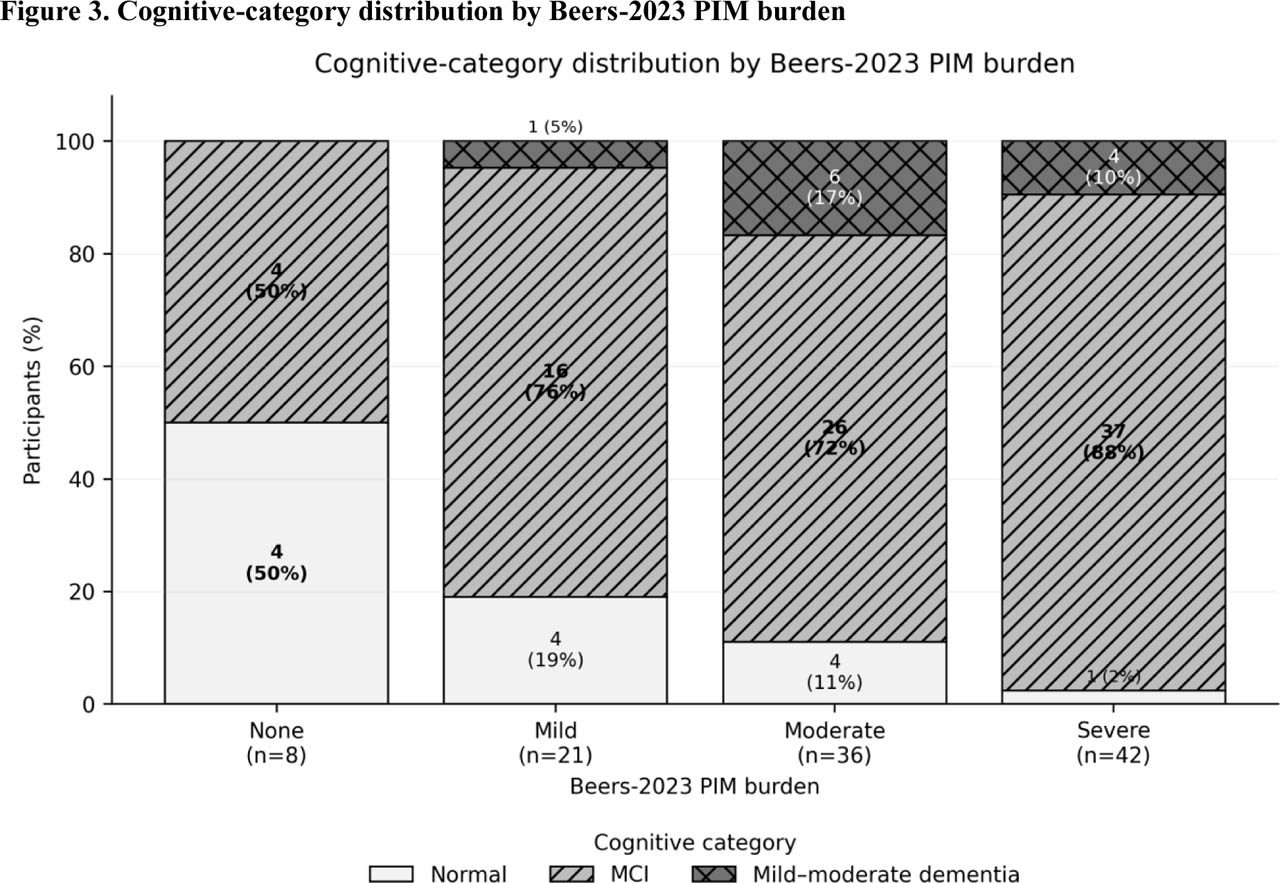
Figure 3.
Stacked bars use both direct labels and hatch patterns so categories remain distinguishable without color.
3.6. Collinearity diagnostics
All VIFs in Model 3 were below 2.0 (range 1.09 to 1.41), indicating no meaningful multicollinearity (Supplementary Table S3). The Spearman correlation between polypharmacy and PIM burden categories was moderate (ρ=0.434; p<0.001), explaining the attenuation observed in Model 3 without constituting problematic collinearity.
3.7. Proportional odds assumption
Brant-style evaluation found that polypharmacy category, education, HF duration, and HFmrEF showed approximately parallel regression coefficients across the two ordinal cutpoints, supporting the proportional odds assumption for these predictors. PIM burden, ACCI, age, sex, and HFrEF showed larger differences between cutpoints, suggesting potential partial violation for these variables. Given the small dementia category (n=11), formal inference from this test is limited.
3.8. Multivariable ordinal regression
Regression results from all three models are summarised in Table 3 and Supplementary Table S2. In Model 1, each additional level of polypharmacy was associated with higher odds of worse cognitive category (aOR 4.73; 95% CI 1.55 to 14.47; p=0.006). In Model 2, each increment of PIM burden severity showed a similar association (aOR 2.16; 95% CI 1.25 to 3.73; p=0.006). Across both single-exposure models, HFrEF was independently associated with worse cognitive category and greater years of education were consistently protective.
When both exposures were entered simultaneously in Model 3, education remained independently protective (aOR 0.82 per year; 95% CI 0.68 to 0.99; p=0.038) and HFrEF retained a strong association with worse cognitive category (aOR 6.10; 95% CI 1.25 to 29.87; p=0.026). Polypharmacy (aOR 2.88; 95% CI 0.82 to 10.08; p=0.099) and PIM burden (aOR 1.70; 95% CI 0.91 to 3.20; p=0.098) showed directionally consistent but statistically inconclusive estimates, attributable to their moderate shared variance (ρ=0.434) rather than collinearity (all VIF <2.0). Model fit indices for Model 3 were AIC=134.7 and Nagelkerke pseudo-R2=0.368. Adjusted odds ratios and 95% confidence intervals across all three models are displayed in Figure 4.
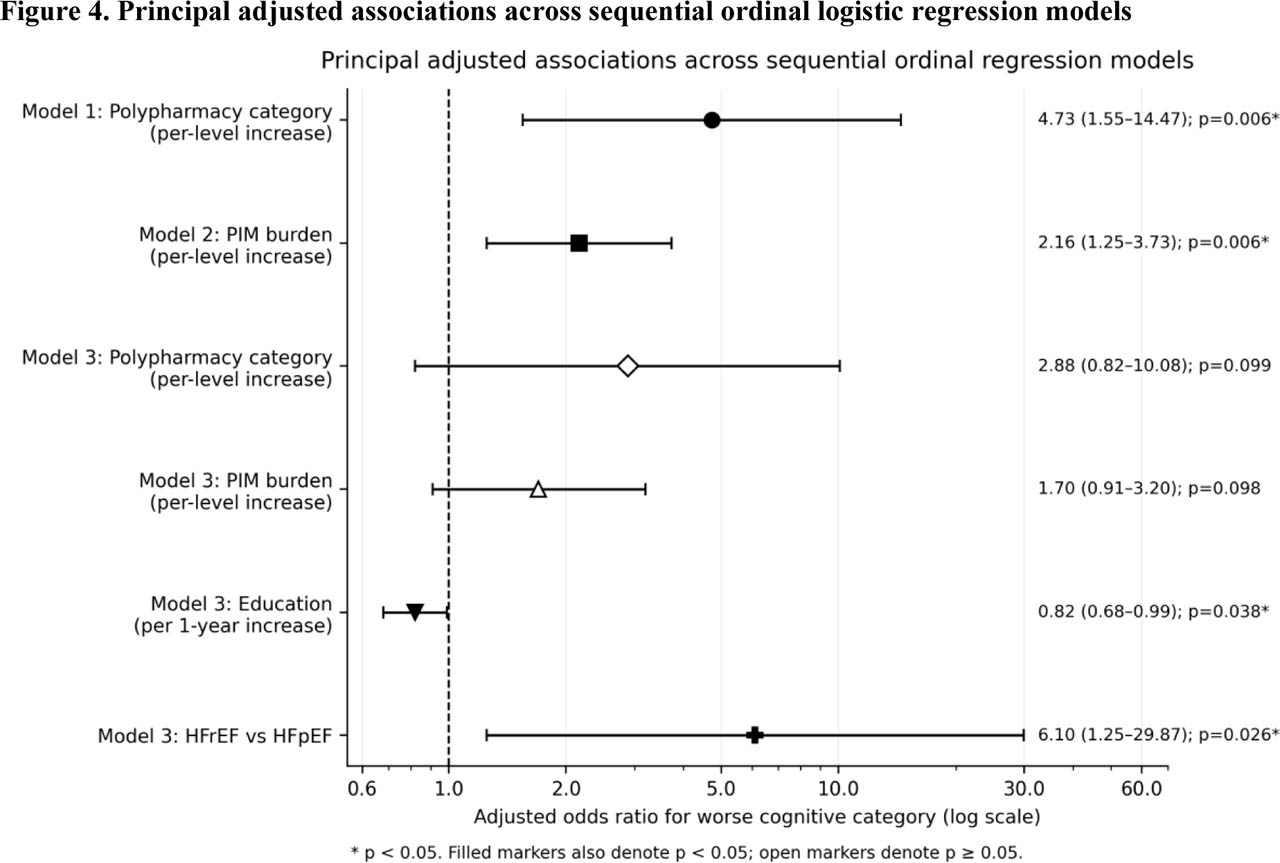
Figure 4.
Forest plot of selected adjusted odds ratios and 95% confidence intervals on a logarithmic scale. An asterisk and filled marker indicate p<0.05; exact estimates are printed next to each point.
4. Discussion
4.1. Principal findings
In this cohort of older HF outpatients, cognitive impairment was highly prevalent, with nearly four in five participants screening positive for mild cognitive impairment on MoCA-INA. Medication burden was substantial: over 95% met criteria for polypharmacy or hyperpolypharmacy, and nearly three-quarters had moderate to severe PIM exposure under Beers-2023 criteria. Both medication exposures demonstrated directional associations with worse cognitive category in bivariate analyses and in single-exposure regression models. In the fully adjusted model including both exposures, estimates attenuated and became statistically inconclusive, reflecting moderate shared variance (ρ=0.434) rather than severe collinearity (all VIF below 1.5). The study is appropriately characterized as hypothesis-generating.
4.2. Comparison with prior studies
Our findings align with broader evidence linking polypharmacy to cognitive impairment in older adults [2, 3]. In HF populations, cognitive impairment has been attributed to reduced cerebral perfusion, microvascular dysfunction, inflammation, and neurohormonal activation [1]. The high prevalence of cognitive impairment in our cohort is consistent with this multifactorial pathophysiology and reinforces the clinical importance of routine screening in HF care.
The large proportion of patients with moderate to severe PIM exposure is consistent with evidence that polypharmacy increases PIM likelihood in Indonesian older adults [8]. Beers-identified PIMs may contribute to cognitive symptoms through anticholinergic and sedative effects, sleep disruption, delirium, and orthostatic hypotension. Long-term exposure to anticholinergic and sedative drug classes has been associated with later-life cognitive decline [5], supporting biological plausibility for the observed directional associations even when statistical significance was not achieved in the adjusted model.
Education was independently protective across models, consistent with the cognitive reserve hypothesis whereby greater educational attainment builds neural redundancy that buffers against medication-related and disease-related cognitive decline. The independent association of HFrEF with worse cognitive category, robust across all three adjusted models, plausibly reflects greater hemodynamic compromise, higher neurohormonal dysregulation, and more severe cerebral hypoperfusion compared to HFpEF. This finding highlights the need for targeted cognitive screening particularly among HFrEF patients.
4.3. Clinical and research implications
HF outpatient services may benefit from integrating routine cognitive screening with structured medication review. A practical approach is to prioritize patients combining high medication counts, Beers-2023 PIM exposure, and HFrEF phenotype for pharmacist-led medication review and deprescribing. The 2023 AGS Beers update provides an actionable framework to flag higher-risk medications and support shared decision-making in geriatric HF care [4]. Because medication reduction is not always feasible in HF given guideline-directed therapy requirements, a nuanced strategy emphasizing substitution with safer alternatives, dose minimization, and monitoring for cognitive adverse effects is recommended over indiscriminate polypharmacy reduction.
For future research, longitudinal or interventional designs with adequate sample sizes are needed to clarify temporal directionality and establish whether deprescribing interventions improve cognitive outcomes. Studies should incorporate frailty, depression, renal function, and cumulative anticholinergic burden as covariates, and should consider validated cumulative anticholinergic burden scales in addition to Beers-based PIM counts to better characterize the neurologically relevant exposure.
4.4. Strengths and limitations
This study has several strengths: consecutive sampling from a real-world HF outpatient setting, use of a locally validated cognitive screening instrument (MoCA-INA), systematic PIM assessment with the updated Beers-2023 criteria, and thorough statistical reporting including VIF diagnostics, proportional odds testing, and multiple model fit indices.
Limitations should be carefully considered. First, the cross-sectional design precludes causal inference and reverse causation cannot be excluded; patients with worse cognitive function may receive more complex prescriptions. Second, the sample was designed for prevalence estimation rather than multivariable association testing; results are exploratory and likely underpowered, and the combination of approximately 9 predictors with n=107 participants raises concern for overfitting. Effect estimates should be interpreted as directional signals only. Third, MoCA-INA is a screening rather than a diagnostic instrument, and cognitive misclassification may occur. Fourth, the proportional odds assumption showed potential partial violation for several predictors including PIM burden, age, sex, ACCI, and HFrEF, further limiting interpretability of the ordinal model; this is compounded by the small dementia category (n=11). Fifth, the non-polypharmacy group comprised only 5 participants (5%), making stratum-specific estimates unreliable for that group. Sixth, important confounders were not measured, including depression, frailty, renal function, and anticholinergic burden; their omission may have confounded the observed associations. Seventh, the AGS Beers Criteria were developed and validated within the United States prescribing context; some listed agents may be unavailable or rarely prescribed in the Indonesian national formulary, potentially misrepresenting the true PIM exposure profile in this setting. Conversely, locally prevalent medications with potential cognitive or CNS risk including traditional Indonesian herbal preparations commonly used in the Indonesian population are not captured by this instrument, which may further limit the completeness of PIM ascertainment in the Indonesian context. Finally, this single-centre study may not be generalisable to other settings or healthcare systems.
5. Conclusions
Among older heart failure outpatients, higher medication burden and Beers-2023 PIM exposure were associated with worse cognitive status in unadjusted analyses; adjusted estimates were directionally consistent but statistically inconclusive, consistent with a hypothesis-generating study.
HFrEF was the most robust independent predictor of worse cognitive status, consistent across all three adjusted models; education was independently protective, identifying two clinically actionable targets for cognitive risk stratification in HF outpatient care.
Routine cognitive screening integrated with structured medication review, including deprescribing and safer substitution where feasible, is warranted as part of comprehensive heart failure care for older adults, pending confirmation in adequately powered longitudinal studies.
Acknowledgements
The authors thank the cardiology outpatient clinic staff and medical records unit of the study hospital for supporting data access and study coordination. No external funding was received for this study.