
What is new ? What is important?
This real-world study demonstrates the high prevalence of metabolic comorbidities among patients with moderate-to-severe psoriasis receiving biologic therapy. The findings emphasize the importance of systematic metabolic screening in dermatology practice and support the integration of multidisciplinary management to improve long-term patient outcomes.
1. INTRODUCTION
Psoriasis is a chronic, immune-mediated inflammatory disease, with a worldwide prevalence of 4.4% of the population, the highest prevalence being found in Asia [1]. Over the past decades, psoriasis has evolved from being considered solely a skin disease to a chronic, systemic inflammatory disorder associated with multiple comorbidities, like metabolic syndrome, insulin resistance and increased cardiovascular risk [2,3,4,5,6,7]. The key role of this association is represented by the Th-17/IL-23 immune response mechanisms, which lead to systemic inflammation present in both psoriasis and other comorbidities, such as metabolic syndrome, metabolic dysfunction-associated fatty liver disease (MASLD), diabetes mellitus, or arterial hypertension [8,9,10,11,12,13]. In addition, oxidative stress and endothelial dysfunction can increase the overall vascular and metabolic risk in these patients [14].
MASLD is of particular importance in patients with psoriasis, as recent meta-analyses and clinical studies have demonstrated an increased risk of MASLD and metabolic steatohepatitis in patients with moderate-to-severe psoriasis, even in the absence of abnormal liver enzyme levels. The pathophysiology of MASLD follows a “multiple-hit” model, in which insulin resistance plays a central role [13,15]. Reduced insulin sensitivity promotes increased lipolysis in adipose tissue, leading to an enhanced flux of free fatty acids to the liver. These fatty acids are subsequently esterified and stored, promoting hepatic steatosis. Simultaneously, adipocyte dysfunction induces an imbalance of adipokines and increased secretion of pro-inflammatory cytokines such as tumor necrosis factor α (TNF-α) and interleukin 6 (IL-6), contributing to hepatic and systemic inflammation [16]. The excessive accumulation of bioactive non-triglyceride lipids induces lipotoxicity, oxidative stress, and mitochondrial dysfunction, activating inflammatory and fibrogenic pathways in the liver [15,17,18].
This low-grade chronic inflammation constitutes a common pathogenic factor in both MASLD and psoriasis, suggesting the same biological substrate [9]. In this context, the gut–liver axis plays an increasingly important role, as intestinal dysbiosis and increased mucosal permeability promote translocation of bacterial endotoxins to the liver. Activation of Kupffer cells and hepatic inflammatory pathways accelerates the progression from simple steatosis to metabolic steatohepatitis and fibrosis [17]. Consequently, MASLD should be regarded as a hepatic manifestation of systemic inflammation and metabolic dysfunction [19].
The management and outcomes of psoriasis have been dramatically improved by the introduction of biologic therapies [20]. They are classified by the mechanisms involved in three main categories – anti-tumor necrosis factor alpha (anti-TNF-α), anti-interleukin 17 (anti-IL-17) and anti-interleukin 23 (anti-IL-23), the choice between them being influenced by the existing comorbidities [17,18,21]. For example, obesity and MASLD may negatively influence treatment response, whereas a history of latent infections, such as tuberculosis, requires careful monitoring [20,22]. Although biologic therapies have demonstrated high efficacy in randomized clinical trials, real-world data regarding treatment response in patients with psoriasis and multiple metabolic comorbidities remain limited. Moreover, clinical response to biologic therapy varies among individuals, and a proportion of patients require switching to another biologic class, mainly because of loss of efficacy or safety concerns [23,24,25]. Therefore, identifying factors associated with treatment response remains an important area of research [23,24,25].
The aim of this study was to evaluate the prevalence and types of comorbidities in patients with psoriasis receiving biologic therapy, to assess treatment response using the Psoriasis Area and Severity Index (PASI) and Dermatology Life Quality Index (DLQI), and to explore factors associated with therapeutic response at six and 12 months after treatment initiation.
2. MATERIALS AND METHODS
This study is a retrospective observational cohort study including 121 patients with psoriasis treated with biologic therapies in the Dermatology Department of “Dr. Carol Davila” Central Military Emergency University Hospital. Data were collected at biologic treatment initiation and at standardized assessments at 6 and 12 months. In addition, the latest available clinical assessment performed in 2025 was recorded for each patient. Because biologic treatment had been initiated at different time points, the 2025 assessment represented variable treatment durations and was not considered a standardized longitudinal follow-up time point. The inclusion criteria were: age over 18 years, a clinical and histopathological diagnosis of psoriasis, the initiation of biologic therapy and clinical follow-up for at least 12 months after the beginning of the treatment. The patients with pustular or erythrodermic forms, those with exclusive psoriatic arthritis, as well as those with incomplete data were excluded. The following variables were included in the analysis: demographic characteristics (age, sex, urban/rural residence, and smoking status); clinical parameters (age at diagnosis, disease duration, scalp, nail, and genital involvement, and body mass index); comorbidities (obesity, arterial hypertension, diabetes mellitus, hepatic steatosis, chronic kidney disease, viral hepatitis, HIV infection, chronic obstructive pulmonary disease, malignancies, and positive family history); and treatment-related parameters (biologic class, duration of conventional and biologic therapy, and number of biologic treatment switches). All 121 patients underwent abdominal ultrasound and transient elastography (FibroScan). Hepatic steatosis on ultrasound was defined by increased hepatic echogenicity relative to the renal cortex, with associated attenuation of the ultrasound beam and reduced visualization of intrahepatic vascular structures, as applicable. Hepatic steatosis was further characterized using the controlled attenuation parameter (CAP). Steatosis was categorized as S0 for CAP values < 240 dB/m, S1 for 240 to < 260 dB/m, S2 for 260 – 300 dB/m, and S3 for > 300 dB/m. Liver stiffness measurements were used to assess hepatic fibrosis, categorized as F0-F1 for values < 6 kPa, F2 for 6 to < 8.5 kPa, F3 for 8.5–10 kPa, and F4 for > 10 kPa. The choice of biologic therapy was individualized in accordance with national guidelines and the physician's clinical judgment, taking into account disease severity, prior treatment failures, comorbidities, contraindications, and treatment availability. Consequently, treatment allocation was not randomized and reflects real-world clinical practice.
PASI and DLQI scores were analyzed at treatment initiation and at the standardized 6 and 12-month assessments. The latest available PASI and DLQI values recorded in 2025 were additionally analyzed, recognizing that this assessment occurred after variable durations of biologic treatment. Complete skin clearance was defined as a PASI score of 0 (PASI 100) and was selected as the primary outcome.
The statistical analysis was conducted using SPSS v. 26 and Microsoft Excel. The only variable that was normally distributed was age, which was consequently analyzed as mean and standard deviation. All other variables were non - normally distributed, and, therefore, the results were analyzed as median and interquartile range (IQR). Wilcoxon signed-rank test was used to compare the evolution of PASI and DLQI scores at the moments established during follow-up and the effect size was calculated for each comparison. Also, the relationships between continuous variables were tested using the Spearman correlation coefficient and the differences between those who achieved PASI 100 and PASI 90 at the different check-points mentioned and those who did not were evaluated using the Chi-square test for nominal variables and the Mann-Whitney U test for continuous ones (the Mann-Whitney U test was used because the variables were almost exclusively non-normally distributed). Finally, factors associated with achieving complete skin clearance (PASI 100) at 6 and 12 months were assessed using multivariable binary logistic regression. Statistical significance was defined as p < 0.05. Ethical considerations: the study was carried out in compliance with ethical principles of the Helsinki declaration and it was approved by the ethics committee of the hospital – no. 750/22.01.2025. All the patients signed the informed consent about processing medical data for scientific research purposes.
3. RESULTS
The study included 121 patients with psoriasis vulgaris receiving biologic therapy. The mean age was 52.9 ± 12.4 years, and 57% of the patients were male. Most patients lived in urban areas (68.6%), and more than one-third were smokers (38%). The median BMI was 29.3 kg/m2. Comorbidities were present in 84.3% of patients, with hepatic steatosis (73.6%), obesity (45.5%), arterial hypertension (41.3%), and diabetes mellitus (19%) being the most prevalent. All 121 patients underwent abdominal ultrasound and transient elastography (FibroScan). Hepatic steatosis was identified in 89 patients (73.6%) and was further characterized using controlled attenuation parameter (CAP) measurements, while liver stiffness measurements were used for fibrosis staging.
Other comorbidities were less frequent, but are worth mentioning: chronic kidney disease (2.5%), chronic obstructive pulmonary disease (0.8%), malignancies (1.7%) and viral infections (hepatitis B virus – 5.8%, HIV – 0.8%). An important aspect was also the fact that extra-cutaneous involvement of psoriasis was frequent: more than half of the patients had psoriatic arthritis (51.2%), involvement of the scalp (80.2%) and of genitalia (34.7%). All of these aspects are presented in Table 1 and Table 2.
Table 1.
General characteristics of the patients.
| Variable | Results (121 patients) |
|---|---|
| Age, mean (SD) | 52.9 (12.4) |
| Sex, M (%) | 69 (57%) |
| Urban environment (%) | 83 (68.6%) |
| Smokers (%) | 38% |
| BMI, median (Q1-Q3) | 29.3 (27.11 – 32.19) |
| Age at diagnosis, median (Q1-Q3) | 34 (23 – 47) |
| Year of diagnosis, median (Q1-Q3) | 2010 (1997 – 2017) |
| Year of histopathological diagnosis, median (Q1-Q3) | 2018 (2011 – 2022) |
Table 2.
Comorbidities.
| Comorbidity | Prevalence |
|---|---|
| Obesity (%) | 55 (45.5%) |
| Arterial hypertension (%) | 50 (41.3%) |
| Diabetes mellitus (%) | 23 (19%) |
| HBV (%) | 7 (5.8%) |
| HCV (%) | 0 (0%) |
| HIV (%) | 1 (0.8%) |
| TB (%) | 15 (12.4%) |
| CKD (%) | 3 (2.5%) |
| COPD (%) | 1 (0.8%) |
| HF (%) | 0 (0%) |
| Chronic venous insufficiency (%) | 1 (0.8%) |
| Stroke (%) | 1 (0.8%) |
| Hepatic steatosis (%) | 89 (73.6%) |
| Malignancies (%) | 2 (1.7%) |
| Comorbidities (%) | 102 (84.3%) |
| Scalp involvement (%) | 97 (80.2%) |
| Genital involvement (%) | 42 (34.7%) |
| Nail involvement (%) | 61 (50.4%) |
| Psoriatic arthritis (%) | 62 (51.2%) |
| Positive familial history (%) | 30 (24.8%) |
Regarding the treatment, all the patients underwent at least six months of classical therapy with methotrexate, with a median duration of three years. Also, the median duration from the moment of diagnosis to the initiation of biologic therapy was ten years and that of the total length of biologic therapy was three years. The three classes of biologic therapy were distributed almost equally in the cohort, as can be seen from Figure 1, with a slight predominance of anti-IL-23 class.
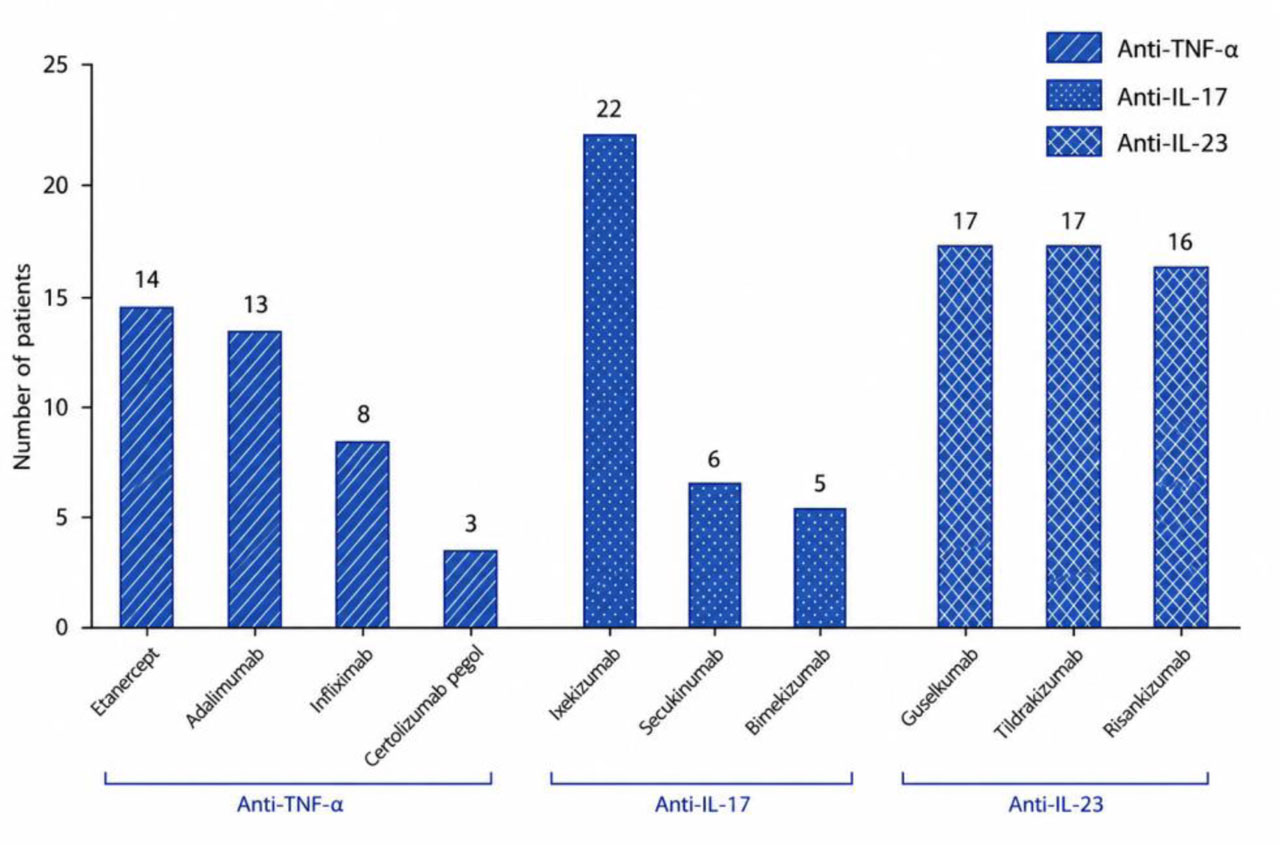
Figure 1.
Distribution of biologic therapies in the study population
Among the biologic agents used, the most frequent were Ixekizumab (18.2%), Guselkumab (14%), Tildrakizumab (14%), Risankizumab (13.2%), Etanercept (11.6%), and Adalimumab (10.7%). The distribution of biologic agents reflects real-world prescribing patterns in our clinical practice. The median duration of the therapy was three years (Q1-Q3: 2–10 years), and 14.8% of the patients required a switch to another biologic therapy. Also, as was already mentioned, the PASI and DLQI scores were recorded at treatment initiation of the biologic therapy and at 6 and 12 months, while the 2025 values represented the latest available assessment after variable treatment durations. These aspects are depicted in Table 3.
Table 3.
Characteristics of the treatment.
| Variable | Results (121 patients) |
|---|---|
| Classic therapy* (years), median (Q1-Q3) | 3 (0–7) |
| Initiation of biologic therapy (year), median (Q1-Q3) | 2022 (2015–2023) |
| Time between diagnosis and initiation of biologic therapy (years), median (Q1-Q3) | 10 (4–20) |
| Total length of biologic therapy (years), median (Q1-Q3) | 3 (2–10) |
| Adalimumab | 13 (10.7%) |
| Infliximab | 8 (6.6%) |
| Etanercept | 14 (11.6%) |
| Certolizumab pegol | 3 (2.5%) |
| Ixekizumab | 22 (18.2%) |
| Secukinumab | 6 (5.0%) |
| Bimekizumab | 5 (4.1%) |
| Guselkumab | 17 (14.0%) |
| Risankizumab | 16 (13.2%) |
| Tildrakizumab | 17 (14.0%) |
| Number of biologic therapies, median (Q1-Q3) | 1 (1–1) |
| Switch of biologic therapy (%) | 18 (14.8%) |
| Length of first biologic therapy (years), median (Q1-Q3) | 3 (2–9.5) |
| Length of second biologic therapy (years), median (Q1-Q3) | 0 (0–0) |
| PASI_i, median (Q1-Q3) | 18.9 (15–22.3) |
| PASI_6 months, median (Q1-Q3) | 6 (1.45–12) |
| PASI_12 months, median (Q1-Q3) | 1.6 (0–6) |
| PASI switch 1**, median (Q1-Q3) | 17.2 (7.5–23.2) |
| PASI switch 2**, median (Q1-Q3) | 13 (5.4–15.8) |
| PASI_2025, median (Q1-Q3) | 0 (0–0) |
| DLQI_i, median (Q1-Q3) | 20 (17–24) |
| DLQI_6 months, median (Q1-Q3) | 8 (2–12) |
| DLQI_12 months, median (Q1-Q3) | 2 (0–6) |
| DLQI switch 1**, median (Q1-Q3) | 25 (17.8–32) |
| DLQI switch 2**, median (Q1-Q3) | 28 (23.1–30.9) |
| DLQI_2025, median (Q1-Q3) | 0 (0–0) |
To comprehensively assess the effectiveness of biologic therapy, we evaluated longitudinal changes in PASI and DLQI scores, the frequency and characteristics of treatment switching, the achievement of PASI 100, and the relationship between the duration of conventional therapy and the severity of hepatic steatosis.
To analyze the evolution of the PASI and DLQI scores, the Wilcoxon signed-rank test was used. Standardized comparisons were performed between baseline, 6 months and 12 months. The latest available assessment recorded in 2025 was also analyzed separately; however, because patients had different durations of biologic treatment at that time, the 2025 assessment did not represent a standardized follow-up point. The results showed that between the PASI at 6 months and the initial PASI there was a highly statistically significant improvement Md=7.43 versus Md=19.36, with z=−9.5, p<0.001 and with r=0.61, which corresponds to a large effect size. The same highly significant result was also identified between PASI at 1 year versus PASI at 6 months – Md 3.07 versus Md 7.43, z=−8.61, p<0.001, r=0.55 – also with a large effect size, and also between PASI at the latest available 2025 assessment and PASI at 1 year: Md 0.83 versus Md 3.07, z=−6.76, p<0.001, r=0.43 – but this time with a moderate effect size. The same results were also obtained following the analysis of the DLQI score, respectively between DLQI at 6 months after initiation of therapy versus the baseline DLQI – Md=7.85 versus Md=20.18, z=−9.55, p<0.001, r=0.61, between DLQI at 1 year versus DLQI at 6 months – Md=3.15 versus Md=7.85, z=−8.57, p<0.001, r=0.55, and between DLQI at the latest available 2025 assessment versus DLQI at 1 year – Md=0.40 versus Md=3.15, z=−6.93, p<0.001, r=0.44. These findings demonstrated statistically significant reductions in both PASI and DLQI scores during the standardized first year of follow-up. Further reductions were observed at the latest available 2025 assessment; however, these values reflected variable treatment durations and should not be interpreted as a standardized longitudinal follow-up time point.
For an easier understanding of these results, they are also presented in Table 4 and Figure 2.
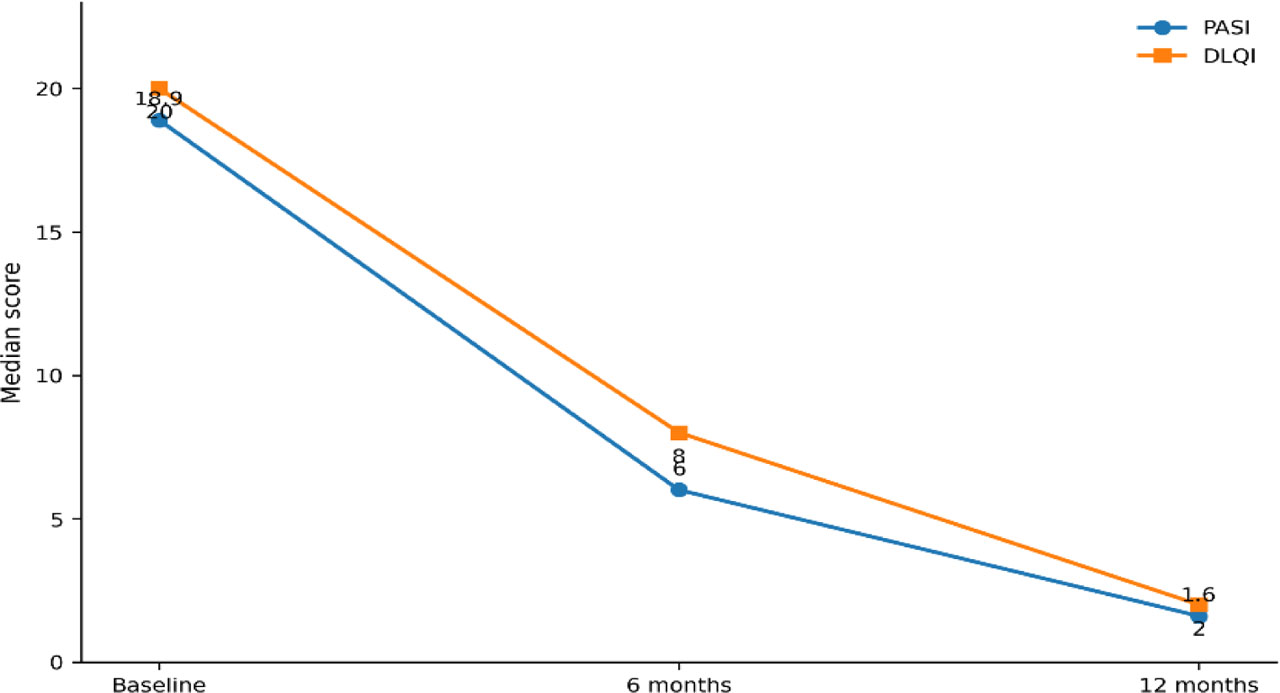
Figure 2.
Evolution of median PASI and DLQI scores during biologic therapy
Table 4.
Evolution of PASI and DLQI scores.
| Comparison | Md | z | p |
|---|---|---|---|
| PASI_6 months vs PASI_i | 7.43 versus 19.36 | −9.50 | <0.001 |
| PASI_12 months vs PASI_6 months | 3.07 versus 7.43 | −8.61 | <0.001 |
| PASI_2025 vs PASI_12 months | 0.83 versus 3.07 | −6.76 | <0.001 |
| DLQI_6 months vs DLQI_i | 7.85 versus 20.18 | −9.55 | <0.001 |
| DLQI_12 months vs DLQI_6 months | 3.15 versus 7.85 | −8.57 | <0.001 |
| DLQI_2025 vs DLQI_12 months | 0.40 versus 3.15 | −6.93 | <0.001 |
[i] DLQI – Dermatology Life Quality Index score; DLQI_i – initial DLQI from the moment of initiation of biologic therapy; Md – median of differences; p – statistical significance; PASI – Psoriasis Area and Severity Index score; PASI_i - initial PASI score from the moment of initiation of biologic therapy; z - standardized test statistic value.
In addition, correlations between PASI and DLQI scores at 6 and 12 months were tested using Spearman correlation coefficient in order to identify the relationships between objective and subjective assessment of psoriasis.
Spearman correlation analysis demonstrated strong positive correlations between PASI scores at 6 and 12 months (rs = 0.83, p < 0.001), PASI and DLQI scores at 6 months (rs = 0.78, p < 0.001), PASI and DLQI scores at 12 months (rs = 0.78, p < 0.001), and DLQI scores at 6 and 12 months (rs = 0.79, p < 0.001). Baseline PASI and DLQI scores showed only weak-to-fair correlations with subsequent follow-up assessments, suggesting that early disease severity and quality of life were influenced by additional individual factors.
Despite the substantial overall treatment response, 18 patients (14.8%) required a change in biologic therapy. The observed switching rate of 14.8% should be interpreted descriptively, as treatment changes may be influenced by multiple factors, including treatment efficacy, adverse events, treatment availability, reimbursement policies, physician preference, and duration of follow-up. Among them, one patient was on anti-TNF-α therapy, seven were on anti-IL-17 therapy, and ten were on anti-IL-23 therapy. The Wilcoxon signed-rank test was also applied in this subgroup; however, despite a significant improvement in PASI compared with baseline, the effect size was small and PASI remained above 10 in all patients.
Regarding the achievement of PASI 100 response, twenty-two patients (18.1%) achieved PASI 100 at six months and fifty-four patients (44.6%) at one year. This PASI 100 response rate is comparable to the efficacy reported in international randomized clinical trials on biologic therapy. Of the twenty-two patients who achieved PASI 100 at six months, eight had anti-TNF-α class, eight had anti-IL-23 class, and six had anti-IL-17 class. No statistically significant difference in PASI 100 response was detected between biologic classes at six months (p = 0.85). At one year, no statistically significant difference in PASI 100 response was detected between biologic classes in this cohort ( p= 0.056).
A secondary exploratory analysis assessed whether the duration of conventional therapy was associated with the severity of hepatic steatosis. For this aspect, the Spearman correlation analysis was used. However, it returned a negative result – no correlation identified: rs=0.05, p=0.48. On the other hand, a positive and statistically significant correlation coefficient was identified between the body mass index and the severity of hepatic steatosis: rs = 0.43, p<0.001.
To identify factors associated with treatment response at 6 and 12 months after treatment initiation, we constructed a logistic regression model. The first step was to test the differences between those who achieved PASI 100 at 6 or 12 months and those who did not in order to enter those variables in the regression model. For this aim, we used the Mann-Whitney U test for continuous variables and the Chi-square test for categorical ones, and all the variables recorded in our database were evaluated. At six months, there were no significant differences between those who achieved PASI 100 and those who did not. However, at one year, both baseline and at six months PASI and DLQI scores had significantly higher values in those who did not achieve PASI 100 – p<0.001. No statistically significant difference in PASI 100 response was detected between biologic classes – Figures 3 and 4.
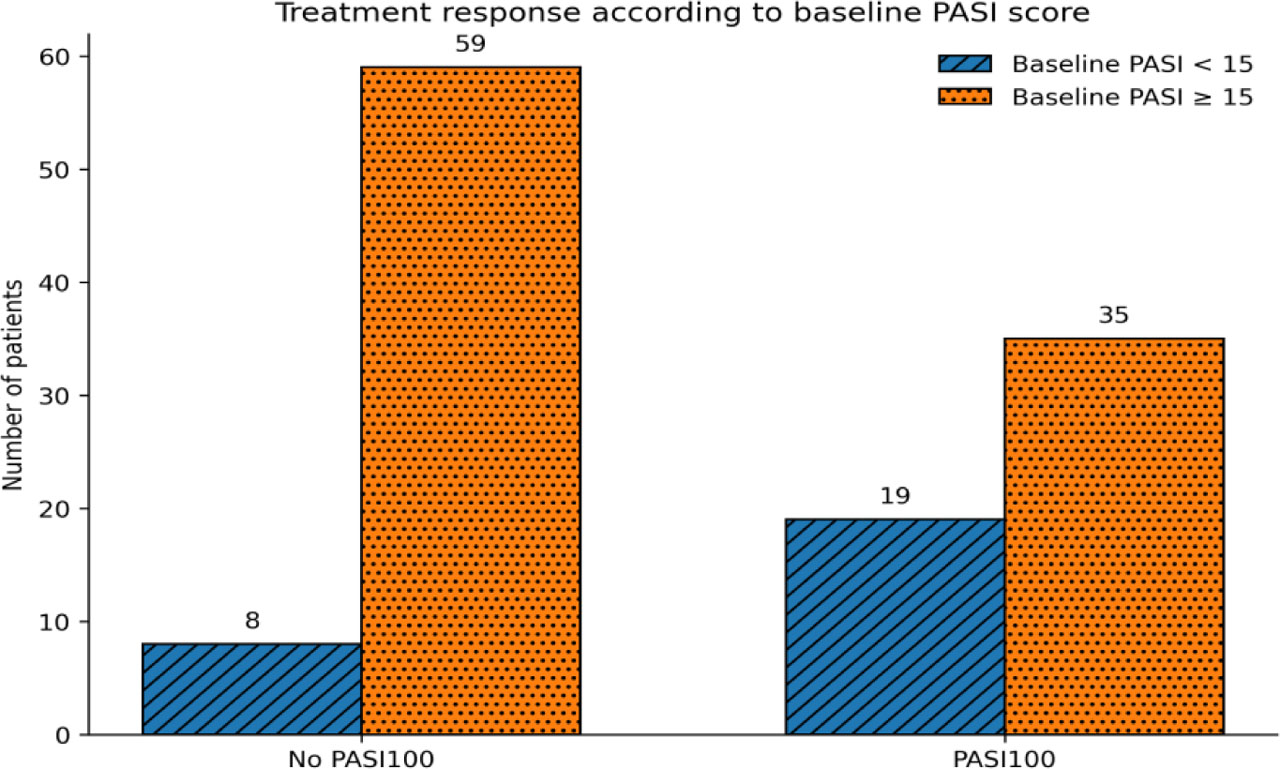
Figure 3.
Treatment response according to baseline PASI score
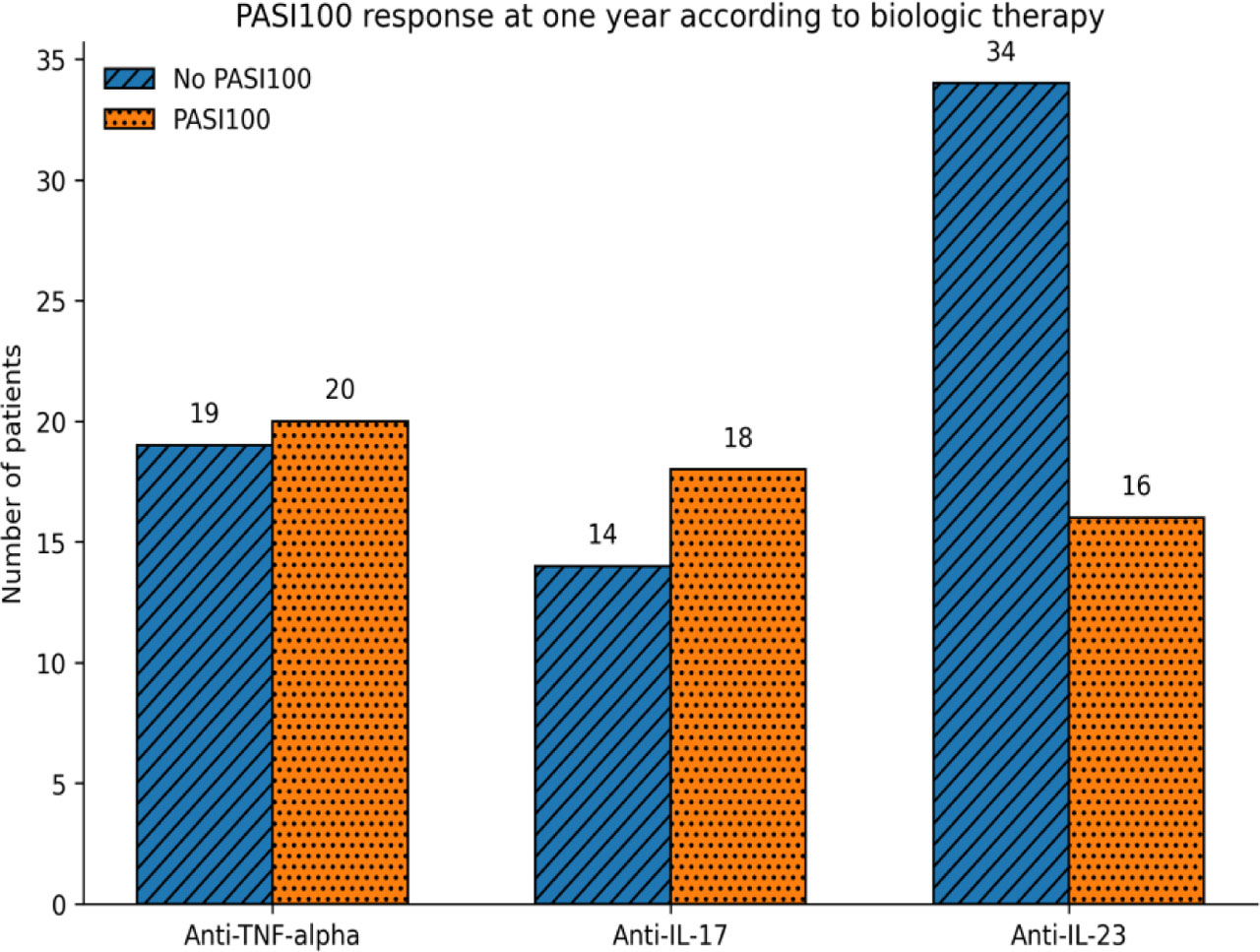
Figure 4.
PASI 100 response at one year according to biologic therapy
We also repeated the same steps regarding PASI 90 at 6 and 12 months. At six months, again, no difference was noted between those who achieved PASI 90 and those who did not. However, at 12 months, both baseline and at six months PASI and DLQI scores had significantly higher values in those who did not achieve PASI 90 – p<0.001, similar to the results presented above.
Variables that differed significantly between patients who achieved PASI 100 at one year and those who did not were subsequently assessed for collinearity using Spearman’s correlation coefficient. Because PASI and DLQI scores at six months were strongly correlated (|rs| > 0.7), DLQI at six months was excluded from the multivariable model. Baseline PASI, baseline DLQI, and PASI at six months were therefore included in the multivariable binary logistic regression model using the Enter method. The model showed an adequate fit (Hosmer–Lemeshow p = 0.18; χ2 = 67.8; Nagelkerke R2 = 0.57). PASI at six months was the only variable independently associated with achieving PASI 100 at one year (p < 0.001; OR = 0.71, 95% CI 0.633–0.796). Higher PASI scores at six months were associated with lower odds of achieving complete skin clearance at one year.
4. DISCUSSION
In this real-world cohort of patients with moderate-to-severe psoriasis receiving biologic therapy, substantial and sustained improvements in disease severity and quality of life were observed during follow-up. PASI 100 was achieved by 18.1% of patients at six months and 44.6% at one year. No statistically significant difference in PASI 100 response was detected between biologic classes in this cohort. These findings should be interpreted in the context of the observational design and non-randomized treatment allocation. In addition, the proportion of patients achieving complete skin clearance at one year – 44.6%, is comparable with the values observed in clinical trials, where the PASI 100 response rate is between 40% and 50% [25].
The high prevalence of comorbidities (84.3%) emphasizes the systemic nature of psoriasis. Obesity (45.5%), arterial hypertension (41.3%), diabetes mellitus (19%) and hepatic steatosis (73.6%) were the most common, in agreement with the literature showing an increased prevalence of these conditions compared to the general population [8,10]. Psoriasis is closely related to metabolic dysfunction and low-grade inflammation, and the mechanisms that link psoriasis to these comorbidities involve pro-inflammatory cytokines such as TNF-α, IL-6, and IL-17, which interfere with insulin sensitivity, endothelial function and lipid metabolism [14]. Our analysis revealed a significant positive correlation between body mass index and the severity of hepatic steatosis (rs = 0.43, p < 0.001), consistent with the well-established relationship between obesity and hepatic steatosis. Previous studies have suggested that obesity and MASLD may be associated with a suboptimal response to biologic therapy in patients with psoriasis [17,18]. However, this association was not demonstrated in the present cohort. Therefore, our findings should not be interpreted as demonstrating an adverse effect of obesity or hepatic steatosis on biologic treatment response. A key strength of our study is that the diagnosis of hepatic steatosis was not based solely on medical history or alterations in liver function tests, but rather on objective imaging assessment. All patients underwent abdominal ultrasound and transient elastography (FibroScan), allowing for a more precise evaluation of liver involvement and fibrosis severity. We believe this approach enhances diagnostic accuracy and supports the validity of the high prevalence of hepatic steatosis observed in our cohort. Nevertheless, the high prevalence of metabolic abnormalities observed in our population supports systematic metabolic assessment in patients with moderate-to-severe psoriasis. Identification and management of obesity, hepatic steatosis, and other cardiometabolic risk factors remain important components of comprehensive psoriasis care, independently of their observed association with biologic treatment response in the present study.
Although only 14.8% of patients required a change in biological treatment, the lack of complete response to the first therapy remains a challenge. Multivariable regression analysis showed that lower PASI scores at six months were independently associated with a higher likelihood of achieving PASI 100 at one year. This finding should not be interpreted as evidence of a baseline prognostic effect, because PASI at six months already reflects the patient’s early response to biologic therapy. Rather, six-month PASI may represent a clinically useful early treatment-response marker that can help identify patients who are more or less likely to achieve complete skin clearance at one year. This information may support closer monitoring and individualized therapeutic reassessment in patients showing an insufficient early response. In addition, recent studies confirm that patients with a high inflammatory burden or metabolic comorbidities may require earlier and more aggressive therapies to achieve complete skin clearance [20,21,22]. In our cohort, the number of comorbidities was not significantly associated with response to biologic therapy.
Baseline PASI and DLQI scores showed only weak-to-fair correlations with subsequent assessments, whereas strong correlations between PASI and DLQI were observed at six and 12 months. These findings indicate increasing concordance between clinical disease severity and patient-reported quality-of-life impairment during follow-up. However, the present study did not assess psychological or behavioral factors that might explain these relationships, and further investigation would be required to clarify the underlying mechanisms.
The study also has several limitations. First, the retrospective design did not allow an accurate assessment of patient adherence to conventional therapy. However, this drawback was minimized after the initiation of the biologic therapy, after which the patients were regularly followed up and all the comorbidities were properly evaluated, providing us with a realistic picture of the therapeutic response. In addition, inflammatory markers such as C-reactive protein and interleukin-6 were not systematically available during follow-up because of laboratory limitations. Another important limitation of the study is that the allocation of biological therapy was not randomized. Treatment selection was based on the physician's clinical judgment and national reimbursement criteria, taking into account disease severity, treatment history, and patient comorbidities. Consequently, confounding by indication cannot be ruled out; patients treated with different classes of biological therapies may have exhibited baseline differences that were not fully captured by the analyzed variables. For this reason, comparisons between therapeutic classes should be interpreted with caution. However, this allocation method faithfully reflects current clinical practice and enhances the relevance of the findings from a real-world evidence perspective. Finally, another limitation of the study is its single-center design and the exclusive inclusion of psoriasis patients treated with biological therapy at a tertiary care center. Consequently, the results cannot be directly generalized to patients with mild forms of psoriasis, those treated in primary dermatological practice, or healthcare systems with different policies regarding the prescription and reimbursement of biological therapies. Nevertheless, the analyzed cohort represents a relevant group of patients with moderate-to-severe psoriasis evaluated in real-world clinical practice.
5. CONCLUSIONS
Biologic therapy was associated with significant and sustained improvements in psoriasis severity and quality of life in this real-world cohort. Metabolic comorbidities were highly prevalent, particularly hepatic steatosis, obesity, arterial hypertension, and diabetes mellitus, highlighting the substantial cardiometabolic burden among patients with moderate-to-severe psoriasis. Despite their high prevalence, no statistically significant association between metabolic comorbidities and PASI 100 response at one year was identified in the analyses performed. In multivariable analysis, PASI at six months was the only independent factor associated with PASI 100 at one year. Because PASI at six months already reflects the effect of treatment, this finding should be interpreted as an early treatment-response marker rather than as a baseline prognostic factor. Lower PASI scores at six months were associated with a higher likelihood of achieving complete skin clearance at one year. These findings support early assessment of therapeutic response and comprehensive evaluation of metabolic comorbidities as complementary components of individualized care for patients with psoriasis receiving biologic therapy.
Acknowledgments
N/A
Notes
[8] Contributed by Author Contributions:
Conceptualization, A.F.G, D.O.C, C.C.; methodology, A.F.G, D.O.C, C.C; validation, C.C., D.O.C. and R.S.C.; investigation, A.F.G, D.C, I.S.F. and R.S.C., writing—original draft preparation, A.F.G., D.C., I.D.A, C.S., writing—review and editing, D.O.C., C.C. and R.S.C. All authors have read and agreed to the published version of the manuscript.
[9] Supported by Funding:
This research received no external funding. Publication of this paper was supported by the University of Medicine and Pharmacy Carol Davila, through the institutional program Publish not Perish
[10] Institutional Review Board Statement:
The study was carried out in compliance with ethical principles of the Helsinki declaration and it was approved by the ethics committee of the hospital – no. 750/22.01.2025.
[11] Informed Consent Statement:
All the patients signed the informed consent about the processing of medical data for scientific research purposes.