
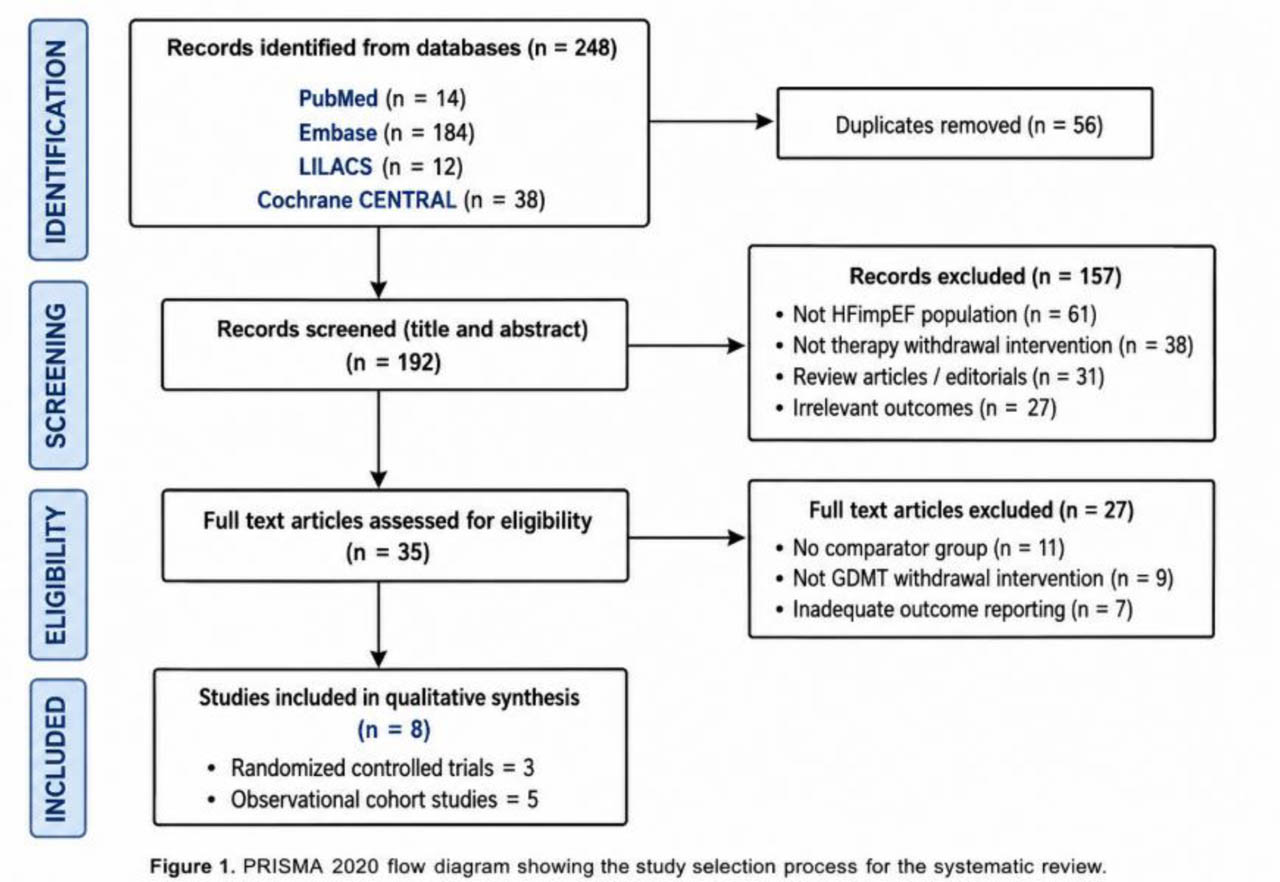
Figure 1.
PRISMA 2020 flow diagram showing the study selection process for the systematic review of withdrawal versus continuation of guideline-directed medical therapy in patients with HFimpEF.
Table 1A.
Study characteristics of the included studies
| Study | Country | Study design | Population | Sample size |
|---|---|---|---|---|
| Halliday, 2019 [5] | United Kingdom | Randomized clinical trial | Recovered dilated cardiomyopathy | 51 |
| Bakhsh, 2020 [6] | Canada | Pilot withdrawal study | Recovered dilated cardiomyopathy | 22 |
| Chen, 2021 [10] | China | Prospective observational cohort | Dilated cardiomyopathy with improved EF | 70 |
| Segan, 2025 [7] | Australia | Randomized clinical trial | Atrial fibrillation–mediated cardiomyopathy with recovered EF | 60 |
| Lee, 2023 [11] | South Korea | Prospective registry cohort | Post-myocardial infarction HF with restored EF | 726 |
| Chen, 2025 [8] | China | Retrospective cohort | HF with improved EF | 4,560 |
| Vaduganathan, 2024 [9] | International | Registry cohort | HF with improved EF | 8,728 |
| Basile, 2025 [12] | Sweden | Registry-based observational cohort | HF with improved EF | 8,728 |
Table 1B.
Interventions and reported outcomes
| Study | Intervention | Comparator | Primary reported outcomes |
|---|---|---|---|
| Halliday, 2019 [5] | Withdrawal of HF therapy | Continued HF therapy | Relapse of cardiomyopathy |
| Bakhsh, 2020 [6] | Withdrawal of ACE inhibitors and beta-blockers | Continued therapy | Decline in LVEF; recurrence of LV dysfunction |
| Chen, 2021 [10] | Spironolactone withdrawal | Continued spironolactone | Relapse of cardiomyopathy |
| Segan, 2025 [7] | Withdrawal of HF therapy | Continued therapy | Maintenance of LVEF; quality of life |
| Lee, 2023 [11] | Discontinuation of RAAS inhibitors | Continued RAAS inhibitors | All-cause mortality, myocardial infarction, HF hospitalization |
| Chen, 2025 [8] | GDMT discontinuation | Continued GDMT | Major adverse cardiovascular events; recurrent HF |
| Vaduganathan, 2024 [9] | Withdrawal of GDMT components | Continued GDMT | Cardiovascular mortality; HF hospitalization |
| Basile, 2025 [12] | Withdrawal of RASi/ARNi, beta-blockers, or MRA | Continued therapy | Cardiovascular mortality or HF hospitalization |
[i] Abbreviations: HF, heart failure; HFimpEF, heart failure with improved ejection fraction; GDMT, guideline-directed medical therapy; LVEF, left ventricular ejection fraction; ACE, angiotensin-converting enzyme; RAAS, renin–angiotensin–aldosterone system; RASi, renin–angiotensin system inhibitor; ARNi, angiotensin receptor–neprilysin inhibitor; MRA, mineralocorticoid receptor antagonist.
Table 2.
Risk of bias assessment of interventional studies using RoB2
| Study | Randomization Process | Deviations from Intended Interventions | Missing Outcome Data | Outcome Measurement | Selection of Reported Results | Overall Risk |
|---|---|---|---|---|---|---|
| Halliday, 2019 | Low | Some concerns | Low | Low | Low | Low risk |
| Segan, 2025 | Low | Some concerns | Low | Low | Low | Low risk |
| Bakhsh, 2020 | Some concerns | Some concerns | Low | Low | Some concerns | Some concerns |
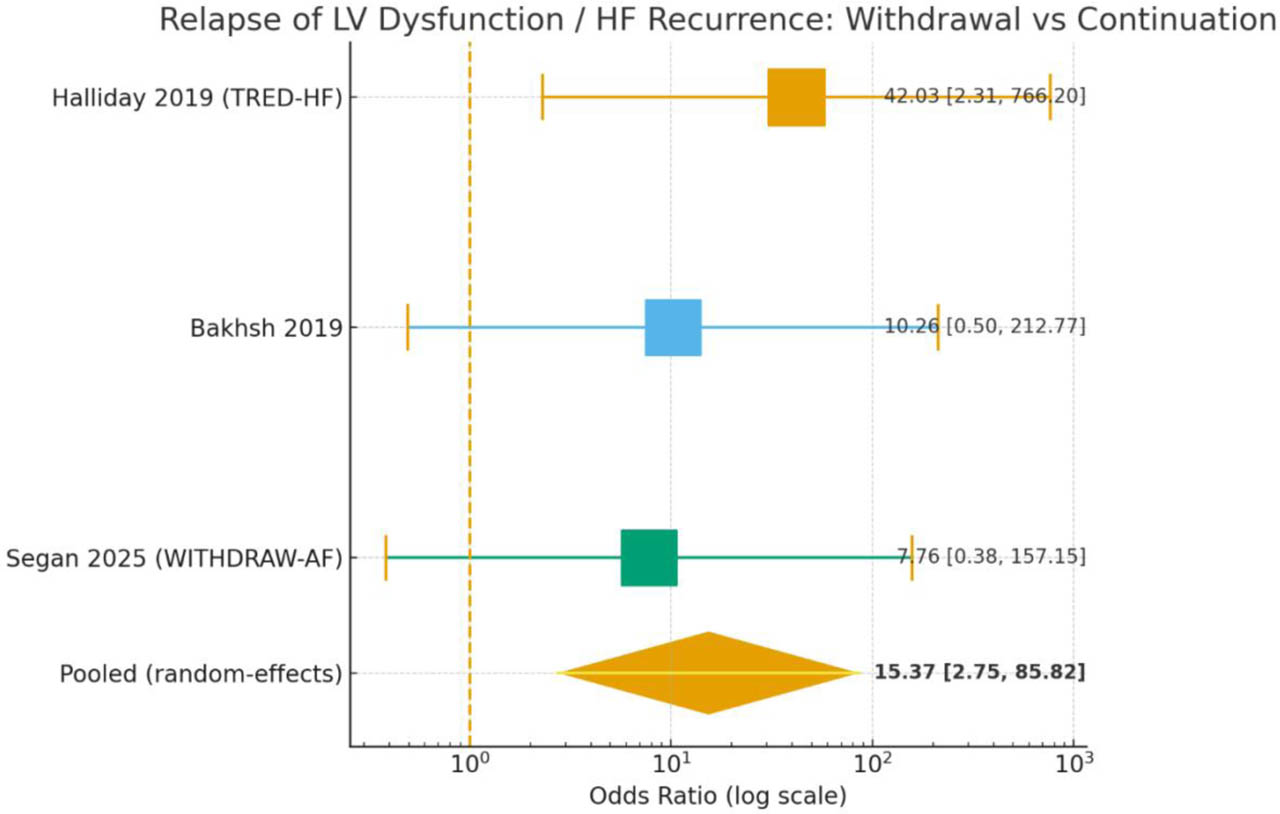
Figure 2.
Forest plot showing pooled odds ratio for relapse of left ventricular dysfunction or heart failure recurrence after withdrawal versus continuation of guideline-directed medical therapy. Squares represent individual study estimates and the diamond represents the pooled effect using a random-effects model.
Table 4.
GRADE assessment of certainty of evidence
| Outcome | No. of studies | Study design | Risk of bias | Inconsistency | Indirectness | Imprecision | Publication bias | Overall certainty |
|---|---|---|---|---|---|---|---|---|
| Relapse of left ventricular systolic dysfunction | 3 | Randomized/prospective withdrawal studies | Not serious | Not serious | Not serious | Serious | Not suspected | Moderate

|
| Heart failure hospitalization | 3 | Observational cohorts | Serious | Not serious | Not serious | Serious | Not suspected | Low

|
| Mortality | 3 | Observational cohorts | Serious | Serious | Not serious | Serious | Not suspected | Very low

|
Supplementary Table S1.
Search strategies used in the electronic databases
| Database | Search Strategy | Results |
|---|---|---|
| PubMed (MEDLINE) | (“Heart Failure with Reduced Ejection Fraction” [MeSH] OR HFrEF OR “systolic heart failure”) AND (“Recovered Ejection Fraction” OR “improved ejection fraction” OR “recovered LVEF” OR HFrecEF) AND (“Drug Withdrawal”[MeSH] OR “therapy withdrawal” OR “treatment discontinuation” OR “withdrawal of pharmacologic treatment”) | 14 |
| Embase | (‘heart failure with reduced ejection fraction’/exp OR ‘systolic heart failure’ OR HFrEF) AND (‘ejection fraction’/exp AND (recovered OR improved)) AND (‘drug withdrawal’/exp OR ‘treatment discontinuation’ OR ‘therapy interruption’ OR ‘pharmacologic withdrawal’) | 184 |
| LILACS (BVS/DeCS) | (“insuficiencia cardíaca con fracción de eyección reducida” OR “insuficiencia cardíaca sistólica” OR HFrEF) AND (“fracción de eyección recuperada” OR “mejoría de fracción de eyección”) AND (“retiro del tratamiento” OR “suspensión de la terapia” OR “abandono del tratamiento” OR “interrupción terapéutica”) | 12 |
| Cochrane CENTRAL | (“heart failure” OR HFrEF) AND (“recovered ejection fraction” OR HFimpEF OR HFrecEF) AND (“therapy withdrawal” OR “drug discontinuation” OR “treatment withdrawal”) | 38 |