
What is new/important?
Heart failure with improved ejection fraction (HFimpEF) is increasingly recognized as a distinct clinical phenotype. However, uncertainty remains regarding the safety of withdrawing guideline-directed medical therapy after recovery of systolic function. This systematic review summarizes the available evidence on therapy withdrawal in HFimpEF and suggests that discontinuation may be associated with a substantially increased risk of relapse of left ventricular systolic dysfunction. These findings are consistent with current guideline recommendations favoring continuation of therapy in most patients with recovered ejection fraction.
INTRODUCTION
Heart failure (HF) remains a major cause of morbidity and mortality worldwide despite substantial advances in pharmacological and device-based therapies. In patients with heart failure with reduced ejection fraction (HFrEF), guideline-directed medical therapy (GDMT) has significantly improved survival, reduced hospitalizations, and promoted reverse cardiac remodeling. [1]
As a consequence of contemporary HF management, an increasing proportion of patients experience substantial improvement in left ventricular systolic function. This clinical entity, currently referred to as heart failure with improved ejection fraction (HFimpEF), is increasingly recognized as a distinct phenotype within the heart failure spectrum and is defined by a previous left ventricular ejection fraction (LVEF) ≤40%, followed by a subsequent improvement in LVEF after treatment. [1,2]
Although patients with HFimpEF generally have better clinical outcomes than those with persistent HFrEF, uncertainty remains regarding the biological significance of ventricular recovery. Reverse remodeling may represent true myocardial recovery in some patients, whereas in others it may reflect disease remission maintained by ongoing neurohormonal blockade. [3,4]
These uncertainties have important therapeutic implications. Current clinical practice guidelines recommend continuation of GDMT in patients with HFimpEF; however, long-term treatment may be associated with medication burden, adverse effects, and healthcare costs. Consequently, whether GDMT can be safely withdrawn in selected patients with recovered ventricular function remains an unresolved clinical question. [1]
Given the increasing prevalence of HFimpEF and the ongoing uncertainty regarding long-term management strategies, we conducted a systematic review and meta-analysis to evaluate the clinical effects of withdrawal versus continuation of GDMT in patients with recovered or improved left ventricular systolic function.
MATERIAL AND METHODS
Study design
This systematic review was conducted in accordance with the Preferred Reporting Items for Systematic Reviews and Meta-Analyses (PRISMA) 2020 guidelines. The methodology followed established recommendations from the Cochrane Handbook for Systematic Reviews of Interventions. Eligibility criteria
Eligibility criteria were defined using the Population, Intervention, Comparator, Outcomes, and Study design (PICOS) framework.
Population
Studies were eligible if participants had a documented history of HFrEF (baseline LVEF ≤40%) and subsequently achieved HFimpEF according to the definition adopted by contemporary heart failure guidelines, namely a baseline LVEF ≤40% with a follow-up LVEF >40% and an absolute improvement of at least 10 percentage points.
Intervention
Withdrawal, discontinuation, or de-escalation of guideline-directed medical therapy (GDMT) used for the treatment of heart failure, including angiotensin-converting enzyme inhibitors (ACE inhibitors), angiotensin receptor blockers (ARBs), angiotensin receptor–neprilysin inhibitors (ARNIs), beta-blockers, mineralocorticoid receptor antagonists (MRAs), or sodium–glucose cotransporter-2 inhibitors (SGLT2 inhibitors).
Comparator
Continuation or maintenance of guideline-directed medical therapy.
Outcomes
Studies reporting at least one of the following clinically relevant outcomes were included: relapse of left ventricular systolic dysfunction, heart failure hospitalization, cardiovascular mortality, all-cause mortality, clinical deterioration or worsening heart failure.
Study design
Randomized controlled trials and observational comparative studies (prospective or retrospective cohort studies) were eligible.
Exclusion criteria
Excluded records comprised case reports, case series, narrative reviews, editorials, letters to the editor, studies lacking a comparator group, pediatric-only populations, and duplicate publications.
Search strategy
A comprehensive literature search was performed in MEDLINE (via PubMed), Embase, LILACS, and the Cochrane Central Register of Controlled Trials (CENTRAL) from database inception to March 15, 2025. Search strategies combined controlled vocabulary terms (MeSH, Emtree, and DeCS) and free-text keywords related to heart failure with reduced ejection fraction, recovered or improved ejection fraction, and treatment withdrawal. The complete search strategies for all databases are provided in Supplementary Table S1.
Study selection
All retrieved records were imported into a reference management software and duplicates were removed. Two reviewers independently screened titles and abstracts to identify potentially eligible studies. Full texts of relevant articles were subsequently assessed for eligibility.
Disagreements were resolved through discussion and consensus.
Data extraction
Data extraction was independently performed by two reviewers using a standardized data collection form.
The following information was extracted first author and year of publication, country, study design, sample size, baseline patient characteristics, definition of recovered ejection fraction, therapies withdrawn or continued, duration of follow-up, reported clinical outcomes.
Risk of bias assessment
Risk of bias was independently assessed by two reviewers.
Randomized controlled trials were evaluated using the Cochrane Risk of Bias 2 (RoB 2) tool. Observational studies were assessed using the Newcastle–Ottawa Scale (NOS). Disagreements were resolved through consensus.
Data synthesis
Due to anticipated heterogeneity in study populations, definitions of recovered ejection fraction, treatment withdrawal strategies, and outcome reporting, results were summarized using a qualitative narrative synthesis.
When studies reported comparable outcomes, results were described according to study design and clinical endpoints. The certainty of evidence for each outcome was assessed using the Grading of Recommendations Assessment, Development and Evaluation (GRADE) framework.
Protocol registration
The protocol for this systematic review was not prospectively registered
RESULTS
Study selection
The literature search identified records across the selected databases, including MEDLINE, Embase, and the Cochrane Library. After removal of duplicate records, the remaining studies were screened based on titles and abstracts. Full-text articles were subsequently assessed for eligibility according to the predefined inclusion and exclusion criteria. Studies were excluded if they did not include a comparator group, did not evaluate withdrawal of guideline-directed medical therapy, or did not report relevant clinical outcomes.
Finally, eight studies met the eligibility criteria and were included in the qualitative synthesis, comprising three interventional withdrawal studies and five observational cohort studies. The study selection process is summarized in the PRISMA flow diagram (Figure 1).
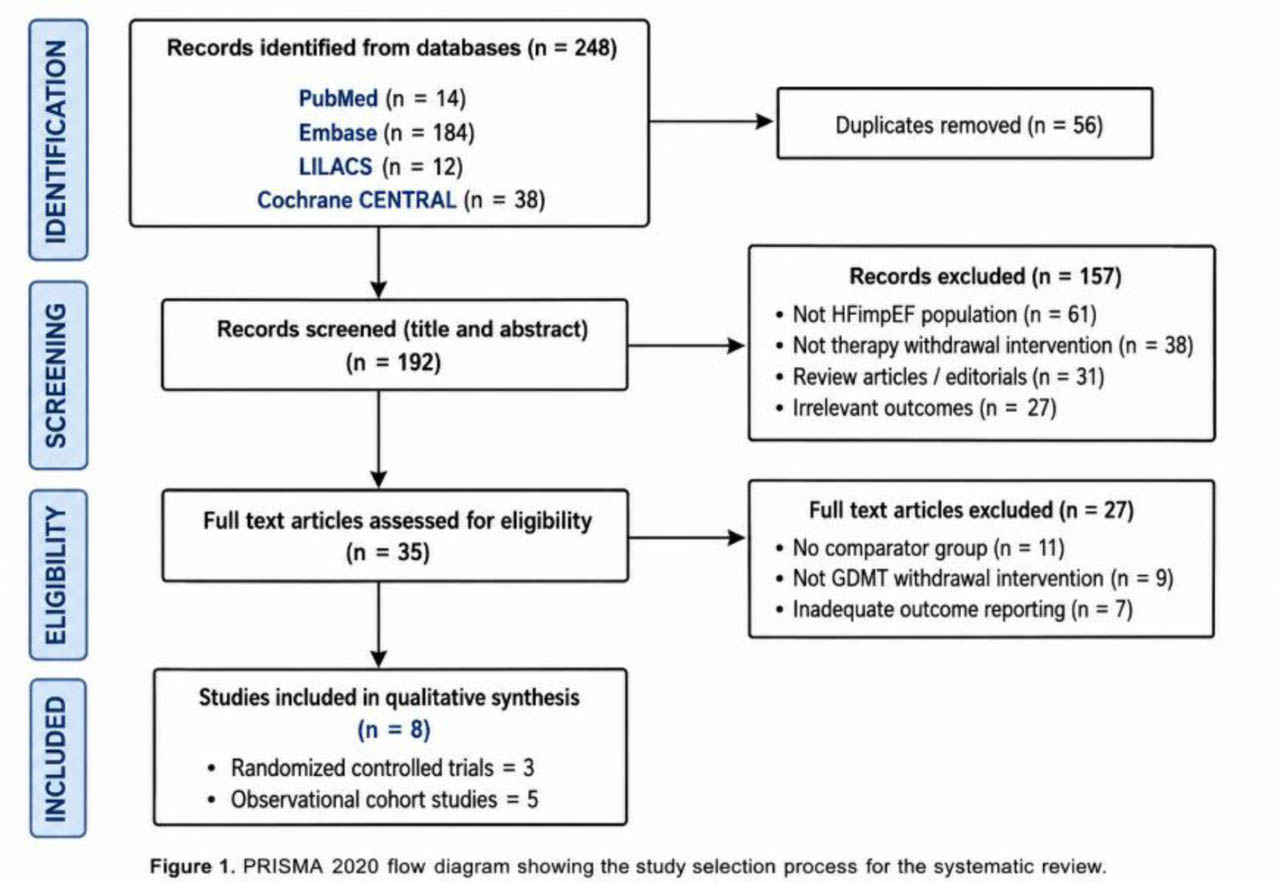
Figure 1.
PRISMA 2020 flow diagram showing the study selection process for the systematic review of withdrawal versus continuation of guideline-directed medical therapy in patients with HFimpEF.
Characteristics of included studies
A total of eight studies met the inclusion criteria, comprising three studies in patients with recovered dilated cardiomyopathy, one study in atrial fibrillation–mediated cardiomyopathy, and four studies involving broader HFimpEF populations or ischemic etiologies. Study designs included three randomized or prospective withdrawal studies and five observational cohort studies. The general characteristics of the included studies are summarized in Table 1A, whereas details regarding the interventions, comparators, and reported outcomes are presented in Table 1B.
Table 1A.
Study characteristics of the included studies
| Study | Country | Study design | Population | Sample size |
|---|---|---|---|---|
| Halliday, 2019 [5] | United Kingdom | Randomized clinical trial | Recovered dilated cardiomyopathy | 51 |
| Bakhsh, 2020 [6] | Canada | Pilot withdrawal study | Recovered dilated cardiomyopathy | 22 |
| Chen, 2021 [10] | China | Prospective observational cohort | Dilated cardiomyopathy with improved EF | 70 |
| Segan, 2025 [7] | Australia | Randomized clinical trial | Atrial fibrillation–mediated cardiomyopathy with recovered EF | 60 |
| Lee, 2023 [11] | South Korea | Prospective registry cohort | Post-myocardial infarction HF with restored EF | 726 |
| Chen, 2025 [8] | China | Retrospective cohort | HF with improved EF | 4,560 |
| Vaduganathan, 2024 [9] | International | Registry cohort | HF with improved EF | 8,728 |
| Basile, 2025 [12] | Sweden | Registry-based observational cohort | HF with improved EF | 8,728 |
Table 1B.
Interventions and reported outcomes
| Study | Intervention | Comparator | Primary reported outcomes |
|---|---|---|---|
| Halliday, 2019 [5] | Withdrawal of HF therapy | Continued HF therapy | Relapse of cardiomyopathy |
| Bakhsh, 2020 [6] | Withdrawal of ACE inhibitors and beta-blockers | Continued therapy | Decline in LVEF; recurrence of LV dysfunction |
| Chen, 2021 [10] | Spironolactone withdrawal | Continued spironolactone | Relapse of cardiomyopathy |
| Segan, 2025 [7] | Withdrawal of HF therapy | Continued therapy | Maintenance of LVEF; quality of life |
| Lee, 2023 [11] | Discontinuation of RAAS inhibitors | Continued RAAS inhibitors | All-cause mortality, myocardial infarction, HF hospitalization |
| Chen, 2025 [8] | GDMT discontinuation | Continued GDMT | Major adverse cardiovascular events; recurrent HF |
| Vaduganathan, 2024 [9] | Withdrawal of GDMT components | Continued GDMT | Cardiovascular mortality; HF hospitalization |
| Basile, 2025 [12] | Withdrawal of RASi/ARNi, beta-blockers, or MRA | Continued therapy | Cardiovascular mortality or HF hospitalization |
[i] Abbreviations: HF, heart failure; HFimpEF, heart failure with improved ejection fraction; GDMT, guideline-directed medical therapy; LVEF, left ventricular ejection fraction; ACE, angiotensin-converting enzyme; RAAS, renin–angiotensin–aldosterone system; RASi, renin–angiotensin system inhibitor; ARNi, angiotensin receptor–neprilysin inhibitor; MRA, mineralocorticoid receptor antagonist.
Dilated Cardiomyopathy
Across studies evaluating recovered dilated cardiomyopathy, withdrawal of GDMT was consistently associated with a high risk of recurrent left ventricular dysfunction, with relapse rates ranging from 44% to 58%. Similar findings were observed regardless of whether complete GDMT or individual pharmacological classes were withdrawn. These findings were reported in the TRED-HF trial, the pilot study by Bakhsh et al., and the prospective cohort by Chen et al. [5,6,10].
Atrial Fibrillation–Mediated Cardiomyopathy
The WITHDRAW-AF study by Segan et al. [7] evaluated withdrawal of heart failure therapy after successful rhythm control and normalization of left ventricular ejection fraction in patients with atrial fibrillation–mediated cardiomyopathy.
Other HFimpEF Populations
Four studies evaluated broader HFimpEF populations, consistently demonstrating that withdrawal of one or more components of GDMT was associated with worse cardiovascular outcomes, including recurrent heart failure, hospitalization, and mortality. These studies included patients with ischemic and nonischemic etiologies and evaluated withdrawal of different neurohormonal therapies. [8,9,11,12]
Overall, the included studies encompassed diverse HFimpEF etiologies and withdrawal strategies, reflecting the heterogeneity of clinical practice and supporting the need for etiology-specific interpretation of treatment withdrawal outcomes.
Risk of bias assessment
Among the interventional studies, Halliday et al. [5] and Segan et al. [7] were judged to have an overall low risk of bias according to the RoB2 tool. Although both studies were open-label, outcome assessment relied largely on objective measures of ventricular function, reducing the likelihood of detection bias. The study by Bakhsh et al. [6] was rated as having some concerns because of its small sample size and limited reporting of allocation procedures.
Five observational studies were assessed using the Newcastle–Ottawa Scale. Lee et al. [11], Chen et al. [8], Vaduganathan et al. [9], and Basile et al. [12] achieved a score of 8 out of 9 on the Newcastle–Ottawa Scale, indicating good methodological quality. Nevertheless, all observational studies remain susceptible to residual confounding and confounding by indication despite statistical adjustment
Table 2.
Risk of bias assessment of interventional studies using RoB2
| Study | Randomization Process | Deviations from Intended Interventions | Missing Outcome Data | Outcome Measurement | Selection of Reported Results | Overall Risk |
|---|---|---|---|---|---|---|
| Halliday, 2019 | Low | Some concerns | Low | Low | Low | Low risk |
| Segan, 2025 | Low | Some concerns | Low | Low | Low | Low risk |
| Bakhsh, 2020 | Some concerns | Some concerns | Low | Low | Some concerns | Some concerns |
Recurrence of Left Ventricular Systolic Dysfunction
Across studies evaluating recovered dilated cardiomyopathy, withdrawal of GDMT was consistently associated with high relapse rates of left ventricular dysfunction, ranging from 44% to 58%. This pattern was observed regardless of whether complete GDMT or individual pharmacological classes were withdrawn. Similar findings were consistently observed across the available interventional studies. [5,6,10]
In contrast, the WITHDRAW-AF trial evaluated patients with atrial fibrillation–mediated cardiomyopathy after successful rhythm control and reported that approximately 90% of patients maintained a left ventricular ejection fraction ≥50% six months after treatment withdrawal, suggesting a lower relapse risk in selected patients with potentially reversible cardiomyopathy. [7]
Observational studies also supported an association between treatment withdrawal and adverse outcomes. Chen et al. reported recurrent HFrEF in 28.6% of patients with HFimpEF during follow-up [8], while Basile et al. demonstrated higher rates of cardiovascular mortality and heart failure hospitalization following withdrawal of selected GDMT components in a large national HFimpEF registry. [12]
Heart Failure Hospitalization
Evidence regarding heart failure hospitalization was derived primarily from observational cohort studies and consistently suggested that withdrawal of guideline-directed medical therapy (GDMT) was associated with a higher risk of recurrent heart failure events. This association was observed across different HFimpEF populations, including patients with recovered cardiomyopathy and those with restored left ventricular ejection fraction after acute myocardial infarction. The increased risk was reported following withdrawal of several GDMT components, including renin–angiotensin system inhibitors, angiotensin receptor–neprilysin inhibitors, mineralocorticoid receptor antagonists, and other neurohormonal therapies. These findings were consistently observed in large registry-based and cohort studies despite differences in patient populations and treatment strategies. [8,11,12]
Because studies varied substantially in outcome definitions, therapeutic classes evaluated, and duration of follow-up, quantitative pooling of hospitalization outcomes was not considered appropriate.
Mortality
Evidence regarding mortality was likewise derived predominantly from observational studies. Overall, discontinuation of GDMT was consistently associated with a higher risk of adverse cardiovascular outcomes, including all-cause mortality, cardiovascular mortality, or composite endpoints incorporating heart failure hospitalization. Although the specific outcome definitions differed across studies, the direction of the association consistently favored continuation of GDMT. The largest registry analyses demonstrated an increased risk following withdrawal of renin–angiotensin system inhibitors/angiotensin receptor–neprilysin inhibitors and mineralocorticoid receptor antagonists, while other cohorts reported similar findings after discontinuation of renin–angiotensin–aldosterone system inhibitors in patients with recovered ventricular function. [8,11,12]
Because mortality outcomes, effect measures, and composite endpoints were heterogeneous across studies, quantitative synthesis was not feasible.
Quality of life
Evidence regarding patient-reported quality of life was scarce. Only one prospective study evaluated this outcome, enrolling patients with atrial fibrillation–mediated cardiomyopathy who achieved normalization of left ventricular ejection fraction following successful rhythm control. In this selected population, withdrawal of GDMT was not associated with deterioration in quality of life during six months of follow-up, suggesting that carefully selected patients with potentially reversible cardiomyopathy may tolerate treatment withdrawal without short-term impairment in patient-reported outcomes. [7]
No quality-of-life data were reported by the remaining prospective withdrawal studies or by the observational cohorts included in this review. Consequently, the available evidence remains insufficient to determine the impact of GDMT withdrawal on patient-reported outcomes across the broader HFimpEF population. [5,6,7,8,9]
Meta-analysis
Although the pooled estimate suggested a markedly increased risk of relapse following GDMT withdrawal, the quantitative synthesis was restricted to prospective withdrawal studies with comparable relapse outcomes and was based on only three small trials involving 133 participants. Therefore, the meta-analysis should be interpreted as exploratory and hypothesis-generating rather than definitive.
Across these trials, relapse of left ventricular systolic dysfunction or heart failure recurrence occurred in 21 of 71 patients (29.6%) in the withdrawal groups. In contrast, no relapses were reported among 62 patients who continued therapy. The pooled effect estimate was calculated using a random-effects model (Mantel–Haenszel method). Withdrawal of GDMT was associated with a significantly higher risk of relapse compared with continued therapy (OR 15.37, 95% CI 2.75–85.82; I2 = 0%). Importantly, although the magnitude of the pooled effect is uncertain due to imprecision, the direction of the effect was consistent with findings from larger observational cohorts, which also demonstrated higher risks of recurrent heart failure events following GDMT withdrawal.
A separate forest plot was generated only for the relapse of LV dysfunction because hospitalization and mortality outcomes lacked sufficiently homogeneous event-level data for quantitative synthesis.
Although statistical heterogeneity was absent (I2 = 0%), the pooled odds ratio should be interpreted cautiously because the confidence interval was extremely wide (OR 15.37, 95% CI 2.75–85.82), reflecting substantial statistical imprecision due to the limited number of events and the small sample size. Consequently, the magnitude of effect remains uncertain despite the consistent direction of the association.
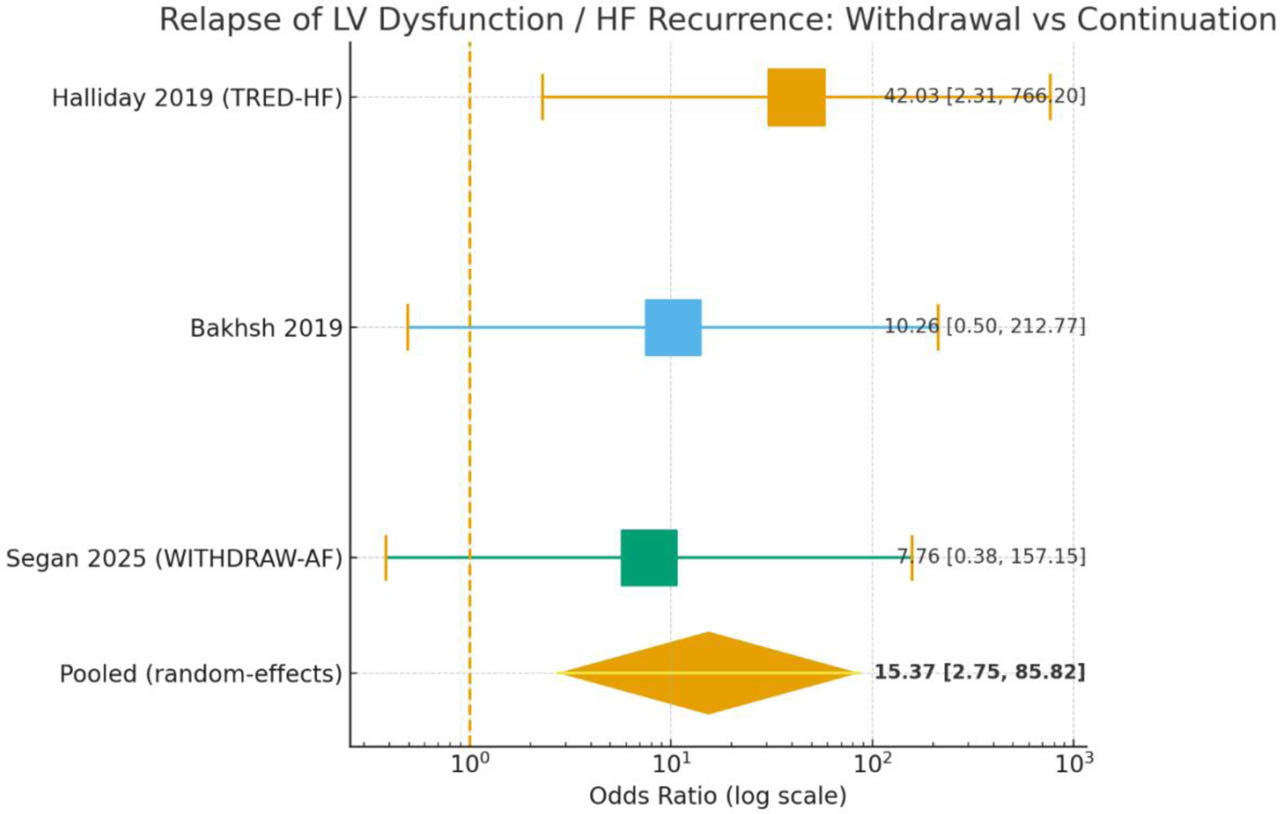
Figure 2.
Forest plot showing pooled odds ratio for relapse of left ventricular dysfunction or heart failure recurrence after withdrawal versus continuation of guideline-directed medical therapy. Squares represent individual study estimates and the diamond represents the pooled effect using a random-effects model.
Certainty of Evidence (GRADE)
According to the GRADE framework, certainty of evidence for the relapse of left ventricular dysfunction was rated as moderate. Although most evidence originated from prospective interventional studies with a consistent direction of effect, certainty was downgraded because of serious imprecision related to the small sample size and wide confidence intervals. Evidence for heart failure hospitalization was rated as low, whereas certainty for mortality was very low because of the observational design, inconsistency, residual confounding, and serious imprecision.
Table 4.
GRADE assessment of certainty of evidence
| Outcome | No. of studies | Study design | Risk of bias | Inconsistency | Indirectness | Imprecision | Publication bias | Overall certainty |
|---|---|---|---|---|---|---|---|---|
| Relapse of left ventricular systolic dysfunction | 3 | Randomized/prospective withdrawal studies | Not serious | Not serious | Not serious | Serious | Not suspected | Moderate

|
| Heart failure hospitalization | 3 | Observational cohorts | Serious | Not serious | Not serious | Serious | Not suspected | Low

|
| Mortality | 3 | Observational cohorts | Serious | Serious | Not serious | Serious | Not suspected | Very low

|
DISCUSSION
Principal Findings
This systematic review identified eight studies evaluating the effects of guideline-directed medical therapy (GDMT) withdrawal in patients with heart failure and recovered or improved ejection fraction. Overall, the available evidence suggests that treatment withdrawal is associated with an increased risk of recurrent left ventricular dysfunction and adverse clinical outcomes. However, the magnitude of this risk appears to vary according to the underlying etiology of cardiomyopathy.
Patients with recovered dilated cardiomyopathy consistently demonstrated higher relapse rates following treatment withdrawal, supporting the concept that improvement in ventricular function may often represent disease remission rather than permanent myocardial recovery. In contrast, patients with atrial fibrillation–mediated cardiomyopathy generally maintained preserved ventricular function after therapy withdrawal during short-term follow-up, suggesting that selected reversible etiologies may have a lower risk of recurrence. Observational studies further indicated that discontinuation of neurohormonal therapies was associated with higher rates of heart failure hospitalization and adverse cardiovascular outcomes.
The absence of statistical heterogeneity should not be interpreted as evidence of high precision. Rather, the extremely wide confidence interval indicates considerable uncertainty around the pooled estimate, emphasizing that the meta-analysis should primarily be regarded as hypothesis-generating until larger randomized trials become available.
Comparison With Previous Literature
The findings of this review are consistent with contemporary heart failure guidelines, which recommend continuation of GDMT in patients with HFimpEF despite recovery of left ventricular systolic function [1]. The rationale for this recommendation is supported by the concept that reverse remodeling does not necessarily imply complete resolution of the underlying myocardial disease. Experimental and clinical studies have proposed that many patients remain in a state of remission maintained by ongoing neurohormonal blockade, rendering them susceptible to recurrent ventricular dysfunction after treatment withdrawal. [3,4]
Our findings also align with emerging observational evidence demonstrating worse clinical outcomes following discontinuation of renin–angiotensin system inhibitors, mineralocorticoid receptor antagonists, and other components of GDMT. Importantly, the available data suggest that the risk associated with treatment withdrawal may not be uniform across all HFimpEF populations. Etiology appears to be an important determinant of relapse risk and may partly explain the heterogeneity observed across studies.
Clinical Implications
The present findings are consistent with current recommendations favoring continuation of GDMT in most patients with HFimpEF. Although recovery of ventricular function is associated with improved prognosis, the available evidence suggests that treatment withdrawal may increase the risk of recurrent ventricular dysfunction and adverse cardiovascular outcomes.
Nevertheless, management decisions should remain individualized. Patients with potentially reversible cardiomyopathies, particularly those related to atrial fibrillation and successful rhythm control, may represent a subgroup in whom treatment de-escalation could be considered under close clinical surveillance. However, the current evidence remains insufficient to support routine withdrawal strategies in any specific patient subgroup.
Limitations
Several limitations should be considered. First, the evidence base remains limited, with only three prospective withdrawal studies available for quantitative synthesis and a total sample size of 133 participants. Second, follow-up durations were relatively short in most interventional studies, limiting assessment of long-term outcomes. Third, observational studies are inherently susceptible to residual confounding and confounding by indication despite statistical adjustment. Fourth, substantial heterogeneity existed regarding patient populations, underlying etiologies, definitions of recovery, treatment withdrawal strategies, and outcome measures. Fifth, this review was not prospectively registered in PROSPERO or a similar database. Finally, the pooled estimates should be interpreted as exploratory because they were derived from a small number of studies and events.
An additional limitation is that two large observational studies were derived from the Swedish Heart Failure Registry and may therefore include partially overlapping patient populations. Although these studies evaluated different therapeutic components and reported complementary analyses, the possibility of population overlap should be considered when interpreting the consistency of observational findings. However, these studies were not included in the quantitative synthesis, minimizing their influence on the pooled effect estimate.
Future Directions
Future research should focus on identifying clinical, imaging, biomarker, and genetic predictors of relapse after treatment withdrawal. Larger randomized studies with longer follow-up are needed to determine whether specific HFimpEF subgroups may safely undergo treatment de-escalation and to clarify the long-term effects of withdrawing individual components of GDMT.
CONCLUSION
Available evidence suggests that withdrawal of guideline-directed medical therapy may increase the risk of recurrent left ventricular dysfunction and adverse clinical outcomes in patients with heart failure and improved ejection fraction. This risk appears greatest in patients with recovered dilated cardiomyopathy, whereas selected reversible etiologies may have a lower risk of relapse. Given the limited certainty of the available evidence and the consistency of findings across prospective and observational studies, the available evidence supports continuation of GDMT in most patients with HFimpEF. Further randomized studies are required before treatment withdrawal can be routinely recommended in clinical practice.
Notes
Notes
Supplementary Table S1.
Search strategies used in the electronic databases
| Database | Search Strategy | Results |
|---|---|---|
| PubMed (MEDLINE) | (“Heart Failure with Reduced Ejection Fraction” [MeSH] OR HFrEF OR “systolic heart failure”) AND (“Recovered Ejection Fraction” OR “improved ejection fraction” OR “recovered LVEF” OR HFrecEF) AND (“Drug Withdrawal”[MeSH] OR “therapy withdrawal” OR “treatment discontinuation” OR “withdrawal of pharmacologic treatment”) | 14 |
| Embase | (‘heart failure with reduced ejection fraction’/exp OR ‘systolic heart failure’ OR HFrEF) AND (‘ejection fraction’/exp AND (recovered OR improved)) AND (‘drug withdrawal’/exp OR ‘treatment discontinuation’ OR ‘therapy interruption’ OR ‘pharmacologic withdrawal’) | 184 |
| LILACS (BVS/DeCS) | (“insuficiencia cardíaca con fracción de eyección reducida” OR “insuficiencia cardíaca sistólica” OR HFrEF) AND (“fracción de eyección recuperada” OR “mejoría de fracción de eyección”) AND (“retiro del tratamiento” OR “suspensión de la terapia” OR “abandono del tratamiento” OR “interrupción terapéutica”) | 12 |
| Cochrane CENTRAL | (“heart failure” OR HFrEF) AND (“recovered ejection fraction” OR HFimpEF OR HFrecEF) AND (“therapy withdrawal” OR “drug discontinuation” OR “treatment withdrawal”) | 38 |