
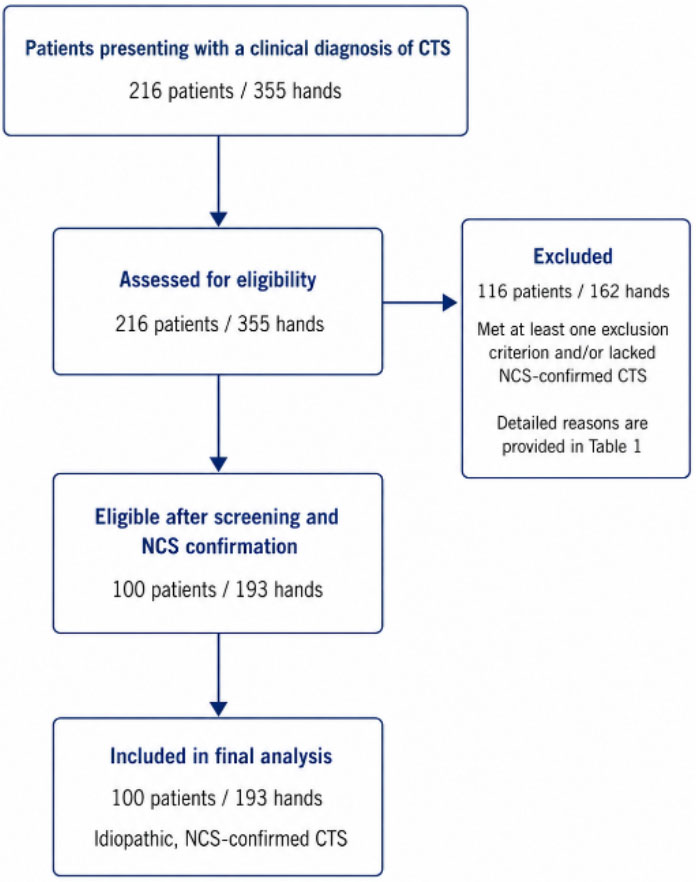
Figure 1.
STROBE-style flow diagram of patient and hand selection. Detailed exclusion criteria are provided in Table 1. CTS, carpal tunnel syndrome; NCS, nerve conduction studies.
Table 1.
Number of excluded patients/hands (216 patients, 355 hands)
| Exclusion criterion | Patients | Hands |
|---|---|---|
| history of paresis or cervical radiculopathy | 1 | 1 |
| diabetic polyneuropathy | 10 | 12 |
| previous fractures or malunited callus of wrist | 2 | 2 |
| prior carpal tunnel decompression surgery | 7 | 10 |
| local glucocorticoid injection ≤3 months | 1 | 1 |
| local physiotherapy ≤3 months | 1 | 1 |
| pregnancy or postpartum ≤6 months | 2 | 4 |
| decompensated hypothyroidism | 1 | 2 |
| rheumatoid arthritis | 22 | 34 |
| psoriatic arthritis | 8 | 10 |
| spondyloarthritis | 5 | 8 |
| systemic lupus erythematosus | 10 | 15 |
| systemic sclerosis | 22 | 29 |
| Sjögren’s disease | 9 | 13 |
| gout | 7 | 8 |
| undifferentiated arthritis | 1 | 1 |
| lack of diagnostic nerve conduction study criteria | 7 | 11 |
| Total | 116 | 162 |
[i] Note: Exclusion categories were recorded as mutually exclusive for reporting purposes. When more than one exclusion criterion was met, the primary reason for exclusion was recorded. The following exclusion criteria did not apply to any screened patient: age under 18 years, diagnosis of acute carpal tunnel syndrome, proximal compressive neuropathies (e.g., thoracic outlet syndrome), use of oral contraceptives within the preceding 6 months, acromegaly, chronic kidney disease requiring hemodialysis.
Table 2.
General and CTS characteristics of the sample (n = 100)
| demographics | CTS characteristics | ||
|---|---|---|---|
| age (years) | 58.5±9.8 | right dominant hand | 95% |
| women | 93.0% | left dominant hand | 3.0% |
| menopause age (years) | 47.8±5.6 | ambidextrous | 2.0% |
| urban dwelling | 62.0% | history of CTS | 67.0% |
| secondary school | 10.0% | time from menopause to CTS (years) | 12.0±9.5 |
| high school | 64.0% | bilateral CTS | 97.0% |
| college | 26.0% | unilateral CTS of dominant hand | 3.0% |
| professionally active | 57.0% | unilateral CTS of nondominant hand | 0 |
| smoking, current | 18.0% | professional vibration exposure | 23.0% |
| smoking, ever | 37.0% | occupation involving manual load handling | 82.0% |
| alcohol, frequent | 48.0% | keyboard work | 38.0% |
| BMI (kg/m2) | 29.2±5.0 | professional repetitive maneuvers | 83.0% |
| arterial hypertension | 57.0% | extended flexion or extension | 52.0% |
| Raynaud’s phenomenon | 3.0% | cold work environment | 30.0% |
[i] Notes: “Professional vibration exposure” referred to regular use of vibrating tools or equipment. “Occupation involving manual load handling” referred to regular lifting, carrying, pushing, or pulling of objects during work. “Keyboard work” referred to regular occupational computer or keyboard use. “Professional repetitive maneuvers” referred to repeated hand or wrist movements performed as part of work tasks. “Extended flexion or extension” referred to sustained or repeated wrist flexion or extension during occupational activity. “Cold work environment” referred to regular work in low-temperature environments or exposure to cold surfaces/materials.
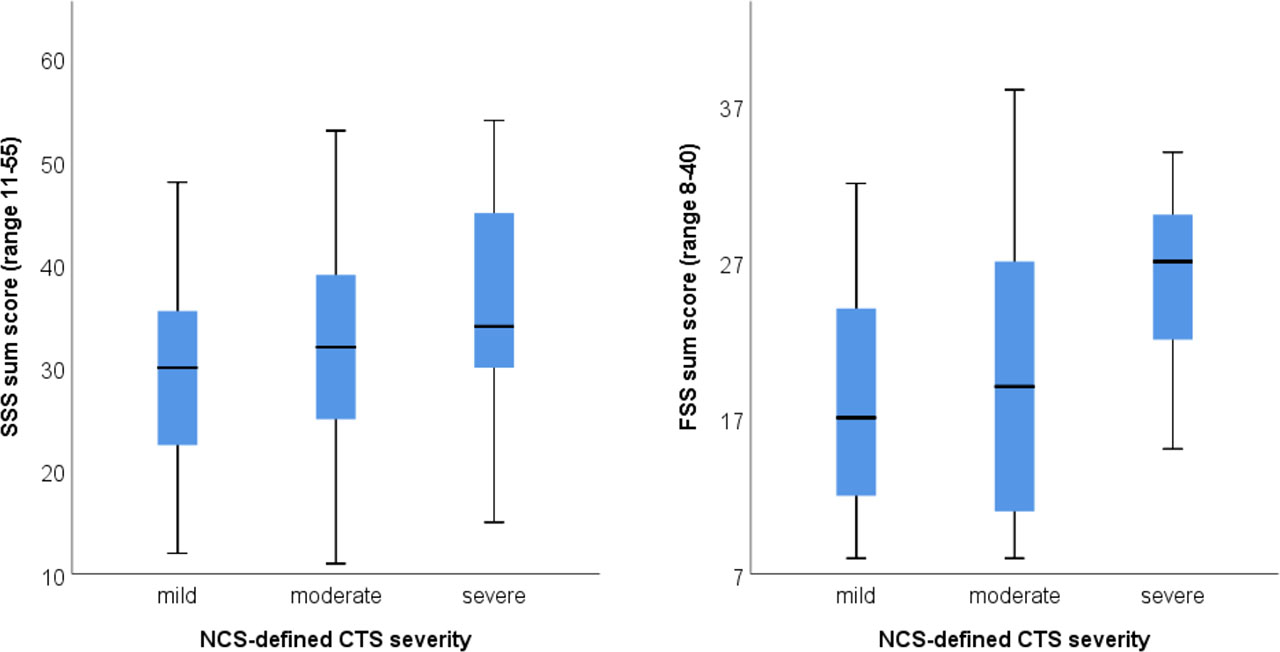
Figure 2.
Median SSS (left; p = 0.006) and FSS scores (right; p < 0.001) according to the NCS-defined CTS severity class. P-values represent the significance level of Kruskal-Wallis tests. Per-group hand counts of NCS severity categories: mild (n=56), moderate (n=90) and severe (n=47).
Abbreviations: BCTQ - Boston Carpal Tunnel Questionnaire; CTS – carpal tunnel syndrome; FSS - Functional Status Scale; SSS - Symptom Severity Scale.
Table 3.
Exploratory item-level analysis of the BCTQ questions and NCS-defined CTS severity (n=193 hands).
| mild (n=56) | moderate (n=90) | severe (n=47) | |||
|---|---|---|---|---|---|
| SSS question 6 | 0.004 | 2 | 27.3% | 21.3% | 6.4%* |
| 4 | 27.3% | 25.8% | 55.3%* | ||
| SSS question 8 | 0.049 | 2 | 29.1%* | 12.4% | 10.6% |
| 4 | 0%* | 11.2% | 10.6% | ||
| SSS question 9 | 0.005 | 2 | 30.9%* | 14.6% | 10.6% |
| 5 | 1.8%* | 15.7% | 25.5%* | ||
| SSS question 10 | 0.012 | 5 | 1.8%* | 15.7% | 10.6% |
| SSS question 11 | 0.002 | 4 | 9.1% | 11.2% | 36.2%* |
| FSS question 1 | <0.001 | 1 | 58.2% | 48.3% | 6.4%* |
| 3 | 14.5% | 18.0 | 46.8%* | ||
| 5 | 0% | 0% | 4.3%* | ||
| FSS question 2 | <0.001 | 1 | 52.7%* | 39.3% | 6.4%* |
| 4 | 5.5%* | 16.9% | 29.8%* | ||
| 5 | 0 | 1.1% | 17.0%* | ||
| FSS question 3 | <0.001 | 1 | 30.9% | 23.6% | 4.3%* |
| 4 | 10.9% | 19.1% | 40.4%* | ||
| FSS question 4 | <0.001 | 2 | 40.0%* | 13.5% | 10.6% |
| 3 | 20.0% | 21.3% | 42.6% | ||
| FSS question 5 | 0.037 | 5 | 7.3% | 16.9% | 29.8%* |
| FSS question 7 | 0.001 | 4 | 29.1% | 29.5% | 53.2%* |
| FSS question 8 | 0.006 | 1 | 47.3% | 40.3% | 19.1%* |
| 3 | 29.1% | 18.0% | 44.7%* |
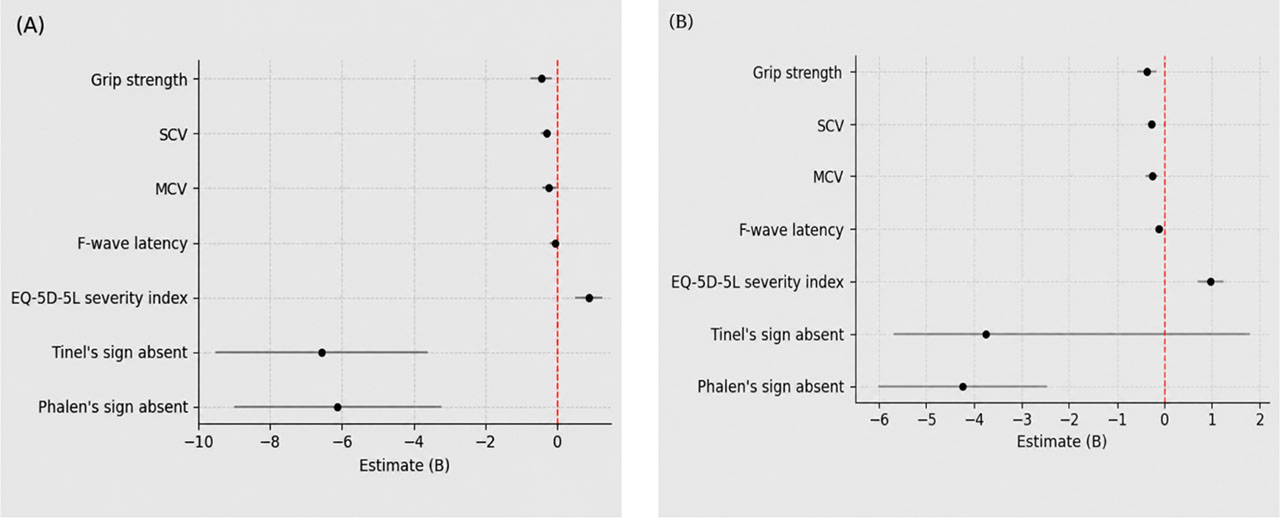
Figure 3.
Forest plots of linear mixed models to predict SSS (panel A) and FSS scores (panel B).
Notes: Each estimate comes from a separate adjusted model as specified in Table 4. For Tinel's and Phalen's signs, the plotted coefficient represents absence versus presence of the sign.
Abbreviations: FSS - Functional Status Scale; MCV - Motor Conduction Velocity; SCV - Sensory Conduction Velocity; SSS - Symptom Severity Scale.
Table 4.
Associations between BCTQ scores and clinical, NCS, and patient-reported measures
| Spearman’s | linear mixed models* for F/SSS | ||||||
|---|---|---|---|---|---|---|---|
| rho | p | B | 95% CI | p | pseudo-R2 | ||
| grip strength | SSS | −0.161 | 0.028 | −0.431 | −0.727; −0.135 | 0.005 | 0.108 |
| FSS | −0.392 | <0.001 | −0.355 | −0.552; −0.158 | <0.001 | 0.289 | |
| SCV | SSS | −0.330 | <0.001 | −0.298 | −0.429; −0.166 | <0.001 | 0.181 |
| FSS | −0.308 | <0.001 | −0.273 | −0.361; −0.184 | <0.001 | 0.332 | |
| MCV | SSS | −0.190 | 0.012 | −0.221 | −0.415; −0.027 | 0.026 | 0.054 |
| FSS | −0.272 | <0.001 | −0.250 | −0.374; −0.126 | <0.001 | 0.168 | |
| F wave | SSS | 0.007 | 0.924 | −0.067 | −0.191; 0.056 | 0.283 | - |
| FSS | −0.185 | 0.011 | −0.100 | −0.193; −0.008 | 0.034 | 0.005 | |
| SNAP | SSS | −0.333 | <0.001 | −0.276 | −0.411; −0.142 | <0.001 | 0.130 |
| FSS | −0.337 | <0.001 | −0.208 | −0.299; −0.117 | <0.001 | 0.197 | |
| CMAP | SSS | −0.133 | 0.077 | −0.855 | −1.428; −0.281 | 0.004 | 0.127 |
| FSS | −0.305 | 0.000 | −0.879 | −1.268; −0.490 | <0.001 | 0.189 | |
| DML | SSS | 0.300 | <0.001 | 1.484 | 0.661; 2.308 | <0.001 | 0.127 |
| FSS | 0.311 | <0.001 | 1.328 | 0.750; 1.905 | <0.001 | 0.187 | |
| EQ-5D-5L DSS | SSS | 0.381 | <0.001 | 0.882 | 0.488; 1.277 | <0.001 | 0.125 |
| FSS | 0.592 | <0.001 | 0.988 | 0.720; 1.255 | <0.001 | 0.337 | |
| Mann Whitney | linear mixed models* for F/SSS | ||||||
|---|---|---|---|---|---|---|---|
| no vs. yes& | p | B | 95% CI | p | pseudo-R2 | ||
| Absence of Tinel’s sign | SSS | 31 (13) vs 36 (15) | <0.001 | −6.569 | −9.529; −3.610 | <0.001 | 0.239 |
| FSS | 18 (13) vs 25 (13) | <0.001 | −3.739 | −5.675; −1.802 | <0.001 | 0.338 | |
| Absence of Phalen’s sign | SSS | 30 (12) vs 35 (13) | <0.001 | −6.124 | −9.012; −3.236 | <0.001 | 0.224 |
| FSS | 15 (11) vs 24 (13) | <0.001 | −4.235 | −6.012; −2.457 | <0.001 | 0.365 | |
* mixed linear models additionally included, for grip strength, the covariates: age, sex and CTS severity; for SCV, MCV and F wave, the covariates: age, sex and education level; for EQ-5D-5L, Tinel and Phalen signs, the covariates: age, sex, grip strength and CTS severity. Each predictor was analyzed in a separate linear mixed-effects model with patient ID as random intercept. Models for grip strength were adjusted for age, sex, and NCS severity; SCV/MCV/F-wave models for age, sex, and education; EQ-5D-5L, Tinel's sign, and Phalen's sign models for age, sex, grip strength, and NCS severity. Spearman correlations and Mann-Whitney tests are descriptive and exploratory, as they do not account for within-patient clustering. Presence of the clinical sign (Tinel’s and Phalen’s) was the reference category.
Abbreviations: BCTQ - Boston Carpal Tunnel Questionnaire; CI - confidence interval; CMAP - Compound Muscle Action Potential; CTS - carpal tunnel syndrome; DML - distal motor latency; DSS – descriptive severity score; FSS - Functional Status Scale; MCV - Motor Conduction Velocity; SCV - Sensory Conduction Velocity; SNAP - Sensory Nerve Action Potential; SSS - Symptom Severity Scale.