
What is new/what is important
This study evaluates the Romanian BCTQ beyond its initial linguistic validation, in a consecutive outpatient sample with idiopathic, NCS-confirmed CTS. It shows that BCTQ scores are stable across age, sex, and education groups and are meaningfully associated with grip strength, NCS severity, provocative clinical signs, and self-reported health burden. The findings support the Romanian BCTQ as a practical patient-reported outcome measure that complements NCS and clinical examination in CTS assessment.
1. INTRODUCTION
Carpal tunnel syndrome (CTS) is the most common peripheral entrapment neuropathy, affecting up to 5% of the population [1,2,3], with prevalence estimates varying according to diagnostic criteria and assessment methods (lower if diagnosed with electrophysiological testing [4]). Clinically, CTS is characterized by paresthesia, sensorimotor deficits, and progressive functional impairment. Diagnosis typically relies on medical history and physical examination, while nerve conduction studies (NCS) and ultrasound offer additional value [4,5,6,7,8,9]. While NCS remains the diagnostic reference standard, particularly when surgical intervention is considered, its cost and limited accessibility constrain routine use. Ultrasound has therefore gained prominence as a complementary modality, offering non-invasive visualization of median nerve morphology and surrounding structures, with diagnostic accuracy comparable to NCS in mild-to-moderate CTS [10,11,12]. Recent developments, including elastography, assessment of nerve vascularization, and AI-assisted image analysis, further expand the role of ultrasound in CTS evaluation [13, 14].
Alongside objective diagnostic tools, patient-reported outcome measures are essential for capturing symptom burden and functional impact. The Boston Carpal Tunnel Questionnaire (BCTQ), also known as the Levine-Katz questionnaire [15], is the most widely used disease-specific instrument for CTS. Comprising the Symptom Severity Scale (SSS) and Functional Status Scale (FSS), the BCTQ has demonstrated strong reliability, validity, and responsiveness [16] and is extensively used in both clinical practice and research to monitor disease progression and treatment outcomes. The BCTQ has been validated in numerous languages and cultural contexts [17,18,19,20,21,22,23]. Following internationally accepted procedures for translation and cross-cultural adaptation, a validated version of the BCTQ is now available in Romanian [24]. However, linguistic and internal validity alone do not guarantee that a translated instrument will perform equally well across diverse real-world settings and patient populations. In particular, there is limited evidence for many language versions, including Romanian [25], regarding known-groups consistency and clinical construct validity, including score stability across demographic subgroups and alignment with objective clinical measures. This gap is clinically relevant, especially in settings where alternative shorter instruments (such as CTS-6) are available and compete for routine use [26].
Unlike the initial Romanian validation, which focused on translation and internal psychometric properties, the aim of this study was to evaluate the clinical construct validity and subgroup stability of the Romanian BCTQ in an outpatient idiopathic, NCS-confirmed CTS sample. Specifically, the study aimed to evaluate known-groups consistency of BCTQ scores across key demographic subgroups (age, sex, and educational level) and to assess their associations with objective clinical and electrophysiological measures, including grip strength, NCS severity, provocative tests, and health-related quality of life. Through this approach, we sought to determine whether the Romanian BCTQ reliably reflects symptom burden and functional impairment in an outpatient idiopathic, NCS-confirmed CTS sample beyond the original validation setting.
2. MATERIALS AND METHODS
2.1. Study design and population
This cross-sectional study included all consecutive eligible patients presenting to the Rheumatology Unit of Colentina Hospital (Bucharest, Romania) between January 2023 and March 2025, without randomization or stratification, referred with a clinical diagnosis of CTS. Only those who had the diagnosis confirmed according to the American Academy of Orthopaedic Surgeons (AAOS) evidence-based guideline [27] and through electrophysiological testing were included in the study.
In order to include only idiopathic cases of CTS, patients with systemic or orthopedic conditions were excluded based on clinical and paraclinical evaluation, including detailed medical history, physical examination, laboratory tests (blood and urine analyses), and wrist imaging (plain radiography and ultrasonography). Participants were excluded from the study based on the following criteria: age under 18 years, diagnosis of acute CTS, history of paresis or cervical radiculopathy, presence of proximal compressive neuropathies (e.g., thoracic outlet syndrome), confirmed diabetic polyneuropathy, previous fractures or malunited callus affecting the wrist, prior CTS decompression surgery, local glucocorticoid or anesthetics injection in the carpal tunnel, or physiotherapy targeting the wrist region within the last three months, pregnancy or postpartum status up to six months, use of oral contraceptives within the preceding six months (to avoid hormonally driven fluctuations in median nerve edema and symptom severity), decompensated hypothyroidism, acromegaly, chronic kidney disease requiring hemodialysis, and presence of inflammatory joint diseases such as rheumatoid arthritis, psoriatic arthritis, spondyloarthritis, systemic lupus erythematosus, gout, or other conditions associated with arthritis and tendon thickening. All study procedures (clinical interview, general clinical examination, CTS-oriented clinical examination, grip strength measurement, questionnaires and electrophysiological study) were done within a 7-day span for each patient.
The study was conducted in accordance with the Helsinki Declaration and was approved by the local ethics committee (number 2/January 19th, 2023). All patients signed informed consent before any study procedure.
2.2. Clinical assessment
CTS diagnosis was based on a detailed clinical history and physical examination, in accordance with the AAOS evidence-based guideline [27], and all examinations were made by the same author (rheumatologist). The examination focused on sensory alterations in the median nerve distribution and included the median-ulnar sensory discrimination test, Tinel’s and Phalen’s signs, as well as the assessment of thenar atrophy and motor weakness using the lateral pinch test. Tinel’s sign was assessed by percussion over the median nerve at the level of the carpal tunnel (volar aspect of the wrist). A test was considered positive when percussion reproduced paresthesia or “electric shock” sensations in the median nerve distribution. Phalen’s test was performed by maintaining maximal wrist flexion with the dorsal surfaces of both hands pressed together for up to 60 seconds; the test was considered positive if typical median-distribution paresthesia and/or pain was reproduced during the maneuver.
In the same day of clinical evaluation and NCS, all patients completed the Romanian version of the BCTQ (which was administered and scored separately for each hand), recently translated and culturally validated [24]. The BCTQ was completed before patients received their NCS results, in order to minimize potential anchoring of symptom or functional ratings to electrophysiological findings. Clinical construct validity was operationalized as the ability of the Romanian BCTQ to retain meaningful clinical associations and consistent score distributions when applied outside the original internal validation setting. Subgroup stability/known-groups consistency was assessed by examining whether overall BCTQ scores remained comparable across demographic groups. This approach did not assess formal measurement invariance or differential item functioning. The SSS and FSS were analyzed as sum scores (SSS range 11–55; FSS range 8–40), consistent with the original instrument structure. For comparability with prior studies reporting mean item scores, corresponding mean values (sum score divided by number of items) were also calculated.
All patients also filled in the validated Romanian EQ-5D-5L questionnaire. A standard preference-based EQ-5D-5L utility index was not calculated. Instead, for exploratory convergent-validity analysis, an unweighted EQ-5D-5L severity index was derived by summing the levels reported across the five EQ-5D-5L dimensions, yielding a score range from 5 to 25, with higher values indicating greater self-reported health burden.
BCTQ and EQ-5D-5L questionnaires were reviewed for completeness at the time of administration. If an item was inadvertently left unanswered, the patient was asked to complete it before the end of the visit. Consequently, no missing item responses were present in the final dataset, and no imputation or prorating procedure was required.
Grip strength was measured with a Camry EH101 digital hand dynamometer (Zhongshan Camry Electronic Co., Ltd., Guangdong, China). Tests were performed with the patient seated, the arm at the side, elbow flexed at 90°, and wrist in a neutral position. Each patient performed three maximal-effort trials with brief rest intervals, and the mean value (kgf) recorded independently for each hand.
2.3. Electrophysiological assessment
To confirm clinical diagnoses of CTS for each hand, electrophysiological examinations were all conducted by the same author (neurologist) using a Nihon Kohden Neuropack electromyograph (Nihon Kohden Corporation, Tokyo, Japan) with two surface cup recording electrodes and a surface electrical stimulator. Sensory and motor nerve conduction studies and F-waves of the median nerve were performed at a stimulation rate of 1 Hz. Sensory nerve action potentials (SNAPs) were recorded antidromically by stimulating the median nerve at the wrist, with recording electrodes placed on the index, middle, and ring fingers for comparative analysis, maintaining a distance of 14 cm from the wrist. Motor nerve conduction studies were also performed, with compound muscle action potentials recorded following standard protocols with the active electrode positioned over the abductor pollicis brevis muscle. The stimulus duration was set at 0.2 msec across all sites. All nerve conduction studies were performed by the same neurologist for consistency, who was blind to clinical examination. Hand skin temperature was continuously monitored in an air-conditioned room maintained at 23–25°C throughout the examination. Median nerve conduction was considered abnormal according to the laboratory reference limits used in our neurophysiology unit. Values considered within normal limits were distal motor latency (DML) ≤ 4.4 ms, sensory conduction velocity (SCV) ≥ 50 m/s, motor conduction velocity (MCV) ≥49 m/s, sensory nerve action potential (SNAP) amplitude ≥ 20 µV, and compound muscle action potential (CMAP) amplitude ≥4 mV, and F wave ≤31 m/s [28]. Values outside these limits, as well as absent sensory or motor responses, were classified as abnormal according to the Bland scale [29].
2.4. Statistical analysis
Nominal variables were reported as absolute frequency and percent of sub/group. Data distribution normality was assessed using descriptive statistics, normality, stem-and-leaf plots, and the Lilliefors corrected Kolmogorov-Smirnov tests. Normally-distributed continuous variables are reported as “mean ± standard deviation”. Non-normally distributed continuous variables are reported as “median (interquartile range)” and their correlations were assessed with Spearman ρ (rho) coefficients. For comparing differences of continuous variable between groups of nominal variables, Mann Whitney U tests and Kruskal Wallis tests were used depending on the number of subgroups. To assess the magnitude of differences of continuous variables among categories of nominal variables, the effect size for Mann-Whitney U tests was calculated using the rank-biserial correlation coefficient (r), derived from the standardized test statistic (Z) divided by the square root of the total number of observations, which was interpreted as small (r < 0.3), medium (0.3 < r < 0.5), and large (r > 0.5). Similarly, the effect size for Kruskal Wallis tests was calculated using epsilon-squared (ε2), derived by dividing Kruskal-Wallis H test statistic after subtracting the number of groups (3) and adding one with the number of observations after subtracting the number of groups (3), which was interpreted as small (r < 0.06), medium (0.06 < r < 0.14), and large (r > 0.14).
Given that CTS can present asymmetrically and vary in severity between hands, a hand-based analysis was chosen over a patient-based approach, which allowed for a more precise examination of symptom severity, functional impairment, and electrophysiological findings as they relate to each individual hand, rather than aggregating potentially discordant data at the patient level. In contrast to prior validation work, linear mixed-effects models were used to assess the association between predictors and BCTQ scores, accounting for non-independence of hands within the same patient (specifying patient as a random intercept to model within-subject correlation). Fixed effects included the predictors of interest, as well as relevant covariates such as age, sex, and CTS severity or education level, depending on the model. Compound symmetry was assumed for the covariance structure between repeated measures (hands) of the same individual. Estimates of fixed effects were reported as unstandardized coefficients (B) with 95% confidence intervals and p-values. To quantify the proportion of variance explained by the fixed effects, a pseudo-R2 was calculated as the residual variances from the null (intercept-only) and full models, respectively. Estimation was performed using restricted maximum likelihood (REML). To characterize within-patient clustering of bilateral hand data, intraclass correlation coefficients (ICC) were calculated from unconditional random-intercept mixed-effects models.
To assess associations between nominal variables, χ2 tests were used. To identify which specific sub-category contributed most to the observed group differences, standardized residuals were examined and residuals exceeding ± 1.96 were considered statistically significant.
Because most patients had bilateral CTS, analyses that did not explicitly account for within-patient clustering (i.e., Spearman correlations and non-parametric subgroup comparisons) were considered descriptive and exploratory. Inferential conclusions were based primarily on linear mixed-effects models.
Because this was a consecutive clinical sample, no formal a priori sample-size calculation was performed. A post-hoc precision assessment was conducted for the correlation analyses using Fisher’s z transformation. Using the patient-level sample size as a conservative effective sample size (n = 100), the approximate 95% CI half-width for a Spearman correlation of 0.30 was approximately 0.18–0.19; using the hand-level sample size (n = 193), the corresponding half-width was approximately 0.13. Thus, the study provided acceptable precision for estimating moderate correlations, while weak correlations were interpreted cautiously.
The statistical tests were considered significant if p < 0.05 and were performed using IBM SPSS Statistics version 25.0 for Windows (IBM Corp., Armonk, NY, USA).
3. RESULTS
3.1. Demographic and CTS characteristics in the patient sample
Within the timeframe, 216 patients (355 hands) presented with a clinical diagnosis of CTS, of which 116 patients (162 hands) either failed the exclusion criteria or lacked diagnostic NCS criteria for CTS (Table 1). Thus, the study included 100 patients and 193 hands with a clinical and NCS-defined diagnosis of idiopathic CTS (Figure 1). Of the total participants, 93 (93.0%) were women. The mean age of the study population was 58.5 ± 9.8 years, with ages ranging from 29 to 82 years. All descriptive characteristics of the study cohort are summarized in table 2.
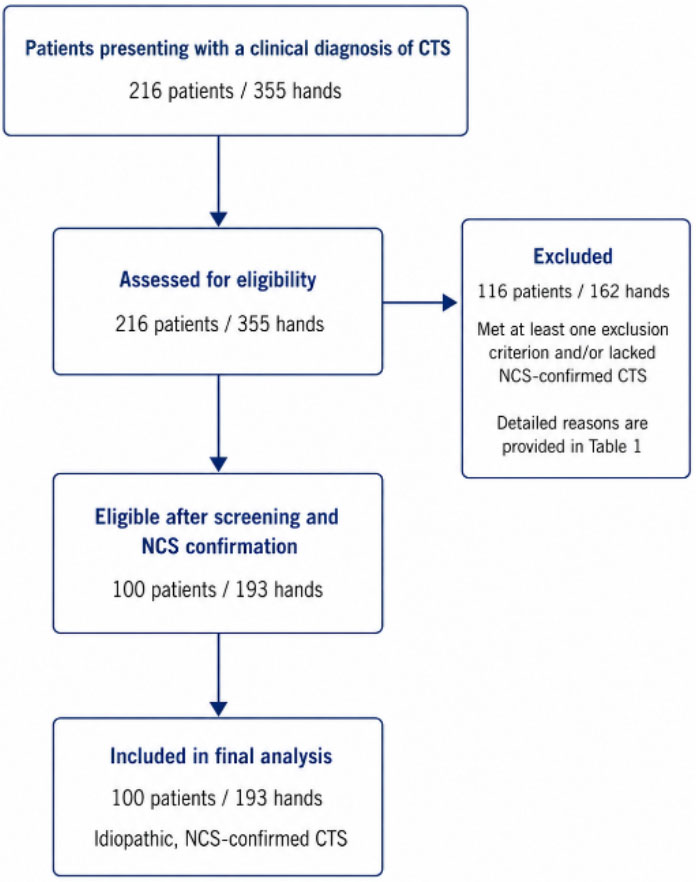
Figure 1.
STROBE-style flow diagram of patient and hand selection. Detailed exclusion criteria are provided in Table 1. CTS, carpal tunnel syndrome; NCS, nerve conduction studies.
Table 1.
Number of excluded patients/hands (216 patients, 355 hands)
| Exclusion criterion | Patients | Hands |
|---|---|---|
| history of paresis or cervical radiculopathy | 1 | 1 |
| diabetic polyneuropathy | 10 | 12 |
| previous fractures or malunited callus of wrist | 2 | 2 |
| prior carpal tunnel decompression surgery | 7 | 10 |
| local glucocorticoid injection ≤3 months | 1 | 1 |
| local physiotherapy ≤3 months | 1 | 1 |
| pregnancy or postpartum ≤6 months | 2 | 4 |
| decompensated hypothyroidism | 1 | 2 |
| rheumatoid arthritis | 22 | 34 |
| psoriatic arthritis | 8 | 10 |
| spondyloarthritis | 5 | 8 |
| systemic lupus erythematosus | 10 | 15 |
| systemic sclerosis | 22 | 29 |
| Sjögren’s disease | 9 | 13 |
| gout | 7 | 8 |
| undifferentiated arthritis | 1 | 1 |
| lack of diagnostic nerve conduction study criteria | 7 | 11 |
| Total | 116 | 162 |
[i] Note: Exclusion categories were recorded as mutually exclusive for reporting purposes. When more than one exclusion criterion was met, the primary reason for exclusion was recorded. The following exclusion criteria did not apply to any screened patient: age under 18 years, diagnosis of acute carpal tunnel syndrome, proximal compressive neuropathies (e.g., thoracic outlet syndrome), use of oral contraceptives within the preceding 6 months, acromegaly, chronic kidney disease requiring hemodialysis.
Table 2.
General and CTS characteristics of the sample (n = 100)
| demographics | CTS characteristics | ||
|---|---|---|---|
| age (years) | 58.5±9.8 | right dominant hand | 95% |
| women | 93.0% | left dominant hand | 3.0% |
| menopause age (years) | 47.8±5.6 | ambidextrous | 2.0% |
| urban dwelling | 62.0% | history of CTS | 67.0% |
| secondary school | 10.0% | time from menopause to CTS (years) | 12.0±9.5 |
| high school | 64.0% | bilateral CTS | 97.0% |
| college | 26.0% | unilateral CTS of dominant hand | 3.0% |
| professionally active | 57.0% | unilateral CTS of nondominant hand | 0 |
| smoking, current | 18.0% | professional vibration exposure | 23.0% |
| smoking, ever | 37.0% | occupation involving manual load handling | 82.0% |
| alcohol, frequent | 48.0% | keyboard work | 38.0% |
| BMI (kg/m2) | 29.2±5.0 | professional repetitive maneuvers | 83.0% |
| arterial hypertension | 57.0% | extended flexion or extension | 52.0% |
| Raynaud’s phenomenon | 3.0% | cold work environment | 30.0% |
[i] Notes: “Professional vibration exposure” referred to regular use of vibrating tools or equipment. “Occupation involving manual load handling” referred to regular lifting, carrying, pushing, or pulling of objects during work. “Keyboard work” referred to regular occupational computer or keyboard use. “Professional repetitive maneuvers” referred to repeated hand or wrist movements performed as part of work tasks. “Extended flexion or extension” referred to sustained or repeated wrist flexion or extension during occupational activity. “Cold work environment” referred to regular work in low-temperature environments or exposure to cold surfaces/materials.
3.2. CTS characteristics
In the patient sample (n = 100), medical history revealed that 67.0% of patients had a previous diagnosis of CTS. While the majority of patients were right-handed (95%), only 3% had unilateral CTS of the dominant hand, and the remaining patients had bilateral CTS (97%). The majority of patients had multiple professional risk factors for CTS development (table 2).
In the analyzed sample of 193 hands, the average SSS score was 32.1 ± 10.0 (with a mean item score of 2.92), while the mean FSS score was 20.8 ± 8.0 (with mean item score of 2.60), indicating moderate levels of symptom burden and functional limitation. In the null mixed-effects models, the ICC was 0.496 for SSS and 0.719 for FSS, indicating moderate-to-high within-patient clustering of hand-level BCTQ scores. Specifically, approximately 49.6% of the variance in SSS and 71.9% of the variance in FSS was attributable to between-patient differences.
Tinel’s sign was found in 39.9% of hands, while Phalen’s sign in 64.8%. The average grip strength was 19.4 ± 5.8 kgf, reflecting varying degrees of hand motor impairment. Nerve conduction studies showed a mean sensory conduction velocity (SCV) of 37.5 ± 11.0 m/s and a mean motor conduction velocity (MCV) of 54.6 ± 7.3 m/s. Other electrophysiological parameters included SNAP (15.9 ± 11.0 µV), compound muscle action potential (CMAP; 7.2 ± 2.8 mV) and distal motor latency (DML; 5.4 ± 1.9 ms). The mean unweighted EQ-5D-5L severity index was 6.7 ± 4.3, reflecting greater self-reported overall health burden with higher values. According to the Bland electrophysiological grading scale, the mean severity score was 3, corresponding to a moderate degree of CTS.
3.3. Subgroup stability of BCTQ by age
Of the 193 hands, 59.6% came from patients aged 60 years or below, while 40.4% from patients aged above 60 years. The median SSS score and the median FSS score did not differ significantly among the two age categories: 33 (16) versus 32 (12), p = 0.371, respectively 20 (15) versus 23 (14), p = 0.102. The effect size indicated a negligible association between age groups and BCTQ scores (r = −0.064 for SSS and r = −0.118 for FSS). Exploratory item-level analysis revealed statistically significant differences in the response distributions for SSS question 2 (p = 0.003) and SSS question 10 (p < 0.001). Further examination of standardized residuals indicated that in the case of SSS question 2, the first response option (“normal” or “no difficulty”) was selected significantly more often by individuals aged ≤ 60 years (21.2% versus 7.7%), while for SSS question 10 all the standardized residuals were non-significant, indicating that the associations were not driven by any single response category. The linear mixed-effects model with a random intercept for patient identification showed no statistically significant association between age groups and SSS or FSS scores: the estimated mean difference in SSS scores between age groups was 1.69 (95% confidence interval CI: −1.82 to 5.21; p = 0.341) and −0.36 (95% CI: −3.31 to 2.58; p = 0.807) for FSS scores, indicating that reported symptom severity did not differ significantly between patients aged ≤60 years and those aged >60 years, after accounting for within-patient correlation.
3.4. Subgroup stability of BCTQ by sex
In terms of sex distribution, 92.7% of hands came from women, while only 7.3% of hands came from men. The median SSS and FSS scores did not differ significantly between men and women: 34 (12) versus 32 (15), p = 0.218, respectively 16 (18) versus 22 (15), p = 0.746. As for age groups, the effect size indicated a negligible association between sex and BCTQ scores (r = −0.089 for SSS and r = −0.023 for FSS). Exploratory item-level analysis revealed statistically significant differences in the response distributions for SSS question 7 (p < 0.033; answer “very serious” was more frequently observed among men: 21.4% versus 3.4%), SSS question 9 (p < 0.006; answer “medium” was favored by men: 71.4% versus 28.8%), FSS question 2 (p < 0.001; answer “cannot perform the activity at all due to symptoms” was more frequent in men: 28.6% versus 2.8%), FSS question 3 (p = 0.010; answer “cannot perform the activity at all due to symptoms” was more frequent in men: 14.3% versus 1.1%), and FSS question 6 (p = 0.024; answer “little difficulty” was more frequent in men: 50.0% versus 16.9%). Sex was also significantly associated with SSS question 4 (p = 0.041), but all standardized residuals were non-significant, indicating that the associations were not driven by any single response category. The linear mixed-effects model with a random intercept for patient ID showed no statistically significant association between sex and SSS or FSS scores: the estimated mean difference in SSS scores between age groups was 3.51 (95% CI: −3.24 to 10.24; p = 0.305) and −0.97 (95% CI: −6.80 to 4.87; p = 0.743) for FSS scores, indicating that reported symptom severity did not differ significantly between men and women, after accounting for within-patient correlation.
3.5. Subgroup stability of BCTQ by education level
Of the 193 hands, 25.9% came from patients with completed college education, while 74.1% had completed only high school education at best. The median SSS score and the median FSS score did not differ significantly among college and non-college education categories: 32 (18) versus 32 (14), p = 0.502, respectively 23 (15) versus 21 (15), p = 0.410. As for age groups and sex, the effect size showed a negligible association between education level and BCTQ scores (r = −0.048 for SSS and r = −0.059 for FSS). Exploratory item-level analysis of the BCTQ revealed statistically significant associations of education level and SSS question 6 (p = 0.022), SSS question 7 (p = 0.023), and FSS question 3 (p = 0.006). However, in all three cases, none of the standardized residuals exceeded the significance level, indicating that the associations were not driven by any single response category. Instead, the significance appears to reflect distributed shifts in response patterns between education groups. The linear mixed-effects model with a random intercept for patient ID showed no statistically significant association between education level and SSS or FSS scores: the estimated mean difference in SSS scores between education level groups was 1.20 (95% CI: −2.83 to 5.23; p = 0.556) and −1.33 (95% CI: −4.78 to 2.13; p = 0.449) for FSS scores, indicating that reported symptom severity did not differ significantly between education levels, after accounting for within-patient correlation.
3.6. Consistency of BCTQ with NCS-defined CTS severity
NCS-defined severity categorized the 193 hands with CTS as mild (grades 1–2) in 29.0% of cases, moderate (grades 3–4) in 46.6% of cases or severe (grades 5–6) in 24.4% of cases. The median SSS score and the median FSS score significantly increased with NCS-defined severity group from mild to moderate and severe (Figure 2): 30 (14), 32 (14) and 34 (15) for SSS (p = 0.006; with a small effect-size: ε2 = 0.044), respectively 17 (12), 19 (17) and 27 (8) for FSS (p < 0.001; with a moderate effect-size: ε2 = 0.118). Exploratory item-level analysis of the BCTQ revealed statistically significant associations with several individual questions (table 3), revealing that both symptom severity and functional impairment scores increase with greater electrophysiological severity, particularly for functional limitations, displaying a graded relationship between electrophysiological severity and reported symptoms. For example, the presence of numbness, addressed by SSS questions 6, displayed a high frequency of answer 4 (“severe”) in severe NCS-defined CTS, and the severity of numbness, addressed by SSS question 9, showed a high frequency of answer 2 (“slight”) in mild NCS-defined CTS and a high frequency of answer 5 (“very serious”) in severe NCS-defined CTS (table 3).
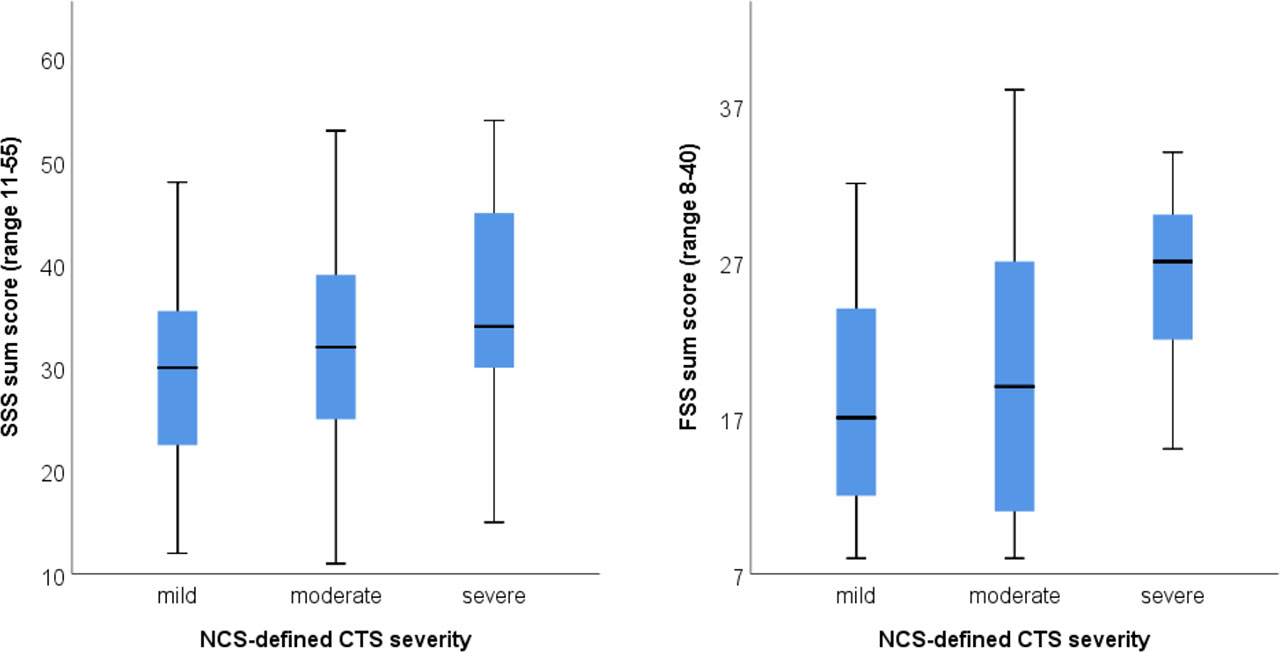
Figure 2.
Median SSS (left; p = 0.006) and FSS scores (right; p < 0.001) according to the NCS-defined CTS severity class. P-values represent the significance level of Kruskal-Wallis tests. Per-group hand counts of NCS severity categories: mild (n=56), moderate (n=90) and severe (n=47).
Abbreviations: BCTQ - Boston Carpal Tunnel Questionnaire; CTS – carpal tunnel syndrome; FSS - Functional Status Scale; SSS - Symptom Severity Scale.
Table 3.
Exploratory item-level analysis of the BCTQ questions and NCS-defined CTS severity (n=193 hands).
| mild (n=56) | moderate (n=90) | severe (n=47) | |||
|---|---|---|---|---|---|
| SSS question 6 | 0.004 | 2 | 27.3% | 21.3% | 6.4%* |
| 4 | 27.3% | 25.8% | 55.3%* | ||
| SSS question 8 | 0.049 | 2 | 29.1%* | 12.4% | 10.6% |
| 4 | 0%* | 11.2% | 10.6% | ||
| SSS question 9 | 0.005 | 2 | 30.9%* | 14.6% | 10.6% |
| 5 | 1.8%* | 15.7% | 25.5%* | ||
| SSS question 10 | 0.012 | 5 | 1.8%* | 15.7% | 10.6% |
| SSS question 11 | 0.002 | 4 | 9.1% | 11.2% | 36.2%* |
| FSS question 1 | <0.001 | 1 | 58.2% | 48.3% | 6.4%* |
| 3 | 14.5% | 18.0 | 46.8%* | ||
| 5 | 0% | 0% | 4.3%* | ||
| FSS question 2 | <0.001 | 1 | 52.7%* | 39.3% | 6.4%* |
| 4 | 5.5%* | 16.9% | 29.8%* | ||
| 5 | 0 | 1.1% | 17.0%* | ||
| FSS question 3 | <0.001 | 1 | 30.9% | 23.6% | 4.3%* |
| 4 | 10.9% | 19.1% | 40.4%* | ||
| FSS question 4 | <0.001 | 2 | 40.0%* | 13.5% | 10.6% |
| 3 | 20.0% | 21.3% | 42.6% | ||
| FSS question 5 | 0.037 | 5 | 7.3% | 16.9% | 29.8%* |
| FSS question 7 | 0.001 | 4 | 29.1% | 29.5% | 53.2%* |
| FSS question 8 | 0.006 | 1 | 47.3% | 40.3% | 19.1%* |
| 3 | 29.1% | 18.0% | 44.7%* |
Linear mixed-effects models with patient ID included as a random intercept showed a statistically significant association between electrophysiological CTS severity class and both SSS scores (p = 0.001) and FSS scores (p < 0.001). Using mild CTS as the reference category, severe CTS was associated with higher SSS scores (mean difference of 7.8 points, 95% CI 3.8 to 11.8), and higher FSS scores (mean difference of 8.9 points, 95% CI 6.3 to 11.6). Similarly, compared with moderate CTS, severe CTS was associated with higher SSS scores (mean difference of 4.8 points, 95% CI 1.4 to 8.2) and higher FSS scores (mean difference of 7.1 points, 95% CI 4.9 to 9.2).
In addition to evaluating each subscale in relation to NCS severity, the correlation between the two components of the BCTQ (SSS and FSS) was also examined, revealing a strong positive correlation between the two (rho = 0.651, p < 0.001), indicating that patients who reported more severe symptoms also tended to report greater functional impairment.
3.7. Clinical construct validity of BCTQ scores
In exploratory analyses, SSS and FSS scores were significantly correlated with measures selected to assess clinical construct validity, including objective clinical and NCS variables, and with EQ-5D-5L DSS as a measure of convergent validity. SSS and FSS scores showed a negative correlation with grip strength and sensory and motor conduction velocities, and a positive correlation with EQ-5D-5L DSS and with NCS-defined severity (table 4). Similarly, patients with Tinel’s and Phalen’s signs on clinical examination exhibited significantly higher median SSS and FSS scores than patients without these objective clinical signs. Regression analysis demonstrated that SSS and FSS score were significantly and independently predicted by grip strength, sensory and motor conduction velocities (Figure 3), NCS-measured F-wave (only for FSS), the presence of Tinel’s and Phalen’s clinical signs and a different patient-reported outcome (EQ-5D-5L; table 4).
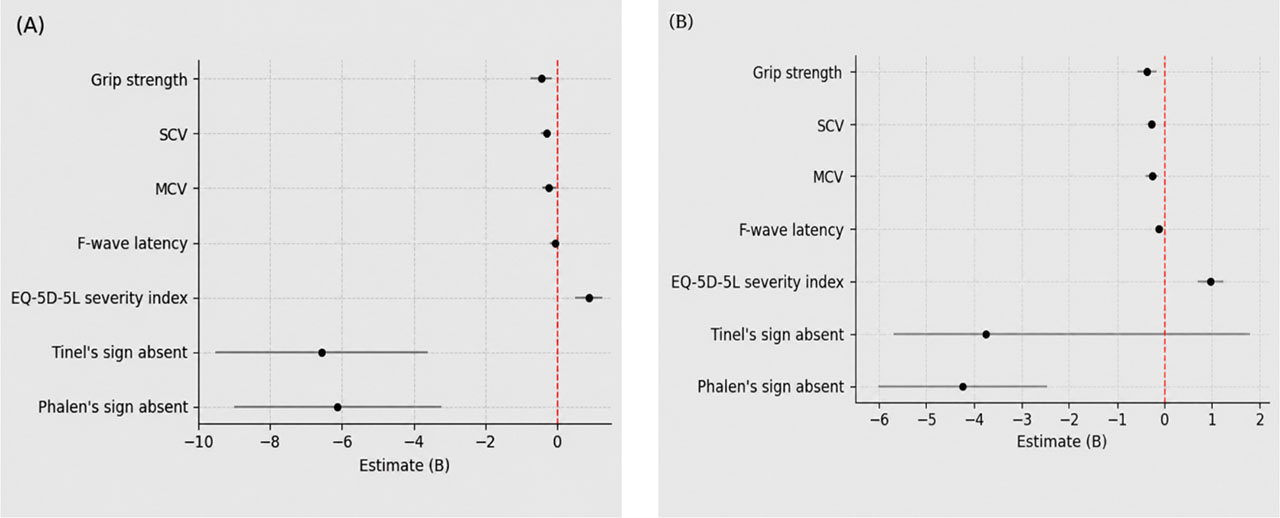
Figure 3.
Forest plots of linear mixed models to predict SSS (panel A) and FSS scores (panel B).
Notes: Each estimate comes from a separate adjusted model as specified in Table 4. For Tinel's and Phalen's signs, the plotted coefficient represents absence versus presence of the sign.
Abbreviations: FSS - Functional Status Scale; MCV - Motor Conduction Velocity; SCV - Sensory Conduction Velocity; SSS - Symptom Severity Scale.
Table 4.
Associations between BCTQ scores and clinical, NCS, and patient-reported measures
| Spearman’s | linear mixed models* for F/SSS | ||||||
|---|---|---|---|---|---|---|---|
| rho | p | B | 95% CI | p | pseudo-R2 | ||
| grip strength | SSS | −0.161 | 0.028 | −0.431 | −0.727; −0.135 | 0.005 | 0.108 |
| FSS | −0.392 | <0.001 | −0.355 | −0.552; −0.158 | <0.001 | 0.289 | |
| SCV | SSS | −0.330 | <0.001 | −0.298 | −0.429; −0.166 | <0.001 | 0.181 |
| FSS | −0.308 | <0.001 | −0.273 | −0.361; −0.184 | <0.001 | 0.332 | |
| MCV | SSS | −0.190 | 0.012 | −0.221 | −0.415; −0.027 | 0.026 | 0.054 |
| FSS | −0.272 | <0.001 | −0.250 | −0.374; −0.126 | <0.001 | 0.168 | |
| F wave | SSS | 0.007 | 0.924 | −0.067 | −0.191; 0.056 | 0.283 | - |
| FSS | −0.185 | 0.011 | −0.100 | −0.193; −0.008 | 0.034 | 0.005 | |
| SNAP | SSS | −0.333 | <0.001 | −0.276 | −0.411; −0.142 | <0.001 | 0.130 |
| FSS | −0.337 | <0.001 | −0.208 | −0.299; −0.117 | <0.001 | 0.197 | |
| CMAP | SSS | −0.133 | 0.077 | −0.855 | −1.428; −0.281 | 0.004 | 0.127 |
| FSS | −0.305 | 0.000 | −0.879 | −1.268; −0.490 | <0.001 | 0.189 | |
| DML | SSS | 0.300 | <0.001 | 1.484 | 0.661; 2.308 | <0.001 | 0.127 |
| FSS | 0.311 | <0.001 | 1.328 | 0.750; 1.905 | <0.001 | 0.187 | |
| EQ-5D-5L DSS | SSS | 0.381 | <0.001 | 0.882 | 0.488; 1.277 | <0.001 | 0.125 |
| FSS | 0.592 | <0.001 | 0.988 | 0.720; 1.255 | <0.001 | 0.337 | |
| Mann Whitney | linear mixed models* for F/SSS | ||||||
|---|---|---|---|---|---|---|---|
| no vs. yes& | p | B | 95% CI | p | pseudo-R2 | ||
| Absence of Tinel’s sign | SSS | 31 (13) vs 36 (15) | <0.001 | −6.569 | −9.529; −3.610 | <0.001 | 0.239 |
| FSS | 18 (13) vs 25 (13) | <0.001 | −3.739 | −5.675; −1.802 | <0.001 | 0.338 | |
| Absence of Phalen’s sign | SSS | 30 (12) vs 35 (13) | <0.001 | −6.124 | −9.012; −3.236 | <0.001 | 0.224 |
| FSS | 15 (11) vs 24 (13) | <0.001 | −4.235 | −6.012; −2.457 | <0.001 | 0.365 | |
* mixed linear models additionally included, for grip strength, the covariates: age, sex and CTS severity; for SCV, MCV and F wave, the covariates: age, sex and education level; for EQ-5D-5L, Tinel and Phalen signs, the covariates: age, sex, grip strength and CTS severity. Each predictor was analyzed in a separate linear mixed-effects model with patient ID as random intercept. Models for grip strength were adjusted for age, sex, and NCS severity; SCV/MCV/F-wave models for age, sex, and education; EQ-5D-5L, Tinel's sign, and Phalen's sign models for age, sex, grip strength, and NCS severity. Spearman correlations and Mann-Whitney tests are descriptive and exploratory, as they do not account for within-patient clustering. Presence of the clinical sign (Tinel’s and Phalen’s) was the reference category.
Abbreviations: BCTQ - Boston Carpal Tunnel Questionnaire; CI - confidence interval; CMAP - Compound Muscle Action Potential; CTS - carpal tunnel syndrome; DML - distal motor latency; DSS – descriptive severity score; FSS - Functional Status Scale; MCV - Motor Conduction Velocity; SCV - Sensory Conduction Velocity; SNAP - Sensory Nerve Action Potential; SSS - Symptom Severity Scale.
4. Discussion
4.1. Comparison with other validation studies
Our findings are consistent with validation studies of other BCTQ language versions. Because our analysis used sum scores, whereas most prior studies report mean item scores (range 1–5), corresponding mean values (SSS = 2.9; FSS = 2.6) were considered for comparison. These values are comparable to those reported in Greek [17], Turkish [30], Korean [31], Farsi [32], and Brazilian Portuguese [33] adaptations, where moderate rather than strong correlations with NCS severity has also been observed, reflecting the partial dissociation between symptom perception and nerve conduction abnormalities. The limited subgroup differences and the strong association between the FSS and grip strength are also in line with findings from Italian and Brazilian cohorts, supporting the cross-cultural stability of the questionnaire. Across different CTS populations, BCTQ scores generally indicate moderate symptom severity and functional impairment. For example, Arabic and Polish validation studies reported mean SSS and FSS values comparable to those observed in our cohort [34, 35], consistent with the expected performance of the instrument across diverse clinical and linguistic settings.
4.2. Discussion of hand-based analysis
A key methodological consideration in CTS research concerns the unit of analysis in patients with bilateral disease. Some validation studies administer the BCTQ separately for each affected hand, thereby increasing sample size and enabling side-specific assessment [36]. Although this approach introduces within-patient correlation, prior work has shown that hand-specific BCTQ scores are highly correlated within individuals and that validation results are comparable between hand- and patient-level analyses [37]. In the present study, the potential dependency of bilateral observations was addressed using appropriate statistical adjustment, supporting the use of a hand-based analytical approach.
4.3. Sex variation of BCTQ
Previous population-based analyses have reported higher SSS and FSS scores in women with CTS compared to men of similar clinical severity, suggesting sex-related differences in symptom perception [38]. This pattern was not reproduced in the present cohort, likely reflecting sample characteristics and limited male representation. In contrast, age and educational level showed only minor effects on BCTQ responses, consistent with prior evidence that overall BCTQ performance remains stable across demographic subgroups, despite occasional item-level differences detected in psychometric analyses [39].
4.4. BCTQ and NCS severity
Consistent with previous validation studies, we observed moderate associations between BCTQ scores and electrophysiological severity [40]. Prior work has shown that although higher SSS and FSS scores tend to be associated with worse NCS grades, substantial overlap exists across electrophysiological severity categories [40], indicating that patient-reported severity does not tightly mirror physiological impairment. This partial dissociation likely reflects the subjective nature of symptoms, early sensory plateau, compensatory behaviors, delayed motor involvement, and interindividual variability in pain perception. Despite these limitations, objective measures remained clinically relevant in our cohort. Both sensory and motor conduction velocities (SCV and MCV) were significant predictors of symptom severity and functional limitation, supporting the link between conduction slowing and patient-reported burden. In contrast, F-wave latency predicted functional status but not symptom severity, suggesting that proximal conduction abnormalities may preferentially affect motor-dependent activities captured by the FSS rather than subjective sensory complaints. Overall, these findings reinforce the complementary role of the BCTQ alongside NCS, with patient-reported outcomes capturing dimensions of CTS impact that extend beyond electrophysiological staging alone.
4.5. BCTQ and CTS clinical signs
Provocative tests such as Tinel’s and Phalen’s are commonly used in CTS diagnosis, with high specificity and sensitivity, respectively [41]. Consistent with prior reports, patients with positive Tinel’s or Phalen’s signs exhibited higher BCTQ scores, reflecting greater symptom severity and functional limitation [37]. Although these tests are not explicitly included in the BCTQ, their association with higher questionnaire scores supports the clinical relevance of patient-reported outcomes. Importantly, the BCTQ also captures symptom burden in patients with negative provocative tests, underscoring its complementary role in CTS assessment.
4.6. BCTQ and quality of life
Worse BCTQ scores were associated with higher values on the unweighted EQ-5D-5L severity index, supporting convergent validity between CTS-specific symptom/function scores and a broader patient-reported measure of health burden. Because this index was not derived from a preference-based EQ-5D-5L value set, it should not be compared directly with utility values reported in other cohorts [22, 35]. Rather, this finding indicates that greater CTS-related symptom burden and functional limitation are accompanied by worse self-reported overall health status within the present sample.
4.7. Relevance for clinical practice
The demonstrated subgroup stability and clinical construct validity of the Romanian BCTQ supports its use as a standardized, patient-centered tool for assessing CTS severity and monitoring treatment response in routine practice. Because BCTQ scores aligned with electrophysiological severity, grip strength, clinical signs, and convergent patient-reported quality-of-life measures, the questionnaire provides clinically meaningful information that complements objective testing. In everyday settings, the BCTQ offers a rapid and reproducible assessment of symptom burden and functional limitation, particularly useful for follow-up when repeated NCS or ultrasound evaluations are impractical. Rather than replacing objective investigations, the BCTQ should be integrated with NCS and, when appropriate, with ultrasound in order to provide a comprehensive evaluation of CTS.
4.8. Study limitations and further research
Several limitations should be acknowledged. Formal measurement invariance or differential item functioning analyses were not performed, as item-level subgroup differences were small and exploratory. In addition, no formal adjustment for multiple comparisons was applied in exploratory item-level analyses; these findings should therefore be interpreted cautiously, as the primary conclusions rely on scale-level analyses and clinical construct validity assessed through mixed-effects models, which are less susceptible to multiplicity-related bias. Consistent with previous reports, the BCTQ has limited ability to discriminate extremely severe CTS cases, as long-standing disease may lead to sensory adaptation and paradoxically lower symptom scores [25]. Conversely, psychosocial factors may amplify subjective symptom reporting, resulting in only moderate correspondence between BCTQ scores and objective clinical metrics. Accordingly, the BCTQ should not be used as a stand-alone diagnostic or staging tool, and electrodiagnostic testing remains essential, particularly in equivocal or advanced cases [40]. The cross-sectional, single-center design precludes assessment of longitudinal responsiveness and limits generalizability. The relatively small number of male participants reflects known sex differences in healthcare-seeking behavior in CTS and is consistent with prior Romanian data [24]; however, because only seven male participants were included, item-level sex comparisons are particularly unstable and should not be interpreted as evidence of systematic sex-specific response patterns. Finally, exclusion of patients who had recently undergone physiotherapy may reduce generalizability to all CTS populations but was necessary to avoid short-term treatment effects. Future multicenter and prospective studies should assess longitudinal responsiveness, include patients undergoing conservative treatment, and formally examine psychometric invariance across sex, age, and educational strata. These findings support the clinical validity of the Romanian BCTQ in idiopathic CTS; further studies should evaluate its performance in secondary CTS and more comorbid populations.
5. CONCLUSION
The Romanian BCTQ demonstrated good subgroup stability and clinical construct validity, supporting its use as a clinically relevant outcome measure in Romanian-speaking patients for assessing patient-reported symptom severity and functional impairment in individuals with CTS.
Acknowledgements
Publication of this paper was supported by the University of Medicine and Pharmacy Carol Davila, through the institutional program Publish not Perish.