
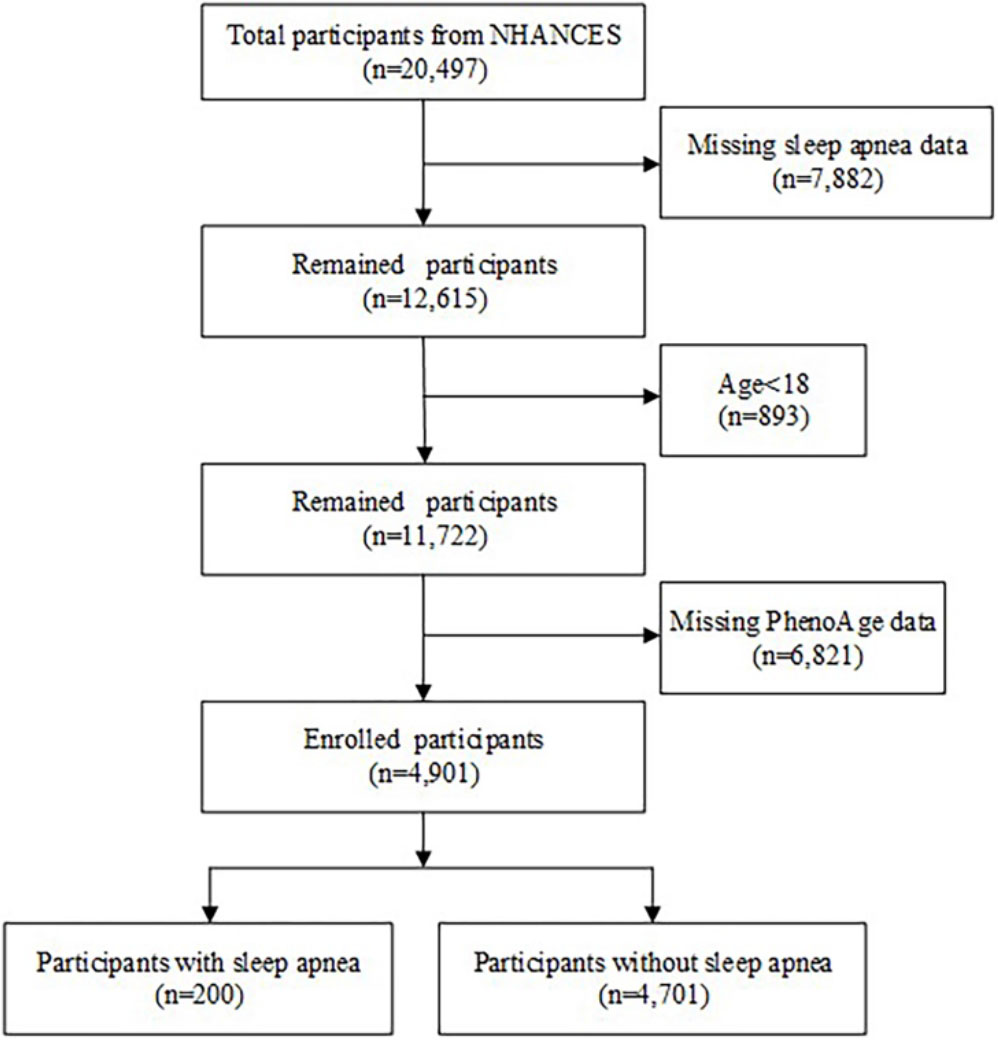
Figure 1.
Participant selection flowchart from the NHANES database.
A total of 20,497 initial participants were assessed for eligibility. Participants were excluded sequentially due to: (1) missing sleep apnea data (n=7,882); (2) age under 18 years (n=893); and (3) missing PhenoAge data (n=6,821). The final analytical cohort consisted of 4,901 participants, who were stratified into sleep apnea (n=200) and non-sleep apnea (n=4,701) groups for subsequent analysis.
Abbreviations: NHANES, National Health and Nutrition Examination Survey; PhenoAge, Phenotypic Age
Table 1
Baseline Characteristics of the Study Participants by Sleep Apnea Status.
| Overall (n=4901) | SA-group (n=200) | NSA-group (n=4701) | P-value | |
|---|---|---|---|---|
| Demographic characteristics | ||||
| Age (years) | 47.0(31.0–64.0) | 55.0(42.3–66.0) | 46.0(31.0–63.0) | <0.001 |
| Gender, n(%) | <0.001 | |||
| Male | 2435(49.7) | 129(64.5) | 2306(49.1) | |
| Femal | 2466(50.3) | 71(35.5) | 2395(50.9) | |
| Ethnic, n(%) | <0.001 | |||
| Mexican American | 955(19.5) | 14(7.0) | 941(20.0) | |
| Other Hispanic | 377(7.7) | 12(6.0) | 365(7.8) | |
| Non-Hispanic White | 2340(47.7) | 123(61.5) | 2217(47.2) | |
| Non-Hispanic Black | 1035(21.1) | 46(23) | 989(21.0) | |
| Other | 194(4.0) | 5(2.5) | 189(4.0) | |
| PIR, n(%) | 0.012 | |||
| Low level | 1354(29.6) | 52(27.7) | 1302(29.7) | |
| Moderate level | 1808(39.5) | 60(31.9) | 1748(39.8) | |
| High level | 1413(30.9) | 76(40.4) | 1337(30.5) | |
| Education, n(%) | 0.012 | |||
| Less than high school | 577(11.8) | 13(6.5) | 564(12.0) | |
| High school or equivalent | 2121(43.3) | 80(40.0) | 2041(43.5) | |
| College or above | 2197(44.9) | 107(53.5) | 2090(44.5) | |
| Smoking status, n(%) | 0.007 | |||
| Current | 1015(22.3) | 45(22.7) | 970(22.2) | |
| Former | 1200(26.3) | 70(35.4) | 1130(25.9) | |
| Never | 2344(51.4) | 83(41.9) | 2261(51.8) | |
| Drinking status, n(%) | 0.025 | |||
| Current | 2743(64.5) | 106(57.9) | 2637(64.8) | |
| Former | 912(21.5) | 54(29.5) | 858(21.1) | |
| Never | 596(14.0) | 23(12.6) | 573(14.1) | |
| Body measurement indicators | ||||
| Weight (kg) | 78.6 (66.9–92.3) | 101.4 (90.0–116.7) | 77.9 (66.4–91.0) | <0.001 |
| BMI (kg/m2) | 27.8(24.3–32.1) | 34.6(30.4–39.5) | 27.6(24.1–31.7) | <0.001 |
| BMI group, n(%) | <0.001 | |||
| Underweight/normal | 1123(23.3) | 6(3.1) | 1117(24.1) | |
| Overweight | 1360(28.2) | 18(9.4) | 1342(29) | |
| Obese | 2335(48.5) | 167(87.4) | 2168(46.9) | |
| WC (cm) | 97.4(87.2–107.8) | 114.8(106.0–125.6) | 96.8(86.9–107.0) | <0.001 |
| Dietary and exercise indicators | ||||
| Energy (kcal/d) | 1918(1458–2478) | 2078(1506–2808) | 1914(1456–2472) | 0.027 |
| Protein (gm/d) | 74.3(55.1–97.8) | 78.0(58.2–111.1) | 74.2(54.9–97.2) | 0.008 |
| Carbohydrate (gm/d) | 233.6(175.3–307.5) | 240.7(175.0–310.1) | 233.2(175.3–307.4) | 0.424 |
| Fat (gm/d) | 70.2(50.1–96.8) | 82.1(57.8–115.5) | 69.8(49.8–95.9) | <0.001 |
| PA, n(%) | 0.385 | |||
| High-intensive | 1108(22.9) | 42(21.2) | 1066(22.9) | |
| Moderate-intensive | 1423(29.4) | 52(26.3) | 1371(29.5) | |
| Low-intensive | 2314(47.8) | 104(52.5) | 2210(47.6) | |
| Metabolic indicators | ||||
| SBP (mmHg) | 120.0(110.7–132.0) | 124.0(113.5–136) | 120.0(110.7–132.0) | 0.006 |
| DBP (mmHg) | 68.7(60.7–76.0) | 72.0(63.5–78.7) | 68.7(60.7–76.0) | 0.002 |
| MAP (mmHg) | 85.8(78.9–93.6) | 88.8(82.3–96.0) | 85.6(78.7–93.3) | <0.001 |
| UA (umol/L) | 321.2(261.7–380.7) | 356.9(315.2–416.4) | 321.2(261.7–374.7) | <0.001 |
| TG (mmol/L) | 1.28(0.88–1.90) | 1.47(1.01–2.09) | 1.26(0.87–1.89) | <0.001 |
| TC (mmol/L) | 4.97(4.27–5.72) | 4.76(4.19–5.40) | 4.97(4.28–5.74) | 0.005 |
| HDL-C (mmol/L) | 1.34(1.11–1.63) | 1.19(1.03–1.45) | 1.34(1.11–1.63) | <0.001 |
| LDL-C (mmol/L) | 2.87(2.30–3.52) | 2.81(2.22–3.37) | 2.87(2.30–3.52) | 0.086 |
| FPG (mmol/L) | 5.55(5.11–6.11) | 5.80(5.33–6.76) | 5.50(5.11–6.05) | <0.001 |
| HbA1C (%) | 5.4(5.1–5.8) | 5.8(5.3–6.4) | 5.4(5.1–5.8) | <0.001 |
| HOME-IR | 2.06(1.22–3.63) | 3.44(1.95–7.00) | 2.01(1.21–3.54) | <0.001 |
| TyG index | 7.29(6.87–7.73) | 7.49(7.05–8.00) | 7.28(6.86–7.72) | <0.001 |
| UHR | 0.103(0.076–0.139) | 0.128(0.100–0.166) | 0.102(0.075–0.137) | <0.001 |
| Inflammatory indicators | ||||
| CRP (mg/L) | 2.1(0.9–5.1) | 3.3(1.4–7.8) | 2.0(0.9–5.0) | <0.001 |
| NLR | 1.95(1.44–2.64) | 2.17(1.58–2.73) | 1.95(1.44–2.63) | 0.021 |
| MLR | 0.26(0.21–0.33) | 0.28(0.21–0.37) | 0.26(0.21–0.33) | 0.095 |
| SII | 509.8(361.6–730.2) | 533.1(379.8–716.1) | 508.4(360.0–731.7) | 0.450 |
| SIRI | 1.01(0.68–1.49) | 1.15(0.79–1.55) | 1.00(0.68–1.49) | 0.008 |
| Biological age | ||||
| PhenoAge (years) | 43.9(27.8–61.7) | 54.5(42.8–68.9) | 43.2(27.4–61.2) | <0.001 |
| PhenoAgeAccel (years) | −1.28(−4.77–2.97) | 1.54(−2.90–6.43) | −1.37(−4.82–2.82) | <0.001 |
[i] Data are presented as median (interquartile range) for continuous variables and number (%) for categorical variables. Group comparisons were made using the Mann-Whitney U test (continuous variables) or the chi-square test (categorical variables).
[ii] Abbreviations: SA, sleep apnea; NSA, non-sleep apnea; WC, waist circumference; PA, physical activity; MAP, mean arterial pressure; UA, uric acid; TG, triglyceride; HDL-C, high-density lipoprotein cholesterol; LDL-C, low-density lipoprotein cholesterol; FPG, fasting plasma glucose; FINS, fasting insulin; HbA1c, glycated hemoglobin; HOMA-IR, homeostasis model assessment of insulin resistance; TyG index, triglyceride-glucose index; CRP, C-reactive protein; NLR, neutrophil-to-lymphocyte ratio; MLR, monocyte-to-lymphocyte ratio; SII, systemic immune-inflammation index; SIRI, systemic inflammation response index; UHR, uric acid to HDL-C ratio; γ-GGT, gamma-glutamyl transferase.
[iii] Measurement and calculation notes: Blood pressure values (SBP and DBP) represent the average of at least three measurements. The following indices were calculated as shown: MAP=DBP + 1/3(SBP - DBP); NLR = neutrophil count / lymphocyte count; MLR = monocyte count / lymphocyte count; SII = (neutrophil count × platelet count) / lymphocyte count; SIRI = (neutrophil count × monocyte count) / lymphocyte count; HOMA-IR = [FPG (mmol/L) × FINS (μU/mL)] / 22.5; TyG = Ln[TG (mg/dL) × FPG (mg/dL) / 2.
Table 2
Associations of PhenoAge with Sleep Apnea.
| Variable / Analysis | Crude Model | Model 1 | Model 2 |
|---|---|---|---|
| PhenoAge, year | |||
| OR (95% CI) | 1.00(1.00–1.00) | 1.04(1.02–1.06) | 1.03(1.01–1.04) |
| P-value | <0.001 | <0.001 | 0.002 |
| PhenoAge,by quartiles | |||
| Q1 (Lowest) (n=1226) | 1.00 (Ref.) | 1.00 (Ref.) | 1.00 (Ref.) |
| Q2(n=1225) | |||
| OR (95% CI) | 1.02(1.01–1.04) | 4.02(2.11–7.67) | 2.30(1.19–4.47) |
| P-value | 0.016 | <0.001 | 0.004 |
| Q3(n=1225) | |||
| OR (95% CI) | 1.04(1.03–1.06) | 9.52(4.44–20.47) | 4.00(1.79–8.93) |
| P-value | <0.001 | <0.001 | <0.001 |
| Q4 (Highest) (n=1225) | |||
| OR (95% CI) | 1.05(1.04–1.07) | 17.15(6.53–45.06) | 5.84(2.10–16.22) |
| P-value | <0.001 | <0.001 | <0.001 |
[i] Model adjustments: Crude Model: Unadjusted; Model 1: Age, sex, race/ethnicity, educational attainment, poverty-to-income ratio; Model 2: Model 1 + physical activity, drinking status, smoking status, body mass index, total energy intake.
[iii] Note: Phenotypic Age (PhenoAge) was analyzed both as a continuous variable (per 1-year increase) and by quartiles (Q1-Q4), with the lowest quartile (Q1) as reference. Data are presented as regression coefficient (β), odds ratio (OR) with 95% confidence interval (CI), and P value. All estimates were obtained from logistic regression analyses.
Table 3
Association Between PhenoAgeAccel and Sleep Apnea
| Variable / Analysis | Crude Model | Model 1 | Model 2 |
|---|---|---|---|
| PhenoAgeAccel, year | |||
| OR (95% CI) | 1.00(1.00–1.00) | 1.04(1.02–1.06) | 1.03(1.01–1.05) |
| P-value <0.001 | <0.001 | <0.001 | 0.004 |
| PhenoAgeAccel, by category | |||
| EQ (n=1249) | 1.00 (Ref.) | 1.00 (Ref.) | 1.00 (Ref.) |
| AC-1 (n=554) | |||
| OR (95% CI) | 1.01(0.99–1.03) | 1.38(0.84–2.27) | 1.39(0.84–2.31) |
| P-value | 0.316 | 0.206 | 0.202 |
| AC-2 (n=884) | |||
| OR (95% CI) | 1.04(1.02–1.06) | 2.19(1.47–3.26) | 1.98(1.31–3.00) |
| P-value | <0.001 | <0.001 | 0.001 |
| DC-1(n=1075) | |||
| OR (95% CI) | 1.00(0.98–1.02) | 0.94(0.61–1.46) | 1.77(0.71–1.74) |
| P-value | 0.947 | 0.783 | 0.658 |
| DC-2 (n=1139) | |||
| OR (95% CI) | 0.98(0.97–1.00) | 0.52(0.31–0.86) | 0.80(0.47–1.36) |
| P-value | 0.051 | 0.011 | 0.459 |
[i] Model adjustments: Crude Model: Unadjusted; Model 1: Age, sex, race/ethnicity, educational attainment, poverty-to-income ratio; Model 2: Model 1 + physical activity, drinking status, smoking status, body mass index, total energy intake.
[ii] Abbreviations: AC-1 & 2, acceleration group 1 & 2; CI, confidence interval; DC-1 & 2, deceleration group 1 & 2; EQ, equality group; OR, odds ratio; Ref, reference.
[iii] Note: Phenotypic age acceleration (PhenoAgeAccel) was analyzed as both a continuous variable (per 1-year increase) and a categorical variable with five groups (see Methods for definitions). Data are presented as regression coefficient (β), odds ratio (OR) with 95% CI, and P value. All estimates were derived from logistic regression analyses.
Table 4
Subgroup Analysis of the Associations Between PhenoAge and Sleep Apnea.
| SA Cases / Total N | OR [95%CI] | P-Value | P-Interaction | |
|---|---|---|---|---|
| Overall | 200/4901 | 1.03(1.01–1.04) | 0.002 | - |
| Gender | 0.433 | |||
| Male | 129/2435 | 1.03(1.01–1.06) | 0.006 | |
| Female | 71/2466 | 1.01(0.99–1.04) | 0.307 | |
| Age | 0.001 | |||
| <40 years | 36/1887 | 0.99(0.93–1.05) | 0.705 | |
| ≥40 years | 164/3014 | 1.03(1.01–1.05) | 0.003 | |
| Obesity status | 0.144 | |||
| Non-obese | 26/2518 | 0.99(0.90–1.09) | 0.822 | |
| Obese | 174/2383 | 1.03(1.01–1.05) | 0.003 |
[ii] Note: Obesity status was defined as BMI ≥ 30 kg/m2 (obese) and BMI < 30 kg/m2 (non-obese). ORs and 95% CIs are from Model 2, adjusted for age, gender, race, education, poverty-income ratio, physical activity, drinking, smoking, BMI, and total energy intake. The P for interaction was obtained by adding an interaction term (PhenoAge × subgroup variable) to Model 2.
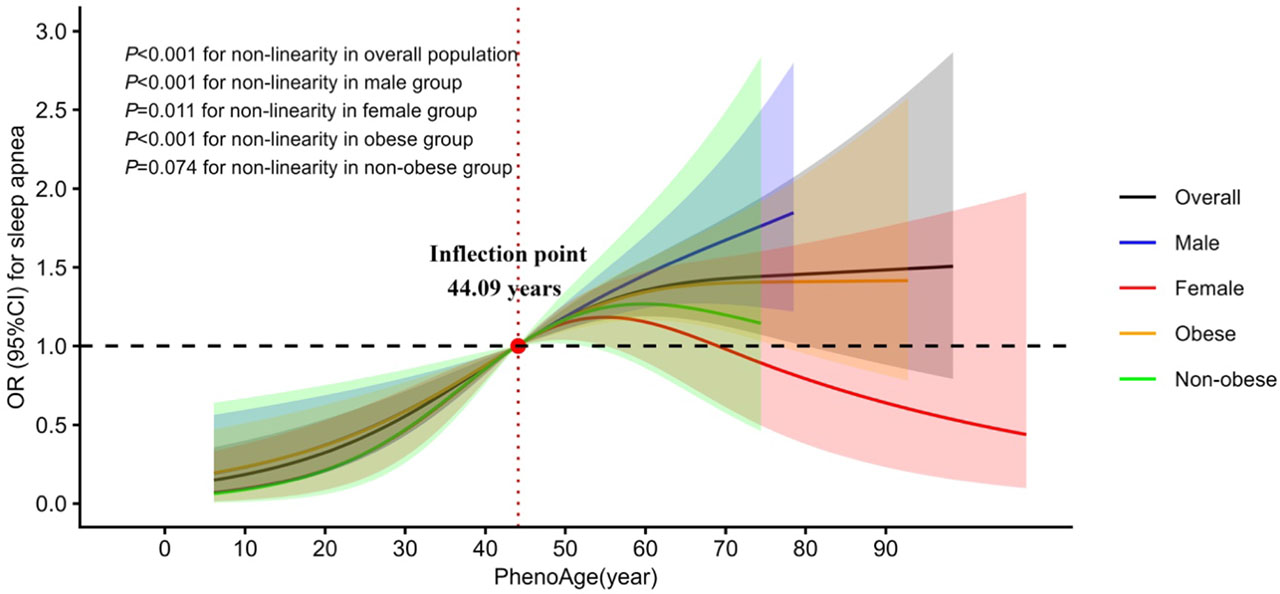
Figure 2.
Nonlinear Dose-Response Associations of Phenotypic Age with Sleep Apnea Risk: Overall and Subgroup Analyses.
The restricted cubic spline analysis revealed a significant nonlinear association between PhenoAge and sleep apnea risk in the overall population in model 2 (P for nonlinearity < 0.001). A consistent inflection point was observed at a PhenoAge of 44.09 years (vertical dashed line) in the overall population, male, female, and obese subgroups (all P for nonlinearity < 0.05). In the non-obese subgroup, the association did not reach statistical significance for nonlinearity (P = 0.074), although a similar inflection pattern was visually apparent. Solid lines represent odds ratios, and shaded areas represent 95% confidence intervals. Black represents the overall population, blue represents males, red represents females, yellow represents the obese group, and green represents the non-obese group.
Table 5.
Segmented Logistic Regression Analysis of the Association Between PhenoAge and Sleep Apnea (SA) Risk.
| Group | SA Cases / Total N | OR (95% CI) | P-value |
|---|---|---|---|
| Overall population | |||
| Low PhenoAge | 57/2459 | 0.99(0.93–1.05) | 0.705 |
| High PhenoAge | 143/2442 | 1.03(1.01–1.05) | 0.003 |
| Male | |||
| Low PhenoAge | 37/1193 | 0.99(0.90–1.09) | 0.816 |
| High PhenoAge | 92/1242 | 1.03(1.01–1.06) | 0.009 |
| Female | |||
| Low PhenoAge | 20/1266 | 1.09(0.99–1.21) | 0.079 |
| High PhenoAge | 51/1200 | 1.00(0.97–1.03) | 0.944 |
| Obese | |||
| Low PhenoAge | 47/1048 | 1.06(0.98–1.14) | 0.171 |
| High PhenoAge | 127/1335 | 1.02(1.00–1.04) | 0.025 |
| Non-obese | |||
| Low PhenoAge | 10/1411 | 0.97(0.81–1.15) | 0.700 |
| High PhenoAge | 16/1107 | 1.01(0.93–1.09) | 0.824 |
[i] This table summarizes logistic regression results (Model 2) assessing the association between PhenoAge (low: <44.09 years vs. high: ≥44.09 years, based on the inflection point) and sleep apnea (SA). Values represent SA case counts/total participants, odds ratios (ORs) with 95% confidence intervals (CIs), and P values for the overall population and for strata defined by sex and obesity status.
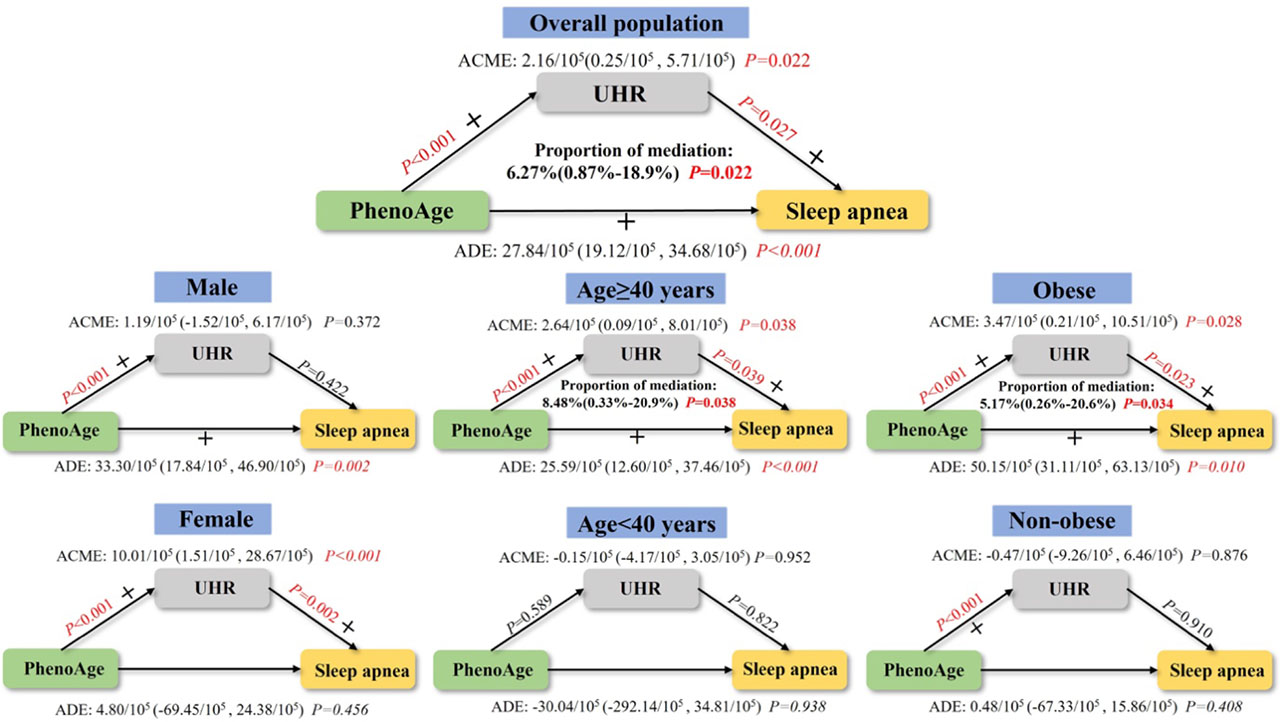
Figure 3.
Mediation analysis of the effect of PhenoAge on sleep apnea risk through UHR (Model 2).
This analysis used Model 2, with PhenoAge as the predictor (X), the uric acid-to-high-density lipoprotein cholesterol ratio (UHR) as the mediator (M), and sleep apnea risk as the outcome (Y). Based on bootstrap analysis, the figure presents point estimates and 95% confidence intervals for the average causal mediation effect (ACME, or indirect effect) and the average direct effect (ADE). The proportion mediated is reported where both ACME and ADE were statistically significant. Results are displayed for the overall population and stratified by sex (male, female), age (<40 / ≥40 years), and obesity status (obese, non-obese). A plus sign (+) denotes a positive path coefficient.
| Abbreviation | Full Term |
|---|---|
| AC-1 & 2 | Acceleration Group-1 & 2 |
| ACME | Average Causal Mediation Effect |
| ADE | Average Direct Effect |
| BMI | Body Mass Index |
| CAPI | Computer-Assisted Personal Interview |
| CI | Confidence Interval |
| CIH | Chronic Intermittent Hypoxia |
| CRP | C-Reactive Protein |
| DBP | Diastolic Blood Pressure |
| DC-1 & 2 | Deceleration Group-1 & 2 |
| EQ Group | Equality Group |
| FPG | Fasting Plasma Glucose |
| HbA1c | Glycated Hemoglobin |
| HDL-C | High-Density Lipoprotein Cholesterol |
| HOMA-IR | Homeostatic Model Assessment of Insulin Resistance |
| IQR | Interquartile Range |
| IR | Insulin Resistance |
| LDL-C | Low-Density Lipoprotein Cholesterol |
| MAP | Mean Arterial Pressure |
| MET | Metabolic Equivalent Task |
| MICE | Multiple Imputation by Chained Equations |
| MLR | Monocyte-to-Lymphocyte Ratio |
| NHANES | National Health and Nutrition Examination Survey |
| NLR | Neutrophil-to-Lymphocyte Ratio |
| NSA | Non-Sleep Apnea |
| OR | Odds Ratio |
| OSA | Obstructive Sleep Apnea |
| PA | Physical Activity |
| PhenoAge | Phenotypic Age |
| PhenoAgeAccel | Phenotypic Age Acceleration |
| PIR | Poverty-to-Income Ratio |
| Q1-Q4 | First, Second, Third, Fourth Quartile |
| RCS | Restricted Cubic Spline |
| SA | Sleep Apnea |
| SBP | Systolic Blood Pressure |
| SII | Systemic Immune-Inflammation Index |
| SIRI | Systemic Inflammation Response Index |
| TC | Total Cholesterol |
| TG | Triglycerides |
| TyG index | Triglyceride-Glucose index |
| UA | Uric Acid |
| UHR | Uric Acid to High-Density Lipoprotein Cholesterol Ratio |