
What is new and important?
This cross-sectional study identifies a nonlinear association between phenotypic aging (PhenoAge) and sleep apnea, with a statistically derived inflection point at 44.09 years. The association is dose-dependent, primarily evident in adults ≥40 years, and was only modestly linked to metabolic-oxidative dysfunction. These findings position PhenoAge as a novel correlate for understanding risk heterogeneity in OSA, warranting prospective validation.
1. INTRODUCTION
Obstructive sleep apnea (OSA) is a prevalent respiratory disorder characterized by recurrent episodes of upper airway collapse during sleep, leading to sleep fragmentation and intermittent hypoxia. It poses a significant public health burden, with an estimated global prevalence of approximately 22.5% in women and 27.3% in men[1][2]. OSA is a well-established risk factor for a spectrum of cardiometabolic and neurodegenerative diseases, including stroke, depression, and cancer[3][4][5][6][7].The pathogenesis of OSA is multifactorial, involving both anatomical predispositions (e.g., abnormalities in maxillofacial structure, fat deposition in the neck, nocturnal rostral fluid shift especially in patients with cardiac or renal failure) and functional impairments (e.g., low respiratory arousal threshold, diminished upper airway muscle tone, unstable ventilatory chemoreflex control) that collectively contribute to upper airway stenosis and collapse[8].
While chronological age is a primary risk factor for OSA, considerable heterogeneity in disease susceptibility exists among individuals of the same age. This variation is better captured by the concept of biological age, which reflects the progressive functional decline of organ systems. Among various quantification methods, Phenotypic Age (PhenoAge) was selected for this study due to its unique balance of predictive accuracy for mortality/morbidity, clinical translatability (derived from routine blood biomarkers), and the actionable nature of its components, making it ideal for large-scale epidemiological research[9][10]. Although evidence suggests that OSA may accelerate biological aging [11], the reverse causality—whether accelerated biological aging acts as a causal risk factor for OSA incidence—remains poorly understood and constitutes a significant knowledge gap.
Accelerated aging is characterized by several interconnected pathophysiological alterations, including chronic low-grade inflammation (“inflammaging”)[12][13], oxidative stress[14][15], insulin resistance (IR)[16][17][18], and adipose tissue remodeling[19][20][21]. Crucially, these hallmarks of aging can adversely affect upper airway structure and neuromuscular control, thereby providing plausible biological pathways linking accelerated aging to OSA pathogenesis[8].
We propose that metabolic dysregulation serves as a central hub integrating these aging-related pathways. The uric acid to high-density lipoprotein cholesterol ratio (UHR) emerges as a novel, integrative biomarker of such dysregulation. UHR uniquely captures the imbalance between pro-oxidant/pro-inflammatory processes (represented by uric acid, a product of xanthine oxidase activity) and anti-atherogenic/anti-inflammatory defenses (mediated by high-density lipoprotein cholesterol) [22][23]. Clinically, elevated UHR is strongly associated with metabolic syndrome[24], IR[25], and visceral adiposity[26]—conditions that are not only hallmarks of accelerated aging but also key risk factors for OSA.
Therefore, we hypothesize that UHR acts as a pivotal metabolic mediator, bridging the gap between accelerated biological aging (quantified by PhenoAge) and increased OSA risk. To test this hypothesis, we conducted an analysis using data from the National Health and Nutrition Examination Survey (NHANES) with the following aims: (1) to investigate the association between PhenoAge and OSA risk, and (2) to formally evaluate the potential mediating role of UHR in this relationship. Elucidating this pathway may identify UHR as a modifiable target for interventions aimed at mitigating OSA risk in individuals exhibiting accelerated aging.
2. MATERIAL AND METHODS
2.1. Study Population and Data Source
This cross-sectional study utilized data from the 2005–2008 cycles of the NHANES. Initially, 20,497 participants were available. After sequentially applying the following exclusion criteria, the final analytic sample was derived: (1) age < 18 years (n = 893); (2) missing data on sleep apnea status (n = 7,882); (3) missing data required for calculating biological age (n = 6,821). Consequently, 4,901 adults with complete data on both sleep apnea and biological age were included in the final analysis. Based on the sleep apnea status, participants were categorized into two groups: the sleep apnea group (SA-group, n = 200) and the non-sleep apnea group (NSA-group, n = 4,701). The detailed participant selection flowchart is illustrated in Figure 1.
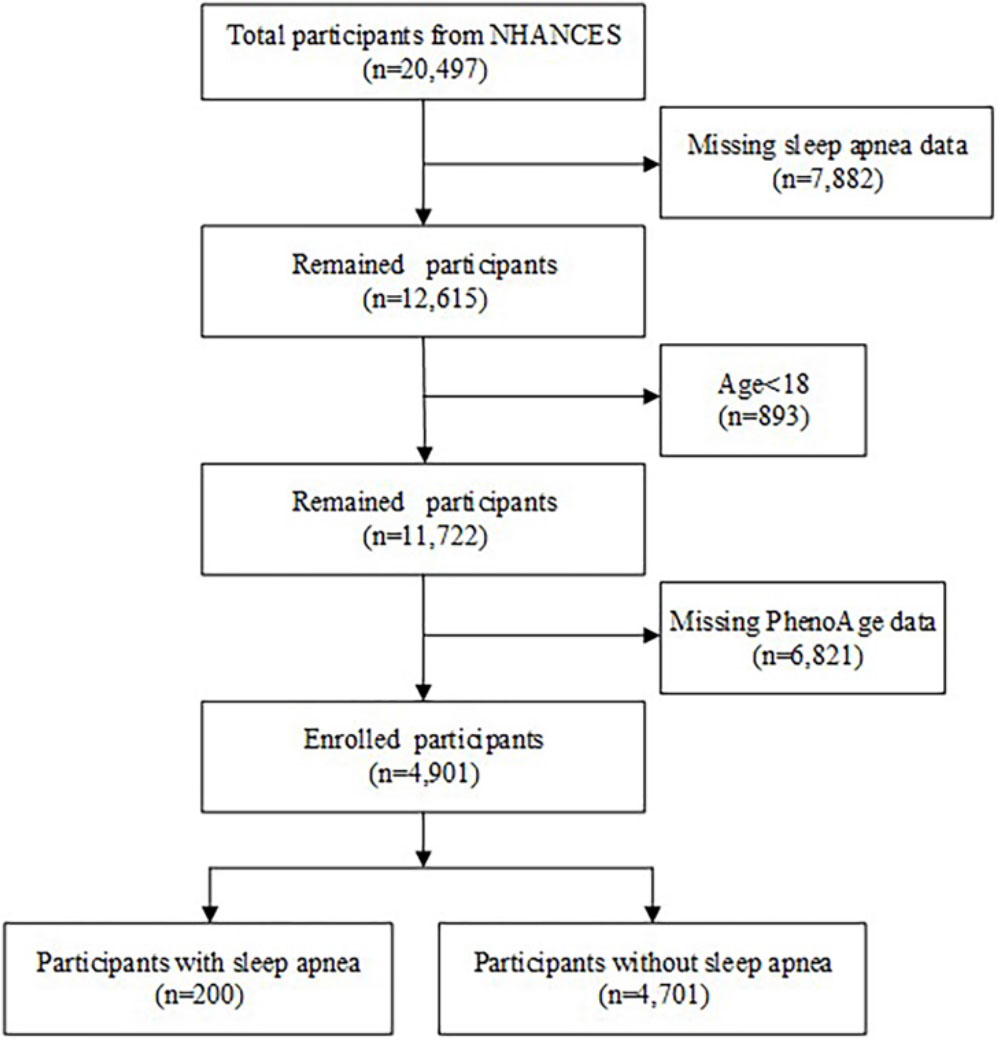
Figure 1.
Participant selection flowchart from the NHANES database.
A total of 20,497 initial participants were assessed for eligibility. Participants were excluded sequentially due to: (1) missing sleep apnea data (n=7,882); (2) age under 18 years (n=893); and (3) missing PhenoAge data (n=6,821). The final analytical cohort consisted of 4,901 participants, who were stratified into sleep apnea (n=200) and non-sleep apnea (n=4,701) groups for subsequent analysis.
Abbreviations: NHANES, National Health and Nutrition Examination Survey; PhenoAge, Phenotypic Age
All NHANES protocols were approved by the Ethics Review Board of the National Center for Health Statistics, and written informed consent was obtained from all participants. Data on sociodemographic characteristics, lifestyle factors, anthropometric measures, and laboratory parameters were collected through structured interviews, self-administered questionnaires, standardized physical examinations, and laboratory tests at mobile examination centers.
Specifically, the baseline metabolic and inflammatory indicators included in this analysis comprised the following: Metabolic indicators: systolic blood pressure (SBP), diastolic blood pressure (DBP), mean arterial pressure (MAP), triglycerides (TG), high-density lipoprotein cholesterol (HDL-C), low-density lipoprotein cholesterol (LDL-C), total cholesterol (TC), serum uric acid (UA), fasting plasma glucose (FPG), glycated hemoglobin (HbA1c), triglyceride-glucose index (TyG index), and homeostatic model assessment of insulin resistance (HOMA-IR).Inflammatory indicators: C-reactive protein (CRP), neutrophil-tolymphocyte ratio (NLR), monocyte-to-lymphocyte ratio (MLR), systemic immune-inflammation index (SII), and systemic inflammation response index (SIRI). For detailed measurement and calculation methods, see the notes to Table 1.
Table 1
Baseline Characteristics of the Study Participants by Sleep Apnea Status.
| Overall (n=4901) | SA-group (n=200) | NSA-group (n=4701) | P-value | |
|---|---|---|---|---|
| Demographic characteristics | ||||
| Age (years) | 47.0(31.0–64.0) | 55.0(42.3–66.0) | 46.0(31.0–63.0) | <0.001 |
| Gender, n(%) | <0.001 | |||
| Male | 2435(49.7) | 129(64.5) | 2306(49.1) | |
| Femal | 2466(50.3) | 71(35.5) | 2395(50.9) | |
| Ethnic, n(%) | <0.001 | |||
| Mexican American | 955(19.5) | 14(7.0) | 941(20.0) | |
| Other Hispanic | 377(7.7) | 12(6.0) | 365(7.8) | |
| Non-Hispanic White | 2340(47.7) | 123(61.5) | 2217(47.2) | |
| Non-Hispanic Black | 1035(21.1) | 46(23) | 989(21.0) | |
| Other | 194(4.0) | 5(2.5) | 189(4.0) | |
| PIR, n(%) | 0.012 | |||
| Low level | 1354(29.6) | 52(27.7) | 1302(29.7) | |
| Moderate level | 1808(39.5) | 60(31.9) | 1748(39.8) | |
| High level | 1413(30.9) | 76(40.4) | 1337(30.5) | |
| Education, n(%) | 0.012 | |||
| Less than high school | 577(11.8) | 13(6.5) | 564(12.0) | |
| High school or equivalent | 2121(43.3) | 80(40.0) | 2041(43.5) | |
| College or above | 2197(44.9) | 107(53.5) | 2090(44.5) | |
| Smoking status, n(%) | 0.007 | |||
| Current | 1015(22.3) | 45(22.7) | 970(22.2) | |
| Former | 1200(26.3) | 70(35.4) | 1130(25.9) | |
| Never | 2344(51.4) | 83(41.9) | 2261(51.8) | |
| Drinking status, n(%) | 0.025 | |||
| Current | 2743(64.5) | 106(57.9) | 2637(64.8) | |
| Former | 912(21.5) | 54(29.5) | 858(21.1) | |
| Never | 596(14.0) | 23(12.6) | 573(14.1) | |
| Body measurement indicators | ||||
| Weight (kg) | 78.6 (66.9–92.3) | 101.4 (90.0–116.7) | 77.9 (66.4–91.0) | <0.001 |
| BMI (kg/m2) | 27.8(24.3–32.1) | 34.6(30.4–39.5) | 27.6(24.1–31.7) | <0.001 |
| BMI group, n(%) | <0.001 | |||
| Underweight/normal | 1123(23.3) | 6(3.1) | 1117(24.1) | |
| Overweight | 1360(28.2) | 18(9.4) | 1342(29) | |
| Obese | 2335(48.5) | 167(87.4) | 2168(46.9) | |
| WC (cm) | 97.4(87.2–107.8) | 114.8(106.0–125.6) | 96.8(86.9–107.0) | <0.001 |
| Dietary and exercise indicators | ||||
| Energy (kcal/d) | 1918(1458–2478) | 2078(1506–2808) | 1914(1456–2472) | 0.027 |
| Protein (gm/d) | 74.3(55.1–97.8) | 78.0(58.2–111.1) | 74.2(54.9–97.2) | 0.008 |
| Carbohydrate (gm/d) | 233.6(175.3–307.5) | 240.7(175.0–310.1) | 233.2(175.3–307.4) | 0.424 |
| Fat (gm/d) | 70.2(50.1–96.8) | 82.1(57.8–115.5) | 69.8(49.8–95.9) | <0.001 |
| PA, n(%) | 0.385 | |||
| High-intensive | 1108(22.9) | 42(21.2) | 1066(22.9) | |
| Moderate-intensive | 1423(29.4) | 52(26.3) | 1371(29.5) | |
| Low-intensive | 2314(47.8) | 104(52.5) | 2210(47.6) | |
| Metabolic indicators | ||||
| SBP (mmHg) | 120.0(110.7–132.0) | 124.0(113.5–136) | 120.0(110.7–132.0) | 0.006 |
| DBP (mmHg) | 68.7(60.7–76.0) | 72.0(63.5–78.7) | 68.7(60.7–76.0) | 0.002 |
| MAP (mmHg) | 85.8(78.9–93.6) | 88.8(82.3–96.0) | 85.6(78.7–93.3) | <0.001 |
| UA (umol/L) | 321.2(261.7–380.7) | 356.9(315.2–416.4) | 321.2(261.7–374.7) | <0.001 |
| TG (mmol/L) | 1.28(0.88–1.90) | 1.47(1.01–2.09) | 1.26(0.87–1.89) | <0.001 |
| TC (mmol/L) | 4.97(4.27–5.72) | 4.76(4.19–5.40) | 4.97(4.28–5.74) | 0.005 |
| HDL-C (mmol/L) | 1.34(1.11–1.63) | 1.19(1.03–1.45) | 1.34(1.11–1.63) | <0.001 |
| LDL-C (mmol/L) | 2.87(2.30–3.52) | 2.81(2.22–3.37) | 2.87(2.30–3.52) | 0.086 |
| FPG (mmol/L) | 5.55(5.11–6.11) | 5.80(5.33–6.76) | 5.50(5.11–6.05) | <0.001 |
| HbA1C (%) | 5.4(5.1–5.8) | 5.8(5.3–6.4) | 5.4(5.1–5.8) | <0.001 |
| HOME-IR | 2.06(1.22–3.63) | 3.44(1.95–7.00) | 2.01(1.21–3.54) | <0.001 |
| TyG index | 7.29(6.87–7.73) | 7.49(7.05–8.00) | 7.28(6.86–7.72) | <0.001 |
| UHR | 0.103(0.076–0.139) | 0.128(0.100–0.166) | 0.102(0.075–0.137) | <0.001 |
| Inflammatory indicators | ||||
| CRP (mg/L) | 2.1(0.9–5.1) | 3.3(1.4–7.8) | 2.0(0.9–5.0) | <0.001 |
| NLR | 1.95(1.44–2.64) | 2.17(1.58–2.73) | 1.95(1.44–2.63) | 0.021 |
| MLR | 0.26(0.21–0.33) | 0.28(0.21–0.37) | 0.26(0.21–0.33) | 0.095 |
| SII | 509.8(361.6–730.2) | 533.1(379.8–716.1) | 508.4(360.0–731.7) | 0.450 |
| SIRI | 1.01(0.68–1.49) | 1.15(0.79–1.55) | 1.00(0.68–1.49) | 0.008 |
| Biological age | ||||
| PhenoAge (years) | 43.9(27.8–61.7) | 54.5(42.8–68.9) | 43.2(27.4–61.2) | <0.001 |
| PhenoAgeAccel (years) | −1.28(−4.77–2.97) | 1.54(−2.90–6.43) | −1.37(−4.82–2.82) | <0.001 |
[i] Data are presented as median (interquartile range) for continuous variables and number (%) for categorical variables. Group comparisons were made using the Mann-Whitney U test (continuous variables) or the chi-square test (categorical variables).
[ii] Abbreviations: SA, sleep apnea; NSA, non-sleep apnea; WC, waist circumference; PA, physical activity; MAP, mean arterial pressure; UA, uric acid; TG, triglyceride; HDL-C, high-density lipoprotein cholesterol; LDL-C, low-density lipoprotein cholesterol; FPG, fasting plasma glucose; FINS, fasting insulin; HbA1c, glycated hemoglobin; HOMA-IR, homeostasis model assessment of insulin resistance; TyG index, triglyceride-glucose index; CRP, C-reactive protein; NLR, neutrophil-to-lymphocyte ratio; MLR, monocyte-to-lymphocyte ratio; SII, systemic immune-inflammation index; SIRI, systemic inflammation response index; UHR, uric acid to HDL-C ratio; γ-GGT, gamma-glutamyl transferase.
[iii] Measurement and calculation notes: Blood pressure values (SBP and DBP) represent the average of at least three measurements. The following indices were calculated as shown: MAP=DBP + 1/3(SBP - DBP); NLR = neutrophil count / lymphocyte count; MLR = monocyte count / lymphocyte count; SII = (neutrophil count × platelet count) / lymphocyte count; SIRI = (neutrophil count × monocyte count) / lymphocyte count; HOMA-IR = [FPG (mmol/L) × FINS (μU/mL)] / 22.5; TyG = Ln[TG (mg/dL) × FPG (mg/dL) / 2.
2.2. Assessment of Sleep Apnea
Sleep apnea status was assessed based on self-reported physician diagnosis collected through the Computer-Assisted Personal Interview (CAPI) system. Participants were first asked: “Have you ever been told by a doctor or other health professional that you have a sleep disorder?” Those who answered “yes” were then asked, “What type of sleep disorder was it?” Those who reported “sleep apnea” were classified as having sleep apnea; all others were classified as not having sleep apnea.
2.3. Assessment of Biological Age
The primary exposure variables in this study were biological aging, operationalized by PhenoAge and its derivative measure, Phenotypic Age Acceleration (PhenoAgeAccel).
2.3.1. Calculation of PhenoAge
PhenoAge was developed based on a multivariate analysis of mortality hazards and aims to predict an individual’s functional age using a panel of nine clinical biomarkers in conjunction with chronological age. The algorithm incorporates the following ten variables: chronological age, albumin, alkaline phosphatase, creatinine, glucose, high-sensitivity C-reactive protein (CRP), lymphocyte percentage, mean corpuscular volume, red blood cell distribution width, and white blood cell count. PhenoAge was calculated according to the published algorithm [10], as follows:
2.3.2. Calculation and Categorization of PhenoAgeAccel
To isolate the component of biological aging that is independent of chronological age, we calculated PhenoAgeAccel. Consistent with standard practice, we fitted a linear regression model of PhenoAge on chronological age, adjusted for the covariates sex and race, and extracted the residuals as PhenoAgeAccel. A positive PhenoAgeAccel indicates that an individual’s biological age is higher than their chronological age, signifying accelerated aging[27].
For categorical analysis, PhenoAgeAccel was further categorized into five mutually exclusive groups based on clinically and biologically relevant thresholds:
Equality Group (EQ): Participants with |PhenoAgeAccel| ≤ 2 years, indicating a biological age closely aligned with chronological age.
Acceleration Group-1 (AC-1): Participants with PhenoAgeAccel > 2 and ≤ 5 years, indicating mild-to-moderate acceleration of biological aging.
Acceleration Group-2 (AC-2): Participants with PhenoAgeAccel ≥ 5 years, indicating pronounced acceleration of biological aging.
Deceleration Group-1 (DC-1): Participants with PhenoAgeAccel < −2 and ≥ −5 years, indicating mild-to-moderate deceleration of biological aging.
Deceleration Group-2 (DC-2): Participants with PhenoAgeAccel < −5 years, indicating pronounced deceleration of biological aging.
The EQ served as the reference category in subsequent categorical analyses.
2.4. Calculation of UHR
The UHR was derived from fasting serum samples and served as the mediator in the analysis. Serum UA concentration was measured using the timed endpoint method, and HDL-C was measured by direct immunoassay or precipitation methods. UHR was calculated using the following formula:
2.5. Covariates
Based on previous literature and expert clinical opinions, the following potential covariates were included: age; sex (male, female); race/ethnicity (Mexican American, Other Hispanic, Non-Hispanic White, Non-Hispanic Black, Other); educational attainment (less than high school, high school or equivalent, college or above); poverty-to-income ratio (PIR, low, moderate, high); body mass index (BMI, underweight/normal, overweight, obese); smoking status (never, former, current), drinking status (never, former, current); physical activity level (PA level, high, moderate, low), total energy intake.
Covariates were defined as follows: PIR was calculated as total family income divided by the federal poverty threshold, and categorized into three levels: low (<1.3), moderate (1.3–3.49), and high (≥3.5). BMI was calculated as weight (kg) / height (m)2 and categorized as underweight/normal (<25 kg/m2), overweight (25–29.9 kg/m2), and obese (≥30 kg/m2). Smoking status was defined as: never smoker (<100 cigarettes in lifetime); former smoker (≥100 cigarettes in lifetime but not current); and current smoker (≥100 cigarettes in lifetime and currently smoking). Drinking status was defined as: never drinker (<12 alcoholic drinks in lifetime); former drinker (≥12 drinks in lifetime but not current); and current drinker (≥12 drinks in lifetime and currently drinking). PA was quantified as weekly metabolic equivalent task (MET)-minutes according to WHO guidelines, using activity-specific MET values from NHANES. Total weekly PA volume was calculated as: MET-min/week = MET value of the activity × duration (minutes per session) × frequency (sessions per week). Based on this, participants were categorized into three mutually exclusive groups: 1.High-activity group: Participants who met either of the following criteria: (a) Engaged in vigorous-intensity PA on at least 3 days per week, with a total PA volume ≥1500 MET-min/week, or (b)Performed total activity (all intensities combined) on at least 7 days per week, with a total PA volume ≥3000 MET-min/week; 2.Moderate-activity group: Participants who did not meet the high-activity criteria, but met at least one of the following: (a) Engaged in vigorous-intensity PA for ≥20 minutes per session on at least 3 days per week, or (b) Engaged in moderate-intensity PA for ≥30 minutes per session on at least 5 days per week, or (c) Performed total activity (all intensities combined) on at least 5 days per week, with a total PA volume ≥600 MET-min/week; 3. Low-activity group: Participants who did not meet the criteria for either the high- or moderate-activity groups.
2.6. Statistical analysis
All statistical analyses were performed using R software (version 4.5.1; www.R-project.org). Baseline characteristics were summarized as medians with interquartile ranges (IQRs) for continuous variables and as frequencies with percentages for categorical variables. Group comparisons were performed using the Mann-Whitney U test for continuous variables and the chi-square test for categorical variables.
Missing data (affecting education level, PIR, PA, drinking status, smoking status, BMI, and total energy intake, with the proportion of missing values was less than 20% for any variable) were handled using the multiple imputation by chained equations (MICE) method. Five imputed datasets were generated and pooled for analysis according to Rubin’s rules.
Multivariable logistic regression, adjusted for all covariates specified in Model 2 (see Covariate Selection), was employed to assess the associations between sleep apnea status and the biological aging indicators, PhenoAge and PhenoAgeAccel. Both indicators were analyzed as continuous variables and, in categorical analyses. PhenoAge was divided into quartiles (Q1–Q4) and PhenoAgeAccel into five groups (as defined in the Methods section). Stratified analyses by sex, age and obesity status were performed to examine potential effect modifications, with interaction terms formally tested.
Potential nonlinear dose-response relationships, restricted cubic spline (RCS) analyses with 3 knots were applied within the logistic regression framework, examining the association between continuous PhenoAge and sleep apnea risk in the overall population and across prespecified subgroups.
Causal mediation analyses were performed to test our primary mechanistic hypothesis—that the effect of accelerated biological aging on sleep apnea risk is mediated through specific physiological pathways. All models were specified with PhenoAge as the exposure, UHR as the mediator, and sleep apnea status as the outcome, while adjusting for the full set of covariates from Model 2. Using the mediation package in R, we estimated the average direct effect (ADE), average causal mediation effect (ACME, i.e., indirect effect), and total effect based on the counterfactual framework, with 95% confidence intervals derived from quasi-Bayesian Monte Carlo simulations (1,000 iterations). The proportion mediated was calculated as ACME/Total Effect. Analyses were conducted in the overall population and repeated in subgroups stratified by sex and obesity status.
All statistical tests were two-sided, and a P-value < 0.05 was considered statistically significant.
3. RESULTS
3.1. Baseline Characteristics of the Study Participants
A total of 4901 participants aged 18 years and older with complete data on biological age and sleep apnea were included in the final analysis. The baseline characteristics of the study participants are summarized inTable 1. Among the 4901 participants, 200 (4.1%) were identified as having sleep apnea. The median age of the overall cohort was 47years (IQR 31–64), and 2435 (49.7%) were female.
Compared to participants without sleep apnea, those with sleep apnea were significantly older, more likely to be male or obese. They also had higher socioeconomic and educational attainment. In terms of lifestyle and metabolic profile, the sleep apnea group reported higher daily energy and fat intake, exhibited a higher prevalence of features associated with metabolic syndrome (including larger waist circumference, higher mean arterial pressure, elevated triglyceride levels, increased glycated hemoglobin and fasting plasma glucose, lower HDL-C, higher UHR and more severe IR), and showed evidence of more pronounced systemic inflammation (higher CRP, NLR, and SIRI) (P < 0.05 for all comparisons).
Furthermore, participants with sleep apnea had a significantly higher PhenoAge (54.5 vs. 43.2 years; P < 0.001) and a less negative PhenoAgeAccel (1.54 vs. −1.37 years; P < 0.001), indicating accelerated biological aging compared to their counterparts without sleep apnea.
3.2. Association Between Biological Aging and Sleep Apnea: Logistic Regression Analyses
The results of logistic regression analyses assessing the associations of PhenoAge and PhenoAgeAccel with sleep apnea are presented in Table 2&3.
Table 2
Associations of PhenoAge with Sleep Apnea.
| Variable / Analysis | Crude Model | Model 1 | Model 2 |
|---|---|---|---|
| PhenoAge, year | |||
| OR (95% CI) | 1.00(1.00–1.00) | 1.04(1.02–1.06) | 1.03(1.01–1.04) |
| P-value | <0.001 | <0.001 | 0.002 |
| PhenoAge,by quartiles | |||
| Q1 (Lowest) (n=1226) | 1.00 (Ref.) | 1.00 (Ref.) | 1.00 (Ref.) |
| Q2(n=1225) | |||
| OR (95% CI) | 1.02(1.01–1.04) | 4.02(2.11–7.67) | 2.30(1.19–4.47) |
| P-value | 0.016 | <0.001 | 0.004 |
| Q3(n=1225) | |||
| OR (95% CI) | 1.04(1.03–1.06) | 9.52(4.44–20.47) | 4.00(1.79–8.93) |
| P-value | <0.001 | <0.001 | <0.001 |
| Q4 (Highest) (n=1225) | |||
| OR (95% CI) | 1.05(1.04–1.07) | 17.15(6.53–45.06) | 5.84(2.10–16.22) |
| P-value | <0.001 | <0.001 | <0.001 |
[i] Model adjustments: Crude Model: Unadjusted; Model 1: Age, sex, race/ethnicity, educational attainment, poverty-to-income ratio; Model 2: Model 1 + physical activity, drinking status, smoking status, body mass index, total energy intake.
[iii] Note: Phenotypic Age (PhenoAge) was analyzed both as a continuous variable (per 1-year increase) and by quartiles (Q1-Q4), with the lowest quartile (Q1) as reference. Data are presented as regression coefficient (β), odds ratio (OR) with 95% confidence interval (CI), and P value. All estimates were obtained from logistic regression analyses.
Table 3
Association Between PhenoAgeAccel and Sleep Apnea
| Variable / Analysis | Crude Model | Model 1 | Model 2 |
|---|---|---|---|
| PhenoAgeAccel, year | |||
| OR (95% CI) | 1.00(1.00–1.00) | 1.04(1.02–1.06) | 1.03(1.01–1.05) |
| P-value <0.001 | <0.001 | <0.001 | 0.004 |
| PhenoAgeAccel, by category | |||
| EQ (n=1249) | 1.00 (Ref.) | 1.00 (Ref.) | 1.00 (Ref.) |
| AC-1 (n=554) | |||
| OR (95% CI) | 1.01(0.99–1.03) | 1.38(0.84–2.27) | 1.39(0.84–2.31) |
| P-value | 0.316 | 0.206 | 0.202 |
| AC-2 (n=884) | |||
| OR (95% CI) | 1.04(1.02–1.06) | 2.19(1.47–3.26) | 1.98(1.31–3.00) |
| P-value | <0.001 | <0.001 | 0.001 |
| DC-1(n=1075) | |||
| OR (95% CI) | 1.00(0.98–1.02) | 0.94(0.61–1.46) | 1.77(0.71–1.74) |
| P-value | 0.947 | 0.783 | 0.658 |
| DC-2 (n=1139) | |||
| OR (95% CI) | 0.98(0.97–1.00) | 0.52(0.31–0.86) | 0.80(0.47–1.36) |
| P-value | 0.051 | 0.011 | 0.459 |
[i] Model adjustments: Crude Model: Unadjusted; Model 1: Age, sex, race/ethnicity, educational attainment, poverty-to-income ratio; Model 2: Model 1 + physical activity, drinking status, smoking status, body mass index, total energy intake.
[ii] Abbreviations: AC-1 & 2, acceleration group 1 & 2; CI, confidence interval; DC-1 & 2, deceleration group 1 & 2; EQ, equality group; OR, odds ratio; Ref, reference.
[iii] Note: Phenotypic age acceleration (PhenoAgeAccel) was analyzed as both a continuous variable (per 1-year increase) and a categorical variable with five groups (see Methods for definitions). Data are presented as regression coefficient (β), odds ratio (OR) with 95% CI, and P value. All estimates were derived from logistic regression analyses.
In the crude model, both higher PhenoAge and greater PhenoAgeAccel were significantly associated with an increased risk of sleep apnea. After adjustment for age, sex, race/ethnicity, educational level, and PIR (Model 1), these positive associations remained significant. The associations persisted in the fully adjusted model (Model 2), which additionally included PA, drinking status, smoking status, BMI, and total energy intake.
Specifically, in Model 2, each 1-year increase in PhenoAge was associated with a 3% higher risk of sleep apnea (odds ratio [OR] 1.03, 95% confidence interval [CI] 1.01–1.04, P = 0.002). When analyzed by quartiles, participants in the second, third, and fourth quartiles of PhenoAge had incrementally higher risks of sleep apnea compared to those in the first quartile (Q2: OR 2.30, 95% CI 1.19–4.47, P = 0.004; Q3: OR 4.00, 95% CI 1.79–8.93, P < 0.001; Q4: OR 5.84, 95% CI 2.10–16.22, P < 0.001), indicating a dose-response relationship.
Regarding PhenoAgeAccel, the risk of sleep apnea varied across groups compared to the EQ. In the acceleration groups, the AC-2 had a significantly higher risk (OR 1.98, 95% CI 1.31–3.00, P = 0.004), whereas the risk in the AC-1 did not differ significantly (OR 1.39, 95% CI 0.84–2.31, P = 0.202). In the deceleration groups, neither DC-1 nor DC-2 showed a significant difference in risk relative to the EQ.
3.3. Subgroup Analysis of the Association Between PhenoAge and Sleep Apnea
Subgroup analyses were conducted to examine whether the association between PhenoAge and sleep apnea was modified by age, sex, or obesity status, using the fully adjusted model (Model 2). The results are detailed in Table 4.
Table 4
Subgroup Analysis of the Associations Between PhenoAge and Sleep Apnea.
| SA Cases / Total N | OR [95%CI] | P-Value | P-Interaction | |
|---|---|---|---|---|
| Overall | 200/4901 | 1.03(1.01–1.04) | 0.002 | - |
| Gender | 0.433 | |||
| Male | 129/2435 | 1.03(1.01–1.06) | 0.006 | |
| Female | 71/2466 | 1.01(0.99–1.04) | 0.307 | |
| Age | 0.001 | |||
| <40 years | 36/1887 | 0.99(0.93–1.05) | 0.705 | |
| ≥40 years | 164/3014 | 1.03(1.01–1.05) | 0.003 | |
| Obesity status | 0.144 | |||
| Non-obese | 26/2518 | 0.99(0.90–1.09) | 0.822 | |
| Obese | 174/2383 | 1.03(1.01–1.05) | 0.003 |
[ii] Note: Obesity status was defined as BMI ≥ 30 kg/m2 (obese) and BMI < 30 kg/m2 (non-obese). ORs and 95% CIs are from Model 2, adjusted for age, gender, race, education, poverty-income ratio, physical activity, drinking, smoking, BMI, and total energy intake. The P for interaction was obtained by adding an interaction term (PhenoAge × subgroup variable) to Model 2.
The positive association between PhenoAge and sleep apnea risk remained statistically significant in several key subgroups: among participants aged 40 years or older, males, and those with obesity (all P<0.05). In contrast, this association was attenuated and did not reach statistical significance in the complementary subgroups: participants younger than 40 years, females, and those without obesity (all P>0.05). Formal tests for interaction (effect modification) revealed a significant modifying effect for age group (P for interaction = 0.001), but not for sex (P for interaction = 0.433) or obesity status (P for interaction = 0.144) (see Table 4).
3.4. RCS curves for the associations of the PhenoAge with sleep apnea risk
RCS analyses demonstrated a significant nonlinear relationship between PhenoAge and the risk of sleep apnea in the overall study population (Figure 2). A threshold inflection point was identified at a PhenoAge of 44.09 years (P for nonlinearity < 0.001). Below this threshold, the associated risk remained relatively stable; whereas beyond it, a progressive positive association with increasing PhenoAge was observed.
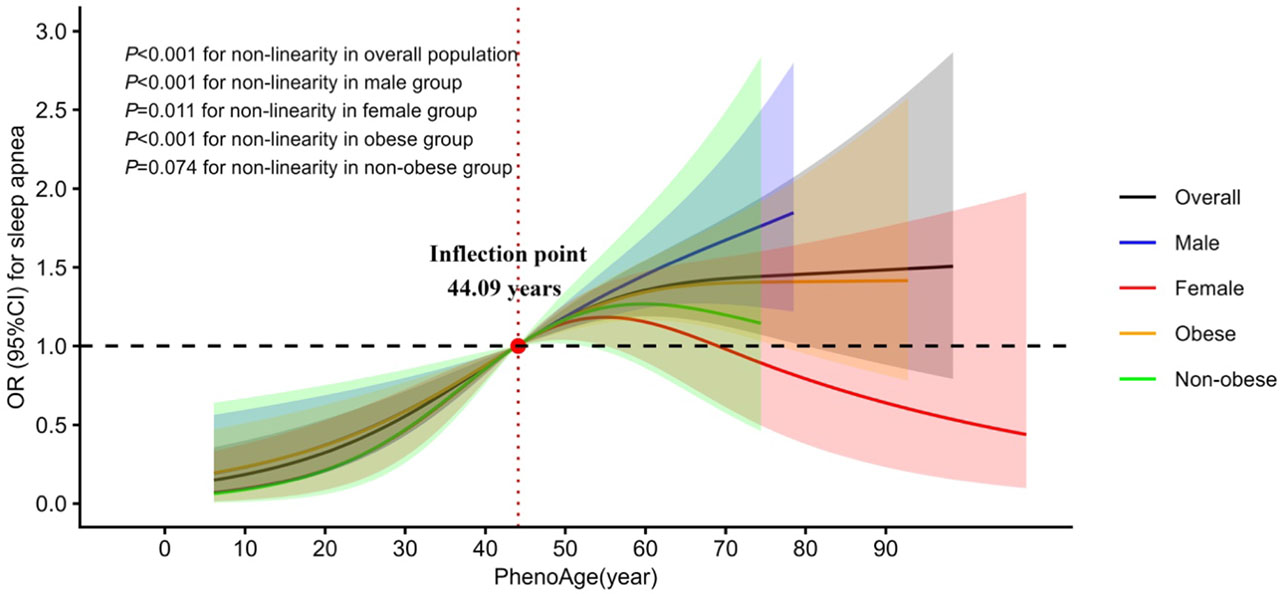
Figure 2.
Nonlinear Dose-Response Associations of Phenotypic Age with Sleep Apnea Risk: Overall and Subgroup Analyses.
The restricted cubic spline analysis revealed a significant nonlinear association between PhenoAge and sleep apnea risk in the overall population in model 2 (P for nonlinearity < 0.001). A consistent inflection point was observed at a PhenoAge of 44.09 years (vertical dashed line) in the overall population, male, female, and obese subgroups (all P for nonlinearity < 0.05). In the non-obese subgroup, the association did not reach statistical significance for nonlinearity (P = 0.074), although a similar inflection pattern was visually apparent. Solid lines represent odds ratios, and shaded areas represent 95% confidence intervals. Black represents the overall population, blue represents males, red represents females, yellow represents the obese group, and green represents the non-obese group.
This threshold pattern around 44.09 years was consistently evident across males (P for nonlinearity < 0.001), individuals with obesity (P for nonlinearity < 0.001) and females (P for nonlinearity = 0.011), although the strength of association and post-threshold slopes varied (Figure 2). The nonlinear association was most pronounced in males, who exhibited the steepest increase in risk after the inflection point. A similarly steep and statistically significant trend was observed in participants with obesity. Although a statistically significant association was also detected in females, the risk trajectory was markedly attenuated: the point estimate plateaued and suggested a potential decline at the highest PhenoAge values, yet wide confidence intervals encompassing the null value render this late-phase trend inconclusive. In contrast, while a comparable threshold pattern was visually suggested in the non-obese subgroup, the association did not reach statistical significance (P for nonlinearity = 0.074).
To quantify the risk difference attributable to surpassing the 44.09-year PhenoAge threshold, we performed stratified logistic regression analyses (Model 2), comparing participants with high PhenoAge (≥ 44.09 years) to those with low PhenoAge (< 44.09 years) within each stratum (Table 5). Although an elevated risk in the high-PhenoAge group was observed across most strata, the magnitude and statistical significance of this elevation varied considerably. The strongest associations were observed in males (OR 1.03, 95% CI 1.01–1.06) and in individuals with obesity (OR 1.02, 95% CI 1.00–1.04). Conversely, in female and non-obese subgroups, no statistically significant risk difference was observed between high- and low-PhenoAge groups.
Table 5.
Segmented Logistic Regression Analysis of the Association Between PhenoAge and Sleep Apnea (SA) Risk.
| Group | SA Cases / Total N | OR (95% CI) | P-value |
|---|---|---|---|
| Overall population | |||
| Low PhenoAge | 57/2459 | 0.99(0.93–1.05) | 0.705 |
| High PhenoAge | 143/2442 | 1.03(1.01–1.05) | 0.003 |
| Male | |||
| Low PhenoAge | 37/1193 | 0.99(0.90–1.09) | 0.816 |
| High PhenoAge | 92/1242 | 1.03(1.01–1.06) | 0.009 |
| Female | |||
| Low PhenoAge | 20/1266 | 1.09(0.99–1.21) | 0.079 |
| High PhenoAge | 51/1200 | 1.00(0.97–1.03) | 0.944 |
| Obese | |||
| Low PhenoAge | 47/1048 | 1.06(0.98–1.14) | 0.171 |
| High PhenoAge | 127/1335 | 1.02(1.00–1.04) | 0.025 |
| Non-obese | |||
| Low PhenoAge | 10/1411 | 0.97(0.81–1.15) | 0.700 |
| High PhenoAge | 16/1107 | 1.01(0.93–1.09) | 0.824 |
[i] This table summarizes logistic regression results (Model 2) assessing the association between PhenoAge (low: <44.09 years vs. high: ≥44.09 years, based on the inflection point) and sleep apnea (SA). Values represent SA case counts/total participants, odds ratios (ORs) with 95% confidence intervals (CIs), and P values for the overall population and for strata defined by sex and obesity status.
3.5. Mediation analysis of the association between PhenoAge and sleep apnea
Finally, we conducted a causal mediation analysis to examine the potential mediating role of UHR in the association between PhenoAge and sleep apnea (Figure 3). Consistent with our primary findings, PhenoAge maintained a significant positive direct effect in the total population, as well as in the male, age ≥40 years, and obesity subgroups (all ADE P< 0.05).
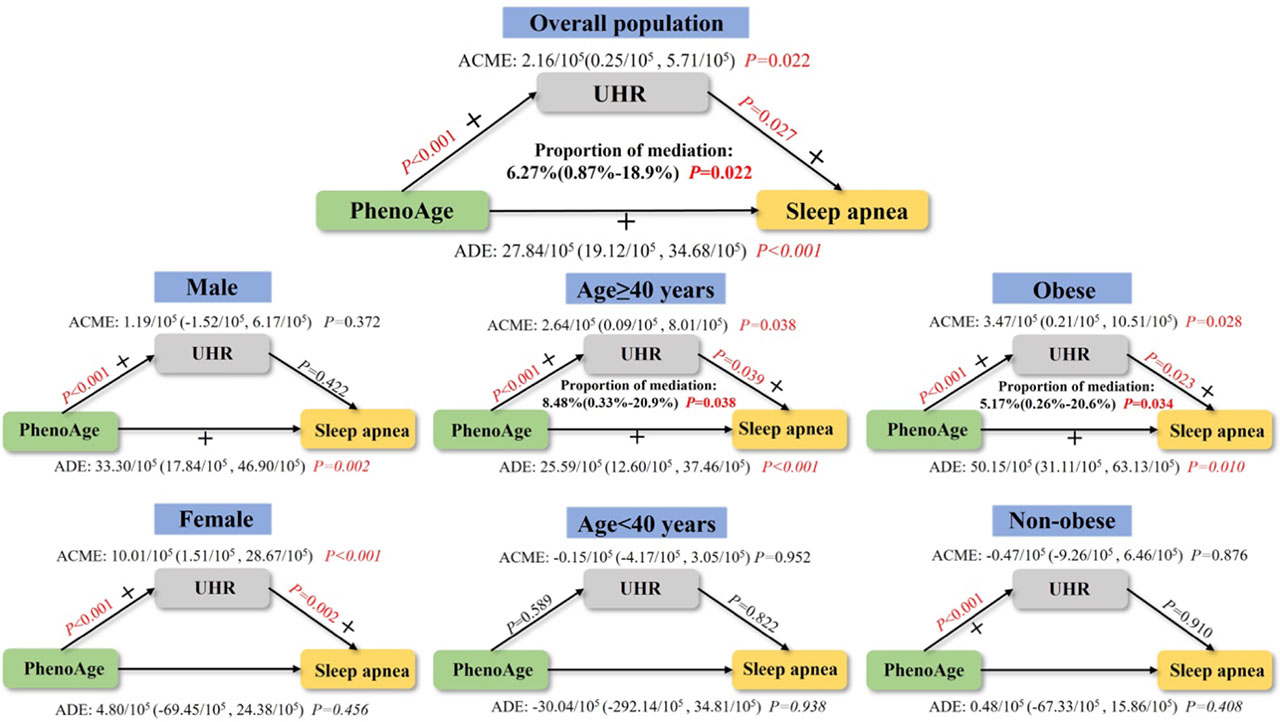
Figure 3.
Mediation analysis of the effect of PhenoAge on sleep apnea risk through UHR (Model 2).
This analysis used Model 2, with PhenoAge as the predictor (X), the uric acid-to-high-density lipoprotein cholesterol ratio (UHR) as the mediator (M), and sleep apnea risk as the outcome (Y). Based on bootstrap analysis, the figure presents point estimates and 95% confidence intervals for the average causal mediation effect (ACME, or indirect effect) and the average direct effect (ADE). The proportion mediated is reported where both ACME and ADE were statistically significant. Results are displayed for the overall population and stratified by sex (male, female), age (<40 / ≥40 years), and obesity status (obese, non-obese). A plus sign (+) denotes a positive path coefficient.
A small but statistically significant indirect effect mediated by UHR was observed in the total population (ACME: 2.16/105, 95% CI: 0.25/105 to 5.71/105, P = 0.022), accounting for 6.27% of the total effect. Subgroup analyses revealed that this mediation was significant in the female subgroup (ACME: 10.01/105, 95% CI: 1.51/105 to 28.67/105, P<0.001), while the ADE was not statistically significant (ADE: 4.8/105, 95% CI: −69.45/105 to 24.38/105, P= 0.456), as well as in the age ≥40 years (ACME: 2.64/105, 95% CI: 0.09/105 to 8.01/105, P=0.038; proportion mediated: 8.48%) and obese subgroups (ACME: 3.47/105, 95% CI: 0.21/105 to 10.51/105, P=0.028; proportion mediated: 5.17%). In contrast, no significant indirect effect was found in the male, non-obese or age < 40 years subgroups (all ACME P > 0.05).
4. DISCUSSION
This study provides robust epidemiological evidence for an association between accelerated biological aging, as measured by PhenoAge, and OSA. The findings reveal a dose-dependent association that is both age-delimited and nonlinear, with distinct patterns across population subgroups. Below, we discuss the implications of PhenoAge as a novel risk correlate, interpret the heterogeneity in association patterns, and explore the limited potential mechanistic insights gleaned from mediation analysis, all while situating our findings within the broader context of aging biology and OSA pathogenesis.
4.1. PhenoAge: A Novel, Dose-Dependent Potential Risk Correlate of OSA
Our primary finding establishes PhenoAge as a potential metric associated with OSA risk. Critically, this association was not observed across the entire lifespan; it was statistically significant only in adults aged 40 years or older. This age-delimited pattern suggests that the pathophysiological link between biological aging and upper airway dysfunction may become prominent in midlife, when the cumulative impact of metabolic and molecular aging processes reaches clinical significance[28].
The identification of a nonlinear inflection point at ∼44.09 PhenoAge-years further indicates that OSA risk may transition into a phase of accelerated increase beyond this biological age threshold. It is critical to emphasize that this statistically derived inflection point should be interpreted as a model-based observation rather than a definitive clinical cutoff. It may, however, correspond to a potential critical state at which cumulative aging-related damage begins to overwhelm physiological compensatory capacity. Specifically, aging impairs ventilatory and circulatory control, leading to reduced tolerance to hypoxia and diminished post-event compensatory recovery[29]. This renders individuals more susceptible to progressing from mild respiratory events to more severe OSA upon airway obstruction, which in turn results in exacerbated chronic intermittent hypoxia (CIH). CIH may further accelerate cellular senescence through oxidative stress and autophagic dysfunction[30]. These interconnected processes establish a vicious cycle: “Aging → Impaired ventilatory/circulatory control → OSA Progression → Exacerbated CIH → Accelerated Aging.” When the combined burden exceeds an individual's physiological reserve, this cycle may explain the disproportionate rise in OSA susceptibility observed beyond the inflection point.
From a hypothesis-generating perspective, the observed inflection point suggests that PhenoAge may help identify individuals entering a phase of accelerated OSA risk, thereby highlighting a potential avenue for future research in risk assessment within the middle-aged population. If validated in prospective studies, individuals whose biological age falls within or beyond this statistical risk transition zone could be considered for more vigilant assessment. Our findings, however, are not intended for immediate clinical screening or risk stratification. They underscore the need for longitudinal research to determine if biological aging metrics can meaningfully inform OSA risk prediction models.
4.2. Heterogeneity in Risk Patterns: Synergistic Effects and Putative Mechanisms
Our findings reveal a heterogeneous pattern in the association between PhenoAge and OSA risk. The association was strongest and most accelerated in males and individuals with obesity, indicating a potential synergistic interaction between biological aging and these traditional risk factors. In contrast, the link was substantially weaker in females, with no distinct acceleration phase observed. This divergence suggests that different contributing factors may be at play.
The pronounced association in males and those with obesity can be interpreted within a framework of “metabolically accelerated aging.” In midlife, metabolic dysregulation is thought to become closely coupled with aging processes, potentially creating a vulnerable state. Obesity, particularly visceral adiposity, could amplify this by driving inflammation and adipokine alterations that further induce metabolic dysregulation and tissue damage. Men appear more susceptible to this synergy, which might be due to body composition and hormonal differences that favor a detrimental metabolic profile[28].
Conversely, the attenuated association in females could reflect a protective phenotype potentially mediated by sex hormones. Evidence indicates that estrogen and progesterone are crucial for respiratory stability, and their decline, especially after menopause, is an independent OSA risk factor. It is hypothesized that estrogen benefits the upper airway by maintaining muscle tone, improving fat distribution, and modulating inflammation. This hormonal environment may raise the threshold for biological aging to cause significant airway dysfunction[31]. Therefore, the observed “complete mediation” by the UHR in females should be interpreted with great caution—it is more likely due to methodological limitations (e.g., limited power, unmeasured confounders like menopausal status) than true biological dominance of a single metabolic route. This finding remains highly preliminary and requires validation in studies accounting for the distinct physiological profile of OSA in women.
These results suggest that elevated PhenoAge may help pinpoint individuals at potential imminent risk transition. Specifically, middle-aged men and individuals with obesity whose PhenoAge places them within the risk acceleration zone represent a subgroup of interest for future longitudinal studies aimed at understanding risk progression. For research purposes, exploring whether coordinated metabolic risk-factor modification offers synergistic benefits in such high-risk subgroups could be a valuable direction for future interventional studies.
4.3. Interpreting the Association: A Modest Contribution of UHR and Implications for Future Research
Exploratory mediation analysis indicated that the UHR accounted for a significant but small proportion (6.27%) of the total association. This finding implies that oxidative-metabolic dysregulation, as measured by UHR, may play a contributory yet minor role in linking biological aging to OSA. Given its limited explanatory power, the clinical relevance of specifically targeting UHR for OSA prevention is likely to be modest. Consequently, the remaining ≈94% of the association likely involves other mechanisms, warranting greater research attention in the future.
Future investigations should prioritize exploring candidate mechanisms such as: (1) Senescence-associated systemic inflammation (“inflammaging”): Chronic, low-grade inflammation is a hallmark of aging (“inflammaging”) and is also a recognized feature of OSA pathophysiology[8]. Elevated pro-inflammatory mediators (e.g., IL-6, TNF-α) could impair vascular function and neuromuscular control, thereby contributing to upper airway instability[32]. It is therefore plausible that inflammaging may serve as a common biological link between accelerated aging and OSA; (2) Neuromuscular aging, involving structural muscle degeneration and functional decline in neural control. Preclinical evidence suggests that age-related changes might impair muscle function and neural control. If applicable to human upper airway muscles, these processes could erode compensatory reserve, possibly leading to increased collapsibility during sleep[33][34]; (3) Microcirculatory remodeling. Aging itself can alter microvascular structure[35]. Preliminary histological evidence indicates a positive correlation between OSA severity and outward hypertrophy of the pharyngeal microcirculation. This physical alteration of the microvascular bed could thereby change local tissue properties, representing another potential factor contributing to upper airway dysfunction[36].
Given the limited explanatory power of the UHR in our statistical mediation model, these alternative mechanisms are likely to be important. Ultimately, a comprehensive understanding of how accelerated biological aging translates to upper airway collapse will require a concerted effort to identify and validate these underlying biological mechanisms through dedicated prospective and experimental research.
4.4. Limitations and Future Directions
While this study provides novel insights, several limitations must be considered when interpreting the findings.
First, the cross-sectional design precludes definitive causal inference regarding the temporal sequence between accelerated biological aging and sleep apnea onset. Therefore, all conclusions should be framed as observational associations rather than causal effects. This fundamental limitation underscores the necessity for prospective cohort studies with repeated measurements to determine if accelerated biological aging precedes and predicts the development of sleep apnea, and to refine the predictive utility of the identified inflection point.
Second, the reliance on self-reported physician-diagnosed sleep apnea constitutes a significant measurement limitation. This approach is susceptible to misclassification bias, likely resulting in substantial under-ascertainment of cases, particularly among individuals with mild or undiagnosed disease. This non-differential misclassification likely attenuated the observed effect estimates toward the null. Furthermore, the resultant under-ascertainment of cases not only leads to an underestimation of prevalence but may also introduce instability and bias into subgroup analyses and the modeling of nonlinear relationships. As such, the specific patterns of heterogeneity observed across subgroups (e.g., sex, obesity) and the precise location of the statistically derived inflection point (∼44.09 PhenoAge-years) should be considered in light of this potential measurement error. Future studies employing objective diagnostic gold standards, such as polysomnography, are therefore imperative to validate these associations with greater accuracy and precision.
Third, the substantial proportion of the initial NHANES sample excluded due to missing data raises the possibility of selection bias. Participants with complete data for analysis may differ systematically from those excluded in terms of health status, healthcare access, or health-seeking behavior. This potential bias may affect the generalizability of our findings. Combined with the fact that the dataset (NHANES 2005–2008) is nearly two decades old—a cycle selected specifically because it contained the requisite sleep apnea question—the contemporary relevance of our estimates may be influenced by shifts in population health, obesity prevalence, and clinical diagnostic practices. Consequently, external validation in more recent, diverse cohorts with rigorous data collection is crucial.
Fourth, despite comprehensive statistical adjustment, residual confounding from unmeasured or imperfectly measured factors cannot be ruled out. Key variables such as detailed craniofacial morphology, specific genetic predispositions, or nuanced environmental exposures were not available. Future prospective studies designed a priori to include these potential confounders are needed to more definitively ascertain the independent association of phenotypic aging.
Finally, the exploratory mediation analysis, while methodologically sound, has inherent limitations. Most notably, the UHR explained only a modest proportion (∼6.27%) of the total association. This small effect size fundamentally constrains its biological and clinical interpretation, clearly indicating it is not the predominant mechanism. More importantly, mediation analysis within a cross-sectional framework cannot establish causal directionality among PhenoAge, the mediator, and the outcome. Therefore, the putative mechanistic insights are preliminary; elucidating the full spectrum of pathways will require future longitudinal studies, multi-omics investigations, and targeted exploration of other candidates, such as those involving systemic inflammation or neuromuscular aging.
In summary, this cross-sectional, observational study identifies PhenoAge as a novel correlate of OSA and provides a preliminary, hypothesis-generating foundation for integrating biological aging concepts into research on sleep apnea. The acknowledged limitations simultaneously chart a clear and prioritized course for future research, from prospectively confirming causality and discovering mechanisms to exploring the potential utility of biological aging metrics in future risk prediction research.
5. Conclusion
In conclusion, this study suggests that accelerated biological aging, measured by PhenoAge, is associated with OSA in a dose-dependent and non-linear manner. This association was only partially related to metabolic-oxidative dysfunction, implicating a broader, yet uncharacterized, biological interface between aging and OSA. These observations demonstrate an association between population-level OSA risk and a metric of biological aging, thereby extending the risk factor profile beyond traditional measures. Given the exploratory nature of the evidence, prospective validation is now required to determine if biological aging metrics can meaningfully inform future risk prediction models.
Acknowledgements
The authors thank the National Center for Health Statistics (NCHS) for the study design and data sharing of the National Health and Nutrition Examination Survey (NHANES). We also extend our gratitude to all the investigators and participants involved in the NHANES program.
Notes
List of abbreviations
| Abbreviation | Full Term |
|---|---|
| AC-1 & 2 | Acceleration Group-1 & 2 |
| ACME | Average Causal Mediation Effect |
| ADE | Average Direct Effect |
| BMI | Body Mass Index |
| CAPI | Computer-Assisted Personal Interview |
| CI | Confidence Interval |
| CIH | Chronic Intermittent Hypoxia |
| CRP | C-Reactive Protein |
| DBP | Diastolic Blood Pressure |
| DC-1 & 2 | Deceleration Group-1 & 2 |
| EQ Group | Equality Group |
| FPG | Fasting Plasma Glucose |
| HbA1c | Glycated Hemoglobin |
| HDL-C | High-Density Lipoprotein Cholesterol |
| HOMA-IR | Homeostatic Model Assessment of Insulin Resistance |
| IQR | Interquartile Range |
| IR | Insulin Resistance |
| LDL-C | Low-Density Lipoprotein Cholesterol |
| MAP | Mean Arterial Pressure |
| MET | Metabolic Equivalent Task |
| MICE | Multiple Imputation by Chained Equations |
| MLR | Monocyte-to-Lymphocyte Ratio |
| NHANES | National Health and Nutrition Examination Survey |
| NLR | Neutrophil-to-Lymphocyte Ratio |
| NSA | Non-Sleep Apnea |
| OR | Odds Ratio |
| OSA | Obstructive Sleep Apnea |
| PA | Physical Activity |
| PhenoAge | Phenotypic Age |
| PhenoAgeAccel | Phenotypic Age Acceleration |
| PIR | Poverty-to-Income Ratio |
| Q1-Q4 | First, Second, Third, Fourth Quartile |
| RCS | Restricted Cubic Spline |
| SA | Sleep Apnea |
| SBP | Systolic Blood Pressure |
| SII | Systemic Immune-Inflammation Index |
| SIRI | Systemic Inflammation Response Index |
| TC | Total Cholesterol |
| TG | Triglycerides |
| TyG index | Triglyceride-Glucose index |
| UA | Uric Acid |
| UHR | Uric Acid to High-Density Lipoprotein Cholesterol Ratio |