
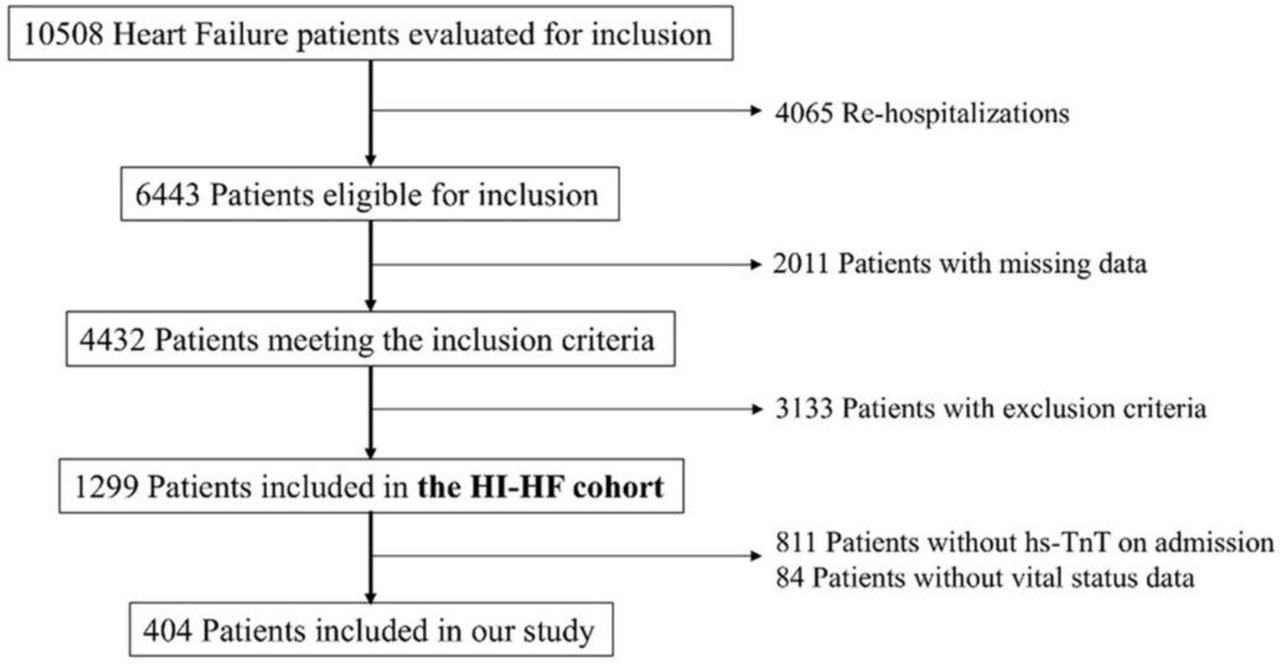
Figure 1.
PRISMA consort flow diagram of the study.
Table 1
General characteristics for male and female patients
| Demographics and risk factors | Entire group (n=404) | Female (n=221) | Male (n=183) | p value* |
|---|---|---|---|---|
| General characteristics | ||||
| Age (years) | 71.87 (±10.06) | 74.24 (±8.93) | 69.00 (±10.61) | <0.001 |
| Systolic BP (mmHg) | 144.77 (±29.14) | 147.29 (±30.53) | 141.80 (±27.21) | 0.077 |
| Diastolic BP (mmHg) | 81.39 (±13.62) | 82.44 (±13.59) | 80.15 (±13.60) | 0.115 |
| Heart rate (bpm) | 85.01 (±25.63) | 85.60 (±26.32) | 84.28 (±24.79) | 0.624 |
| Heart failure characteristics | ||||
| HFrEF | 129 (31.9%) | 50 (22.6%) | 79 (43.2%) | <0.001 |
| HFmrEF | 121 (30.0%) | 69 (31.2%) | 52 (28.4%) | |
| HFpEF | 152 (37.6%) | 102 (46.2%) | 50 (27.3%) | |
| NYHA class III | 243 (60.1%) | 134 (60.6%) | 109 (59.6%) | 0.827 |
| NYHA class IV | 58 (14.5%) | 32 (14.5%) | 26 (14.5%) | 0.995 |
| Hospitalization outcome | ||||
| Length of stay (days) | 6.00 [5.00–8.00] | 6.00 [4.00–8.00] | 6.00 [5.00–9.75] | 0.498 |
| Extended stay | 97 (24.1%) | 45 (20.5%) | 52 (28.4%) | 0.066 |
| All causes mortality | 149 (36.9%) | 78 (35.3%) | 71 (38.8%) | 0.467 |
| Comorbidities and risk factors | ||||
| Arterial Hypertension | 325 (80.4%) | 184 (83.3%) | 141 (77.0%) | 0.117 |
| COPD | 19 (4.7%) | 3 (1.4%) | 16 (8.7%) | <0.001 |
| History of stroke | 49 (12.1%) | 29 (13.1%) | 20 (10.9%) | 0.501 |
| Atrial fibrillation | 191 (47.3%) | 104 (47.1%) | 87 (47.5%) | 0.923 |
| Ischemic heart disease | 176 (43.6%) | 85 (38.5%) | 91 (49.7%) | 0.023 |
| Prior myocardial infarction | 106 (26.2%) | 38 (17.2%) | 68 (37.2%) | <0.001 |
| Chronic kidney disease | 229 (56.7%) | 130 (58.8%) | 99 (54.1%) | 0.340 |
| Type 2 Diabetes Mellitus | 131(32.4%) | 71 (32.1%) | 60 (32.8%) | 0.888 |
| Obesity | 177 (43.8%) | 103 (46.6%) | 74 (40.4%) | 0.213 |
| Thyroid dysfunction | 36 (8.9%) | 30 (13.6%) | 6 (3.3%) | 0.003 |
| Echocardiographic characteristics | ||||
| LVEF (%) | 42.06 (±12.48) | 44.59 (±11.54) | 39.12 (±12.91) | <0.001 |
| Severe aortic stenosis | 6 (1.5%) | 4 (1.8%) | 2 (1.1%) | 0.553 |
| Severe aortic regurgitation | 5 (1.2%) | 3 (1.4%) | 2 (1.1%) | 0.811 |
| Severe mitral regurgitation | 57 (14.1%) | 32 (14.5%) | 25 (13.7%) | 0.814 |
| Pulmonary hypertension | 195 (48.3%) | 110 (49.8%) | 85 (46.4%) | 0.505 |
| Pericardial effusion | 27 (6.7%) | 18 (8.1%) | 9 (4.9%) | 0.196 |
| Aortic atheromatosis | 151 (37.4%) | 95 (43.0%) | 56 (30.6%) | 0.036 |
| Biological characteristics | ||||
| Hemoglobin (g/dL) | 13.13 (±1.91) | 12.61 (±1.70) | 13.77 (±1.98) | <0.001 |
| ESR (mm/h) | 19.00 [8.75–34.00] | 20.50 [10.00–33.25] | 17.50 [7.00–34.00] | 0.020 |
| Serum Na (mmol/L) | 139.65 (±7.94) | 140.05 (±4.56) | 139.15 (±10.75) | 0.262 |
| Serum K (mmol/L) | 4.36 (±0.50) | 4.34 (±0.55) | 4.38 (±0.43) | 0.469 |
| eGFR (ml/min/1.73m2) | 71.92 [55.06–88.75] | 66.16 [49.09–84.39] | 78.29 [57.35–89.37] | 0.026 |
| Glycemia (mg/dL) | 107.50 [94.00–134.50] | 111.50 [98.00–139.25] | 105.00 [88.75–126.75] | 0.401 |
| Total cholesterol (mg/dL) | 163.80 [137.00–207.25] | 172.75 [140.75–223.15] | 155.00 [127.35–190.75] | 0.010 |
| AST (UI/L) | 21.50 [17.47–28.57] | 21.00 [17.07–28.22] | 21.60 [17.62–28.72] | 0.264 |
| ALT (UI/L) | 18.10 [14.00–26.15] | 17.50 [13.45–24.85] | 19.90 [14.12–31.55] | 0.030 |
| NT-proBNP (ng/L) | 1687.50 [622.20–4319.75] | 1607.50 [504.62–3860.75] | 1777.50 [766.77–4859.00] | 0.595 |
| hs-TnT (pg/mL) | 17.06 [10.43–29.42] | 14.18 [9.21–25.25] | 22.44 [12.77–33.53] | <0.001 |
[ii] Abbreviations: BP – blood pressure; HFrEF – heart failure with reduced ejection fraction; HFmrEF – heart failure with mid-range ejection fraction; HFpEF – heart failure with preserved ejection fraction; COPD – Chronic obstructive pulmonary disease; LVEF – left ventricular ejection fraction; ESR – erythrocyte sedimentation rate; eGFR – estimated glomerular filtration rate; AST – aspartate aminotransferase; ALT – alanine aminotransferase; hsTnT – high-sensitivity troponin T.
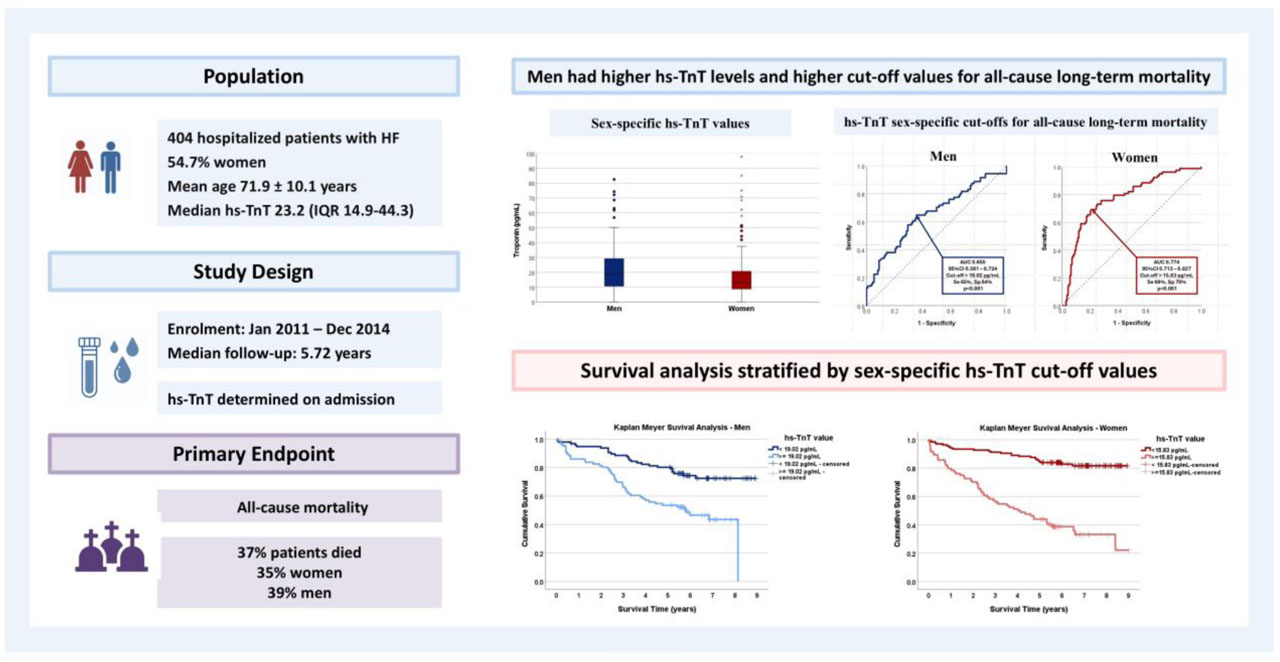
Figure 2.
Central illustration. Derivation of sex-specific hs-TnT cut-off values and their implementation in survival analysis.
Table 2
Baseline characteristics for outcome sex-specific hs-TnT cut-off groups in men and women
| A. Categorical variables | ||||||||
|---|---|---|---|---|---|---|---|---|
| Men | Women | |||||||
| Variable | hs-TnT <19.02 pg/mL n (%) | hs-TnT ≥19.02 pg/mL n (%) | OR (95% CI) | p | hs-TnT <15.83 pg/mL n (%) | hs-TnT ≥15.83 pg/mL n (%) | OR (95% CI) | p |
| Heart failure characteristics | ||||||||
| NYHA III and IV | 38 (39.20%) | 55 (64.00%) | 2.75 (1.51–5.03) | 0.001 | 66 (48.18%) | 60 (71.43%) | 2.69 (1.51–4.80) | 0.001 |
| Clinical congestion | 25 (25.80%) | 48 (55.80%) | 3.64 (1.95–6.78) | <0.0 01 | 39 (28.47%) | 45 (53.57%) | 2.90 (1.64–5.11) | <0.0 01 |
| Hospitalization outcome | ||||||||
| Extended stay (>7 days) | 16 (16.50%) | 36 (41.90%) | 3.65 (1.84–7.24) | <0.0 01 | 12 (8.76%) | 33 (40.24%) | 7.02 (3.35–14.68) | <0.0 01 |
| Comorbidities and risk factors | ||||||||
| Hypertension | 76 (78.40%) | 65 (75.60%) | 0.86 (0.43–1.70) | 0.657 | 117 (85.40%) | 67 (79.76%) | 0.67 (0.33–1.37) | 0.276 |
| COPD | 9 (9.30%) | 7 (8.10%) | 0.87 (0.31–2.44) | 0.785 | 0 (0.00%) | 3 (3.57%) | Not estimable | 0.054* |
| Prior stroke | 7 (7.20%) | 13 (15.10%) | 2.29 (0.87–6.04) | 0.087 | 15 (10.95%) | 14 (16.67%) | 1.63 (0.74–3.57) | 0.222 |
| Atrial fibrillation | 45 (46.40%) | 42 (48.80%) | 1.10 (0.62–1.97) | 0.741 | 59 (43.07%) | 45 (53.57%) | 1.53 (0.88–2.63) | 0.129 |
| Ischemic heart disease | 51 (52.60%) | 40 (46.50%) | 0.78 (0.44–1.40) | 0.413 | 53 (38.69%) | 32 (38.10%) | 0.98 (0.56–1.71) | 0.930 |
| Prior myocardial infarction | 36 (37.10%) | 32 (37.20%) | 1.00 (0.55–1.83) | 0.989 | 22 (16.06%) | 16 (19.05%) | 1.23 (0.60–2.50) | 0.568 |
| Type 2 diabetes | 30 (30.90%) | 30 (34.90%) | 1.20 (0.65–2.22) | 0.569 | 39 (28.47%) | 32 (38.10%) | 1.55 (0.87–2.75) | 0.137 |
| Obesity | 42 (43.30%) | 32 (37.20%) | 0.78 (0.43–1.40) | 0.402 | 69 (50.36%) | 34 (40.48%) | 0.67 (0.39–1.16) | 0.15 3 |
| Peripheral artery disease | 11 (11.30%) | 10 (11.60%) | 1.03 (0.41–2.56) | 0.951 | 7 (5.11%) | 5 (5.95%) | 1.18 (0.36–3.83) | 0.769* |
| Chronic kidney disease | 41 (42.30%) | 58 (67.40%) | 2.83 (1.55–5.18) | 0.001 | 64 (46.72%) | 66 (78.57%) | 4.18 (2.25–7.77) | <0.0 01 |
| Echocardiographic characteristics | ||||||||
| Severe aortic stenosis | 1 (1.00%) | 1 (1.20%) | 1.13 (0.07–18.34) | 1.000* | 0 (0.00%) | 4 (4.76%) | Not estimable | 0.020* |
| Severe aortic regurgitation | 0 (0.00%) | 2 (2.30%) | Not estimable | 0.219* | 0 (0.00%) | 3 (3.57%) | Not estimable | 0.054* |
| Severe mitral regurgitation (grade 3–4) | 8 (8.20%) | 17 (19.80%) | 2.74 (1.12–6.72) | 0.024 | 10 (7.30%) | 22 (26.19%) | 4.51 (2.01–10.10) | <0.001 |
| Severe tricuspid regurgitation | 9 (9.30%) | 13 (15.10%) | 1.74 (0.70–4.30) | 0.226 | 13 (9.49%) | 22 (26.19%) | 3.38 (1.60–7.17) | 0.001 |
| Pulmonary hypertension | 36 (37.10%) | 49 (57.00%) | 2.24 (1.24–4.06) | 0.007 | 58 (42.34%) | 52 (61.90%) | 2.21 (1.27–3.86) | 0.005 |
| Pericardial effusion | 5 (5.20%) | 4 (4.70%) | 0.90 (0.23–3.46) | 1.000* | 8 (5.84%) | 10 (11.90%) | 2.18 (0.82–5.76) | 0.110 |
| Biological characteristics | ||||||||
| eGFR <60 mL/min/1.73 m2 | 15 (15.50%) | 37 (43.00%) | 4.13 (2.06–8.28) | <0.001 | 34 (24.82%) | 47 (55.95%) | 3.85 (2.16–6.87) | <0.001 |
| B. Continuous variables | ||||||
|---|---|---|---|---|---|---|
| Men | Women | |||||
| Variable | hs-TnT <19.02 pg/mL | hs-TnT ≥19.02 pg/mL | p | hs-TnT <15.83 pg/mL median [Q1–Q3] | hs-TnT ≥15.83 pg/mL median [Q1–Q3] | p |
| General characteristics | ||||||
| Age (years) | 66.00 [60.00–74.50] | 73.00 [62.00–79.00] | 0.006 | 73.00 [65.00–78.00] | 79.00 [74.25–83.00] | <0.001 |
| Hospitalization outcome | ||||||
| Length of stay (days) | 5.00 [4.00–7.00] | 7.00 [4.75–10.00] | <0.001 | 5.00 [4.00–6.00] | 7.00 [5.00–10.00] | <0.001 |
| Echocardiographic characteristics | ||||||
| LVEF / EF (%) | 46.00 [36.00–52.00] | 35.00 [25.00–45.00] | <0.001 | 50.00 [43.50–54.00] | 43.50 [33.75–50.00] | <0.001 |
| PAPS (mmHg) | 35.00 [28.00–43.00] | 42.00 [34.00–57.25] | 0.003 | 35.00 [27.00–40.00] | 45.00 [32.50–55.00] | <0.001 |
| Biological characteristics | ||||||
| Hemoglobin (g/dL) | 14.30 [13.08–15.12] | 13.60 [11.98–14.90] | 0.025 | 13.00 [12.10–13.90] | 11.92 [10.82–13.40] | <0.001 |
| ESR (mm/h) | 16.00 [6.00–27.00] | 18.00 [6.00–35.00] | 0.435 | 19.00 [10.00–30.50] | 23.00 [12.50–48.00] | 0.061 |
| Sodium (mmol/L) | 141.00 [138.00–142.00] | 140.00 [137.00–142.00] | 0.527 | 141.00 [139.00–143.00] | 140.00 [137.00–143.00] | 0.017 |
| Potassium (mmol/L) | 4.39 [4.05–4.74] | 4.32 [4.05–4.60] | 0.444 | 4.39 [3.98–4.66] | 4.36 [3.93–4.74] | 0.990 |
| Creatinine (mg/dL) | 0.94 [0.85–1.10] | 1.10 [0.90–1.43] | <0.001 | 0.80 [0.70–0.93] | 0.97 [0.80–1.27] | <0.001 |
| eGFR (ml/min/1.73m2) | 83.19 [66.95–92.72] | 64.86 [47.74–84.76] | <0.001 | 74.86 [59.86–92.14] | 55.83 [40.20–73.13] | <0.001 |
| Glycemia (mg/dL) | 104.00 [91.00–119.50] | 106.50 [94.00–126.75] | 0.496 | 101.00 [90.00–124.50] | 117.00 [101.50–150.50] | 0.001 |
| logBNP | 2.89 [2.54–3.13] | 3.40 [2.97–3.79] | <0.001 | 2.89 [2.56–3.26] | 3.46 [3.01–3.83] | <0.001 |
[i] Abbreviation: hs-TnT – high-sensitivity troponin T; OR – odds ratio; CI – confidence interval; Q1–Q3 – interquartile range; COPD – chronic obstructive pulmonary disease; eGFR – estimated glomerular filtration rate; LVEF – left ventricular ejection fraction; PAPS – pulmonary artery systolic pressure; ESR – erythrocyte sedimentation rate.
Table 3
Independent parameters associated with increased hs-TnT – Multivariable analysis
| Men hs-TnT ≥ 19.02 pg/mL | Women hs-TnT ≥ 15.83 pg/mL | ||||
|---|---|---|---|---|---|
| HR* (95%CI) | p value | HR** (95%CI) | p value | ||
| Clinical congestion | 2.24 (1.16–5.07) | 0.019 | Age | 1.08 (1.02–1.14) | 0.005 |
| LnNT-proBNP | 3.30 (1.42–7.67) | 0.005 | LnNT-proBNP | 4.22 (2.02–8.81) | < 0.001 |
| eGFR | 0.97 (0.95–0.99) | 0.001 | eGFR | 0.98 (0.96–0.99) | 0.016 |
| LVEF | 0.96 (0.93–0.99) | 0.027 | |||
[i] Note: *Adjusted for age, NYHA class, chronic obstructive pulmonary disease, chronic kidney disease, severe mitral regurgitation, estimated pulmonary artery systolic pressure, hemoglobin – variables without independent correlation with increased hs-TnT
[ii] Note: **Adjusted for NYHA class, clinical congestion, chronic obstructive pulmonary disease, chronic kidney disease, LVEF, severe aortic stenosis, severe mitral regurgitation, severe tricuspid regurgitation, estimated pulmonary artery systolic pressure, hemoglobin, serum sodium, glycemia – variables without independent correlation with increased hs-TnT
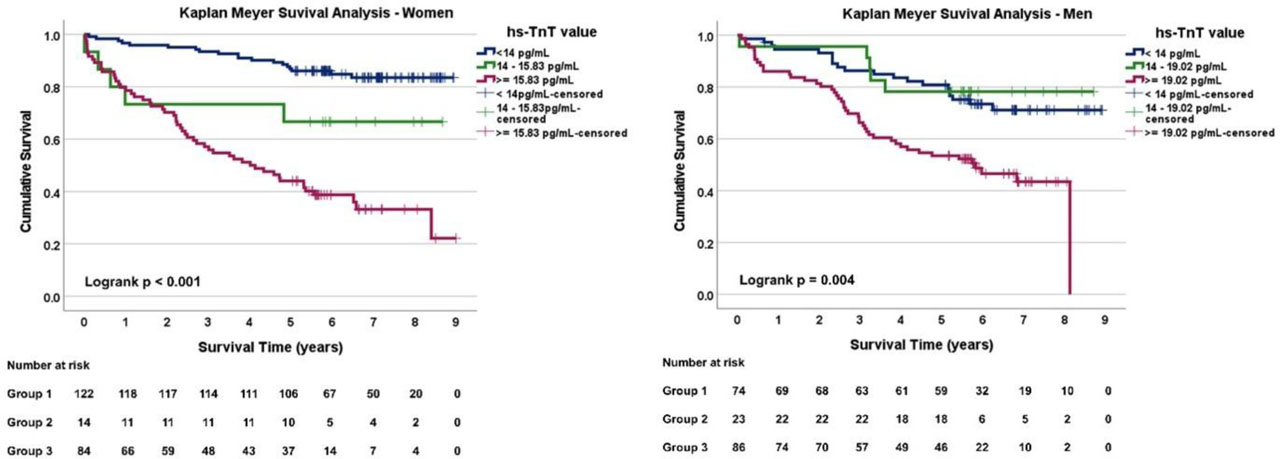
Figure 3.
Survival analysis stratified by hs-TnT values for A – Women, and B – Men.
Table 4
Univariate Cox regression for all-cause mortality – comparison across groups
| Predictor | Men | Women | ||||
|---|---|---|---|---|---|---|
| HR | 95% CI | p | HR | 95% CI | p | |
| General characteristics | ||||||
| Age (per 1 year) | 1.03 | 1.01–1.05 | 0.013 | 1.08 | 1.05–1.11 | <0.001 |
| Heart failure characteristics | ||||||
| NYHA III and IV | 1.82 | 1.13–2.94 | 0.014 | 2.14 | 1.32–3.49 | 0.002 |
| Clinical congestion | 1.74 | 1.09–2.77 | 0.020 | 1.87 | 1.20–2.92 | 0.006 |
| Cardiovascular risk factors and comorbidities | ||||||
| HTN | 0.76 | 0.45–1.28 | 0.298 | 0.63 | 0.37–1.09 | 0.097 |
| Atrial fibrillation | 1.32 | 0.83–2.11 | 0.240 | 1.96 | 1.24–3.08 | 0.004 |
| Prior stroke | 1.47 | 0.75–2.88 | 0.258 | 1.09 | 0.58–2.06 | 0.797 |
| IHD | 1.14 | 0.72–1.82 | 0.580 | 0.77 | 0.48–1.23 | 0.270 |
| Prior MI | 1.36 | 0.85–2.18 | 0.203 | 0.91 | 0.50–1.65 | 0.759 |
| Type 2 diabetes | 0.82 | 0.49–1.37 | 0.444 | 1.24 | 0.78–1.97 | 0.358 |
| CKD | 1.78 | 1.09–2.89 | 0.021 | 2.31 | 1.40–3.81 | 0.001 |
| Obesity | 0.46 | 0.27–0.77 | 0.003 | 0.54 | 0.34–0.86 | 0.009 |
| Echocardiographic characteristics | ||||||
| LVEF (per 1%) | 0.97 | 0.95–0.99 | <0.001 | 0.96 | 0.95–0.98 | <0.001 |
| ePASP (per 1mmHg) | 1.03 | 1.01–1.05 | 0.002 | 1.03 | 1.01–1.05 | 0.004 |
| Severe MR | 2.08 | 1.16–3.73 | 0.015 | 2.34 | 1.39–3.93 | 0.001 |
| Severe TR | 1.71 | 0.89–3.26 | 0.10 | 2.61 | 1.58–4.32 | <0.001 |
| Severe AS | 1.59 | 0.22–11.47 | 0.65 | 2.21 | 0.69–7.02 | 0.18 |
| Biological characteristics | ||||||
| hs-TnT sex-specific cut-off | 2.66 | 1.62–4.34 | <0.001 | 5.50 | 3.38–8.94 | <0.001 |
| hs-TnT ≥14 pg/mL | 2.11 | 1.26–3.56 | 0.005 | 5.66 | 3.36–9.53 | <0.001 |
| lnNTproBNP (per 1 unit) | 1.57 | 1.31–1.88 | <0.001 | 1.58 | 1.34–1.87 | <0.001 |
| eGFR (per 1 mL/min/1.73m2) | 0.99 | 0.98–1.00 | 0.033 | 0.98 | 0.97–0.99 | 0.001 |
| Hemoglobin (per 1 g/dL) | 0.80 | 0.72–0.89 | <0.001 | 0.89 | 0.78–1.00 | 0.056 |
| Serum Na (per 1mmol/L) | 0.99 | 0.98–1.02 | 0.91 | 0.96 | 0.91–1.00 | 0.053 |
| Serum K (per 1 mmol/mL) | 0.89 | 0.51–1.55 | 0.67 | 1.42 | 0.94–2.14 | 0.092 |
[i] Abbreviations: AS – aortic stenosis; CKD – chronic kidney disease; ePASP – estimated pulmonary artery systolic pressure; HTN – arterial hypertension; IHD – ischemic heart disease; LVEF – left ventricular ejection fraction; MI – myocardial infarction; MR – mitral regurgitation; TR – tricuspid regurgitation.
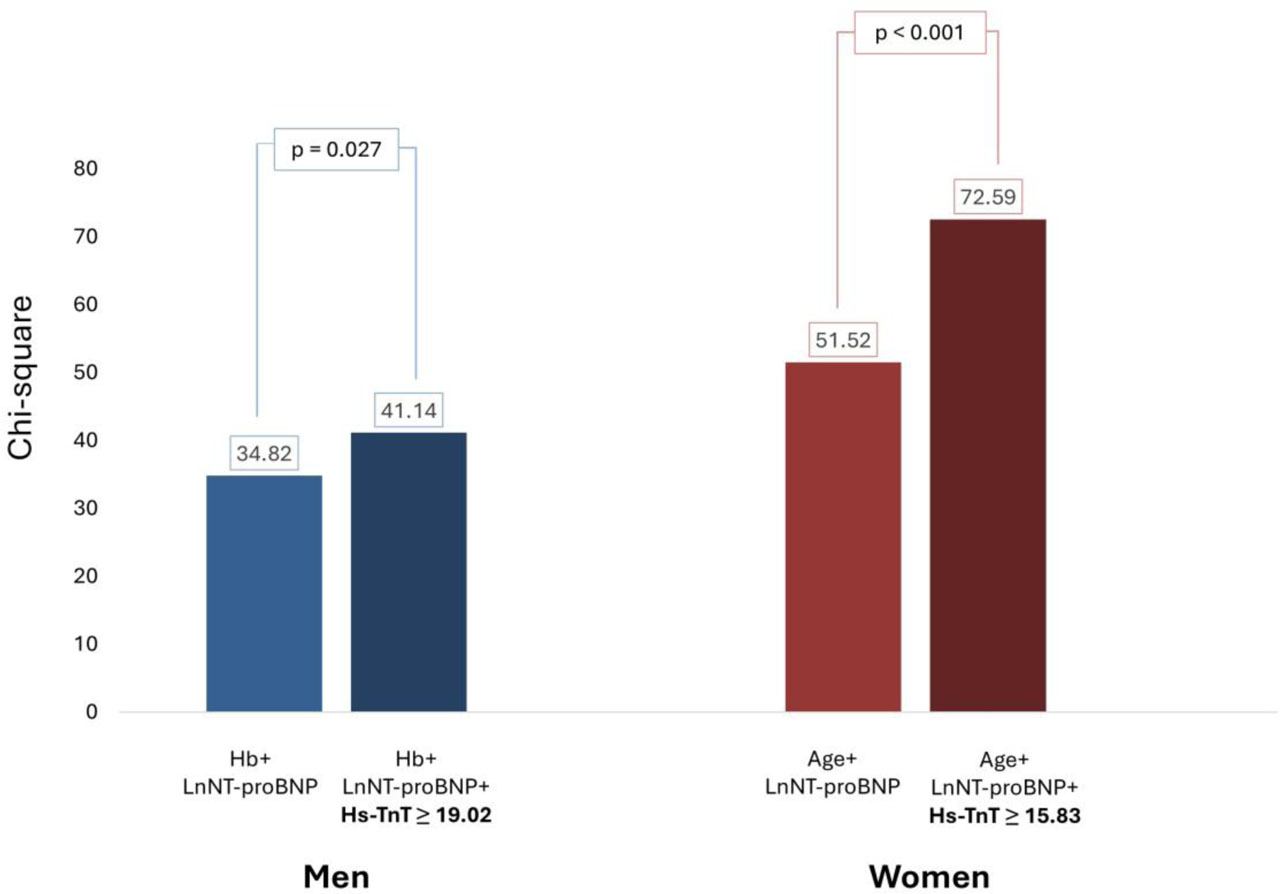
Figure 4.
Hierarchical Cox Regression Analysis showing the incremental clinical value of sex-specific increased hs-TnT.
Table 5
Stepwise multivariable Cox analysis for all-cause long-term mortality
| Independent predictors for all-cause long-term mortality | |||||
|---|---|---|---|---|---|
| Men | Women | ||||
| HR* (95%CI) | p value | HR** (95%CI) | p value | ||
| Hemoglobin (per 1g/dL) | 0.88 (0.78–0.98) | 0.021 | Age (per 1 year) | 1.05 (1.02–1.09) | 0.003 |
| LnNT-proBNP (per 1 unit) | 1.28 (1.03–1.59) | 0.025 | LnNT-proBNP (per 1 unit) | 1.22 (1.01–1.47) | 0.035 |
| hs-TnT ≥ 19.02 pg/mL | 1.91 (1.07–3.41) | 0.029 | hs-TnT ≥ 15.83 pg/mL | 3.54 (2.07–6.07) | < 0.001 |
[i] Note: *Adjusted for NYHA class, clinical congestion, atrial fibrillation, chronic kidney disease, obesity, age, LVEF, estimated pulmonary artery systolic pressure, severe mitral regurgitation, severe tricuspid regurgitation – variables without independent prognostic value in the final steps of the regression
[ii] Note: **Adjusted for NYHA class, clinical congestion, atrial fibrillation, chronic kidney disease, obesity, LVEF, estimated pulmonary artery systolic pressure, severe mitral regurgitation, severe tricuspid regurgitation, severe aortic stenosis, serum sodium, hemoglobin – variables without independent prognostic value in the final steps of the regression
Supplementary Table 1
STROBE checklist
| Item | STROBE recommendation (cohort) | Where addressed in this manuscript |
|---|---|---|
| 1 | Indicate study design in the title or abstract; provide an informative, balanced summary. | Abstract (Methods). |
| 2 | Explain scientific background and rationale. | Introduction (background and gap). |
| 3 | State specific objectives, including prespecified hypotheses. | Introduction-final paragraph. |
| 4 | Present key elements of study design early in the paper. | Materials and Methods-Study design, setting, and data source. |
| 5 | Describe setting, locations, and relevant dates (recruitment, exposure, follow-up). | Materials and Methods-Study design/setting; Outcome and follow-up. |
| 6a | Give eligibility criteria and methods of selection; describe follow-up methods. | Materials and Methods-Study population; Outcome and follow-up; Flow diagram showing derivation from HI-HF parent cohort. |
| 6b | For matched studies, give matching criteria and number of exposed/unexposed. | Not applicable (no matching). |
| 7 | Clearly define outcomes, exposures, predictors, confounders, effect modifiers; diagnostic criteria. | Materials and Methods-Definitions; Biomarker classification; Statistical analysis (covariate set). |
| 8 | For each variable, give data sources and details of assessment; comparability between groups. | Materials and Methods-Clinical variables; Echocardiography; Biomarker assays. |
| 9 | Describe efforts to address potential sources of bias. | Materials and Methods-Bias and confounding paragraph. |
| 10 | Explain how study size was arrived at. | Materials and Methods-Study population (cohort = all eligible patients meeting criteria). |
| 11 | Explain handling of quantitative variables; groupings and rationale. | Materials and Methods-Troponin categories; ln(NT-proBNP); landmark/time re-zeroing. |
| 12a | Describe all statistical methods, including confounding control. | Materials and Methods-Statistical analysis (Cox models; covariate adjustment). |
| 12b | Describe methods for subgroup analyses and interactions. | Materials and Methods-Statistical analysis (sex and troponin interaction). |
| 12c | Explain how missing data were addressed. | Materials and Methods-Statistical analysis (patients with missing data were excluded). |
| 12d | If applicable, explain how loss to follow-up was addressed. | Materials and Methods-Outcome and follow-up (registry-based ascertainment; censoring). |
| 12e | Describe sensitivity analyses. | Results (time-dependent covariates) |
| 13a | Report numbers at each stage (eligible, included, followed-up, analysed). | Results-Study population; PRISMA diagram with counts |
| 13b | Give reasons for non-participation at each stage. | PRISMA diagram provided; Materials and Methods-Study population. |
| 13c | Consider use of a flow diagram. | PRISMA diagram provided |
| 14a | Give characteristics of study participants and information on exposures/confounders. | Results-Baseline (Table 1; troponin category tables). |
| 14b | Indicate number of participants with missing data for each variable of interest. | Patients with missing data were excluded |
| 14c | Summarize follow-up time (e.g., average/total follow-up). | Results-Follow-up summary (median and IQR). |
| 15 | Report numbers of outcome events or summary measures over time. | Results-Deaths; Kaplan–Meier; Cox models. |
| 16a | Give unadjusted and adjusted estimates with precision; state confounders and why included. | Results-Univariable and multivariable Cox tables; covariate list in Materials and Methods-Statistical analysis. |
| 16b | Report category boundaries when continuous variables categorized. | Results-hs-TnT thresholds stated, outcome sex-specific cutoffs stated. |
| 16c | If relevant, translate relative risk into absolute risk for a meaningful time period. | Not required; optional. |
| 17 | Report other analyses (subgroups, interactions, time-dependent, sensitivity). | Results-LVEF subgroup analysis; sex-stratified models; interaction models; time-dependent and landmark analyses. |
| 18 | Summarize key results with reference to objectives. | Discussion-opening paragraph. |
| 19 | Discuss limitations and potential bias/imprecision (direction/magnitude). | Discussion-Limitations section. |
| 20 | Give cautious overall interpretation considering objectives, limitations, and other evidence. | Discussion-Interpretation and comparison with literature. |
| 21 | Discuss generalisability (external validity). | Discussion-final paragraph (Generalisability). |
| 22 | Give funding source and role of funders. | Funding: None |
Supplementary Table 2
Troponin cut-off for all-cause mortality stratified by sex and LVEF
| Men | Women | |||||
|---|---|---|---|---|---|---|
| AUC 95%CI | Cut-off Se, Sp | p value | AUC 95%CI | Cut-off Se, Sp | p value | |
| LVEF < 50% | 0.644, 0.557–0.726 | > 23.25 64.29%, 63.64% | 0.004 | 0.742 0.654–0.818 | > 16.50 75.00%, 73.13% | <0.001 |
| LVEF ≥ 50% | 0.690 0.543–0.813 | >10.96 86.67%, 48.57% | 0.015 | 0.772 0.678–0.849 | > 15.05 61.54%, 82.89% | <0.001 |