
Table 1
General characteristics of the sample (n = 106)
| Characteristics | Value |
|---|---|
| women | 81.1% |
| age (years) | 65.3 ± 9.7 |
| BMI (kg/m2) | 28.1 ± 5.9 |
| smoking (ever) | 35.8% |
| ACPA positive | 73.6% |
| RF positive | 76.4% |
| RA duration at PFT (years) | 14.1 ± 11.9 |
| ESR at RA diagnosis (mm/h) | 42 ± 29 |
| CRP at RA diagnosis (mg/L) | 9.9 (3.5; 23.4) |
| TJC28 at RA diagnosis | 8 (4; 13) |
| SJC28 at RA diagnosis | 5 (1; 8) |
| PtGA at RA diagnosis (mm) | 64 ± 24 |
| PhGA at RA diagnosis (mm) | 49 ± 26 |
| DAS28 at RA diagnosis | 4.8 ± 1.4 |
| DAS28 at RA diagnosis | 5.2 ± 1.2 |
| ESR at PFT (mm/h) | 31 ± 22 |
| CRP at PFT (mg/L) | 3.9 (2.0; 11.8) |
| DAS28 at PFT | 3.7 ± 1.5 |
| DAS28 at PFT | 3.5 ± 1.4 |
| Steinbrocker radiographic stage 1 at PFT | 19.8% |
| Steinbrocker radiographic stage 2 at PFT | 45.3% |
| Steinbrocker radiographic stage 3 at PFT | 17.9% |
| Steinbrocker radiographic stage 4 at PFT | 17.0% |
| csDMARD at PFT | 90.6% |
| duration of MTX exposure at PFT (months) | 48 (13; 108) |
| b/tsDMARD | 47.2% |
| oral glucorticoids | 13.2% |
[i] Notes: Normally-distributed continuous variables are reported as “mean ± SD”, while non-normally-distributed continuous variables are reported as “median (Q1; Q3)”. Normal CRP < 5 mg/L.
[ii] Abbreviations: ACPA – anti-citrullinated protein antibodies; BMI – body mass index; b/tsDMARD – biologic or targeted synthetic disease-modifying antirheumatic drugs; CRP – C-reactive protein; csDMARD – conventional synthetic disease-modifying antirheumatic drugs; ESR – erythrocyte sedimentation rate; MTX – methotrexate; PFT – pulmonary function tests; PhGA – physician global assessment; PtGA – patient global assessment; Q1/3 – first or third quartile; RA – rheumatoid arthritis; RF – rheumatoid factor; SD – standard deviation; SJC – swollen joint count; TB – tuberculosis; TJC – tender joint count.
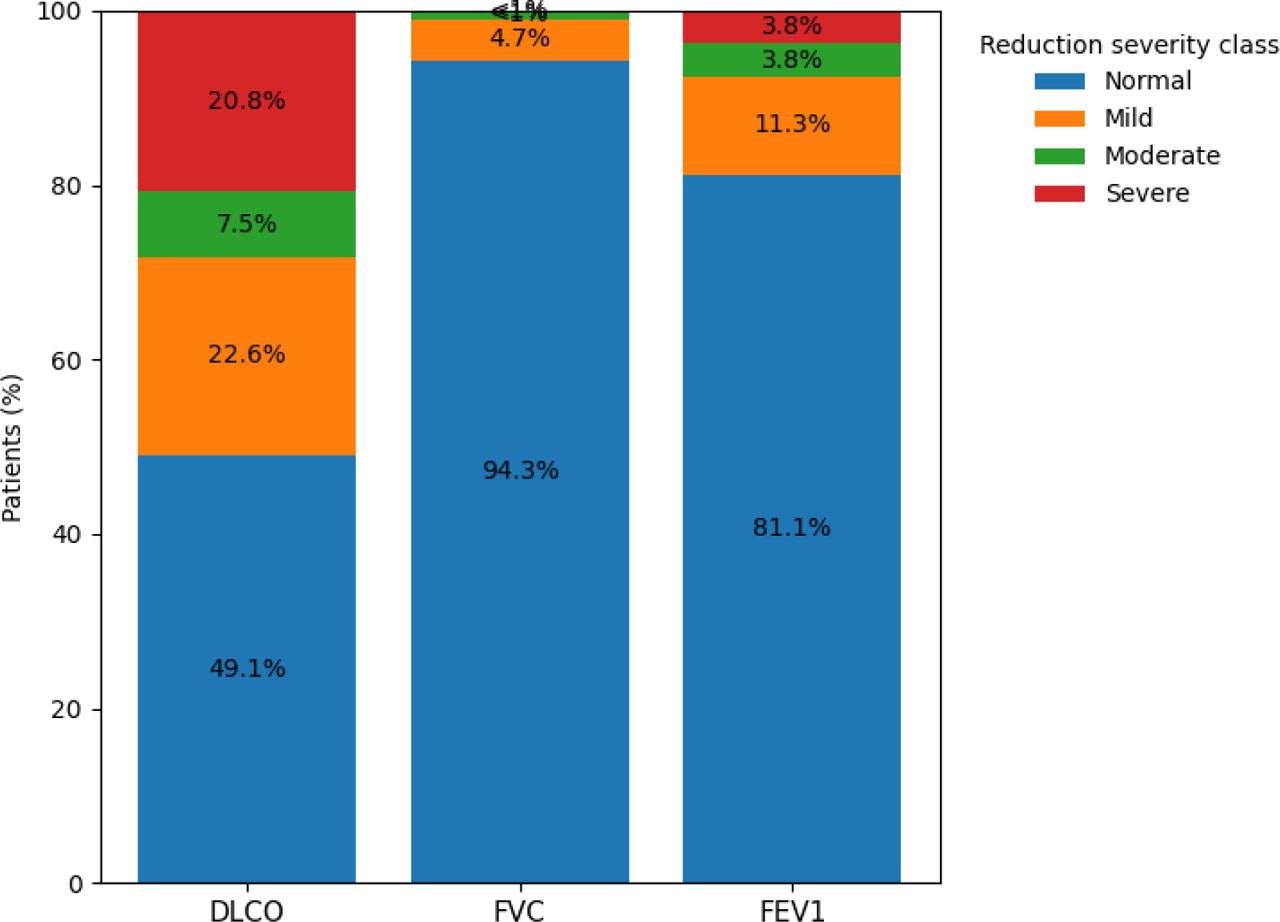
Figure 1.
Categories of decreased PFT measurements (DLCO, FVC, FEV1) based on z-scores: blue represents normal (z-score ≥ −1.645); orange, mildly reduced (−2.5 < z-score < −1.645); green, moderately reduced (−3.0 < z-score ≤ −2.5); and red, severely reduced (z-score ≤ −3.0).
Table 2
Pulmonary phenotype at PFT date
| all RA patients | n = 106 |
|---|---|
| dyspnea | 7.5% |
| cough | 0.9% |
| auscultatory rals | 21.7% |
| DLCO (%predicted) | 69 ± 23 |
| DLCO z score | −1.74 (−2.73; −0.90) |
| FVC (% predicted) | 102 ± 22 |
| FVC z score | 0.16 (−0.98; 0.86) |
| FEV1 (%predicted) | 89 ± 20 |
| FEV1 z score | −0.49 (−1.43; 0.31) |
| X-ray reticulations | 29.2% |
| X-ray bronchiectasis | 2.8% |
| X-ray emphysema | 4.7% |
| X-ray micro/nodules | 14.2% |
| RA patients with hrCT | n = 47 (44.3%) |
|---|---|
| ILD diagnosis | 51.1% |
| UIP (“honey comb” pattern) | 8.5% |
| NSIP (“ground glass” pattern) | 14.9% |
| hrCT other ILD pattern | 34.0% |
| hrCT emphysema | 21.3% |
| hrCT bronchiectasis | 34.0% |
| hrCT micro/nodules | 46.8% |
[i] Note: Normally-distributed continuous variables are reported as “mean ± SD”, while non-normally distributed variables are reported as “median (Q1; Q3)”.
[ii] Abbreviations: DLCO – Diffusing Capacity of the Lungs for Carbon Monoxide; FEV1 – forced expiratory volume; FVC – forced vital capacity; hrCT – high-resolution computed tomography; ILD – interstitial lung disease; NSIP – non-specific interstitial pneumonia; PFT – pulmonary function tests; Q1/3 – first or third quartile; RA – rheumatoid arthritis; UIP – usual interstitial pneumonia.
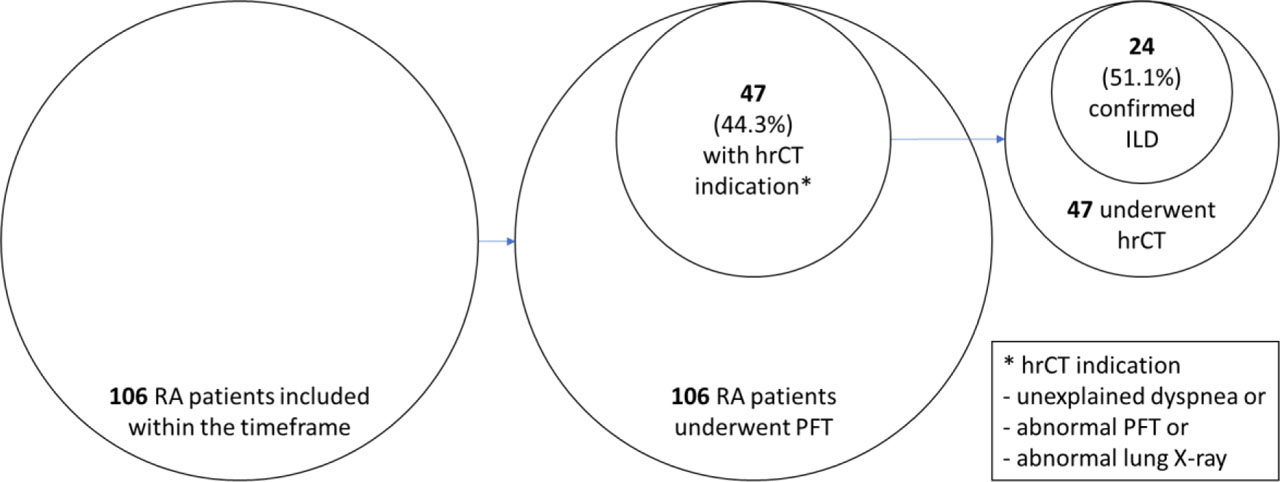
Figure 2.
Flow chart of rheumatoid arthritis (RA) patients and their investigations: all 106 patients underwent pulmonary function tests (PFT), 44.3% of them had indication for lung high-resolution computed tomography (hrCT) and 51.1% of the latter were diagnosed hrCT-confirmed interstitial lung disease (ILD).
Table 3
PFT associations and differences among RA patients (n = 106)
| bivariate correlations | rho | p | |
|---|---|---|---|
| DLCO | Age | −0.360 | 0.001* |
| DLCO | ESR at RA diagnosis | −0.259 | 0.033* |
| DLCO | ESR at PFT | −0.252 | 0.020* |
| FVC | Age | −0.263 | 0.016* |
| FVC | Duration of MTX exposure | −0.241 | 0.037* |
| FEV1 | Age | −0.368 | 0.025* |
| FEV1 | BMI | 0.646 | 0.007* |
| FEV1 | CRP at PFT | −0.317 | 0.046* |
| subgroup differences | |||
|---|---|---|---|
| normal or mildly reduced DLCO (n=72) | moderately or severely reduced DLCO (n=34) | p | |
| Age (years) | 63.0 ± 9.5 | 71.2 ± 7.4 | 0.001# |
| ESR at RA diagnosis (mm/h) | 39 ± 30 | 50 ± 26 | 0.063# |
| ESR at PFT (mm/h) | 27 ± 21 | 40 ± 23 | 0.006# |
| CRP at PFT (mg/L) | 3.7 (8.0) | 19.8 (21.8) | 0.061# |
| csDMARDs | 94.7% | 83.3% | 0.061& |
| dyspnea | 3.9% | 16.7% | 0.026& |
| hrCT-confirmed ILD | 16.5% | 36.7% | 0.019& |
| hrCT other ILD pattern | 11.3% | 40.0% | 0.035& |
| hrCT emphysema | 8.1% | 24.0% | 0.043& |
| hrCT micronodules | 22.6% | 44.0% | 0.046& |
[i] Notes: normally-distributed continuous variables are reported as “mean ± SD”, while non-normally-distributed continuous variables are reported as “median (IQR)”. P values represent significance of Spearman correlation indices (*), of Mann Whitney tests (#) or of χ2 tests (&).
[ii] Abbreviations: BMI – body mass index; CRP – C-reactive protein; DLCO – Diffusing Capacity of the Lungs for Carbon Monoxide; ESR – erythrocyte sedimentation rate; FEV1 – forced expiratory volume; FVC – forced vital capacity; IQR – interquartile range; MTX – methotrexate; PFT – pulmonary function tests; RA – rheumatoid arthritis; SD – standard deviation.
Table 4
Differences of PFT measures among various lung phenotype groups (n = 106)
| no dyspnea (n = 98) | with dyspnea (n = 8) | p | |
|---|---|---|---|
| DLCO (%) | 72 ± 20 | 45 ± 31 | 0.018 |
| RF negative (n = 25) | RF positive (n = 81) | ||
| FVC (%) | 111 ± 25 | 99 ± 21 | 0.046 |
| no X-ray bronchiectasis (n = 103) | X-ray bronchiectasis (n = 3) | ||
| FVC (%) | 103 ± 21 | 65 ± 22 | 0.029 |
| no glucocorticoids (n = 92) | glucocorticoids (n = 14) | ||
| FEV1 (%) | 92 ± 19 | 69 ± 14 | 0.021 |