
What is new? What is important?
This real-world study evaluates pragmatic screening for RA-associated ILD using routine spirometry, DLCO, chest radiography, and clinician-driven hrCT referral. Although pulmonary function abnormalities were common and correlated with inflammatory and structural disease features, PFT parameters showed poor discrimination for hrCT-confirmed ILD in the imaged subgroup, indicating that spirometry and DLCO alone are insufficient screening tools. The findings support an integrated approach combining clinical assessment, radiographic triggers, and PFT interpretation to guide hrCT use in everyday rheumatology practice, and provide data from an underrepresented Eastern European tertiary cohort.
1. INTRODUCTION
Interstitial lung disease (ILD) is one of the most clinically significant extra-articular manifestations of rheumatoid arthritis (RA), contributing substantially to morbidity and mortality. ILD affects approximately 5–10% of patients with RA in clinically overt forms, while subclinical involvement detectable through high-resolution computed tomography (hrCT) or pulmonary function testing (PFT) is considerably more frequent, occurring in up to 30–50% of cases depending on the population and diagnostic criteria used [1,2,3]. The most common radiologic and histopathologic pattern is usual interstitial pneumonia (UIP), followed by nonspecific interstitial pneumonia (NSIP), which is more frequent in other connective tissue diseases [4, 5]. Established risk factors include older age, male sex, smoking history, high titers of rheumatoid factor (RF) and anti-cyclic citrullinated peptide antibody (anti-CCP), as well as longer RA disease duration and higher inflammatory activity [6,7,8,9]. RA-ILD often has an insidious onset, with symptoms such as exertional dyspnea and dry cough, leading to diagnostic delays and worse outcomes. Prognosis is generally poor, especially in UIP-dominant phenotypes, with survival rates comparable to idiopathic pulmonary fibrosis (IPF) [10,11,12]. In the recent years have been seen advances in early detection strategies, including systematic screening protocols and risk prediction models, as well as new therapeutic options such as antifibrotic agents, alongside immunomodulatory therapy [10, 13,14,15]. Given its clinical impact, timely identification and management of ILD in RA is a growing priority in both rheumatology and respiratory medicine.
Pulmonary manifestations in RA are frequently underrecognized clinically in their early stages, despite their well-documented impact on disease burden and outcomes. Functional decline, particularly reductions in diffusing capacity for carbon monoxide (DLCO) and forced vital capacity (FVC), often precedes the onset of overt respiratory symptoms and may reflect subclinical parenchymal changes detectable by hrCT [1, 14, 16]. Although prior studies have identified demographic and serologic factors associated with ILD in RA, the precise interplay between pulmonary function, clinical characteristics, and specific imaging patterns remains incompletely understood, particularly in unselected, real-world populations [3, 6, 17]. Furthermore, ILD can coexist with other pulmonary manifestations such as airway disease, emphysema, or bronchiectasis, which may influence PFT results and clinical presentation [18, 19]. A more refined understanding of how functional impairment relates to clinical and radiologic features of RA may support earlier ILD detection, risk stratification, and individualized management strategies.
Despite growing interest in RA-associated ILD screening, the extent to which routine pulmonary function abnormalities reflect hrCT-confirmed ILD in real-world RA populations remains unclear. We hypothesized that impaired pulmonary function would be associated with a more severe RA phenotype and with a higher likelihood of hrCT-confirmed ILD. Therefore, this study aimed to characterize patterns of pulmonary function in RA, explore their clinical and serologic correlates, and identify factors associated with hrCT-confirmed ILD.
2. MATERIALS AND METHODS
2.1. PATIENTS
Between February and April 2025, this cross-sectional observational study included all consecutive eligible adult patients diagnosed with RA by experienced rheumatologists, also fulfilling the 2010 ACR/EULAR classification criteria for RA [20], from a tertiary university rheumatology center in Romania with nationwide referral coverage. Exclusion criteria were previously hr-CT diagnosed or previously treated RA-associated ILD, known pulmonary conditions unrelated to RA (e.g., lung cancer, active/chronic infection, asthma or chronic obstructive pulmonary disease), recent respiratory exacerbations, significant cardiac disease likely to influence pulmonary function (e.g., severe heart failure), overlap syndromes with other rheumatic inflammatory/autoimmune diseases, incapacity to perform PFT or incomplete clinical or imaging data. Apart from routine management, all included patients underwent ILD screening with PFT and standard anteroposterior thoracic X-ray within the timeframe, irrespective of the presence or absence of respiratory symptoms. Demographic characteristics, disease-related variables, treatment history, and pulmonary findings were extracted from medical records and structured electronic databases. The study was conducted in accordance with the Declaration of Helsinki and approved by the institutional ethics committee. All patients provided written informed consent for the use of their clinical and imaging data for research purposes.
2.2. RA EVALUATION
Clinical evaluation included age, sex, disease duration, smoking history, and treatment exposure. Disease activity at RA diagnosis and at the time of PFT was assessed using Disease Activity Score 28 (DAS28) by each attending physician, using both inflammatory markers (erythrocyte sedimentation rate – ESR and C-reactive protein – CRP), which were recorded at both time points. Serologic status was determined by the presence of rheumatoid factor (RF) and anti-cyclic citrullinated peptide antibody (anti-CCP). Medication history included current and past use of conventional synthetic, biologic or targeted synthetic disease-modifying antirheumatic drugs (cs/b/tsDMARDs), and glucocorticoids.
2.3. PFT
All patients underwent PFT, which were performed by a single trained author (GD) using standardized spirometry and diffusing capacity measurement protocols in accordance with American Thoracic Society – European Respiratory Society (ATS/ERS) guidelines [21, 22]. Parameters assessed included forced vital capacity (FVC), forced expiratory volume in one second (FEV1), and diffusing capacity for carbon monoxide (DLCO), expressed as percentages of predicted values and z-scores. Values were adjusted for age, sex, height, weight and hemoglobin level. The presence of clinically significant impairment was defined according to ATS/ERS reference standards [23]: for each PFT parameter (DLCO, FVC, FEV1), the lower limit of normal (LLN, corresponding to the 5th percentile or z = −1.645) was used to define abnormality. Percent of predicted values of PFT parameters were used descriptively, while z-scores were used for classification: normal was defined as a z-score ≥ −1.645, mildly reduced z-score between −1.645 and −2.5, moderately reduced-score between −2.5 and −3.0 and severely reduced z-score < −3.0.
2.4. hrCT
Patients with unexplained dyspnea, abnormal PFT results or abnormal standard lung X-rays findings were selected to undergo thoracic hrCT (indication for hrCT, as formulated by each attending rheumatologist in real-life clinical setting). Accordingly, hrCT served as a first-line diagnostic investigation for suspected ILD in this cohort. The scans were acquired without contrast media, using a multi-detector CT scanner with patients in the supine position, during full inspiration, and at end-inspiratory lung volume. Image acquisition covered the entire thorax from lung apices to costophrenic angles. Scans were interpreted independently by experienced radiologists blinded to clinical and PFT data. ILD was defined by the presence of interstitial abnormalities consistent with fibrotic or inflammatory lung involvement. Radiologic patterns were classified according to American Thoracic Society / European Respiratory Society criteria [24] into usual interstitial pneumonia (UIP), nonspecific interstitial pneumonia (NSIP), and other ILD patterns. Additional features, including emphysema, bronchiectasis, honeycombing, and nodular or micronodular changes, were systematically recorded.
2.5. STATISTICAL ANALYSIS
Continuous variables were summarized as “mean ± standard deviation” (SD) and “median (first quartile; third quartile)”, depending on normality of distribution (which was assessed using the Shapiro-Wilk test and visual inspection), while categorical variables were expressed as percentages of sub/groups. Group comparisons were performed using Mann-Whitney U tests for continuous variables and the χ2 or Fisher’s exact test for categorical variables, as appropriate. Correlations between PFT parameters (DLCO, FVC, FEV1) and clinical or laboratory variables were analyzed using Spearman’s rank correlation coefficients.
To identify RA-related factors associated with hrCT-confirmed ILD, multivariable logistic regression was performed in the subgroup of patients who underwent hrCT. The dependent variable was hrCT-confirmed ILD (yes/no). Candidate predictors were taken from the available dataset (age, sex, smoking status, RA duration, RF/ACPA serology, radiographic stage, treatment exposures, and inflammatory measures). The limited number of events restricts the number of predictors that could be safely included in regression models. Because ESR, CRP, and DAS28-CRP are collinear, these were not included simultaneously in multivariable models. To minimize overfitting given the limited number of non-ILD cases, parsimonious models were prioritized and the final model was selected using Akaike’s Information Criterion corrected for small samples (AICc). Adjusted odds ratios (OR) with 95% confidence intervals (CI) are reported. Model discrimination was assessed using the area under the ROC curve (AUC), with 95% CIs derived by nonparametric bootstrap resampling (4000 iterations).
Receiver operating characteristic (ROC) analyses were performed to evaluate the ability of continuous PFT z-scores (DLCO, FVC, and FEV1) to discriminate between patients with and without hrCT-confirmed ILD. AUCs were calculated with 95% CI using the DeLong method. The optimal cutoff for each PFT parameter was determined using the Youden index. Cutoff uncertainty was quantified using nonparametric bootstrap resampling (4000 iterations), with the 2.5th and 97.5th percentiles defining the 95% CI. Sensitivity and specificity were reported at the optimal cutoff. A two-sided p value < 0.05 was considered statistically significant. All analyses were performed using IBM SPSS Statistics (version 26.0; IBM).
Because hrCT was performed only in patients selected based on clinical and paraclinical findings, analyses involving hrCT-confirmed ILD were restricted to a clinically enriched subgroup. Therefore, estimates of prevalence and diagnostic performance (AUC, sensitivity, specificity) should be interpreted as conditional on hrCT referral rather than as reflecting performance in an unselected RA population.
3. RESULTS
3.1. DEMOGRAPHICS, RA AND LUNG PHENOTYPES (n=106)
A total of 106 patients with RA were included in the analysis (Table 1). The majority were women (81.1%), with a mean age of 65.3±9.7 years and a mean body mass index (BMI) of 28.1±5.9 kg/m2. A history of smoking (ever) was reported by 35.8% of participants.
Table 1
General characteristics of the sample (n = 106)
| Characteristics | Value |
|---|---|
| women | 81.1% |
| age (years) | 65.3 ± 9.7 |
| BMI (kg/m2) | 28.1 ± 5.9 |
| smoking (ever) | 35.8% |
| ACPA positive | 73.6% |
| RF positive | 76.4% |
| RA duration at PFT (years) | 14.1 ± 11.9 |
| ESR at RA diagnosis (mm/h) | 42 ± 29 |
| CRP at RA diagnosis (mg/L) | 9.9 (3.5; 23.4) |
| TJC28 at RA diagnosis | 8 (4; 13) |
| SJC28 at RA diagnosis | 5 (1; 8) |
| PtGA at RA diagnosis (mm) | 64 ± 24 |
| PhGA at RA diagnosis (mm) | 49 ± 26 |
| DAS28 at RA diagnosis | 4.8 ± 1.4 |
| DAS28 at RA diagnosis | 5.2 ± 1.2 |
| ESR at PFT (mm/h) | 31 ± 22 |
| CRP at PFT (mg/L) | 3.9 (2.0; 11.8) |
| DAS28 at PFT | 3.7 ± 1.5 |
| DAS28 at PFT | 3.5 ± 1.4 |
| Steinbrocker radiographic stage 1 at PFT | 19.8% |
| Steinbrocker radiographic stage 2 at PFT | 45.3% |
| Steinbrocker radiographic stage 3 at PFT | 17.9% |
| Steinbrocker radiographic stage 4 at PFT | 17.0% |
| csDMARD at PFT | 90.6% |
| duration of MTX exposure at PFT (months) | 48 (13; 108) |
| b/tsDMARD | 47.2% |
| oral glucorticoids | 13.2% |
[i] Notes: Normally-distributed continuous variables are reported as “mean ± SD”, while non-normally-distributed continuous variables are reported as “median (Q1; Q3)”. Normal CRP < 5 mg/L.
[ii] Abbreviations: ACPA – anti-citrullinated protein antibodies; BMI – body mass index; b/tsDMARD – biologic or targeted synthetic disease-modifying antirheumatic drugs; CRP – C-reactive protein; csDMARD – conventional synthetic disease-modifying antirheumatic drugs; ESR – erythrocyte sedimentation rate; MTX – methotrexate; PFT – pulmonary function tests; PhGA – physician global assessment; PtGA – patient global assessment; Q1/3 – first or third quartile; RA – rheumatoid arthritis; RF – rheumatoid factor; SD – standard deviation; SJC – swollen joint count; TB – tuberculosis; TJC – tender joint count.
Regarding RA characteristics at the time of PFT (Table 1), 73.6% of patients were positive for ACPA and 76.4% for RF. The mean RA disease duration was 14.1±11.9 years. Radiographic staging at the time of PFT was distributed as follows: stage 1 for 19.8% of patients, stage 2 for 45.3%, stage 3 for 17.9%, and stage 4 for 17.0%. Disease activity was low to moderate, with a mean DAS28CRP of 3.7±1.5. Most patients were receiving csDMARDs (90.6%), nearly half were treated with b/tsDMARDs (47.2%), and 13.2% were on oral glucocorticoids.
Pulmonary status at the time of PFT was characterized by a low prevalence of respiratory symptoms (Table 2): 7.5% of patients reported dyspnea, 0.9% reported cough, whereas auscultatory rales were present in 21.7%. Pulmonary function parameters showed heterogeneous patterns of impairment in the cohort. Mean DLCO was reduced (69±23% of predicted), with a median z-score of −1.74 (−2.73; −0.90). In contrast, mean FVC remained within normal limits (102±22% of predicted), with a median z-score of 0.16 (−0.98; 0.86). FEV1 was modestly reduced overall (89±20% of predicted), with a median z-score of −0.49 (−1.43; 0.31). Figure 1 reports the severity class of PFT parameters.
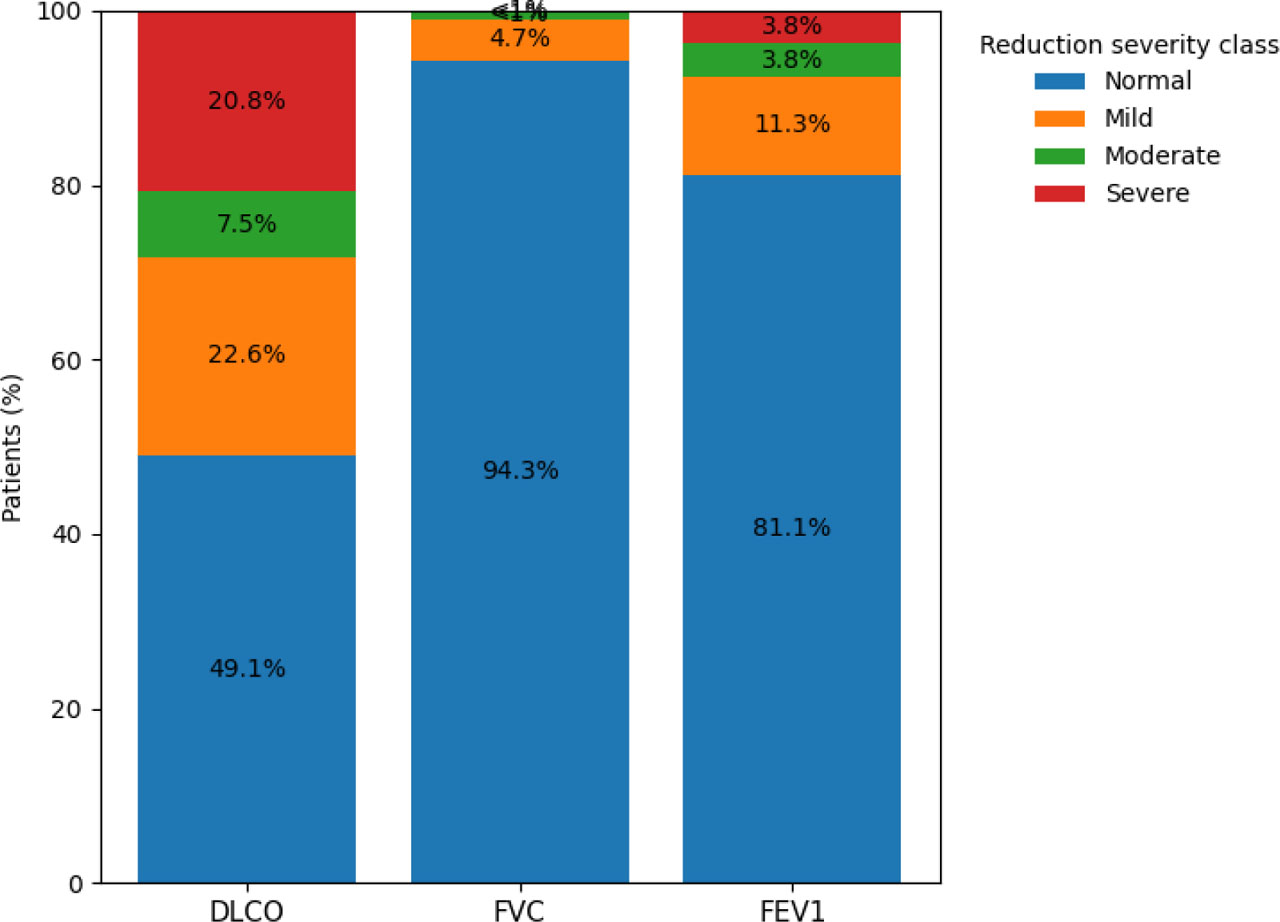
Figure 1.
Categories of decreased PFT measurements (DLCO, FVC, FEV1) based on z-scores: blue represents normal (z-score ≥ −1.645); orange, mildly reduced (−2.5 < z-score < −1.645); green, moderately reduced (−3.0 < z-score ≤ −2.5); and red, severely reduced (z-score ≤ −3.0).
Table 2
Pulmonary phenotype at PFT date
| all RA patients | n = 106 |
|---|---|
| dyspnea | 7.5% |
| cough | 0.9% |
| auscultatory rals | 21.7% |
| DLCO (%predicted) | 69 ± 23 |
| DLCO z score | −1.74 (−2.73; −0.90) |
| FVC (% predicted) | 102 ± 22 |
| FVC z score | 0.16 (−0.98; 0.86) |
| FEV1 (%predicted) | 89 ± 20 |
| FEV1 z score | −0.49 (−1.43; 0.31) |
| X-ray reticulations | 29.2% |
| X-ray bronchiectasis | 2.8% |
| X-ray emphysema | 4.7% |
| X-ray micro/nodules | 14.2% |
| RA patients with hrCT | n = 47 (44.3%) |
|---|---|
| ILD diagnosis | 51.1% |
| UIP (“honey comb” pattern) | 8.5% |
| NSIP (“ground glass” pattern) | 14.9% |
| hrCT other ILD pattern | 34.0% |
| hrCT emphysema | 21.3% |
| hrCT bronchiectasis | 34.0% |
| hrCT micro/nodules | 46.8% |
[i] Note: Normally-distributed continuous variables are reported as “mean ± SD”, while non-normally distributed variables are reported as “median (Q1; Q3)”.
[ii] Abbreviations: DLCO – Diffusing Capacity of the Lungs for Carbon Monoxide; FEV1 – forced expiratory volume; FVC – forced vital capacity; hrCT – high-resolution computed tomography; ILD – interstitial lung disease; NSIP – non-specific interstitial pneumonia; PFT – pulmonary function tests; Q1/3 – first or third quartile; RA – rheumatoid arthritis; UIP – usual interstitial pneumonia.
Of the total of 106 patients, 47 (44.3%) patients had indication for lung hrCT and, among these, 24 (51.1%) patients were diagnosed with hrCT-confirmed ILD (Figure 2). All hrCT-confirmed ILD cases identified during the study period represented newly detected ILD. The reasons for indicating hrCT among the 47 patients were clinical symptoms and signs (dyspnea, cough, or pulmonary rals) for 48.9%, radiographic abnormalities on chest X-ray for 85.1% and abnormal PFT results (DLCO, FVC, or FEV1) for 55.3%, while 14.9% of these patients had all three categories of abnormalities (clinical, radiographic and PFT). Among the 47 patients who underwent hrCT, interstitial and airway abnormalities were frequent: honeycombing was present for 8.5% of scans, ground-glass opacities for 14.9%, and other ILD patterns for 34.0%. Similarly, emphysema was identified for 21.3% of patients, bronchiectasis for 34.0%, and micronodules or nodular changes for 46.8%.
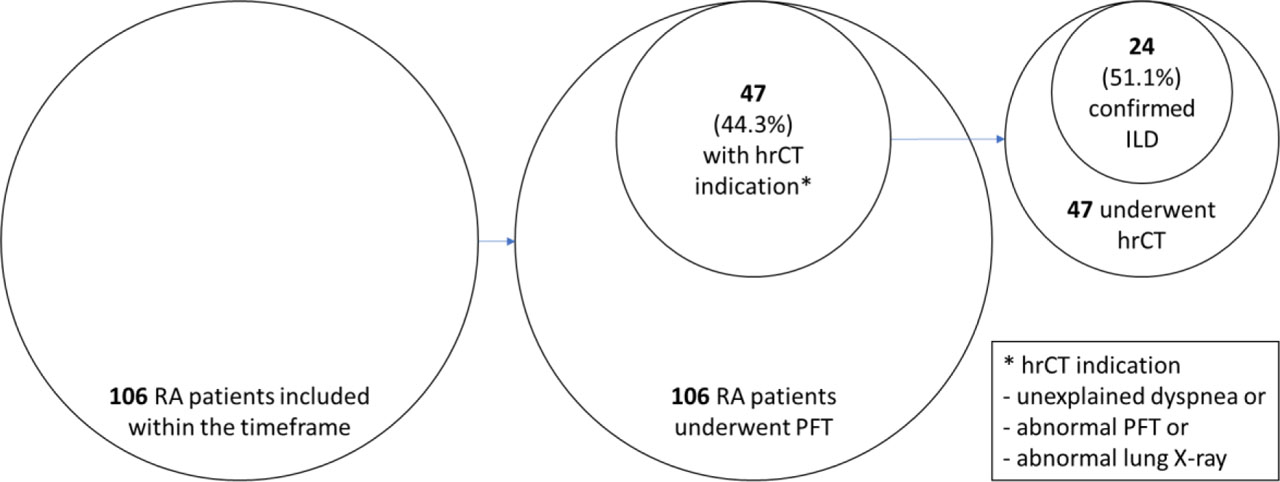
Figure 2.
Flow chart of rheumatoid arthritis (RA) patients and their investigations: all 106 patients underwent pulmonary function tests (PFT), 44.3% of them had indication for lung high-resolution computed tomography (hrCT) and 51.1% of the latter were diagnosed hrCT-confirmed interstitial lung disease (ILD).
3.2. PFT AND RA PHENOTYPE (n=106)
Significant correlations were observed between PFT parameters and clinical as well as RA-related variables (Table 3). DLCO showed a moderate negative correlation with age (ρ=−0.360; p=0.001), ESR at RA diagnosis (ρ=−0.259; p=0.033), and ESR at the time of PFT (ρ=−0.252; p=0.020). FVC was inversely correlated with age (ρ=−0.263; p=0.016) and with the duration of methotrexate exposure (ρ=−0.241; p=0.037). FEV1 was negatively associated with age (ρ=−0.368; p=0.025) and CRP at PFT (ρ=−0.317; p=0.046), and positively associated with BMI (ρ=0.646; p=0.007).
Table 3
PFT associations and differences among RA patients (n = 106)
| bivariate correlations | rho | p | |
|---|---|---|---|
| DLCO | Age | −0.360 | 0.001* |
| DLCO | ESR at RA diagnosis | −0.259 | 0.033* |
| DLCO | ESR at PFT | −0.252 | 0.020* |
| FVC | Age | −0.263 | 0.016* |
| FVC | Duration of MTX exposure | −0.241 | 0.037* |
| FEV1 | Age | −0.368 | 0.025* |
| FEV1 | BMI | 0.646 | 0.007* |
| FEV1 | CRP at PFT | −0.317 | 0.046* |
| subgroup differences | |||
|---|---|---|---|
| normal or mildly reduced DLCO (n=72) | moderately or severely reduced DLCO (n=34) | p | |
| Age (years) | 63.0 ± 9.5 | 71.2 ± 7.4 | 0.001# |
| ESR at RA diagnosis (mm/h) | 39 ± 30 | 50 ± 26 | 0.063# |
| ESR at PFT (mm/h) | 27 ± 21 | 40 ± 23 | 0.006# |
| CRP at PFT (mg/L) | 3.7 (8.0) | 19.8 (21.8) | 0.061# |
| csDMARDs | 94.7% | 83.3% | 0.061& |
| dyspnea | 3.9% | 16.7% | 0.026& |
| hrCT-confirmed ILD | 16.5% | 36.7% | 0.019& |
| hrCT other ILD pattern | 11.3% | 40.0% | 0.035& |
| hrCT emphysema | 8.1% | 24.0% | 0.043& |
| hrCT micronodules | 22.6% | 44.0% | 0.046& |
[i] Notes: normally-distributed continuous variables are reported as “mean ± SD”, while non-normally-distributed continuous variables are reported as “median (IQR)”. P values represent significance of Spearman correlation indices (*), of Mann Whitney tests (#) or of χ2 tests (&).
[ii] Abbreviations: BMI – body mass index; CRP – C-reactive protein; DLCO – Diffusing Capacity of the Lungs for Carbon Monoxide; ESR – erythrocyte sedimentation rate; FEV1 – forced expiratory volume; FVC – forced vital capacity; IQR – interquartile range; MTX – methotrexate; PFT – pulmonary function tests; RA – rheumatoid arthritis; SD – standard deviation.
Patients with dyspnea had markedly lower DLCO compared to those without dyspnea (45±31% versus 72±20%; p=0.018; Table 4). RF-positive patients demonstrated reduced FVC relative to RF-negative individuals (99±21% versus 111±25%; p=0.046). Radiographic abnormalities were associated with impaired lung function: FVC was significantly lower in patients with X-ray bronchiectasis compared to those without (65±22% versus 103±21%; p=0.029). Patients receiving glucocorticoids had lower FEV1 than those not treated with glucocorticoids (69±14% versus 92±19%; p=0.021).
Table 4
Differences of PFT measures among various lung phenotype groups (n = 106)
| no dyspnea (n = 98) | with dyspnea (n = 8) | p | |
|---|---|---|---|
| DLCO (%) | 72 ± 20 | 45 ± 31 | 0.018 |
| RF negative (n = 25) | RF positive (n = 81) | ||
| FVC (%) | 111 ± 25 | 99 ± 21 | 0.046 |
| no X-ray bronchiectasis (n = 103) | X-ray bronchiectasis (n = 3) | ||
| FVC (%) | 103 ± 21 | 65 ± 22 | 0.029 |
| no glucocorticoids (n = 92) | glucocorticoids (n = 14) | ||
| FEV1 (%) | 92 ± 19 | 69 ± 14 | 0.021 |
3.3. ILD AND RA PHENOTYPE (n=47)
In the hrCT-imaged cohort (n=47; 24 ILD and 23 non-ILD), only two variables differed significantly between patients with and without hrCT-confirmed ILD. Swollen joint count at RA diagnosis was significantly higher in the ILD group (median 8.5; 5.75–9.75) compared with the non-ILD group (median 1.0; 0.0–2.0; p=0.008). In addition, chest radiographic emphysema was observed only among non-ILD patients (4/23, 17.4%) and in none of the ILD cases (0/24, 0.0%; p=0.040).
In the AICc-selected parsimonious multivariable logistic regression model of hr-CT ILD, age (OR 1.03 per year; 95% CI 0.94–1.11), smoking history (OR 1.51; 95% CI 0.40–5.66), and DAS28-CRP (OR 1.24 per unit; 95% CI 0.80–1.94) were not independently associated with hrCT-confirmed ILD (all p > 0.05). Overall discrimination of the model was modest (AUC 0.634; bootstrap 95% CI 0.451–0.807).
These findings apply to the hrCT-referred subgroup and reflect associations within this clinically enriched population rather than the entire RA cohort. Also, these regression findings should be interpreted as exploratory, given the limited sample size and wide 95% CI in the hrCT subgroup.
3.4. PFT PERFORMANCE TO IDENTIFY HR-CT ILD (n=47)
In the hrCT-imaged subgroup (n=47; 24 ILD and 23 non-ILD), ROC analyses using continuous PFT z-scores showed poor discrimination for hrCT-confirmed ILD. DLCO z-score performed worst, with an AUC of 0.431 (95% CI 0.255–0.603); the Youden-optimal threshold (z ≤ −0.51) yielded high sensitivity (95.5%) but very low specificity (13.0%). FVC z-score showed only marginal discrimination (AUC 0.562, 95% CI 0.387–0.731), with an optimal cutoff of z ≤ 0.48 corresponding to sensitivity 87.0% and specificity 34.8%. Similarly, FEV1 z-score demonstrated poor performance (AUC 0.444, 95% CI 0.277–0.619), with an optimal cutoff of z ≤ 0.31 providing sensitivity 91.3% and specificity 17.4%. These diagnostic accuracy estimates reflect performance within a clinically selected, high pre-test probability subgroup and may not be generalizable to unselected RA populations. Likewise, the diagnostic performance estimates derived from the hrCT subgroup should be regarded as exploratory and specific to this clinically selected population.
4. DISCUSSION
4.1. RA SAMPLE AND PHENOTYPE
In this cohort of 106 RA patients, the majority were older women with overweight BMI and a substantial burden of seropositivity and disease duration, most patients were receiving csDMARDs, and nearly half were on b/tsDMARDs, despite of which disease activity at the time of PFT was generally low to moderate. The demographic and disease profile of this cohort aligns with typical RA populations described in contemporary epidemiologic studies, where older age, female predominance, and high rates of RF/ACPA seropositivity are common [25, 26]. The substantial proportion of patients with long-standing disease and advanced radiographic stages reflects a population at increased risk for extra-articular manifestations, including ILD [3, 12]. Low-to-moderate disease activity at the time of assessment is consistent with widespread DMARD use, yet persistent inflammation remains a known contributor to pulmonary involvement [27, 28]. The high seropositivity rates are clinically relevant, as RF and ACPA titers are strongly associated with RA-ILD development and progression [6, 7, 29]. Therefore, the clinical phenotype observed in this study corresponds to a well-recognized high-risk RA sample for ILD, supporting the relevance of comprehensive respiratory evaluation in such patients.
4.2. CLINICAL PULMONARY FINDINGS IN RA
In this cohort, respiratory symptoms were infrequent, with only 7.5% of patients reporting dyspnea and 1% reporting cough, despite the presence of auscultatory rales in 21.7%. Such low symptom prevalence is consistent with prior evidence demonstrating that RA-associated ILD is frequently subclinical, particularly in early or mild forms [3, 30]. Studies using systematic hrCT screening have shown that up to one-third of RA patients with imaging-confirmed ILD deny respiratory symptoms, highlighting the poor sensitivity of symptom-based screening [2, 16]. Similarly, auscultatory crackles lack sensitivity but retain moderate specificity for fibrotic ILD in RA [31, 32]. The discordance between symptoms and objective abnormalities suggests that clinical questioning and examination alone underestimates early pulmonary involvement, reinforcing the importance of routine PFT and targeted hrCT screening in RA patients, as also emphasized in the 2023 Delphi consensus on RA-ILD screening [33].
4.3. X-RAY PULMONARY FINDINGS IN RA
In our cohort, chest radiography revealed reticulations in 29.2% of patients, while micronodules (14.2%), emphysema (4.7%) and bronchiectasis (2.8%) were identified far less frequently. These findings are consistent with prior evidence showing that chest X-ray has low sensitivity for early or mild interstitial lung abnormalities, often missing disease that is readily detectable on hrCT [34, 35]. Reticular opacities on radiography typically reflect more established interstitial involvement, whereas subtle ground-glass changes and early fibrosis frequently remain radiographically occult [36]. Similarly, bronchiectasis and emphysema are also under-recognized on X-ray compared with hrCT, which can detect airway and parenchymal changes even when radiographs appear normal [37]. The relatively modest prevalence of radiographic abnormalities in this study therefore likely underestimates the true burden of pulmonary structural disease, reinforcing current recommendations that radiography should not be relied upon as a primary screening tool for RA-associated ILD [33].
4.4. PFT IN RA
In this cohort, mean DLCO was reduced, it was correlated negatively with current ESR and it was more frequently reduced among patients with dyspnea. Reduced DLCO is a well-established functional hallmark of early and established RA-associated ILD, reflecting impaired alveolar-capillary diffusion due to interstitial inflammation or fibrosis. Prior studies show that DLCO is often the earliest abnormal PFT parameter in RA and correlates strongly with inflammatory activity and hrCT abnormalities [2, 16, 38, 39]. The observed association between lower DLCO and elevated ESR supports the concept that systemic inflammation contributes to diffusion impairment, consistent with earlier work linking inflammatory markers to reduced gas-exchange efficiency [3]. The markedly lower DLCO in symptomatic patients aligns with evidence that diffusion defects correlate more strongly with dyspnea than spirometric reductions [4]. In this context, our observation reinforces DLCO as a sensitive and clinically relevant tool for detection of pulmonary involvement in RA.
On the contrary, mean FVC was normal, but FVC declined with longer methotrexate exposure, RF-positivity and X-ray bronchiectasis presence. Associations of FVC with seropositivity and X-ray structural abnormalities indicate that restrictive impairment may be present in at-risk subgroups and that that FVC may provide relevant structural correlates even when its mean values appear preserved. Reduced FVC in RF-positive patients aligns with the strong link between autoantibody positivity and more severe pulmonary manifestations, including ILD and airway disease [6, 7]. The association between lower FVC and bronchiectasis mirrors earlier findings showing that airway involvement is frequent in RA and can produce mixed restrictive-obstructive abnormalities [34]. The inverse correlation between methotrexate exposure and FVC should be interpreted cautiously, as observational studies have generally not supported MTX as a causative factor for chronic ILD [29] and even suggest that ILD may be detected later in methotrexate-treated patients [40, 41]. Methotrexate exposure likely reflects cumulative treatment duration and, indirectly, long-standing or more severe disease, rather than a direct drug-related pulmonary effect. In contrast, DAS28-CRP captures current inflammatory activity and may not adequately represent cumulative inflammatory burden over time, while disease duration alone does not account for treatment intensity or disease severity. Therefore, methotrexate exposure may act as a surrogate marker of cumulative disease burden, which has been linked to pulmonary involvement in RA. Therefore, the present finding should be interpreted as non-causal and hypothesis-generating, potentially reflecting confounding by indication.
Lastly, FEV1 was modestly reduced overall and it was correlated negatively with current CRP and current use of glucocorticoids. FEV1 reduction in RA often reflects small-airway disease, bronchiectasis, or airway-centric inflammatory changes and it may accompany or precede ILD. Prior hrCT-based studies report high rates of airway abnormalities in RA, including bronchial wall thickening and bronchiectasis, which contribute to impaired airflow [35, 42]. The negative correlation between FEV1 and CRP supports the contribution of systemic inflammation to airway dysfunction, consistent with findings linking elevated CRP to worsened airflow parameters [43]. Lower FEV1 among glucocorticoid-treated patients may reflect disease activity rather than a medication effect, as they are typically prescribed in more active RA cases. Given these observations, FEV1 appears to capture both obstructive and restrictive components of RA-related ILD, complementing DLCO and FVC.
Our diagnostic accuracy analysis demonstrated that PFT abnormalities, even when defined rigorously using z-scores, offer only limited capacity to discriminate RA patients with hrCT-confirmed ILD. Although DLCO had the highest sensitivity among individual parameters, it’s very low specificity underscores its well-known susceptibility to non-interstitial factors such as anemia, pulmonary vascular changes, or emphysema, as documented in prior RA-ILD studies [3, 44]. In contrast, the markedly high sensitivity of FVC mirrors findings that restrictive physiology reflects more advanced or fibrotic disease [8], yet its poor specificity (12.5%) confirms that FVC remains normal in many patients with early or mild RA-ILD. The low diagnostic performance of FEV1 aligns with previous work showing that airflow parameters are influenced by airway disease and do not reliably detect ILD [34, 45]. ROC values confirm that PFTs alone lack sufficient discriminatory power to serve as standalone screening tools for ILD in RA, which is consistent with expert consensus that PFTs should complement, rather than replace, hrCT in at-risk populations [33, 46].
4.5. hrCT INDICATION IN RA PATIENTS
In our cohort, the indication for hrCT was based on a pragmatic, real-life strategy: patients were referred for thoracic hrCT in the presence of unexplained dyspnea, abnormal PFT results or abnormal chest X-ray, at the discretion of the attending rheumatologist. This approach reflects current routine practice and overlaps with several domains that have been incorporated into recently proposed RA-ILD risk scores and formalized indications for hrCT: family history of (RA-associated) ILD [33, 47], age [29, 30, 33, 47, 48], male sex [29, 33, 47,48,49,50], smoking [30, 33, 47,48,49,50], long RA disease duration [47], RF/ACPA positivity [30, 33, 47, 48, 50], RA extra-articular manifestations [49], persistent RA activity on composite scores [29, 33, 47,48,49], ESR/CRP [49, 50], respiratory signs and symptoms [33, 47], PFT [33], and genetic/biologic markers [29, 48, 50]. Our strategy therefore captures a high-risk subset defined by “downstream” manifestations (symptoms, abnormal PFT, abnormal X-ray), but likely underestimates the burden of truly subclinical ILD that might be detected by applying risk-scores or systematic hrCT in asymptomatic but high-risk individuals. From a clinical perspective, this trade-off aims to balance accessibility, feasibility, radiation exposure and cost against sensitivity, but it also means that our ILD prevalence and pattern distribution should be interpreted as estimates in a symptom- and test-enriched subgroup rather than a fully screened RA population. The fact that an established RA-ILD risk score was not used to determine which patients should undergo hrCT arose from the observation that most currently available cited tools were derived or validated in highly specific populations and frequently incorporate elements that are not routinely available in many real-world rheumatology centers, especially in Eastern Europe. In contrast, our hrCT indications were based on routinely accessible clinical triggers which directly overlap with the central domains embedded within these risk scores. This clinician-driven approach therefore reflects a pragmatic and feasible strategy aligned with consensus recommendations, while remaining applicable across diverse resource settings. Although the indication for hrCT was determined by the attending rheumatologist, potential center-dependent variability was minimized because the criteria were homogeneous, pre-specified, and consistently applied within a single tertiary rheumatology unit. Importantly, this clinician-driven approach reflects how current Delphi-based recommendations are intended to be operationalized in real-world practice [33]. Importantly, our dataset offers an opportunity for future work to externally test or adapt existing RA-ILD risk scores in an Eastern European, real-life RA population, where such validation efforts are currently lacking.
4.6. ILD IN RA
In our cohort, 44.3% of RA patients met clinically driven criteria for thoracic hrCT, and among these, just over half (51.1%) had hrCT-confirmed ILD. This translates into an ILD prevalence of approximately 22.6% in the overall sample, which sits at the upper end of estimates reported in contemporary literature and well within the wide range described for RA-ILD (3–42%) [51]. Recent meta-analytic data suggest a global pooled prevalence of RA-ILD around 20–22% when diagnosis is based on hrCT [51], which is highly consistent with our findings. Importantly, our use of hrCT was restricted to patients with symptoms, abnormal PFT, or abnormal chest X-ray, which likely enriched the scanned subgroup for ILD, explaining the high proportion of ILD among those imaged, while at the same time risking under-detection of subclinical disease in asymptomatic patients who did not undergo hrCT. So, our prevalence estimate should be interpreted as reflecting the burden of ILD in a real-world, selectively imaged population, rather than the true frequency of radiologic abnormalities in all RA patients.
Elevated swollen joint at disease onset of patients with hr-CT ILD reinforce the contribution of persistent or intense systemic inflammation to ILD development, consistent with studies showing that higher RA disease activity and inflammatory markers are associated with an increased ILD risk and progression [6,7,8].
Seeing emphysema on chest radiography only in the non-ILD group (17.4% vs 0%) likely reflects misclassification by modality and competing explanations for abnormal PFT/respiratory findings in a clinician-selected hrCT cohort. Chest X-ray is insensitive for both mild emphysema and early interstitial abnormalities; when emphysema is visible on radiography, it usually represents more established airspace destruction and may drive symptoms, auscultatory findings, and diffusion impairment in the absence of ILD, thereby increasing the likelihood of hrCT referral in patients who ultimately have “non-ILD” diagnoses on hrCT. In RA specifically, emphysema and airway disease can occur as part of RA-associated lung disease (sometimes independent of ILD) and can also coexist with ILD; however, emphysema is more reliably detected and characterized on hrCT rather than radiography, and radiographic emphysema may therefore identify a subset whose pulmonary phenotype is predominantly airway/emphysema rather than interstitial involvement [52].
In the hrCT-referred subgroup, age, smoking history, and contemporaneous disease activity (DAS28-CRP) were not independently associated with hrCT-confirmed ILD, and overall discrimination was modest. This likely reflects: referral enrichment and partial-verification structure, whereby both ILD and non-ILD patients undergoing hrCT already had pulmonary triggers and shared upstream risk factors; limited power with wide CI that cannot exclude clinically meaningful effects; and the fact that DAS28-CRP captures current inflammatory activity rather than cumulative inflammatory burden. Collectively, these findings suggest that within clinically selected hrCT cohorts, readily available clinical predictors may have limited incremental value for discriminating ILD from alternative pulmonary phenotypes, reinforcing the need for integrated assessment and, where appropriate, direct imaging confirmation.
An important consideration when interpreting these findings is the partial verification design inherent to the study. The reference standard, hrCT, was performed only in patients selected on the basis of symptoms, abnormal PFT, or radiographic abnormalities. Consequently, both ILD and non-ILD patients in the imaged subgroup represent a population with increased likelihood of pulmonary disease. This enrichment reduces contrast between groups and may attenuate discrimination, contributing to the modest AUC values observed. Accordingly, both the regression model and ROC analyses should be viewed as exploratory, as the limited hrCT sample size reduces precision and may contribute to unstable estimates.
Recent international guidance reinforces a risk-based, multimodal approach to ILD screening in systemic autoimmune rheumatic diseases, including RA. The 2023 ACR guideline recommends screening and monitoring strategies that integrate clinical risk assessment with PFT and chest imaging, rather than relying on any single modality alone, while the recent RA-specific Delphi consensus similarly supports targeted hrCT in patients with respiratory symptoms, abnormal PFT, or other high-risk features [33, 53]. Our findings are closely aligned with these recommendations. In this real-world cohort, PFT abnormalities were common and clinically informative, but their ability to discriminate hrCT-confirmed ILD within the referred subgroup was modest, underscoring that PFT and DLCO are useful components of screening but not sufficient as standalone tools for ILD detection. At the same time, the substantial diagnostic yield of hrCT in patients selected on the basis of symptoms, abnormal PFT, or chest radiographic abnormalities supports a targeted imaging strategy in routine practice. Our data support current guideline principles: PFT should be interpreted within an integrated clinical framework, whereas hrCT remains the reference standard for confirming ILD in RA patients identified as being at increased risk.
4.7. LIMITATIONS
This study has several limitations that should be acknowledged. Its single-center design limits generalizability, as patient characteristics, referral pathways, and screening practices differ across institutions. Furthermore, the use of hrCT only in a subset of patients introduces partial verification bias, which may affect both prevalence estimates and diagnostic accuracy metrics. Specifically, the clinically driven selection of patients for hrCT likely enriched the imaged subgroup for pulmonary abnormalities, potentially inflating sensitivity and reducing specificity of PFT parameters, while attenuating overall discrimination. As a result, the reported diagnostic performance metrics should be interpreted as conditional on clinical selection for hrCT rather than as intrinsic test characteristics applicable to screening in unselected RA populations. Only a subset of RA patients underwent hrCT, which may have led to underestimation of subclinical ILD and introduced selection bias in imaging-based analyses. The hrCT subgroup was relatively small, which reduced statistical power for radiologic pattern comparisons, widened 95% CI, and limited the stability of multivariable regression and diagnostic performance estimates. As a result, analyses performed within the hrCT subgroup should be interpreted as exploratory and hypothesis-generating rather than definitive. The cross-sectional design precludes any assessment of longitudinal trajectories, such as ILD progression, treatment effects, or the temporal relationship between RA activity, inflammation, and pulmonary impairment. Multiple exploratory comparisons were performed without formal adjustment. While the study observed an association between methotrexate exposure and reduced FVC, the design does not support causal inference, and this finding may reflect confounding by indication or cumulative disease burden, which should not be interpreted as evidence of a causal drug effect. These limitations highlight the need for prospective, multicenter studies with systematic imaging protocols and longitudinal follow-up to better characterize RA-related pulmonary involvement.
5. CONCLUSIONS
Pulmonary function impairment in RA reflects the interplay of demographic, inflammatory, and disease-specific factors. In this cohort, DLCO was the parameter most closely associated with interstitial abnormalities and dyspnea, whereas FVC reductions corresponded to parenchymal and airway structural changes, and FEV1 captured mixed obstructive-restrictive components. Patients with ILD exhibited greater joint burden, consistent with a more severe systemic phenotype. Although PFT parameters showed meaningful clinical associations, their ability to discriminate hrCT-confirmed ILD was limited within this clinically pre-selected population, indicating that spirometry and DLCO are insufficient as standalone tools for ILD identification in hrCT-referred patients. Rather than diminishing their clinical utility, these findings support a complementary approach in which PFT are interpreted alongside clinical risk factors and radiographic abnormalities to identify patients warranting further imaging assessment. In such high-risk individuals, hrCT may be considered to facilitate earlier detection of RA-associated ILD and support individualized management.
Acknowledgements
Publication of this paper was supported by the “Carol Davila” University of Medicine and Pharmacy, through the institutional program Publish not Perish.