
What is new? What is important?
This study provides new insights by comparing bacteremic and non-bacteremic UTIs. We identified hospital-acquired infection as an independent predictor of bacteremia, while the latter was associated with longer hospital stays, increased disease severity and mortality. Presence of multidrug-resistant pathogen were strongly associated with adverse outcomes, including treatment failure and death.
1. INTRODUCTION
Urinary tract infections (UTIs) are among the most common infections in clinical practice, representing a significant burden in healthcare systems [1,2]. They are strongly associated with sepsis, hospitalization, longer length of stay (LOS), and mortality in patients presenting to the emergency department [3]. Complicated UTIs are particularly challenging due to increasing resistance rates of uropathogens including E.coli [4,5,6] Contributing factors include misuse and overuse of broad-spectrum antibiotics, prolonged treatment [7] and inappropriate treatment of asymptomatic bacteriuria despite existing guidelines [8]. Antimicrobial resistance (AMR) not only complicates treatment options, but also increases the risk of recurrent episodes and future resistant infections [9].
UTIs appear to be the most frequent source of secondary bacteremia [10], observed in up to 31% of acute pyelonephritis cases [11] and in 38% to 69% of instances involving severe sepsis or septic shock [12]. They account for approximately 24% of nosocomial secondary bloodstream infections [13]. Gram-negative bacteria, especially Enterobacterales, are the most prevalent pathogens in these cases [13], posing an increasing challenge due to emerging antibiotic resistance, affecting both nosocomial and community-acquired UTIs [14,15].
Although previous research has explored the impact and economic burden of UTIs and bloodstream infections separately [16,17], data evaluating the impact of bacteremia on the outcomes of UTIs remain scarce [18,19]. This study aims to provide further insights into the influence of secondary bacteremia on the clinical outcomes of UTIs, identify potential predictive factors for the presence of bacteremia, and assess predictors of poor outcomes.
2. MATERIALS AND METHODS
2.1. STUDY DESIGN AND SETTING
This retrospective, single-center study was conducted at the University General Hospital of Patras, a tertiary care institution in Greece, over a three-year period from January 2016 to December 2018.
2.2. PATIENT SELECTION AND ELIGIBILITY CRITERIA
This study utilized the Internal Medicine ward registry, including patients aged 18 or older admitted with a UTI diagnosis. Inclusion required clinical symptoms of UTI; patients were grouped by blood culture results (with or without bacteremia). UTIs were defined by symptoms with or without positive urine culture. Uncomplicated UTIs occurred in nonpregnant, premenopausal women without urologic abnormalities; all male UTIs were considered complicated. Bacteremia was defined as at least one positive blood culture. Antibiotic administration followed hospital protocols, in line with international guidelines. Outcomes were determined retrospectively from medical records, including patients’ symptoms, medication changes, and clinical course; success was defined as symptom resolution without modification of antibiotic therapy and discharge from the hospital, whereas therapeutic failure was defined as need for antibiotic change, urgent surgery, or death. Positive blood cultures from contaminants or discordant pathogens, as well as asymptomatic bacteriuria (positive urine culture without symptoms) were excluded.
2.3. CLINICAL OUTCOMES AND DATA ACQUISITION
Data were collected from hospital electronic medical records and patients’ files, including demographic data, laboratory results, clinical presentations, and the antibiotic regimens used in each case. Isolated pathogens from urine and blood cultures were assessed for multidrug resistance (MDR), extensively drug-resistant (XDR), and pan-drug-resistant (PDR) status. MDR was defined as non-susceptibility to at least one agent in three or more antimicrobial categories, XDR as non-susceptibility to at least one agent in all but two or fewer antimicrobial categories, and PDR as non-susceptibility to all agents in all tested categories. Severity scores were used, while outcomes were categorized as success or failure.
2.4. STUDY ETHICS
Study was performed according to Good Clinical Research Practice and Declaration of Helsinki and Ethical approval was obtained from the Institutional Review Board of the hospital in the context of medical ward infection registry (96/15.04.2016).
2.5. STATISTICAL ANALYSIS
Categorical variables were summarized as counts and percentages, and continuous variables as medians with interquartile ranges. Normality was assessed with the Kolmogorov-Smirnov test. Associations between categorical variables used Pearson’s chi-squared test, while continuous variables were compared using the Mann-Whitney U test or t-test. Multivariate analysis to evaluate the influence of independent variables was performed. Statistical significance was set at p=0.05. Missing data were handled by pairwise deletion. Analyses were performed using SPSS version 29.0 (IBM Corp.).
3. RESULTS
3.1. PATIENT CHARACTERISTICS
A total of 232 patients were included, 56 of whom developing bacteremia (Table 1). Median age was higher in the bacteremia group, although not statistically significant. No significant differences were found in sex, Charlson Comorbidity Index (CCI), or complicated infections. Hospital-acquired infections were significantly more common in the bacteremia group (27.1% vs. 5.2%, p < 0.01). The bacteremia group had higher qSOFA (1 (0–1.75) vs. 0 (0–1), p = 0.01), SAP (35 (23.5–43) vs. 30 (20.5–36), p = 0.033), and APACHE scores (13 (7–17) vs. 10 (4–14), p = 0.048). Hemoglobin (Hb, 11.1 vs. 12 g/dL, p < 0.01) and platelet counts (PLT, 176,500 vs. 224,500 ×103/μL, p = 0.04) were lower, and C-reactive protein (CRP, 18 vs. 8 mg/dL, p < 0.01) was higher in the bacteremia group. White blood cell (WBC) counts were similar between groups.
Table 1
Demographic, clinical, and laboratory characteristics of patients with and without bacteremia
| Values | Non-Bacteremia (n=176) | Bacteremia (n=56) | p-value |
|---|---|---|---|
| Age (years) | 72.5 (46.5–80) | 76 (59.75–81) | 0.118 |
| Sex | 0.729 | ||
| Male (n, %) | 61 (34.7%) | 18 (32.1%) | |
| Female (n, %) | 115 (65.3%) | 38 (67.9%) | |
| CCI | 4 (1–6) | 4 (3–6) | 0.286 |
| qSOFA Score | 0 (0–1) | 1 (0–1.75) | 0.01 |
| SOFA Score | 2 (1–5) | 3 (2–7) | 0.110 |
| SAP score | 30 (20.5–36) | 35 (23.5–43) | 0.033 |
| APACHE | 10 (4–14) | 13 (7–17) | 0.048 |
| Type of Infection | (n=97) | (n=48) | <0.01 |
| Hospital-Acquired (n, %) | 5 (5.2%) | 13 (27.1%) | |
| Community-Acquired (n, %) | 92 (94.8%) | 35 (72.9%) | |
| Complicated Infection | (n=149) | (n=44) | 0.149 |
| Yes (n, %) | 73 (49%) | 27 (61.4%) | |
| No (n, %) | 76 (51%) | 17 (38.6%) | |
| Laboratory Parameters | |||
| WBC Count (×109/L) | 12,430 (9,402.5–16,000) | 12,515 (7,502–15,857.5) | 0.546 |
| Hb (g/dL) | 12 (11–13.3) | 11.1 (9.7–12.3) | <0.01 |
| PLT(×103/μL) | 224,500 (178,250–278,250) | 176,500 (132,000–225,450) | 0.04 |
| CRP (mg/dL) | 8 (3–15) | 18 (7–23) | <0.01 |
[i] Abbreviations: CCI – Charlson Comorbidity Index; qSOFA – quick Sequential Organ Failure Assessment; SOFA – Sequential Organ Failure Assessment; SAP – Simplified Acute Physiology Score; APACHE – Acute Physiology and Chronic Health Evaluation; WBC – White Blood Cell count (×109/L); Hb – Hemoglobin (g/dL); PLT – Platelet count (×103/μL); CRP – C-reactive protein (mg/dL).
3.2. ISOLATED PATHOGENS AND ANTIBIOTIC USE
Urine pathogens were analyzed in both groups. E. coli was most common, followed by K. pneumoniae. Other pathogens included P. aeruginosa, P. mirabilis, S. aureus, A. baumannii, E. faecium, and Serratia spp., with no significant differences between groups. Resistance patterns were also similar; MDR, XDR, and PDR rates showed no significant differences (Figure 1).
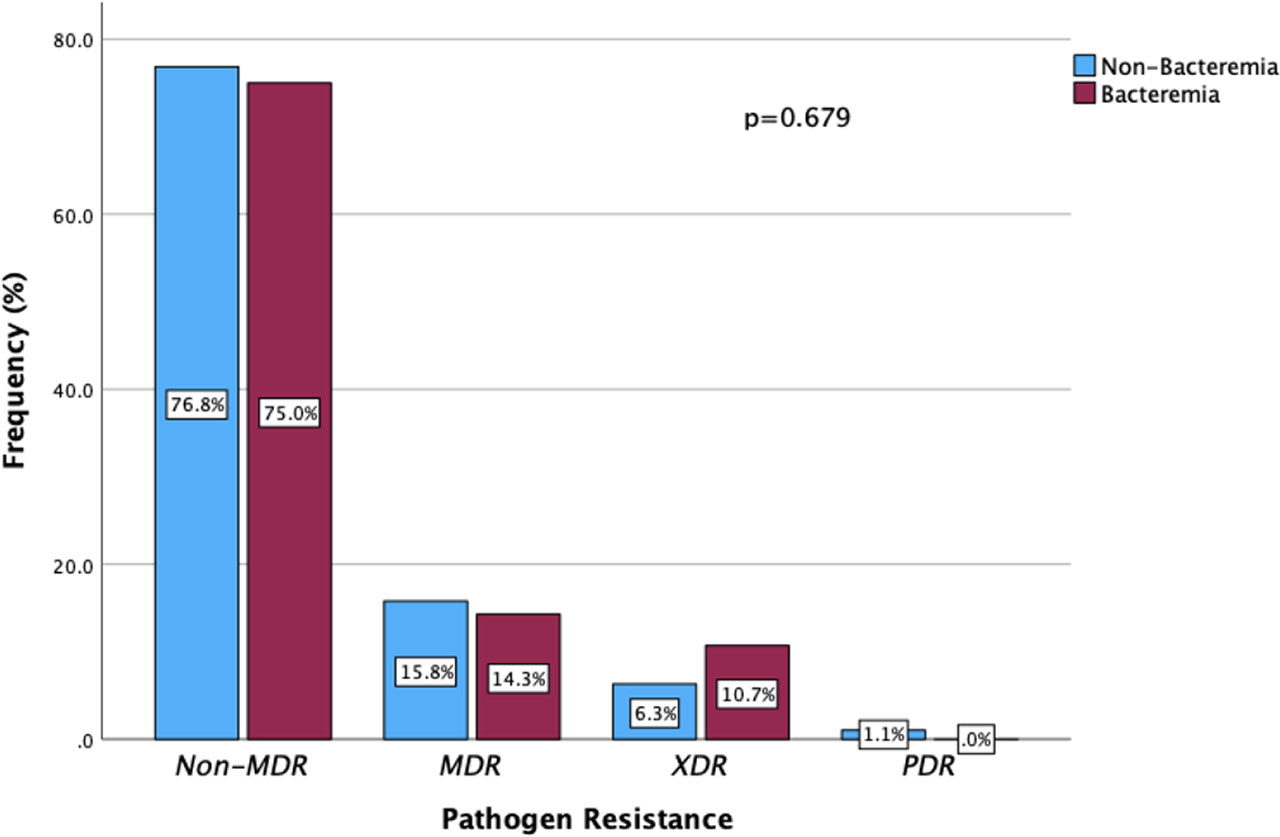
Figure 1.
Microbiological resistance of isolated pathogens.
Abbreviations: Non-MDR – Non-Multidrug Resistant; MDR – Multidrug Resistant; XDR – Extensively Drug-Resistant; PDR – Pan-drug Resistant.
The antibiotic regimens are detailed in Supp Table 1. Carbapenems (38.7% vs. 14.3%, p = 0.002), amikacin (25.8% vs. 9.0%, p = 0.01), and vancomycin (12.9% vs. 1.5%, p = 0.002) were used significantly more in the bacteremia group. No significant differences were observed between groups in the use of ceftriaxone (p = 0.794), piperacillin/tazobactam (p = 0.343), quinolones (p = 0.654), ampicillin/sulbactam (p = 0.53), colistin (p = 0.134), or teicoplanin (p = 0.061).
2.3. OUTCOMES
LOS was significantly higher in the bacteremia group than in the non-bacteremia group [8.5 (5.3–13) vs. 4 (3–6) days, p < 0.01; Table 2]. Treatment failure was considerably higher in the bacteremia group (56.8%) compared to the non-bacteremia group (27.2%, p < 0.01). Death occurred in 24.3% of patients with bacteremia versus 5.8% without and antibiotic change was required in 32.4% versus 20.5%, respectively. Surgery was required in none of the patients in the bacteremia group, compared with 0.07% in the non-bacteremia group.
Table 2
Outcomes
| Values | Non-Bacteremia (n=176) | Bacteremia (n=56) | p-value |
|---|---|---|---|
| Clinical Outcome | (n=136) | (n=37) | <0.01 |
| Treatment Success (n, %) | 99 (72.8%) | 16 (43.2%) | |
| Treatment Failure (n, %) | 37 (27.2%) | 21 (56.8%) | |
| Death (n, %) | 8 (5.8%) | 9 (24.3%) | |
| Change Antibiotic (n, %) | 28 (20.5%) | 12 (32.4%) | |
| Need for Surgery | 1 (0.07%) | 0 (0%) | |
| LOS (days) | 4(3–6) | 8.5 (5.3–13) | <0.01 |
2.4. FACTORS ASSOCIATED WITH BACTEREMIA
Key factors associated with bacteremia in patients with UTIs were assessed (Table 3). In univariate analysis, hospital-acquired infection was strongly associated with bacteremia (OR 6.834, 95% CI 2.2269–20.581, p < 0.001), and this association remained significant in multivariate analysis (OR 4.440, 95% CI 1.037–19.007, p = 0.045). Age over 74 showed a trend toward increased risk of bacteremia, but this did not reach statistical significance in univariate (OR 1.385, 95% CI 0.757–2.531, p = 0.29) or multivariate analysis (OR 2.355, 95% CI 0.889–6.243, p = 0.085). Sex, higher CCI, and MDR status were not significantly associated with bacteremia.
Table 3
Univariate and multivariate analysis of factors correlated with bacteremia
| Variable | Univariate OR (95% C.I.) | p-value (Univariate) | Multivariate OR (95% C.I.) | p-value (Multivariate) |
|---|---|---|---|---|
| Age > 74 (median) | 1.385 (0.757–2.531) | 0.290 | 2.355 (0.889–6.243) | 0.085 |
| Sex (Female) | 1.120 (0.590–2.126) | 0.729 | 0.716 (0.263–1.953) | 0.515 |
| Type of Infection (Hospital-Acquired) | 6.834 (2.269–20.581) | <0.001 | 4.440 (1.037–19.007) | 0.045 |
| CCI > 4 (median) | 1.128 (0.606–2.100) | 0.704 | 0.811 (0.297–2.213) | 0.682 |
| MDR status (yes) | 1.106 (0.512–2.389) | 0.798 | 1.913 (0.560–6.532) | 0.301 |
2.5. FACTORS ASSOCIATED WITH OUTCOME
Factors linked to outcomes were assessed (Table 4). MDR status was strongly associated with poor outcomes (composite outcome of need for surgical intervention, antibiotic change or death) in both univariate analysis (OR 6.48, 95% CI 2.44–17.22, p < 0.001) and multivariate analysis (OR 7.79, 95% CI 2.65–22.95, p < 0.001), representing the main independent predictor. Bacteremia was significantly associated with poor outcomes in univariate analysis (OR 3.512, 95% CI 1.655–7.45, p = 0.001) but did not remain significant in multivariate analysis (OR 2.01, 95% CI 0.784–5.15, p = 0.146). Age, sex, complicated UTI, and higher CCI were not significantly associated with poor outcomes.
Table 4
Univariate and multivariate analysis of factors correlated with outcome
| Variable | Univariate OR (95% C.I.) | p-value (Univariate) | Multivariate OR (95% C.I.) | p-value (Multivariate) |
|---|---|---|---|---|
| Age > 74 (median) | 1.440 (0.763–2.719) | 0.261 | 2.055 (0.674–6.261) | 0.205 |
| Sex (Female) | 0.776 (0.402–1.500) | 0.451 | 0.898 (0.326–2.472) | 0.834 |
| Complicated UTI (yes) | 1.714 (0.894–3.289) | 0.105 | 0.896 (0.333–2.412) | 0.828 |
| CCI > 4 (median) | 1.587 (0.825–3.054) | 0.167 | 1.079 (0.348–3.343) | 0.895 |
| MDR status (yes) | 6.484 (2.442–17.216) | <0.001 | 7.792 (2.645–22.951) | <0.001 |
| Bacteremia (yes) | 3.512 (1.655–7.45) | 0.001 | 2.010 (0.784–5.150) | 0.146 |
2.6. FACTORS ASSOCIATED WITH MORTALITY
Factors associated with mortality as a separate outcome were evaluated (Table 5). Hospital-acquired infection, MDR status, and bacteremia were all significantly correlated with death in univariate analysis (OR 5.08, 95% CI 1.24–20.78, p = 0.024; OR 3.90, 95% CI 1.23–12.41, p = 0.021; and OR 5.14, 95% CI 1.82–14.50, p = 0.020, respectively). In the multivariate model, only bacteremia remained independently associated with mortality (OR 11.01, 95% CI 1.19–101.50, p = 0.034). Hospital-acquired infection and MDR status did not retain statistical significance after adjustment (OR 2.11, 95% CI 0.36–12.26, p = 0.404; and OR 3.66, 95% CI 0.64–21.10, p = 0.146, respectively).
Table 5
Univariate and multivariate analysis of factors correlated with mortality
| Variable | Univariate OR (95% C.I.) | p-value (Univariate) | Multivariate OR (95% C.I.) | p-value (Multivariate) |
|---|---|---|---|---|
| Type of Infection (Hospital Acquired) | 5.079 (1.242–20.775) | 0.024 | 2.113 (0.364–12.260) | 0.404 |
| MDR status (yes) | 3.900 (1.226–12.405) | 0.021 | 3.663 (0.636–21.101) | 0.146 |
| Bacteremia (yes) | 5.143 (1.824–14.499) | 0.02 | 11.007 (1.194–101.501) | 0.034 |
3. DISCUSSION
This study compared UTIs with and without bacteremia, revealing that patients with bacteremia exhibited more severe illness, poorer prognosis, higher severity scores, and more abnormal laboratory findings. Gram-negative pathogens were the predominant causative agents. Secondary bacteremia was associated with increased mortality and longer hospital stays. MDR status independently predicted for poorer outcomes as this reflected for need for antibiotic change, surgical intervention or death, despite similar resistance patterns across groups.
From our perspective, patients in the bacteremia group presented in a more deteriorated clinical condition than those without bacteremia, as reflected by higher qSOFA, APACHE, and SAP scores. Moreover, inflammatory markers (CRP) were significantly elevated in the bacteremia group, while surrogate indices of severe disease including Hematocrit (Ht) and PLT level were more severely affected. This comes as no surprise as bacteremia in sepsis patients is associated with higher mortality rates and longer Intensive Care Unit (ICU) stays compared to non-bacteremic infections [20].
Patients with bacteremia exhibit a more severe systemic inflammatory response, meeting more systemic inflammatory response syndrome (SIRS) criteria and showing elevated levels of inflammatory markers, SOFA scores and a greater need for intensive care [21]. The inflammatory mediator profile differs between sepsis patients with and without bacteremia, with significant differences in plasma levels of cytokines, adhesion molecules, and tissue inhibitors of metalloproteinases [22]. Given the significantly worse clinical scores and laboratory parameters observed in the bacteremia group, our findings clearly support the notion that bacteremia in UTIs reflects greater disease severity.
As already shown, we confirmed the presence of E.coli as the most commonly isolated pathogen [23,24], followed by K. pneumoniae and P.aeruginosa. However, the presence of bacteria such as S.aureus and Enterococcus species, particularly in the bacteremia group, highlights the need to consider antibiotics effective against Gram-positive strains in patients with relevant risk factors.
In our study, the presence of an MDR pathogen was observed with a frequency of 23.1% in the non-bacteremia group and 25% in the bacteremia group. The absence of significant differences in resistance patterns between bacteremic and non-bacteremic UTIs in our study could potentially be explained by the overall high rates of antimicrobial resistance in Greece. Given the endemic presence of MDR pathogens in the region, resistance patterns may be similarly distributed across different patient groups, regardless of bacteremia status. Drug resistance is a major concern phenomenon with significant mortality forcing the identification of newer antibiotics and the global guidelines to rapidly update their strategies for the treatment of antimicrobial-resistant Gram-negative infections [25]. MDR prevalence in Greece is reported alarmingly high, as evidenced by previous and current studies [26] and a recent report by the European Centre for Disease Prevention and Control (ECDC) [27]. Since the late 2000s, Greece has faced an endemic challenge of MDR pathogens in hospitals, primarily due to carbapenem-resistant Gram-negative bacilli, consistently recording some of the highest antimicrobial resistance rates in Europe [27]. Our study, conducted on patient files before the COVID-19 pandemic, suggested that resistance trends will likely continue to escalate, consistent with local epidemiological patterns [28]. The increase of MDR pathogens is also confirmed by the UTILY study, which reported a 39.1% prevalence of MDR pathogens in patients admitted to emergency departments for UTIs, including a 21% prevalence among those without any known risk factors [29]. In special populations such as individuals with diabetes mellitus the prevalence of MDR pathogens can rise up to 58.4% [30]. Importantly, our analysis showed that MDR pathogens remained a significant independent factor for worse outcomes, underscoring MDR status as a key predictor of poor prognosis. The fact that MDR pathogens remain an independent predictor for adverse outcome in our study with an OR of 7.792 aligns with the results of other studies such as the SERPENS study where patients with MDR pathogens are at higher risk of poor outcomes [31]. However, the reason for the increased mortality risk associated with resistant pathogens remains under discussion since, many authors primarily attribute it to the initial use of inappropriate antibiotic therapy, rather than increased virulence of the resistant organisms themselves [32,33,34].
Significant differences in antibiotic regimens were found between groups. The use of carbapenems (38.7% vs. 14.3%, p=0.002), amikacin (25.8% vs. 9%, p=0.01), and vancomycin (12.9% vs. 1.5%, p=0.002) was significantly higher in bacteremic patients, while no significant differences were observed for ceftriaxone, piperacillin/tazobactam, quinolones, ampicillin/sulbactam, or other broad spectrum antibiotics. This increased use of broad-spectrum antibiotics was statistically significant and likely driven by the severity of infections. Meropenem remained the preferred option for the treatment of complicated urinary tract infections, as it exhibits a high test-of-cure rate of 91.4%, demonstrating superior efficacy among treatment options, according to a systematic review by Sivanandy et al. [35]. Attending physicians seemed to prefer the use of carbapenems and aminoglycosides in bacteremia patients, often presenting in more severe condition, in line with their bacteriocidal vs. bacteriostatic properties of other regimens e.g. quinolones [36]. This, in combination with the fact that MDR profile has been associated with prior use of antibiotics [37] underscores the importance of implementing antimicrobial stewardship programs (ASPs) in hospital wards, along with strategies like de-escalation in microbiologically documented infections, to minimize unnecessary antibiotic exposure and curb the emergence of multidrug-resistant pathogens [38].
Complicated UTIs are associated with a varied range of bacterial pathogens and an elevated risk of clinical complications [39]. Specific conditions classified under complicated UTIs, such as urolithiasis, serve as significant risk factors for the development of septic shock in older patients [40], which is strongly associated with increased mortality [41]. However, in our study, the prevalence of complicated infections did not statistically differ between the bacteremia and non-bacteremia groups. Moreover, complicated UTIs were not identified as a factor significantly correlated with poor outcomes in our analysis, suggesting that the impact of complicated UTIs on prognosis may depend on additional factors beyond their classification alone. Of note. on this parameter the authors do acknowledge the limitation of missing file data.
Our study has several limitations. Being a single-center study limits generalizability to other hospitals with different patient demographics, resources, or infection control protocols. However, managing UTIs complicated by bacteremia remains a global concern, and our findings are relevant to similar healthcare settings, especially those with high antibiotic resistance. Although the data were collected between 2016 and 2018, the evaluated antimicrobial regimens remain relevant, as current guidelines continue to recommend these agents. However, resistance patterns and microbiological epidemiology may have changed substantially over time, even within the same institution, which could limit the generalizability of our findings to the current clinical context. While molecular sequencing methods were not available at the time, comparing historical and current data helps identify patterns, assess progress, and highlight persistent gaps. Fundamental patient characteristics such as age, sex, and comorbidities continue to influence outcomes despite evolving resistance patterns. As a retrospective study, some clinical and laboratory data were missing, potentially affecting accuracy and the strength of associations in our multivariate analysis. Our limited sample size restricted the number of variables we could examine, and wide confidence intervals, particularly for hospital-acquired infections and MDR-status as predictors, indicate model instability. Moreover, in our study, the primary outcome was defined as a composite of death, need for surgical intervention, or modification of antibiotic therapy, rather than mortality alone. As a result, the percentages and statistical analyses reported for outcomes differ from those that would be obtained if mortality were analyzed as a separate endpoint. This heterogeneity among outcome components, which vary considerably in clinical severity, likely contributed to a greater variance in the results and may have diluted the strength of associations observed. As we performed an analysis based on mortality as the primary outcome (death vs. survival), the small proportion of deaths in our cohort may have contributed to instability in the regression analysis. Consequently, some odds ratios showed wide confidence intervals, reflecting limited statistical power and preventing firm conclusions regarding independent predictors of mortality. Our study was limited by the retrospective nature of data collection, which did not allow us to capture information on pre-hospital antibiotic exposure. As a result, we cannot determine whether some negative cultures were influenced by prior antimicrobial therapy, potentially leading to an overestimation of culture-negative cases. This missing information represents an important limitation, as pre-admission antibiotics can alter pathogen detection and affect the assessment of resistance patterns. Despite these limitations, our study offers valuable insights into secondary bacteremia in UTIs, supporting clinical decision-making and underscoring the need for larger, multicenter research.
5. CONCLUSIONS
Bacteremia in UTIs leads to worse outcomes. Early detection through blood cultures, urinalysis, and biomarkers is critical. Prompt, appropriate antimicrobial therapy – especially for MDR pathogens – guided by Infectious Disease specialists, along with careful monitoring and stewardship practices, improves outcomes, reduces complications, and optimizes patient care.
Notes
[8] Contributed by Author contributions: Conceptualization, K.A., C.G.; methodology, AL.dL, V.N., M.G., E.P., S.T., K.S., A.L.; software, E.P.; validation, K.A., E.P.; formal analysis, E.P., A.L.; data curation, K.A., E.P.; writing – original draft preparation, E.P.; writing – review and editing, K.A.; visualization, K.A.; supervision, K.A.; project administration, K.A. All authors have read and agreed to the published version of the manuscript.
Notes
Supp Table 1
Antibiotic usage patterns in patients with and without bacteremia
| Values | Non-Bacteremia (n=176) | Bacteremia (n=56) | p-value |
|---|---|---|---|
| Antibiotic Regimen | |||
| Ceftriaxone (n, %) | n=133 | n=31 | 0.794 |
| No | 114 (85.7%) | 14 (45.2%) | |
| Yes | 19 (14.3%) | 17 (54.8%) | |
| Piperacillin/Tazobactam (n, %) | n=133 | n=31 | 0.343 |
| No | 81 (60.9%) | 16 (51.6%) | |
| Yes | 52 (39.1%) | 15 (48.4%) | |
| Quinolones (n, %) | n=133 | n=31 | 0.654 |
| No | 66 (49.6%) | 14 (45.2%) | |
| Yes | 67 (50.4%) | 17 (54.8%) | |
| Carbapenems (n, %) | n= 133 | n=31 | 0.002 |
| No | 114 (85.7%) | 19 (61.3%) | |
| Yes | 19 (14.3%) | 12 (38.7%) | |
| Ampicillin/Sulbactam (n, %) | n= 133 | n=31 | 0.53 |
| No | 91 (68.4%) | 23 (74.2%) | |
| Yes | 42 (31.6%) | 8 (25.8%) | |
| Amikacin (n, %) | n=133 | n=31 | 0.01 |
| No | 121 (91%) | 23 (74.2%) | |
| Yes | 12 (9%) | 8 (25.8%) | |
| Colistin (n, %) | n=133 | n=31 | 0.134 |
| No | 123 (92.5%) | 26 (83.9%) | |
| Yes | 10 (7.5%) | 5 (16.1%) | |
| Vancomycin (n, %) | n=133 | n=31 | 0.002 |
| No | 131 (98.5%) | 27 (87.1%) | |
| Yes | 2 (1.5%) | 4 (12.9%) | |
| Teicoplanin (n, %) | n=133 | n=31 | 0.061 |
| No | 110 (82.7%) | 21 (67.7%) | |
| Yes | 23 (17.3%) | 10 (32.3%) |