
1. INTRODUCTION
Cirrhosis is one of the leading causes of death [1] worldwide, with at least one million deaths occurring each year [2]. Ascites, an important marker of progression to the decompensated stage in the natural course of cirrhosis, occurs in approximately 50% of patients with cirrhosis within 10 years [3]. Once ascites develops, patients with cirrhosis experience a sharp rise in mortality, with a 1-year and 5-year death rate of 20% [4] and 44%, respectively [5].
Although some treatment methods, such as the use of diuretics or albumin (ALB), have achieved remarkable progress in patients with cirrhotic ascites [6], the frequent relapses of ascites, high incidence of complications (including spontaneous bacterial peritonitis [SBP], hepatic encephalopathy [HE], and sepsis), high mortality rate, and poor quality of life currently remain major problems that trouble clinicians. Exploring the factors influencing adverse prognosis in such patients remains essential for providing breakthroughs for more effective management.
Patients with cirrhosis often have various complications related to abnormalities of cardiac structure or function [7], such as cirrhotic cardiomyopathy [8], arrhythmia [9], and portopulmonary hypertension [10]. In addition to liver function and traditional complications (such as SBP and HE), cardiovascular abnormalities can also contribute to poor clinical outcomes [11], highlighting the need to pay more attention to cardiac issues in patients with cirrhosis. LVDD, occurring in 25.7–81.4% of patients with cirrhosis, is the earliest manifestation of cardiac insufficiency [12] and becomes more common when complicated by ascites. It is closely related to disease severity [13]. However, in a systematic review, Ieva S. et al. [13] proposed that LVDD, a characteristic of liver cirrhosis, has not yet received sufficient attention from clinicians. Particularly, the predictive value for prognosis of LVDD in cirrhotic patients after the onset of ascites, and whether it can be extended to subgroups of patients with or without concomitant hepatic malignancies, remains unclear.
Therefore, this study aimed to elucidate the impact of LVDD on the risk of medium-term poor prognosis in patients with cirrhotic ascites. Moreover, subgroup analyses stratified by the presence or absence of concomitant hepatic malignancy were also conducted. It explores new predictive markers for patients with cirrhotic ascites and provides a new perspective for treatment strategies.
2. MATERIALS AND METHODS
2.1. STUDY PARTICIPANTS
Patients with cirrhotic ascites admitted to the Hepatic Center of the Third People's Hospital of Kunming, Yunnan Province, China, were consecutively enrolled in this retrospective study between October 4, 2022, and October 3, 2023. The enrolled participants met the diagnostic criteria for cirrhotic ascites in the “Guidelines for the Diagnosis and Treatment of Cirrhotic Ascites (2023)” [14]. The exclusion criteria included: (1) Ascites not caused by liver cirrhosis; (2) Pregnancy; (3) Hypertension or diabetes mellitus; (4) Coronary heart disease, rheumatic heart disease, congenital heart disease, or a history of cardiac surgery; (5) Incomplete clinical data; and; (6) Refusal to sign the informed consent form.
2.2. ECHOCARDIOGRAPHIC EXAMINATION AND GROUPING
Transthoracic echocardiography (TTE) was performed by the same senior ultrasonologist to assess left ventricular diastolic function (LVDF) in all participants. Based on baseline TTE results, patients were categorized into two groups: LVDD and non-LVDD. The diagnostic criteria for LVDD followed the European “Recommendations for the Evaluation of Left Ventricular Diastolic Function by Echocardiography (2009)” [15].
2.3. DATA COLLECTION
To obtain clinical outcomes, all participants were followed up for at least 12 months (deadline: October 3, 2024) via cellphone. Case report forms were used to record demographic data, basic clinical information, TTE parameters, and routine laboratory data (including liver and renal function, blood cell analysis, coagulation, inflammatory indexes, and alpha-fetoprotein). All datasets were entered into the EpiData database using manual double-entry.
2.4. STATISTICAL ANALYSIS
Datasets were analyzed using SPSS 26.0 or R 4.3.3 software. Measurement data are expressed as mean ± standard deviation (x̅ ± s), and an independent samples t-test was used for comparison between the two groups if normally distributed. If not normally distributed, data are described as median (lower quartile, upper quartile) (M [P25, P75]), and the Mann–Whitney U test was used. Enumeration data are expressed as rates or percentages (%), and the chi-square test was used for comparison between groups.
LASSO regression was used to reduce collinearity and perform the preliminary variable selection. LASSO shrinks the coefficients of irrelevant variables to zero by introducing an L1 penalty term into the loss function and subsequently effectively removes them from the model. Specifically, when the absolute value of a variable's coefficient is less than the penalty parameter λ, it is shrunk directly to zero. The optimal β value was determined via 10-fold cross-validation, and the λ.1se criterion – the value of λ within one standard error of the minimum cross-validated error that yields the simplest model. Using one-year mortality as the dependent variable, we screened 75 candidate variables spanning 5 domains (demographics, basic clinical information, liver functions, laboratory findings, and cardiac parameters of TTE) and identified predictors with non-zero coefficients. The predictors with |β| > λ and under the chosen penalty strength, which provide independent and meaningful information for explaining outcome variation, were used to construct the final multivariate model.
Furthermore, all the potential influencing factors selected via Lasso regression will be used in univariate Cox regression, through which those variables with P < 0.05 will then be included in multivariate Cox regression to ultimately identify independent influencing factors for the 1-year mortality risk.
K-M curves were then used to visualize differences in mortality risk with or without LVDD. Finally, time-dependent receiver operating characteristic (ROC) curves were used to assess the predictive efficacy of LVDD for 1-year cumulative mortality risk in patients with cirrhotic ascites. The DeLong test was used to compare the areas under the ROC curves (AUCs) of LVDD with those of traditional liver function models, including the MELD score and CTP classification.
Statistical significance was set at P < 0.05. The K-M and time-dependent ROC curves were plotted using R 4.3.3 software.
3. RESULTS
3.1. DEMOGRAPHIC, BASIC CLINICAL CHARACTERISTICS, TTE PARAMETERS, AND BASELINE INFORMATION OF THE PARTICIPANTS
As shown in Table 1, a total of 194 patients with cirrhotic ascites met the inclusion and exclusion criteria and were enrolled in this study. The study included 135 males (69.5%) and 59 females (30.4%), with a median age of 55(47.00, 60.25) years (Table 1). Sixty-eight patients (35.1%) had grade 1 ascites (ascites depth < 3 cm), 114 (58.8%) had grade 2 ascites (depth 3–10 cm), and 12 (6.2%) had grade 3 ascites (depth > 10 cm). The MELD and CTP scores were 13.3 ± 5.2 and 9.2 ± 2.1, respectively.
Table 1
Demographic, basic clinical characteristics, and baseline information
| Factors | Total (n = 194) | Non-LVDD group (n = 102) | LVDD group (n = 92) | t/Z/χ2 | P |
|---|---|---|---|---|---|
| Demographics | |||||
| Age, M(P25, P75) years | 55.0(47.0, 60.2) | 49.0(43.0, 57.3) | 59.0(53.2, 65.7) | −5.936 | <0.001 |
| Male sex, n(%) | 135(69.6) | 77(75.5) | 58(63) | 3.541 | 0.060 |
| Han ethnicity, n(%) | 177(91.2) | 96(94.1) | 81(88) | 2.232 | 0.135 |
| BMI, M(P25, P75) kg/cm2 | 22.0(20.3, 24.3) | 22.0(20.0, 23.9) | 22.4(20.4, 24.6) | −0.807 | 0.420 |
| Smoking history, n(%) | |||||
| Yes | 103(53.1) | 60(58.9) | 43(46.7) | 3.204 | 0.202 |
| No | 84(43.3) | 38(37.3) | 46(50) | ||
| Quit | 7(3.6) | 4(3.9) | 3(3.3) | ||
| Alcohol consumption, n(%) | |||||
| Yes | 82(42.3) | 48(47.1) | 34(37) | 2.849 | 0.241 |
| No | 91(46.9) | 42(41.2) | 49(53.3) | ||
| Quit | 21(10.8) | 12(11.8) | 9(9.8) | ||
| Family history of hepatic malignant, n(%) | 22(11.3) | 13(12.7) | 9(9.8) | 0.422 | 0.516 |
| Basic clinical information | |||||
| Etiology of cirrhosis, n(%) | 7.603 | 0.055 | |||
| Viral hepatitis | 144(74.2) | 83(81.4) | 61(66.2) | ||
| Alcohol | 17(8.8) | 6(5.9) | 11(12) | ||
| Virus + Alcohol | 18(9.3) | 9(8.8) | 9(9.8) | ||
| Others | 15(7.7) | 4(3.9) | 11(12) | ||
| Hepatic malignant, n(%) | 124(63.9) | 31(30.4) | 39(42.4) | 3.020 | 0.082 |
| EGVB, n(%) | 22(11.3) | 12(11.8) | 10(10.9) | 0.039 | 0.844 |
| Systolic blood pressure, M(P25, P75) mmHg | 115.0(104.0, 128.0) | 115.0(101.7, 122.0) | 117.0(105.0, 134.0) | −1.752 | 0.080 |
| Diastolic blood pressure, M(P25, P75) mmHg | 72.0(66.0, 82.0) | 71.0(65.0, 78.0) | 74.0(68.0, 85.0) | −2.066 | 0.039 |
| Heart rate, M(P25, P75) bpm | 82.0(72.0, 92.0) | 80.0(72.0, 91.0) | 83.5(71.3, 92.0) | −0.334 | 0.738. |
| Liver function | |||||
| CTP, M(P25, P75) scores | 9.0(8.0, 11.0) | 9.0(7.0, 11.0) | 9.0(8.0, 11.0) | −0.889 | 0.374 |
| MELD, M(P25, P75) scores | 12.6(10.0, 17.0) | 12.4(10.1, 16.4) | 12.6(9.5, 15.7) | −0.517 | 0.605 |
| Laboratory findings | |||||
| TBIL, M(P25, P75) μmol/L | 31.9(18.2, 64.5) | 32.2(18.0, 77.8) | 31.6(18.2, 58.1) | −0.142 | 0.887 |
| DBIL, M(P25, P75) μmol/L | 14.4(7.8, 36.0) | 13.3(7.5, 44.6) | 14.6(7.8, 28.8) | −0.187 | 0.852 |
| ALT, M(P25, P75) U/L | 35.0(23.0, 75.0) | 37.0(24.8, 72.3) | 32.5(23.0, 78.0) | −0.940 | 0.347 |
| AST, M(P25, P75) U/L | 54.0(37.8, 120.0) | 58.5(37.0, 109.75) | 51.0(38.0, 132.7) | −0069 | 0.945 |
| GGT, M(P25, P75) U/L | 96.0(40.8, 169.6) | 80.5(38.7, 156.3) | 103.5(46.4, 162.7) | −1.247 | 0.212 |
| ALP, M(P25, P75) U/L | 142.0(102.8, 201.2) | 142.0(105.2, 195.0) | 153(100.0, 217.0) | −0.513 | 0.608 |
| TP, M(P25, P75) g/L | 61.6(57.5, 67.4) | 61.8(57.0, 67.1) | 61.3(57.7, 68.2) | −0.133 | 0.894 |
| PALB, M(P25, P75) g/L | 76.1(49.1, 110.3) | 77.0(46.4, 105.4) | 71.1(52.1, 112.8) | −0.428 | 0.669 |
| ALB, M(P25, P75) g/L | 29.5(25.7, 33.3) | 30.2(27.3, 35.0) | 28.2(24.8, 31.8) | −2.596 | 0.009 |
| GLOB, M(P25, P75) g/L | 31.2(27.2, 36.7) | 30.4(27.0, 35.5) | 32.1(28.0, 37.8) | −1.629 | 0.103 |
| CHE, M(P25, P75) U/L | 2978.0(2136.8, 4008.3) | 2978.0(2214.0, 3999.0) | 2886.5(2089.7, 4253.5) | −0.636 | 0.525 |
| PT, M(P25, P75) sec | 16.6(15.3, 18.4) | 16.6(15.3, 18.4) | 16.6(15.4, 18.1) | −0.236 | 0.814 |
| PTA, M(P25, P75) % | 59.8(68.0, 50.7) | 59.7(50.1, 69.9) | 59.8(51.0, 68.0) | −0.008 | 0.994 |
| INR, M(P25, P75) | 1.4(1.3, 1.6) | 1.4(1.2, 1.6) | 1.4(1.2, 1.5) | −0.003 | 0.998 |
| WBC, M(P25, P75) ×109/L | 4.4(3.1, 7.3) | 4.1(2.7, 7.9) | 4.5(3.4, 7.4) | −1.694 | 0.092 |
| RBC, (x̅±s) ×1012/L | 3.6±0.8 | 3.6±0.7 | 3.5±0.8 | 0.556 | 0.579 |
| HGB, M(P25, P75) g/L | 115.0(97.8, 133.0) | 117.5(95.0, 132.3) | 115.0(99.3, 133.0) | 0.080 | 0.937 |
| PLT, M(P25, P75) ×109/L | 89.5(59.7, 141.5) | 83.5(53.7, 139.0) | 100.0(71.2, 142.5) | −1.580 | 0.114 |
| K, (x̅±s) mmol/L | 3.7±0.5 | 3.7±0.5 | 3.8±0.5 | −2.053 | 0.041 |
| Na, M(P25, P75) mmol/L | 138.9(136.1, 141.1) | 138.9(136.5, 141.2) | 108.9(105.8, 140.8) | −0.690 | 0.490 |
| Ca, (x̅±s) mmol/L | 2.1±0.2 | 2.0±0.1 | 2.09±0.2 | −0.752 | 0.453 |
| CL, M(P25, P75) mmol/L | 106.9(136.1, 141.1) | 106.9(103.9, 109.4) | 106.5(103.1, 109.4) | −0.491 | 0.630 |
| CO2, M(P25, P75) mmol/L | 23.3(21.5, 25.2) | 23.2(21.7, 24.9) | 23.4(21.3, 25.2) | −0.122 | 0.903 |
| BUN, M(P25, P75) mmol/L | 4.8(3.8, 7.1) | 4.5(3.6, 6.5) | 5.2(4.1, 8.5) | −2.768 | 0.006 |
| Crea, M(P25, P75) μmol/L | 61.5(52.0, 74.0) | 60.0(49.0, 73.0) | 63.5(53.0, 80.7) | −1.515 | 0.130 |
| UA, M(P25, P75) μmol/L | 295.0(244.0, 375.2) | 290.5(243.7, 355.2) | 301(242.2, 406.0) | −0.946 | 0.344 |
| FPG, M(P25, P75) mmol/L | 5.6(4.9, 7.4) | 5.5(4.8, 7.1) | 5.7(5.0, 8.2) | −1.375 | 0.169 |
| TG, M(P25, P75) mmol/L | 0.8(0.6, 1.3) | 0.8(0.5, 1.2) | 0.8(0.6, 1.2) | −1.204 | 0.229 |
| CHOL, M(P25, P75) mmol/L | 3.2(2.6, 3.9) | 3.1(2.5, 3.5) | 3.1(2.7, 4.2) | −2.427 | 0.015 |
| HDL-C, M(P25, P75) mmol/L | 0.8(0.5, 1.1) | 0.7(0.4, 1.0) | 0.7(0.5, 1.0) | −0.552 | 0.581 |
| LDL-C, M(P25, P75) mmol/L | 1.9(1.4, 2.5) | 1.8(1.3, 2.2) | 2.0(1.4, 2.8) | −2.957 | 0.003 |
| CEA, M(P25, P75) μg/L | 3.2(2.1, 4.8) | 3.0(2.0, 4.5) | 3.6(2.3, 5.0) | −2.300 | 0.021 |
| AFP, M(P25, P75) μg/L | 6.4(3.1, 66.7) | 6.3(3.2, 38.9) | 6.8(2.8, 100.4) | −0.391 | 0.696 |
| CA125, M(P25, P75) U/mL | 107.5(31.5, 276.5) | 76.8(27.9, 228.2) | 152.9(40.9, 442.8) | −2.944 | 0.003 |
| CA199, M(P25, P75) U/mL | 31.8(17.4, 68.5) | 31.5(16.3, 72.9) | 34.0(18.3, 67.2) | −0.210 | 0.834 |
| LYMP, M(P25, P75) ×109/L | 0.9(0.6, 1.3) | 0.9(0.5, 1.2) | 0.9(0.5, 1.2) | −0.344 | 0.730 |
| HCT, (x̅±s) % | 33.0±7.6 | 33.0±7.1 | 33.0±8.1 | 0.013 | 0.990 |
| RDW, M(P25, P75) fL | 15.7(14.4, 17.0) | 15.7(14.4, 17.2) | 15.3(14.2, 16.9) | −0.613 | 0.540 |
[i] Note: Abbreviations: Body Mass Index (BMI), Esophageal GastroVariceal Bleeding (EGVB), White Blood Cell Count (WBC), Red Blood Cell Count (RBC), Hemoglobin (HGB), Platelet (PLT), Potassium (K), Sodium (Na), Blood Urea Nitrogen (BUN), Creatinine (Crea), Total Bilirubin (TBIL), Direct Bilirubin (DBIL), Alanine Aminotransferase (ALT), Aspartate Aminotransferase (AST), Albumin (ALB), International Normalized Ratio (INR), Lymphocyte Count (LYMP), Hematocrit (HCT), Red Blood Cell Distribution Width (RDW), Calcium (Ca), Chloride (CL), Carbon Dioxide Content (CO2), Uric Acid (UA), Fasting Plasma Glucose (FPG), Gamma-Glutamyl Transferase (GGT), Alkaline Phosphatase (ALP), Total Protein (TP), Prealbumin (PALB), Globulin (GLOB), Cholinesterase (CHE), Triglyceride (TG), CHOL, High-Density Lipoprotein Cholesterol (HDL-C), Low-Density Lipoprotein Cholesterol (LDL-C), Carcinoembryonic Antigen (CEA), Alpha-Fetoprotein (AFP), Cancer Antigen 125 (CA125), Cancer Antigen 19-9 (CA199), Prothrombin Time (PT), Prothrombin Time Activity (PTA).
To elucidate the influence of cardiac structure and function on mortality risk in patients with cirrhosis, TTE was performed, and relevant parameters were recorded, including stroke volume (70.0 [61.0, 80.0] mL), ejection fraction (68.0 [64.0, 73.0]%), end-systolic volume (31.0 [23.0, 40.0] mL), end-diastolic volume (100.5 [89.0, 117.2] mL), and E-wave/A-wave ratio (0.9 [0.7, 1.3]). Based on TTE results, participants were categorized into two groups: LVDD and non-LVDD. Approximately 47.4% (92/194) of participants were diagnosed with LVDD, while the remaining 52.6% (102/194) belonged to the non-LVDD group. Comparative analysis showed that the LVDD group had significantly lower ALB levels and significantly higher age, potassium, and blood urea nitrogen levels (P < 0.05). (Tables 1 and 2).
Table 2
Cardiac parameters of TTE [M(P25, P75)]
| Parameters of TTE | Total (n = 194) | Non-LVDD group (n = 102) | LVDD group (n = 92) | t/Z/χ2 | P |
|---|---|---|---|---|---|
| Aortic Valve Ring Internal Diameter, mm | 23.0(22.0, 25.0) | 23.0(22.0, 25.0) | 24.0(21.2, 25.7) | −1.382 | 0.173 |
| Ascending Aorta Internal Diameter, mm | 25.0(23.0, 27.0) | 25.0(23.0, 26.0) | 25.5(23.0, 28.0) | −1.947 | 0.052 |
| Mitral annulus diameter (MAD), mm | 20.0(18.0, 22.0) | 20.0(18.0, 22.0) | 21.0(19.0, 22.0) | −0.897 | 0.370 |
| Left Cardiac Chamber Diameter (LCD), mm | 28.0(26.0, 31.0) | 28.0(25.0, 31.0) | 28.0(26.0, 31.0) | −0.435 | 0.663 |
| Intrapericardial Pressure, mmHg | 42.0(38.7, 46.0) | 43.0(39.0, 46.0) | 42.0(39.0, 46.0) | −0.785 | 0.432 |
| Right Ventricular Diameter, mm | 20.0(18.0, 22.0) | 20.0(18.0, 22.0) | 20.0(18.0, 21.7) | −0.784 | 0.433 |
| Right Atrial Diameter, mm | 32.0(30.0, 35.0) | 32.5(30.0, 35.0) | 32.0(29.0, 34.0) | −1.255 | 0.210 |
| Right Ventricular Outflow Tract Diameter (RVOTD), mm | 22.0(20.0, 24.0) | 22.0(20.0, 24.0) | 23.0(21.0, 25.0) | −1.573 | 0.116 |
| Interventricular Septum Thickness, mm | 9.0(8.0, 10.0) | 9.0(8.0, 10.0) | 9.0(8.0, 10.0) | −1.385 | 0.166 |
| Left Posterior Wall Thickness, mm | 9.0(8.0, 10.0) | 9.0(8.0, 10.0) | 9.0(8.0, 10.0) | −1.015 | 0.310 |
| end-diastolic volume (EDV), ml | 100.5(89.0, 117.2) | 102.0(89.0, 113.0) | 99.5(89.5, 121.0) | −0.320 | 0.749 |
| end-systolic volume (ESV), ml | 31.0(23.0, 40.0) | 31.0(24.0, 40.0) | 32.0(23.0, 42.5) | −0.238 | 0.812 |
| ejection fraction (EF), % | 68.0(64.0, 73.0) | 69.0(64.0, 72.2) | 67.0(63.0, 73.0) | −0.792 | 0.428 |
| Fractional Shortening, % | 38.0(34.0, 42.0) | 38.0(35.0, 42.0) | 37.0(34.0, 42.7) | −0.921 | 0.357 |
| stroke volume (SV), ml | 70.0(61.0, 80.0) | 69.5(60.0, 78.6) | 71.0(61.0, 80.0) | −0.353 | 0.724 |
| E-point Septal Separation, mm | 5.0(5.0, 6.0) | 5.0(5.0, 6.0) | 5.0(5.0, 6.0) | −1.358 | 0.174 |
| Pulmonary Artery Systolic Pressure, mmHg | 24.0(22.7, 28.0) | 24.0(21.0, 28.0) | 24.0(23.0, 28.0) | −0.116 | 0.908 |
| Tricuspid Regurgitation (peak velocity), m/s | 220.0(210.0, 246.0) | 220.0(200.0, 240.0) | 220.0(210.0, 240.0) | −0.275 | 0.783 |
| Pulmonary Artery Valve Forward Flow Rate, m/s | 113.0(96.7, 131.0) | 111.0(94.7, 130.0) | 113.0(100.0, 134.2) | −0.899 | 0.369 |
| Pulmonary Pulmonic Valve Forward Flow Rate, m/s | 90.0(80.0, 104.5) | 90.5(80.7, 102.2) | 90.0(80.0, 106.7) | −0.193 | 0.847 |
| E-wave/A-wave ratio (E/A) | 0.9(0.7, 1.3) | 1.2(1.0, 1.3) | 0.7(0.6, 0.8) | −9.412 | <0.001 |
The baseline characteristics or other supporting datasets of demographics, basic clinical information, liver functions, laboratory findings, and cardiac parameters of TTE used in the following analyses were also provided in Tables 1 and 2.
3.2. IDENTIFICATION OF LVDD'S PREDICTIVE VALUE FOR 1-YEAR DEATH RISK IN PATIENTS WITH CIRRHOTIC ASCITES
Using 1-year mortality risk as the dependent variable, Lasso regression was used to reduce collinearity and identify potential influencing factors from 75 candidate variables across five dimensions (including demographics, basic clinical information, liver functions, laboratory findings, and cardiac parameters of TTE) listed in Tables 1 and 2. For the total cohort (Fig. 1A and B), the 10-fold cross-validation of Lasso regression shows that the log(λ.min) was −3.56, which corresponded to 19 model variables, and the log(λ.1se) was −2.90, which corresponded to 13 model variables. The model with a log(λ.1se) value of −2.90 was the optimal model we selected, and those 13 corresponding variables it contained, including BMI, hepatic malignancy, mitral annular disjunction (MAD), right ventricular outflow tract diameter (RVOTD), LVDD, WBC, PLT, Na, DBIL, GGT, ALP, CHE, and INR, were just the potential influencing factors screened out.
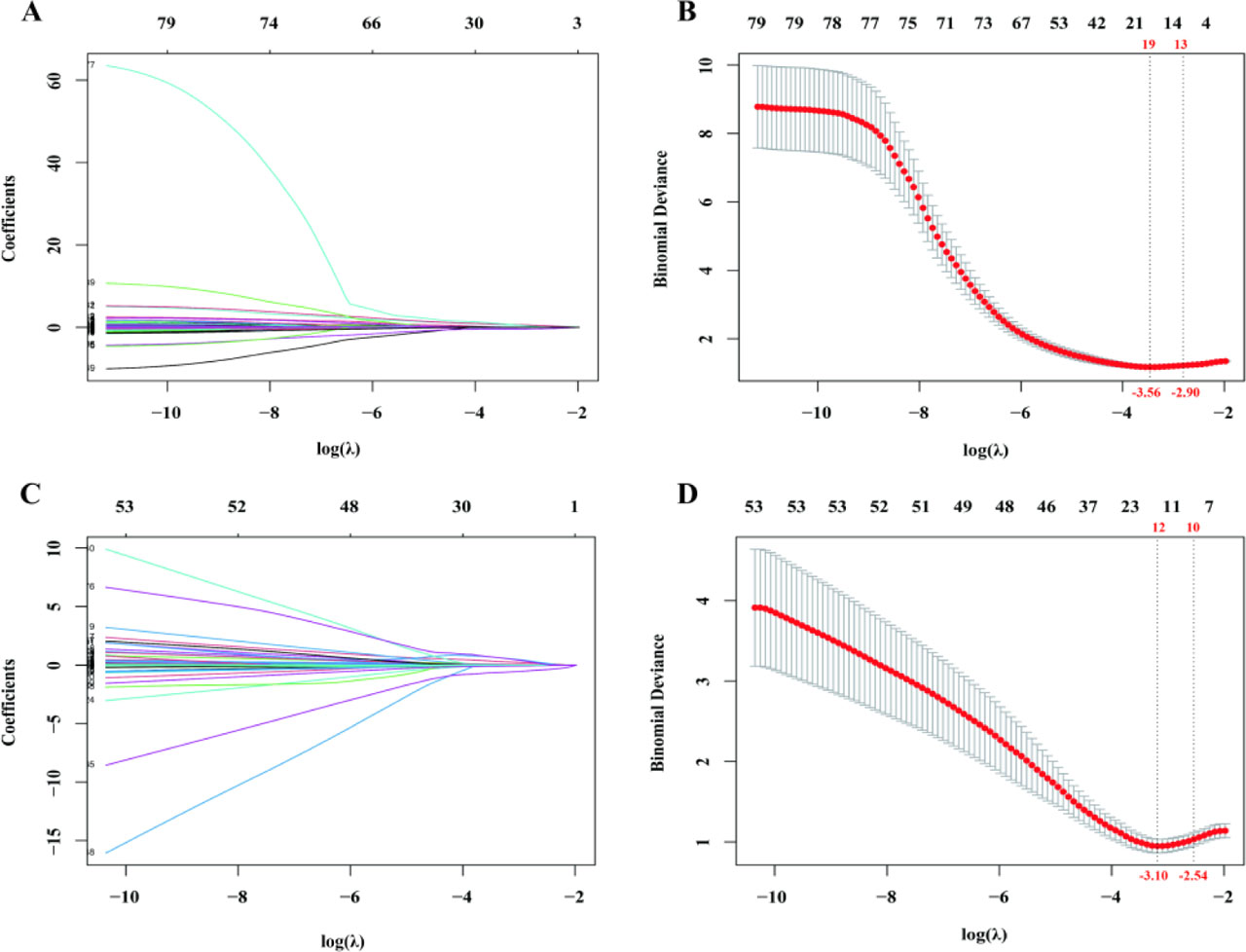
Figure 1.
Lasso regression for screening potential influencing factors of 1-year mortality risk.
Note for figure 1: (A) and (B) belong to total cohort, and (C) and (D) belong to subgroup without hepatic malignancy. (A) and (C) are lasso coefficient plots. The vertical axis represents model coefficients, the lower horizontal axis shows the logarithm of λ, and the upper horizontal axis indicates the number of variables corresponding to each λ. λ is the regularization parameter, which controls the degree of penalty applied to model coefficients, thereby balancing the model's fitting ability and complexity. As λ increases, the penalty on model coefficients intensifies, compressing more coefficients toward zero or even setting them to zero. This achieves variable selection by eliminating relatively unimportant predictors, while variables not compressed to zero become the final retained model variables. (B) and (D) are 10-fold cross-validation plots. The vertical axis, Binomial Deviance (also known as Log loss), represents model error. This loss function measures the discrepancy between predicted and observed outcomes, quantifying the quality of model predictions. The lower horizontal axis displays the logarithm of λ, while the upper horizontal axis shows the number of variables corresponding to each λ. The left dashed vertical line indicates λ.min, where model error is minimized, but this model may be relatively complex and carry some risk of overfitting. The right dashed line corresponds to λ.1 standard error (λ.1se), the λ value where the evaluation metric is one standard error larger than that at λ.min. Models at λ.1se sacrifice some predictive accuracy (slightly higher than optimal prediction error) in exchange for a relatively simpler, more stable model with reliable generalization capabilities. Using 1-year mortality risk as the dependent variable, this study selected predictive models from 75 candidate variables across five dimensions (including demographics, basic clinical information, liver functions, laboratory findings, and cardiac parameters of TTE). After Lasso regression, the log(λ.min) and log(λ.1se) for the total cohort were −3.56 and −2.90, corresponding to 19 and 13 model variables, respectively, therefore, the 13 variables associated with log(λ.1se) were identified as potential influencing factors. For the subgroup without hepatic malignancy, log(λ.min) and log(λ.1se) were −3.10 and −2.54, corresponding to 12 and 10 model variables, respectively, so this study adopted the 10 variables corresponding to log(λ.1se) as potential influencing factors.
Subsequently, univariate Cox regression removed MAD, retaining 12 variables. Multivariate Cox regression further identified the following independent risk factors for 1-year mortality (Table 3): LVDD (HR = 2.109, 95% CI [1.279–3.478], P = 0.003), hepatic malignancy (HR = 1.863, 95% CI [1.107–3.141], P = 0.019) and RVOTD (HR = 1.077, 95% CI [1.018–1.139], P = 0.008), PLT (HR = 1.003, 95% CI [1.0002–1.0062], P = 0.035), and INR (HR = 7.031, 95% CI [2.504–19.748], P < 0.001). In contrast, BMI (HR = 0.876, 95% CI [0.808–0.950], P = 0.001) was a protective factor. MAD, WBC, Na, DBIL, GGT, ALP, and CHE were not retained in the final multivariate model.
Table 3
Univariate and multivariate Cox regression of 1-year mortality risk
| Participants | Factors | Univariate Cox | Multivariate Cox | ||||
|---|---|---|---|---|---|---|---|
| HR | 95% CI | P-value | HR | 95% CI | P-value | ||
| Total | BMI | 0.917 | 0.851–0.987 | 0.021 | 0.876 | 0.808–0.950 | 0.001 |
| Hepatic malignancy | 2.579 | 1.635–4.069 | <0.001 | 1.863 | 1.107–3.141 | 0.019 | |
| MAD | 1.069 | 0.999–1.155 | 0.088 | ||||
| RVOTD | 1.087 | 1.039–1.137 | <0.001 | 1.077 | 1.018–1.139 | 0.008 | |
| LVDD | 2.447 | 1.522–3.933 | <0.001 | 2.109 | 1.279–3.478 | 0.003 | |
| WBC | 1.114 | 1.065–1.165 | <0.001 | ||||
| PLT | 1.004 | 1.002–1.006 | <0.001 | 1.003 | 1.0002–1.0062 | 0.035 | |
| Na | 0.886 | 0.839–0.936 | <0.001 | ||||
| DBIL | 1.004 | 1.001–1.007 | 0.001 | ||||
| GGT | 1.001 | 1.001–1.002 | 0.007 | ||||
| ALP | 1.002 | 1.001–1.003 | <0.001 | ||||
| CHE | 0.352 | 0.213–0.580 | <0.001 | ||||
| INR | 4.713 | 2.197–10.110 | <0.001 | 7.031 | 2.504–19.748 | <0.001 | |
| Without hepatic malignancy | Etiology of cirrhosis | 3.874 | 1.482–10.129 | 0.006 | |||
| viral hepatitis | 1 | - | - | ||||
| alcohol | 2.169 | 0.929–5.064 | 0.074 | ||||
| virus+alcohol | 0.423 | 0.056–3.106 | 0.398 | ||||
| others | 3.150 | 1.332–7.448 | 0.009 | ||||
| RVOTD | 1.061 | 1.017–1.107 | 0.006 | ||||
| LVDD | 3.020 | 1.441–6.332 | 0.003 | 2.351 | 1.040–5.313 | 0.040 | |
| RDW | 1.215 | 1.063–1.388 | 0.004 | ||||
| CO2 | 0.886 | 0.828–0.948 | <0.001 | 0.840 | 0.764–0.922 | <0.001 | |
| CREA | 1.003 | 1.001–1.004 | 0.003 | ||||
| TBIL | 1.005 | 1.002–1.008 | <0.001 | 1.007 | 1.003–1.011 | 0.001 | |
| CHE | 0.248 | 0.114–0.540 | <0.001 | ||||
| INR | 10.400 | 2.963–36.510 | <0.001 | ||||
| CTP score | 1.291 | 1.116–1.494 | <0.001 | ||||
To further elucidate the predictive value of LVDD for 1-year mortality, subgroup analyses were conducted based on the presence or absence of hepatic malignancy. For the subgroup without hepatic malignancy (Fig. 1C and D), the log(λ.min) and log(λ.1se) in Lasso regression were −3.10 and −2.54, corresponding to 12 and 10 model variables, respectively. Based on the log(λ.1se) of −2.54, the optimal model was screened out, and a total of 10 corresponding variables, including Etiology of cirrhosis, RVOTD, LVDD, RDW, CO2, CREA, TBIL, CHE, INR, and CTP score, were selected as the potential influence factors. Furthermore, the subsequent univariate and multivariate Cox regression revealed (Table 3) that LVDD was still an independent risk factor in the subgroup without hepatic malignancy (HR = 2.351, 95% CI [1.040–5.313], P = 0.040).
3.3. COMPARISON OF MORTALITY RISK BETWEEN LVDD AND NON-LVDD GROUPS VIA K–M CURVES
The cumulative mortality risk was statistically higher in the LVDD group than that of the non-LVDD group, as shown by the K-M curves and log-rank test (P < 0.05) for all participants (HR = 2.447, 95% CI [1.522–3.933]) and the subgroup without hepatic malignancy (HR = 3.020, 95% CI [1.441–6.332]). However, no statistically significant difference was observed in the subgroup with hepatic malignancy (Fig. 2).
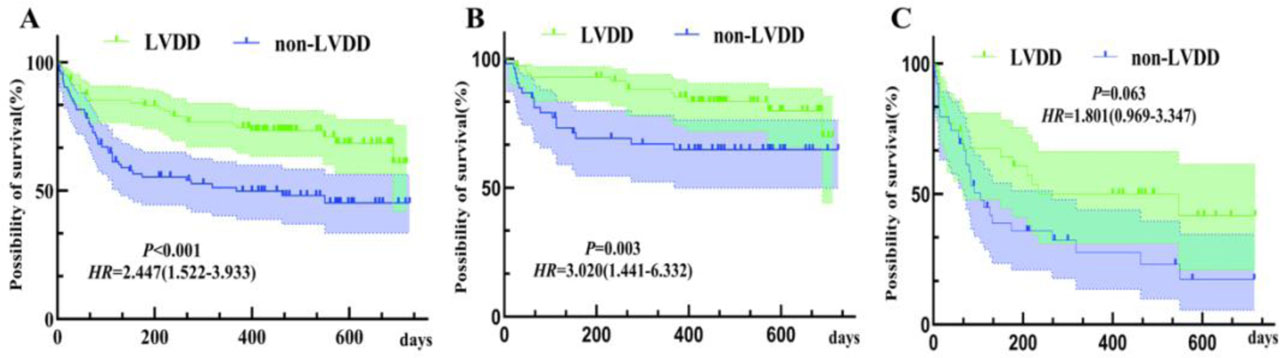
Figure 2.
K-M curves showing the predictive value of LVDD vs. non-LVDD for 1-year mortality risk. (A) Total participants; (B) Without hepatic malignancy; (C) With hepatic malignancy.
3.4. ANALYSIS OF TIME-DEPENDENT ROC CURVES TO ASSESS THE PREDICTIVE EFFICACY OF LVDD FOR MORTALITY
The Delong test (Fig. 3) showed that the AUC of the time-dependent ROC curve for LVDD predicting 360-day mortality was comparable to that of the MELD or CTP score, in the overall population (AUCLVDD = 0.662 [95% CI: 0.589–0.735], AUCMELD = 0.612 [95% CI: 0.524–0.700], and AUCCTP = 0.674 [95% CI: 0.593–0.755]) and the subgroup without hepatic malignancy (AUCLVDD = 0.674 [95% CI: 0.571–0.776], AUCMELD = 0.638 [95% CI: 0.504–0.773], and AUCCTP = 0.728 [95% CI: 0.599–0.836]), with all P > 0.05.
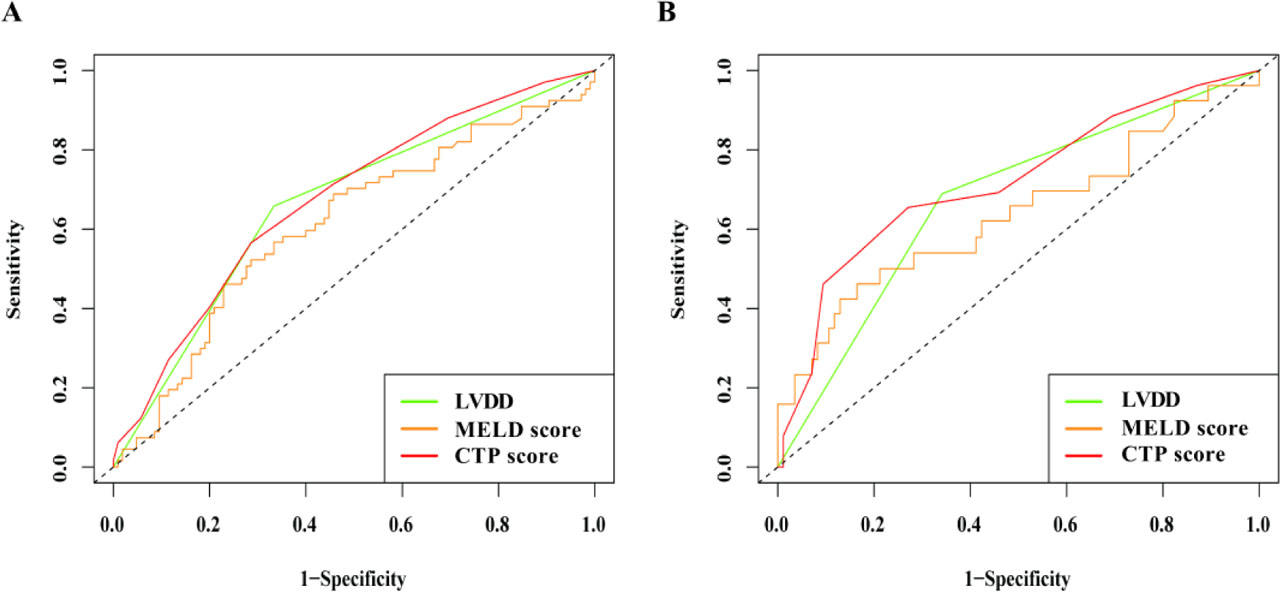
Figure 3.
Time-dependent ROC curves showing the efficacy of LVDD in predicting 1-year mortality. (A) Overall participants; (B) Subgroup without hepatic malignancy.
4. DISCUSSION
Cirrhotic ascites is associated with high mortality globally and is a major challenge to clinicians. Identifying new biomarkers to predict adverse outcomes remains one of the most important aspects of its management. Over the past decades, increasing attention has been directed toward hepato-cardiac disorders [16], opening new avenues for optimizing treatment and improving the prognosis of patients with liver cirrhosis [17].
LVDD, one of the most common cardiac disorders in patients with cirrhosis, has gained increasing attention in recent years [13] and appears to be associated with disease severity, the development of complications, and even mortality [18]. It is reported that the incidence of LVDD in cirrhosis ranges from 25.7% to 81.4% in general [13]. In this study, we observed 47.4% of the patients with cirrhotic ascites complicated with LVDD after the onset of ascites.
An Indian study involving 92 participants revealed that patients with decompensated cirrhosis and MELD scores ≥15 had higher E/e' ratios (an important echocardiographic parameter). Conversely, patients with E/e' ratios >10 had higher MELD and CTP scores, suggesting more severe LVDD in advanced cirrhosis. Cox multivariate analysis further revealed that E/e' ≥10 and serum ALB were independent predictors of mortality in these patients [19]. Other small-sample studies also found that patients with ≥ grade 2 LVDD had lower survival rates. [12] Innovatively and exclusively, this study focused on cirrhotic patients after the onset of ascites and furthermore elucidated the predictive value of LVDD for 1-year mortality risk, which provides a necessary complement to traditional CTP classification and MELD scoring in assessing poor prognosis. It also confirms that LVDD is not merely a consequence of cirrhosis but a contributor to its poor prognosis. Additionally, subgroup analysis was also performed and revealed that the predictive value of LVDD for 1-year mortality risk was applicable to cirrhotic ascites patients without hepatic malignancy.
As shown in Fig. 4, the intrinsic relationship between cirrhosis and LVDD and the corresponding mechanisms are extremely complicated. However, some progress has been made recently. Lower serum ALB, higher MELD scores, presence of ascites, and ascitic fluid protein levels are independent predictors of LVDD in patients with liver cirrhosis [20, 21], which indicates that LVDD is closely related to the disease severity in such patients. High-dynamic circulation [22] and activation of the renin-angiotensin-aldosterone system (RAAS) [23] caused by cirrhosis can increase heart rate or cardiac output and subsequently induce myocardial remodeling such as cardiac hypertrophy, fibrosis, and edema [24,25], which is the main mechanism of LVDD development. Conversely, renin activity, glomerular filtration rate, and levels of serum lipopolysaccharide-binding protein, tumor necrosis factor-α, and noradrenaline can induce further gradations to LVDD [26], which can decrease the heart rate-to-norepinephrine ratio, impair cardiac chronotropic function, reduce effective blood volume [27] and renal perfusion (hepatorenal syndrome), and blunt the stress response during sepsis, ultimately leading to poorer outcomes [28] and an increased risk of death [29, 30].
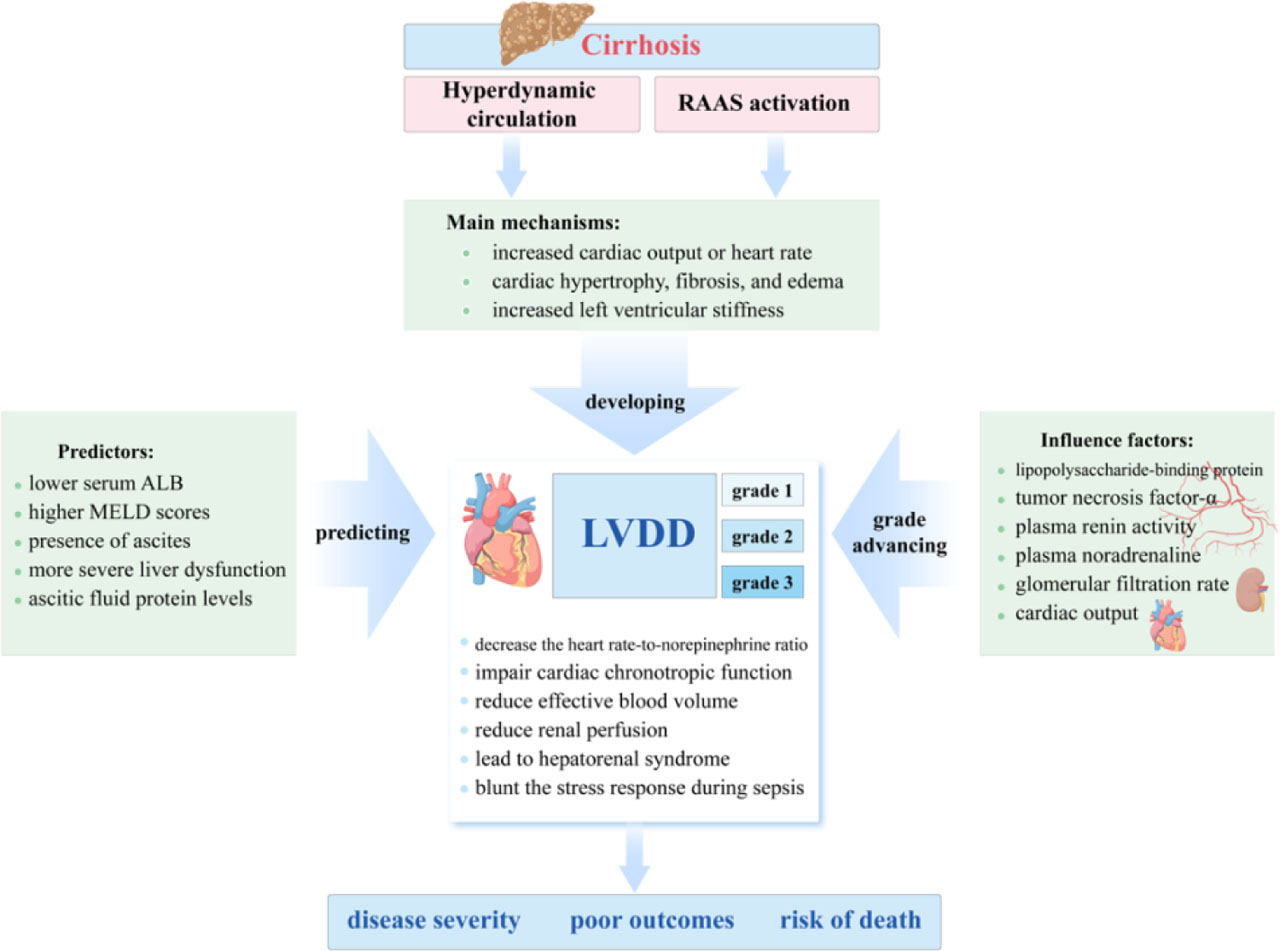
Figure 4.
The intrinsic relationship between cirrhosis and LVDD and corresponding mechanisms.
Based on our findings, we infer that managing or intervening in LVDD may be an effective approach to improving the prognosis of patients with cirrhotic ascites. Premkumar M. et al. [31] found that combining ivabradine with carvedilol improved LVDD, reduced the risk of encephalopathy and acute kidney injury, and improved survival in patients with cirrhosis. Non-selective beta blockers [32], such as propranolol or carvedilol, not only reduce portal pressure [33] but may also improve cirrhotic prognosis by improving LVDF.
In summary, LVDD is highly prevalent and is one of the most common cardiac manifestations in patients with cirrhotic ascites. It is not only a specific feature of cirrhosis but also an independent risk factor for mortality, making it a valuable predictor of medium-term poor outcomes. Although the predictive accuracy of LVDD, MELD, and CTP scores is not very high (AUC values around 0.61–0.67), LVDD can be considered an additional marker rather than a substitute indicator. More importantly, intervention in LVDD may offer another effective strategy for improving prognosis. However, this study also has certain limitations: we focused exclusively on LVDD caused by cirrhosis itself; the relationship between LVDD and prognosis in cirrhotic patients with underlying cardiovascular conditions remains an important area warranting further investigation. Moreover, we performed TTE assessment based on the European “Recommendations for the Evaluation of Left Ventricular Diastolic Function by Echocardiography (2009)” rather than the updated guidelines of the American Society of Echocardiography/European Association of Cardiovascular Imaging. However, this will not change the results of our study because the former includes more LVDD parameters and the latter mainly focuses on simplifying the diagnostic process. Finally, the single-center retrospective nature of the study introduces the potential for selection bias, and larger multicenter perspective cohort studies with external validations are needed to further validate its predictive value. Moreover, basic research is required to elucidate the underlying mechanisms, and randomized controlled trials are necessary to determine whether LVDD interventions can truly reduce mortality.
5. CONCLUSION
LVDD increases the risk of 1-year mortality in patients with cirrhotic ascites, particularly in those without hepatic malignancy. Our study reveals new prognostic value for traditional LVDD parameters, indicating that targeting LVDD in cirrhotic patients may be one of the effective strategies to improve their prognosis.
Notes
[3] Ethics statement: This study was approved by the Ethics Committee of the Third People's Hospital of Kunming (Approval No. 2023032023) and was conducted in accordance with the local legislation and institutional requirements. All the participants provided their written informed consent to participate.
[4] Financial disclosure Funding: This study was supported by the National Natural Science Foundation of China (No.82260408), Science Research Fund of Education Department of Yunnan Province (No.2024J0863), and Health Research Project of Kunming Municipal Health Commission (No. 2025-02-04-001, 2025-03-03-005, and 2025-03-08-020).