
INTRODUCTION
Previously, we published the case of a 27-year-old female patient diagnosed with hypereosinophilic myocarditis – an uncommon but life-threatening manifestation of hypereosinophilic syndrome. Initial investigations revealed significant hypereosinophilia, myocardial injury markers, and reduced left ventricular function. Advanced cardiac imaging and biochemical investigations supported the diagnosis.[1]
At that point, although eosinophilic granulomatosis with polyangiitis (Churg-Strauss syndrome) appeared to be a very plausible etiology of eosinophilia, there was not enough evidence (according to ACR and Lanham criteria) to support a definite positive diagnosis. Given the high-risk cardiac involvement and the absence of a definitive etiology, although extensively evaluated, prompt empirical treatment with high-dose glucocorticoids and guideline-directed heart failure therapy was initiated. The patient showed a rapid clinical and biological response, suggesting a potentially transient or reactive form of eosinophilia, despite extensive investigations ruling out common infectious, hematologic, and autoimmune causes.
In light of new clinical and biological data, we revisit the previously reported case to provide an updated perspective, now anchored by a definitive diagnosis.
UPDATED CLINICAL COURSE
After the initial episode, interpreted as HES with myocardial involvement, the patient had a favorable course of the disease, with normalization of the eosinophilic count, clinical improvement, and progressive improvement in HF parameters (EF, loading pressure, NT-proBNP). The favorable evolution was also maintained after complete cessation of glucocorticoid treatment; the patient remained asymptomatic, with normal eosinophilic count, and an almost complete resolution of myocardial dysfunction (LVEF of 50% with only mild diffuse hypokinesia).
After about 1 year, in the context of a respiratory viral infection, the patient developed dyspnea and wheezing, along with mild eosinophilia. A pulmonary evaluation with spirometry confirmed the diagnosis of bronchial asthma [obstructive ventilatory dysfunction with FEV1 48%. A significant bronchodilator response was observed – FEV1 increased by 430 mL (11% of predicted)]. The patient was prescribed long-term inhaled therapy with beclometasone/formoterol 100/6 mcg.
This event renewed the clinical suspicion of eosinophilic granulomatosis with polyangiitis (EGPA), and the diagnostic workup for EGPA was resumed. In the following weeks, the patient remained asymptomatic, except for persistent paresthesia along the lateral aspect of the left foot. Laboratory findings show a slight decrease in peripheral eosinophilia (from 1,260/μL to 740/μL) and in serum IgE levels (from 275 IU/mL to 270 IU/mL) (Table 1). However, the patient still did not meet sufficient criteria for a definitive diagnosis. Although a tissue biopsy (eg peripheral nerve) would have been useful for a rapid and conclusive diagnosis, the patient declined the procedure. The patient remains in good general condition, nearly asymptomatic, and continues treatment for heart failure and bronchial asthma.
Table 1
Temporal evolution of the important laboratory parameters (1)
| Data | Eosinophiles (*1000/mcL) | CRP (mg/L) | ESR (mm/h) | Fibrinogen (mg/dl) | IgE (IU/ml) | NTproBNP (pg/mL) | hsTnT (pg/mL) | LDH (UI/L) |
|---|---|---|---|---|---|---|---|---|
| January 2023 | 15.36 | 38.5 | 32 | 482 | 1296 | 6174 | 1445 | 607 |
| February 2023 | 0.06 | 0.27 | 2 | 226 | 1967 | 50.24 | ||
| July 2023 | 0.24 | 0.99 | 4 | 762 | 18.96 | |||
| January 2024 | 1.64 | 0.7 | 2 | 349 | 219 | 539 | 10.02 | 206 |
| April 2024 | 1.24 | 1.05 | 7 | 371 | 275 | 500 | ||
| June 2025 | 7.00 | 42.5 | 55 | 539 | 3782 | 509 | 15 | 502 |
| July 2025 | 0.03 | 1.63 | 7 | 336 | 966 | 366 | 232 |
After an additional 2 months, the patient becomes progressively more asthenic and has marked eosinophilia (7000/mcL), elevation of inflammatory markers (CRP 42.5 mg/L; ESR 55 mm/h; fibrinogen 539 mg/dl), mild increase of liver enzymes (TGO 40.9 UI/L), marked Ig E levels (3782 IU/mL) (Table 1). The patient underwent another spirometry, which revealed a mixed ventilatory dysfunction, partially reversed after three days of intravenous methylprednisolone therapy. Thoracic and cerebral computed tomography (CT) scans were performed, revealing focal ground-glass opacities with a predominantly peripheral, bilateral distribution, along with several posterior subpleural pulmonary consolidations bilaterally. These suggestive images were not present during the first hospitalization imaging evaluation.
An otolaryngology (ENT) examination was also carried out, with no pathological findings. Cardiac evaluation identified a mildly reduced left ventricular ejection fraction (LVEF: 42.5%, GLS: −8%), associated with an NT-proBNP level of 509 pg/mL. A second cardiac MRI was performed during the acute flare. MRI showed diffuse subendocardial fibrosis (transmural in the mid-segments of the lateral wall), mild systolic dysfunction (LVEF 44%) – Imaging findings are consistent with post-eosinophilic myocarditis sequelae with no myocardial edema or other features indicative of acute myocarditis.
Based on these updated findings, the patient now fulfilled both the accepted criteria and the diagnosis recommendation by ACR/EULAR (2022) for EGPA [2]. The patient had a score of 9 points, exceeding the diagnostic threshold of 6 points and thus supporting a positive diagnosis. Treatment was initiated with intravenous methylprednisolone 500 mg daily for three consecutive days, followed by oral methylprednisolone 32 mg/day for two weeks, then tapered to 28 mg per day for one additional week. The patient continued maintenance therapy with beclometasone/formoterol 100/6 mcg and heart failure medication. The patient demonstrated a favorable clinical course under medical treatment, with resolution of fatigue and improved inflammatory markers and eosinophilia. However, upon tapering of corticosteroid therapy, the patient experienced a recurrence of eosinophilia, which prompted initiation of Rituximab (500 mg bid). She is currently maintained on a remission protocol consisting of Rituximab and gradually tapering.
Table 2
Temporal evolution of the important laboratory parameters (2)
| Data | Proteinuria (mg/24h) | C3 (g/L) | C4 (g/L) | C-ANCA AB (UI/ml) | P-ANCA AB (UI/ml) |
|---|---|---|---|---|---|
| January – February 2023 | 126 | 1.01 | 0.11 | ||
| January 2024 | 80.4 | 01.08 | 0.2 | 2.36 | 1.73 |
| June – July 2025 | 103.51 | 1.52 | 0.07 | 0.45 | 0.28 |
Table 3
Timeline of diagnostic feature evolution
| Feature | 2023 | 2024 | 2025 |
|---|---|---|---|
| Asthma | − | + | + |
| Eosinophilia | + | + | + |
| ENT involvement | − | − | − |
| Pulmonary infiltrates | − | − | + |
| Neuropathy (mononeuritis multiplex) | + | + | + |
| Skin manifestations | − | − | − |
| Cardiac involvement | + | + | + |
| Gastrointestinal involvement | − | − | − |
| Renal involvement | − | − | − |
| ANCA positivity | − | − | − |
| Histopathology | − | − | − |
| Systemic symptoms | + | + | + |
DISCUSSION
From the first presentation of our patient, the differential diagnosis work-up was conducted as recommended by the available data [3], as presented in the initial published case report [1].
Although no universally accepted diagnostic criteria have been established for small- or medium-vessel vasculitis, current diagnostic practice is guided by expert consensus. It relies on a comprehensive assessment of clinical features, laboratory and imaging findings, and, when available, histopathological evidence, with careful exclusion of conditions that mimic it. Classification criteria – such as the 2022 ACR/EULAR criteria for eosinophilic granulomatosis with polyangiitis – are primarily intended for research purposes but may support clinical diagnosis in appropriate contexts [2,3].
The diagnosis of EGPA can sometimes be made without a biopsy if clinical, laboratory, and imaging findings strongly support the diagnosis and the patient meets established classification criteria [2,4]. As previously mentioned, the patient declined to undergo a biopsy, resulting in a potential delay in establishing a positive diagnosis compared to a scenario in which histopathological examination could have confirmed the diagnosis earlier by identifying eosinophilic infiltrates in the affected tissue.
Few cases with initial disease manifestation of EGPA with cardiac involvement (eosinophilic myocarditis) have been reported; however, for some, the differential diagnosis with HES is debatable [5]. Still, for the vast majority of patients with EGPA and cardiac involvement, asthma has been previously diagnosed [6,7,8]. Importantly, asthma is not a mandatory element for EGPA diagnosis, and it can sometimes be challenging to distinguish it from HES. Thus, this case underscores the importance of follow-up and continuous search for etiology.
Another particularity of this case, with an initial presentation with eosinophilic myocarditis, is the absence of signs suggesting myocardial deterioration at the time of disease relapse (as indicated by clinical manifestation, echocardiography, NTproBNP, and confirmed by cardiac MRI). Limited evidence from the literature indicates EGPA with cardiac involvement may exhibit two distinct phenotypes: one characterized by acute myocarditis and another by chronic inflammatory cardiomyopathy. The acute phenotype is associated with a worse prognosis and tends to occur in patients with higher eosinophil counts [9].
An essential question, brought back into focus by this case, is whether EGPA and HES represent distinct manifestations within the same syndromic spectrum or, conversely, constitute separate nosological entities sharing overlapping pathophysiological features.
Current consensus views HES and EGPA as overlapping but distinct disease entities rather than a single syndrome spectrum.
EGPA is classified among ANCA-associated vasculitides and is defined by eosinophil-rich granulomatous inflammation with small-to-medium vessel vasculitis, often with asthma and sometimes ANCA positivity; organ injury reflects both eosinophil-mediated tissue damage and vasculitis. [10,11,12,13] By contrast, HES comprises heterogeneous disorders unified by persistent hypereosinophilia with eosinophil-mediated organ damage, without a defining vasculitis phenotype; many cases are idiopathic or have clonal/lymphocytic drivers, and vasculitis is not requisite.[14,15,16]
Churg–Strauss disease is the historical name for what is now termed EGPA; the entities are considered identical in contemporary nomenclature. The 2012 Chapel Hill Consensus nomenclature changes and subsequent reviews explicitly state that “Churg–Strauss syndrome” and EGPA refer to the same small-to-medium vessel vasculitis characterized by asthma, eosinophilia, and eosinophil-rich granulomatous inflammation, with variable ANCA association.[13,17]
That said, boundaries can be blurred: biomarker gaps and overlapping phenotypes (including ANCA-negative EGPA and HES with eosinophilic vasculitis) make differentiation challenging, and some authors describe them as “two sides of the same coin.” Nonetheless, practice generally separates EGPA (vasculitis-centered classification and therapies) from HES (eosinophil-driven syndromes with distinct subtypes and targeted approaches).[18] Neuropathology and clinical patterns can diverge (eg, mononeuritis multiplex typical of EGPA vs polyneuropathy with nonvasculitic eosinophilic infiltrates in idiopathic HES).[16] Anti–IL-5/IL-5R therapies have efficacy in both, reinforcing shared eosinophil biology while not erasing nosologic distinctions.[19]
This updated case highlights the evolving and often insidious nature of eosinophilic granulomatosis with polyangiitis (EGPA), emphasizing the critical role of long-term monitoring in patients presenting with unexplained hypereosinophilia. EGPA may initially manifest with atypical or isolated organ involvement – such as peripheral neuritis or eosinophilic myocarditis – without fulfilling full diagnostic criteria at presentation. Although EGPA represented a highly plausible etiological diagnosis from the early course of the disease, the diagnostic criteria were not initially met, underscoring the need to maintain a high index of clinical suspicion and close monitoring with follow-ups. Clinicians must diligently pursue additional clinical, laboratory, and histopathological evidence to achieve a definitive diagnosis, while simultaneously considering alternative differential diagnoses. Not of secondary importance, it should be emphasized that accepted diagnostic criteria are not exhaustive, and the clinical judgement remains a cornerstone. Reliance on initial clinical improvement with nonspecific therapies, such as glucocorticoids, should not preclude further investigation. Early and accurate recognition of EGPA remains crucial, as the timely initiation of treatment significantly improves prognosis and reduces the risk of irreversible organ damage [3].
CONCLUSION
This case underscores the importance of early recognition and intervention in eosinophilic myocarditis, even in the absence of a confirmed underlying cause. The favorable evolution invites further reflection and discussion, along with a continuous search for etiology, which we now provide through updated insights and extended follow-up. It illustrates the dynamic and evolving nature of eosinophilic granulomatosis with polyangiitis, particularly when initial clinical presentations are incomplete or atypical. This case emphasizes the importance of sustained clinical vigilance, even in the face of temporary improvement with nonspecific therapy, and the need to seek a definitive etiological diagnosis through careful longitudinal assessment. Prompt recognition and timely initiation of treatment are essential to improving long-term outcomes and preventing irreversible organ damage.
Notes
Acknowledgements
The authors declare that they have no conflicts of interest related to this work and that this work received no external funding.
Notes
SUPPLEMENTAL MATERIAL
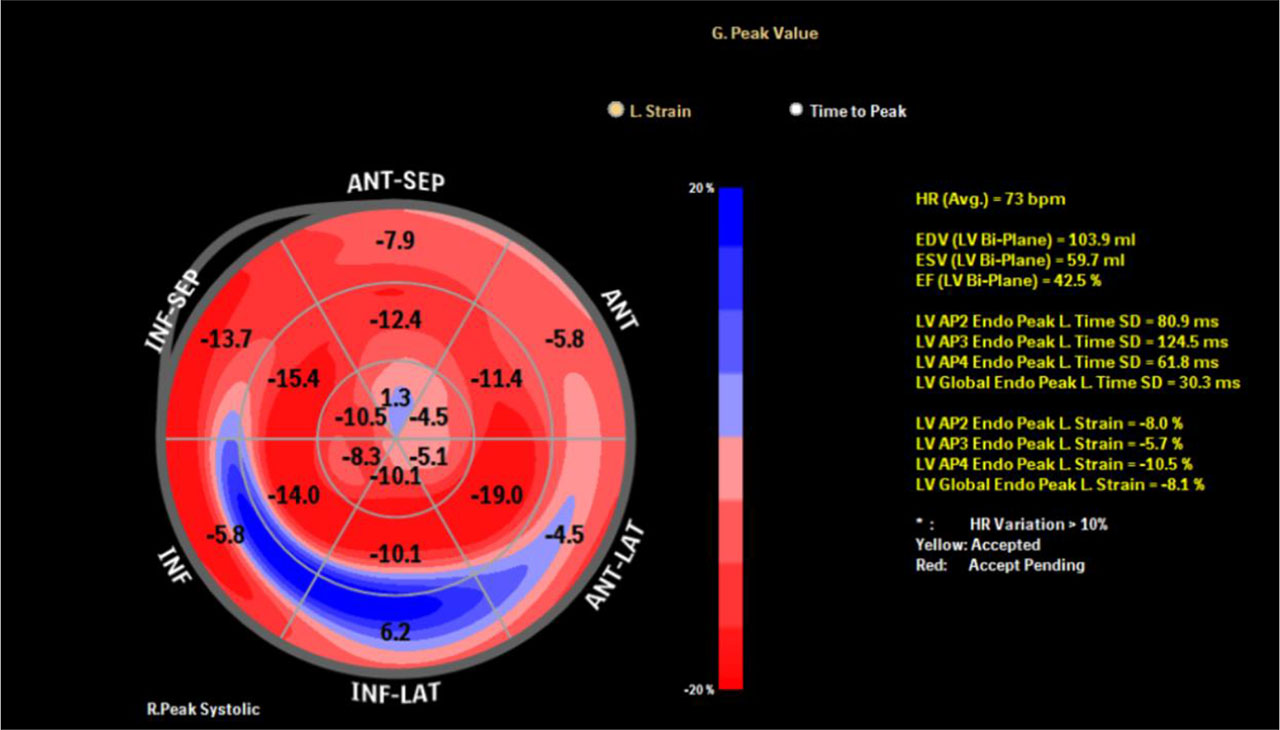
Figure 1.
Strain echocardiography performed in 2025 revealed moderate left ventricular systolic dysfunction (EF: 42.5%; GLS: −8%), with more pronounced impairment in the inferior wall.
Table 1
Antibody levels relevant to vasculitis workup
| Antibodies | Value | Reference range for normal |
|---|---|---|
| Anti-dsDNA (IU/mL) | 13.52 | <200 |
| Anti-CCP (IU/mL) | 1.40 | 0–20 |
| Anti-Ro (Anti-SSA) (IU/mL) | 0.78 | 0–20 |
| Anti-Sm (Anti-SSB) (IU/mL) | 1.93 | 0–20 |
| Antinuclear AB(ANA) (IU/mL) | 9.04 | 0–20 |
| Anti-β2 Glycoprotein I IgG (SGU/mL) | 2.47 | 0–20 |
| Anti-cardiolipin IgG (GLP/mL) | 1.36 | 0–20 |
| Anti-cardiolipin IgM(MPL/mL) | 5.73 | 0–20 |