
Introduction
The ductus arteriosus is a crucial fetal vascular connection between the pulmonary artery and the descending aorta, originating from the embryonic left sixth aortic arch.[1,2]
In utero, it diverts blood away from the non-functioning fetal lungs and toward the systemic circulatory system. This shunting is facilitated by the high pulmonary vascular resistance and low systemic resistance imposed by the placenta, resulting in preferential flow from the pulmonary artery to the aorta. [3] Following birth, the initiation of respiration leads to a rapid increase in alveolar oxygen tension, causing pulmonary vasodilation and, subsequently, a decrease in pulmonary vascular resistance. [4] Concurrently, the removal of placental prostaglandins contributes to ductal constriction and eventual functional closure.[5] In term neonates, functional closure typically occurs within one to three days, followed by anatomical closure over the following two to three weeks.[5] In contrast, preterm infants often experience delayed ductal closure due to structural immaturity of the ductus, heightened sensitivity to nitric oxide, and persistently elevated levels of prostaglandin E2. [6] In some preterm neonates, closure may be prolonged by as many as 71 days.[7]
Persistent patent ductus arteriosus (PDA) in preterm infants is associated with significant morbidities, including pulmonary overcirculation, congestive heart failure, and an increased risk of pulmonary hypertension.[8] Management strategies for PDA include conservative (expectant) approaches, pharmacologic therapy, and surgical ligation. Pharmacologic closure is generally considered first-line, with cyclooxygenase inhibitors such as indomethacin or ibuprofen commonly employed to reduce prostaglandin synthesis and facilitate ductal closure.[8,9]. Among these, oral ibuprofen has demonstrated superior efficacy compared to intravenous formulations, likely due to its longer half-life and more sustained systemic concentrations. [6,9] Recently, acetaminophen (paracetamol) has emerged as an alternative pharmacologic option for PDA closure. Unlike NSAIDs, acetaminophen is thought to inhibit the peroxidase component of the prostaglandin synthetase enzyme, thereby reducing prostaglandin synthesis via a distinct mechanism.[7,9] Its favorable safety profile— particularly regarding renal, gastrointestinal, and cerebral side effects—makes it an attractive option for vulnerable preterm populations. Nevertheless, the precise mechanism of its action remains incompletely understood, and comparisons of its efficacy with ibuprofen or placebo are still few. [10] Although acetaminophen has shown promise, some studies suggest that ibuprofen remains more effective for achieving ductal closure. [10] Therefore, the present study aims to evaluate and compare the efficacy of acetaminophen, ibuprofen, and conservative management (with no pharmacological treatment) in achieving closure of patent ductus arteriosus in preterm neonates.
Material and Methods
1. Study design and setting
This double-blind, randomized controlled trial (IRCT20230917059446N1) was conducted at Ali Ebn Abi Talib Hospital, affiliated with the Zahedan University of Medical Sciences, Iran, and underwent ethical review and received approval (IR. ZAUMS.REC.1404.203). The study enrolled 327 preterm neonates to evaluate the efficacy of pharmacological interventions for PDA closure. Ethical approval and parental informed consent were obtained prior to enrollment.
2. Participants
Eligible neonates met the following criteria: gestational age (GA) < 37 weeks; birth weight (BW) < 2500 g; and echocardiographic confirmation of hemodynamically significant PDA (left atrium-to-aortic root (LA/Ao) ratio > 1.3 and ductal diameter > 1.5 mm). Exclusion criteria included congenital heart defects requiring ductus arteriosus patency (e.g., pulmonary atresia with intact ventricular septum); major chromosomal or congenital anomalies; maternal NSAID use during pregnancy; hydrops fetalis; and primary pulmonary hypertension. Preterm neonates with severe symptomatic PDA were also excluded because immediate treatment is considered standard care and randomization to a control group would not be ethically justified. Clinical contraindications included active necrotizing enterocolitis; intestinal perforation; liver dysfunction; thrombocytopenia (platelet count < 50,000/mm3); elevated serum creatinine (> 1.8 mg/dL); and hyperbilirubinemia requiring exchange transfusion.
All control infants were clinically stable and managed according to a standardized expectant (watchful waiting) protocol, consistent with contemporary neonatal practice for hemodynamically non-severe PDA. Continuous clinical and echocardiographic monitoring ensured timely detection of deterioration, and predefined criteria triggered immediate pharmacologic rescue therapy. This approach guaranteed that no infant was denied appropriate treatment, thereby addressing ethical considerations associated with subjects’ inclusion in a conservatively managed control group; the number of infants requiring rescue therapy was also documented. The inclusion of healthy preterm neonates as a control group is ethically justified and scientifically necessary to distinguish spontaneous PDA closure from treatment effects. Control participants were exposed only to routine, non-invasive monitoring (clinical evaluation and echocardiography), ensuring minimal risk. Informed consent was obtained from parents or legal guardians, with the option to withdraw at any time without affecting standard care. Continuous monitoring and predefined rescue criteria ensured that any neonate showing signs of hemodynamic compromise received immediate pharmacological intervention, thus safeguarding participant safety. This design respects the principles of beneficence, non-maleficence, and clinical equipoise—aligning with international ethical guidelines—while also providing robust baseline data essential for evaluating the efficacy of pharmacological interventions in PDA management.
3. Randomization and blinding
Randomization was performed using computer-generated block sequences. Though stratification by gestational age was not applied, baseline demographic and clinical characteristics were comparable among groups. Owing to differences in routes of administration, full double-blinding was not feasible; therefore, the study was conducted as a randomized trial with blinded outcome assessment and blinded data analysis.
4. Interventions
Participants were stratified into three groups. Group A (IV acetaminophen) received 15 mg/kg/dose intravenously every six hours for three days, and non-responders were administered a second course of 60 mg/kg/day divided into four doses. Group B (oral ibuprofen) received a tapering regimen of 10-5-5 mg/kg/day orally for three days. Finally, group C (control) received standard care without pharmacological intervention, with anticipated spontaneous PDA closure.
5. Outcome assessment
A pediatric cardiologist performed echocardiography using a GE Vivid 3 ultrasound machine on day 3 post-birth and 24 hours post-treatment completion. Hemodynamically significant PDA was defined as LA/Ao ratio > 1.3 and ductal diameter > 1.5 mm. Treatment response was determined by confirming ductal closure via echocardiography.
6. Statistical considerations
Statistical analyses were performed using SPSS software version 24.0 (IBM Corp., Armonk, NY, USA). Continuous variables were expressed as mean ± standard deviation, and categorical variables were summarized as frequencies and percentages. Group comparisons for categorical variables were carried out using the Chisquare test, or Fisher’s exact test when expected cell counts were fewer than five. The normality of continuous variables was assessed using the Shapiro-Wilk test. As the main study variables deviated from normal distribution, non-parametric statistical methods were employed. Comparisons between two independent groups were performed using the Mann-Whitney U test. A two-sided p value < 0.05 was considered statistically significant.
Results
In this randomized study involving 327 preterm neonates, participants were evenly allocated to acetaminophen, ibuprofen, and control groups. The proportion of male neonates was similar across all groups, and no statistically significant difference was observed (P = 0.620), indicating balanced group allocation. Baseline demographic and echocardiographic parameters—including gestational age, birth weight, PDA diameter, and LA/Ao ratio—were comparable among the three groups (Table 1). Figure 1 presents a comparative distribution of PDA closure status and LA/Ao ratio status among the three groups: acetaminophen (paracetamol), ibuprofen, and control. Regarding PDA status after treatment, the highest closure rate was observed in the ibuprofen group (94.5%), followed by the acetaminophen group (89%), while the control group showed a lower closure rate (71%). Conversely, the prevalence of persistent open PDA was lowest in the ibuprofen group (5.5%), slightly higher in the acetaminophen group (11%), and substantially higher in the control group (29%). These findings visually demonstrate the superior effectiveness of pharmacological treatment compared with non-intervention, with ibuprofen showing the highest numerical success rate.
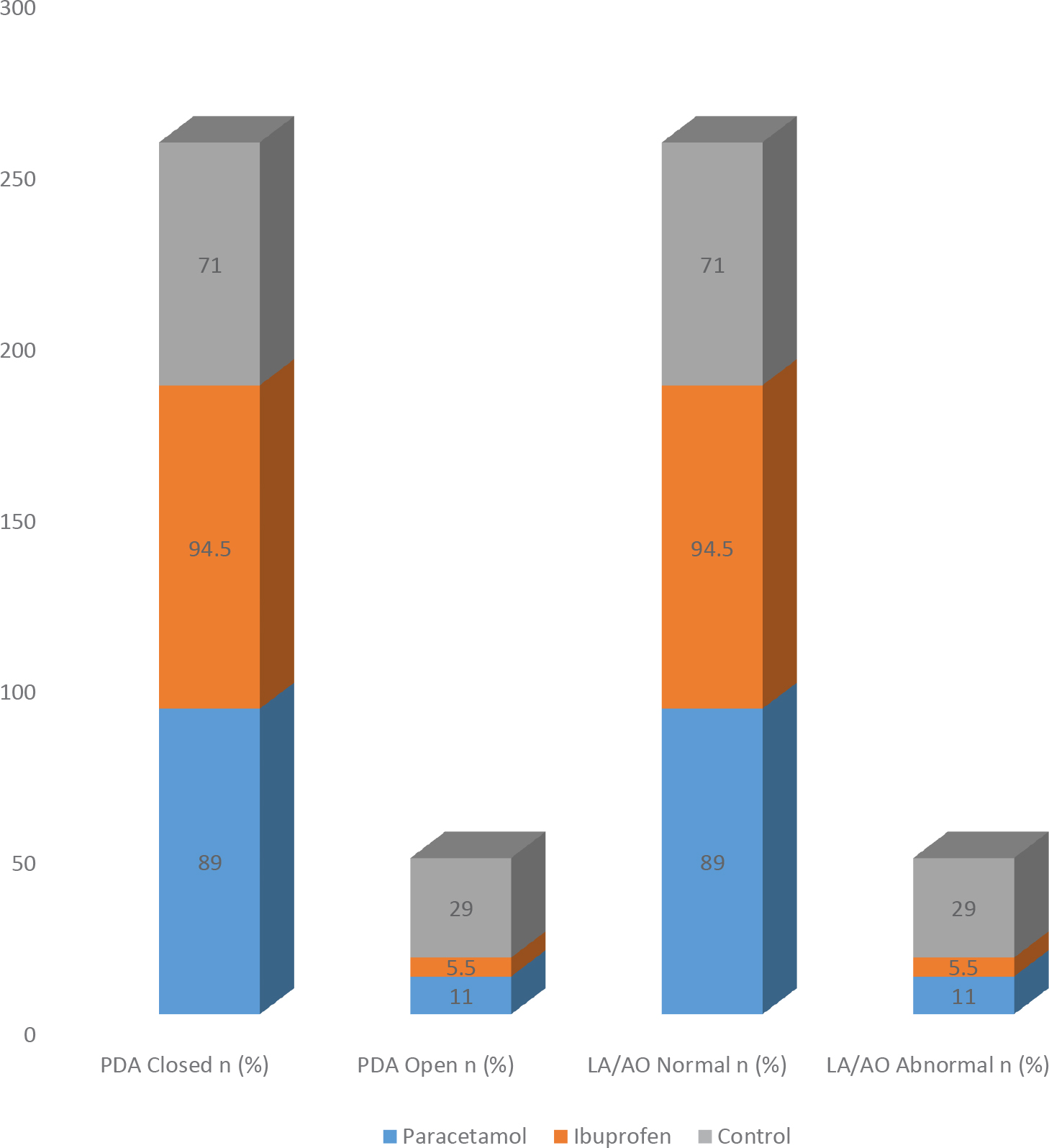
Figure 1
PDA closure and LA/Ao outcomes following pharmacological and conservative management
Table 1
Pre-treatment demographic and echocardiographic characteristics of neonates in the three study groups.
| Variable | Acetaminophen Mean ± SD | Ibuprofen Mean ± SD | Control Mean ± SD | Total Mean ± SD | 25th | 50th (Median) | 75th | χ2 | P-value |
|---|---|---|---|---|---|---|---|---|---|
| Gestational age (weeks) | 32.06 ± 2.45 | 31.63 ± 2.66 | 31.61 ± 2.56 | 31.77 ± 2.56 | 29.00 | 32.000 | 34.00 | 2.293 | 0.318 |
| Birth weight (g) | 1816.06 ± 448.78 | 1739.31 ± 441.30 | 1815.82 ± 427.25 | 1790.39 ± 439.34 | 1426.00 | 1774.00 | 2136.00 | 2.014 | 0.365 |
| LA/Ao before treatment | 1.49 ± 0.01 | 1.49 ± 0.01 | 1.49 ± 0.01 | 1.49 ± 0.01 | 1.48 | 1.4891 | 1.50 | 0.948 | 0.389 |
| PDA diameter before treatment (mm) | 2.35 ± 0.30 | 2.34 ± 0.33 | 2.34 ± 0.32 | 2.35 ± 0.31 | 2.10 | 2.3517 | 2.50 | 0.019 | 0.981 |
For the LA/Ao ratio status, a similar pattern was observed. The proportion of patients with a normal LA/Ao ratio was highest in the ibuprofen group (94.5%), followed by the acetaminophen group (89%), and lowest in the control group (71%). In contrast, the frequency of abnormal LA/Ao ratio was lowest in the ibuprofen group (5.5%), higher in the acetaminophen group (11%), and markedly higher in the control group (29%).
Overall, the figure clearly illustrates that both acetaminophen and ibuprofen are associated with markedly higher PDA closure rates and improved normalization of the LA/Ao ratio compared with the control group, with ibuprofen demonstrating the most numerically favorable outcomes. In Table 2, the results show that the PDA closure rate was 89.0% (97/109) in the acetaminophen group and 94.5% (103/109) in the ibuprofen group, with no statistically significant difference between these two interventions (χ2 = 2.18, p = 0.14). However, when compared with the control group, which had a closure rate of 71% (78/109), acetaminophen showed a significantly higher success rate (89.0%; χ2 = 10.46, p < 0.001), and ibuprofen was even more effective (94.5%; χ2 = 26.35, p < 0.001). The proportion of persistent open PDA was lowest in the ibuprofen group (5.5%) followed by the acetaminophen group (11.0%), and highest in the control group (29%).
Table 2
Pairwise analysis of post-treatment PDA closure between acetaminophen, ibuprofen, and control groups.
| PDA status after treatment | Statistics | Intervention | Total | χ2 | p | |
|---|---|---|---|---|---|---|
| Acetaminophen | Ibuprofen | |||||
| Closed | n | 97 | 103 | 200 | 2.18 | 0.14 |
| % | 89.00% | 94.50% | 91.70% | |||
| Open | n | 12 | 6 | 18 | ||
| % | 11.00% | 5.50% | 8.30% | |||
| Acetaminophen | Control | |||||
| Closed | n | 97 | 78 | 175 | 10.46 | < 0.001 |
| % | 89.00% | 71% | 80.3% | |||
| Open | n | 12 | 31 | 43 | ||
| % | 11.00% | 29% | 19.7% | |||
| Ibuprofen | Control | |||||
| Closed | n | 103 | 78 | 181 | 26.35 | < 0.001 |
| % | 94.50% | 71% | 83% | |||
| Open | n | 6 | 31 | 37 | ||
| % | 5.50% | 29% | 17% | |||
Overall, both pharmacological interventions were significantly more effective than no treatment, while no statistically significant difference was observed between acetaminophen and ibuprofen. Stratified analyses by gestational age revealed no significant treatment-related differences among neonates born before 32 weeks of gestation (Table 3). The table showed no statistically significant difference was detected; in infants with GA < 32 weeks, closure rates were 86.7% for acetaminophen versus 90.5% for ibuprofen (p = 0.51), and in those with GA ≥ 32 weeks, rates were 91.8% for acetaminophen versus 100% for ibuprofen (p = 0.05).
Table 3
Effect of gestational age on PDA closure: pairwise comparisons between acetaminophen, ibuprofen, and control groups.
| Gestational age (GA) | PDA status after treatment | Statistics | Intervention | Total | χ2 | p | |
|---|---|---|---|---|---|---|---|
| Acetaminophen | Ibuprofen | ||||||
| GA < 32 weeks | Closed | n | 52 | 57 | 109 | 0.442 | 0.51 |
| % | 86.70 | 90.50 | 88.60 | ||||
| Open | n | 8 | 6 | 14 | |||
| % | 13.30 | 9.50 | 11.40 | ||||
| GA ≥ 32 weeks | Closed | n | 45 | 46 | 91 | 3.92 | 0.05 |
| % | 91.80 | 100.00 | 95.80 | ||||
| Open | n | 4 | 0 | 4 | |||
| % | 8.20 | 0.00 | 4.20 | ||||
| Acetaminophen | Control | ||||||
| GA < 32 weeks | Closed | n | 52 | 50 | 102 | 4.44 | 0.035 |
| % | 86.7% | 71.4% | 78.5% | ||||
| Open | n | 8 | 20 | 28 | |||
| % | 13.3% | 28.6% | 21.5% | ||||
| GA ≥ 32 weeks | Closed | n | 45 | 28 | 73 | 6.17 | 0.013 |
| % | 91.8% | 71.8% | 83.0% | ||||
| Open | n | 4 | 11 | 15 | |||
| % | 8.2% | 28.2% | 17.0% | ||||
| Ibuprofen | Control | ||||||
| GA < 32 weeks | Closed | n | 57 | 50 | 107 | 7.65 | 0.006 |
| % | 90.5% | 71.4% | 80.5% | ||||
| Open | n | 6 | 20 | 26 | |||
| % | 9.5% | 28.6% | 19.5% | ||||
| GA ≥ 32 weeks | Closed | n | 46 | 28 | 74 | 14.90 | < 0.001 |
| % | 100.0% | 71.8% | 87.1% | ||||
| Open | n | 0 | 11 | 11 | |||
| % | 0.0% | 28.2% | 12.9% | ||||
However, both active drugs demonstrated significant superiority over the control condition. For infants with GA < 32 weeks, compared to the control’s 71.4% closure rate, acetaminophen achieved a closure rate of 86.7% (p = 0.035), while ibuprofen achieved 90.5% (p = 0.006). This superiority was even more pronounced in the group with GA ≥ 32 weeks, where, in comparison to the control’s 71.8% closure rate, acetaminophen closed 91.8% of cases (p = 0.013), and ibuprofen achieved a 100% closure rate (p < 0.001).
A similar pattern was observed when outcomes were analyzed by birth weight (Table 4). The results showed no significant difference between acetaminophen (83.3%) and ibuprofen (85.7%) in very low birth weight infants (< 1500g). However, in infants with a birth weight of ≥ 1500 g, Ibuprofen demonstrated a significantly superior closure rate of 98.6%, compared to 91.1% for acetaminophen (p = 0.04). Compared to the Control group, both active drugs were highly effective, but their statistical superiority was confined to the higher birth weight stratum. In infants weighing ≥ 1500 g, acetaminophen achieved a 91.1% closure rate versus 70.5% in the control group (p < 0.001), while ibuprofen achieved 98.6% (p < 0.001). In contrast, for infants with a birth weight under 1500 g, statistical significance compared to controls was not reached by either acetaminophen (83.3% vs. 74.2%, p = 0.384) or ibuprofen (85.7% vs. 74.2%, p = 0.240).
Table 4
Effect of birth weight on PDA closure: pairwise comparisons between acetaminophen, ibuprofen, and control groups.
| Weight at birth | PDA status after treatment | Statistics | Intervention | Total | χ2 | p | |
|---|---|---|---|---|---|---|---|
| Acetaminophen | Ibuprofen | ||||||
| Weight at birth < 1500 g | Closed | n | 25 | 30 | 55 | 0.07 | 0.79 |
| % | 83.30 | 85.70 | 84.60 | ||||
| Open | n | 5 | 5 | 10 | |||
| % | 16.70 | 14.30 | 15.40 | ||||
| Weight at birth > = 1500 g | Closed | n | 72 | 73 | 145 | 4.348 | 0.04 |
| % | 91.10 | 98.60 | 94.80 | ||||
| Open | n | 7 | 1 | 8 | |||
| % | 8.90 | 1.40 | 5.20 | ||||
| Acetaminophen | Control | ||||||
| Weight at birth < 1500 g | Closed | n | 25 | 23 | 48 | 0.760 | 0.384 |
| % | 83.3% | 74.2% | 78.7% | ||||
| Open | n | 5 | 8 | 13 | |||
| % | 16.7% | 25.8% | 21.3% | ||||
| Weight at birth > = 1500 g | Closed | n | 72 | 55 | 127 | 10.803 | <0.001 |
| % | 91.1% | 70.5% | 80.9% | ||||
| Open | n | 7 | 23 | 30 | |||
| % | 8.9% | 29.5% | 19.1% | ||||
| Ibuprofen | Control | ||||||
| Weight at birth < 1500 g | Closed | n | 30 | 23 | 53 | 1.380 | 0.240 |
| % | 85.7% | 74.2% | 80.3% | ||||
| Open | n | 5 | 8 | 13 | |||
| % | 14.3% | 25.8% | 19.7% | ||||
| Weight at birth > = 1500g | Closed | n | 73 | 55 | 128 | 22.608 | <0.001 |
| % | 98.6% | 70.5% | 84.2% | ||||
| Open | n | 1 | 23 | 24 | |||
| % | 1.4% | 29.5% | 15.8% | ||||
Discussion
Pharmacological closure of patent ductus arteriosus (PDA) in preterm infants is most commonly achieved using non-steroidal antiinflammatory drugs (NSAIDs).[10] Although these agents are generally effective, their use may be constrained by serious adverse effects, including intraventricular hemorrhage, gastrointestinal bleeding, elevated blood urea nitrogen levels, and necrotizing enterocolitis.[9] In the present study, PDA closure was achieved in 94.5% of infantstreated with ibuprofen and 89.0% of those receiving acetaminophen, compared with a lower closure rate of 74.3% in the control group. Compared to conservative management, pharmacological treatment was associated with a higher likelihood of post-treatment normalization of the LA/Ao ratio compared with conservative management. Both ibuprofen and acetaminophen demonstrated favorable effects, with ibuprofen showing the greatest degree of normalization. The superiority of ibuprofen over control reached statistical significance, whereas acetaminophen did not, despite exhibiting higher closure rates than control. Importantly, no significant difference was observed between the two active treatments groups overall, suggesting comparable efficacy in promoting ductal closure.
Subgroup analyses further indicated that the beneficial effect of ibuprofen was more evident in neonates with a gestational age greater than 32 weeks and a birth weight above 1500 g. In more immature or lower-birth-weight infants, closure outcomes were similar between ibuprofen and acetaminophen, highlighting the influence of developmental factors on treatment response. Given the well-recognized adverse effects associated with NSAIDs, there has been increasing interest in alternative therapeutic approaches that maintain efficacy while improving safety. Acetaminophen has emerged as a potential candidate in this regard, with accumulating evidence supporting its role in PDA management. Several studies have suggested that early pharmacologic intervention with acetaminophen may reduce the persistence of PDA while avoiding many complications related to cyclooxygenase inhibition.[19,10] Aikio et al.[11] demonstrated that early initiation of acetaminophen was associated with higher ductal closure rates compared with delayed treatment, without an increase in adverse events. Similarly, Terrin et al.[12] reported that acetaminophen administered within the first days of life resulted in a marked reduction in residual PDA and was well tolerated. Harkin et al.[13] further emphasized the benefits of early acetaminophen therapy by showing a shorter duration of ductal patency and a reduced need for surgical or additional medical interventions. In line with these findings, Hock et al.[14] highlighted that early acetaminophen use not only improved closure rates but also mitigated complications related to prolonged PDA, such as pulmonary overcirculation and heart failure, while preserving renal and hepatic function. Evidence from previous investigations on the effectiveness of acetaminophen for PDA closure has been inconsistent. Dash et al.[15] reported wide variability in treatment success, a finding that may be partially explained by the relatively advanced gestational age of their cohort (mean GA: 31.6 weeks). Comparable heterogeneity in closure outcomes has also been described by Bagheri et al.[16] and Schindle et al.,[17] underscoring the influence of population characteristics on therapeutic response. In contrast, other studies have demonstrated a clear therapeutic benefit of acetaminophen. Surak et al.[18] and Terrin et al. [12] showed significantly higher closure rates with acetaminophen compared with placebo, supporting its potential role as an alternative to NSAIDs in selected clinical settings.
Variations in institutional protocols and treatment strategies may further contribute to these discrepant findings, as emphasized by lacobelli et al., [19] who documented substantial inter-center differences in PDA management. Nevertheless, not all investigations have confirmed a favorable effect; for example, Asbagh et al.[20] found no significant advantage for acetaminophen over placebo. Overall, the inconsistent results reported by Dash et al., [15] Bagheri et al.,[16] and Schindle et al.[17] likely reflect differences in gestational age distribution, study design, and clinical practice patterns across cohorts.
With respect to ibuprofen therapy, prior investigations have consistently demonstrated its effectiveness in promoting ductal closure. Ohlsson et al.[21] reported significantly higher closure rates with ibuprofen compared with placebo and noted that higher dosing regimens substantially reduced the need for surgical ligation. These findings were corroborated by Hillier et al.[22], who showed that high-dose ibuprofen was associated with lower ligation rates than standard dosing in preterm infants with low birth weight. Comparative studies evaluating ibuprofen against acetaminophen have yielded variable results. Dani et al.[23] observed inferior efficacy of acetaminophen relative to ibuprofen, whereas Balachander et al.[24] found no meaningful difference between the two agents. Similarly, Yang et al.[25] reported comparable closure rates but highlighted a more favorable safety profile for acetaminophen, including lower rates of oliguria, reduced toxicity, and decreased urinary prostaglandin E2 excretion. In extremely preterm populations, Oncell et al.[26] documented closure rates of 77.5% with ibuprofen and 72.5% with acetaminophen among infants born before 30 weeks of gestation and weighing less than 1250 g, while Gonzalez-Luis et al.[27] also found no statistically significant difference between the two drugs. The findings of the present study are consistent with existing evidence indicating that the probability of PDA closure increases with advancing gestational age and higher birth weight. Spontaneous ductal closure has been reported in approximately 31% of neonates by the seventh postnatal day. [28] Furthermore, two-thirds of very-low-birth-weight infants have been shown to achieve closure before hospital discharge, with the remainder closing after discharge[29] Previous research has also demonstrated an inverse relationship between time to ductal closure and birth weight,[30] emphasizing the importance of neonatal maturity, hemodynamic adaptation, and pulmonary vascular resistance in ductal physiology.
Importantly, the results provide novel evidence suggesting that the effectiveness of ibuprofen and acetaminophen may vary according to neonatal maturity, with more pronounced benefits observed in relatively more mature preterm infants. This finding has significant clinical implications, supporting a tailored, physiology-guided approach to PDA management rather than a uniform treatment strategy for all preterm neonates.
Overall, the integration of a large randomized sample, a conservative control arm, stratified analyses, and identification of maturity-dependent treatment effects represents a meaningful contribution to the current literature. These strengths enhance the clinical relevance of the study and provide evidence that may help inform future guidelines and individualized therapeutic decisionmaking for PDA in preterm infants.
Several limitations should be noted. First, as this is a singlecenter study, our findings may not be fully generalizable to institutions with different patient populations or clinical protocols. Second, our analysis focused on short-term ductal closure rates, without long-term follow-up data on clinically important outcomes such as neurodevelopment, growth, chronic lung disease, or potential PDA reopening. Third, although randomization eliminated allocation bias, the open-label design meant that caregivers and outcome assessors were not blinded to treatment assignment, which could introduce bias in outcomes requiring subjective interpretation. Finally, while pre-interventional echocardiography included standard parameters like ductal diameter and shunt direction, we did not systematically record hemodynamic measures such as flow velocity or pressure gradient across the ductus factors that may help predict spontaneous closure. The absence of these variables represents an additional limitation.
Conclusion
From the study, we can conclude that ibuprofen was the most effective agent for promoting PDA closure in preterm neonates, particularly in those with gestational age ≥ 32 weeks and birth weight ≥ 1500 g. While acetaminophen also improved outcomes compared to no treatment at all, its effect was more modest. These findings support the preferential use of ibuprofen in clinically stable preterm neonates with PDA, especially in those with more advanced gestational age or higher birth weight. The evidence from our study and recent literature suggests that ibuprofen remains highly effective for PDA closure, particularly in more mature and heavier preterm infants. For extremely preterm or very low-birth-weight infants, the efficacy differences between ibuprofen and acetaminophen appear minimal, suggesting that either drug could be considered depending on the clinical context.
Acknowledgments
The authors would like to express their gratitude to the families of the neonates who participated in this study for their cooperation and trust.
Notes
[1] Ethics compliance
We confirm that the article was conducted in compliance with ethical guidelines.
[2] Conflicts of interest Conflicts of interest
The authors declare that there are no conflicts of interest regarding the publication of this study.
[3] Contributed by Authors’ contributions
NMN: Designed the study protocol, supervised clinical data collection, conducted echocardiographic evaluations and contributed to interpreting the clinical data. SY: Coordinated patient recruitment and data acquisition, particularly in the field of pediatric infectious diseases. AT: Conducted the statistical analysis, interpreted the findings, and provided substantial input on the study’s design and methodology. He also led the drafting and revision of the manuscript, integrating contributions from all authors and preparing it for submission. All authors read and approved the final version of the manuscript and agree to be accountable for all aspects of the work.