
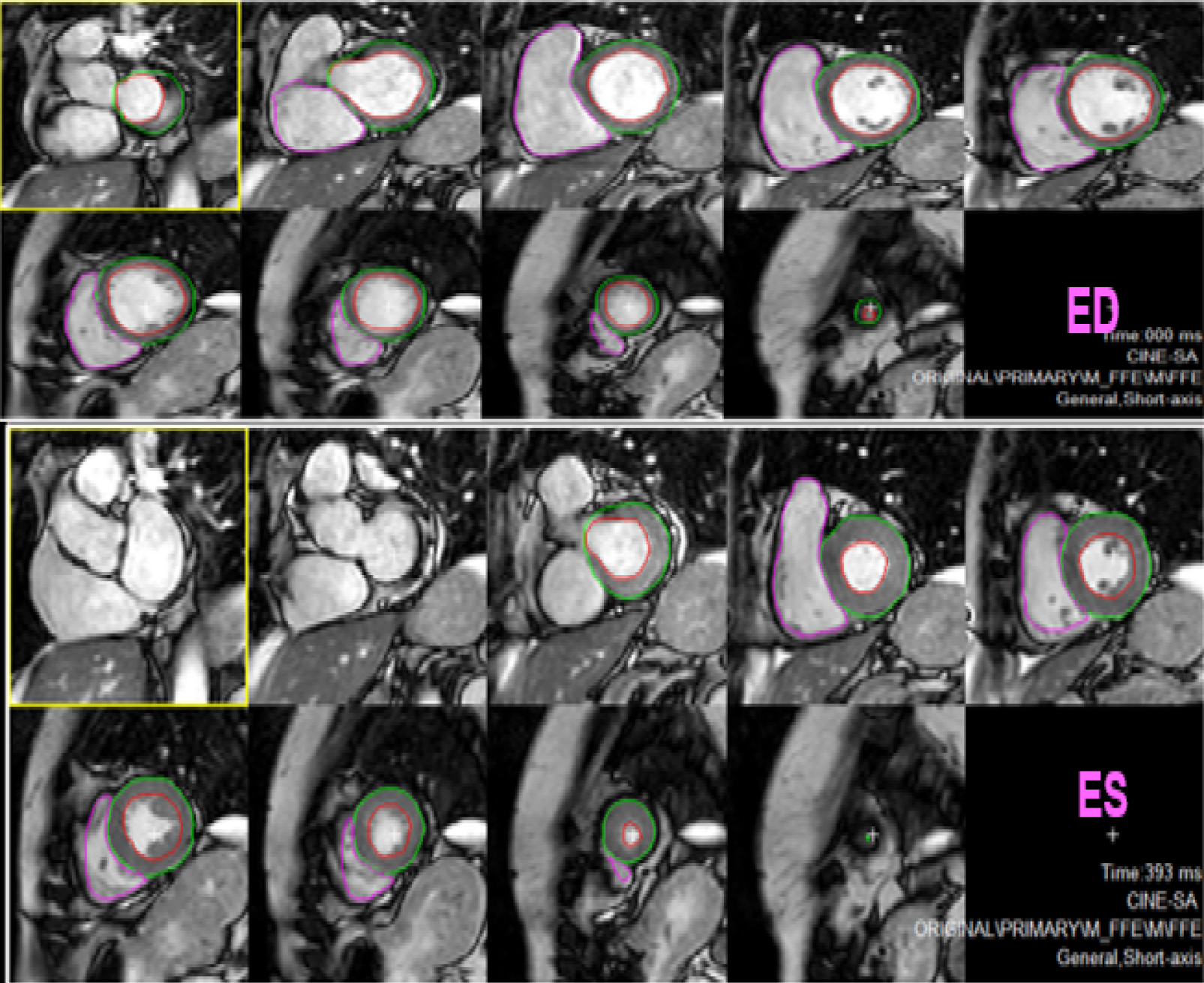
Figure 1
Volumetric assessment of left ventricular (LV) and right ventricular (RV) function in dedicated software. It involves contouring the LV endocardium (in red), epicardium (in green), and RV endocardium (in purple) in a short-axis stack at end-diastole (ED) and end-systole (ES).
Table 1
CMR criteria for the majority of cardiomyopathy diagnoses
| Indication | Structural Features (cine-SSFP) | LGE | Native T1 | ECV | T2 |
|---|---|---|---|---|---|
| DCM | -LV dilatation and disfunction - diffuse regional wall motion abnormalities - +/_RV dilatation and disfunction | - typical mid-wall pattern | -slightly diffuse increased | -slightly increased | - slightly increased, especially in inflammatory etiologies |
| NDLVC | -no LV dilatation with LV disfunction -normal LV systolic function with + LGE | -nonischemic pattern | -normal -slightly increased | -normal -slightly increased | -can be increased in inflammatory etiologies |
| Myocarditis | -none -regional wall motion abnormalities -global LV dysfunction -pericardial effusion | -patchy subepicardial pattern | -increased in the oedema zone | -increased in the oedema zone | -regional or global increased |
| HCM | -hypertrophy (≥15 mm LV wall thickness): symmetrical, asymmetric, apical - other anomalies: LV crypts, papillar hypertrophy, SAM | -mid-wall, usually in the areas where the wall is the thickest -insertion points of the septum to the RV level | -increased | -increased | -normal -slightly increased in the burnout type |
| ARVC | -RV dilatation, dysfunction, -akinetic, dyskinetic aneurysms at the RV level, often affecting the RV triangle: sub tricuspid area, RV ejection tract, and RV apex -LV systolic dysfunction, regional wall motion abnormality | - transmural RV region(s) (inlet, outlet, and apex) - subepicardial or mid-wall at LV lateral/inferolateral, septum, or both -subepicardial circumferential infiltration in those with predominantly LV damage | -decreased in fat infiltration -increased in scar region | -non-specific | - can be increased at the level of LGE in acute phases |
| Cardiac amyloidosis | -concentric hypertrophy -IAS, LA wall thickening - LV dysfunction -pericardial effusion | -diffuse subendocardial -nulling effect of the myocardium -dark blood aspect | -diffuse increased | -very increased | -non-specific pattern - can be increased in those with AL form |
| Cardiac sarcoidosis | -global systolic dysfunction -regional or global wall motion abnormalities, -bi-ventricular dilatation or hypertrophy. -slight increase in left ventricular mass secondary to granulomatous expansion | -mid-wall or sub-epicardial focal fibrosis, -transmural or subendocardial, but without a correlation to a coronary territory -papillary muscles, RV-free wall, and the atria can also be involved. | -increased in the scar zone | - increased diffuse | -increased in areas with granulomas |
| LV non-compaction/hypertrabeculation | -noncompacted-to-compacted myocardium ratio of 2.3:1 -trabeculated mass > 20% - LV disfunction/dilatation | -non-specific pattern -most frecvent subepicardial | -slightly increase | -increased diffuse | -normal |
| Anderson-Fabry disease | -concentric important LV hypertrophy | -mid-wall inferolateral -mid-wall septal | -decreased - pseudonormal | -decreased | -slightly increased, basal anteroseptal |
| Neuromuscular dystrophy | -normal -LV dysfunction -regional wall motion defects | -focal fibrosis predominantly at the level of the lateral and inferolateral walls | -increased diffuse | -increased diffuse | -hypersignal at the LGE level |
1 DCM- dilated cardiomyopathy, NDLVC- non-dilated left vetricular cardiomyopathy, HCM- hypertrophic cardiomyopathy, ARVC- arrhythmogenic right ventricular cardiomyopathy, LV- left ventricle, RV- right ventricle, LA- left atrium, AS- interatrial septum, AL- light chain amyloidosis. According to [14,18,25].
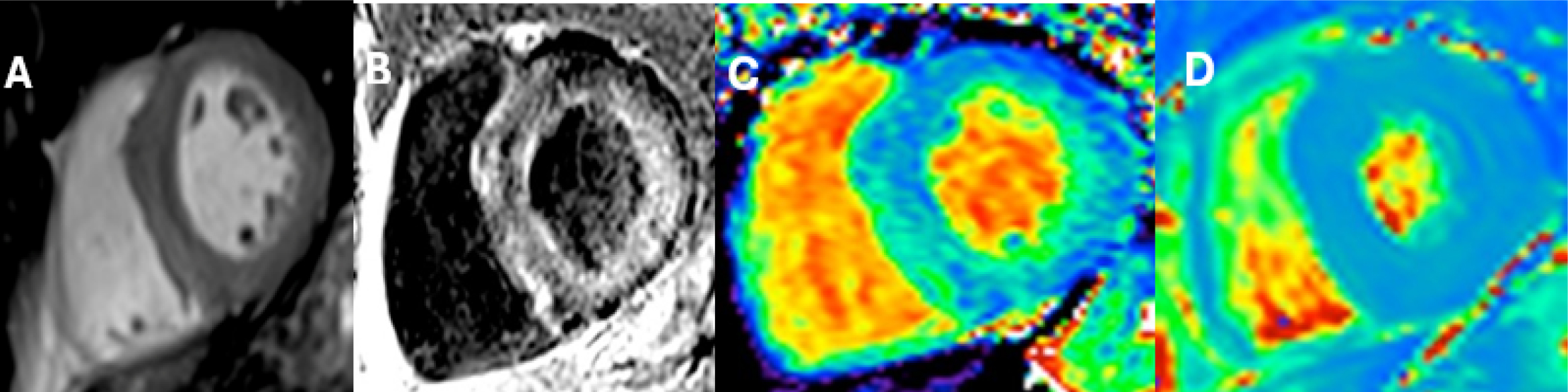
Figure 2
Cardiac magnetic resonance (CMR) exam of a 65-year-old female addressed for hypertrophic cardiomyopathy assessment, the contrast-enhanced CMR identifies changes susceptible to cardiac amyloidosis. (A) The diastolic phase of a balanced steady-state free precession (bSSFP) cine sequence of the short axis shows predominant septal hypertrophy; the basal antero-septum is 18mm thick, while the other walls are 12mm. (B) LGE acquired in the short axis shows difficult nulling of the myocardium, with areas of transmural hyperenhancement without respecting a coronary artery distribution. (C) T1 mapping imaging identified elevated T1=1100 ms and very high extracellular volume (ECV=48%). (D) T2 mapping imaging revealed diffuse edema, T2 =52-58 ms.
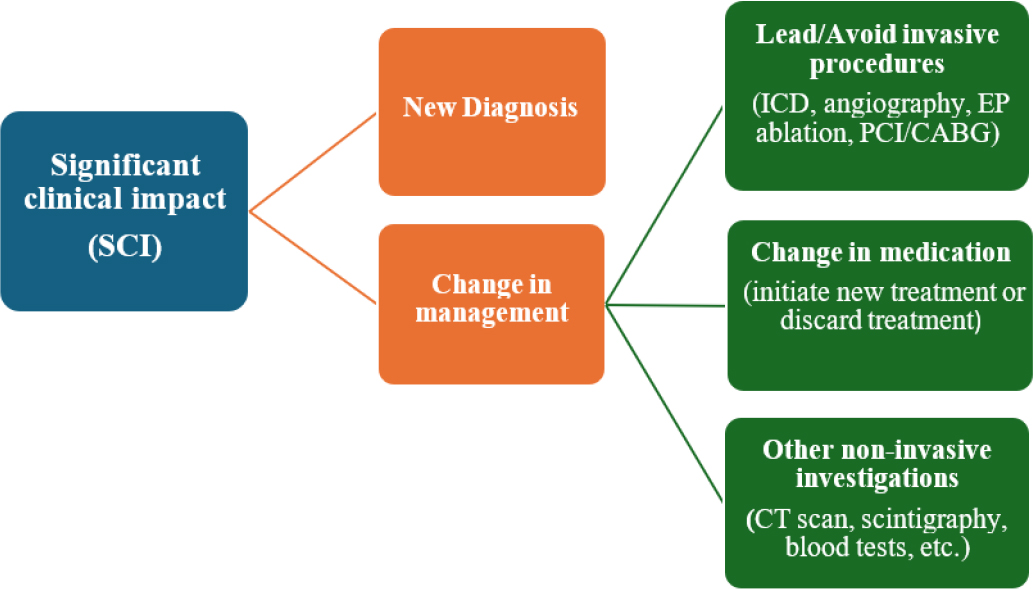
Figure 3
Significant clinical impact definition. ICD- implantable cardioverter-defibrillator, EP-electrophysiology, PCI-percutaneous coronary intervention, CABG-coronary artery bypass grafting, CT- computer tomography
Table 2
Baseline characteristics
| Baseline characteristics | |
| Age, years | 49 (±14) |
| Sex (male), % | 65% |
| Body surface area, m2 | 1.99 (±0.2) |
| Family history of cardiomyopathy | 4% |
| NYHA Class | |
| I | 21% |
| II | 65% |
| III | 13% |
| IV | 1% |
| Coronary artery risk factors | |
| Hypertension, % | 55% |
| Diabetes mellitus, % | 3% |
| Hypercholesterolemia, % | 51% |
| Smoking % | 15% |
| Alcohol consumption, % | 4.5% |
| Comorbidities | |
| History of myocardial infarction, % | 0.5% |
| Aortocoronary bypass operation, % | 0% |
| PCI, % | 0.5% |
| CKD, % | 5% |
| Electrocardiogram | |
| Sinus Rhythm, % | 93% |
| Atrial Fibrillation, % | 7% |
| Complete LBBB, % | 12% |
| Frequent PVC, % | 7% |
| Complications | 0.5% |
| Cardiac tests before CMR | |
| Echocardiography | 100% |
| Coronary angiogram CT | 1% |
| Coronary angiography | 20% |
| SPECT | 1% |
| Treadmill test | 2% |
| The primary indication for CMR | |
| DCM/ NDLVC | 45% |
| HCM/ LVH | 18% |
| Cardiac amyloidosis | 5.2% |
| ARVC | 4 % |
| Myocarditis | 3.6% |
| Cardiac sarcoidosis | 1% |
| LV non-compaction/hypertrabeculation | 2% |
| Anderson-Fabry disease | 2% |
| Tachycardia-induced cardiomyopathy | 1% |
| Chemotherapy induces cardiomyopathy | 0.5% |
| Neuromuscular cardiomyopathy | 0.5% |
| Arrhythmia/SND substrate | 2.5% |
| Ischemic cardiomyopathy | 1% |
| Other cardiomyopathy | 10% |
1 Data are presented as numbers (percentage), mean ± standard deviation. ICA- invasive coronary angiography, CMR- cardiovascular magnetic resonance, PCI-percutaneous intervention. CABG- coronary artery bypass grafting, LBBB- left bundle branch block, PVC- premature ventricular contraction, SPECT- single-photon emission computer tomography, LBBB-left bundle branch block, DCM- dilated cardiomyopathy, NDLVC- non-dilated left ventricular cardiomyopathy, HCM- hypertrophic cardiomyopathy, LVH- left ventricular hypertrophy, LV-left ventricle, ARVC- arrhythmogenic right ventricular cardiomyopathy, SND- sinus node dysfunction
Table 3
CMR parameters
| Cardiac dimensions and function | |
|---|---|
| LVEDV, ml | 224 (±100) |
| LVEDVi, ml/m2 | 113(± 47) |
| LVESV, ml | 129 (±92) |
| LVESVi, ml/m2 | 64 (±43) |
| LVSV | 92 (±58) |
| LVEF, % | 46 (±15) |
| LV mass i, g/m2 | 68(±27) |
| RVEDV, ml | 168 (±58) |
| RVEDVi, ml/m2 | 81 (±29) |
| RVESV, ml | 89 (±27) |
| RVESVi, ml/m2 | 43 (±26) |
| RVEF% | 55 (±11) |
| Tissue characterization | |
| Oedema n, (%) | 15, (4,2%) |
| Native T1 (ms) | 1030(±50) |
| T2 (ms) | 49 (±19) |
| Characterization of focal scars | |
| Scar present n, (%) | 177 (65%) |
| Non-ischaemic scar n, (%) | 164 (92%) |
| Ischaemic scar n, (%) | 13 (7.3%) |
Number of scars (%)
|
|
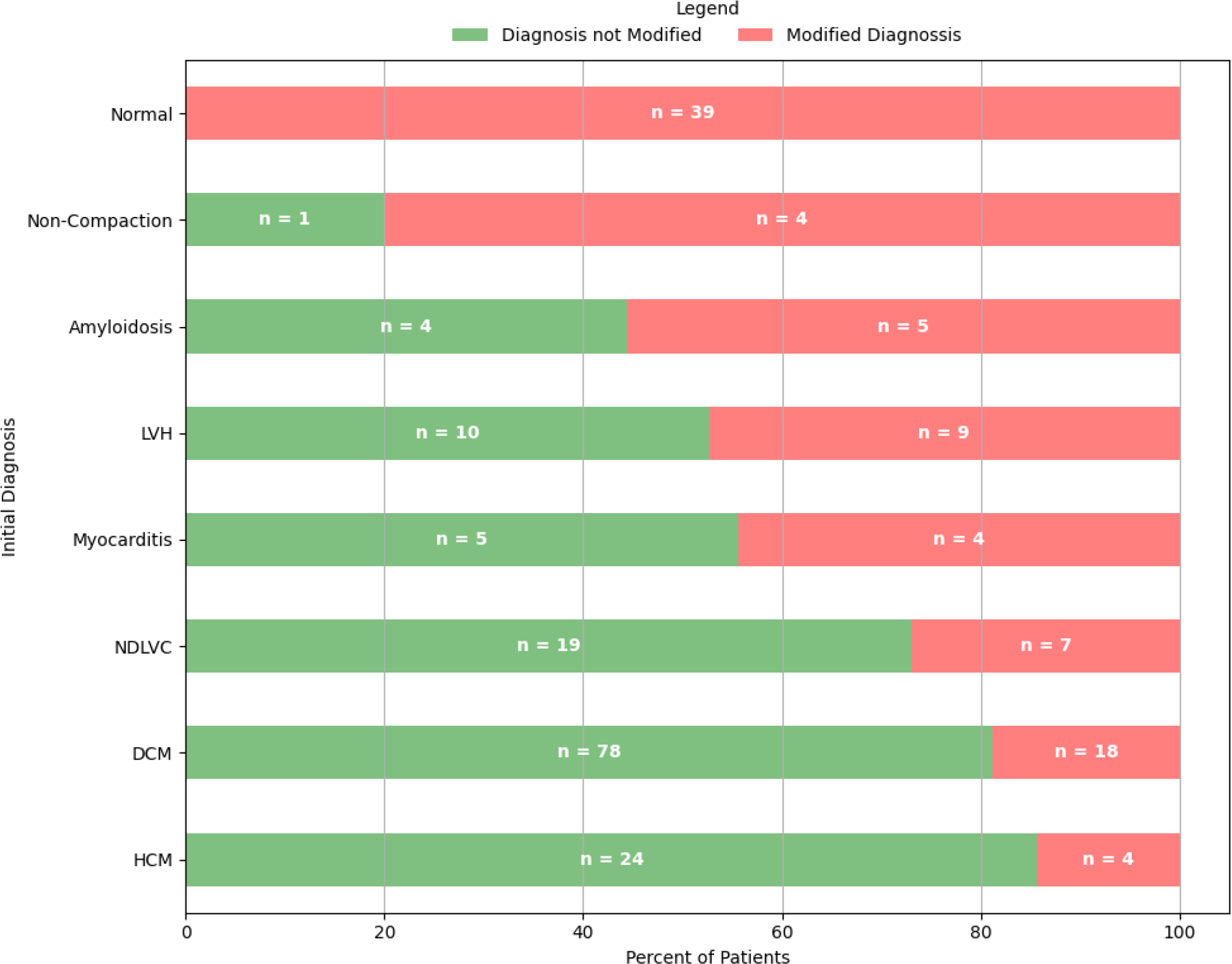
Figure 4
The change of diagnosis after CMR examination. DCM- dilated cardiomyopathy, NDLVC non-dilated left ventricular cardiomyopathy, HCM- hypertrophic cardiomyopathy, LVH- left ventricular hypertrophy, ARVC- arrhythmogenic right ventricular cardiomyopathy
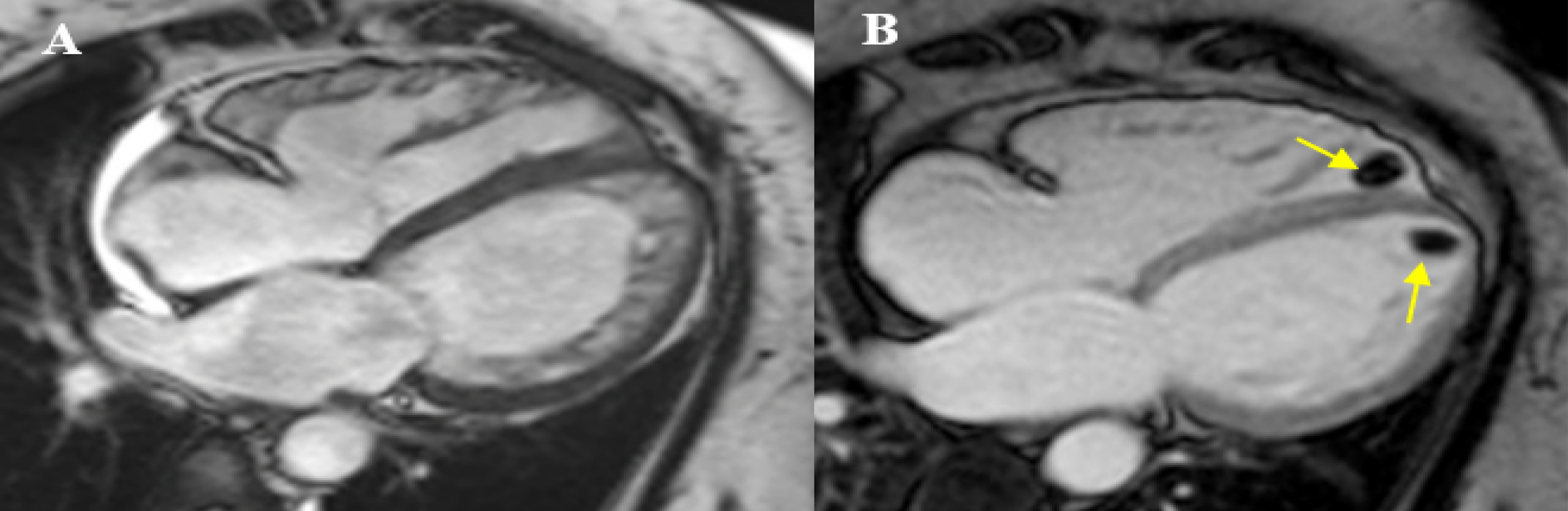
Figure 5
(A) Contrast-enhanced cardiovascular magnetic resonance diastolic frame of cine image in 4 chamber view shows a noncompact aspect of the myocardium. (B) The early gadolinium enhancement image in the same four-chamber view highlights apical thrombi at the left ventricle (LV) and right ventricle (RV) levels, indicated by yellow arrows
Table 4
Demographic Parameters. Predictor of significant clinical impact - univariable analysis
| Predictor | N | Event N | OR (95% CI)1 | p-value |
|---|---|---|---|---|
| Age | 272 | 180 | 1.00 (0.99 to 1.02) | 0.733 |
| Gender (M) | 179 | 121 | 1.20 (0.71 to 2.03) | 0.492 |
| BSA | 272 | 180 | 1.22 (0.53 to 2.96) | 0.643 |
| Coronary angiography | 57 | 41 | 1.39 (0.74 to 2.71) | 0.312 |
| Hypertension | 151 | 102 | 1.16 (0.70 to 1.93) | 0.559 |
| Hypercholesterolemia | 140 | 95 | 1.18 (0.71 to 1.96) | 0.517 |
| Alcohol | 12 | 10 | 2.66 (0.68 to 17.6) | 0.212 |
| Tabacco use | 40 | 28 | 1.24 (0.61 to 2.64) | 0.568 |
| NYHA class | ||||
| 1 | 29 | 19 | — | |
| 2 | 176 | 110 | 0.88 (0.37 to 1.96) | 0.755 |
| 3 & 4 | 36 | 29 | 2.18 (0.72 to 6.97) | 0.175 |
Table 5
CMR parameters. Predictor of significant clinical impact-univariable analysis
| Predictor | N | Event N | OR (95% CI)1 | p-value |
|---|---|---|---|---|
| LVEF | 272 | 180 | 0.97 (0.95 to 0.99) | 0.002 |
| LVEDVi | 272 | 180 | 1.01 (1.00 to 1.01) | 0.067 |
| LVESVi | 272 | 180 | 1.01 (1.00 to 1.02) | 0.012 |
| LVSVi | 272 | 180 | 0.98 (0.96 to 1.00) | 0.026 |
| RVEF | 265 | 175 | 0.97 (0.95 to 0.99) | 0.002 |
| LGE | 177 | 113 | 1.84 (1.11 to 3.07) | 0.019 |
| Native septal T1 | 243 | 157 | 1.00 (1.00 to 1.01) | 0.507 |
| T2 | 254 | 167 | 0.99 (0.93 to 1.01) | 0.387 |
Table 6
CMR parameters. Multiple univariate binominal logistic regression
| Predictor | N | SCI N | OR (95% CI) 1 | p-value | VIF1 |
|---|---|---|---|---|---|
| LVESVi | 272 | 180 | 1.01 (1.005 to 1.02) | 0.021 | 1.0 |
| LGE | 177 | 113 | 1.72 (1.03 to 2.89) | 0.038 |
Table 7
Comparison of CMR’s significant clinical impact in current studies
| Study | Study period | Study patient | n | Change in diagnostic (%) | Change in management (%) |
|---|---|---|---|---|---|
| Bruder O et al. [28] | 2007-2009 | euro CMR registry (German pilot) | 11, 040 | 16.4% | 61.8% |
| Bruder O et al. [20] | 2006-2012 | SCMR registry | 27,301 | 8.7 % | 61 % |
| Roifman et al. [19] | 2013-2019 | Patients with HF indications from the SCMR registry | 3,837 | 49% | - |
| Abbasi et al. [21] | 2013 | Patient with LVEF < 50%. | 150 | 52% | 65% |
| Lin et al. [3] | 2004-2017 | Patients Undergoing Cardiac Transplantation | 338 | 23 (7%) | |
| Kangala et al. [22] | 2017 | Patient with HFpEF | 154 | 27% | |
| Witek et al. [29] | 2008-2017 | Patient with HF of unknown etiology | 243 | 38. 7% | 16.9% |
| Onciul et al. [30] | 2018-2020 | Patient referred for stress CMR | 120 | 15.85% |