
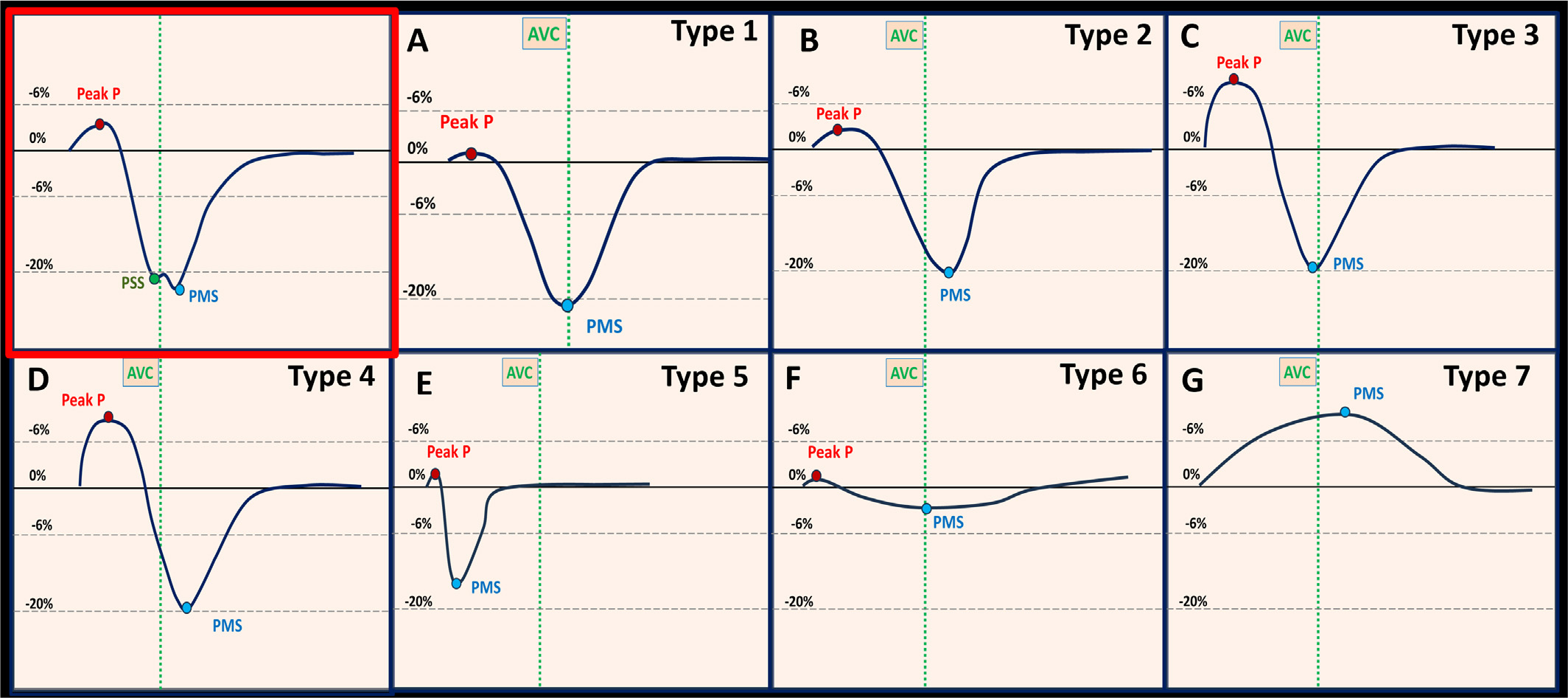
Figure 1
Red quadrant: longitudinal strain curve showing all components: Peak P as initial lengthening; PSS: peak systolic strain as the maximum longitudinal deformation before aortic valve closure (AVC); PMS: peak maximum strain as the maximum longitudinal deformation during the cardiac cycle. A) Type 1 curve; B) Type 2 curve; C) Type 3 curve; D) Type 4 curve; E) Type 5 curve; F) Type 6 curve; G) Type 7 curve.
Table 1
Characteristics of longitudinal strain curves
| Peak P (%) | PMS (%) | TPMS (ms) | Characteristics | |
|---|---|---|---|---|
| Type 1 (T1) | <6 | ≥6 | Before AVC | Normal segmental activation (Figure 1A) |
| Type 2 (T2) | <6 | ≥6 | After AVC | Post systolic deformation (Figure 1B) |
| Type 3 (T3) | ≥6 | ≥6 | Before AVC | ISL followed by normal segmental activation (Figure 1 C) |
| Type 4 (T4) | ≥6 | ≥6 | After AVC | ISL followed by post systolic deformation (Figure 1 D) |
| Type 5 (T5) | <6 | ≥6 | First third of systole | Early systolic shortening followed by no active event during systole (Figure 1E) |
| Type 6 (T6) | <6 | <6 | - | No active event during systole (figure 1F) |
| Type 7 (T7) | ≥6 | <6 | - | Holo-systolic lengthening (Figure 1G) |
Table 2
Anthropometric and conventional two dimensional and Doppler echocardiography measurements
| Unit | Control group (n=100) | Ischemic group (n=50) | |
|---|---|---|---|
| Age | (years) | 45±14 | 54±16* |
| SBP | (mmHg) | 118±14 | 118±18 |
| DBP | (mmHg) | 71±9 | 72±9 |
| HR | (bpm) | 66±13 | 67±14 |
| IVSd | (mm) | 8.6±1.7 | 10.2±3.2* |
| PWd | (mm) | 8.7±1.4 | 9.2±2.2 |
| LVIDd | (mm) | 47.4±4.8 | 57.0±8.5* |
| LVIDs | (mm) | 30.8 ±5.3 | 43.3 ±12.7* |
| LVMi | (g/m2) | 78.5±22.3 | 116.7±39.7* |
| LV EDVi | (ml/ m2) | 56±13 | 79±29* |
| LV ESVi | (ml/ m2) | 21±7 | 44±26* |
| LV EF | (%) | 64±6 | 48±14* |
| LAESVi | (ml/ m2) | 33±8 | 43±16* |
| E wave | (m/s) | 72±15 | 72±19 |
| DTE | (ms) | 185±38 | 203±54 |
| A wave | (m/s) | 46±13 | 60±28* |
| E/A | 1.7±0.5 | 1.5±1.0 | |
| LV s’ | (cm/s) | 10±2 | 7±3* |
| LV e’ | (cm/s) | 13±3 | 8±4* |
| LV a’ | (cm/s) | 10±3 | 7±3* |
| E/e’ | 6±1 | 11±6* | |
| TAPSE | (mm) | 23±3 | 16±3* |
1* p<0.01 control group vs. ischemic group
DTE, deceleration time E wave; EDA, end diastolic area; EDV, end diastolic volume; EF, ejection fraction; ESV, end-systolic volume; LA, left atrium; LV, left ventricle; LVM, left ventricular mass; IVSd, interventricular septum thickness; PWd, posterior wall thickness; TAPSE, tricuspid annular systolic excursion.
Table 3
Average PSS and PMS in the two study groups for each LSC type
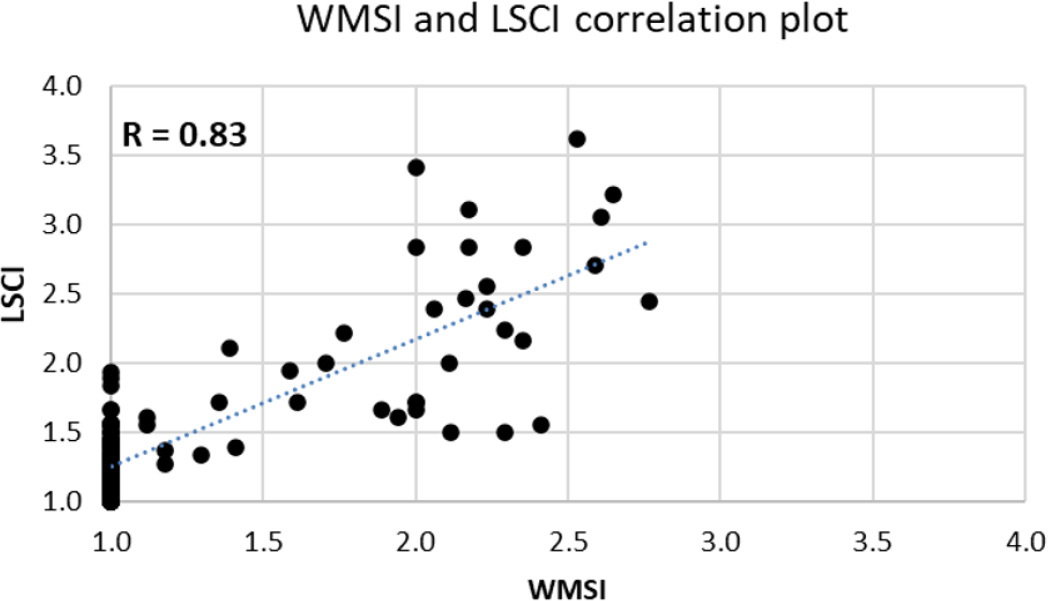
Figure 2
Correlation plot between echocardiographic derived WMSI and LSCI.