
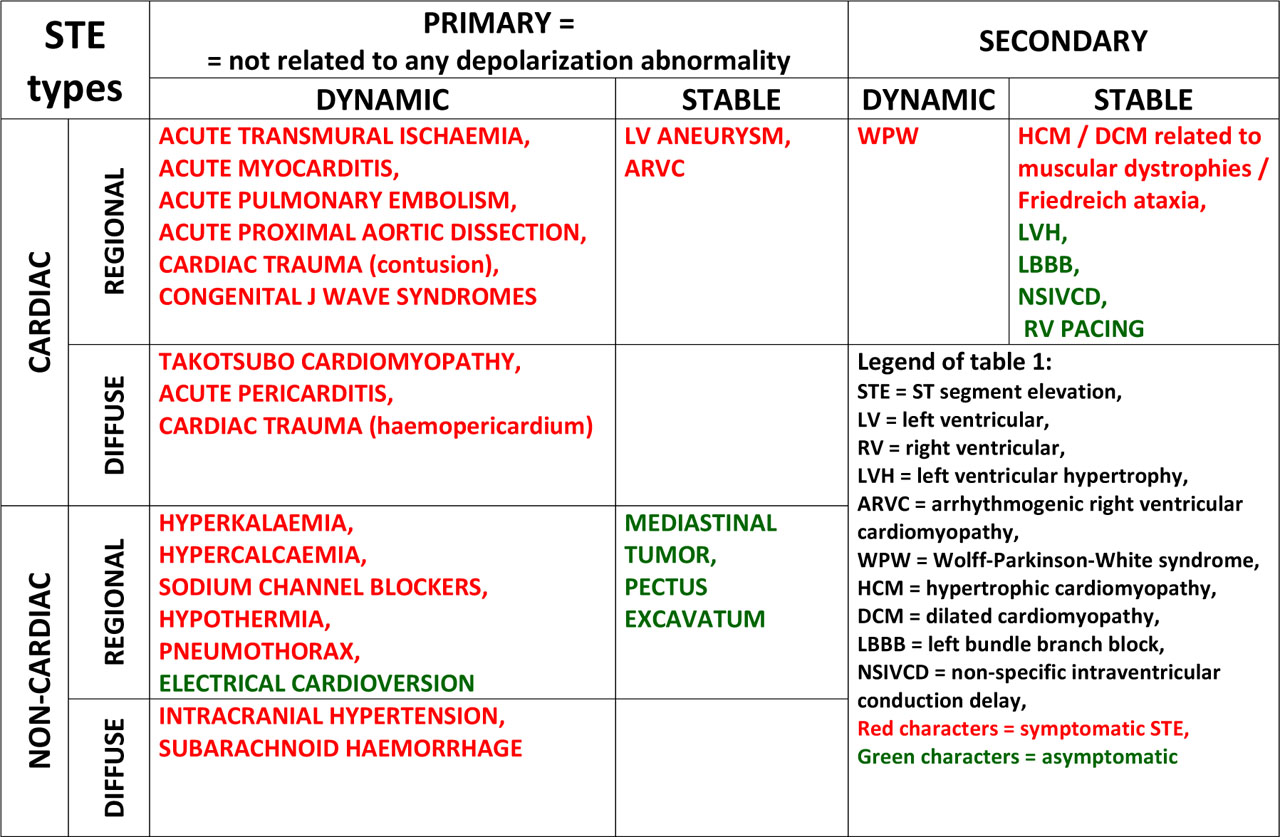
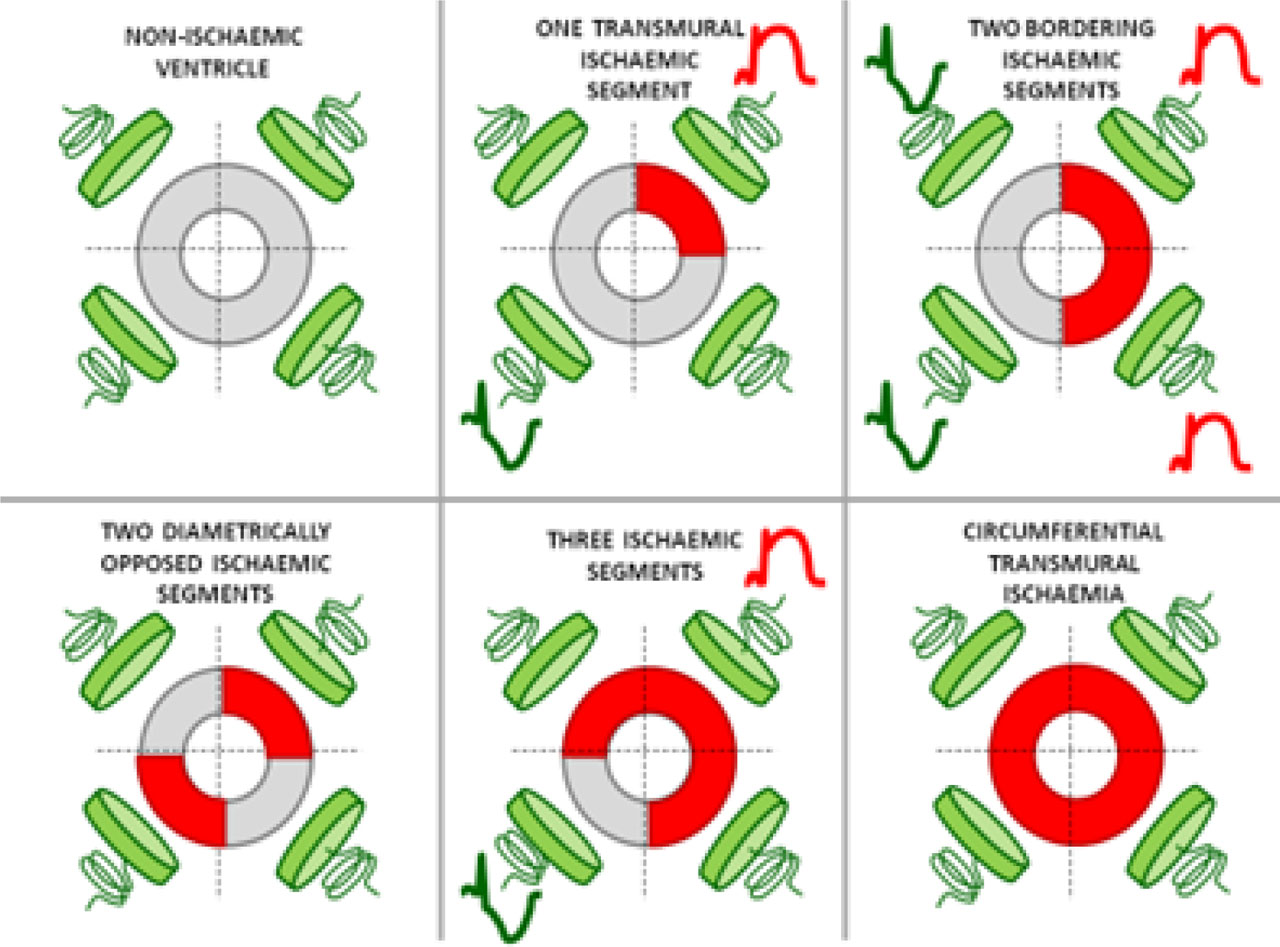
Figure 1
ST segment deviations in direct and indirect leads.
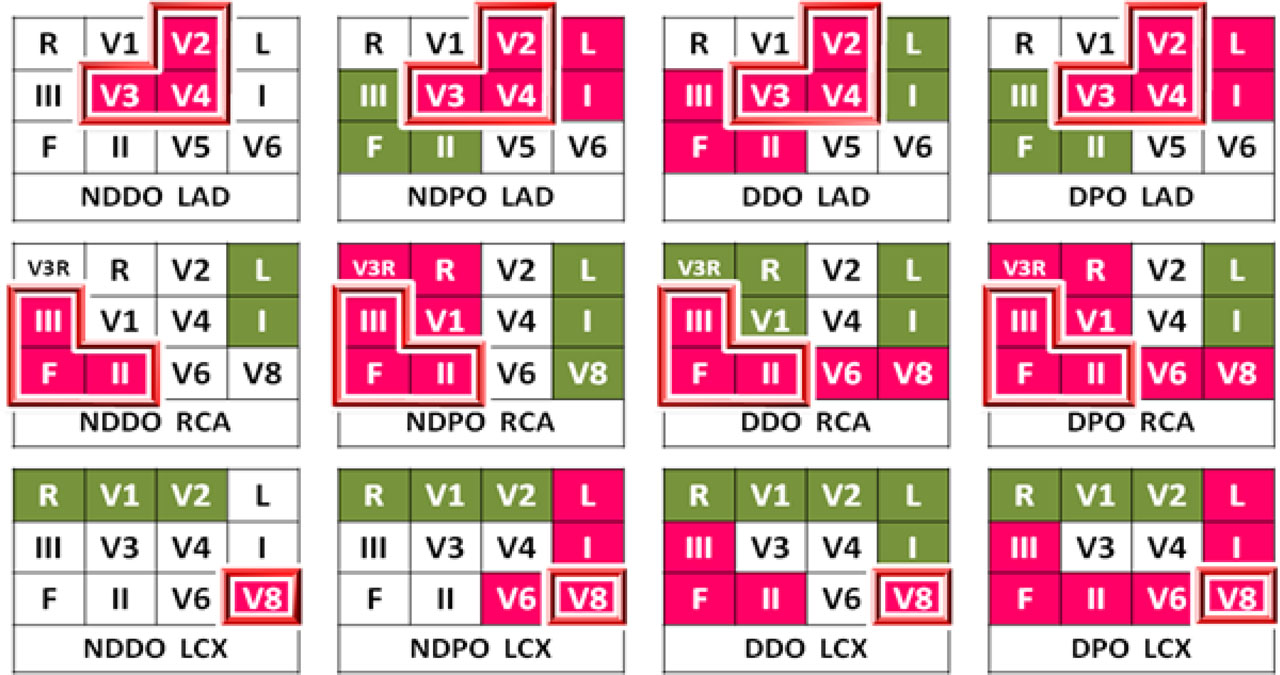
Figure 2a
The layout of the ST elevations (RED) and of the reciprocal ST depressions (GREEN) due to single vessel occlusions of the left anterior descending artery (LAD), right coronary artery (RCA) and left circumflex artery (LCX), respectively. NDDO = non-dominant artery with distal occlusion, NDPO = non-dominant artery with proximal occlusion, DDO = dominant artery with distal occlusion, DPO = dominant artery with proximal occlusion. For each one of the following cases RCA-DPO and LCX-DPO, the versions where the result of subtraction of the ST elevations conveyed by diametrically opposite territories is NOT zero (diametrically opposite ST elevations do not nullify each other) are displayed (the last two charts from the last column).
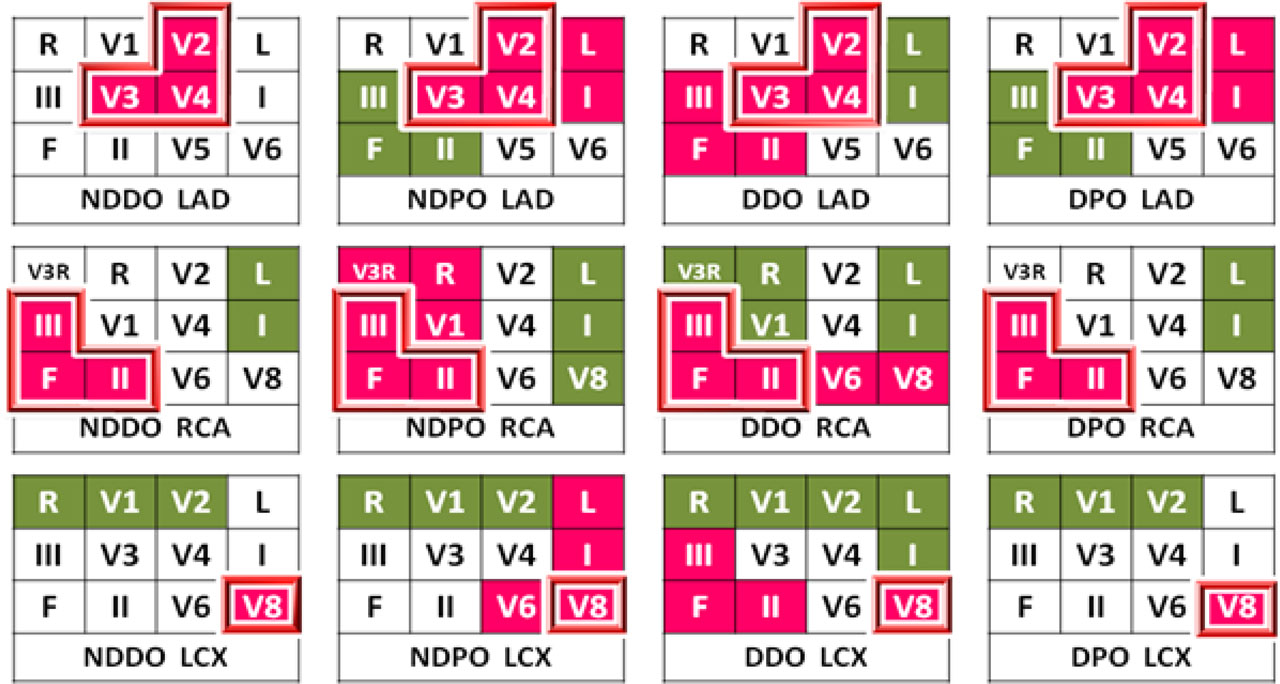
Figure 2b
The layout of the ST elevations (RED) and of the reciprocal ST depressions (GREEN) due to single vessel occlusions of the left anterior descending artery (LAD), right coronary artery (RCA) and left circumflex artery (LCX), respectively. NDDO = non-dominant artery with distal occlusion, NDPO = non-dominant artery with proximal occlusion, DDO = dominant artery with distal occlusion, DPO = dominant artery with proximal occlusion. For each one of the following cases RCA-DPO and LCX-DPO, the versions where the ST elevations conveyed by diametrically opposite territories cancel each other are displayed (the last two charts from the last column).
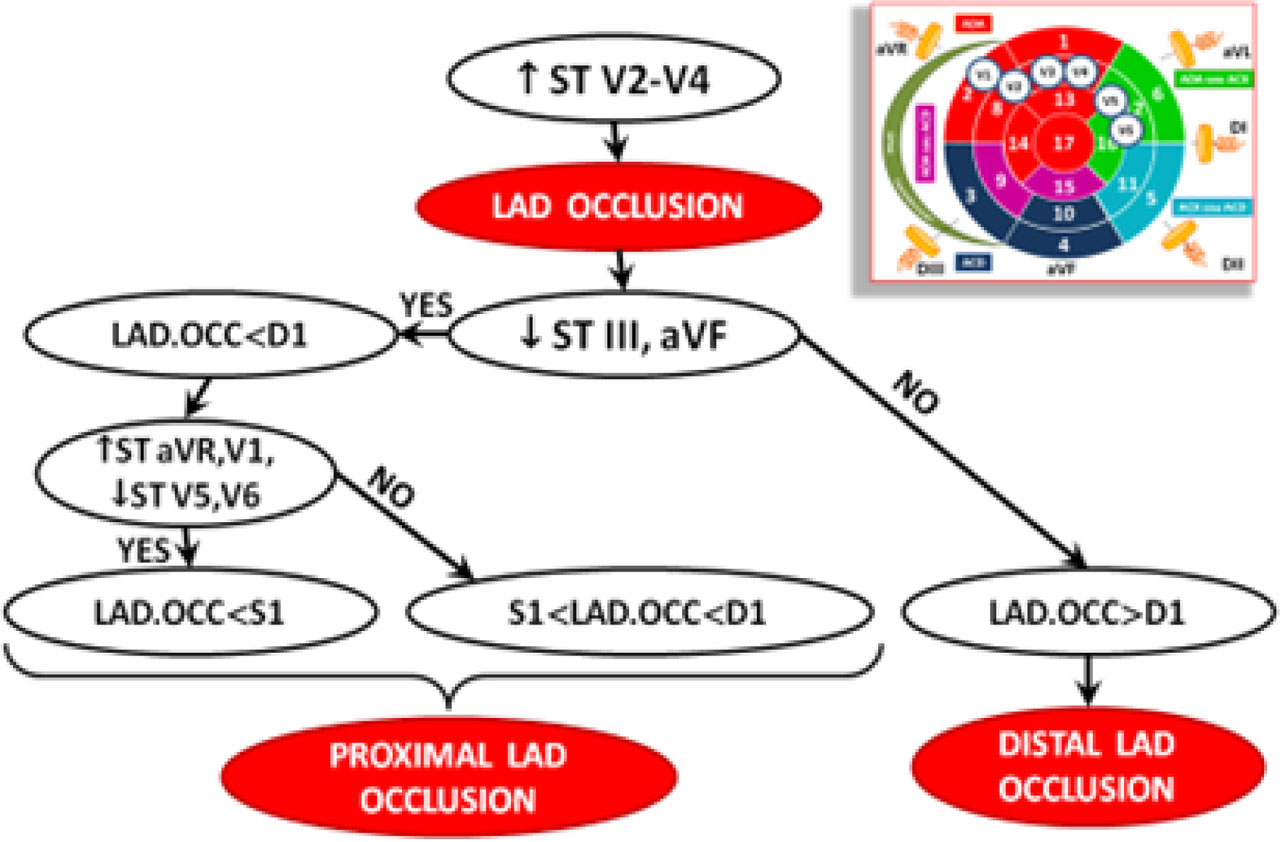
Figure 3
Electrocardiographic locating algorithm of expected acute single coronary occlusion, based upon the highest ST segment elevation found in precordial leads. LAD = left anterior descending artery, OCC = occlusion, D1 = first diagonal artery, S1 = first septal artery, “<” = proximal to, “>” = distal to. (data according to references 3, 15, 17, 36–42)
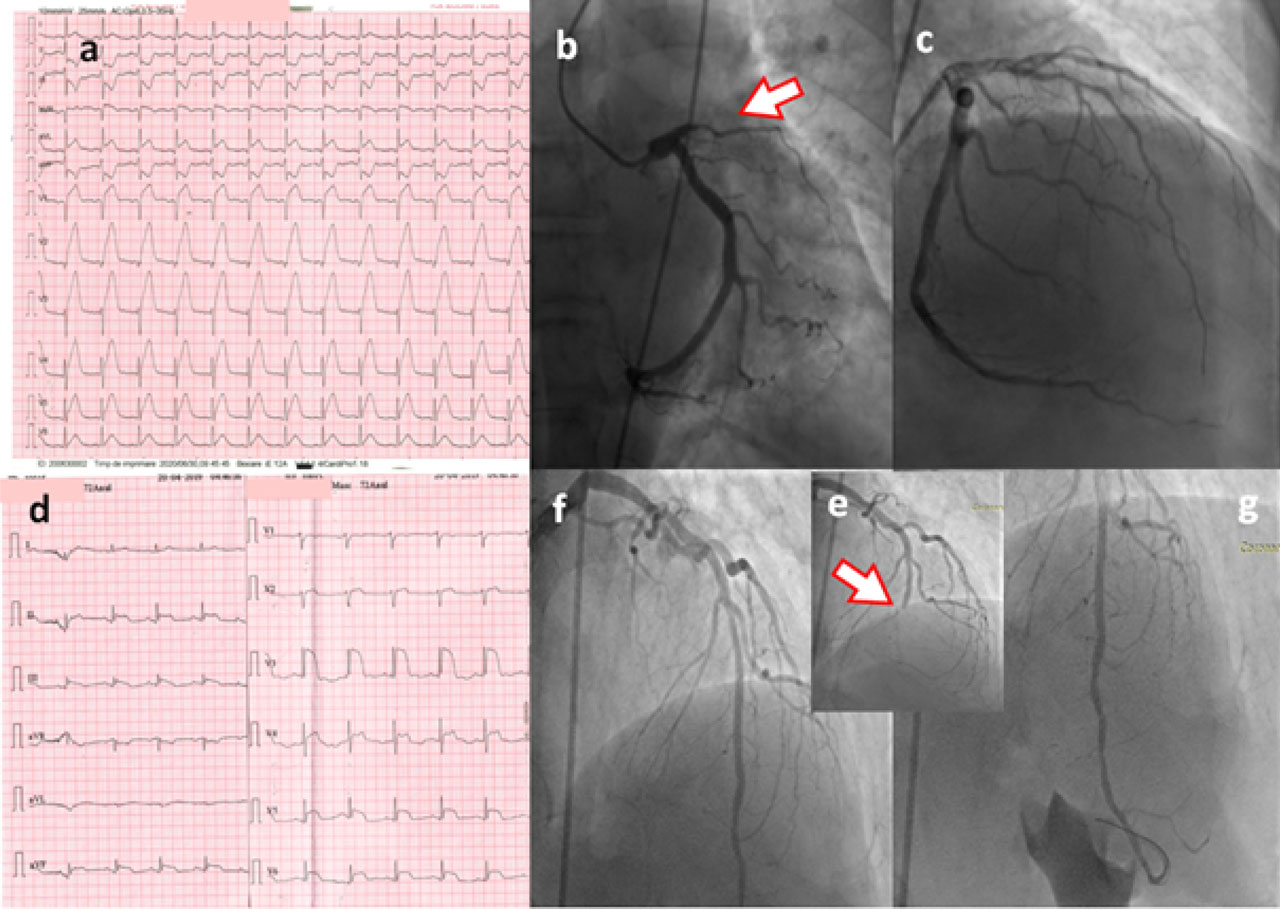
Figure 4
Acute occlusion of a)PROXIMAL LAD b)before and c)after drug-eluting stent primary angioplasty, as seen in RAO view (dr. Alexandru Burlacu). Acute occlusion of d)DISTAL LONG LAD e)before and f)g)after drug-eluting stent primary angioplasty, as seen in RAO view (dr. Marius Adoamnei). RAO = right anterior oblique.
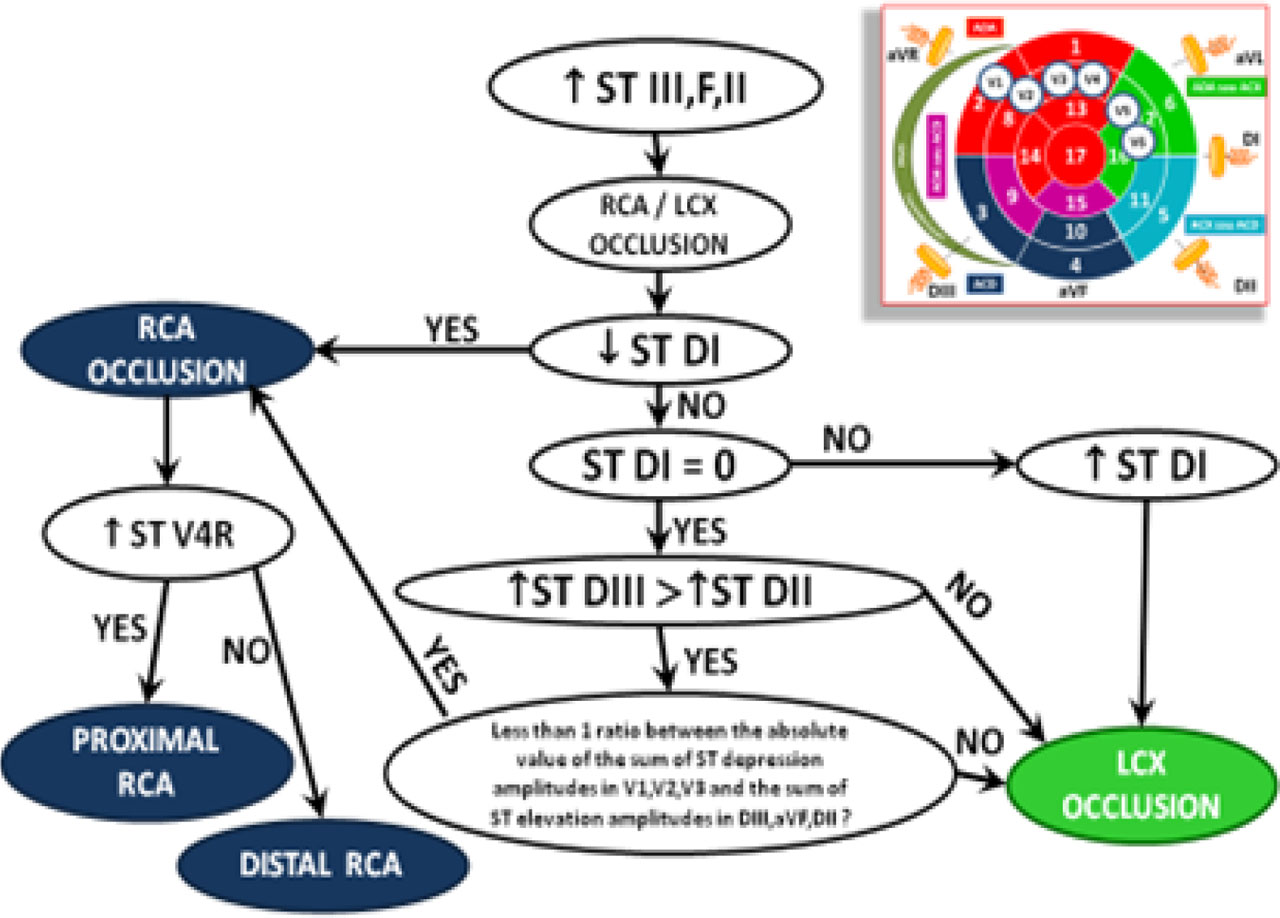
Figure 5
Electrocardiographic locating algorithm of expected acute coronary single occlusion, based upon the highest ST segment elevation found in the inferior leads. RCA = right coronary artery, LCX = left circumflex artery. (data according to references 3, 15, 17, 36–42).
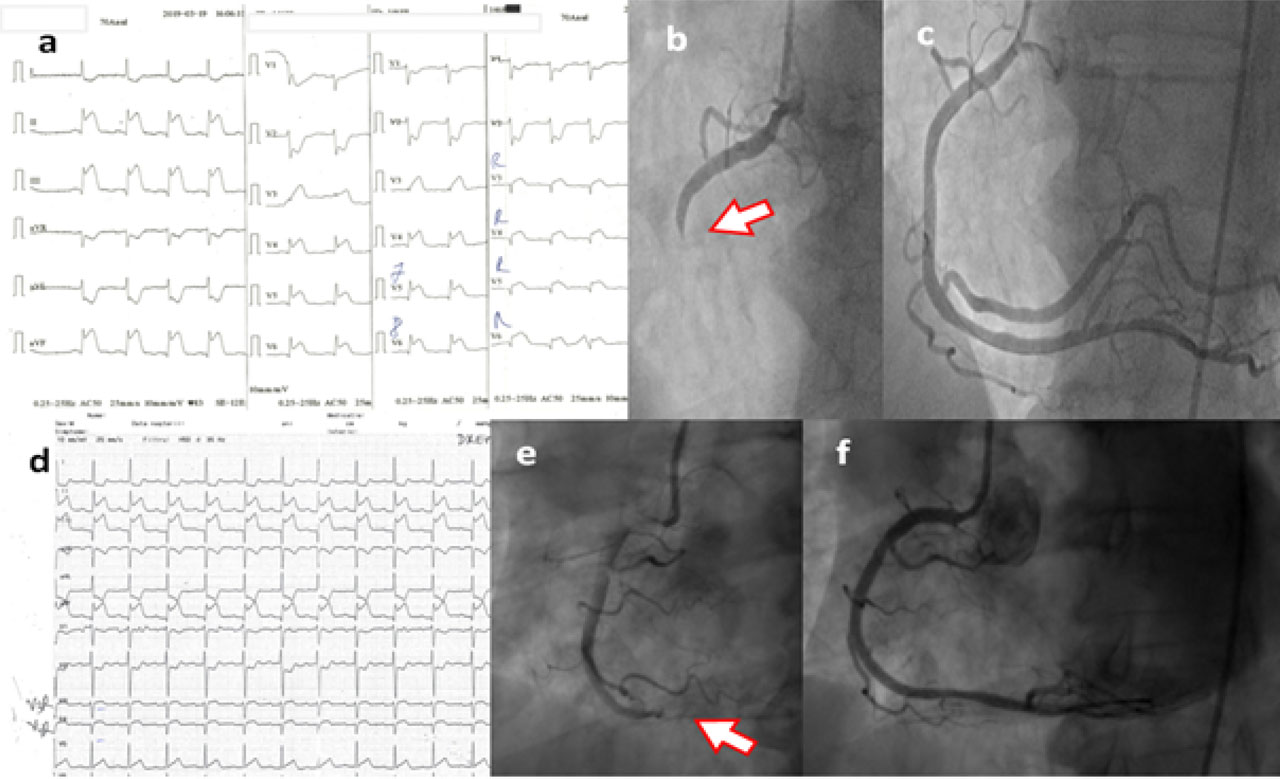
Figure 6
Acute occlusions of a)PROXIMAL RCA b)before and c)after drug-eluting stent primary angioplasty, as seen in LAO view (dr. Dan Năstasă) and d)DISTAL RCA e)before and f)after drug-eluting stent primary angioplasty, as seen in LAO view (dr. Nicușor Lovin). LAO = left anterior oblique.
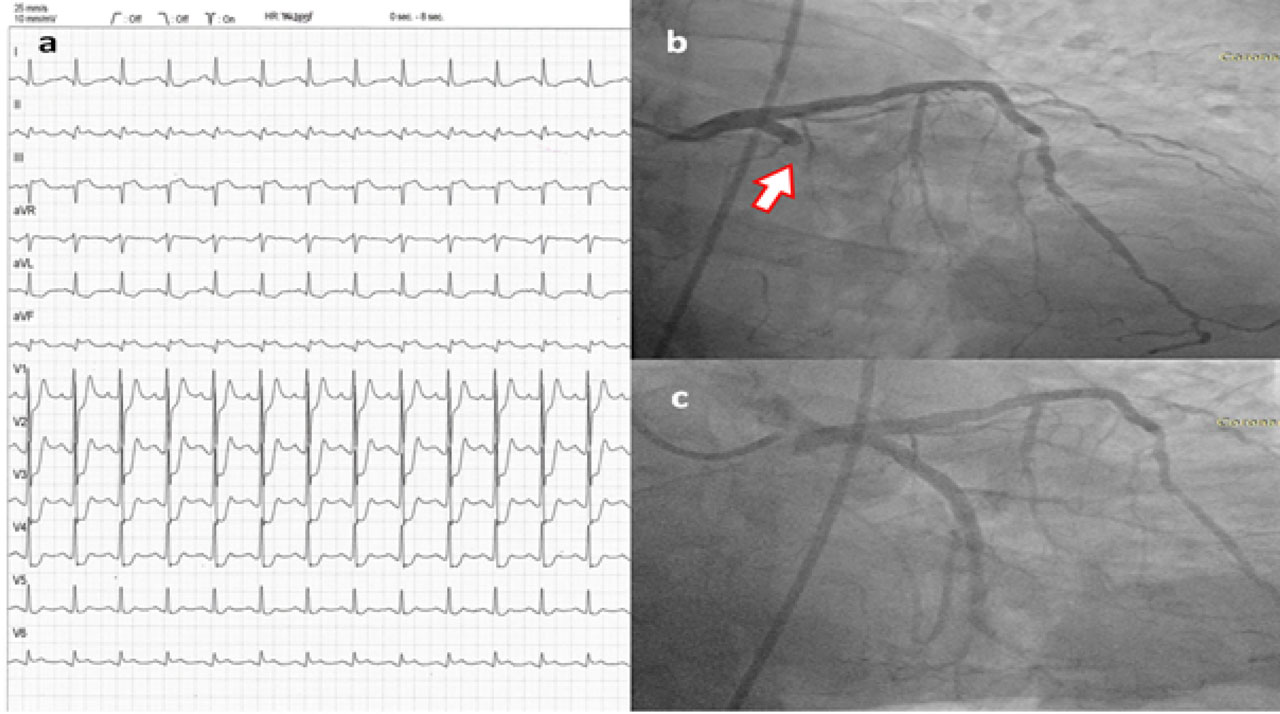
Figure 7
Acute occlusion of a a)PROXIMAL left circumflex artery b)before and c)after the drug-eluting stent primary angioplasty, as seen in RAO view (dr. Dan Năstasă).
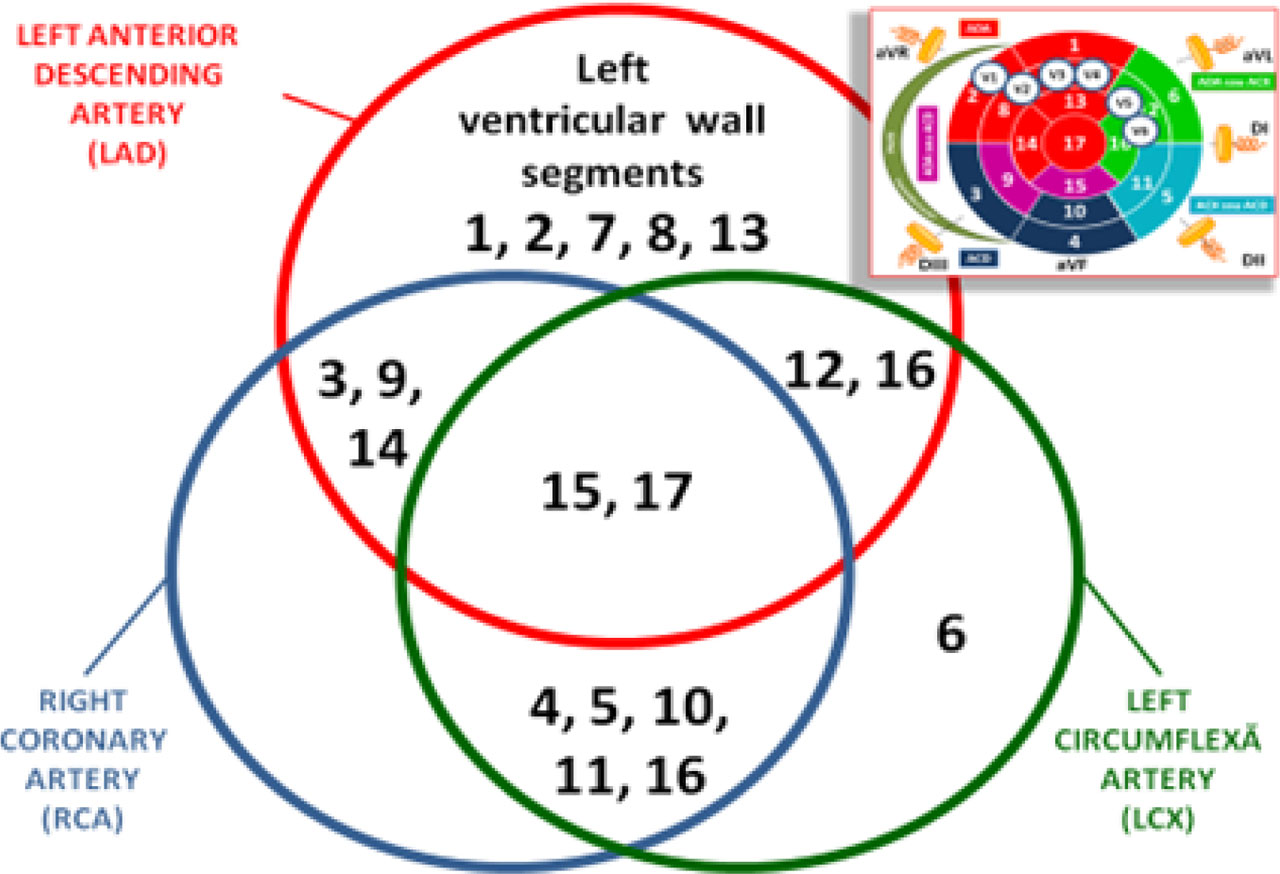
Figure 8
Left ventricular wall segments blood supply versions (data according to references 42, 43).
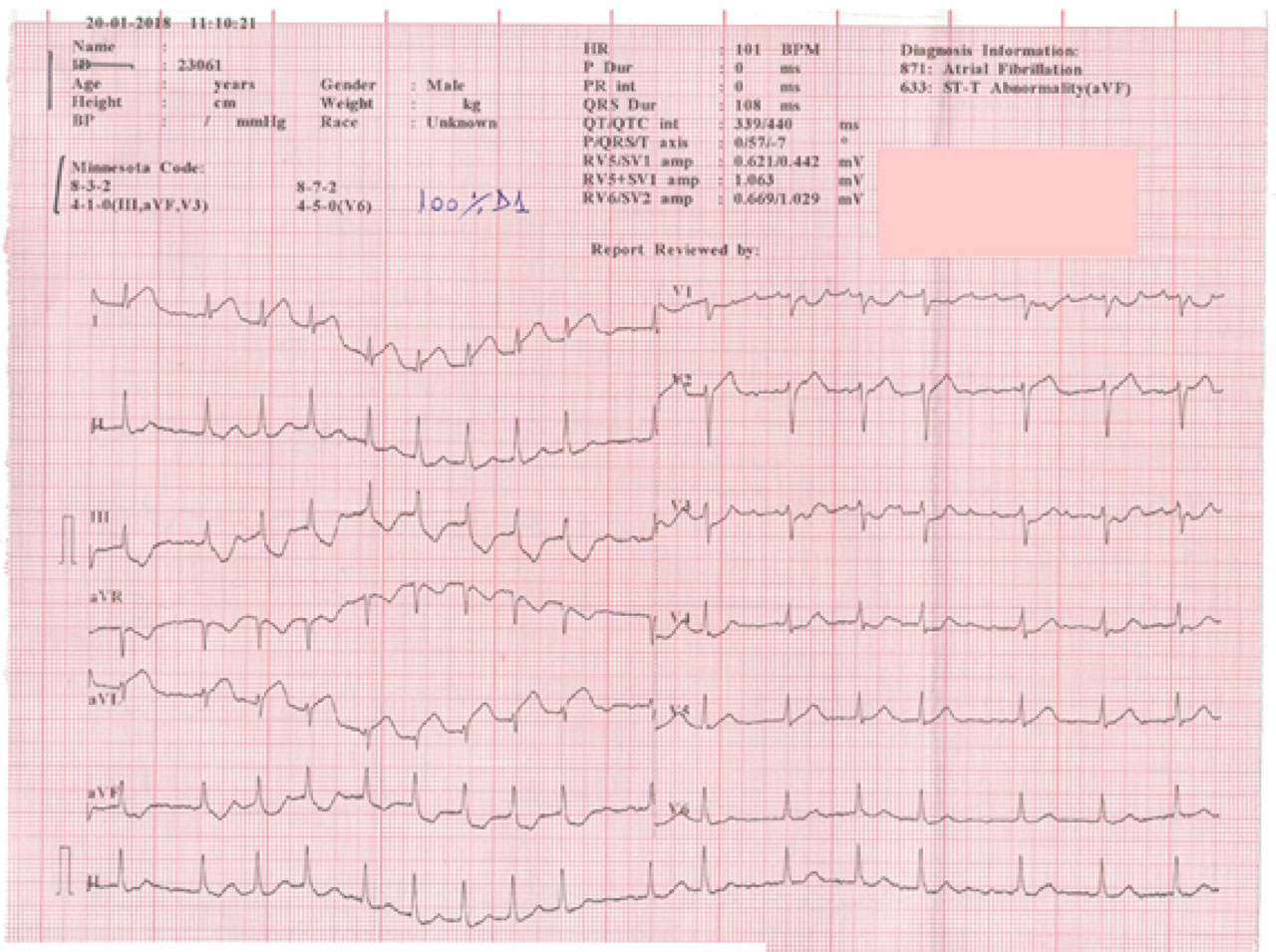
Figure 9
Acute occlusion of the first diagonal artery.
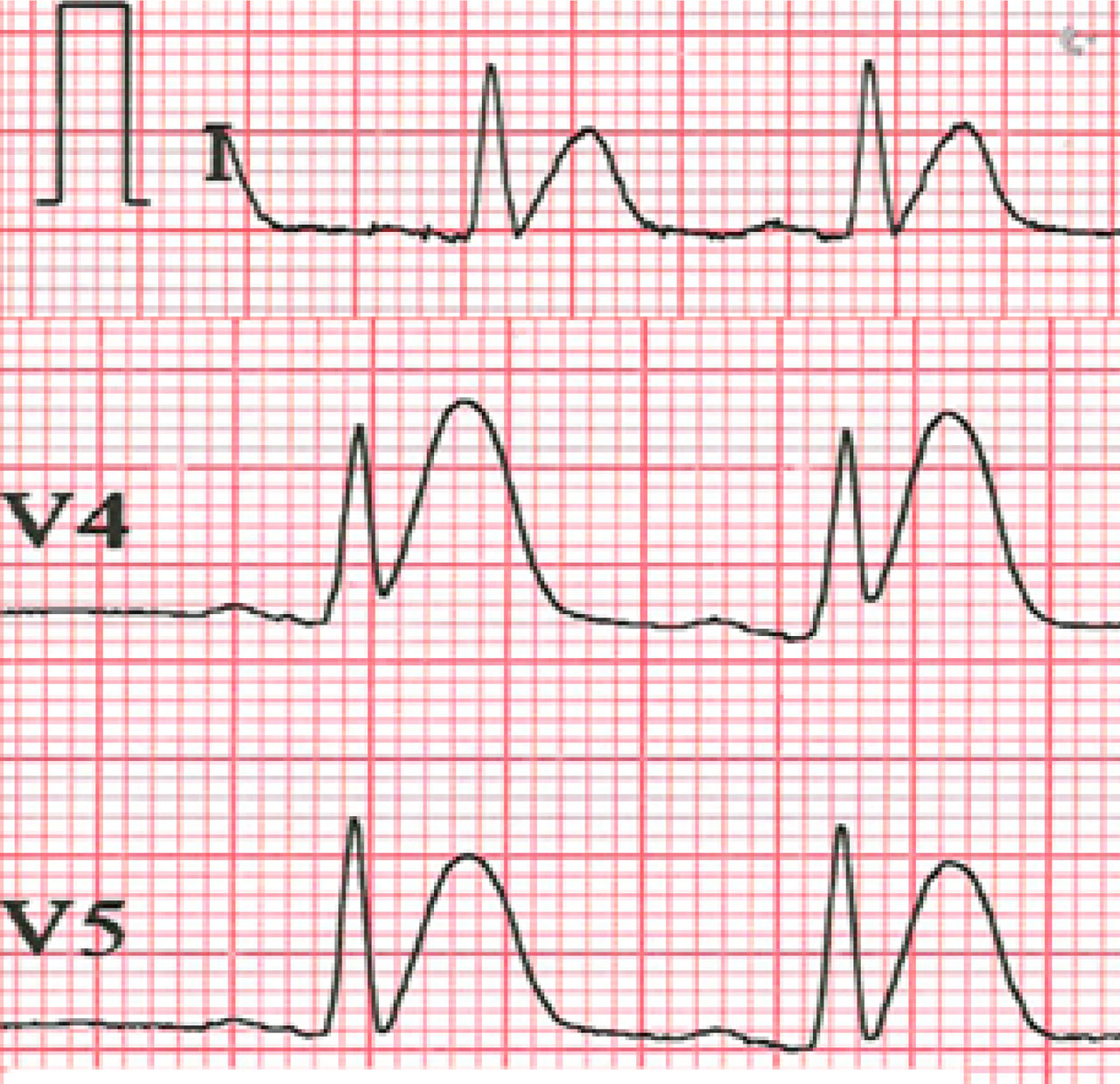
Figure 10
Hyperacute T wave.
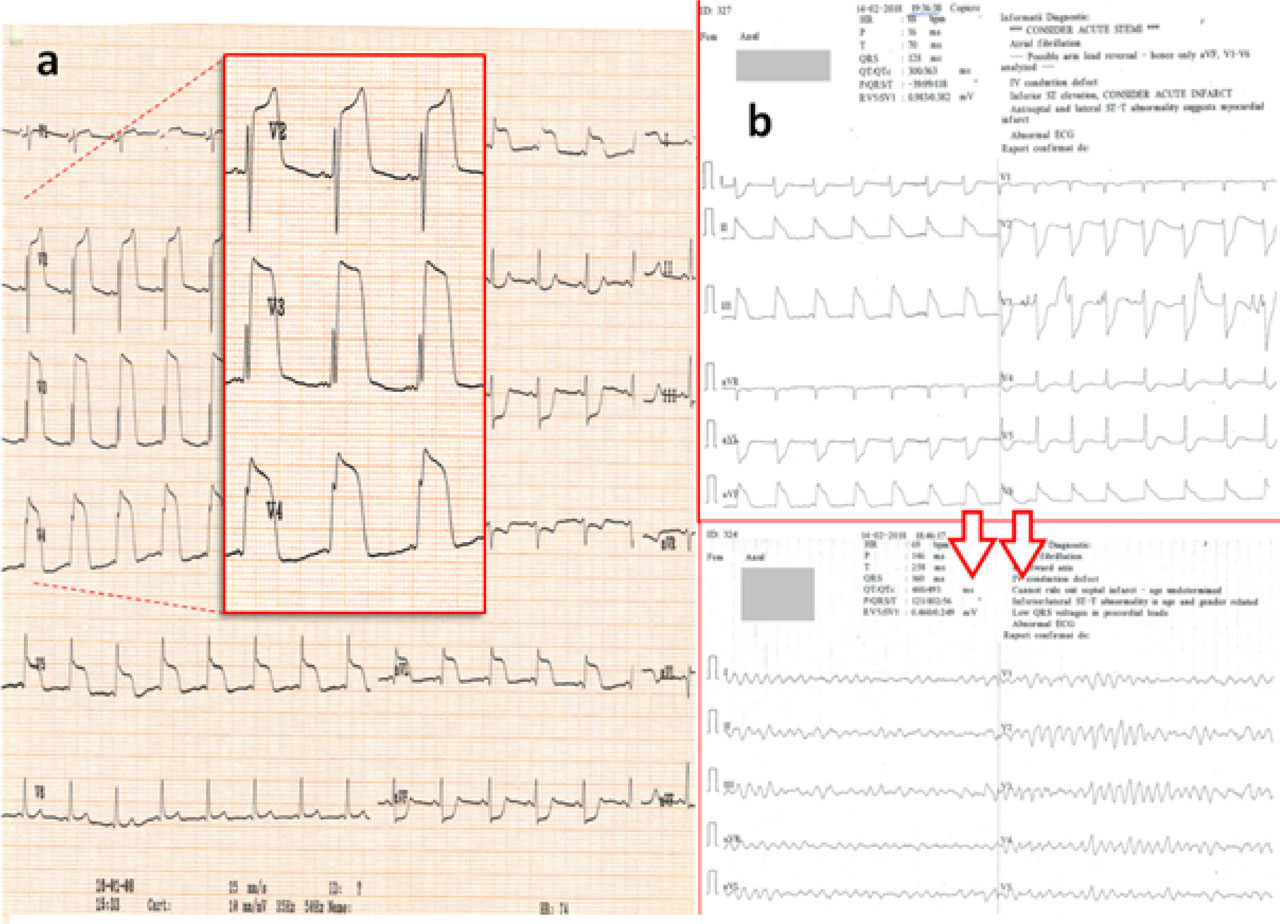
Figure 11
a)”tombstoning” and b)”shark fin” configurations of the ischaemic ST segment elevation.
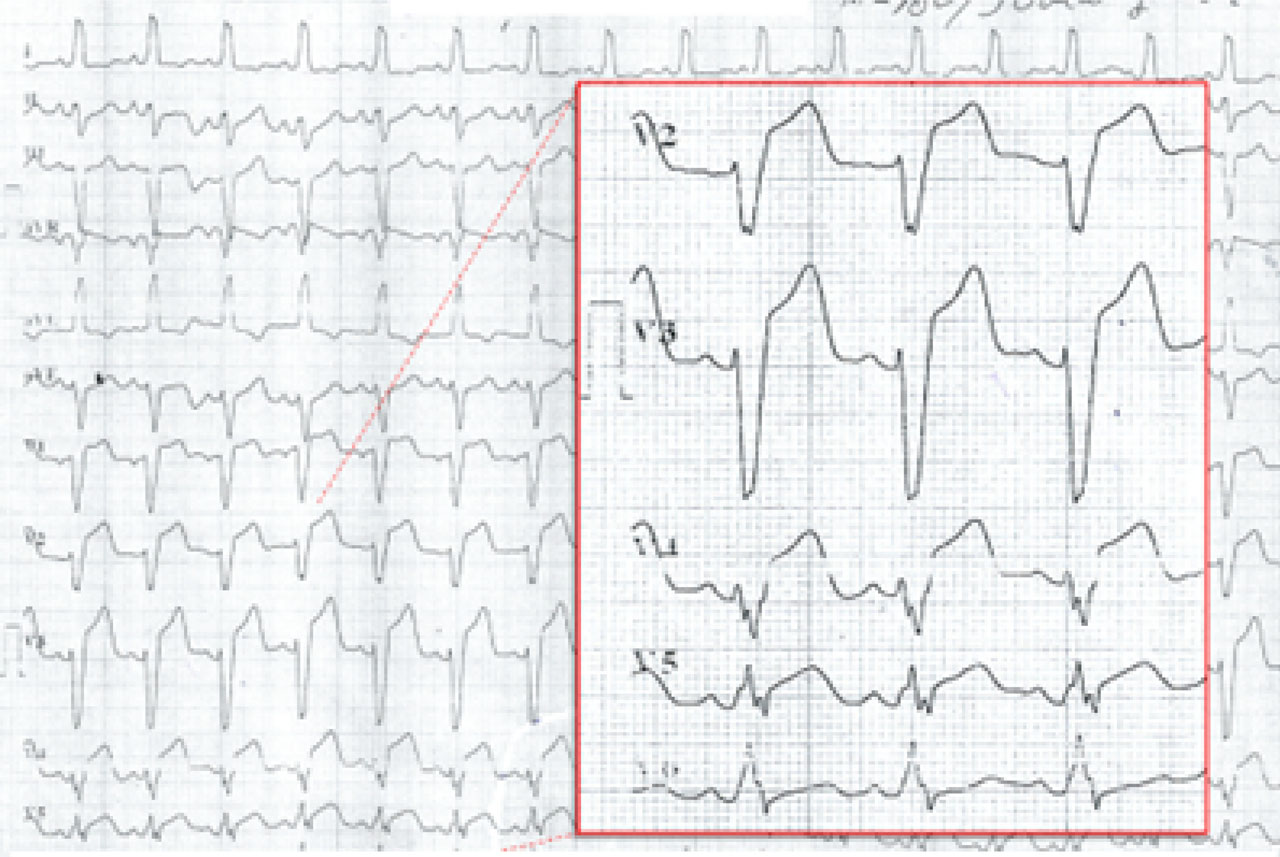
Figure 12
ST-elevation acute myocardial infarction inferred from fulfilling modified Sgarbossa criteria 1 and 3 in a patient with left bundle branch block and anterior chest pain.
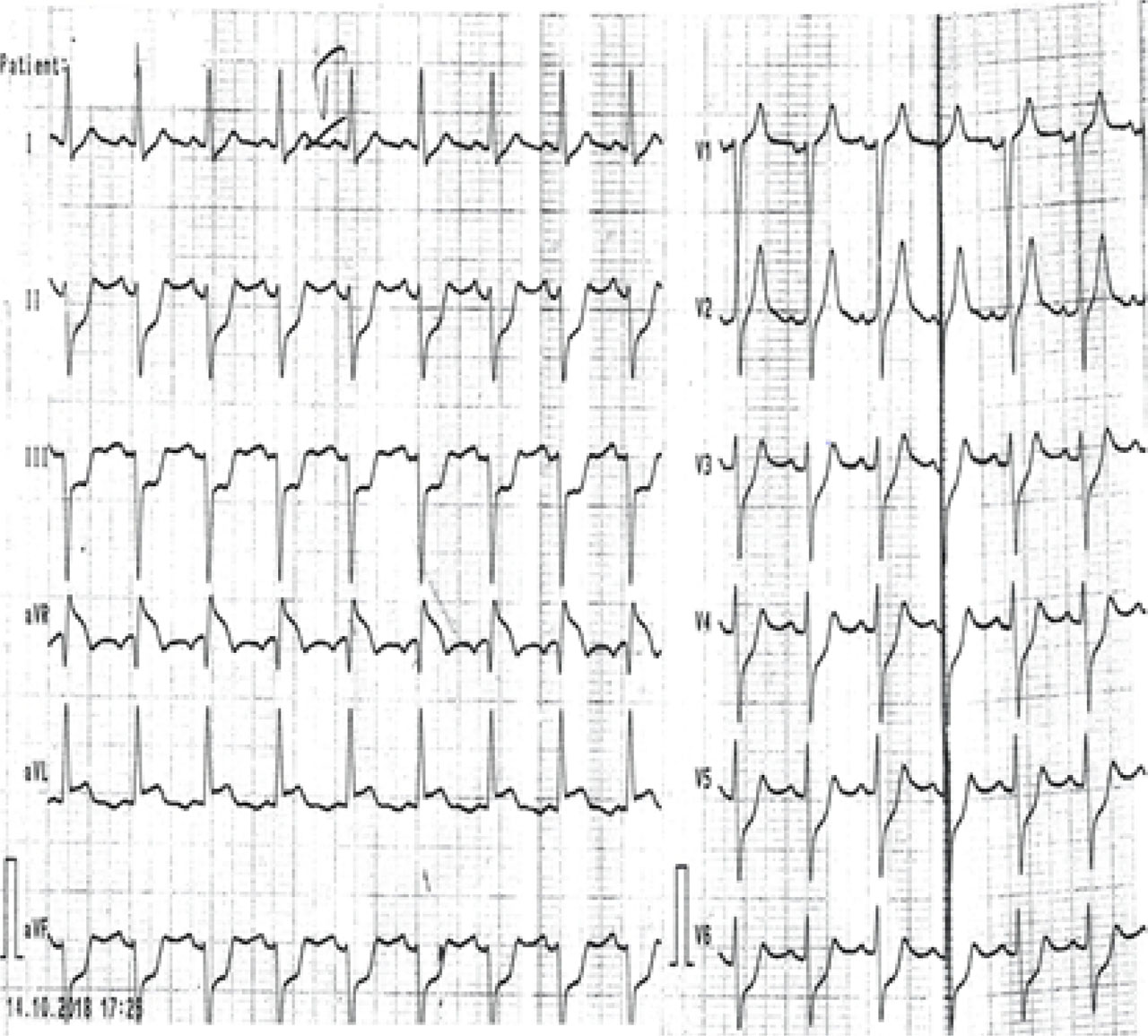
Figure 13
Left main coronary trunk severe stenosis.
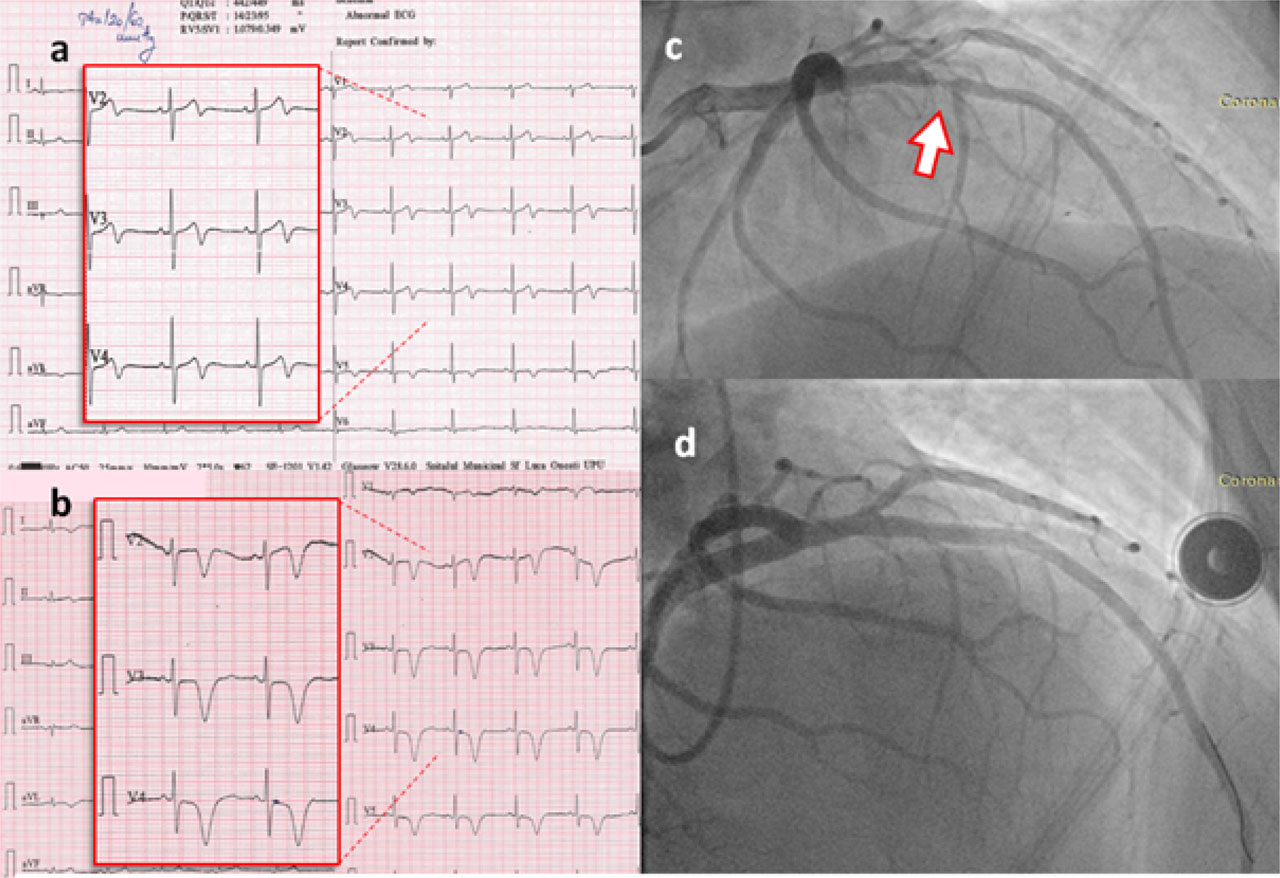
Figure 14
Wellens syndrome a)b)electrocardiographic features and c)angiogram in a patient with proximal LAD severe stenosis, c)dilated later on and secured by drug-eluting stent deployment. (dr. Dan Năstasă).
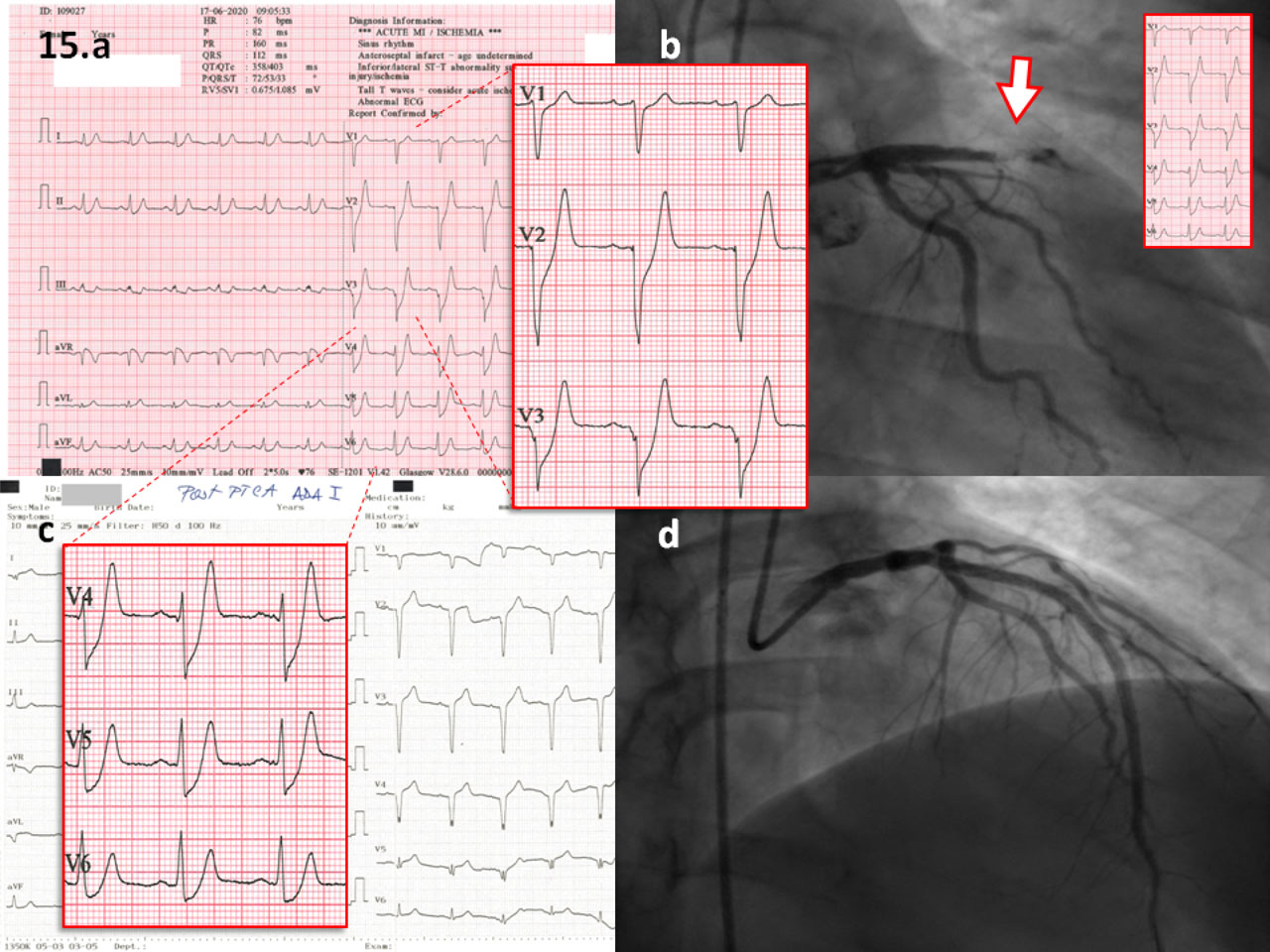
Figure 15
a)de Winter ST-T pattern b)before and c)d)after the drug-eluting stent angioplasty (dr. Dan Năstasă) of a proximal left anterior descending artery occlusion.
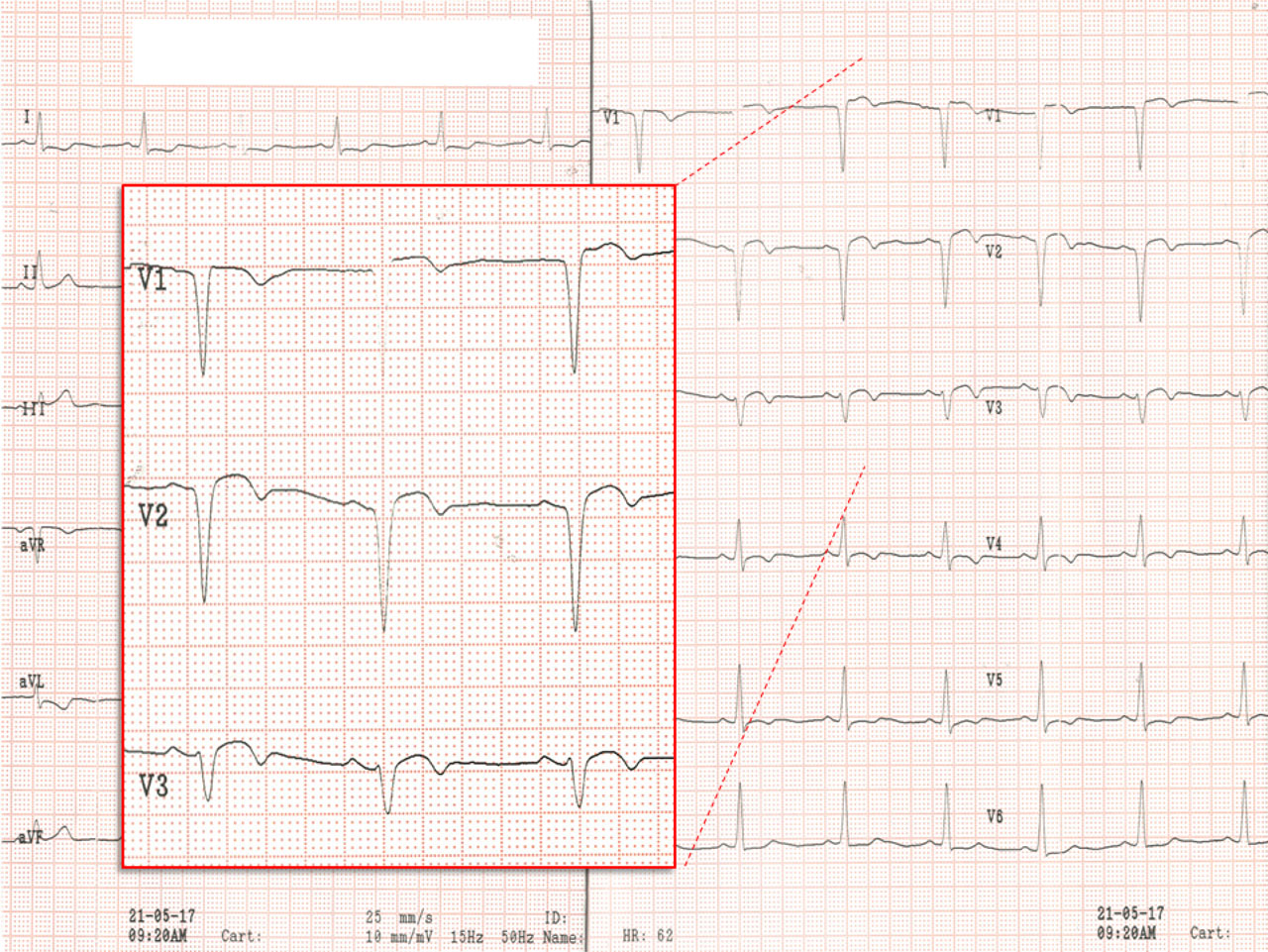
Figure 16
Electrocardiographic image of a left ventricular anterior wall aneurysm.
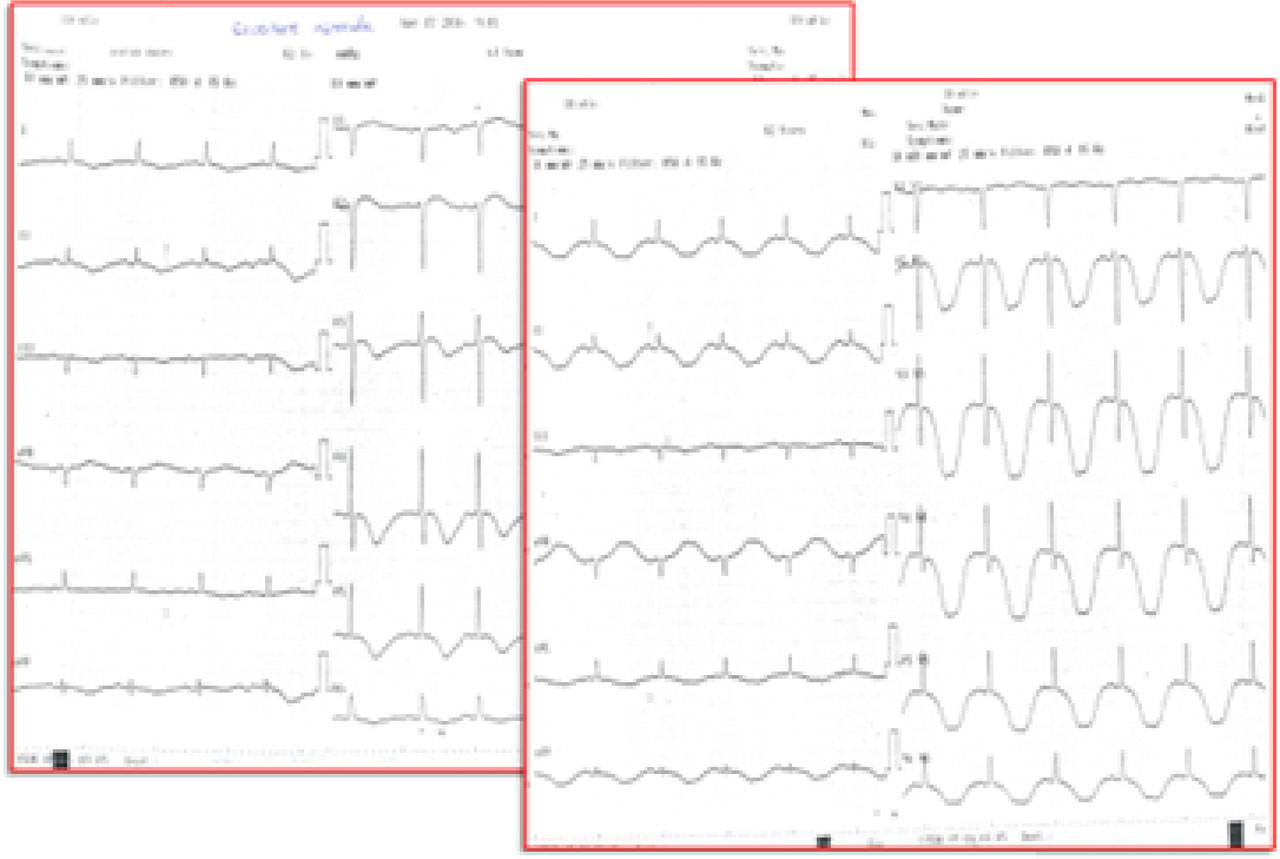
Figure 17
Electrocardiographic course of a patient with Takotsubo cardiomyopathy.
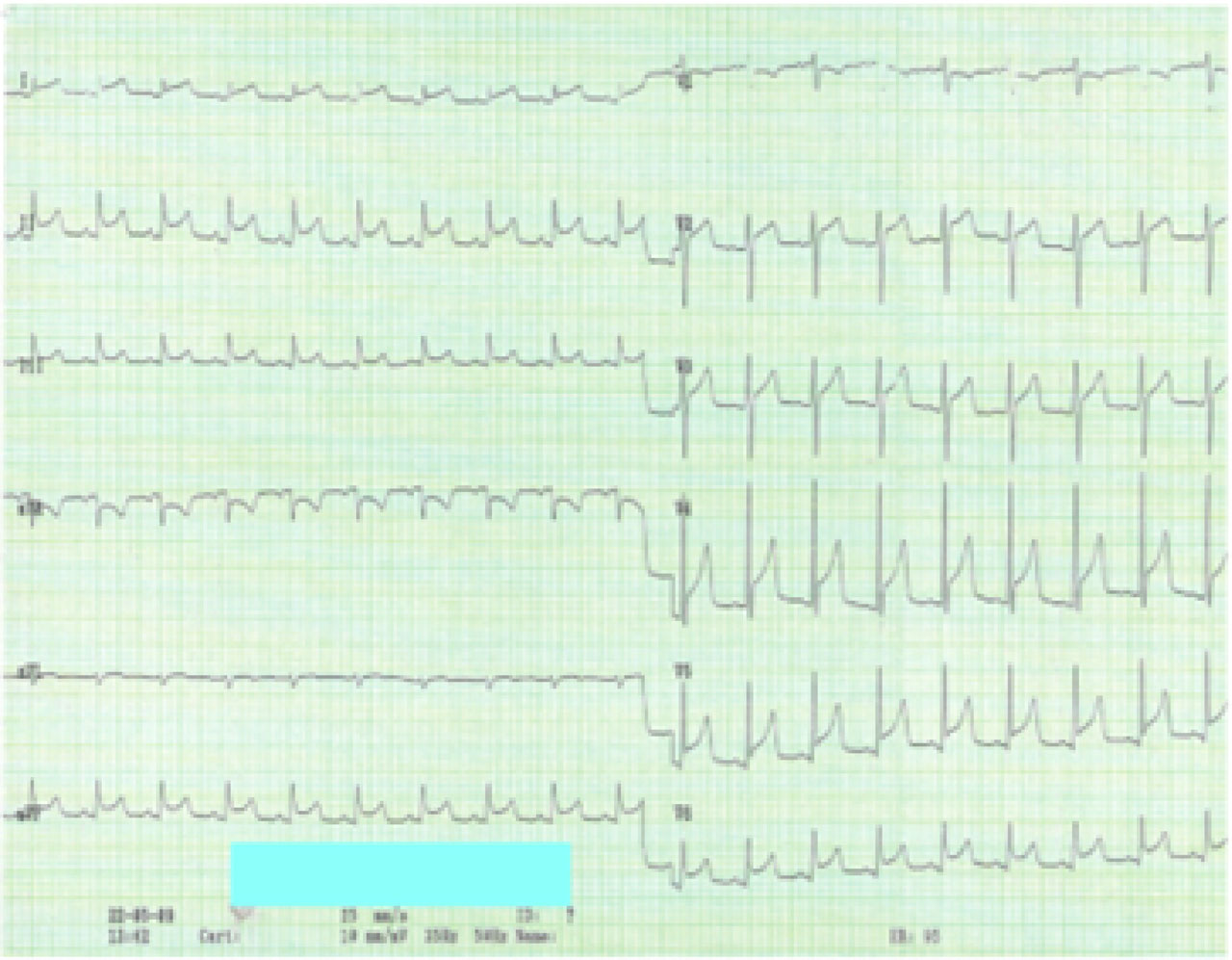
Figure 18
Acute pericarditis.
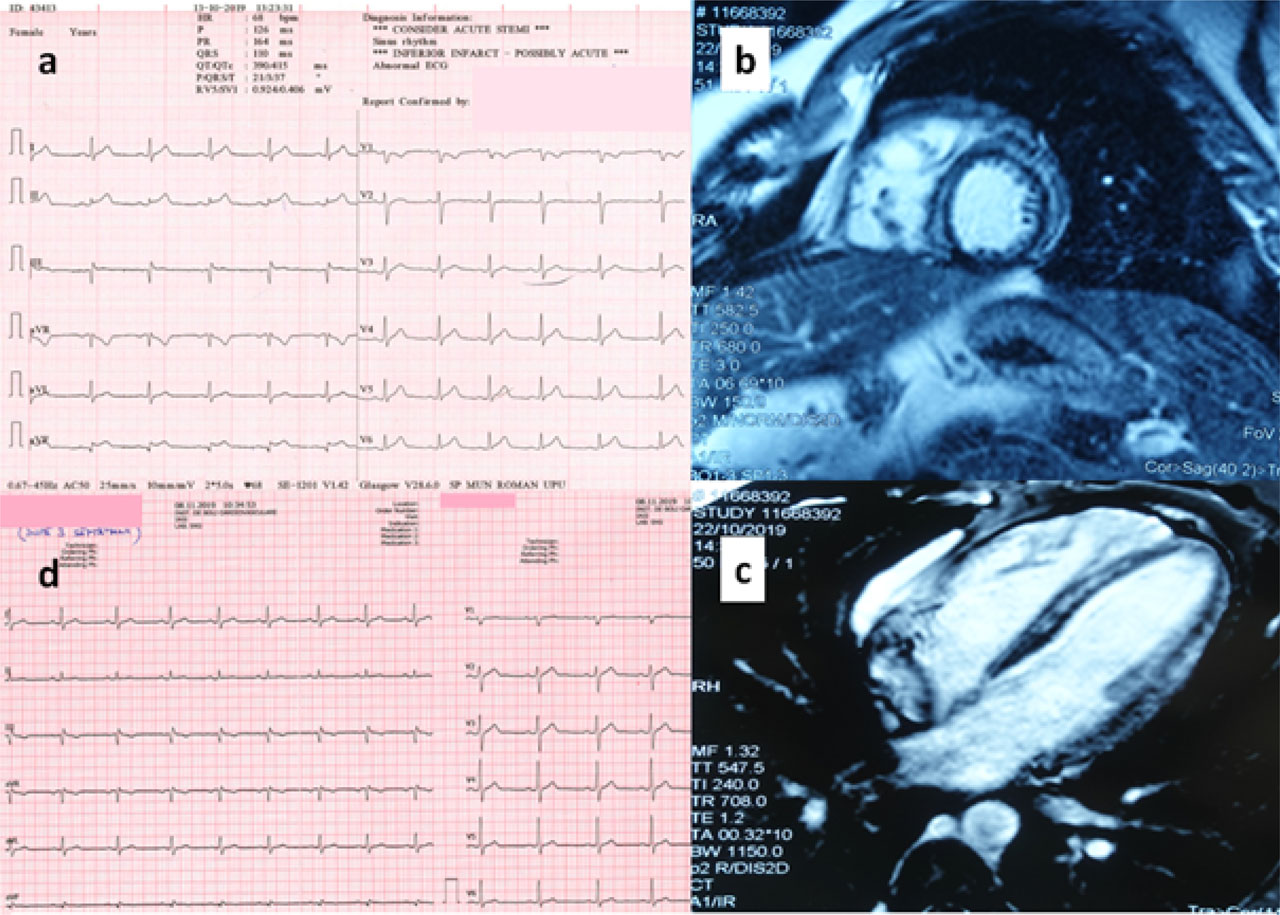
Figure 19
Acute myocarditis featuring a)ST-elevation within the inferior leads in a young patient with chest pain and myocardial injury enzymes variation, against the background of normal CT angiographic appearance of subepicardial coronary arteries and b)c)MRI markings of myocardial oedema (dr. Anatolie Cazacu) with d)ST segment fallen to baseline three weeks later.
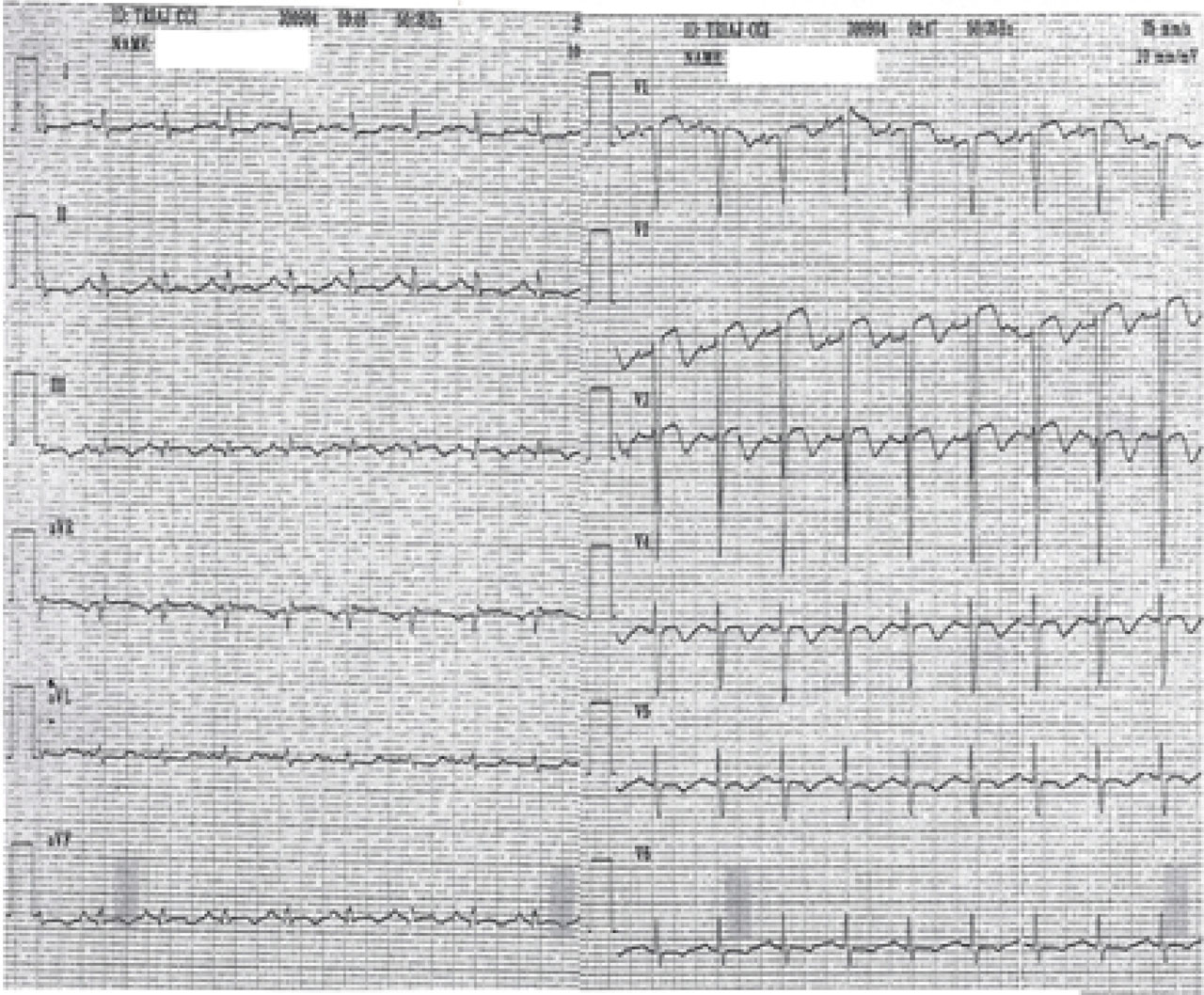
Figure 20
Acute pulmonary embolism, displaying ST segment elevation within the precordial leads.
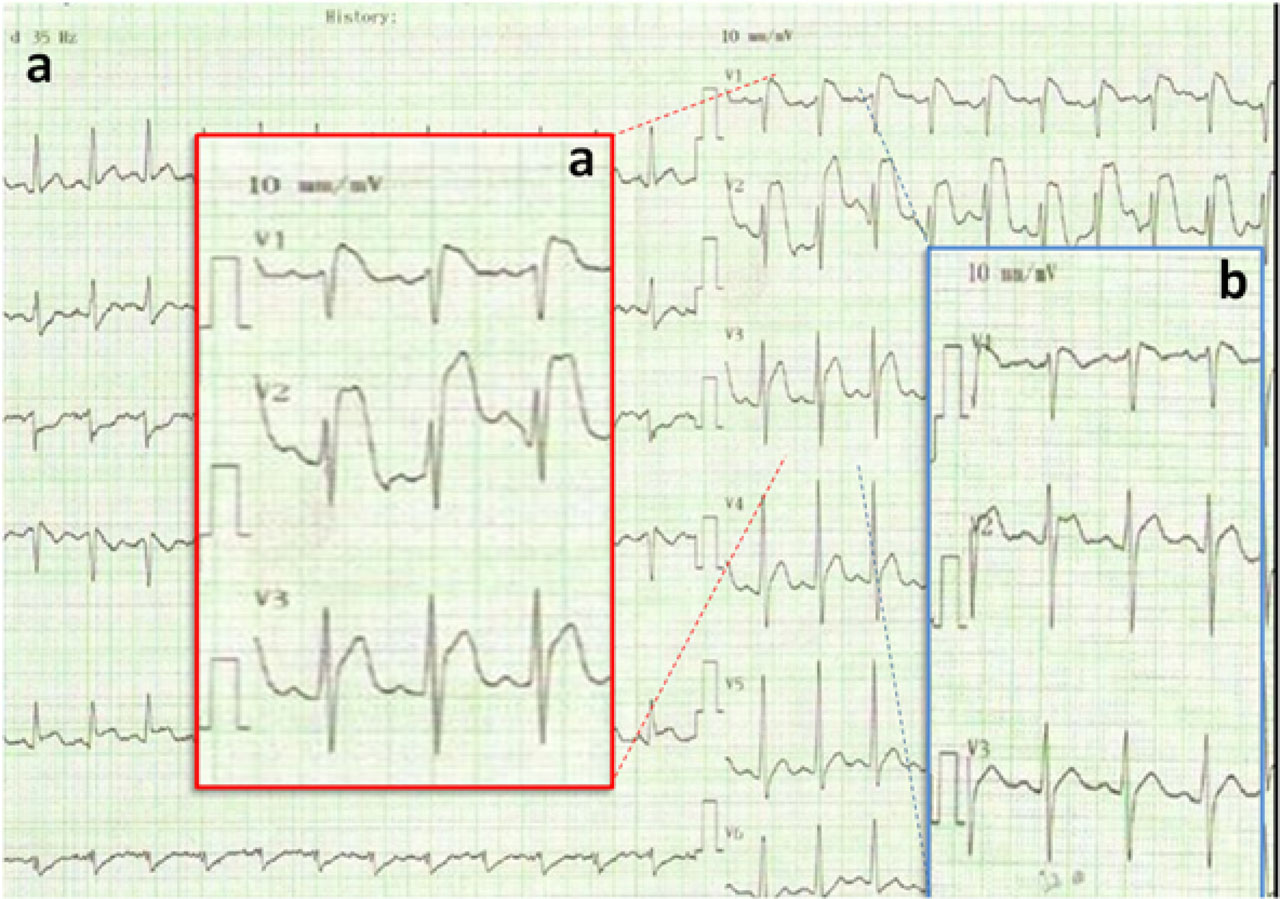
Figure 21
The type 1 diagnostic electrocardiographic pattern of Brugada syndrome a)enhanced by 39°C fever, as well as b)diminished after fever remission under paracetamol, reinforced thereafter by a flecainide challenge test (by kind permission of dr. Mircea Balasanian, from his personal collection).
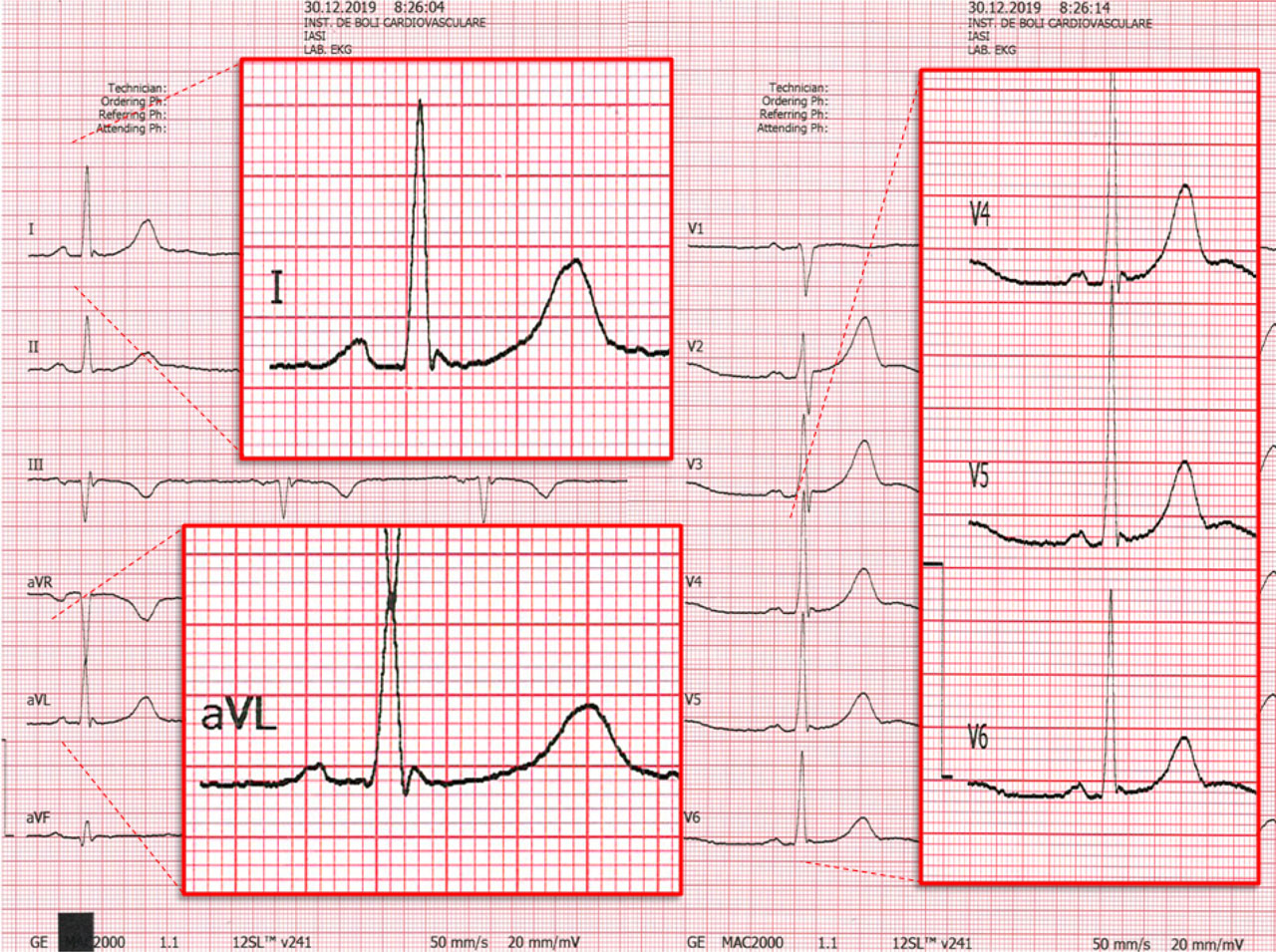
Figure 22
Electrocardiographic pattern of early repolarization, showing J wave across lateral leads.
Table 2
Comparison between ST elevation in myocardial ischaemia, early repolarization and acute pericarditis.
| TRANSMURAL MYOCARDIAL ISCHAEMIA (STEMI, VASOSPASTIC ANGINA, TAKOTSUBO CARDIOMYOPATHY, LEFT VENTRICULAR ANEURYSM) | EARLY REPOLARIZATION (ER) | ACUTE PERICARDITIS | ||
|---|---|---|---|---|
| PR SEGMENT DEPRESSION | Any depth in atrial infarction, associated with abnormal P wave morphology | Less than 1 mm, means early atrial repolarization | Often present (wherefore invariably combined with PR elevation in aVR +/− V1), indicating subepicardial atrial lesion, at least 1 mm depth, mostly in DII, aVF, V4–V6 | |
| QRS COMPLEX | As time goes by, QRS abates quickly in direct leads and elevates in reciprocal leads, while pathologic Q waves (or QS complexes) emerge in direct leads | High within precordial leads and left unchanged in the long run | Similar to that one before the pericarditis onset | |
| ST SEGMENT ELEVATION (STE) | ST/QRS AMPLITUDES RATIO | High ratio in at least one lead, STE sometimes having the “tombstoning” pattern = as the ST segment elevates, it hides beneath its shadow the decreasing R wave, while becoming rectilineal or convex upwards by engulfing the T wave | Small in any lead | Small = normal |
| USEFUL ECG LEADS |
|
| DIFFUSE (except aVR and V1, +/− DIII), hardly ever seen in aVL | |
| SHAPE | Concave upwards at first, fast increasing while becoming either upsloping or convex upwards, shortly thereafter | Concave upwards (with three subtypes: dominant ascending, symmetric and dominant descending), and J point clearly outlined / notched / beclouded | Concave upwards and dominant ascending, merged smoothly with the ascending limb of the T wave | |
| ST AMPLITUDE AT J POINT |
| ST amplitude between 1 and 3 mm within at least two adjoining leads, outside V1, V2 and V3 (so as to avoid confusion with Brugada syndrome); | At most 5 mm, highest in DII, V5, V6 (DII > DIII) | |
| ST/T RATIO | ST/T amplitudes ratio at least 0.25 | Small ST/T amplitudes ratio în V6 | ST / T ratio at least 0.25 in V4–V6 | |
| TIME DEPENDENCY |
| Dependent on autonomic tone: increased during heightened vagal tone and decreased during sympathetic stimulation | Vanishes once inflammation goes away | |
| RECIPROCAL ST DEPRESSION |
| present in aVR in 50% of cases | Usually revealed in aVR +/− V1, sometimes as well in DIII, aVL | |
| T WAVE | POLARITY AND AMPLITUDE | Normal polarity and getting taller at first, inverted and going deeper thereafter. Inversion begins when STE is still in place. | Usually of normal polarity. Seldom its terminal side becomes negative and small throughout V3–V5 (+/−V1–V2), driven by changes in autonomic tone |
|
| MORPHOLOGY | Wide base, symmetric limbs | Narrow base | ||
| QT INTERVAL | Sometimes prolonged | Normal QTc | Normal QTc | |
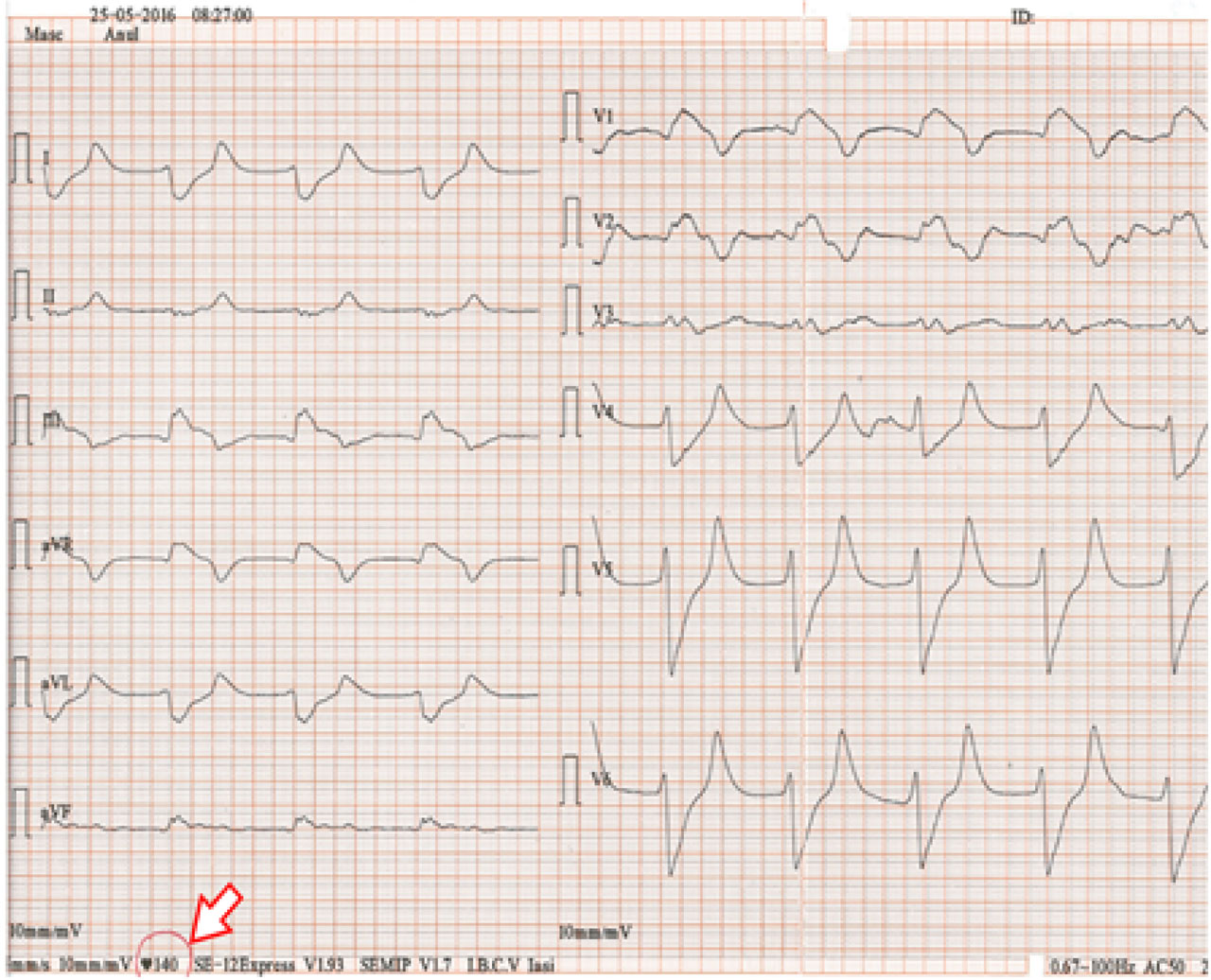
Figure 23
Electrocardiogram in hyperkalaemia, revealing ST segment elevation in lead V1, following a wide and rightward shifted QRS complex, related to a rhythm presumably idioventricular in origin, alongwith high and sharply pointed T wave in V4–V6. The amplitudes alike of the S and T waves promote the automatic erroneous heart rate double counting (an event not specific to, but nevertheless possible in hyperkalaemia).
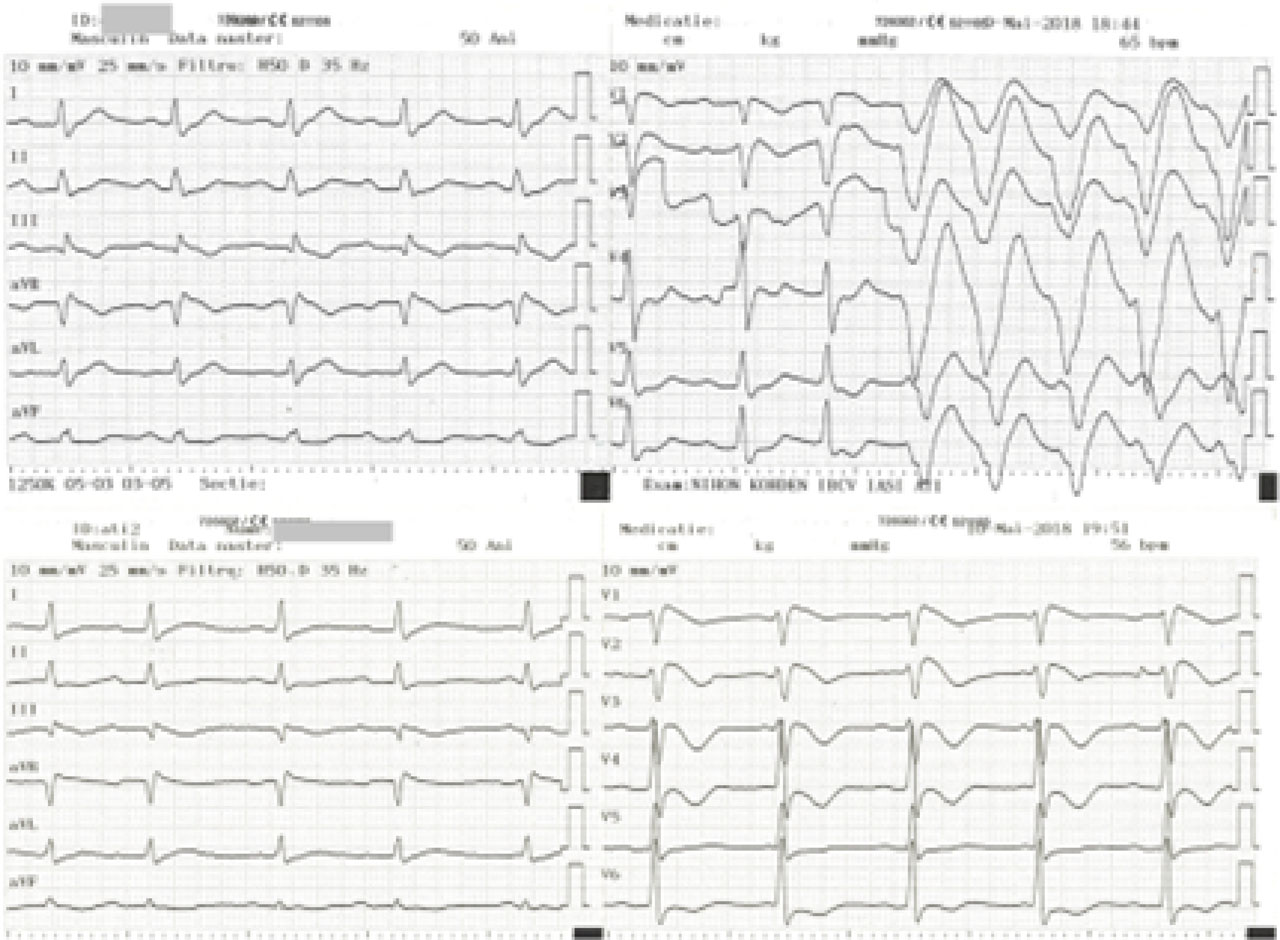
Figure 24
ST elevation within the right precordial leads and wide QRS complex in sinus rhythm, alternating with episodes of accelerated idioventricular rhythm, against the background of a deliberate intoxication with flecainide.
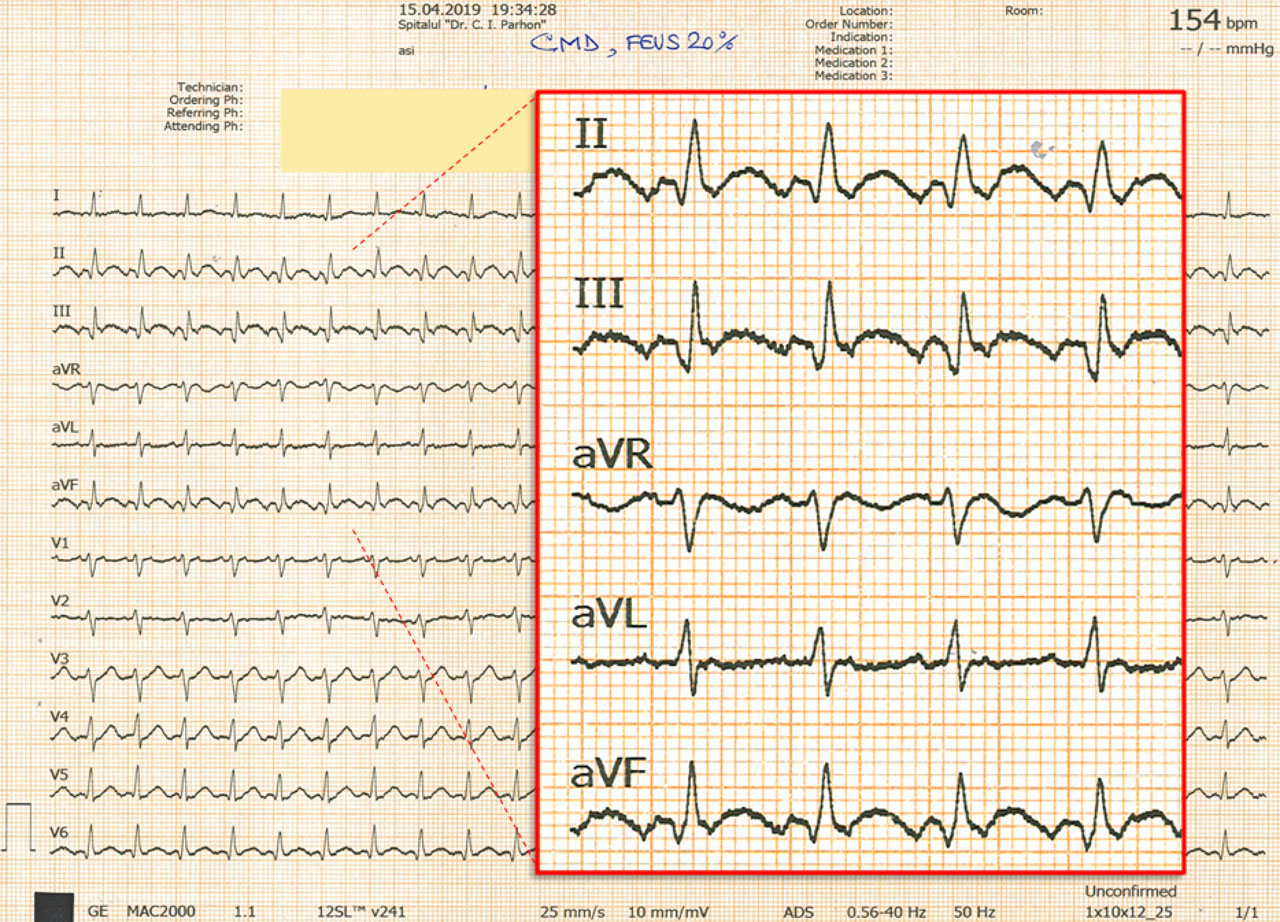
Figure 25
Pseudo ST elevation in the inferior leads, created by the F wave of the atrial flutter.
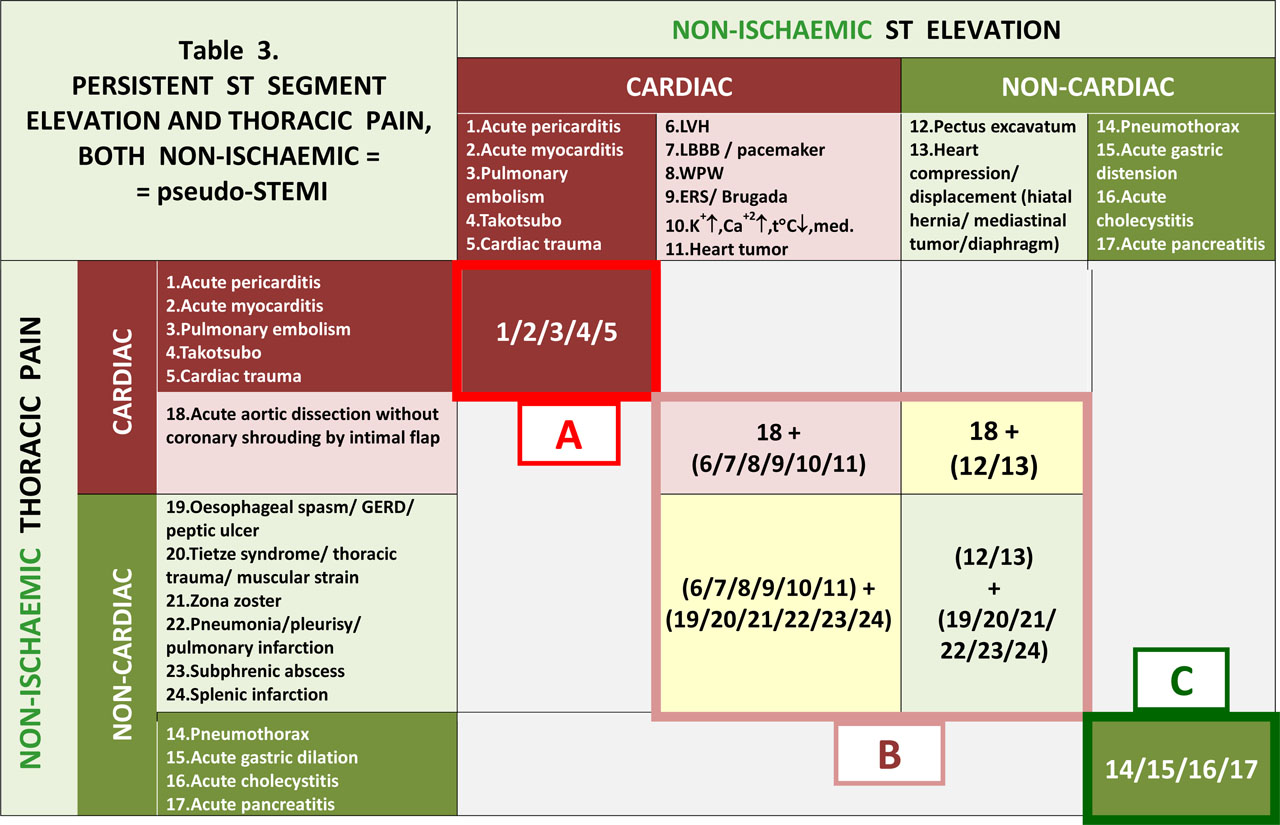
Table 4
Scenario of ST segment elevation and troponin variation over time.
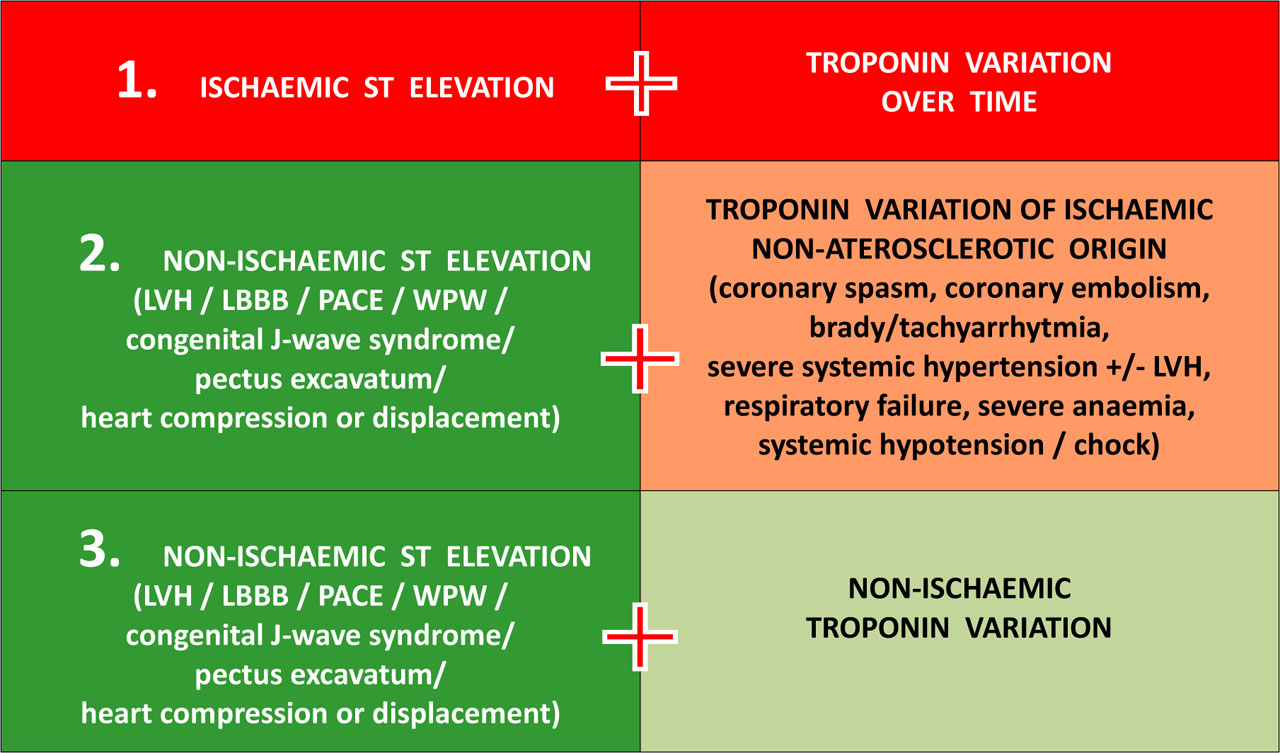 |
[i] Legend of Table 4: LVH = left ventricular hypertrophy,
[ii] LBBB = left bundle branch block, PACE = ventricular pacemaker,
[iii] WPW = Wolff-Parkinson-White syndrome