

Tab. 1:
Areas and indicators for studying the country’s security level in wartime in economic and environmental terms
| Industrial safety in the regions | Share of high-tech products in the volume of industrial products sold, % Share of added value of enterprises in the high-tech manufacturing sector, % Share of added value of enterprises in the medium-high-tech sector, % Share of employees in high- and medium-high-tech sectors, % Labour intensity of industrial production, % Profitability of industrial enterprises’ operating activities, % Profitability of operating activities in construction, % Profitability of operating activities in transport, warehousing, postal and courier services, % |
| External economic security of regions | Openness of the economy Ratio of exports to imports, times Share of raw materials and low-value-added industrial exports in total exports – reflects the qualitative structure of exports Share of imports in domestic consumption – allows assessing the degree of import dependence of the domestic market |
| Investment and innovation security of regions | Ratio of net foreign direct investment to GRP, % Ratio of real estate loans to GRP, % Size of the region’s economy, % of Ukraine’s GDP Share of R&D in GRP, % R&D expenditure from the state budget in GRP, % Number of researchers to the employed population (per 1,000 persons) Share of enterprises implementing innovations, % Share of innovative products in industry, % |
| Food security in the regions | Daily calorie intake per person, thousand kcal, % Affordability of food Ratio of meat and meat product production and consumption per person, % Sufficiency of meat and meat product production, % Ratio of milk and dairy product production and consumption per capita, % Level of milk and dairy product production adequacy, % Ratio of egg production and consumption per capita, % Level of egg production adequacy, % Ratio of production and consumption of potatoes per capita, % Level of sufficiency of potato production, % Ratio of production and consumption of vegetables and melons per capita, % Level of sufficiency of vegetable and melon production, % Grain production per capita per year, tonnes Level of sufficiency of bread |
| Environmental safety of regions | Share of renewable energy in final energy consumption in the transport sector/Share of renewable sources in total primary energy supply Share of polluted (untreated or insufficiently treated) wastewater discharges into water bodies, per cent Share of municipal and similar waste recovery, per cent Area of organic land in total agricultural area, per cent Current expenditure on environmental protection, per cent of GDP Share of capital investment in environmental protection in total capital investment, per cent |
Tab. 2:
Number of problematic indicators (by area) of economic security by region of Ukraine (based on average values for the period 2019–2023)
| Region | Production (8 indic. in total) | Foreign economic (4 indicat. in total) | Investment and innovation (10 indicat. in total) | Food (8 indicat. in total) | Environmental (6 indicat. in total) | Total (36 indicat. in total) |
|---|---|---|---|---|---|---|
| Sumy | 3 | 1 | 8 | 3 | 5 | 20 |
| Vinnytsia | 4 | 1 | 8 | 1 | 4 | 18 |
| Volyn | 4 | 3 | 9 | 3 | 4 | 23 |
| Dnipropetrovsk | 4 | 1 | 9 | 4 | 3 | 21 |
| Zhytomyr | 5 | 2 | 9 | 3 | 4 | 23 |
| Ivano-Frankivsk | 5 | 1 | 8 | 2 | 4 | 20 |
| Ternopil | 5 | 2 | 7 | 2 | 4 | 20 |
| Kharkiv | 5 | 2 | 8 | 4 | 3 | 22 |
| Donetsk | 6 | 2 | 8 | 7 | 3 | 26 |
| Zaporizhzhia | 6 | 2 | 7 | 4 | 4 | 23 |
| Kyiv region and Kyiv city | 6 | 2 | 8 | 2 | 4 | 22 |
| Kirovograd | 6 | 2 | 8 | 3 | 4 | 23 |
| Luhansk | 6 | 2 | 9 | 8 | 4 | 29 |
| Mykolaiv | 6 | 2 | 9 | 4 | 4 | 25 |
| Odessa | 6 | 1 | 7 | 6 | 5 | 25 |
| Poltava | 6 | 2 | 7 | 2 | 5 | 22 |
| Rivne | 6 | 1 | 9 | 3 | 4 | 23 |
| Khmelnytsky | 6 | 2 | 9 | 3 | 4 | 24 |
| Chernihiv | 6 | 2 | 9 | 2 | 4 | 23 |
| Chernivtsi | 7 | 2 | 9 | 4 | 4 | 26 |
| Transcarpathian | 7 | 2 | 9 | 4 | 3 | 25 |
| Lviv | 7 | 2 | 8 | 5 | 5 | 27 |
| Kherson | 7 | 2 | 9 | 4 | 4 | 26 |
| Cherkasy | 8 | 3 | 7 | 2 | 4 | 24 |
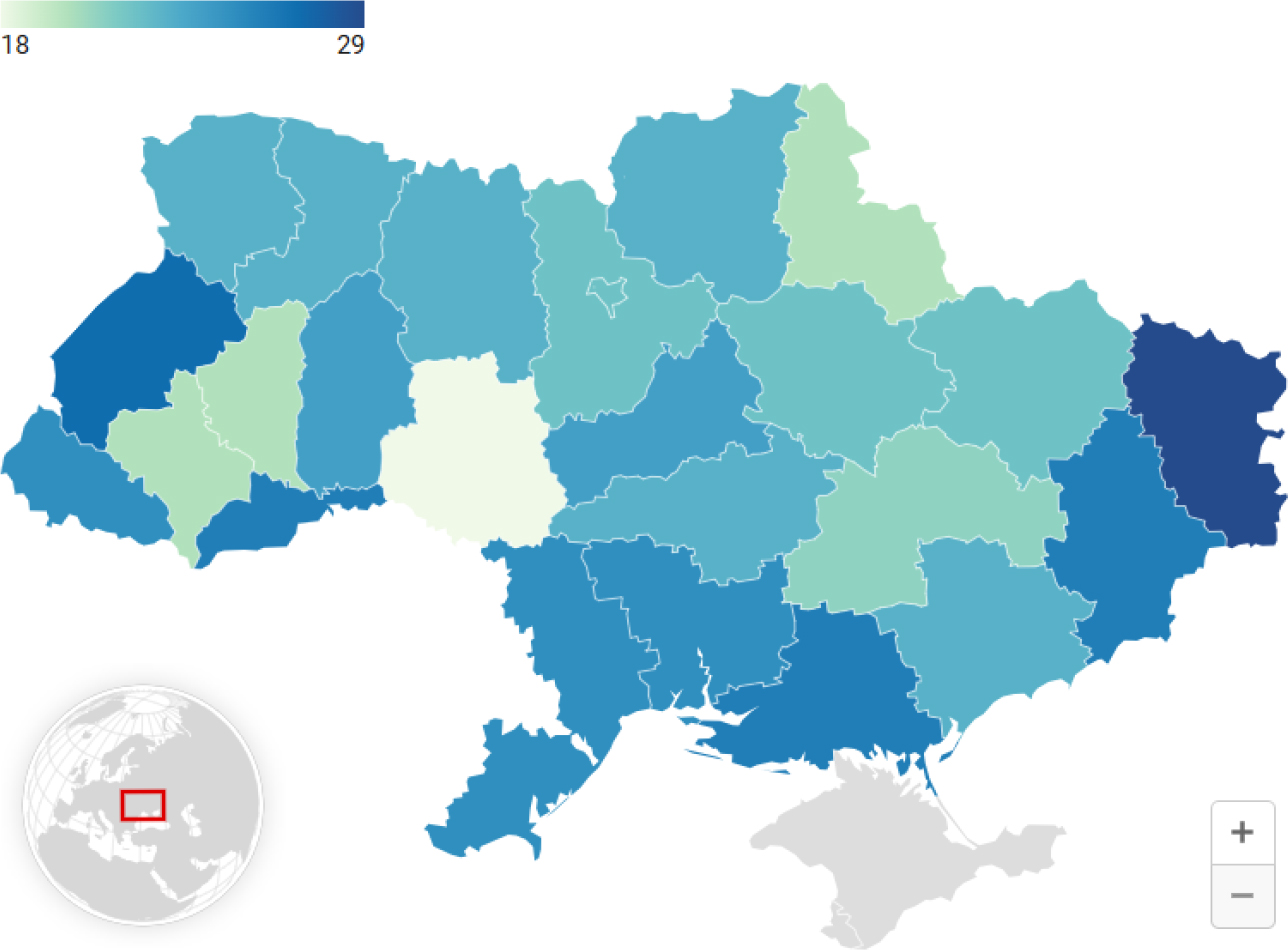
Fig. 1:
Spatial distribution of Ukraine’s regions by number of problematic economic security indicators (average values for the study period) using the resource https://app.datawrapper.de/
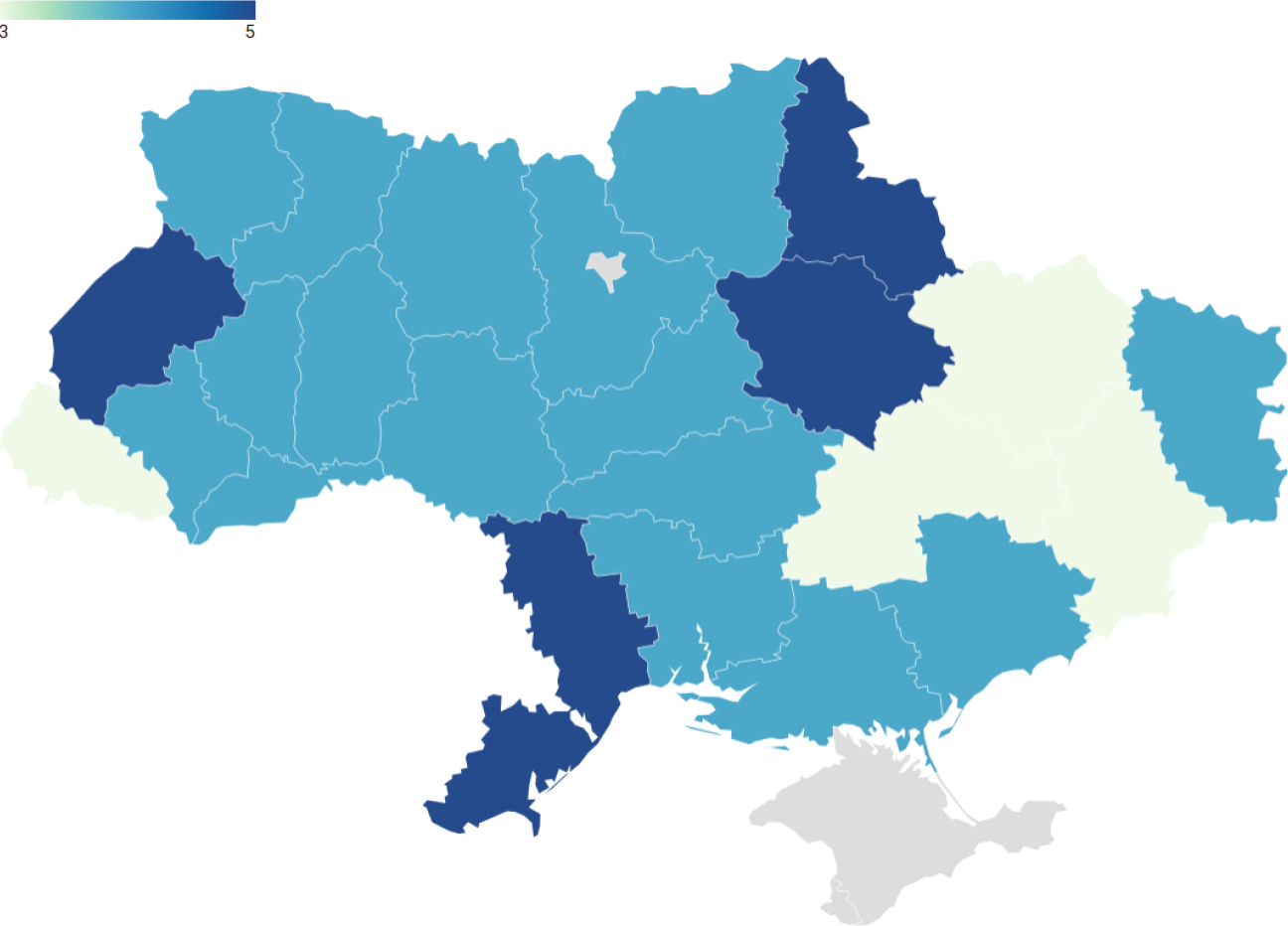
Fig. 2:
Spatial distribution of regions of Ukraine by number of problematic environmental indicators (average values for the study period 2019–2024) using the resource https://app.datawrapper.de/
Tab. 3:
Share of problematic indicators (by type of security and overall) by region of Ukraine (based on average values for the period 2019–2024)
| Region | Production | Foreign economic | Investment and innovation | Food | Environmental | Total |
|---|---|---|---|---|---|---|
| Luhansk | 75 | 50 | 90 | 100 | 66.67 | 80.56 |
| Lviv | 8 | 5 | 80 | 62 | 83.33 | 75 |
| Donetsk | 75 | 50 | 80 | 87.5 | 50 | 72.22 |
| Chernivtsi | 87.5 | 50 | 90 | 50 | 66.67 | 72.22 |
| Kherson | 87 | 50 | 90 | 50 | 66.67 | 72.22 |
| Mykolaiv | 75 | 50 | 90 | 50 | 66.67 | 69.44 |
| Odessa | 75 | 25 | 70 | 75 | 83.33 | 69.44 |
| Transcarpathian | 87 | 50 | 90 | 50 | 50 | 69.44 |
| Khmelnytsky | 75 | 50 | 90 | 37.5 | 66.67 | 66.67 |
| Cherkasy | 100 | 75 | 70 | 25 | 66.67 | 66 |
| Volyn | 5 | 75 | 90 | 37 | 66.67 | 63.89 |
| Zhytomyr | 62 | 50 | 90 | 37.5 | 66.67 | 63.89 |
| Zaporizhzhia | 75 | 50 | 70 | 50 | 66.67 | 63.89 |
| Kirovograd | 75 | 50 | 80 | 37.5 | 66.67 | 63.89 |
| Rivne | 75 | 25 | 90 | 37.5 | 66.67 | 63.89 |
| Chernihiv | 75 | 50 | 90 | 25 | 66.67 | 63.89 |
| Kharkiv | 62 | 50 | 80 | 50 | 50 | 61.11 |
| Kyiv region and Kyiv city | 75 | 50 | 80 | 25 | 66.67 | 61.11 |
| Poltava | 75 | 50 | 70 | 25 | 83.33 | 61.11 |
| Dnipropetrovsk | 50 | 25 | 90 | 50 | 50 | 58.33 |
| Sumy | 37 | 25 | 80 | 37.5 | 83.33 | 55.56 |
| Ivano-Frankivsk | 62 | 25 | 80 | 25 | 66.67 | 55.56 |
| Ternopil | 62 | 50 | 70 | 25 | 66.67 | 55.56 |
| Vinnytsia | 50 | 25 | 80 | 12.5 | 66.67 | 50 |
| Average value for Ukraine | 71.354 | 45.833 | 82 | 44.270 | 66.668 | 64.815 |
Tab. 4:
Comparison of average security levels in the Ukrainian Black Sea region before and after the full-scale aggression
| Indicator | Odesa region | Mykolaiv region | Kherson region |
|---|---|---|---|
| Industrial safety in the regions | |||
| Share of high-tech products in the total volume of industrial output, per cent | 1.40/2.21 ↑ | 0.24/0.38 ↑ | 0.24/0.00 ↓ |
| Share of value added at production cost of enterprises belonging to the high-tech sector of the manufacturing industry in total value added at production cost, per cent | 0.45/0.45 ≈ | 0.08/0.15 ↑ | 0.11/0.00 ↓ |
| Share of value added based on production costs of enterprises belonging to the medium-high-tech sector of the manufacturing industry in total value added based on production costs, per cent | 1.94/1.10 ↓ | 6.08/1.85 ↓ | 1.79/0.73 ↓ |
| Proportion of employees working in enterprises belonging to the high- and medium-high-tech sectors of the manufacturing industry as a percentage of the total number of employees in industry | 16.57/13.70 ↓ | 27.68/9.16 ↓ | 10.01/3.37 ↓ |
| Labour intensity of industrial production, per cent | 9.88/8.96 ↓ | 13.10/15.22 ↑ | 11.29/12.61 ↑ |
| Operating profit margin of industrial enterprises, per cent | 4.6/3.5 ↓ | 5.8/–4.7 ↓ | 9.0/–30.5 ↓ |
| Operating profit margin of construction companies, per cent | 2.0/0.8 ↓ | 4.0/3.0 ↓ | 4.6/–8.0 ↓ |
| Operating profit margin of transport, warehousing, postal and courier services, in per cent | 13.0/9.8 ↓ | 12.8/6.4 ↓ | –1.6/–8.7 ↓ |
| External economic security of regions | |||
| Economic openness, per cent | 56.5/54.9 ↑ | 104.2/46.5 ↑ | 26.8/2.4 ↓ |
| Export-to-import coverage ratio, times | 0.95/0.87 ↓ | 3.03/1.99 ↓ | 1.04/0.97 ↓ |
| Share of the leading partner country in total exports of goods, per cent | 8.9/14.2 ↑ | 21.7/19.6 ↓ | 16.0/21.4 ↑ |
| Share of the leading partner country in total volume of goods imports, per cent | 25.9/26.4 ↑ | 18.8/19.5 ↓ | 22.1/23.6 ↑ |
| Share of the leading product (product group) in total exports of goods, per cent | 34.0/36.0 ↑ | 49.9/53.0 ↑ | 19.5/24.0 ↑ |
| Share of the leading product (product group), excluding energy imports, in total imports of goods, per cent | 8.7/9.7 ↑ | 16.8/16.3 ≈ | 38.2/23.7 ↓ |
| Share of raw material and low-value-added industrial exports in total goods exports, per cent | 84.3/94.9 ↑ | 74.8/92.4 ↑ | 86.0/91.0 ↑ |
| Share of imports in domestic consumption, per cent | 13.3/n.a. | 9.7/n.a. | 6.6/n.a. |
| Investment and innovation security of regions | |||
| Ratio of net increase in foreign direct investment to GRP, per cent | 1.27/1.08 ↓ | 5.56/–0.43 ↓ | — |
| Ratio of loans granted to non-financial corporations and households for the purchase, construction and renovation of real estate (cumulative, adjusted for exchange rate differences) to GVA | 1.7/0.9 ↓ | 0.8/0.5 ↓ | 1.2/0.4 ↓ |
| Size of the region’s economy (GRP), as a percentage of Ukraine’s GDP | 5.05/4.98 ↓ | 2.30/2.28 ↓ | 1.60/1.62 ↑ |
| Share of scientific and scientific-technical work in GDP, per cent | 0.15/0.11 ↓ | 0.31/0.10 ↓ | 0.10/0.01 ↓ |
| Ratio of expenditure on scientific and scientific-technical work funded from the state budget, as a percentage of GDP | 0.07/0.05 ↓ | 0.04/0.03 ↓ | — |
| Number of specialists engaged in scientific and technical work as a proportion of the employed population (per 1,000 people) | 1.65/1.23 ↓ | 1.84/1.22 ↓ | 0.87/0.04 ↓ |
| Share of intangible investment in GRP, per cent | 0.34/0.13 ↓ | 0.07/0.09 ↑ | 0.11/0.00 ↓ |
| Food security in the regions (based on the level of self-sufficiency in domestic production) | |||
| Level of self-sufficiency in meat and meat products, per cent | 30.01/29.2 ↓ | 50.69/63.29 ↑ | 72.43/14.12 ↓ |
| Self-sufficiency rate for milk and dairy products, per cent | 85.41/83.27 ↓ | 163.39/143.31m ↓ | 169.62/51.93 ↓ |
| Egg production self-sufficiency rate, per cent | 31.45/22.33 ↓ | 81.98/66.06 ↓ | 329.38/47.68 ↓ |
| Potato production sufficiency rate, per cent | 154.48/149.64 ↓ | 212.91/188.22 ↓ | 322.33/0 ↓ |
| Self-sufficiency rate for vegetable and edible melon production, per cent | 139.59/136.19 ↓ | 499.85/329.47 ↓ | 1356.22/— ↓ |
| Grain production per capita per year, tonnes | 1.52/1.8 ↑ | 2.81/2.46 ↓ | 2.92/0.12 ↓ |
| Environmental safety of regions | |||
| Proportion of discharges of polluted (untreated or inadequately treated) wastewater into water bodies, per cent | 20.70/9.26 ↑ | 28.29/28.85 ↑ | 7.81/0.00 ↑ |
| Recycling rate for household and similar waste, per cent | 0.00/0.00 ≈ | 1.47/1.07 ↓ | 0.00/0.00 ≈ |
| Area of organic land as a percentage of total agricultural land | 4.47/5.27 ↓ | 0.18/0.13 ↓ | 4.28/1.99 ↓ |
| Current expenditure on environmental protection, as a percentage of GRP | 0.26/0.21 ↓ | 0.76/0.43 ↓ | 0.23/0.11 ↓ |
| Share of capital investment in environmental protection as a percentage of total capital investment | 0.43/0.31 ↓ | 2.76/1.53 ↓ | 0.53/2.70 ↑ |
Tab. 5:
Generalised proposals for improving Ukraine’s production indicators
| No | Indicators | Key problem | Proposals |
|---|---|---|---|
| 1 | Share of high-tech products in the volume of industrial products sold, % | Very low values in most regions, lack of effective incentive programmes | Formulation of targeted programmes for the development of high-tech production at the level of regional state administrations; tax incentives for such enterprises |
| 2 | Share of added value of enterprises in the high-tech manufacturing sector, % | Very low values in most regions, lack of effective incentive programmes | Conducting cluster analysis of successful regions and scaling up practices through public-private technical modernisation projects |
| 3 | Share of added value of enterprises in the medium-high-tech sector, % | Sharp regional disparities: growth only in some regions, stagnation or decline in others | Conducting cluster analysis of successful regions and scaling up practices through public-private technical modernisation projects |
| 4 | Share of employees in high-and medium-high-tech sectors, % | Systemic degradation of the workforce in manufacturing in most regions | Regional programmes for professional retraining of personnel with a focus on STEM and engineering professions; support for dual education |
| 5 | Labour intensity of industrial production, % | High labour intensity in a number of regions, indicating a low level of automation | Launch of a national programme to support the technological modernisation of industrial enterprises with the involvement of preferential financing |
| 6 | Profitability of industrial enterprises’ operating activities, % | Fluctuations in profitability between regions; significant decline after 2022 | Introduction of mechanisms to stabilise access to energy resources and logistics for industrial enterprises, especially in de-occupied territories |
| 7 | Profitability of operating activities in construction, % | Fluctuations in profitability between regions; significant decline after 2022 | Long-term construction planning with state support; state reconstruction strategies |
| 8 | Profitability of operating activities in transport, warehousing, postal and courier services, % | Fluctuations in profitability between regions; significant decline after 2022 | Global logistics projects, compensation for logistics losses |
Tab. 6:
Generalised proposals for improving the state of investment and innovation indicators in Ukraine
| No | Indicators | Key problem | Proposals |
|---|---|---|---|
| 1 | Ratio of net foreign direct investment inflows to GRP, % | High regional imbalance in FDI inflows | Creation of regional investment portals and project banks focused on environmental and innovative areas |
| 2 | Ratio of real estate loans to GRP, % | Insufficient volume of available lending outside the capital regions | Creation of regional programmes to guarantee loans for housing and production modernisation |
| 3 | Size of the region’s economy, % of Ukraine’s GDP | Excessive concentration of the economy in certain regions | Support for interregional infrastructure clusters in weaker regions |
| 4 | Share of R&D in GRP, % | Chronic underfunding of science in most regions | Introduction of regional grant competitions with a mandatory commercialisation component |
| 5 | Expenditure on R&D from the state budget in GRP, % | Lack of sustainable programmes to support applied science in the regions | Delegation of part of state funding for R&D to the regional level through targeted funds |
| 6 | Number of researchers per employed population (per 1,000 people) | Brain drain and lack of incentives for young professionals | Regional co-financing programmes for doctoral studies, youth science, mobility |
| 7 | Percentage of enterprises implementing innovations, % | Prevalence of an extensive industrial model, weak R&D | Industrial accelerators, incentives for innovation costs in regional development programmes |
| 8 | Share of innovative products in industry, % | Predominant focus on low-tech products | Target orders for innovative products in regional procurement, partnerships with universities |
| 9 | Share of people using the Internet, % | Territorial gaps in digital inclusion | Co-financing the development of digital infrastructure in rural communities |
| 10 | Share of intangible investments in GDP, % | Insufficient attention to intellectual property and creative sectors | Regional programmes to stimulate IT, design, start-ups with IP component support |
Tab. 7:
Generalised proposals for improving Ukraine’s food security indicators
| No | Indicators | Key issue | Proposals |
|---|---|---|---|
| 1 | Daily calorie intake per person, thousand kcal, % | Regional imbalance in dietary calorie intake, particularly in areas of active hostilities. | Review of the list of food products |
| 2 | Affordability of food | A high proportion of household expenditure is accounted for by food and non-alcoholic beverages – the average for Ukraine is 47.24% | comprising the consumer basket and, consequently, the minimum subsistence level |
| 3 | Ratio of production and consumption volumes of meat and meat products per capita, % Self-sufficiency rate for meat and meat products, % | Insufficient meat production by region. | Establishment of regional investment programmes/projects and grant schemes for livestock development to supply educational and healthcare institutions, the Armed Forces of Ukraine, and socially vulnerable groups |
| 4 | Ratio of production and consumption of milk and dairy products per capita, % Level of self-sufficiency in milk and dairy product production, % | Insufficient meat production across individual regions. Imbalances in production. | |
| 5 | Ratio of production and consumption of eggs per capita, Level of self-sufficiency in egg production, % | Insufficient egg production by region. Imbalances in production. | Creation of regional investment programmes/projects and grant schemes for poultry farming development at the local level to supply educational and healthcare institutions, as well as the Armed Forces of Ukraine |
| 6 | Ratio of potato production to consumption per capita, % Level of self-sufficiency in potato production, % | Excess production | Development of regional programmes for potato processing and the enhancement of export potential to facilitate the export of high value-added processed products |
| 7 | Ratio of production to consumption of vegetables and edible melons per capita, % Self-sufficiency level of vegetable and edible melon production, % | Excess production | Development of regional programmes for the deep processing of vegetables and melons to meet domestic demand and increase export potential |
| 8 | Annual grain production per capita, tonnes, Self-sufficiency level of bread products (bread, pasta products converted to flour, cereals, pulses), per cent | Existence of regional disparities | Increasing the degree of processing of cereals and pulses to boost exports of high value-added products |
Tab. 8:
Generalised proposals for improving the state of environmental indicators in Ukraine
| No | Indicators | Key problem | Proposals |
|---|---|---|---|
| 1 | Share of renewable energy in final energy consumption in the transport sector/Share of renewable sources in total primary energy supply | Lack of a comprehensive energy balance for regions, which makes it impossible to analyse energy security | Development of a methodology for assessing the energy balances of Ukraine’s regions based on international standards + creation of regional RES development plans based on needs/threats |
| 2 | Percentage of polluted (untreated or insufficiently treated) wastewater discharged into water bodies | Critical situation with discharges in 5+ regions | Regional Zero Polluted Discharge programmes with modernisation of treatment systems, local projects in communities |
| 3 | Percentage of household and similar waste recycled | Extremely low recycling rates in most regions | Introduce annual recycling growth quotas; support projects for sorting, recycling organic waste and solid waste |
| 4 | Area of organic land as a percentage of total agricultural land | No official statistics, accounting through unofficial sources | Inclusion of organic matter in statistics (through the state observation plan) + formation of regional programmes to support organic farming |
| 5 | Current expenditure on environmental protection, per cent of GRP | Share of expenditure < 1% of GRP in most regions | Recommended minimum expenditure on environmental protection in local budgets |
| 6 | Share of capital investments in environmental protection in total capital investments, per cent | Low interest among businesses in investing in environmental protection | Tax incentives: VAT/tax credit for eco-investments in purification technologies, renewable energy sources, waste disposal |
Tab. 9:
Characteristic values of indicators for external economic security as a component of economic security
| No. | Indicator name, unit of measurement | XL critical | XL non-critical | XL non-dual | XL double | XL opt | XR wholesale | XR pair | XR single | XR nonseparable | XR critical |
|---|---|---|---|---|---|---|---|---|---|---|---|
| 1 | Economic openness, per cent | 75 | 85 | 90 | 95 | 100 | |||||
| 2 | Export-to-import coverage ratio, times | 0.85 | 0.9 | 0.95 | 0.975 | 1 | 1.2 | 1.25 | 1.3 | 1.5 | 1.7 |
| 3 | Share of raw material and low-value-added industrial exports in total goods exports, per cent | 0.1 | 3 | 5 | 8 | 15 | 20 | 30 | 40 | 50 | 60 |
| 4 | Share of imports in the country’s domestic consumption, per cent | 5 | 7 | 10 | 12.5 | 15 | 17 | 19 | 22 | 25 | 30 |
Tab. 10:
Characteristic values of indicators for industrial safety as a component of economic security for regions
| No. | Indicator name, unit of measurement | XL critical | XL non-critical | XL non-dual | XL double | XL opt | XR whole-sale | XR pair | XR single | XR non-separable | XR critical |
|---|---|---|---|---|---|---|---|---|---|---|---|
| 1 | Share of high-tech products in the total volume of industrial output, per cent | 1 | 2 | 3 | 5 | 7 | 12 | 30 | 45 | 60 | 75 |
| 2 | Share of value added at production cost of enterprises belonging to the high-tech sector of the manufacturing industry in total value added at production cost, per cent | 2 | 3.25 | 4.5 | 5.75 | 7 | |||||
| 3 | Share of value added by production costs of enterprises belonging to the medium-high-tech sector of the manufacturing industry in total value added by production costs, per cent | 4 | 5.4 | 6.8 | 8.2 | 9.6 | |||||
| 4 | Proportion of employees working in enterprises belonging to the high- and medium-high-tech sectors of the manufacturing industry as a percentage of the total number of employees in industry | 18 | 20.5 | 23 | 25.5 | 28 | |||||
| 5 | Labour intensity of industrial production, per cent | 4 | 8 | 10 | 15 | 20 | 25 | 30 | 40 | 45 | 50 |
| 6 | Operating profit margin of industrial enterprises, per cent | 1 | 3 | 4 | 5 | 6 | 10 | 20 | 30 | 40 | 60 |
| 7 | Operating profit margin of construction companies, per cent | –1 | 3 | 4 | 5 | 6 | 10 | 20 | 30 | 40 | 60 |
| 8 | Operating profitability of transport, warehousing, postal and courier services, per cent | –5 | 0 | 1 | 3 | 5 | 8 | 10 | 12 | 13 | 15 |
Tab. 11:
Characteristic values of indicators for investment and innovation security as a component of economic security for regions
| No. | Indicator name, unit of measurement | XL critical | XL non-critical | XL nondual | XL pair | XL opt | XR whole-sale | XR pair | XR single | XR non-separable | XR critical |
|---|---|---|---|---|---|---|---|---|---|---|---|
| 1 | Ratio of the region’s net increase in foreign direct investment to GRP, per cent | 4 | 4.5 | 5 | 6 | 7 | |||||
| 2 | Ratio of loans granted to non-financial corporations and households for the purchase, construction and renovation of real estate in the region, as a percentage of GRP | 10 | 13 | 15 | 20 | 25 | 30 | 50 | 60 | 70 | 80 |
| 3 | Size of the region’s economy (GRP), as a percentage of Ukraine’s GDP | 0.8 | 1.6 | 2.4 | 3.2 | 4 | 4 | 4.8 | 5.6 | 6.4 | 7.2 |
| 4 | Share of the volume of scientific and scientific-technical work performed in GRP, per cent | 0.5 | 1 | 1.5 | 2 | 3 | |||||
| 5 | Ratio of expenditure on scientific and scientific-technical work funded from the regional state budget to GRP | 0.2 | 0.3 | 0.5 | 0.75 | 1 | |||||
| 6 | Number of specialists engaged in scientific and technical work as a percentage of the employed population (per 1,000 persons) | 5 | 10 | 13 | 17 | 22 | |||||
| 7 | Proportion of enterprises that introduced innovations in the total number of industrial enterprises, per cent | 5 | 10 | 15 | 25 | 35 | |||||
| 8 | Proportion of innovative products sold in total industrial output, per cent | 3 | 7 | 15 | 20 | 25 | |||||
| 9 | Proportion of people who reported having used the Internet in the last 12 months (household survey), per cent | 20 | 30 | 45 | 60 | 80 | |||||
| 10 | Share of the region’s intangible investments in GRP, per cent | 2.8 | 5.6 | 8.4 | 11.2 | 14 |
Tab. 12:
List of indicators and definition of the scale for assessing their values to evaluate the level of self-sufficiency in the production of staple foods (conventionally rational consumption standard)
| No. | Indicator name, unit of measurement | Method of calculating the indicator | Standards recommended by theUkrainian Research Institute of Nutrition and Hygiene of the Ministry of Health | Food product sets, Resolution of the Cabinet of Ministers of Ukraine No. 780 of 11 October 2016 | |||
|---|---|---|---|---|---|---|---|
| Children under 6 years | Children aged 6 to 18 | Working-age population | Non-working population | ||||
| 1 | Self-sufficiency rate for meat and meat products, per cent | Volume of meat and meat product production, thousand tonnes / (current population, million people × consumption standard of the Institute of Nutrition and Hygiene of the Ministry of Health, kg) Volume of meat and meat product production, thousand tonnes / (number of children under 6 years old × standard + number of children aged 6–18 years × standard + number of working-age population × standard + number of non-working-age population × standard) | 83 | 40 | 62.4 | 53 | 38 |
| 2 | Self-sufficiency rate for milk and dairy products, per cent | Volume of milk and dairy product production, thousand tonnes / (total population, million people × consumption standard of the Institute of Nutrition and Hygiene of the Ministry of Health, kg) Volume of milk and dairy product production, thousand tonnes / (number of children under 6 years of age × standard rate + number of children aged 6–18 years × standard rate + number of working-age population × standard rate + number of non-working-age population × standard rate) | 380 | 213.05 | 209.3 | 143.5 | 122.3 |
| 3 | Self-sufficiency level of egg production, per cent | Egg production volume, thousand units / (current population, million people × consumption standard of the Institute of Nutrition and Hygiene of the Ministry of Health, units) Egg production volume, thousand tonnes / total population, million people / (number of children under 6 years old × standard + number of children aged 6–18 years × standard + working-age population × standard + non-working-age population × standard) | 290 | 182.5 | 365 | 220 | 187.5 |
| 4 | Self-sufficiency level of potato production, per cent | Potato production volume, thousand tonnes / (current population, million people × consumption rate set by the Institute of Nutrition and Hygiene of the Ministry of Health, kg) Potato production volume, thousand tonnes / (number of children under 6 years old × standard + number of children aged 6–18 years × standard + number of working-age population × standard + number of non-working-age population × standard) | 124 | 73 | 93.7 | 95 | 108 |
| 5 | Self-sufficiency level of vegetable and edible melon production, per cent | Volume of vegetable and edible melon production, thousand tonnes / (current population, million people × consumption standard of the Institute of Nutrition and Hygiene of the Ministry of Health, kg) Volume of vegetable and edible melon production, thousand tonnes / (number of children under 6 years of age × standard rate + number of children aged 6–18 years × standard rate + number of working-age population × standard rate + number of non-working-age population × standard rate) | 161 | 82.1 | 109.3 | 110 | 98 |
| 6 | Self-sufficiency level of cereal product production (bread, pasta products converted to flour, cereals, pulses), per cent | Volume of cereal and legume production, thousand tonnes / (current population, million people × consumption standard of the National Institute of Nutrition and Food Hygiene of the Ministry of Health, kg) Volume of cereal and legume production, thousand tonnes / (number of children under 6 years old × standard + number of children aged 6–18 years × standard + number of working-age population × standard + number of non-working-age population × standard) | 101 | 63 | 107.7 | 123.4 | 122.9 |
Tab. 13:
Characteristic values of indicators for food security as a component of economic security
| No. | Indicator name, unit of measurement | XL critical | XL non-critical | XL non-dual | XL double | XL opt | XR whole-sale | XR pair | XR single | XR non-separable | XR critical |
|---|---|---|---|---|---|---|---|---|---|---|---|
| 1 | Daily calorie intake, kcal | 2250 | 2500 | 2700 | 2900 | 3100 | |||||
| 2 | Ratio of production and consumption of meat and meat products per capita, per cent | 80 | 85 | 90 | 95 | 105 | |||||
| 3 | Ratio of production and consumption of milk and dairy products per capita, per cent | 80 | 85 | 90 | 95 | 105 | |||||
| 4 | Ratio of egg production to consumption per capita, per cent | 80 | 85 | 90 | 95 | 105 | |||||
| 5 | Ratio of potato production and consumption per capita, per cent | 80 | 85 | 90 | 95 | 105 | |||||
| 6 | Ratio of production and consumption of vegetables and edible melons per capita, per cent | 80 | 85 | 90 | 95 | 105 | |||||
| 7 | Grain production per capita per year, tonnes | 0.6 | 0.7 | 0.8 | 0.9 | 1 | |||||
| 8 | Affordability of products | 40 | 45 | 50 | 55 | 60 |
Tab. 14:
Characteristic values of indicators for environmental security as a component of economic security
| No. | Indicator name, unit of measurement | XL critical | XL non-critical | XL non-dual | XL pair | XL opt | XR whole-sale | XR pair | XR single | XR non-separable | XR critical |
|---|---|---|---|---|---|---|---|---|---|---|---|
| 1 | Share of renewable energy in final energy consumption in the transport sector, per cent | 2.8 | 5.6 | 8.4 | 11.2 | 14 | |||||
| 2 | Share of renewable sources in total primary energy supply, per cent Proportion of discharges of polluted | 5 | 9 | 11 | 25 | 42.5 | |||||
| 3 | (untreated or inadequately treated) wastewater into water bodies, per cent | 0 | 5 | 13 | 18 | 22 | |||||
| 4 | Recycling rate for household and similar waste, per cent | 13 | 26 | 39 | 52 | 65 | |||||
| 5 | Area of organic land as a percentage of total agricultural land | 5 | 10 | 15 | 20 | 25 | |||||
| 6 | Current expenditure on environmental protection, as a percentage of GDP | 0.4 | 0.8 | 1.2 | 1.6 | 2.0 | |||||
| 7 | Share of capital investment in environmental protection as a percentage of total capital investment | 0.5 | 1.0 | 1.5 | 2.0 | 2.5 |