

1. INTRODUCTION
Against the backdrop of a full-scale war in Ukraine, the issue of safeguarding economic security takes on particular significance both for the country as a whole and for its individual regions, which combine strategic importance, resource potential and heightened vulnerability to external threats. Institutional safeguards are crucial not only for the functioning of the country’s economy, but also for its subsequent recovery. To date, a whole range of strategies and programmes aimed at strengthening the economic system and ensuring its further development have been developed and partially implemented in Ukraine. Most of them were adopted whilst the country was already at war and therefore already anticipate the threats and risks that arise or may arise for the country’s economic security, as well as mechanisms to avoid or mitigate their negative impact. In particular, in 2024, the Plan of Ukraine (Ministry of Economy of Ukraine, 2024) was approved, which includes the directions and instruments for achieving the set goals regarding the restoration of the economy, its resource potential and, importantly, human capital, the formation and development of which requires a high level of economic security for the country and its subsystems. A number of documents were also adopted to ensure economic security at the regional level. These include the Regional Development Strategy for the period up to 2027 (Cabinet of Ministers of Ukraine, 2020) and the Seaport Development Strategy for the period up to 2038 (Cabinet of Ministers of Ukraine, 2013). The latter was revised as early as 2026 in light of new challenges and threats to Ukraine’s port infrastructure located in the Ukrainian Black Sea region.
All the documents examined correlate to some extent with global concepts and programmes that outline mechanisms for obtaining international aid to support Ukraine’s economic recovery.
The Ukrainian Black Sea region is one of the key areas of national security, where industrial, food, environmental, foreign economic, and investment and innovation factors converge, determining its resilience and competitiveness during the war and post-war periods. The escalation of hostilities has triggered profound structural transformations, manifesting in the loss of production capacity, disruption of logistics networks, increased environmental risks, reduced opportunities for integration into global markets, and a decline in investment attractiveness. At the same time, it is precisely a comprehensive study of these processes that enables the formulation of a strategic vision for the region’s recovery and the enhancement of its economic security.
The aim of this article is to identify the spatial differentiation of economic security across Ukraine’s regions in wartime through the lens of economic and environmental dimensions, based on a comparative analysis of key indicators (in the pre-war and wartime periods), and to propose measures to minimise the impact of the identified threats.
The research objectives are as follows:
To develop a system of indicators (within five key blocks of economic security) for a comprehensive assessment of the economic and environmental state of the regions.
To analyse the main changes that have occurred under the influence of military challenges and threats, specifically using the example of the regions of the Ukrainian Black Sea coast to assess the dynamics of changes in key indicators;
To substantiate strategic priorities and scientific and applied principles aimed at strengthening the country’s economic security and reducing environmental threats.
2. LITERATURE REVIEW
The development of a modern paradigm for national security is shaped by global changes and the restructuring of the world economic order. According to recent studies conducted in response to new challenges, discussions on aspects of economic security such as supply chain resilience, energy security and cybersecurity have intensified significantly (OECD, 2024). This, in turn, requires a critical review of methodological approaches and tools for assessing the resilience of state systems in both security and economic-environmental dimensions. In their foundational research, Buzan and Lawson (2015) provide a substantial analysis of the conceptual shift from linear, military-centric security models to multi-component systems, in which a country’s economic capacity and institutional resilience are dominant stabilising factors amidst the restructuring of the global geopolitical order. In particular, a topical issue in the academic community today is the transformation of logistics chains under the influence of the pandemic and the war in Ukraine, which is discussed in detail in the works of Lazic et al. (2023), which highlights the need to transition to models of regional self-sufficiency and import substitution as a strategic foundation for strengthening the state’s food and overall economic security. The issue of countries competing for capital investment, particularly in the post-crisis period (following the 2008 financial crisis), deserves special attention; this is described in detail in the work of Bauerle Danzman and Meunier (2021) in the light of contemporary geopolitical transformations, and by Li et al. (2022) and Mbah and Wasum (2022), who investigated the impact of the Russia-Ukraine conflict on the spread of volatility and its dynamics across major global financial markets.
In the Ukrainian academic community, the methodological foundations for identifying threats are based on a normative-adaptive approach. At the same time, Heyets et al. (2006) and Gnatenko (2021) emphasise the non-linear nature of economic disruptions, which necessitates the implementation of dynamic monitoring systems. The spatial specification of individual security parameters has been investigated in the works of Krylenko (2013) and Ovcharenko (2021). In their works, the researchers note a significant heterogeneity in the distribution of exogenous shocks. The contemporary methodological developments by Iermakova et al. (2025a) allow these approaches to be integrated into a comprehensive model.
Against the backdrop of the active phase of the war in Ukraine, the interdependence between the pace of economic activity and the emergence of environmental threats has become critical. The current military challenges in Ukraine highlight the correlation between economic destabilisation and environmental risks, reflecting a global clash of interests between energy and climate (Perkins, 2022). In this context, a comprehensive assessment of sustainable development based on the integration of environmental, economic and social indices (Singh et al., 2021) confirms that environmental security and the conservation of natural resources are fundamental prerequisites for the stability of regional economic systems in times of crisis. Kameneva et al. (2018) argue that the environmental component of security is an integral determinant of regional viability, as largescale war-related pollution, environmental destruction and climate disruption create long-term barriers to expanded reproduction. This conclusion by the researchers correlates with the global trend towards the greening of financial performance (Anton et al., 2025) and the integration of circular economy principles (Awan and Sroufe, 2022; Knäble et al., 2022) as mechanisms for mitigating resource shortages. The application of seven environmental indicators in the proposed methodology allows for the quantitative specification of the extent of anthropogenic pressure caused by military actions on the territory of Ukraine.
The global destabilisation of the food system resulting from the Russia-Ukraine war has been thoroughly examined in the works of Glauber and Laborde Debucquet (2023) and Ben Hassen and El Bilali (2022). The high vulnerability of distribution networks and critical trade interdependence, identified by Hellegers (2022) and Chorna et al. (2024), led to the inclusion in the analytical model of an expanded set comprising 8 food and 8 foreign trade indicators. The latter reflect the objective need to diversify logistics routes in the event of a blockade of maritime communications (Cabinet of Ministers, 2013, 2020; Iermakova et al., 2025b) and to maintain export capacity as a fundamental condition for macro-financial equilibrium. Ukrainian researchers conduct food security studies in a more strategic dimension, taking into account the specific characteristics of Ukraine, namely its agricultural potential. The issue of regulating food security within the UN, its analysis and assessment, as well as the problem of food security in Ukraine, were the subject of a study by Kvash and Vakulenko (2023). The significance of Ukraine for global food security is highlighted in the work of Parkhomenko (2022). In our view, the analysis of food security at the regional level should be a priority, given its strategic role as a fundamental determinant of economic security as a whole.
Although there is a considerable body of academic research into economic security and its constituent elements, the issue of the regional dimension—taking into account the conditions of war and the prospects for socio-economic development during the post-war recovery period—remains unresolved. Despite the substance of existing academic work, the economic and environmental dimension of security in the context of systemic crises caused by war is predominantly viewed as a collection of isolated processes. Instead, we consider it appropriate to examine the issue of economic security in a more systematic manner, taking into account the components set out in the Methodology for the Assessment of Economic Security (Ministry of Economic Development and Trade of Ukraine, 2013), but with due regard to the specific characteristics of individual regions’ development and the inclusion of the environmental component. This is because most existing approaches ignore the synergistic effect of cumulative environmental damage and direct economic losses at the meso-level. The war in Ukraine has led to the emergence of new negative factors that directly affect and, to a certain extent, reduce the level of economic security and pose a significant threat to the country’s environment. Therefore, further scientific research in this particular area is both relevant and necessary.
3. METHODOLOGY
The methodological basis of the study is grounded in the systemic patterns of security levels within Ukraine’s regional systems amidst military challenges and global shocks. The hypothesis of this work posits a non-linear transformation of the security profile of territories under the influence of military threats. To verify the validity of the proposed hypothesis, a comparative analysis was conducted covering the retrospective dynamics of the pre-war period (2019–2021) and the destructive changes of the war period (2022–2023).
To ensure methodological consistency and terminological standardisation, within the scope of this study, the components of a region’s economic security are understood as functionally distinct spheres of the territorial system’s stability. The proposed analytical model is based on the author’s modification of methodological approaches (Ministry of Economic Development and Trade of Ukraine, 2013; Iermakova et al., 2025a) and covers the assessment of five key components, the calculation procedure for which is defined by the Methodology (Ministry of Economic Development and Trade of Ukraine, 2013; Iermakova et al., 2025a), whilst individual indicators of the food component are presented in the Appendix (Tab. 12).
Each group of indicators highlights specific issues: from significantly negative operating profit margins to insufficient funding for environmental protection. Given the limited information available (due to the war, some statistical observations in each region are not carried out at all, or are incomplete, and certain data are currently withheld), we have calculated the indicators for all regions of Ukraine (Tab. 1) and include 36 indicators (the characteristic values of which are presented in the Appendix), which allow for a comprehensive assessment of the level of safety through the following components:
production security comprises 8 indicators and is based on the intensity of high-tech production, the degree of depreciation of fixed assets, and the operating profitability of the industrial and transport complex;
external economic security comprises 4 indicators and assesses the degree of openness of the regional economy, the import-to-export coverage ratio, and the qualitative transformation of trade operations;
investment and innovation security comprises 10 indicators and involves assessing the dynamics of foreign direct investment inflows, the level of innovation capitalisation, the number of researchers, and the degree of digitalisation of territories;
food security covers 8 indicators and determines the level of self-sufficiency of regions in strategic agricultural products, the caloric content of the diet, and parameters of the economic affordability of food;
environmental security comprises 6 indicators and determines the degree of anthropogenic and military pressure on the environment, the share of renewable energy, and the intensity of investment in environmental protection measures.
Tab. 1:
Areas and indicators for studying the country’s security level in wartime in economic and environmental terms
| Industrial safety in the regions | Share of high-tech products in the volume of industrial products sold, % Share of added value of enterprises in the high-tech manufacturing sector, % Share of added value of enterprises in the medium-high-tech sector, % Share of employees in high- and medium-high-tech sectors, % Labour intensity of industrial production, % Profitability of industrial enterprises’ operating activities, % Profitability of operating activities in construction, % Profitability of operating activities in transport, warehousing, postal and courier services, % |
| External economic security of regions | Openness of the economy Ratio of exports to imports, times Share of raw materials and low-value-added industrial exports in total exports – reflects the qualitative structure of exports Share of imports in domestic consumption – allows assessing the degree of import dependence of the domestic market |
| Investment and innovation security of regions | Ratio of net foreign direct investment to GRP, % Ratio of real estate loans to GRP, % Size of the region’s economy, % of Ukraine’s GDP Share of R&D in GRP, % R&D expenditure from the state budget in GRP, % Number of researchers to the employed population (per 1,000 persons) Share of enterprises implementing innovations, % Share of innovative products in industry, % |
| Food security in the regions | Daily calorie intake per person, thousand kcal, % Affordability of food Ratio of meat and meat product production and consumption per person, % Sufficiency of meat and meat product production, % Ratio of milk and dairy product production and consumption per capita, % Level of milk and dairy product production adequacy, % Ratio of egg production and consumption per capita, % Level of egg production adequacy, % Ratio of production and consumption of potatoes per capita, % Level of sufficiency of potato production, % Ratio of production and consumption of vegetables and melons per capita, % Level of sufficiency of vegetable and melon production, % Grain production per capita per year, tonnes Level of sufficiency of bread |
| Environmental safety of regions | Share of renewable energy in final energy consumption in the transport sector/Share of renewable sources in total primary energy supply Share of polluted (untreated or insufficiently treated) wastewater discharges into water bodies, per cent Share of municipal and similar waste recovery, per cent Area of organic land in total agricultural area, per cent Current expenditure on environmental protection, per cent of GDP Share of capital investment in environmental protection in total capital investment, per cent |
The information base for the calculations was official statistical data from the State Statistics Service of Ukraine (2024). Given the lack of free access to certain statistical data after February 2022, data selection was carried out in accordance with the following conditions:
Only those indicators with continuous statistical coverage throughout the entire time series (2019–2023) were selected for analysis, which allowed for the identification of stable trends in security transformation.
Indicators to which access was restricted by the State Statistics Service on grounds of national security were excluded from the initial dataset (57 indicators). To ensure data comparability of heterogeneous data, a Min-Max normalisation procedure was applied, which allowed diverse metrics to be reduced to a dimensionless form within a range.
Calculations were carried out for all regions of Ukraine, with the exception of territories under temporary occupation.
Given the significant heterogeneity of the selected indicators in terms of their functional focus and units of measurement, the methodology was supplemented by a stage involving the comparison of actual values with reference thresholds. For each indicator, ranges of status were identified: from ‘optimal’ to ‘critical’ based on the adaptation of the standards of the Methodology (2013) and the targets of the State Strategy for Regional Development (2020), see Appendix.
Since direct aggregation of heterogeneous indicators can lead to statistical distortion of results, the study utilised a quantitative measurement of problem indicators. In particular, for each region, the proportion of indicators in ‘unsatisfactory’, ‘dangerous’ or ‘critical’ states was calculated across the five components of security. This allowed for the transformation of diverse statistical metrics into a comparable analytical space, facilitating a direct comparison of the calculated indicators with the critical values defined in the methodology.
4. RESULTS
In the process of assessing the production component of the economic security of Ukraine’s regions based on the aggregated average values of indicators for the period 2019–2023, the number of indicators whose values fall within the critical, dangerous or unsatisfactory zones was calculated in accordance with the established threshold scales. This made it possible to identify the regions with the highest concentration of structural imbalances and production risks.
The results obtained show (Tab. 2) that in the vast majority of Ukraine’s regions, at least five indicators fall within problem zones, indicating systemic difficulties in the functioning of regional production systems. The highest number of indicators with critically low or unstable values was recorded in the Cherkasy region (8), indicating a wide range of challenges in the areas of industrial development, innovation activity, profitability and labour resources.
Tab. 2:
Number of problematic indicators (by area) of economic security by region of Ukraine (based on average values for the period 2019–2023)
| Region | Production (8 indic. in total) | Foreign economic (4 indicat. in total) | Investment and innovation (10 indicat. in total) | Food (8 indicat. in total) | Environmental (6 indicat. in total) | Total (36 indicat. in total) |
|---|---|---|---|---|---|---|
| Sumy | 3 | 1 | 8 | 3 | 5 | 20 |
| Vinnytsia | 4 | 1 | 8 | 1 | 4 | 18 |
| Volyn | 4 | 3 | 9 | 3 | 4 | 23 |
| Dnipropetrovsk | 4 | 1 | 9 | 4 | 3 | 21 |
| Zhytomyr | 5 | 2 | 9 | 3 | 4 | 23 |
| Ivano-Frankivsk | 5 | 1 | 8 | 2 | 4 | 20 |
| Ternopil | 5 | 2 | 7 | 2 | 4 | 20 |
| Kharkiv | 5 | 2 | 8 | 4 | 3 | 22 |
| Donetsk | 6 | 2 | 8 | 7 | 3 | 26 |
| Zaporizhzhia | 6 | 2 | 7 | 4 | 4 | 23 |
| Kyiv region and Kyiv city | 6 | 2 | 8 | 2 | 4 | 22 |
| Kirovograd | 6 | 2 | 8 | 3 | 4 | 23 |
| Luhansk | 6 | 2 | 9 | 8 | 4 | 29 |
| Mykolaiv | 6 | 2 | 9 | 4 | 4 | 25 |
| Odessa | 6 | 1 | 7 | 6 | 5 | 25 |
| Poltava | 6 | 2 | 7 | 2 | 5 | 22 |
| Rivne | 6 | 1 | 9 | 3 | 4 | 23 |
| Khmelnytsky | 6 | 2 | 9 | 3 | 4 | 24 |
| Chernihiv | 6 | 2 | 9 | 2 | 4 | 23 |
| Chernivtsi | 7 | 2 | 9 | 4 | 4 | 26 |
| Transcarpathian | 7 | 2 | 9 | 4 | 3 | 25 |
| Lviv | 7 | 2 | 8 | 5 | 5 | 27 |
| Kherson | 7 | 2 | 9 | 4 | 4 | 26 |
| Cherkasy | 8 | 3 | 7 | 2 | 4 | 24 |
Taken together, the Zakarpattia, Lviv, Kherson and Chernivtsi regions, based on seven indicators, demonstrate unstable trends across sectors with varying levels of technological sophistication, whilst also losing ground in terms of production efficiency. Transcarpathia is characterised by a heavy reliance on the labour-intensive sector alongside a low level of technical modernisation. Chernivtsi region shows a simultaneous decline in both high-tech production and employment.
Six problematic indicators have been recorded in a number of industrially oriented or transit regions: the Donetsk, Zaporizhzhia and Kyiv regions and the city of Kyiv, as well as the Kirovohrad, Luhansk, Mykolaiv, Odesa, Poltava, Rivne, Khmelnytskyi and Chernihiv regions. This indicates a loss of balance between technical potential, labour resources and the operational efficiency of enterprises.
A smaller but still critical number of negative indicators (between 4 and 5) can be observed in Vinnytsia, Volyn, Dnipropetrovsk, Zhytomyr, Ivano-Frankivsk, Ternopil and Kharkiv regions. Even regions with potential for technical modernisation or a relatively stable institutional environment demonstrate weaknesses – particularly in the context of shifts in demand, market access and war-related restrictions.
The lowest number of problematic indicators (3) was recorded only in the Sumy region; however, this does not imply a complete absence of risks, but rather a concentration of problems within a narrow spectrum – which likewise requires strategic intervention.
The analysis indicates a broad zone of industrial instability covering most regions of Ukraine, necessitating the formulation of a differentiated regional policy prioritising modernisation, technological upgrading and support for the institutional environment for industrial activity.
The spatial distribution of Ukraine’s regions by the number of problematic indicators (Fig. 1) allows for the identification of territorial concentrations of economic security risks linked to the functioning of the industrial sector, the technological structure of production, innovation activity, employment and the financial performance of enterprises. The aggregated average values of the indicators for the period 2019–2023 indicate an uneven distribution of structural imbalances across Ukraine’s macro-regions.
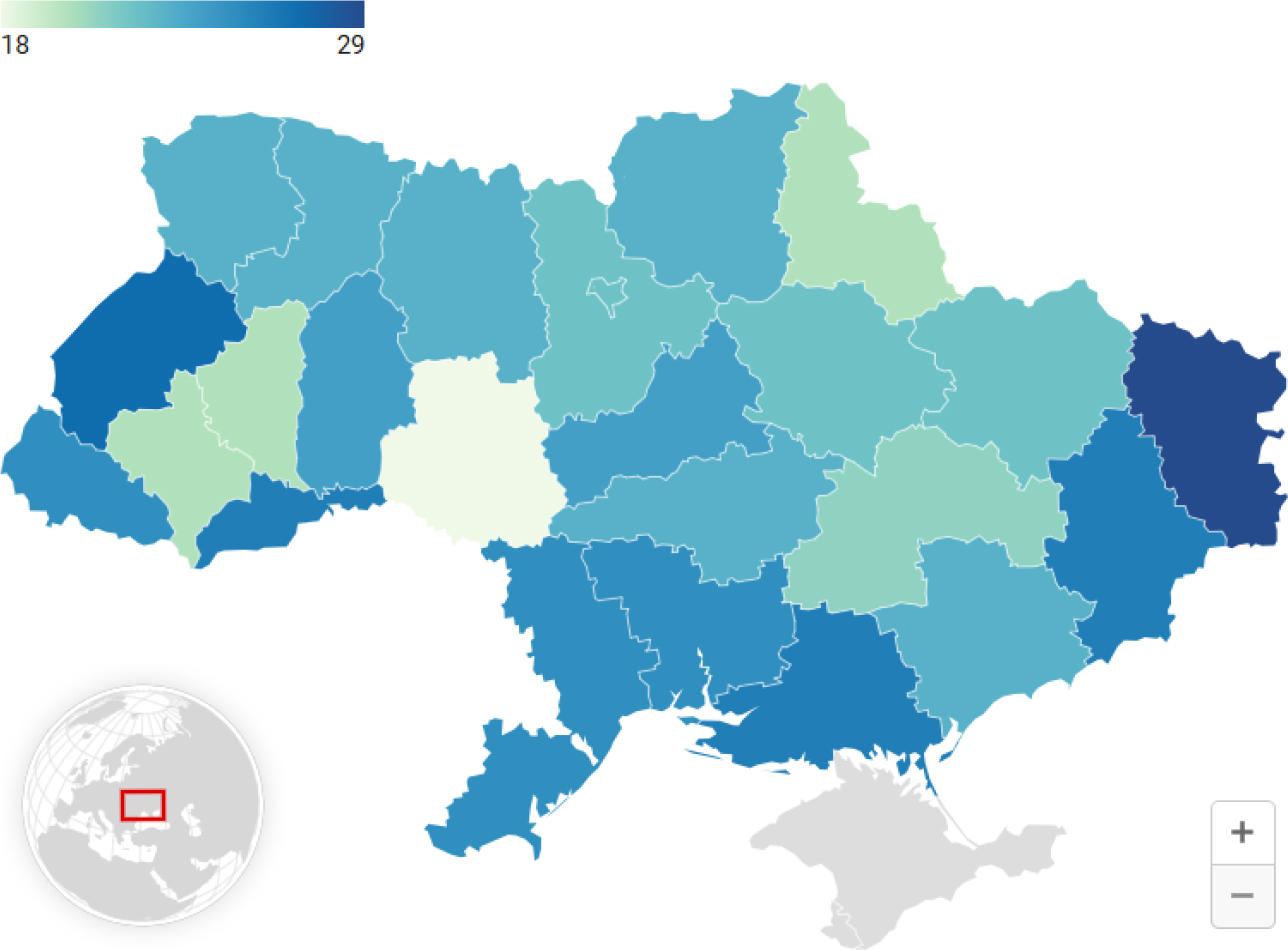
Fig. 1:
Spatial distribution of Ukraine’s regions by number of problematic economic security indicators (average values for the study period) using the resource https://app.datawrapper.de/
In summary, it can be stated that the most problematic areas are found in the southern, southwestern and eastern macro-regions of Ukraine, which have been hardest hit both by military aggression and by structural imbalances in the industrial base. At the same time, the central and northern regions, despite general instability, have greater potential for stabilisation and structural modernisation, which opens up scope for the formation of a regionally differentiated industrial policy in the context of post-war recovery.
The results obtained show (Tab. 2, Fig. 1) that most regions have two problematic indicators (out of the three analysed by region in Ukraine). The worst situation is in Volyn Oblast, where three problematic indicators have been recorded. The best situation is observed in seven regions, where only one problematic indicator was identified: Vinnytsia, Dnipropetrovsk, Ivano-Frankivsk, Odesa, Rivne and Sumy regions.
A detailed analysis of the spatial distribution of Ukraine’s regions by the number of problematic indicators of investment and innovation security (based on average values for 2019–2023) indicates a high level of structural imbalances and uneven development within this subsystem of economic security.
The most challenging situation has been recorded in a group of nine regions, where the number of problematic indicators reached 9 out of a possible 10. This group includes the Volyn, Dnipropetrovsk, Zhytomyr, Zakarpattia, Luhansk, Mykolaiv, Rivne, Kherson, Khmelnytskyi, Chernivtsi and Chernihiv regions. This level indicates the systemic vulnerability of these regions in the areas of investment, innovation, science and intellectual capital. Most of them exhibit critically low levels of intangible investment, weak attraction of foreign direct investment, a low proportion of innovative enterprises and innovative products sold, as well as insufficient scientific activity, manifested both in the number of people employed in the scientific and technical sector and in the share of R&D expenditure in GRP.
The second group, where 8 indicators proved problematic, comprises the Vinnytsia, Donetsk, Ivano-Frankivsk, Kyiv, Kirovohrad, Lviv, Sumy and Kharkiv regions. Some of these regions (in particular, Lviv and Kyiv) have strong scientific or educational centres; however, their exceeding of optimal values for certain indicators (for example, the size of the economy) is not always considered an advantage due to the disincentive effect. At the same time, other regions in this group (such as Sumy and Kirovohrad) demonstrate weaknesses across several fundamental parameters, requiring targeted intervention.
The third group, where seven problematic indicators have been recorded, comprises Zapor-izhzhia, Odesa, Poltava, Ternopil and Cherkasy regions. In these regions, despite some positive developments, such as in the area of investment attraction or in the structure of the economy, the overall situation remains unstable. Most frequently, chronically low levels of intangible investment and innovation activity are recorded, along with a limited presence of knowledge-intensive sectors.
Thus, the overall distribution indicates that no region in Ukraine has fewer than seven problematic indicators, which highlights the nationwide systemic vulnerability of investment and innovation security at the regional level. However, it is precisely the variability in the number of problematic indicators that allows for the identification of the most vulnerable territories, which should be prioritised for the implementation of targeted programmes to support the investment climate, scientific development, innovation infrastructure and the attraction of intangible capital. In this context, dynamic zoning of regions by level of criticality is necessary, with a focus on mobilising local potential and stimulating interregional cooperation to achieve balanced development.
The most unfavourable situation regarding innovation activity is observed in the western regions of Ukraine, specifically in Volyn, Zakarpattia, Rivne, Khmelnytskyi, Chernivtsi, and to some extent Ternopil and Zhytomyr, which have the highest concentration of problematic indicators. This indicates systemic weaknesses in the regional infrastructure for innovation, low investment inflows and limited digital or scientific activity.
The central and northern parts of Ukraine present a mixed picture: there are both regions with a high burden (for example, Chernihiv Oblast) and regions with a lower number of critical indicators (for example, Kyiv Oblast, which has some potential due to the capital’s influence but still remains in the problem zone).
The eastern and southern regions, including Dnipropetrovsk, Luhansk, Mykolaiv and Kherson, also show a significant concentration of problems, which is a consequence of both structural imbalances and the impact of the war.
Overall, the spatial profile of these challenges has a west-east bias, with western regions having accumulated the greatest number of structural barriers to an innovation breakthrough, whilst the east and south combine traditional investment weakness with the impact of war-related destruction.
The assessment of food security in this study is based primarily on the official methodology of the Ministry of Economy of Ukraine, which relies on ‘Consumption Balances’. Due to significant delays in reporting caused by the war, data from the official balances are currently only available up to 2021. To provide a relevant analysis for the period 2022–2023, we have carried out additional independent calculations of production sufficiency levels. This methodological adaptation, described in detail in the Appendix, ensures the synchronisation of food security indicators with other economic data (2019–2023), whilst maintaining the overall consistency and integrity of the study’s results
A total of 8 indicators were analysed. The ratio of production to consumption volumes for oil and sugar was not analysed separately by region, due to the high level of self-sufficiency across the country as a whole and the specific characteristics of these products, as described above in this section. Furthermore, due to the lack of up-to-date data on population size and the share of imported food products sold through retail chains, consumption balances were not calculated.
Overall, all regions can be divided into three groups. The most challenging situation (7 to 8 out of 8 possible indicators) was recorded in Luhansk Oblast, where 8 out of 8 possible indicators were critical, and in Donetsk Oblast, where 7 indicators were critical. This level indicates systemic vulnerability in these regions’ food security.
The second group, where between 4 and 6 indicators were problematic, comprises the Odesa, Lviv, Zaporizhzhia, Kharkiv, Dnipropetrovsk, Zakarpattia, Mykolaiv and Chernivtsi regions. Some of these regions (in particular, Odesa and Lviv) have distinct regional characteristics in terms of agricultural practices, which consequently affect food security.
The third group, where between 1 and 3 problematic indicators were recorded, comprises the Kirovohrad, Sumy, Volyn, Zhytomyr, Rivne, Khmelnytskyi, Poltava, Ternopil, Cherkasy, Ivano-Frankivsk, Kyiv, Chernihiv and Vinnytsia regions. In these regions, despite certain variations, the food security situation is the best due to the specific characteristics of agricultural practices.
Thus, the overall distribution indicates that no region of Ukraine is able to fully provide for all its own needs independently, which highlights the nationwide systemic vulnerability of food security at the regional level. However, it is precisely the variability in the number of problem areas that allows us to identify the most vulnerable territories, which should be prioritised for the implementation of targeted programmes aimed at building a robust food system characterised, above all, by autonomy and the capacity for self-sustainability.
Overall, the results of the environmental security assessment show that the most complex situation is observed in four regions – Sumy, Lviv, Poltava and Odesa regions – each of which has five problem indicators out of a possible five. This indicates systemic environmental vulnerability, encompassing simultaneously the water sector, waste management, the energy structure and a lack of investment in environmental protection measures. Accordingly, these regions should be prioritised for the implementation of cross-sectoral state support.
The second group comprises regions with four problematic indicators. This includes the majority of the country’s regions – 16 out of 24 – notably Mykolaiv, Luhansk, Kyiv, Kirovohrad, Rivne, Kherson, Cherkasy, Vinnytsia and others. This indicates the widespread prevalence of environmental imbalances, which vary in nature and require differentiated approaches – for example, some regions are characterised by high discharges of polluted water, whilst others by a critically low rate of waste recycling or the absence of organic farming.
The third group comprises Dnipropetrovsk, Donetsk, Zakarpattia and Kharkiv regions, each of which has three problematic indicators. Despite a somewhat better position compared to the other regions, these regions also require a comprehensive environmental response, particularly regarding water resources and the promotion of environmental investments.
At the same time, no region was found to be free of environmentally hazardous parameters, which once again confirms the nationwide nature of environmental challenges. Such a classification is useful for planning the territorial prioritisation of state support, developing regional programmes, concentrating donor aid resources and monitoring the effectiveness of measures already implemented.
This approach also allows a shift from the analysis of individual indicators to a spatial assessment of environmental safety, which is a necessary prerequisite for modern environmental policy in the context of limited budgetary and administrative resources.
The spatial distribution of problematic environmental indicators, shown on the map (Fig. 2), reveals significant regional disparities, which have both natural-geographical and administrative causes.
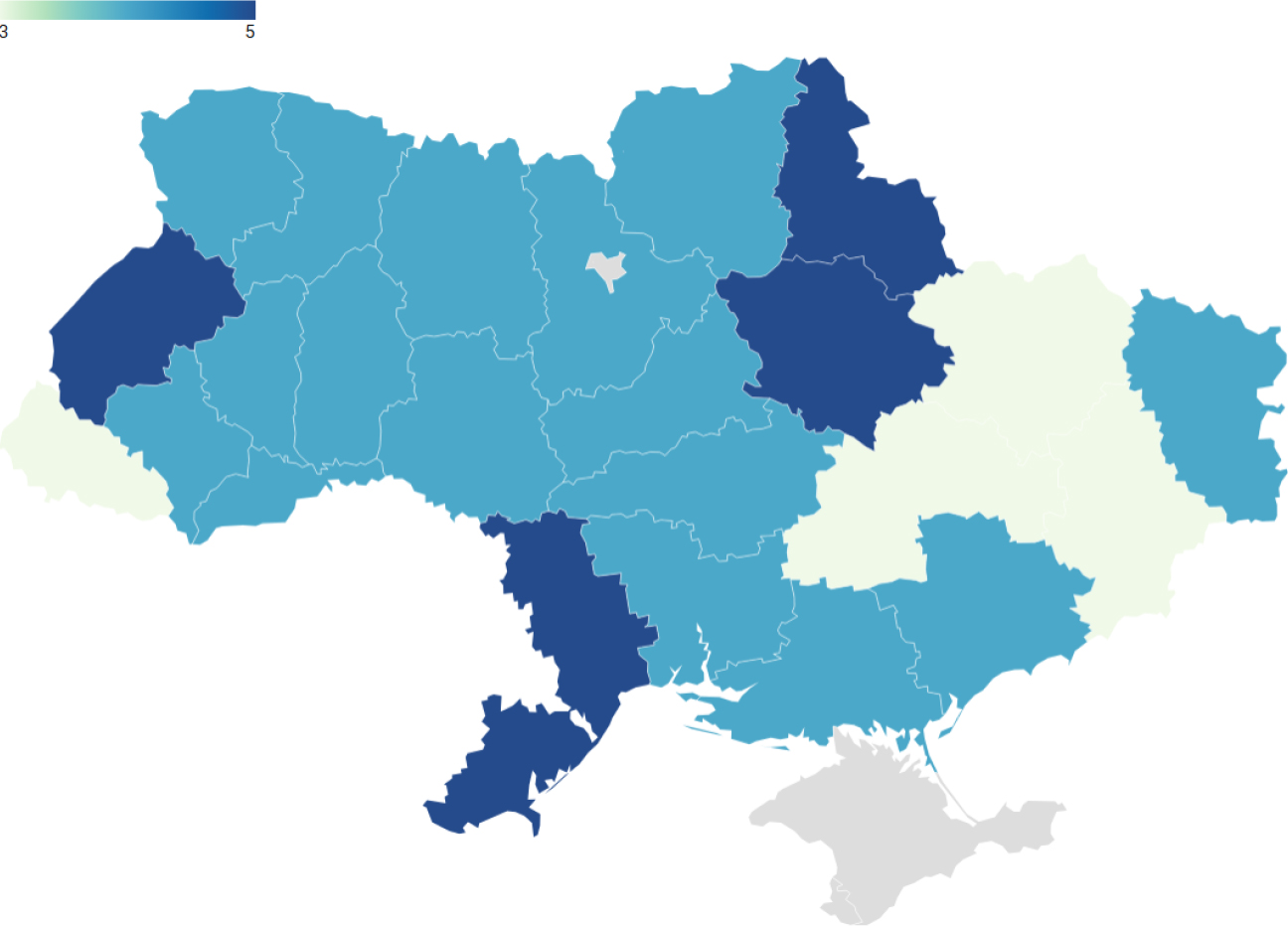
Fig. 2:
Spatial distribution of regions of Ukraine by number of problematic environmental indicators (average values for the study period 2019–2024) using the resource https://app.datawrapper.de/
First and foremost, the regions with the highest concentration of environmental stress zones– those with five problematic indicators–are located in the central-eastern (Poltava, Sumy) and southern parts of the country (Odesa), as well as in the western border region (Lviv Oblast). This indicates that environmental threats do not have a clearly defined territorial location, but are shaped by a complex of factors – the level of industrial concentration, agricultural pressure, the degree of infrastructure deterioration and the weakness of environmental protection policy.
Particular attention is required for the Southern and Ukrainian Black Sea regions, where critical values are accompanied by high pressures on water resources, acute waste management problems, low investment in environmental protection measures, and insufficient uptake of organic farming.
The uniformly blue (4 indicators) regions form a broad band stretching from the north-west to the east and south, covering most of the country’s regions. This indicates the prevalence of chronic environmental imbalances that remain unchanged over time, despite general efforts by the state or international partners.
At the same time, the absence of regions with fewer than three problematic indicators points to systemic inconsistencies in environmental policy at the regional level. This picture confirms the importance of transitioning to an indicator-driven regional environmental policy based on clearly verified data rather than declarative assessments.
Overall, the map demonstrates that environmental vulnerability is not exclusively a problem of industrial centres or agricultural areas, but is of an inter-regional nature. This requires both a more flexible set of state support instruments and the strengthening of the capacity of local self-government bodies to formulate local sustainable development programmes.
In total, 36 indicators were analysed across five key security sectors. It was found that during the war, systemic structural changes and a deterioration in the security situation occurred both across the country as a whole and at the regional level. Having calculated the proportion of problematic indicators (to provide a comprehensive picture of the security dimension) in the economic and environmental sphere, the following negative trends were identified (Tab. 3). Across the country as a whole, between 41.67% and 80.5% of the calculated indicators fall within the ‘unsatisfactory’, ‘dangerous’ or ‘critical’ categories.
Tab. 3:
Share of problematic indicators (by type of security and overall) by region of Ukraine (based on average values for the period 2019–2024)
| Region | Production | Foreign economic | Investment and innovation | Food | Environmental | Total |
|---|---|---|---|---|---|---|
| Luhansk | 75 | 50 | 90 | 100 | 66.67 | 80.56 |
| Lviv | 8 | 5 | 80 | 62 | 83.33 | 75 |
| Donetsk | 75 | 50 | 80 | 87.5 | 50 | 72.22 |
| Chernivtsi | 87.5 | 50 | 90 | 50 | 66.67 | 72.22 |
| Kherson | 87 | 50 | 90 | 50 | 66.67 | 72.22 |
| Mykolaiv | 75 | 50 | 90 | 50 | 66.67 | 69.44 |
| Odessa | 75 | 25 | 70 | 75 | 83.33 | 69.44 |
| Transcarpathian | 87 | 50 | 90 | 50 | 50 | 69.44 |
| Khmelnytsky | 75 | 50 | 90 | 37.5 | 66.67 | 66.67 |
| Cherkasy | 100 | 75 | 70 | 25 | 66.67 | 66 |
| Volyn | 5 | 75 | 90 | 37 | 66.67 | 63.89 |
| Zhytomyr | 62 | 50 | 90 | 37.5 | 66.67 | 63.89 |
| Zaporizhzhia | 75 | 50 | 70 | 50 | 66.67 | 63.89 |
| Kirovograd | 75 | 50 | 80 | 37.5 | 66.67 | 63.89 |
| Rivne | 75 | 25 | 90 | 37.5 | 66.67 | 63.89 |
| Chernihiv | 75 | 50 | 90 | 25 | 66.67 | 63.89 |
| Kharkiv | 62 | 50 | 80 | 50 | 50 | 61.11 |
| Kyiv region and Kyiv city | 75 | 50 | 80 | 25 | 66.67 | 61.11 |
| Poltava | 75 | 50 | 70 | 25 | 83.33 | 61.11 |
| Dnipropetrovsk | 50 | 25 | 90 | 50 | 50 | 58.33 |
| Sumy | 37 | 25 | 80 | 37.5 | 83.33 | 55.56 |
| Ivano-Frankivsk | 62 | 25 | 80 | 25 | 66.67 | 55.56 |
| Ternopil | 62 | 50 | 70 | 25 | 66.67 | 55.56 |
| Vinnytsia | 50 | 25 | 80 | 12.5 | 66.67 | 50 |
| Average value for Ukraine | 71.354 | 45.833 | 82 | 44.270 | 66.668 | 64.815 |
The calculated average values for the components of economic security (bottom row of Tab. 3) enable a clear identification of the most vulnerable components of economic security. In particular, according to the calculations, a critical strain is observed in the investment-innovation and production components, where the average proportion of problem areas exceeds 65–80%.
Investment and innovation, environmental and production security proved to be the most problematic and unstable during the war. As for food security, clear regional disparities can be observed, which are explained by the agricultural specialisation of individual regions and the interdependence of regions in terms of food supply. Military operations and the resulting destruction have disrupted food logistics both within the country and beyond its borders. This has consequently had a negative impact on the country’s export potential.
To identify the impact of the war on meso-level systems in greater depth, it is advisable to analyse the dynamics of indicators for the regions of the Ukrainian Black Sea coast, given their strategic importance for the country’s logistics system. A comparative analysis of the average values of key indicators in the regions of the Ukrainian Black Sea coast prior to the start of the full-scale Russian invasion in 2019–2021 and following the invasion during the period 2022–2023 (Tab. 4) demonstrates a general deterioration in security across all three regions of the Ukrainian Black Sea coast.
Tab. 4:
Comparison of average security levels in the Ukrainian Black Sea region before and after the full-scale aggression
| Indicator | Odesa region | Mykolaiv region | Kherson region |
|---|---|---|---|
| Industrial safety in the regions | |||
| Share of high-tech products in the total volume of industrial output, per cent | 1.40/2.21 ↑ | 0.24/0.38 ↑ | 0.24/0.00 ↓ |
| Share of value added at production cost of enterprises belonging to the high-tech sector of the manufacturing industry in total value added at production cost, per cent | 0.45/0.45 ≈ | 0.08/0.15 ↑ | 0.11/0.00 ↓ |
| Share of value added based on production costs of enterprises belonging to the medium-high-tech sector of the manufacturing industry in total value added based on production costs, per cent | 1.94/1.10 ↓ | 6.08/1.85 ↓ | 1.79/0.73 ↓ |
| Proportion of employees working in enterprises belonging to the high- and medium-high-tech sectors of the manufacturing industry as a percentage of the total number of employees in industry | 16.57/13.70 ↓ | 27.68/9.16 ↓ | 10.01/3.37 ↓ |
| Labour intensity of industrial production, per cent | 9.88/8.96 ↓ | 13.10/15.22 ↑ | 11.29/12.61 ↑ |
| Operating profit margin of industrial enterprises, per cent | 4.6/3.5 ↓ | 5.8/–4.7 ↓ | 9.0/–30.5 ↓ |
| Operating profit margin of construction companies, per cent | 2.0/0.8 ↓ | 4.0/3.0 ↓ | 4.6/–8.0 ↓ |
| Operating profit margin of transport, warehousing, postal and courier services, in per cent | 13.0/9.8 ↓ | 12.8/6.4 ↓ | –1.6/–8.7 ↓ |
| External economic security of regions | |||
| Economic openness, per cent | 56.5/54.9 ↑ | 104.2/46.5 ↑ | 26.8/2.4 ↓ |
| Export-to-import coverage ratio, times | 0.95/0.87 ↓ | 3.03/1.99 ↓ | 1.04/0.97 ↓ |
| Share of the leading partner country in total exports of goods, per cent | 8.9/14.2 ↑ | 21.7/19.6 ↓ | 16.0/21.4 ↑ |
| Share of the leading partner country in total volume of goods imports, per cent | 25.9/26.4 ↑ | 18.8/19.5 ↓ | 22.1/23.6 ↑ |
| Share of the leading product (product group) in total exports of goods, per cent | 34.0/36.0 ↑ | 49.9/53.0 ↑ | 19.5/24.0 ↑ |
| Share of the leading product (product group), excluding energy imports, in total imports of goods, per cent | 8.7/9.7 ↑ | 16.8/16.3 ≈ | 38.2/23.7 ↓ |
| Share of raw material and low-value-added industrial exports in total goods exports, per cent | 84.3/94.9 ↑ | 74.8/92.4 ↑ | 86.0/91.0 ↑ |
| Share of imports in domestic consumption, per cent | 13.3/n.a. | 9.7/n.a. | 6.6/n.a. |
| Investment and innovation security of regions | |||
| Ratio of net increase in foreign direct investment to GRP, per cent | 1.27/1.08 ↓ | 5.56/–0.43 ↓ | — |
| Ratio of loans granted to non-financial corporations and households for the purchase, construction and renovation of real estate (cumulative, adjusted for exchange rate differences) to GVA | 1.7/0.9 ↓ | 0.8/0.5 ↓ | 1.2/0.4 ↓ |
| Size of the region’s economy (GRP), as a percentage of Ukraine’s GDP | 5.05/4.98 ↓ | 2.30/2.28 ↓ | 1.60/1.62 ↑ |
| Share of scientific and scientific-technical work in GDP, per cent | 0.15/0.11 ↓ | 0.31/0.10 ↓ | 0.10/0.01 ↓ |
| Ratio of expenditure on scientific and scientific-technical work funded from the state budget, as a percentage of GDP | 0.07/0.05 ↓ | 0.04/0.03 ↓ | — |
| Number of specialists engaged in scientific and technical work as a proportion of the employed population (per 1,000 people) | 1.65/1.23 ↓ | 1.84/1.22 ↓ | 0.87/0.04 ↓ |
| Share of intangible investment in GRP, per cent | 0.34/0.13 ↓ | 0.07/0.09 ↑ | 0.11/0.00 ↓ |
| Food security in the regions (based on the level of self-sufficiency in domestic production) | |||
| Level of self-sufficiency in meat and meat products, per cent | 30.01/29.2 ↓ | 50.69/63.29 ↑ | 72.43/14.12 ↓ |
| Self-sufficiency rate for milk and dairy products, per cent | 85.41/83.27 ↓ | 163.39/143.31m ↓ | 169.62/51.93 ↓ |
| Egg production self-sufficiency rate, per cent | 31.45/22.33 ↓ | 81.98/66.06 ↓ | 329.38/47.68 ↓ |
| Potato production sufficiency rate, per cent | 154.48/149.64 ↓ | 212.91/188.22 ↓ | 322.33/0 ↓ |
| Self-sufficiency rate for vegetable and edible melon production, per cent | 139.59/136.19 ↓ | 499.85/329.47 ↓ | 1356.22/— ↓ |
| Grain production per capita per year, tonnes | 1.52/1.8 ↑ | 2.81/2.46 ↓ | 2.92/0.12 ↓ |
| Environmental safety of regions | |||
| Proportion of discharges of polluted (untreated or inadequately treated) wastewater into water bodies, per cent | 20.70/9.26 ↑ | 28.29/28.85 ↑ | 7.81/0.00 ↑ |
| Recycling rate for household and similar waste, per cent | 0.00/0.00 ≈ | 1.47/1.07 ↓ | 0.00/0.00 ≈ |
| Area of organic land as a percentage of total agricultural land | 4.47/5.27 ↓ | 0.18/0.13 ↓ | 4.28/1.99 ↓ |
| Current expenditure on environmental protection, as a percentage of GRP | 0.26/0.21 ↓ | 0.76/0.43 ↓ | 0.23/0.11 ↓ |
| Share of capital investment in environmental protection as a percentage of total capital investment | 0.43/0.31 ↓ | 2.76/1.53 ↓ | 0.53/2.70 ↑ |
A comparative analysis of the average values of key production indicators in the regions of the Ukrainian Black Sea coast prior to the start of the full-scale Russian invasion (2019–2021) and during the perio d 2022–2023 revealed a predominantly negative trend in the capacity, efficiency and structural modernisation of the industrial complex.
With regard to foreign economic security, the most pronounced decline in performance is evident in the indicators of economic openness and the import-to-export coverage ratio – in each of the regions, these values have decreased, indicating a reduction in foreign trade activity and a decline in the ability of exports to offset import needs.
The analysis revealed a decline in the share of value added in high-tech sectors and an outflow of skilled scientific and technical personnel, indicating a shift in the priorities of regional economic systems: from strategies of innovative development to models of short-term survival in conditions of high security
An assessment of changes in food security indicators revealed the most striking spatial disparities. In particular, in the de-occupied and frontline areas, the level of self-sufficiency in the production of critically important foodstuffs (eggs, vegetables, melons and gourds) fell to almost zero, which had a negative impact on food security levels. However, the environmental segment of security is characterised by a disregard for long-term environmental goals: a reduction in capital investment in the environment indicates cutbacks in environmental expenditure, which in the long term creates cumulative threats to the sustainable development of the territories.
Based on the analysis conducted, a set of strategic measures aimed at bridging the identified indicator gaps was formulated. These proposals are organised by type of safety.
In the context of this work, the proposed measures to improve specific production indicators should be viewed not as a universal template, but as a guiding analytical framework. Its use should allow for further adaptation to the specific conditions and challenges faced by each individual region. The development of effective strategies to enhance production resilience and investment and innovation security requires consideration of local constraints and opportunities arising from the structure of employment, industrial heritage, access to human capital, and the institutional quality of local governance.
Tab. 5:
Generalised proposals for improving Ukraine’s production indicators
| No | Indicators | Key problem | Proposals |
|---|---|---|---|
| 1 | Share of high-tech products in the volume of industrial products sold, % | Very low values in most regions, lack of effective incentive programmes | Formulation of targeted programmes for the development of high-tech production at the level of regional state administrations; tax incentives for such enterprises |
| 2 | Share of added value of enterprises in the high-tech manufacturing sector, % | Very low values in most regions, lack of effective incentive programmes | Conducting cluster analysis of successful regions and scaling up practices through public-private technical modernisation projects |
| 3 | Share of added value of enterprises in the medium-high-tech sector, % | Sharp regional disparities: growth only in some regions, stagnation or decline in others | Conducting cluster analysis of successful regions and scaling up practices through public-private technical modernisation projects |
| 4 | Share of employees in high-and medium-high-tech sectors, % | Systemic degradation of the workforce in manufacturing in most regions | Regional programmes for professional retraining of personnel with a focus on STEM and engineering professions; support for dual education |
| 5 | Labour intensity of industrial production, % | High labour intensity in a number of regions, indicating a low level of automation | Launch of a national programme to support the technological modernisation of industrial enterprises with the involvement of preferential financing |
| 6 | Profitability of industrial enterprises’ operating activities, % | Fluctuations in profitability between regions; significant decline after 2022 | Introduction of mechanisms to stabilise access to energy resources and logistics for industrial enterprises, especially in de-occupied territories |
| 7 | Profitability of operating activities in construction, % | Fluctuations in profitability between regions; significant decline after 2022 | Long-term construction planning with state support; state reconstruction strategies |
| 8 | Profitability of operating activities in transport, warehousing, postal and courier services, % | Fluctuations in profitability between regions; significant decline after 2022 | Global logistics projects, compensation for logistics losses |
Based on a comprehensive analysis of regional indicators that characterise the investment and innovation component of economic security, the following proposals have been formulated (Tab. 6). Since a number of investment and innovation threats are persistent and chronic in nature, and their impact is exacerbated in the context of post-war recovery, the priority of measures requires not only a generalised but also a targeted response.
Tab. 6:
Generalised proposals for improving the state of investment and innovation indicators in Ukraine
| No | Indicators | Key problem | Proposals |
|---|---|---|---|
| 1 | Ratio of net foreign direct investment inflows to GRP, % | High regional imbalance in FDI inflows | Creation of regional investment portals and project banks focused on environmental and innovative areas |
| 2 | Ratio of real estate loans to GRP, % | Insufficient volume of available lending outside the capital regions | Creation of regional programmes to guarantee loans for housing and production modernisation |
| 3 | Size of the region’s economy, % of Ukraine’s GDP | Excessive concentration of the economy in certain regions | Support for interregional infrastructure clusters in weaker regions |
| 4 | Share of R&D in GRP, % | Chronic underfunding of science in most regions | Introduction of regional grant competitions with a mandatory commercialisation component |
| 5 | Expenditure on R&D from the state budget in GRP, % | Lack of sustainable programmes to support applied science in the regions | Delegation of part of state funding for R&D to the regional level through targeted funds |
| 6 | Number of researchers per employed population (per 1,000 people) | Brain drain and lack of incentives for young professionals | Regional co-financing programmes for doctoral studies, youth science, mobility |
| 7 | Percentage of enterprises implementing innovations, % | Prevalence of an extensive industrial model, weak R&D | Industrial accelerators, incentives for innovation costs in regional development programmes |
| 8 | Share of innovative products in industry, % | Predominant focus on low-tech products | Target orders for innovative products in regional procurement, partnerships with universities |
| 9 | Share of people using the Internet, % | Territorial gaps in digital inclusion | Co-financing the development of digital infrastructure in rural communities |
| 10 | Share of intangible investments in GDP, % | Insufficient attention to intellectual property and creative sectors | Regional programmes to stimulate IT, design, start-ups with IP component support |
At the same time, it should be emphasised that the list of proposals presented is of a general nature and reflects typical problems characteristic of a significant part of Ukraine’s regions. More specific solutions are only possible on the basis of an in-depth analysis of the situation at the level of local communities, the sectoral structure of the region’s economy, available educational, scientific and financial resources, as well as local institutional capacity. Thus, the initiatives presented should be considered as guidelines for the formation of individualised strategies to strengthen investment and innovation security, taking into account regional specifics.
Based on a comprehensive analysis of regional indicators characterising the food component of economic security, the following proposals have been formulated (Tab. 7). It summarises the main problematic aspects identified at the regional level and proposes systematic approaches to overcoming them, with a focus on regional policy makers.
Tab. 7:
Generalised proposals for improving Ukraine’s food security indicators
| No | Indicators | Key issue | Proposals |
|---|---|---|---|
| 1 | Daily calorie intake per person, thousand kcal, % | Regional imbalance in dietary calorie intake, particularly in areas of active hostilities. | Review of the list of food products |
| 2 | Affordability of food | A high proportion of household expenditure is accounted for by food and non-alcoholic beverages – the average for Ukraine is 47.24% | comprising the consumer basket and, consequently, the minimum subsistence level |
| 3 | Ratio of production and consumption volumes of meat and meat products per capita, % Self-sufficiency rate for meat and meat products, % | Insufficient meat production by region. | Establishment of regional investment programmes/projects and grant schemes for livestock development to supply educational and healthcare institutions, the Armed Forces of Ukraine, and socially vulnerable groups |
| 4 | Ratio of production and consumption of milk and dairy products per capita, % Level of self-sufficiency in milk and dairy product production, % | Insufficient meat production across individual regions. Imbalances in production. | |
| 5 | Ratio of production and consumption of eggs per capita, Level of self-sufficiency in egg production, % | Insufficient egg production by region. Imbalances in production. | Creation of regional investment programmes/projects and grant schemes for poultry farming development at the local level to supply educational and healthcare institutions, as well as the Armed Forces of Ukraine |
| 6 | Ratio of potato production to consumption per capita, % Level of self-sufficiency in potato production, % | Excess production | Development of regional programmes for potato processing and the enhancement of export potential to facilitate the export of high value-added processed products |
| 7 | Ratio of production to consumption of vegetables and edible melons per capita, % Self-sufficiency level of vegetable and edible melon production, % | Excess production | Development of regional programmes for the deep processing of vegetables and melons to meet domestic demand and increase export potential |
| 8 | Annual grain production per capita, tonnes, Self-sufficiency level of bread products (bread, pasta products converted to flour, cereals, pulses), per cent | Existence of regional disparities | Increasing the degree of processing of cereals and pulses to boost exports of high value-added products |
More substantive decisions are only possible on the basis of an in-depth analysis of the situation at the level of local communities, the sectoral structure of the region’s economy, the available resource capabilities of a particular territorial unit, and an assessment of the degree of infrastructure development. Thus, the initiatives listed above should be considered as guidelines for the formation of individualised strategies to strengthen food security, taking into account regional specifics.
Tab. 8 lists the most critical problems identified for each environmental indicator and specific ways to address them, indicating the entities responsible for implementation. The material is structured in such a way as to ensure the practical application of its content: the issues addressed by each indicator are logically linked to realistic management decisions that can be incorporated into regional strategies, environmental programmes or changes to the regulatory framework.
Tab. 8:
Generalised proposals for improving the state of environmental indicators in Ukraine
| No | Indicators | Key problem | Proposals |
|---|---|---|---|
| 1 | Share of renewable energy in final energy consumption in the transport sector/Share of renewable sources in total primary energy supply | Lack of a comprehensive energy balance for regions, which makes it impossible to analyse energy security | Development of a methodology for assessing the energy balances of Ukraine’s regions based on international standards + creation of regional RES development plans based on needs/threats |
| 2 | Percentage of polluted (untreated or insufficiently treated) wastewater discharged into water bodies | Critical situation with discharges in 5+ regions | Regional Zero Polluted Discharge programmes with modernisation of treatment systems, local projects in communities |
| 3 | Percentage of household and similar waste recycled | Extremely low recycling rates in most regions | Introduce annual recycling growth quotas; support projects for sorting, recycling organic waste and solid waste |
| 4 | Area of organic land as a percentage of total agricultural land | No official statistics, accounting through unofficial sources | Inclusion of organic matter in statistics (through the state observation plan) + formation of regional programmes to support organic farming |
| 5 | Current expenditure on environmental protection, per cent of GRP | Share of expenditure < 1% of GRP in most regions | Recommended minimum expenditure on environmental protection in local budgets |
| 6 | Share of capital investments in environmental protection in total capital investments, per cent | Low interest among businesses in investing in environmental protection | Tax incentives: VAT/tax credit for eco-investments in purification technologies, renewable energy sources, waste disposal |
Of course, more detailed and practical recommendations are only possible based on a local study of the situation in specific communities or districts. At the same time, the analysis allows us to identify key systemic areas that require priority attention at both the regional and national levels. This creates a basis for targeted management of economic and environmental risks, concentration of resources, and implementation of effective cross-sectoral policies.
5. CONCLUSIONS AND PROSPECTS FOR FURTHER RESEARCH
The scientific and theoretical significance of this study lies in the development of an adaptive toolkit for assessing economic and environmental security in the context of challenges and threats caused by war. The application of the author’s approach to assessment via the ‘share of problematic indicators’ made it possible to neutralise the statistical heterogeneity of 36 cross-cutting indicators across the five core components of economic security. A comprehensive diagnosis of the industrial, food, environmental, foreign economic, and investment-innovation elements of economic security has made it possible to identify specific destructive trends: from critically negative values of operating profitability to chronic underfunding of environmental protection.
A comparative assessment of the state of these elements during the pre-war period (from 2019) and following the onset of full-scale aggression revealed that the trends in the indicators were negative in most cases, but showed no signs of a catastrophic collapse. The moderate fluctuations in indicators observed during the period under review made it possible to calculate average values, confirming the high adaptability of certain sectors of the regional economy. Calculations revealed only relatively minor fluctuations over the period, allowing average values to be derived and presented graphically. This indicates the inherent resilience of certain sectors of the economy. At the same time, methodological difficulties arose during the calculations due to the lack of reliable statistics during the war period, confirming the need to improve the state monitoring system by introducing Big Data tools and rapid environmental audits of war damage.
A key outcome of the study is the development of generalised recommendations aimed at shaping an effective economic security policy for the regions and the country as a whole, capable of ensuring not only adaptation to wartime conditions but also laying the foundations for recovery and sustainable development in the post-war period. Unlike universal approaches, the proposed measures are based on taking into account the specific nature of the Ukrainian Black Sea region as a strategic hub requiring special models of logistical diversification and import substitution. Such an approach creates a basis not only for current adaptation, but also for laying the foundations for post-war sustainable development based on ‘green’ recovery.
Future research should focus on developing predictive scenarios for the economic and environmental sustainability of regions, taking into account the cumulative effects of military pollution and the dynamics of business relocation potential.
Acknowledgements
The publication was prepared within the framework of the research project “Elaboration of program measures to support the economic security of the Ukrainian Black Sea region in the context of recovery in the war and post-war periods” (No. 0125U001382), funded by the budget program “Support for the Development of Priority Areas of Scientific Research” (KΠKBK 6541230).
Notes
[3] Financial disclosure Disclosure statement:
No potential conflict of interest was reported by the author.
Appendices
7
ANNEX
Tab. 9:
Characteristic values of indicators for external economic security as a component of economic security
| No. | Indicator name, unit of measurement | XL critical | XL non-critical | XL non-dual | XL double | XL opt | XR wholesale | XR pair | XR single | XR nonseparable | XR critical |
|---|---|---|---|---|---|---|---|---|---|---|---|
| 1 | Economic openness, per cent | 75 | 85 | 90 | 95 | 100 | |||||
| 2 | Export-to-import coverage ratio, times | 0.85 | 0.9 | 0.95 | 0.975 | 1 | 1.2 | 1.25 | 1.3 | 1.5 | 1.7 |
| 3 | Share of raw material and low-value-added industrial exports in total goods exports, per cent | 0.1 | 3 | 5 | 8 | 15 | 20 | 30 | 40 | 50 | 60 |
| 4 | Share of imports in the country’s domestic consumption, per cent | 5 | 7 | 10 | 12.5 | 15 | 17 | 19 | 22 | 25 | 30 |
Tab. 10:
Characteristic values of indicators for industrial safety as a component of economic security for regions
| No. | Indicator name, unit of measurement | XL critical | XL non-critical | XL non-dual | XL double | XL opt | XR whole-sale | XR pair | XR single | XR non-separable | XR critical |
|---|---|---|---|---|---|---|---|---|---|---|---|
| 1 | Share of high-tech products in the total volume of industrial output, per cent | 1 | 2 | 3 | 5 | 7 | 12 | 30 | 45 | 60 | 75 |
| 2 | Share of value added at production cost of enterprises belonging to the high-tech sector of the manufacturing industry in total value added at production cost, per cent | 2 | 3.25 | 4.5 | 5.75 | 7 | |||||
| 3 | Share of value added by production costs of enterprises belonging to the medium-high-tech sector of the manufacturing industry in total value added by production costs, per cent | 4 | 5.4 | 6.8 | 8.2 | 9.6 | |||||
| 4 | Proportion of employees working in enterprises belonging to the high- and medium-high-tech sectors of the manufacturing industry as a percentage of the total number of employees in industry | 18 | 20.5 | 23 | 25.5 | 28 | |||||
| 5 | Labour intensity of industrial production, per cent | 4 | 8 | 10 | 15 | 20 | 25 | 30 | 40 | 45 | 50 |
| 6 | Operating profit margin of industrial enterprises, per cent | 1 | 3 | 4 | 5 | 6 | 10 | 20 | 30 | 40 | 60 |
| 7 | Operating profit margin of construction companies, per cent | –1 | 3 | 4 | 5 | 6 | 10 | 20 | 30 | 40 | 60 |
| 8 | Operating profitability of transport, warehousing, postal and courier services, per cent | –5 | 0 | 1 | 3 | 5 | 8 | 10 | 12 | 13 | 15 |
Tab. 11:
Characteristic values of indicators for investment and innovation security as a component of economic security for regions
| No. | Indicator name, unit of measurement | XL critical | XL non-critical | XL nondual | XL pair | XL opt | XR whole-sale | XR pair | XR single | XR non-separable | XR critical |
|---|---|---|---|---|---|---|---|---|---|---|---|
| 1 | Ratio of the region’s net increase in foreign direct investment to GRP, per cent | 4 | 4.5 | 5 | 6 | 7 | |||||
| 2 | Ratio of loans granted to non-financial corporations and households for the purchase, construction and renovation of real estate in the region, as a percentage of GRP | 10 | 13 | 15 | 20 | 25 | 30 | 50 | 60 | 70 | 80 |
| 3 | Size of the region’s economy (GRP), as a percentage of Ukraine’s GDP | 0.8 | 1.6 | 2.4 | 3.2 | 4 | 4 | 4.8 | 5.6 | 6.4 | 7.2 |
| 4 | Share of the volume of scientific and scientific-technical work performed in GRP, per cent | 0.5 | 1 | 1.5 | 2 | 3 | |||||
| 5 | Ratio of expenditure on scientific and scientific-technical work funded from the regional state budget to GRP | 0.2 | 0.3 | 0.5 | 0.75 | 1 | |||||
| 6 | Number of specialists engaged in scientific and technical work as a percentage of the employed population (per 1,000 persons) | 5 | 10 | 13 | 17 | 22 | |||||
| 7 | Proportion of enterprises that introduced innovations in the total number of industrial enterprises, per cent | 5 | 10 | 15 | 25 | 35 | |||||
| 8 | Proportion of innovative products sold in total industrial output, per cent | 3 | 7 | 15 | 20 | 25 | |||||
| 9 | Proportion of people who reported having used the Internet in the last 12 months (household survey), per cent | 20 | 30 | 45 | 60 | 80 | |||||
| 10 | Share of the region’s intangible investments in GRP, per cent | 2.8 | 5.6 | 8.4 | 11.2 | 14 |
Tab. 12:
List of indicators and definition of the scale for assessing their values to evaluate the level of self-sufficiency in the production of staple foods (conventionally rational consumption standard)
| No. | Indicator name, unit of measurement | Method of calculating the indicator | Standards recommended by theUkrainian Research Institute of Nutrition and Hygiene of the Ministry of Health | Food product sets, Resolution of the Cabinet of Ministers of Ukraine No. 780 of 11 October 2016 | |||
|---|---|---|---|---|---|---|---|
| Children under 6 years | Children aged 6 to 18 | Working-age population | Non-working population | ||||
| 1 | Self-sufficiency rate for meat and meat products, per cent | Volume of meat and meat product production, thousand tonnes / (current population, million people × consumption standard of the Institute of Nutrition and Hygiene of the Ministry of Health, kg) Volume of meat and meat product production, thousand tonnes / (number of children under 6 years old × standard + number of children aged 6–18 years × standard + number of working-age population × standard + number of non-working-age population × standard) | 83 | 40 | 62.4 | 53 | 38 |
| 2 | Self-sufficiency rate for milk and dairy products, per cent | Volume of milk and dairy product production, thousand tonnes / (total population, million people × consumption standard of the Institute of Nutrition and Hygiene of the Ministry of Health, kg) Volume of milk and dairy product production, thousand tonnes / (number of children under 6 years of age × standard rate + number of children aged 6–18 years × standard rate + number of working-age population × standard rate + number of non-working-age population × standard rate) | 380 | 213.05 | 209.3 | 143.5 | 122.3 |
| 3 | Self-sufficiency level of egg production, per cent | Egg production volume, thousand units / (current population, million people × consumption standard of the Institute of Nutrition and Hygiene of the Ministry of Health, units) Egg production volume, thousand tonnes / total population, million people / (number of children under 6 years old × standard + number of children aged 6–18 years × standard + working-age population × standard + non-working-age population × standard) | 290 | 182.5 | 365 | 220 | 187.5 |
| 4 | Self-sufficiency level of potato production, per cent | Potato production volume, thousand tonnes / (current population, million people × consumption rate set by the Institute of Nutrition and Hygiene of the Ministry of Health, kg) Potato production volume, thousand tonnes / (number of children under 6 years old × standard + number of children aged 6–18 years × standard + number of working-age population × standard + number of non-working-age population × standard) | 124 | 73 | 93.7 | 95 | 108 |
| 5 | Self-sufficiency level of vegetable and edible melon production, per cent | Volume of vegetable and edible melon production, thousand tonnes / (current population, million people × consumption standard of the Institute of Nutrition and Hygiene of the Ministry of Health, kg) Volume of vegetable and edible melon production, thousand tonnes / (number of children under 6 years of age × standard rate + number of children aged 6–18 years × standard rate + number of working-age population × standard rate + number of non-working-age population × standard rate) | 161 | 82.1 | 109.3 | 110 | 98 |
| 6 | Self-sufficiency level of cereal product production (bread, pasta products converted to flour, cereals, pulses), per cent | Volume of cereal and legume production, thousand tonnes / (current population, million people × consumption standard of the National Institute of Nutrition and Food Hygiene of the Ministry of Health, kg) Volume of cereal and legume production, thousand tonnes / (number of children under 6 years old × standard + number of children aged 6–18 years × standard + number of working-age population × standard + number of non-working-age population × standard) | 101 | 63 | 107.7 | 123.4 | 122.9 |
Tab. 13:
Characteristic values of indicators for food security as a component of economic security
| No. | Indicator name, unit of measurement | XL critical | XL non-critical | XL non-dual | XL double | XL opt | XR whole-sale | XR pair | XR single | XR non-separable | XR critical |
|---|---|---|---|---|---|---|---|---|---|---|---|
| 1 | Daily calorie intake, kcal | 2250 | 2500 | 2700 | 2900 | 3100 | |||||
| 2 | Ratio of production and consumption of meat and meat products per capita, per cent | 80 | 85 | 90 | 95 | 105 | |||||
| 3 | Ratio of production and consumption of milk and dairy products per capita, per cent | 80 | 85 | 90 | 95 | 105 | |||||
| 4 | Ratio of egg production to consumption per capita, per cent | 80 | 85 | 90 | 95 | 105 | |||||
| 5 | Ratio of potato production and consumption per capita, per cent | 80 | 85 | 90 | 95 | 105 | |||||
| 6 | Ratio of production and consumption of vegetables and edible melons per capita, per cent | 80 | 85 | 90 | 95 | 105 | |||||
| 7 | Grain production per capita per year, tonnes | 0.6 | 0.7 | 0.8 | 0.9 | 1 | |||||
| 8 | Affordability of products | 40 | 45 | 50 | 55 | 60 |
Tab. 14:
Characteristic values of indicators for environmental security as a component of economic security
| No. | Indicator name, unit of measurement | XL critical | XL non-critical | XL non-dual | XL pair | XL opt | XR whole-sale | XR pair | XR single | XR non-separable | XR critical |
|---|---|---|---|---|---|---|---|---|---|---|---|
| 1 | Share of renewable energy in final energy consumption in the transport sector, per cent | 2.8 | 5.6 | 8.4 | 11.2 | 14 | |||||
| 2 | Share of renewable sources in total primary energy supply, per cent Proportion of discharges of polluted | 5 | 9 | 11 | 25 | 42.5 | |||||
| 3 | (untreated or inadequately treated) wastewater into water bodies, per cent | 0 | 5 | 13 | 18 | 22 | |||||
| 4 | Recycling rate for household and similar waste, per cent | 13 | 26 | 39 | 52 | 65 | |||||
| 5 | Area of organic land as a percentage of total agricultural land | 5 | 10 | 15 | 20 | 25 | |||||
| 6 | Current expenditure on environmental protection, as a percentage of GDP | 0.4 | 0.8 | 1.2 | 1.6 | 2.0 | |||||
| 7 | Share of capital investment in environmental protection as a percentage of total capital investment | 0.5 | 1.0 | 1.5 | 2.0 | 2.5 |
AUTHOR’S ADDRESS
Olga Iermakova, Department of Economic and Ecological Development of Seaside Regions, State Organization “Institute of Market and Economic & Ecological Researches of the National Academy of Sciences of Ukraine”, Odesa, Ukraine, e-mail: impeer@ukr.net (corresponding author)
Kateryna Sokoliuk, Department of Market Mechanisms and Structures, State Organization “Institute of Market and Economic & Ecological Researches of the National Academy of Sciences of Ukraine”, Odesa, Ukraine
Olha Shershun, Department of Economic and Ecological Development of Seaside Regions, State Organization “Institute of Market and Economic & Ecological Researches of the National Academy of Sciences of Ukraine”, Odesa, Ukraine