

1. INTRODUCTION
Over the past two decades, the Czech labour market has undergone a series of significant changes, shaped by both domestic developments and external shocks. Since the country’s accession to the European Union, a rapid inflow of foreign direct investment, the global economic crisis, the subsequent recovery, and more recently, the COVID-19 pandemic, have all left a marked imprint on regional labour market dynamics. All these events have influenced the unemployment dynamics across Czech districts.
This paper investigates whether convergence or divergence occurred in unemployment rates across Czech districts during the period from 2005 to 2024. Understanding the evolution of regional unemployment differences is essential, as such disparities can affect economic resilience, social cohesion, and the effectiveness of economic policy interventions. Specifically, the study examines whether districts with initially higher or lower unemployment rates experienced different growth patterns over time, and whether these trends reflect a broader process of convergence or divergence.
To address this question, the paper employs econometric modelling as its primary methodological approach. The analysis begins by estimating an absolute β-convergence model on crosssectional data and is subsequently extended to a spatial lag model employing spatial econometric techniques. The spatial lag model offers the advantage of accounting for potential spatial interactions between neighbouring districts, which may influence regional unemployment dynamics.
The analysis relies on data from the Ministry of Labour and Social Affairs of the Czech Republic (MoLSA, 2025) – annual average unemployment rates across Czech districts from 2005 to 2024. This time frame was chosen because it represents the entire available data series, allowing for a comprehensive analysis of long-term regional labour market trends. For analytical clarity, the full period is divided into several shorter intervals, enabling a more nuanced examination of temporal patterns. All model estimations were conducted using the econometric software Stata 15.
This study addresses a research gap by providing district-level evidence on crisis-driven β-convergence in unemployment across the Czech Republic, based on econometric modelling augmented with spatial econometric methods. While prior research has largely focused on crosscountry patterns, it often overlooks within-country district dynamics in transition economies and the possibility that inter-district disparities may temporarily compress during downturns, for example through relatively stronger deterioration in districts that initially exhibited low unemployment.
The structure of the paper is aligned with the research objective and, apart from the introduction and conclusion, is divided into four main sections. The first section reviews the relevant literature on regional unemployment dynamics. The second describes the dataset and explains the methodological framework. The third, and central, section presents the empirical results of the econometric analysis, including statistical verification. The fourth section discusses the key findings. Finally, the conclusion summarizes the paper.
2. LITERATURE REVIEW
The analysis of unemployment dynamics, particularly within European countries, has garnered significant academic interest, revealing various factors that influence unemployment rates across different nations and regions.
Blanchard and Wolfers (2000) examined the increase in European unemployment since the 1960s and the substantial heterogeneity in unemployment across countries. They argued that while adverse macroeconomic shocks can account for a large part of the overall rise in unemployment, these shocks alone are too similar across countries to explain cross-country differences. Conversely, labour market institutions help explain current heterogeneity in unemployment rates, yet many of these institutions predate the rise in unemployment. Using panel data on shocks and institutions for 20 OECD countries since 1960, the authors show that it is the interaction between economic shocks and labour market institutions that is crucial for understanding both the long-term increase in unemployment and persistent cross-country variation.
Nickell et al. (2005) provided a complementary empirical assessment of unemployment patterns using OECD data from the 1960s to the 1990s. They found that changes in labour market institutions themselves explain a substantial share of the long-term increase in European unemployment, accounting for around 55% of the rise, alongside cyclical factors such as the deep recession of the early 1990s. Moreover, unlike Blanchard and Wolfers (2000), Nickell et al. (2005) found little evidence that interactions between institutions and shocks add significant explanatory power beyond the direct effects of institutional changes.
Cuestas et al. (2011) analysed unemployment dynamics in eight Central and Eastern European countries that joined the European Union in 2004, with a particular focus on the persistence of shocks to unemployment. They found that unemployment rates in all countries are mean reverting but exhibit a high degree of persistence, consistent with the NAIRU hypothesis over a long-time horizon. The degree of persistence varies substantially across countries. The authors further show that some characteristics such as economic development, institutional quality and employment protection are correlated with the extent of prevalence of shocks.
Bayer and Jüßen (2007) examined convergence in West German regional unemployment rates using Mikrozensus data from 1960–2002. While univariate unit-root tests suggest persistent regional differences, panel tests provide evidence of conditional convergence, albeit at a moderate speed. Accounting for a structural break after the second oil crisis strengthens the results, showing faster adjustment toward regime-specific equilibrium unemployment differentials relative to the national average. The presence of structural breaks suggests several implications for economic policies related to regional unemployment. One of them is that marginal policy measures are unlikely to have lasting effects, as unemployment quickly returns to its equilibrium. In contrast, more extensive interventions can alter the equilibrium itself, implying that policies aimed at reducing regional unemployment must involve significant regime-level changes.
Tyrowicz and Wójcik (2010) investigated convergence patterns in local labour markets in Poland using policy-relevant NUTS4 data for the pre-crisis period 1999–2006. Applying diverse analytical techniques including β and σ-convergence as well as pass-through analysis. The results indicate that the distribution of unemployment rates is highly stable over time, with only weak evidence of convergence clubs, limited to regions with high unemployment. There is no support for β-convergence even after controlling for nation-wide labour market outlooks. Regions at both the high and low ends of the unemployment distribution exhibit strong persistence and limited mobility, whereas regions in the middle of the distribution display greater mobility and little persistence in unemployment differentials. These findings suggest that local unemployment dynamics in Poland are highly heterogeneous and largely resistant to convergence, despite the presence of cohesion and active labour market policy funding.
Iacus and Porro (2015) analysed the evolution of unemployment across EU-27 regions over the period 1991–2008, building on the concept of convergence clubs introduced by Quah (1996) and the evidence of regional unemployment polarization documented by Overman and Puga (2002). Assuming that unemployment rates follow a Gompertz stochastic diffusion process, they estimated regional steady-state unemployment levels and performed a cluster analysis. Their results confirm the emergence of several convergence clubs among European regions. The findings highlight the importance of distributional and spatial approaches to unemployment dynamics.
The importance of accounting for spatial interactions in the analysis of regional labour market dynamics is also highlighted by Cracolici et al. (2007) and López-Bazo et al. (2002). Cracolici et al. (2007) examined the geographical distribution of unemployment across 103 Italian provinces between 1998–2003 using spatial econometric models and found a significant degree of spatial dependence among provincial labour markets. Their results show that unemployment differentials are shaped by both spatial equilibrium and disequilibrium factors, with provinces exhibiting high or low unemployment tending to cluster geographically, indicating persistent unemployment patterns across locations and time. Similarly, López-Bazo et al. (2002) analysed the regional distribution of unemployment in Spain by complementing traditional regression approaches with spatial econometric methods. The findings point to increasing spatial dependence in regional unemployment rates and reveal that the determinants of regional unemployment differentials have changed over time. Together, these studies underscore that spatial effects play a crucial role in regional unemployment dynamics and should be explicitly incorporated into empirical analyses of regional labour markets.
In summary, the literature on unemployment dynamics presents a complex picture of regional economic interactions, labour market policies, and socio-economic variables. The evidence suggests that while some regions demonstrate convergence trends, others maintain persistent disparities due to structural differences, policy choices, and market dynamics. In conclusion, unemployment dynamics are not merely driven by economic policies but are also affected by profound regional characteristics, historical legacies, and ongoing economic transformations.
3. DATA AND METHODOLOGY
This section outlines the data sources and methodological framework employed in the paper. It begins with a description of the unemployment rate data across Czech districts, followed by a methodological subsection that introduces the econometric models used to analyse β-convergence in regional unemployment rates.
3.1. Data
The econometric analysis draws on data from the Ministry of Labour and Social Affairs of the Czech Republic (MoLSA, 2025) on the unemployment rate, defined as the proportion of available job seekers aged 15–64 relative to the total population in the same age group. The dataset comprises annual average values for all Czech districts, including the Capital City of Prague1, covering the period from 2005 to 2024. This time span reflects the longest available continuous data series, enabling a comprehensive analysis of regional labour market developments. The evolution of unemployment rate across individual districts over the selected period is depicted in Fig. 1.
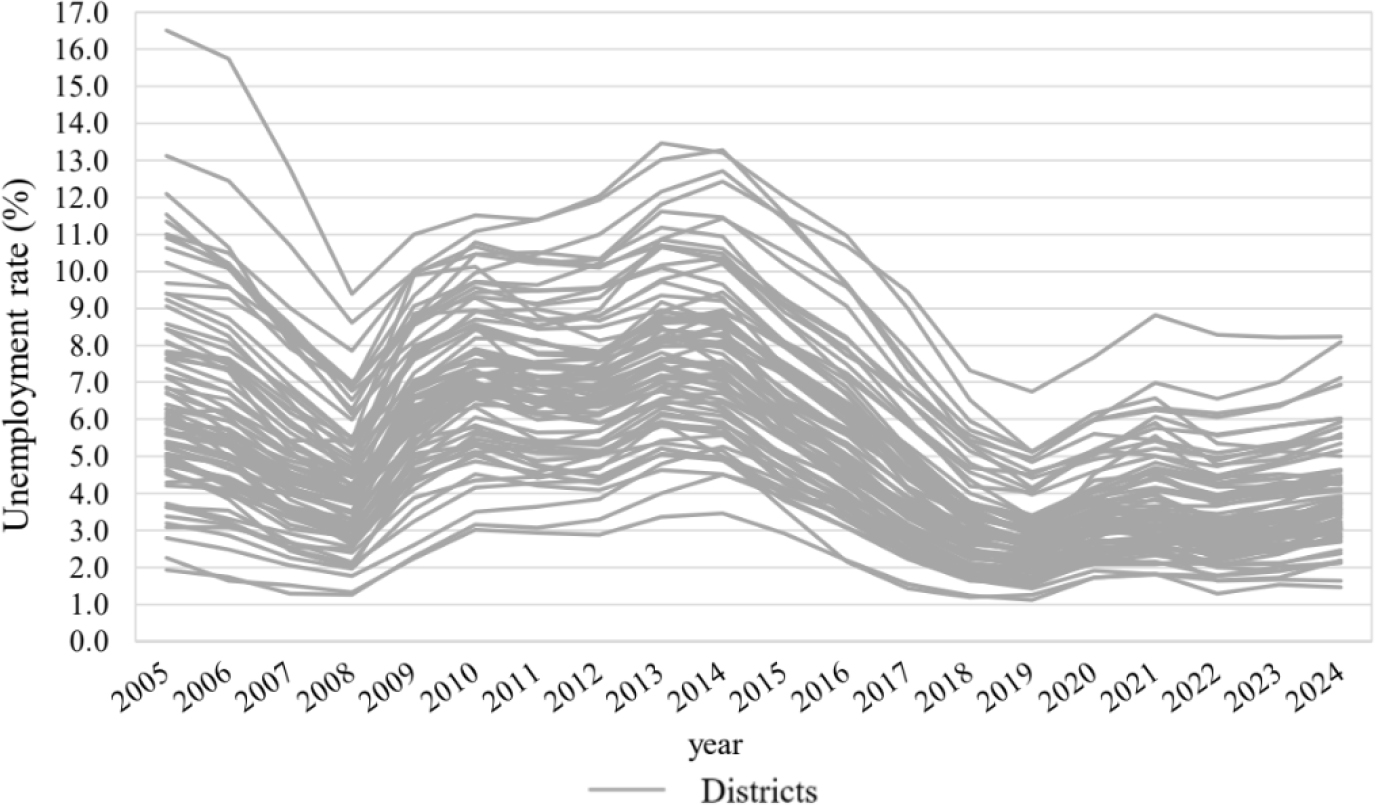
Fig. 1:
The development of unemployment rate across Czech districts (2005–2024, annual averages); author’s elaboration using data from MoLSA (2025)
The development of unemployment depicted via Fig. 1 reveals several distinct phases in the Czech labour market. Between 2005 and 2008, unemployment rates declined significantly, reflecting favourable economic conditions following the Czech Republic’s accession to the European Union and increased inflows of foreign direct investment. However, the global financial crisis led to a sharp rise in unemployment in 2009 and in subsequent years until 2013. From 2014 to 2019, a period of steady recovery is evident, marked by a consistent decline in unemployment across all districts. The COVID-19 pandemic outbreak in 2020 interrupted this positive trajectory, causing a moderate but widespread increase in unemployment. Although a partial recovery followed, the years 2022 to 2024 exhibit slight fluctuations and emerging tendencies across districts. Although the graph provides insight into unemployment trends across districts, it does not allow for a conclusive assessment of the convergence or divergence process during the observed period.
Fig. 2 presents a transformed version of the time series shown in Fig. 1, where the unemployment rate in each district between 2005 and 2024 is expressed as a ratio relative to the national average (set to 1). This modification enables a preliminary assessment of a convergence or divergence trends over time.
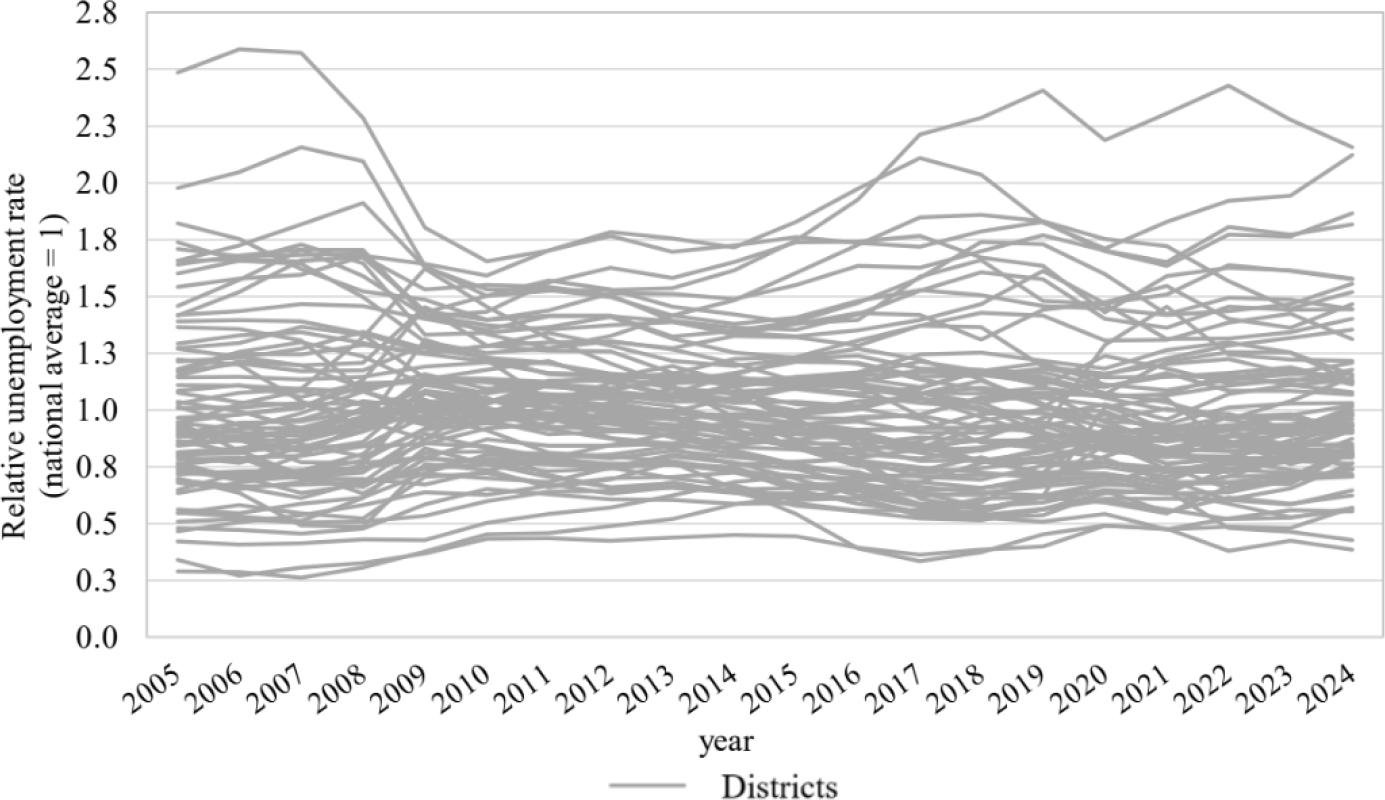
Fig. 2:
The development of relative unemployment rate across Czech districts (2005–2024, annual averages, national average = 1); author’s elaboration using data from MoLSA (2025)
The graph depicted in Fig. 2 allows for a clearer observation of regional disparities and convergence trends in unemployment over time. At the beginning of the observed period, there is considerable heterogeneity, with several districts exhibiting unemployment rates significantly above or below the national average. From the onset of the global financial crisis in 2008, the dispersion narrowed considerably toward the national average, indicating a process of convergence. A gradual trend toward divergence becomes apparent during the period of economic recovery between 2014 and 2019, when variation across districts widens further as some regions increasingly move away from the national average. However, during the COVID-19 pandemic years (2020–2021), disparities appear to have remained stable. In the final period (2022–2024), the relative unemployment rates suggest persistent regional differences. Although some districts remain close to the average, others maintain relatively high or low levels, indicating influence of structural factors at the regional level.
To capture potential variation over time, the full analysed period 2005–2024 was divided into several sub-periods:
2005–2008 (pre-crisis period),
2008–2013 (period of economic recession),
2013–2019 (post-crisis recovery period prior to the COVID-19 pandemic),
2019–2024 (period covering the COVID-19 pandemic and the subsequent years).
The development of unemployment in the boundary years of each sub-period across the districts of the Czech Republic is shown in Fig. 3. The choropleth maps in Fig. 3 illustrate the gradual development of unemployment dynamics across the districts of the Czech Republic. Although the average unemployment rate declined over the observed period, regional disparities persist. Aboveaverage unemployment is concentrated primarily in former coal-mining regions in the northwestern and north-eastern parts of the country, as well as in several rural areas. In contrast, the lowest unemployment rates are consistently observed in Prague and the surrounding Central Bohemian Region.
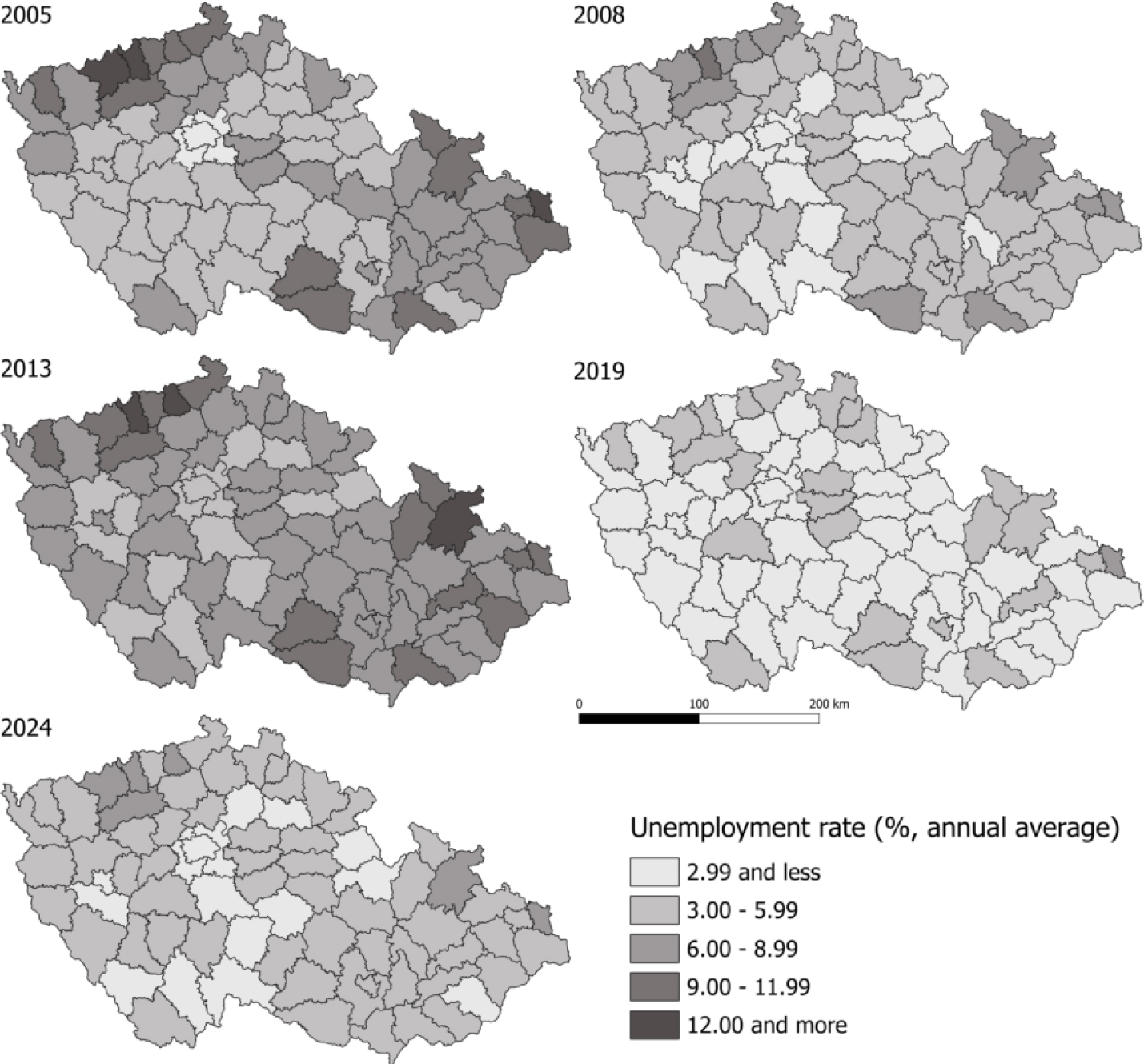
Fig. 3:
Development of unemployment rates across Czech districts in selected years (annual averages, %);author’s elaboration using data from MoLSA (2025) using shapefile from ČÚZK (2022), own elaboration in QGIS 3.36.0-Maidenhead (QGIS.org, 2024), Mapový podklad – Soubor hranic, 2022 © Český úřad zeměměřický a katastrální, www.cuzk.cz (ČÚZK, 2022)
3.2. Methodology
This paper investigates the convergence of unemployment rates across Czech districts through the lens of β-convergence, one of the key empirical approaches used to test for convergence. To capture this phenomenon, both an absolute β-convergence model and a spatial lag model are applied. The specific features and methodological foundations of these two econometric models are discussed in detail in this subsection.
Originating from the neoclassical growth model, the β-convergence concept implies that economies further from their steady states grow faster. If steady states are heterogeneous, lasting inequalities may prevail (Le Gallo et al., 2003). Building on this theoretical foundation, Barro and Sala-i-Martin (1990, 1992, 2004) developed a widely adopted β-convergence model, which posits a negative relationship between the growth rate of real GDP per capita over a given period and its initial level. In this paper, the original model is adapted by replacing GDP per capita with the unemployment rate u. This modification yields the absolute β-convergence model for cross-sectional data, expressed in the following form:
Eq. 1 can be estimated using the Ordinary Least Squares (OLS) method. In the context of convergence analysis, a negative and statistically significant β-coefficient indicates the presence of absolute β-convergence. Conversely, a positive and statistically significant β-coefficient suggests divergence (Barro and Sala-i-Martin, 1992, 2004; Arbia et al., 2005; Arbia and Basile, 2005).
According to Barro and Sala-i-Martin (2004), regions within a single country are more likely to converge toward similar steady states than different countries. This is largely due to the relatively smaller disparities in technological progress, preferences, and institutional settings across regions, as well as the presence of a shared government, legal framework, and common institutions. Such internal homogeneity increases the likelihood of absolute convergence occurring at the regional level. In absolute, or unconditional, β-convergence, regions or economies with varying initial conditions converge toward a common steady state, a process often characterized by the relatively higher growth rates of less developed regions, thus reducing disparities (Sala-i-Martin, 1996; Le Gallo et al., 2003; Barro and Sala-i-Martin, 2004).
One of the key assumptions of the neoclassical growth model is that of a closed economy. However, as noted by Arbia et al. (2005) and Arbia and Basile (2005), this assumption is overly restrictive when applied to regions within a single country. Unlike international contexts, trade barriers and constraints on the movement of production factors are considerably lower between regions of the same country. Consequently, the convergence process at the regional level is shaped by additional mechanisms, such as the mobility of labour and capital, interregional trade, technological diffusion, and knowledge spillovers. These interactions give rise to spatial dependence, a phenomenon frequently observed in spatial datasets where the value of a variable in one geographical unit (e.g., a district) is influenced by values in neighbouring units. In this context, spatial dependence reflects a geographic correlation between observations, which may result from processes such as trade flows, factor mobility, innovation diffusion, or transport networks (LeSage and Pace, 2009; Le Gallo et al., 2003). Recognizing and accounting for spatial dependence is thus essential when analysing convergence among regions within a country.
A substantial body of empirical literature on economic convergence highlights the importance of accounting for spatial dependencies including, for example, Abreu et al. (2005) or the previously mentioned studies by López-Bazo et al. (2002) and Cracolici et al. (2007). As Le Gallo et al. (2003) emphasize, space and geographical location are fundamental factors in convergence analysis and should not be disregarded. Arbia et al. (2005) suggest that spatial interaction effects can be directly incorporated into convergence analysis by including interregional flows of labour, capital, and technology in regression models. However, this approach is often constrained by limited access to detailed data. As an alternative, spatial econometric methods provide an indirect way to capture interregional spillovers through spatial dependence models without requiring flow data. Central role to these models plays the spatial weights matrix, which defines the structure and intensity of spatial interactions between geographical units (Arbia, 2016). This matrix serves as the foundation for incorporating spatial relationships into the estimation process and is essential for identifying and quantifying spatial effects in β-convergence models.
This paper employs a spatial lag model to analyse the convergence of unemployment rates across Czech districts. To account for spatial dependence, a spatial lag operator is introduced as an additional explanatory variable representing a weighted average of the dependent variable in neighbouring districts, with exogenously assigned weights. It is formally expressed as the product of the spatial weights matrix W and the dependent variable u, i.e., W × u (Anselin, 2001; Anselin and Bera, 1998).
Anselin and Bera (1998), Anselin (2001), or LeSage and Pace (2009) describe the spatial lag operator using the following mathematical expression (Eq. 2):
where wi,j denotes an element of the spatial weights matrix W, which is an n × n matrix capturing the spatial structure of the dataset. This element reflects the intensity of spatial dependence between location i (represented by the row) and location j (represented by the column) (Anselin et al., 2008). This paper employs a simple binary spatial weights matrix with dimensions of 77×77, covering 76 districts and the Capital City of Prague, based on the contiguity (neighbourhood) criterion. This matrix assigns a value of 1 to neighbouring units and 0 otherwise, indicating whether two districts share a common boundary. The formal specification of this matrix is given in Eq. 3 (Anselin et al., 2008; Anselin and Bera, 1998):
The diagonal elements wi,j are set to zero, as districts cannot be considered its own neighbour. To facilitate interpretation and ensure comparability across regions, the spatial weights matrix is typically row-normalized meaning that each element in a given row is divided by the sum of that row’s values. This normalization constrains all matrix entries to the interval [0; 1] allowing the spatial lag to be interpreted as a weighted average of values in neighbouring regions, where the weights are given by wi,j (Anselin, 2001; Anselin and Bera, 1998; Elhorst, 2014).
The spatial lag operator (Eq. 2) is incorporated into the regression equation (Eq. 1) to formulate the spatial lag model. This modification yields a new specification (Eq. 4), which indirectly captures spatial spillover effects by accounting for the influence of neighbouring districts (Le Gallo et al., 2003; Arbia et al., 2005; Anselin, 2001). The resulting model represents the spatial lag model for cross-sectional data, extending the standard convergence framework to incorporate spatial dependence.
The spatial autoregressive parameter ρ in Eq. 4 captures spatial dependence between geographical units (e.g., districts) based on the exogenously defined spatial weights matrix W. It reflects how change in the unemployment rate of district i is influenced by both its initial level and unemployment dynamics in neighbouring districts j. According to Le Gallo et al. (2003), the model specified in Eq. 4 can be interpreted through two complementary lenses: from the perspective of economic convergence, the parameter β provides insight into the nature and direction of the convergence process, while from the standpoint of economic geography, the parameter ρ highlights the role of spatial spillover effects.
Estimating Eq. 4 using the OLS method results in inconsistent parameter estimates. To address this issue, the Maximum Likelihood (ML) estimation is employed (Le Gallo et al., 2003; LeSage and Pace, 2009). When estimating a spatial lag model, the objective is to quantify two key effects: the direct effect (or own-region effect) and the indirect effect (also referred to as the spatial spillover or other-region effect). Together, these constitute the total effect (LeSage and Pace, 2009; Elhorst, 2014; LeSage, 2014). The direct effect measures the impact of a variable within a given district, excluding spatial interactions, whereas the indirect effect captures how changes in one district influence neighbouring districts through spatial linkages. After estimating the model in Stata 15, an additional recursive calculation of these effects is required to fully interpret the results.
4. ECONOMETRIC ANALYSIS OF UNEMPLOYMENT CONVERGENCE ACROSS CZECH DISTRICTS
This subsection contains the econometric analysis examining convergence of unemployment rates across Czech districts over the period 2005–2024. Two model specifications are employed: a crosssectional absolute β-convergence model and a spatial lag model. All estimations are performed using the econometric software Stata 15. As mentioned above in the data section, the models are estimated for several sub-periods to capture temporal variation: 2005–2024 (full dataset), 2005–2008 (pre-crisis), 2008–2013 (recession), 2013–2019 (post-crisis recovery), and 2019–2024 (COVID-19 pandemic and subsequent years).
4.1. Model Estimates, Statistical and Econometric Verification
This part presents the estimation results for two cross-sectional models, beginning with the absolute β-convergence model and subsequently the spatial lag model. As part of the estimation process, both statistical and econometric verification procedures were conducted. Statistical verification included t-tests for individual parameter significance and F-test for overall model significance. Econometric verification addressed potential violations of key assumptions, including tests for heteroskedasticity and normality.
Based on the results presented in Tab. 1, it can be concluded that the coefficient of initial unemployment level, denoted as β, is statistically significant for the periods 2013–2019 (at the 5% significance level), and particularly for 2008–2013, 2019–2024, and 2005–2024 (at the 1% significance level). F-tests confirm the statistical significance of the models for the respective periods, with significance levels matching those of the corresponding β coefficients. Furthermore, for these periods, there is no indication of heteroskedasticity or non-normality of the residuals. Of these models, only the model for the period 2008–2013 was clearly the most robust, with a coefficient of determination of 0.734.
Tab. 1:
Absolute β-convergence model for district-level unemployment, OLS estimates (p-values reported in parentheses)
| 2005–2008 | 2008–2013 | 2013–2019 | 2019–2024 | 2005–2024 | |
|---|---|---|---|---|---|
| α (constant) | – 0.1242 (0.000) | 0.2323 (0.000) | –0.2384 (0.000) | 0.0966 (0.000) | 0.0007 (0.891) |
| β (initial unemployment) | –0.0158 (0.201) | –0.0732 (0.000) | 0.0294 (0.022) | –0.0296 (0.000) | –0.0156 (0.000) |
| F test | 1.67 (0.2005) | 206.60 (0.0000) | 5.46 (0.0221) | 16.11 (0.0001) | 35.37 (0.0000) |
| R2 | 0.0218 | 0.7337 | 0.0679 | 0.1768 | 0.3205 |
| White’s test (heteroskedasticity) | 1.75 (0.4169) | 1.25 (0.5359) | 0.04 (0.9783) | 5.00 (0.0820) | 0.26 (0.8787) |
| Breusch-Pagan/Cook-Weisberg test (heteroskedasticity) | 0.07 (0.7978) | 1.37 (0.2410) | 0.00 (0.9886) | 4.53 (0.0333) | 0.18 (0.6693) |
| Skewness/Kurtosis tests for normality (residuals) | 8.03 (0.0180) | 0.85 (0.6526) | 0.30 (0.8601) | 1.37 (0.5029) | 1.53 (0.4655) |
1 Source: Author’s calculations in Stata 15 (StataCorp, 2017)
The statistically significant and negative β coefficients for most periods imply convergence in unemployment rates across Czech districts. Conversely, the statistically significant and positive β coefficient for the 2013–2019 period suggests the presence of divergence. Regarding robustness, Tab. 1 shows that, with the exception of the 2008–2013 period when the model attains a coefficient of determination of 0.734, the explanatory power of the models is relatively weak in the remaining sub-periods. While the estimated β coefficients and F-tests are statistically significant in most of these periods (with the exception of 2005–2008), the low R2 values indicate that the relationships have limited explanatory strength.
A visual depiction of the β-convergence analysis of unemployment rates across Czech districts for each selected sub-period is provided in Fig. 4, which includes five separate graphs corresponding to each analysed sub-period.
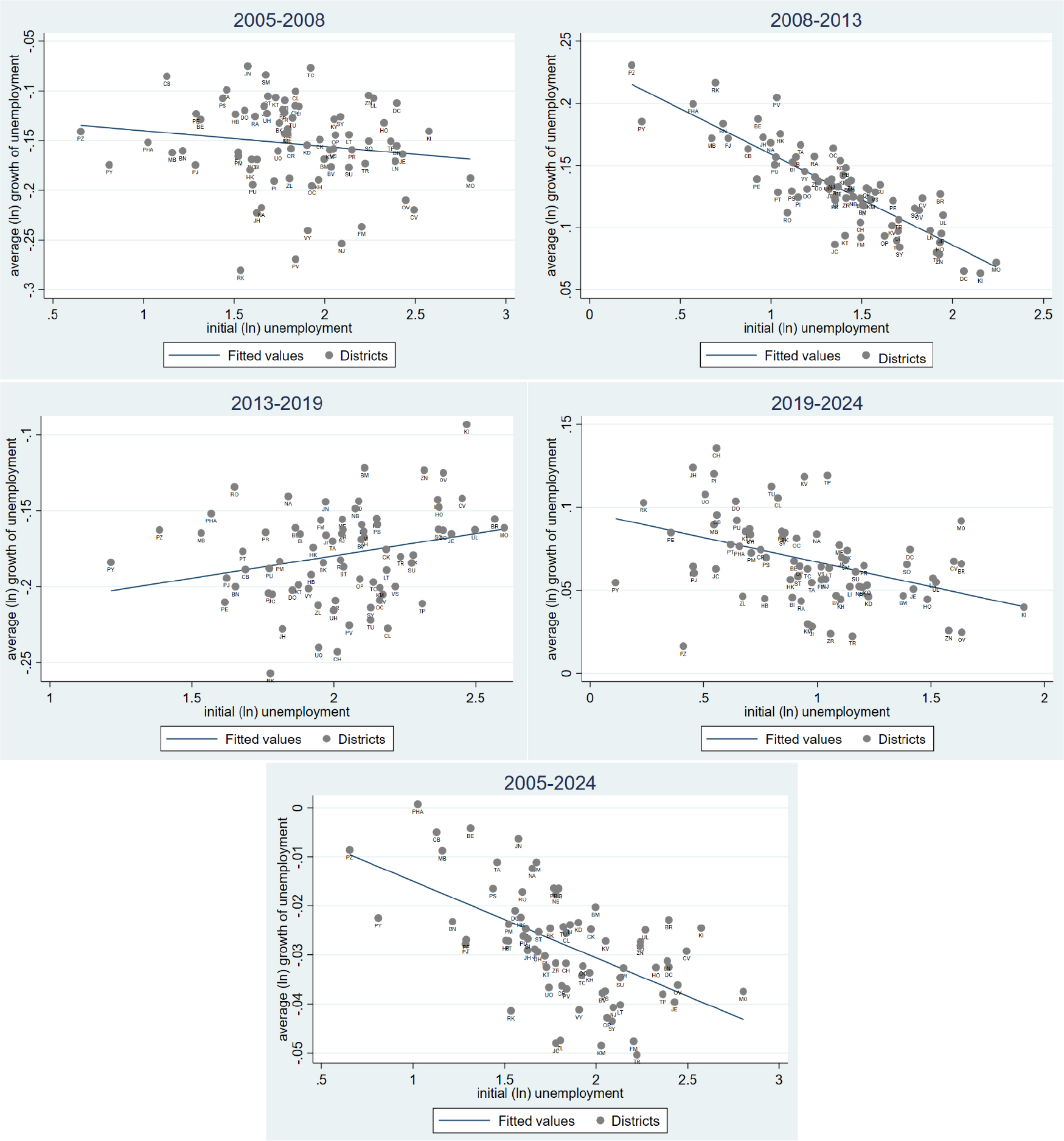
Fig. 4:
Graphical depiction of absolute β-convergence of unemployment rates across Czech districts, 2005–2024; author’s processing in Stata 15 (StataCorp, 2017) based on data from MoLSA (2025)
The vertical axis of each graph in Fig. 4 plots the left-hand side of regression Eq. 1, representing the average change in the unemployment rate over the respective period (with values transformed using the natural logarithm). The horizontal axis shows the natural logarithm of the initial unemployment rate at the beginning of the corresponding period. A positive slope of the regression line (i.e., a positive β coefficient) for the 2013–2019 period indicates divergence, whereas a negative slope (negative β coefficient) for the periods 2005–2008, 2008–2013, 2019–2024, and 2005–2024 indicates convergence. Based on the selected graphs, the 2008–2013 period provides the strongest evidence of convergence, as evidenced by the coefficient of determination (R2 = 0.734).
The heterogeneity in model fit across sub-periods suggests that the explanatory power of the absolute β-convergence framework is strongly regime-dependent. During the 2008–2013 downturn, a substantial aggregate shock generated large unemployment changes across districts, thereby making initial unemployment a strong predictor of subsequent dynamics and leading to a marked increase in R2. By contrast, in expansionary periods (e.g., 2005–2008 or 2013–2019), changes are smaller and more influenced by endogenous local factors not captured by the baseline specification, weakening the relationship and reducing explanatory power. Overall, β-convergence appears most informative during macro-shocks and less suited to explaining internally driven regional dynamics under stable economic growth.
To account for spatial dependencies between the districts of the Czech Republic, a spatial lag model for cross-sectional data is also estimated. Tab. 2 presents the estimation results obtained using the ML method. When interpreting the results, particular attention must be paid to the distinction between direct and indirect effects, which represent key characteristics of spatial econometric models.
Tab. 2:
Spatial lag β-convergence model for district-level unemployment, Maximum Likelihood estimates (p-values reported in parentheses)
| 2005–2008 | 2008–2013 | 2013–2019 | 2019–2024 | 2005–2024 | |
|---|---|---|---|---|---|
| α (constant) | –0.0766 (0.004) | 0.2335 (0.000) | –0.1874 (0.000) | 0.0759 (0.000) | 0.0030 (0.537) |
| β (initial unemployment) | –0.0076 (0.516) | –0.0734 (0.000) | 0.0297 (0.013) | –0.0304 (0.000) | –0.0125 (0.000) |
| ρ (spatial autoregressive parameter) | 0.4089 (0.003) | –0.0065 (0.952) | 0.2870 (0.060) | 0.3178 (0.020) | 0.2875 (0.028) |
| Direct effect | –0.0079 (0.514) | –0.0734 (0.000) | 0.0303 (0.014) | –0.0311 (0.000) | –0.0127 (0.000) |
| Indirect effect | –0.0049 (0.507) | 0.0005 (0.952) | 0.0114 (0.231) | –0.0134 (0.134) | –0.0048 (0.067) |
| Total effect | –0.0128 (0.505) | –0.0729 (0.000) | 0.0417 (0.030) | –0.0446 (0.001) | –0.0175 (0.000) |
| Wald χ2 test | 10.55 (0.0051) | 212.13 (0.0000) | 9.51 (0.0086) | 23.40 (0.0000) | 43.98 (0.0000) |
| Pseudo R2 | 0.0375 | 0.7337 | 0.0494 | 0.1418 | 0.3491 |
| Moran test for spatial dependence | 7.16 (0.0074) | 0.02 (0.8933) | 5.54 (0.0186) | 10.48 (0.0012) | 1.88 (0.1698) |
1 Source: Author’s calculations in Stata 15 (StataCorp, 2017)
Moran’s test for spatial dependence reveals that the residual component is independently and identically distributed for the periods 2008–2013 and 2005–2024, as the test results are not statistically significant. Based on these findings, it can be concluded that there is no statistically significant spatial dependence among neighbouring districts during these two time periods. Conversely, for the periods 2005–2008, 2013–2019, and 2019–2024, the results of Moran’s test are statistically significant at various significance levels (p-values reported in parentheses), implying that the residual component is not independently and identically distributed.
However, most of the spatial spillover effects captured by the indirect effect in Tab. 2 do not reach acceptable levels of statistical significance. The indirect effect is statistically significant at the 10% level only for the period 2005–2024 suggesting that the average change in the unemployment rate within a district is generally not significantly affected by changes in neighbouring districts. Consequently, these results imply that the original absolute β-convergence model estimated via OLS is unlikely to suffer from misspecification due to omitted spatial dependencies (Rey and Montouri, 1999).
The model estimated by the Maximum Likelihood (ML) method shows satisfactory Wald χ2 test results across all periods. The signs of the total effect coefficients, representing the sum of direct and indirect effects, are consistent with the β coefficients from the OLS model, and the corresponding p-values are similar. Like the OLS model, the spatial specification achieves its best performance in the 2008–2013 period, with a pseudo R2 value identical to that of the baseline model (0.734). These results confirm that the original absolute β-convergence model estimated via OLS is not misspecified due to omitted spatial interactions. Moreover, the ML estimation of the spatial lag model further supports the robustness of the baseline model.
5. DISCUSSION
According to the results summarized in Tab. 3, the best results for both types of models were achieved for the period 2008–2013. This period is characterized by an economic downturn associated with the financial crisis. The R2 of the baseline model and the pseudo R2 of spatially extended model for this period reached identically 0.734. For the remaining periods, the results of the econometric analysis are not sufficiently robust mainly due to low coefficients of determination.
Tab. 3:
Summary of results
| 2005–2008 | 2008–2013 | 2013–2019 | 2019–2024 | 2005–2024 | |
|---|---|---|---|---|---|
| Absolute β-convergence (OLS estimates) | |||||
| Conclusion | UNCERTAIN | CON*** | DIV** | CON*** | CON*** |
| R2 | 2.18% | 73.37% | 6.79% | 17.68% | 32.05% |
| Spatial lag model (ML estimates) | |||||
| Conclusion | UNCERTAIN | CON*** | DIV** | CON*** | CON*** |
| Pseudo R2 | 3.75% | 73.37% | 4.94% | 14.18% | 34.91% |
The results presented in Tab. 3 are plotted in Fig. 5, which combines Fig. 1 and 2 and illustrates the development of both the unemployment rate and the relative unemployment rate over the period 2005–2024. As noted above, the most robust results were obtained for the sub period 2008–2013, which is also evident from the graphical depiction. While the unemployment rate increased during the crisis period, regional disparities in unemployment rates relative to the national average across districts in the Czech Republic narrowed.
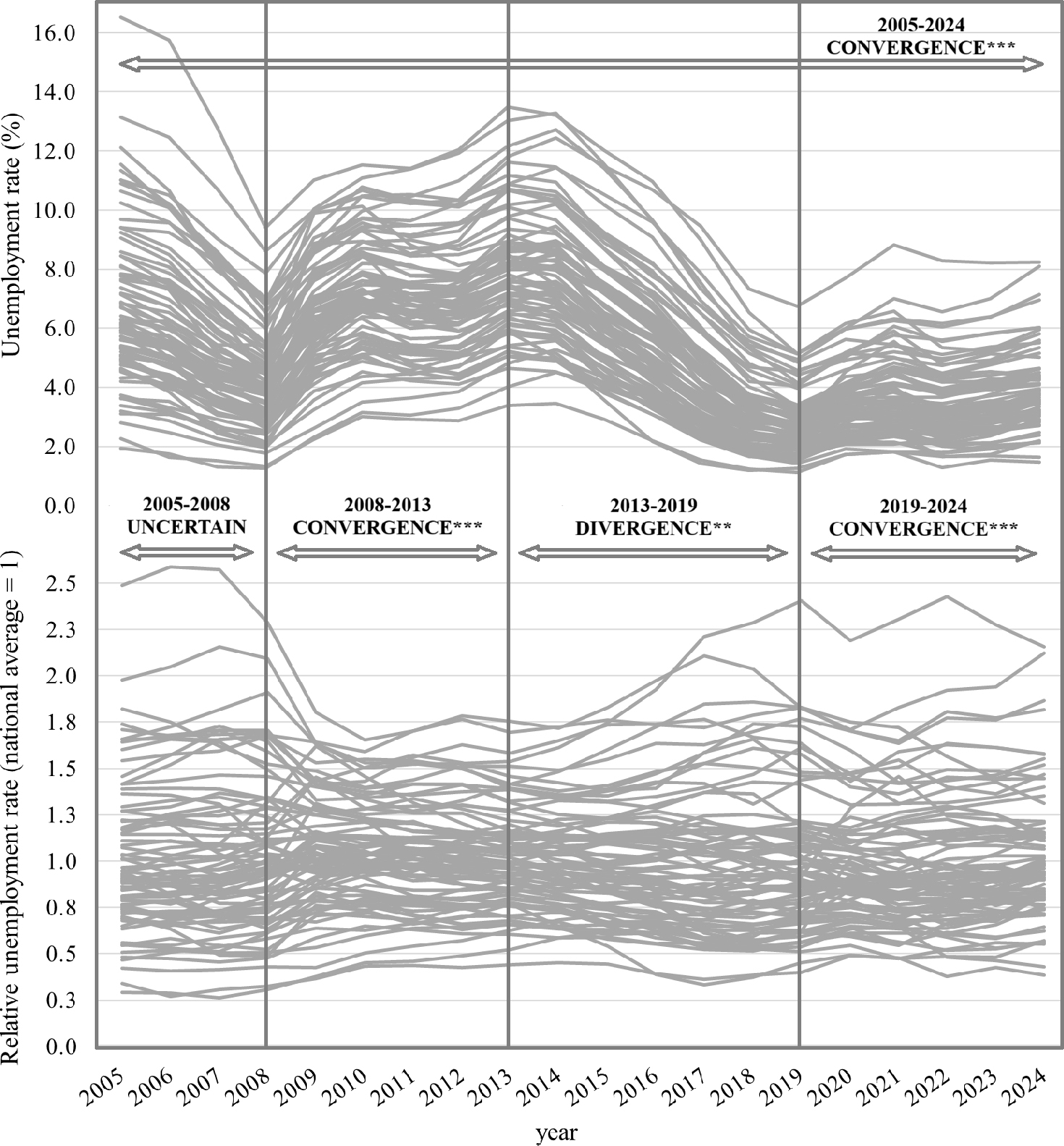
Fig. 5:
Graphical depiction of results – unemployment dynamics across Czech districts, 2005–2024; author’s elaboration based on results of econometric analysis and using data from MoLSA (2025)
The most robust result for the crisis period 2008–2013, during which strong convergence of unemployment rates across Czech districts occurred, can be examined more closely using the β-convergence plot shown in Fig. 6. The negative slope of the regression line (i.e., a negative β coefficient) for this period indicates convergence: the highest average growth in unemployment was recorded in districts where unemployment was lowest at the beginning of the period, whereas the lowest average growth was observed in districts where unemployment was already high at the start of the period.
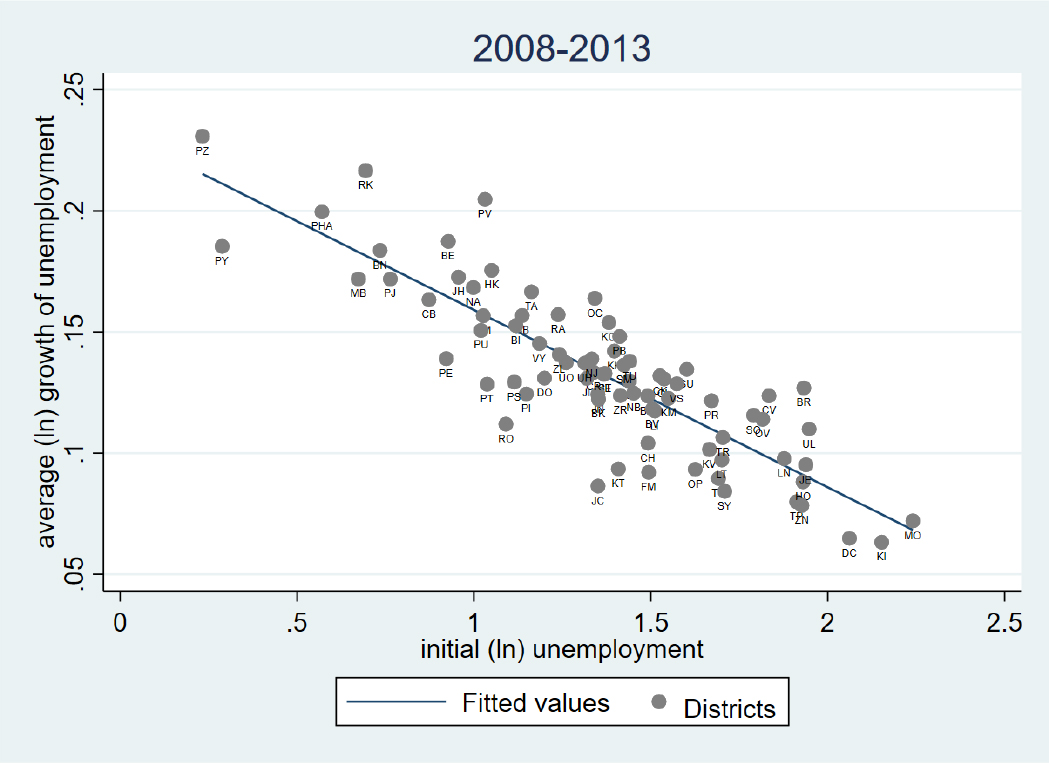
Fig. 6:
Graphical depiction of absolute β-convergence of unemployment rates across Czech districts, 2008–2013; author’s processing in Stata 15 (StataCorp, 2017) based on data from MoLSA (2025)
The three districts with the lowest unemployment rates at the beginning of the observed period in the Czech Republic also recorded average unemployment growth rates among the highest. According to Fig. 6, these were the Capital City of Prague (PHA; +171%) and its two neighbouring districts, Praha-západ (PZ; +217%) and Praha-východ (PY; +153%). By contrast, the three districts that exhibited the highest unemployment rates at the beginning of the observed period experienced the lowest relative growth in unemployment during the economic downturn. These districts, all located in structurally affected regions undergoing economic transformation due to long-term industrial restructuring and related socio-economic challenges, include Karviná (KI; +37%), Děčín (DC; +38%) and Most (MO; +43%).
However, a comparison of two districts located at opposite ends of the spectrum reveals a contrasting picture. In the Praha-západ (PZ) district with the fastest relative increase in unemployment (+217%), the absolute rise amounted to only 2.7 percentage points. By contrast, in the Karviná district (KI), where the relative increase was merely 37%, unemployment rose by 3.2 percentage points in absolute terms, exceeding the increase observed in the Praha-západ (PZ) district with the highest relative growth. The comparison of absolute and relative changes in unemployment rates for the period 2008–2013 across all districts is depicted in Fig. 7, where districts are ranked according to their relative increase in unemployment.
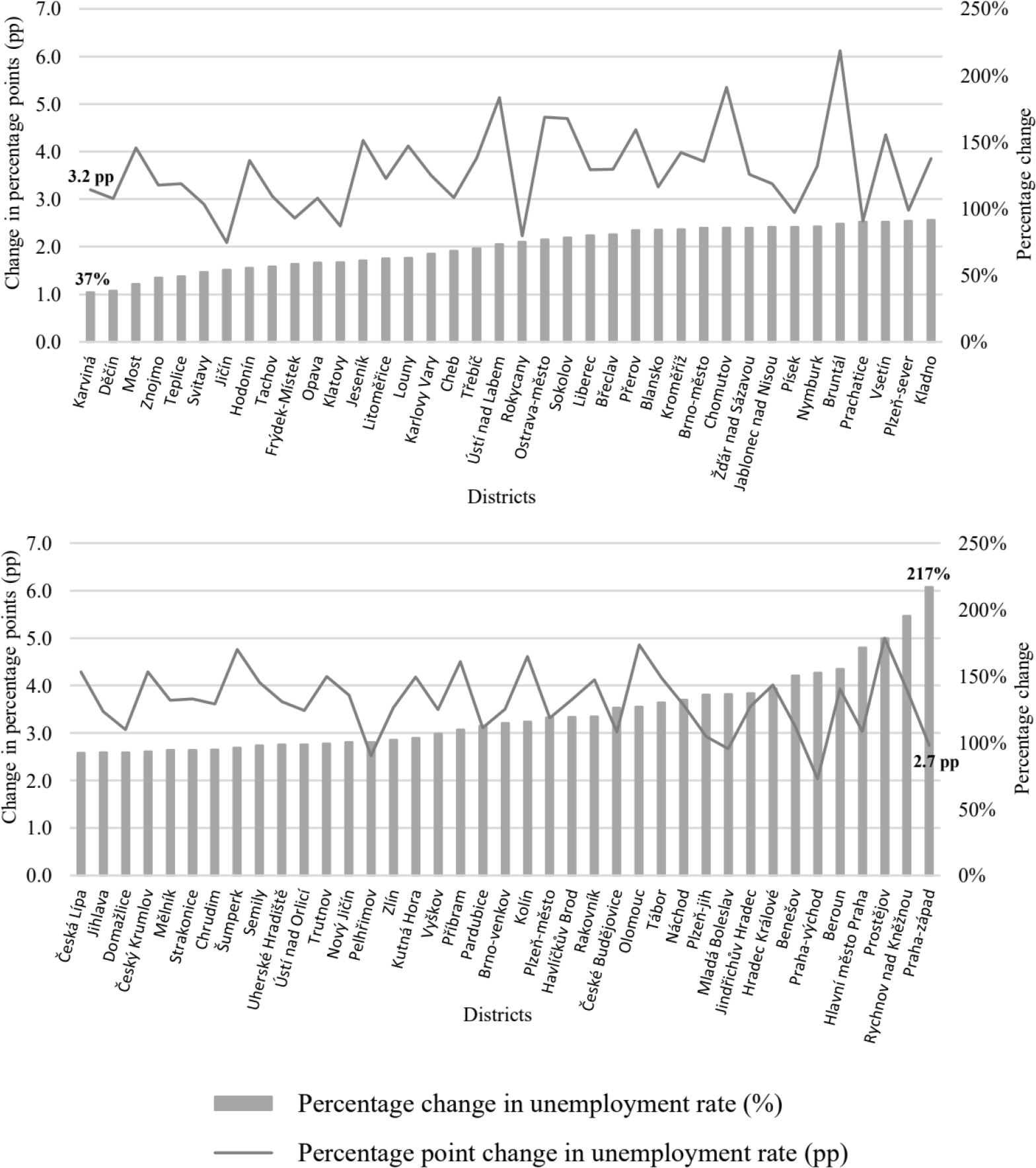
Fig. 7:
Change of unemployment rate across Czech districts (2008–2013), comparison of absolute change (percentage points, pp) and relative change (%); author’s elaboration using data from MoLSA (2025)
Based on these findings, unemployment dynamics during 2008–2013 display robust and statistically significant β-convergence across Czech districts. Importantly, this result should be interpreted as temporary, crisis-driven β-convergence identified within a specific sub-period, rather than as evidence of long-run structural convergence or regional equalisation. The 2008–2013 downturn can be viewed as a common (aggregate) negative shock, yet its regional impact was heterogeneous: districts with initially tight labour markets experienced sharper relative increases in unemployment, whereas structurally affected districts with already high unemployment recorded lower relative growth. The resulting temporary compression of inter-district disparities therefore reflects a crisis-period adjustment and partial regression toward the mean, i.e., an upward convergence driven primarily by relatively stronger deterioration in districts that initially had low unemployment.
The findings of this study contribute to the literature on regional unemployment dynamics by demonstrating that unemployment convergence can emerge as a crisis-induced adjustment within spatially and structurally clustered districts rather than as a sustained process of regional equalisation. This result is consistent with the findings of Audas and MacKay (1997), who examined the unusual, crisis-driven convergence patterns in regional unemployment observed during the early 1990s recession in the United Kingdom, linked to developments in the housing market. During this crisis, a similar atypical pattern emerged, whereby core regions with initially low unemployment experienced relatively stronger increases in unemployment than peripheral regions. The findings from Czech districts are also consistent with the literature emphasising the role of adverse macroeconomic shocks in shaping unemployment dynamics (Blanchard and Wolfers, 2000). At the same time, the persistence of spatial disparities supports findings from the literature highlighting the stability of unemployment differentials and the existence of spatial clusters (Bayer and Jüßen, 2007; Cracolici et al., 2007; López-Bazo et al., 2002) reinforcing the importance of accounting for spatial distribution and interregional spillovers when analysing local labour markets. From a distributional perspective, the findings also align with the concept of club convergence (Iacus and Porro, 2015; Quah, 1996). Rather than converging uniformly, districts appear to adjust within groups defined by similar initial labour market conditions. During the crisis, these clubs temporarily moved closer together, not because of structural improvement, but due to asymmetric deterioration in previously low-unemployment districts.
Despite offering valuable insights into unemployment crisis-driven convergence at the district level, this study has several limitations. First, it focuses solely on the Czech Republic, which may limit the generalizability of the findings. Second, the analysis is based on an absolute β-convergence model later extended to spatial lag model, which does not account for potential structural differences across districts, such as varying steady-state unemployment rates. Additionally, factors like internal migration or demographic changes, which could significantly influence labour market dynamics, are not explicitly incorporated. Finally, the spatial econometric approach relies on a particular form of the spatial weights matrix. Alternative constructions or modifications of the matrix could yield different insights into spatial dependencies.
6. CONCLUSION
This paper examined unemployment-rate convergence across Czech districts over the past two decades. Using cross-sectional econometric modelling, the analysis employed two complementary approaches: an absolute β-convergence model and a spatial lag model. Incorporating spatial dependence allowed the analysis to account for interactions between neighbouring districts and thus strengthened the empirical assessment. The models were applied to annual average unemployment data from the Ministry of Labour and Social Affairs of the Czech Republic (MoLSA, 2025) for 2005–2024, the longest continuous district-level series currently available. To reflect major shifts in macroeconomic conditions, the overall period was divided into several sub-intervals.
The most conclusive results emerged for 2008–2013, coinciding with the global financial crisis and its transmission to the Czech labour market. In this sub-period, both models revealed temporary, crisis-driven β-convergence, supported by strong explanatory power (R2 = 0.734) and consistent graphical evidence. Importantly, this was an upward convergence driven by relatively stronger deterioration in districts that entered the downturn with initially low unemployment, which temporarily compressed inter-district disparities. By contrast, districts in structurally affected regions facing long-term industrial restructuring and related socio-economic challenges, which were often characterised by above-average unemployment prior to the crisis, recorded comparatively milder relative increases.
These findings have relevant implications for labour-market policy. Policies should strengthen resilience by supporting local economic diversification, workforce reskilling, and measures that enhance labour-market flexibility and adaptability. Persistent spatial disparities and uneven regional responses further point to the need for regionally differentiated policy instruments that reduce vulnerability to the asymmetric regional impacts of economy-wide shocks and promote more balanced and sustainable labour-market development across the country.
Acknowledgements
The author would like to express sincere gratitude to his supervisor, Mr. Milan Šimek, and to Ms. Kamila Průšová from the Writing Support Centre at VSB – Technical University of Ostrava for their valuable and constructive feedback throughout the development of this paper.
The author also gratefully acknowledges the Moravian-Silesian Region for its support during his doctoral studies within the framework of the programme “Podpora vědy a výzkumu v Moravskoslezském kraji 2023”, a three-year grant scheme for talented doctoral students (RRC/09/2023).
The author used ChatGPT (OpenAI, 2025) to make final stylistic revisions.
Notes
[7] For the purposes of this study, the Capital City of Prague is treated as a district from a geographical perspective. This simplification does not affect the econometric analysis or the interpretation of the results.
[8] Financial disclosure Disclosure statement:
No potential conflict of interest was reported by the author.
AUTHOR’S ADDRESS
Jan Belardi, Department of Economics, Faculty of Economics, VSB – Technical University of Ostrava, Ostrava, Czech Republic, e-mail: jan.belardi@vsb.cz, ORCID: 0009-0005-2007-6306