
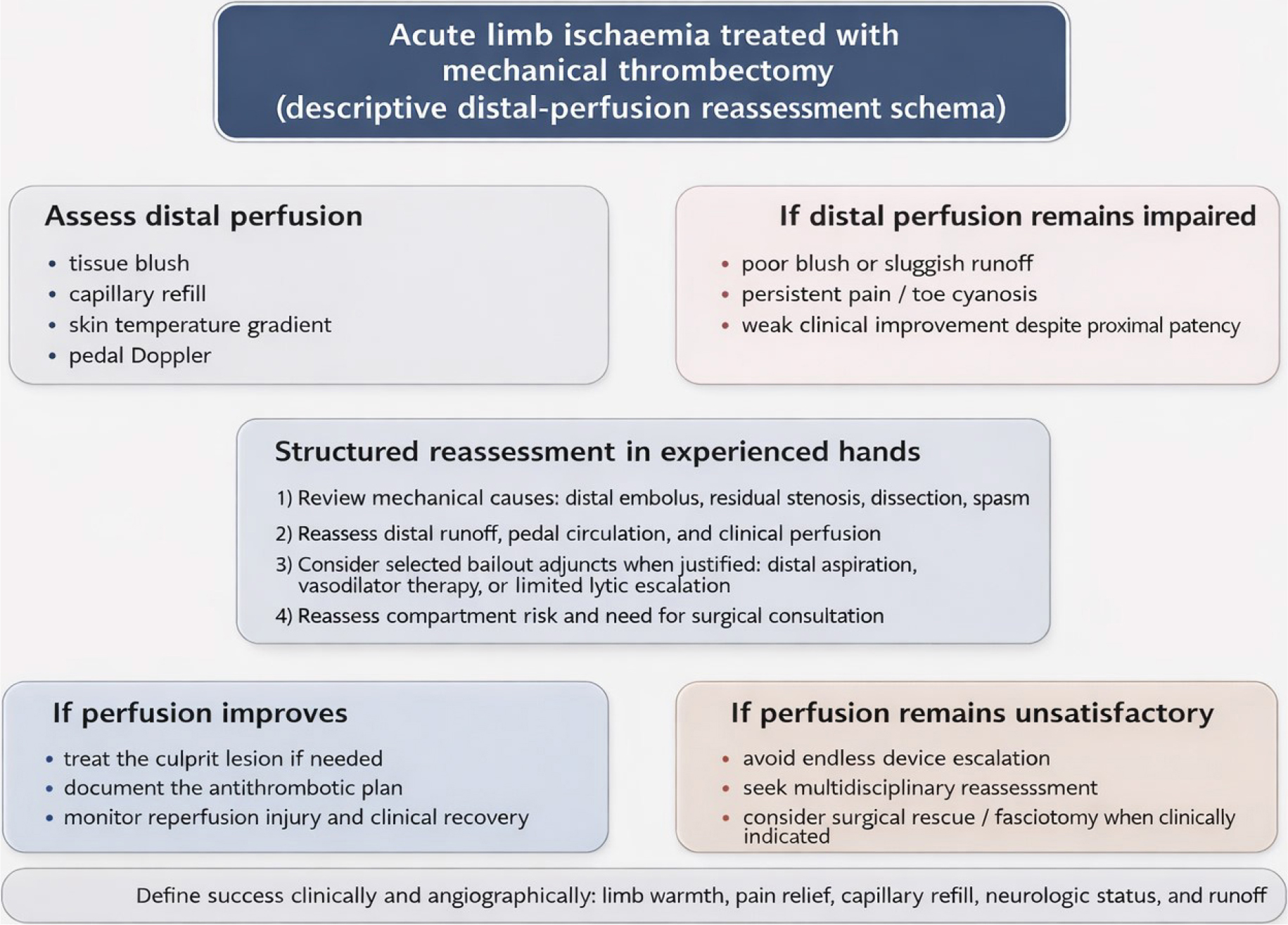
FIGURE 1.
Descriptive reassessment schema for distal perfusion after mechanical thrombectomy in acute limb ischaemia.
After restoration of macro-flow, distal perfusion should be reassessed clinically and angiographically. When distal perfusion remains impaired despite proximal patency, structured reassessment should focus first on treatable mechanical causes, including distal embolus, residual stenosis, dissection, or vasospasm, followed by review of runoff, pedal circulation, and clinical perfusion. Selected bailout adjuncts such as distal aspiration, vasodilator therapy, or limited thrombolytic escalation may be considered in experienced hands when clinically justified. The figure is intended as a descriptive companion schema to support reassessment and reporting, not as a validated treatment algorithm or standard-of-care pathway.
TABLE 1.
Pragmatic interventional radiology taxonomy of mechanical thrombectomy approaches in acute lower limb ischaemia (ALI)
| Approach class | Typical use | Main advantages/limitations | Practical notes |
|---|---|---|---|
| Aspiration | Fresh embolic or thrombotic occlusions; distal aspiration-first work+- | Advantages: simple, scalable, distal reach, lysis-sparing. Limitations: organized clot, embolization, clogging. | Adjuncts: angioplasty/stent, micro-dose intra-arterial lytic, vasodilators. Typically ≥2.0 mm distally; ≥3.0 mm for large-bore systems. Low–moderate aspirate, often 50–300 mL but higher if prolonged. |
| Rotational | Large femoropopliteal mixed thrombus needing rapid debulking | Advantages: rapid debulking, handles mixed thrombus. Limitations: vessel trauma, embolization, device cost. | Adjuncts: angioplasty/stent, distal aspiration, selective protection. Typically ≥3.0 mm; not suited for small below-the-knee arteries. Usually <100–200 mL blood loss/aspirate. |
| Hydrodynamic | High-burden thrombus when lysis-sparing debulking is desired | Advantages: effective in high thrombus burden, trackable. Limitations: hemolysis, learning curve, embolization. | Adjuncts: angioplasty/stent, limited catheterdirected thrombolysis rescue. Typically ≥3.0 mm (device-dependent). Low–moderate aspirate; haemolysis risk may exceed visible blood loss. |
| Rheolytic/pharmacomechanical | Thrombectomy with local lytic facilitation when a combined debulking strategy is desired | Advantages: debulking plus lytic delivery, versatile. Limitations: hemolysis, bradycardia, bleeding if lytic is used. | Adjuncts: heparin optimisation, limited catheter-directed thrombolysis, intensive care unit protocol if lytic is used. Approximately ≥2.5–3.0 mm (catheter-dependent). Monitor for haemolysis/bradycardia. |
| Rescue (off-label) | Below-the-knee/pedal rescue for distal emboli when dedicated devices are unsuitable | Advantages: can engage distal emboli with neuro-like control. Limitations: sparse evidence, vessel injury risk. | Adjuncts: distal aspiration, vasodilators, bailout surgery. Approximately ≥2.0 mm with appropriate sizing. Minimal device-related blood loss; bleeding risk mainly reflects adjunctive therapy. |
TABLE 2.
Rutherford clinical categories of acute limb ischaemia (simplified)
| Category | Clinical findings | Doppler signals | Treatment urgency (typical) |
|---|---|---|---|
| I (Viable) | No sensory loss; no motor deficit | Arterial audible; venous audible | Urgent but not emergent; imaging + plan |
| IIa (Marginally threatened) | Minimal sensory loss; no motor deficit | Arterial often inaudible; venous audible | Urgent revascularization |
| IIb (Immediately threatened) | More than toes sensory loss; mild–moderate motor deficit | Arterial inaudible; venous audible | Emergent revascularization |
| III (Irreversible) | Profound anesthesia; paralysis/rigor | Arterial and venous inaudible | Primary amputation/palliation |
TABLE 3.
Descriptive examples of adjuncts that may be reported in selected bailout cases when distal perfusion remains impaired after thrombectomy
| Agent/class | Rationale | Typical route | Key risks | Reporting note |
|---|---|---|---|---|
| Nitroglycerin | Vasodilation; spasm relief | Intra-arterial via catheter (small bolus) | Hypotension | May be reported when focal spasm is suspected; reassess clinically and angiographically. |
| Verapamil | Calcium-channel vasodilator | Intra-arterial bolus via catheter | Hypotension/bradycardia | Primarily extrapolated from coronary practice; ALI-specific evidence remains limited. |
| Heparin optimization | Reduce ongoing thrombus propagation | Intravenous bolus; activated clotting time-guided | Bleeding | Supportive antithrombotic optimization rather than a no-reflowspecific therapy. |
| Alteplase (microdose) | Resolve distal microthrombus/sludge | Intra-arterial bolus 2 mg every 5-10 min (max 10 mg) | Bleeding | May be described in selected cases with suspected residual distal thrombus; distinct from infusion CDT; not protocolized. |
| How to report bailout adjunct use | Encourage consistent documentation of indication, agent, dose, route, response, and complications | Via working/thrombectomy catheter when used | Bleeding, hypotension, bradycardia; avoid in unstable patients or when surgical rescue is more appropriate | Illustrative descriptive reporting construct only; not a recommended sequence. |
TABLE 4.
Suggested minimum dataset for prospective ALI thrombectomy registries
| Domain | Variables (minimum set) | Why it matters | Capture point |
|---|---|---|---|
| Baseline | Age, sex, atrial fibrillation, coronary artery disease, chronic kidney disease, diabetes, smoking; antithrombotics | Risk stratification, bleeding risk, etiology | Pre-procedure |
| Ischemia | Symptom onset (hours), Rutherford category, baseline Doppler, lactate/creatine kinase | Ischemia time drives limb loss/reperfusion injury | Pre-procedure |
| Imaging | CTA/MRA segment map; calcification; runoff score (if used) | Device selection; predicts below-the-knee work | Pre-procedure |
| Procedure | Access; device class/size; passes; adjunctive angioplasty/stent; lytic (bolus/infusion, dose); vasodilators; distal embolization/below-the-knee rescue | Reproducibility; identifies failure modes | Intraprocedure |
| Outcomes | Technical success; time-to-flow; intensive care unit need; bleeding; complications class; 30-day limb salvage; 30-day mortality; reinterventions; 6-12-month major amputation and patency/target lesion reintervention | Clinically meaningful endpoints | Post-procedure & follow-up |