
Introduction
Cancer is a rare disease in children; nevertheless, it represents one of the leading causes of death in children in developed countries.1 The important role of genetic predisposition in cancer development is well established in adults and is increasingly recognized in the pediatric population as well.2,3 Whereas in adults, cancer is etiologically primarily the result of non-genetic risk factors, such as lifestyle and high-risk behaviours, these factors are considerably less relevant in children. A proportion of childhood cancers can be attributed to inherited and de novo germline pathogenic variants.4,5 It is well known that cancer predisposition syndromes (CPS) are identified in as many as 7–15%of children with cancer.6–11 The frequency of detected predisposing germline variants varies by tumour type, with the highest incidence observed in non-central nervous system (non-CNS) tumours (16.7%), followed by CNS tumours (8.6%), while the lowest prevalence is found in leukemias (approximately 4.4%).4,12
Identification of a predisposition to childhood cancer is of critical importance for both the patient and their family. In some patients, the diagnosis of a CPS enables identification of new therapeutic strategies13, and may guide a shift toward more personalized medical and/or surgical management. For example, patients with Li–Fraumeni syndrome and pathogenic variants in the TP53 gene should generally avoid exposure to ionizing radiation14; the same applies to patients with neurofibromatosis, in whom radiotherapy may increase the risk of secondary malignant tumors15, whereas more conservative surgical approaches are recommended for patients with hereditary retinoblastoma.14 In addition, the identification of a CPS enables the implementation of surveillance measures for the early detection of additional, syndrome related tumours. Family members of patients with an identified CPS may also substantially benefit from awareness of their possible increased cancer risk and may opt for genetic testing, as this may allow their inclusion in surveillance/screening programs when indicated.13 Furthermore, early recognition of associated non-malignant complications may be facilitated, for which timely intervention is crucial, such as in patients with WT1 pathogenic variants who may develop occult renal dysfunction.14 Additionally, the detection of a CPS-associated pathogenic variant may additionally provide opportunities for reproductive counselling and prenatal diagnostics.13 Despite the numerous benefits offered by genetic testing, the widespread implementation of these approaches also raises complex ethical, legal, and psychosocial challenges.16 In children, adolescents, and their families, genetic testing results may lead to feelings of anxiety and uncertainty, particularly in the context of variants of uncertain significance (VUS) and incidental findings, as well as concerns regarding cancer recurrence, transmission of predisposition to offspring, and familial risk.17 Additional challenges include obtaining informed consent that is understandable to patients and their parents in the setting of rapidly evolving genetic knowledge and the complexity of predictive and presymptomatic testing, particularly in minors, while concerns regarding potential genetic discrimination and social stigmatization remain important considerations in clinical practice.16
The identification of CPS relies on a combination of factors, including recognition of CPS-associated phenotypic features, tumour-specific characteristics, family history, physician expertise, and an adequately organized and equipped healthcare setting.18 Nevertheless, in routine clinical practice, underlying syndromes and positive family histories are frequently overlooked.19,20 The recognition of predisposition to paediatric cancer is further complicated by the fact that pathogenic variants in cancer-predisposing genes do not necessarily result in a clearly recognizable clinical phenotype. Moreover, genetic forms of childhood cancer often lack a strong family history, either due to small family size or because the malignancy arises as a result of recessive or de novo germline pathogenic variants.13 To overcome these limitations, some larger centres identify CPS by offering various forms of genomic sequencing (tumour and/or germline DNA sequencing) to all paediatric cancer patients, enabling the detection of a broad spectrum of germline variants regardless of pretest probability.7,21 Although this strategy circumvents the need for patient selection for CPS assessment, it does not represent a global standard of care, as most hospitals worldwide have limited access to specialized oncogenetic services, necessitating a more rational and judicious use of available resources.22 Therefore, it is essential that pediatric healthcare professionals become familiar with the key features of major CPSs. In this context, structured screening tools and checklists that integrate multiple clinical and familial factors can support the assessment of whether genetic testing is warranted for an individual patient. These selection tools typically incorporate information on family history, the type and number of malignancies, specific clinical or physiological features, and treatment-related toxicities.13,23,24
In recent years, many paediatric oncology centres have implemented whole-exome or whole-genome sequencing (WES/WGS) as part of the diagnostic work-up for children with cancer, primarily to facilitate increasingly personalized treatment approaches. In addition, the availability of WES or WGS data creates opportunities for germline genetic analyses in all patients, irrespective of the presence of clinical features suggestive of a CPS. In routine clinical practice, a tumor sequencing approach is most commonly employed, in which tumour DNA is sequenced first, while DNA obtained from blood (or from an alternative non-malignant tissue in the case of hematological malignancies) is used as the germline reference when there is a clinical suspicion of a cancer predisposition syndrome and molecular confirmation is required.25,26
Because current practices of genetic testing for hereditary cancer predisposition syndromes in paediatric cancer patients vary across institutions and countries, we conducted a systematic review of the literature to provide a comprehensive overview of the current state of knowledge and clinical practice in genetic testing of paediatric cancer patients. Specifically, we evaluated which paediatric cancer populations have undergone genetic testing across study cohorts, the age at which testing is performed, the genes most commonly analysed, the diagnostic methods employed and the proportion of paediatric cancer patients who tested positive for a genetic predisposition to cancer. In addition, we aimed to summarize the most recent guidelines and recommendations for genetic testing in children with cancer and to highlight their key principles.
Materials and methods
Articles included in our systematic literature review were identified in the PubMed database using the following keywords: ((childhood cancer) AND ((germline mutation) OR (hereditary mutation)) AND (genetic testing) AND (cancer predisposition)). As of the search date, November 22, 2025, a total of 106 articles published between 1994 and 2025 matched our search criteria.
Initially, we screened all 106 articles based on their titles and abstracts, selecting 47 articles for further evaluation. To ensure that our literature review incorporated more recent and clinically relevant data, we subsequently excluded all articles published prior to 2015 from this subset. After this exclusion, 39 articles remained.
The remaining 39 articles were subsequently reviewed and classified as case reports, original research articles, meta-analyses, or review articles. We focused on studies in which investigators examined cohorts of patients with childhood cancer, detailing the testing technique, the number and the selection genes analysed, and the resulting yield. Articles or studies that did not provide these data were excluded from our review. Likewise, studies with small cohorts (fewer than 20 patients) were not included. For the same reason, all case reports were excluded (8 articles). Following these evaluation, 15 articles were selected, comprising 13 original research studies, one meta-analysis of 11 studies, and one review article encompassing six studies. Figure 1 shows the study selection process.
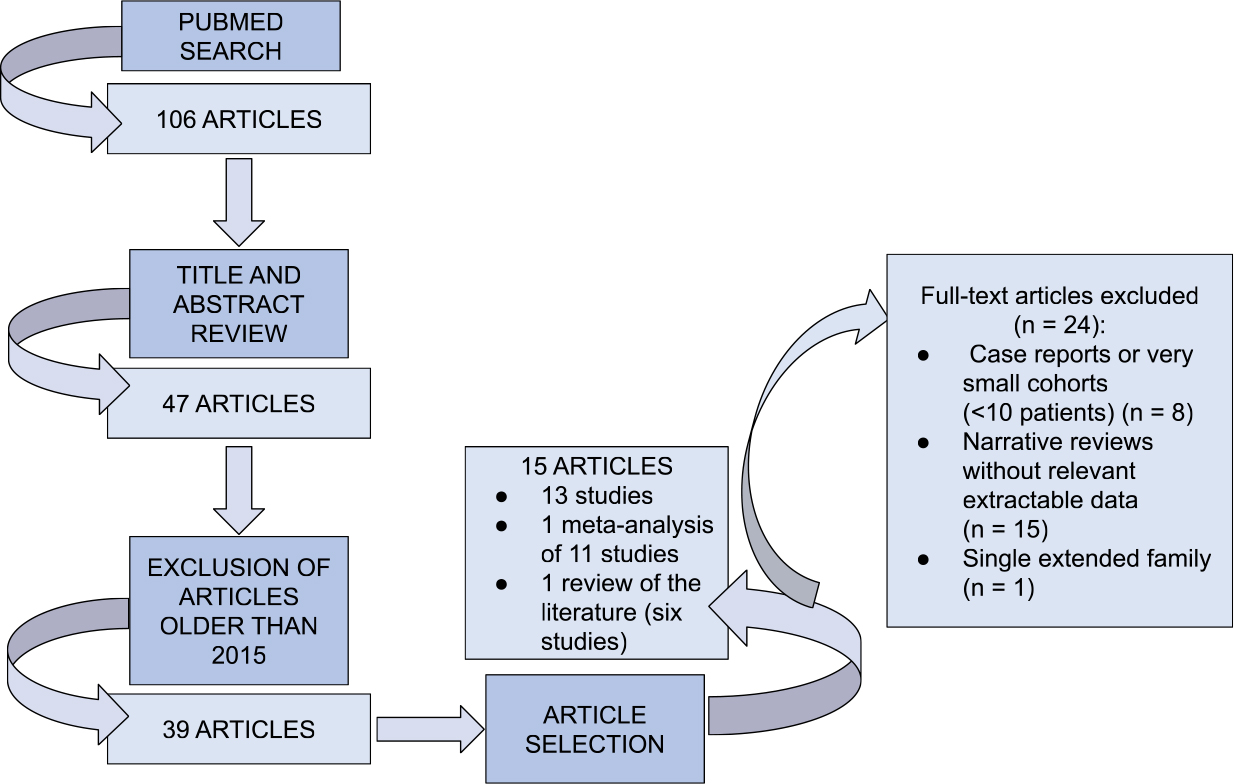
FIGURE 1.
The study selection process.
Furthermore, we searched for the most recent guidelines on genetic testing in children with cancer aimed at identifying CPS. We organized the findings of the recommendation with regards to the following information: who to test, when to offer genetic testing, testing technique and recommendations regarding genetic counselling.
Results
Current practices
In our systematic literature review, we conducted a detailed analysis of 15 articles (Figure 1). A complete list of all 15 evaluated articles is provided in the Table 1, where we compared the presentation of the following data: study type, cohort, age at diagnosis, genes analyzed, testing technique, and outcome (proportion of patients that tested positive for cancer genetic predisposition).
TABLE 1.
Summary of studies included in the literature review
| ARTICLE | Number of patients included in the study | Type of (primary) cancer | Genes analyzed | Testing technique | Proportion of positive for cancer predisposition syndrome | ||||
|---|---|---|---|---|---|---|---|---|---|
| Sebastian M Waszak et al., 201827 | 1022 -retrospective cohorts (n=673) -four prospective studies (n=349) | Medulloblastoma | 16 genes (APC, BRCA2, PALB2, PTCH1, SUFU, and TP53) | WGS and WES from blood and tumour samples | 6%(retrospective cohort) 5%(prospective cohort) | ||||
| RabeaWageneret al., 202128 | 160 | Leukemia, brain tumor, solid tumors, lymphomas, non-CNS embryonal tumor | 295 genes | WES (patient and the respective parents) | 13.8%(6.9%PV +6.9%VUS with a high suspicion of association with carcinogenesis) | ||||
| He Li et al., 202029 | 615 | Rhabdomyosarcoma | 70 genes | Exome-sequencing | 7.3% | ||||
| Zhaoming Wang, 201830 | 3,006 | Leukemia, lymphoma, CNS, other solid tumors | 156 genes | WGS (30-fold) | 5.8% | ||||
| Ulrike A Friedrich et al., 202331 | 139 | Leukemia, brain tumor, sarcoma, lymphoma, neuroblastoma, others | 433 genes | NGS (child + parent): Exome sequencing | 10.1% | ||||
| Carmen L Wilson et al., 202032 | 2450 | Not specified | 156 genes | WGS (mean coverage per sample 36.8X) | 11.8% | ||||
| Anna Byrjalsen et al, 202033 | 198 | Hematologic cancer, tumors of the central nervous system, solid tumors | 59 ACMG 'actionable' genes and 314 cancer genes. | WGS | 47.5%carried pathogenic variants (PVs) in a CPS gene or had clinical features indicating CPS | ||||
| Karin van der Tuin et al., 202434 | 97 | nonmedullary thyroid cancer | 780 genes | WGS | 13% | ||||
| Christian P Kratz et al., 202235 | 3975 (meta-analysis of 11 studies) | brain tumors, non-brain solid tumors, hematological neoplasms | 10 genes: BRCA1, BRCA2, PALB2, ATM, CHEK2, MSH2, MSH6, MLH1, PMS2 and TP53 | Byrjalsen et al. | WES | 2.99% | |||
| Reference | Included in the main analysis? | No. of participants | Chang et al. | WGS | |||||
| Byrjalsen et al. | Yes | 198 | Fiala et al. | NGS-based panel | |||||
| Chang et al. | Yes | 59 | Mody et al. | WES | |||||
| Fiala et al. | Yes | 751 | Newman et al. | WGS | |||||
| Mody et al. | Yes | 102 | Oberg et al. | WES | |||||
| Newman et al. | Yes | 299 | Parsons et al. | WES | |||||
| Oberg et al. | Yes | 101 | Stedingk et al. | Targeted sequencing | |||||
| Parsons et al. | Yes | 150 | Wagener et al. | WES | |||||
| Stedingk et al. | Yes | 790 | Wong et al. | WGS | |||||
| Wagener et al. | Yes | 160 | Zhang et al. | WGS, WES | |||||
| Wong et al. | Yes | 247 | Akhavanfard et al. | WES | |||||
| Zhang et al. | Yes | 1120 | Grobner et al. | WGS, WES | |||||
| Akhavanfard et al. | No | 1507 | Kim et al. | WGS, WES | |||||
| Grobner et al. | No | 914 | Li et al. | WES | |||||
| Kim et al. | No | 394 | Mirabello et al. | WES or targeted sequencies | |||||
| Li et al. | No | 615 | Waszak et al. | WES, WGS | |||||
| Mirabello et al. | No | 1244 | |||||||
| Waszak et al. | No | 1022 | |||||||
| Huma Q Rana et al., 201836 | 38,938 | Patients with SGT or MGPT were included. Among them 30,987 (79.6%) have personal history of cancer, 7951 (20.4%) have not. | TP53 | Single gene, multigene panels (comprehensive panels, breast panels, gyn panels, colon/GI panel, pancreas panel, kidney panel) | 0.2%vs 4.1%of individuals undergoing MGPT vs SGT | ||||
| Katharina Daugs et al., 202537 | 372 | Hematologic neoplasms, brain tumors, various solid entities | 25 selected HBOC-related genes | WES | 7% | ||||
| Liting Zhou et al., 202538 | 499 survivors with SNs (cases) and 625 survivors without (matched controls) | ALL, AML, HL, non-Hodgkin lymphoma, central nervous tumour, soft tissue sarcoma, Ewing sarcoma, osteosarcoma, retinoblastoma, neuroblastoma, Wilms tumor, germ cell tumor, other | 60 CPGs | WES | Cases: 14.43% Control: 6.08% | ||||
| Dianne E Sylvester et al., 201839 | a review of the literature | Zhang et al. | 89 genes | WES and WGS | 8.5%(95/1120) | ||||
| Zhang et al. | 1120 | All | |||||||
| Parsons et al. | 150 | Solid tumours | Parsons et al. | an unspecified | WES | 10.0%(15/150) | |||
| Mody et al. | 91 | All | Mody et al. | WES | 9.9%(9/91) | ||||
| Oberg et al. | 90 | All | Oberg et al. | WES | 20.0%(18/90) | ||||
| Chang et al. | 59 | Non-CNS solid tumours | Chang et al. | WES | 11.8%(7/59) | ||||
| Kline et al. | 31 | CNS tumours | Kline et al. | 510 genes | WES | 35.5%(11/31) | |||
| Gaëlle Bougeard et al., 201540 | 1,730 | Clinical suspicion of Li-Fraumeni syndrome. | TP53 | Sanger sequencing; if no mutation was detected, deletion/duplication analysis with QMPSF | 415 TP53 mutation carriers were identified | ||||
| Dianne E Sylvester et al., 202241 | 76 | Childhood cancer patients with features suggestive of a genetic predisposition to cancer | 1048 genes | Exome sequencing | 25% | ||||
1 acmg = american college of medical genetics and genomics; all = acute lymphoblastic leukemia; aml = acute myeloid leukemia; CNS = central nervous system; CPG = cancer predisposition gene; CPS = cancer predisposition syndrome; EGS = exome or extended gene sequencing; GI = gastrointestinal; HBOC = hereditary breast and ovarian cancer; HL = Hodgkin lymphoma; MGPT = multigene panel testing; NGS = next-generation sequencing; PV = pathogenic variant; QMPSF = quantitative multiplex PCR of short fluorescent fragments; GT = single-gene testing; SN = single nucleotide; WGS = whole genome sequencing; WES = whole-exome sequencing; VUS = variant of uncertain significance
Age at diagnosis and cohort size
Cohort sizes varied substantially across studies, ranging from 31 to 3,975 participants.The largest cohort was included in a meta-analysis of 11 studies comprising exclusively paediatric patients.Most studies focused on children diagnosed with cancer, whereas one study (TP53 phenotype comparison) included both paediatric and adult individuals due to the absence of age restrictions.The ALTE03N1 study evaluated childhood cancer survivors, comparing those with subsequent neo-plasms to matched controls.
Genes analysed
The number of genes assessed differed markedly between studies. The meta-analysis evaluated 10 genes common to all included datasets, while other studies analysed between 1 and 1,048 genes depending on the testing platform. Most cohorts included patients with heterogeneous cancer types, whereas three studies focused on a single paediatric malignancy.
Testing technique
Testing approaches ranged from single-gene testing (SGT) to multigene panel testing (MGPT). The TP53-focused study directly compared SGT and MGPT, illustrating methodological differences in variant detection. The majority of remaining studies employed MGPT, while the ALTE03N1 study systematically tested both cases and controls for pathogenic or likely pathogenic germline variants.
Outcome: proportion of genetic predisposition
The prevalence of germline pathogenic or likely pathogenic variants varied widely. The meta-analysis reported a prevalence of 2.99%across the 10 evaluated genes. In the TP53 study, 4.1%of individuals tested with SGT were TP53-positive compared with 0.2%of those tested with MGPT. In the ALTE03N1 cohort, the prevalence was 14.43%among survivors with subsequent neoplasms and 6.08%among controls. Across the remaining studies, reported prevalence ranged from 5.0%to 47.5%, reflecting differences in cohort composition, gene panel size, and testing methodology.
A detailed examination of the studies included in our systematic literature review is provided in Supplementary Table 1. This table offers a more extensive overview; in addition to the expanded descriptions of the categories presented in Table 1, Supplementary Table 1 also includes information on study design and age at diagnosis.
Figure 2 provides a schematic overview of the main characteristics of the studies included in our literature review. It highlights the number of individuals enrolled in each study who underwent genetic testing, the number of genes analysed (indicated by the green star), and the proportion of identified genetic predisposition (represented by the length of the colored bars). Distinct colors denote different cohorts according to the type of primary diagnosis.
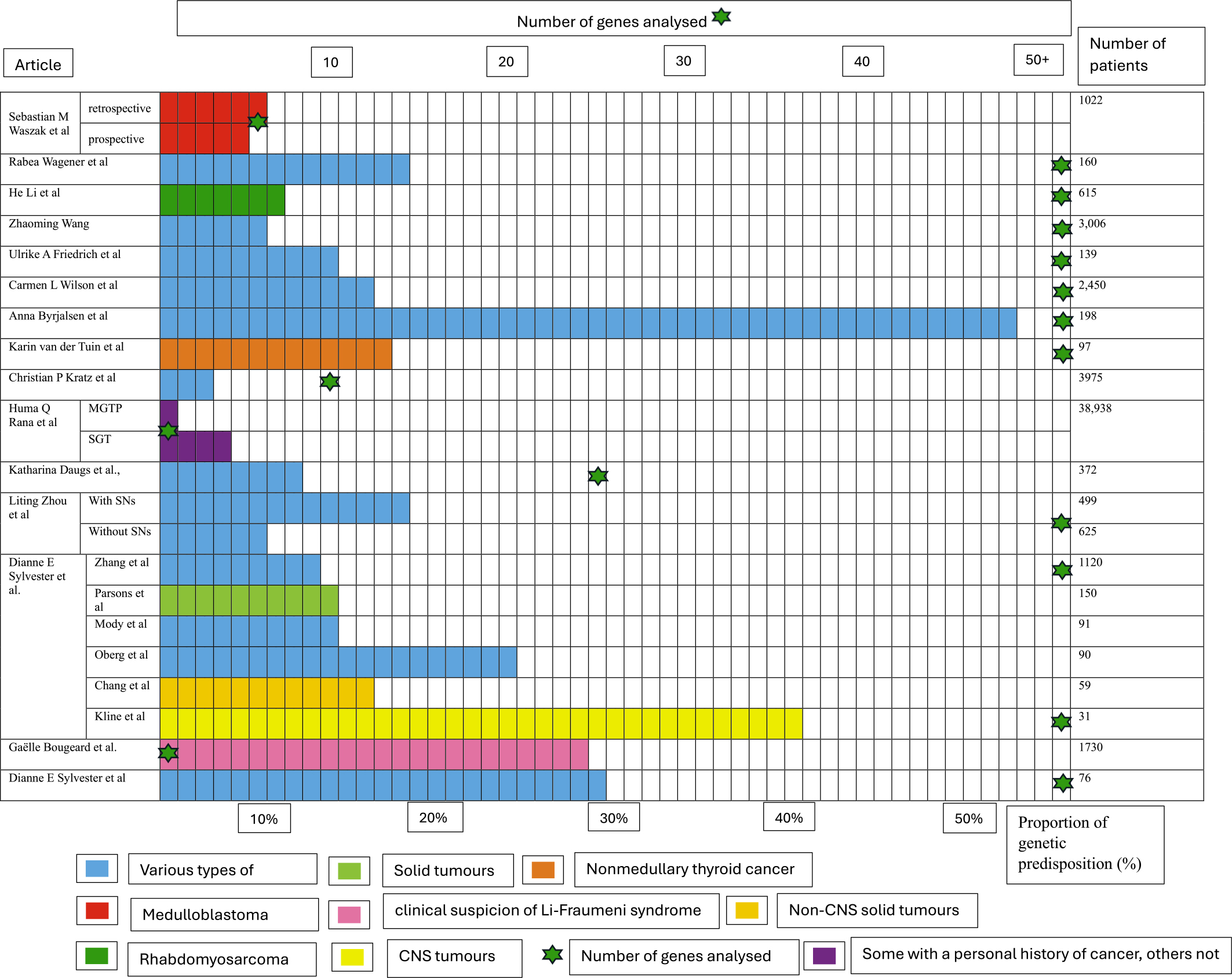
FIGURE 2.
Schematic representation of the main characteristics of the studies included in our literature review.
Guidelines/recommendations for genetic testing and counseling in children diagnosed with cancer
We also searched for guidelines, recommendations or published approaches related to cancer genetic testing in children with cancer. The results are summarized in Table 2. Overall, the recommendations are largely concordant across guidelines and are primarily structured around defined clinical selection criteria. These typically include clinical and phenotypic features, tumor type, family history of malignancy, and molecular findings identified in tumour tissue. Accordingly, most guidelines recommend genetic testing in patients who meet established clinical or biological criteria and do not support universal germline testing or routine use of broad multigene panels in all patients. In contrast, the “Swedish approach” differs in scope, as Sweden has reportedly implemented precision medicine diagnostics using WGS for all children with cancer since 2021.13,42–47
TABLE 2.
Overview of different guidelines/recommendations for genetic testing and counseling in children diagnosed with cancer
| GUIDELINES RECOMMENDATIONS (author, year of publication) | WHOM/WHEN TO TEST | GENETIC COUNSELING/TESTING/TESTING TECHNIQUE | |
|---|---|---|---|
| Genetic testing for childhood cancer predisposition syndromes: Controversies and recommendations from the SIOPE Host Genome Working Group meeting 2022 (Bakhuizen JJ, Bourdeaut F et al., 2024)42 | All children with cancer should undergo clinical screening for their risk of harboring a CPS. | It is recommended to use targeted genetic testing based on clinical indication. Comprehensive CPS gene panels containing over 100–150 genes for all pediatric cancer should rather be used in research contexts than routine practice. Smaller actionable gene panels can be considered when they include genes that supporting diagnosis or have a direct impact on therapeutic management. | |
| Paediatric cancers or tumours – when a genetic assessment is indicated (Cancer Institute NSW, 2020)43 | Family history criteria (child unaffected) An unaffected child may (being at risk of a known cancer predisposition condition) before age 18 years. - Condition: familial adenomatous polyposis, neurofibromatosis type 1, neurofibromatosis type 2, Gorlin, PTEN hamartoma/Cowden, MEN2, SDHx-related familial paraganglioma-phaeochromocytoma, juvenile polyposis, rhabdoid tumour predisposition syndrome, Peutz-Jeghers, Li-Fraumeni, von Hippel-Lindau disease - Gene: AIP, ALK or PHOX2B, APC, CDC73, CMMRD, DICER1, MEN1, CDKN1B, NF1, NF2, PTCH1, SUFU, PTEN, RB1, RET, SDHx-, SMAD4, SMARCA4, SMARCB1, STK11, TP53, VHL | Family history criteria (child unaffected) - predictive genetic testing before age 18 years | |
| Family history criteria (child with cancer) A child with a cancer and one of the following family history characteristics: - Another relative with a cancer diagnosed under age 18 years - 1 or more first degree relative(s) (parent or sibling) with a cancer diagnosed under age 45 years - 2 or more first/second degree relatives in the same lineage with a cancer diagnosed under age 45 years - Parents are genetically related (i.e. consanguineous) | Family history criteria (child with cancer) - considered for testing and/or referred to genetics | ||
| General criteria (child with cancer) A child with cancer and any one of the following features: - Growth abnormalities (e.g. short stature, microcephaly, macrocephaly, overgrowth) - Congenital anomalies (e.g. oral clefting, structural cardiac defects, microphthalmia, microcephaly, urinary tract anomalies) - Facial dysmorphism - Skin features (e.g. unusual pigmentation, multiple café-au-lait macules, UV hypersensitivity) - Haematological abnormalities not explained by the cancer diagnosis or treatment (e.g. thrombocytopenia, anaemia, pancytopenia) - Immunodeficiency not explained by the cancer diagnosis or treatment - Excessive treatment toxicity - Multiple primary cancers (unless the second malignancy is consistent in time and/or tissue type with those expected from their treatment regime); includes multiple or bilateral primary cancers of the same type - Unusual age of onset. Either a cancer usually diagnosed in adulthood (e.g. basal cell carcinoma, colorectal cancer, ovarian cancer, meningioma, renal cell carcinoma); or a cancer diagnosed in a prepubertal child, when the usual age at diagnosis is teenage or young adult years | General criteria (child with cancer) - should be considered for testing and/or referred to genetics unless there is a known alternative explanation for these additional features | ||
| Cancer/tumour criteria A child with one of the following cancers/tumours*: (* This list is not all inclusive. There are other rare tumours/cancers where referral to a clinical genetics service is indicated. Clinical judgement should be used ** 5 or more juvenile polyps or any number of Peutz-Jeghers polyps *** 3 or more under age 10 years; 5 or more over 10 years) - Adrenocortical carcinoma - Medulloblastoma 1. WNT subtype without documented somatic CTNNB1 mutation 2. SHH subtype under age 18 years - B acute lymphoblastic leukaemia (ALL) – low hypodiploid (32-39 chromosomes) - Myelodysplastic syndrome (MDS) - Cerebellar gangliocytoma (Lhermitte-Duclos disease) - Neuroblastoma (with other features suggestive of germline abnormality) - Choroid plexus carcinoma - Optic glioma - Colorectal polyps – hamartomatous** - Osteosarcoma - Colorectal polyps – multiple adenomatous or serrated/hyperplastic*** - Ovarian Sertoli-Leydig cell tumour - Cystic nephroma - Paraganglioma or phaeochromocytoma - Desmoid-type fibromatosis (intra-abdominal/abdominal wall location) - Pineoblastoma - Endolymphatic sac tumour - Pituitary blastoma | - Gastrointestinal stromal tumour (GIST) - Pleuropulmonary blastoma - Haemangioblastoma - Retinoblastoma - Hepatoblastoma - Rhabdomyosarcoma (anaplastic subtype at any age, or any subtype under age 3 years) - Infantile myofibromatosis - Schwannoma - Juvenile myelomonocytic leukaemia (JMML) - Small cell carcinoma of the ovary hypercalcaemic type (SCCOHT) - Malignant peripheral nerve sheath tumour - Subependymal giant cell tumour - Malignant rhabdoid tumour - Wilms tumour - Medullary thyroid cancer General Immunohistochemistry or NGS of tumour DNA raises the possibility of a heritable pathogenic variant in a cancer predisposition gene e.g. CMMRD, Li Fraumeni and others | Cancer/tumour criteria should be considered for testing and/or referred to genetics irrespective of other factors | |
| Childhood cancer: Indication for genetic counseling?* *updated Jongmans criteria [Jongmans et al., 2016] (supporting document to Ripperger et al., 2017)44 | At least one criterion fulfilled - patient may benefit from genetic counselling: | ||
| 1. Family history (3 generation pedigree) - ≥2 malignancies occurred in family members before age 18 years, including index patient - Parent or sibling with current or history of cancer before age 45 years - ≥2 first or second degree relatives in the same parental lineage with cancer before age 45 years - The parents of the child with cancer are consanguineous | |||
| 2. One of the following Neoplasms was diagnosed: - Adrenocortical carcinoma / adenoma - ALL (low hypodiploid) - ALL (ring chromosome 21) - ALL (Robertsonian translocation 15;21) - ALL relapse (TP53 mutated) - AML (Monosomy 7) - Basal cell carcinoma - Botryoid rhabdomyosarcoma of the urogenital tract (fusion-negative) - Chondromesenchymal harmatoma - Choroid plexus carcinoma / tumor - Colorectal carcinoma - Cystic nephroma - Endolymphatic sac tumor - Fetal rhabdomyoma - Gastrointestinal stromal tumor - Glioma of the optic pathway (with signs of NF1) - Gonadoblastoma - Hemangioblastoma - Hepatoblastoma (CTNNB1 wildtype) - Hepatocellular carcinoma - Infantile myofibromatosis - Juvenile myelomonocytic leukemia - Keratocystic odontogenic tumor - Large cell calcifying Sertoli-cell-tumor - Malignant peripheral nerve sheath tumor - Medullary thyroid carcinoma - Medulloblastoma (SHH activated) - Medulloblastoma (WNT activated, CTNNB1 wildtype) | - Medullary renal cell carcinoma - Medulloepithelioma - Melanoma - Meningioma - Myelodysplastic syndrome - Myeloproliferative neoplasms (except CML) - Myxoma - Neuroendocrine tumor - Paraganglioma / pheochromocytoma - Parathyroid carcinoma / adenoma - Pineoblastoma - Pituitary adenoma / tumor - Pituitary blastoma - Pleuropulmonary blastoma - Renal cell carcinoma - Retinoblastoma - Rhabdoid tumor - Rhabdomyosarcoma with diffuse anaplasia - Schwannoma - Schwannomatosis - Sertoli-Leydig cell tumor - Sex cord stromal tumor with annular tubules - Small cell carcin, of the ovary hypercalcemic type - Squamous cell carcinoma - Subependymal giant cell astrocytoma - Thyroid carcinoma (non-medullary) - Transient myeloproliferative disease - Other rare cancers or cancers that typically occur in adults, unusually early manifestation age | ||
| 3. Genetic tumor analysis reveals defect suggesting a germline predisposition | |||
| 4. A patient with ≥2 malignancies (e.g. secondary, bilateral, multifocal, metachronous) | |||
| 5. A child with cancer and congenital or other anomalies Sign: - Congenital anomalies: Abnormal organs, skeletal anomalies, oral clefting, abnormal teeth, urogenital anomalies, abnormal hearing or vision, etc. - Facial dysmorphism - Mental impairment, developmental delay: Abnormal behavior, learning difficulties - Abnormal growth: Height, head circumference, birth weight, hemihyperplasia, growth chart - Skin anomalies: Abnormal pigmentation such as ≥2 café-au-lait spots, vascular lesions, hypersensitivity to sun, benign tumors, etc. - Hematological abnormalities (not explained by current cancer): Pancytopenia, anemia, thrombocytopenia, neutropenia, leukopenia, macrocytic erythrocytes - Immune deficiency: Frequency of infections, lymphopenia - Endocrine anomalies: Primary hyperparathyroidism, precocious puberty, gigantism/acromegaly, Cushing syndrome | |||
| 6. The patient suffers from excessive toxicity of cancer therapy | |||
| The McGill Interactive Pediatric OncoGenetic Guidelines (MIPOGG) (Supplementary Online Content to Gouide C. et al. 2021)45 | Tumor-specific criteria Characteristic that increases the likelihood of having an underlying CPS in the setting of a specific tumor type. These questions can refer to one or more CPS types. | A referral to genetics is recommended. | |
| Universal criteria Characteristic that increases the likelihood of having an underlying CPS, independent of the tumor type. These questions do not refer to a specific CPS type. The universal criteria specify the existence of the following conditions: 1. More than 1 primary tumor (asynchronous or synchronous) 2. Dysmorphism or congenital anomaly that, according to the practitioner's judgment, may be related to the cancer 3. Cancer occurring at age <50 years in a parent/sibling 4. Cancer occurring at age <18 years in an aunt/uncle/first cousin/grandparent 5. Same cancer type or same organ affected by cancer in a close relative 6. Close relative with multiple primary tumors (excluding non-melanoma skin cancer) at age <60 years | |||
| Direct Referrals Included in MIPOGG Myelodysplastic syndromes including JMML Adrenocortical carcinoma Chondrosarcoma GIST Leiomyosarcoma Liposarcoma Atypical lipomatous tumor / well differentiated liposarcoma MPNST Breast tumors Phyllodes tumor Cardiac myxoma Cardiac rhabdomyoma Hepatoblastoma Pleuropulmonary blastoma Medulloepithelioma Retinoblastoma Keratocystic odontogenic tumor Parathyroid tumor Medullary thyroid carcinoma Ovarian SLCT Ovarian sex cord-stromal tumor with annular tubules Cystic nephroma Renal cell carcinoma Anaplastic sarcoma of the kidney Mesothelioma | Pheochromocytoma / Paraganglioma Rhabdoid tumor Angiomyolipoma Gardner fibroma / nuchal-type fibroma Lymphangioleiomyomatosis Nasal chondromesenchymal hamartoma Schwannoma / Acoustic neuroma Fibrofolliculoma Mucosal neuroma Trichodiscoma Carcinomas that typically present in adult age (e.g., breast, gastrointestinal, squamous cell carcinoma, pancreatic, uterine, vaginal, ovarian) Atypical teratoid rhabdoid tumor Choroid plexus carcinoma Dysplastic cerebellar gangliocytoma Endolymphatic sack tumor Hemangioblastoma Medulloepithelioma Meningioma Pineoblastoma Pituitary blastoma Schwannoma Subependymal giant cell tumor | ||
| SWEDISH APPROACH Whole genome sequencing becomes clinical routine for all cases of pediatric cancer (Karolinska university hospital, 2024)46 Childhood Cancer in Sweden (European Partnership for Personalised Medicine - EP PerMed)47 | All children in Sweden diagnosed with cancer (since 2021) | precision medicine diagnostics through WGS | |
| All children in Sweden with cancer (since May 2024) | WGS and whole-transcriptome sequencing (WTS) as part of the standard of care at diagnosis | ||
| Recognition of genetic predisposition in pediatric cancer patients: An easy-to-use selection tool (Jongmans et al., 2016)48 | fulfilling one or more of the criteria: | may benefit from referral to a clinical geneticist. | |
| 1. Family history of the child with cancer - ≥2 malignancies at childhood age (≤18 years) - a first degree relative (parent or sibling) with cancer <45 years - ≥2 second degree relatives with cancer <45 years of age on the same side of the family - the parents of the child with cancer are related | |||
| 2. One of tumors in childhood: - Adrenocortical carcinoma - Atypical teratoid rhabdoid tumor - Cerebellar gangliocytoma - Choroid plexus carcinoma - Endolymphatic sac tumors - Hemangioblastoma - Hepatoblastoma - JMML - Low hypodiploid ALL - Malignant peripheral nerve sheath tumor - Medullary thyroid carcinoma - Medulloblastoma | - Optic glioma - Ovarian sertoli-leydig cell tumor - Pleuropulmonary blastoma - Pituitary blastoma - Pineoblastoma - Retinoblastoma - Schwannoma - Subependymal giant cell tumors Or A cancer of adult age, i.e. colorectal cancer, ovarian cancer, basal cell carcinoma etc. | ||
| 3. A child with two malignancies one of those with onset <18 years of age (unless the 2nd malignancy is consistent in time and/or tissue type with these expected from their treatment regimen). | |||
| 4. A child with cancer and congenital anomalies or other specific symptoms | |||
| Sign | Think of | ||
| Congenital anomalies | Organs, bones, oral clefting, teeth, eyes, ears, brain, urogenital anomalies, etc. | ||
| Facial dysmorphisms | |||
| Intellectual disability | |||
| Aberrant growth | Length, head circumference, birth weight, asymmetric growth | ||
| Skin anomalies | Aberrant pigmentation i.e. >2 café-au-lait spots, vascular skin changes, hypersensitivity for sunlight, multiple benign tumors of the skin | ||
| Hematological disorders | Pancytopenia, anemia, thrombocytopenia, neutropenia | ||
| 5. A child with excessive treatment toxicity. | |||
1 ALL = acute lymphoblastic leukemia; malignant proliferation of lymphoid precursor cells in bone marrow and blood; CMMRD = constitutional mismatch repair deficiency; CML = hronic myeloid leukemia; CPS = cancer predisposition syndrome; DNA = deoxyribonucleic acid; MDS = myelodysplastic syndrome; MEN2 = multiple endocrine neoplasia type 2; GIST = aastrointestinal stromal tumour; JMML = juvenile myelomonocytic leukemia; MIPOGG – The McGill Interactive Pediatric OncoGenetic Guidelines; NGS = next-generation sequencing; NF1 = neurofibromatosis type 1; NSW = New South Wales (commonly used to denote regional clinical guidelines or registries originating from New South Wales, Australia); SCCOHT = small cell carcinoma of the ovary, hypercalcemic type; SIOPE = International Society of Paediatric Oncology Europe; SLCT – Sertoli–Leydig cell tumor; UV = ultraviolet radiation; WGS = whole-genome sequencing; WTS = whole-transcriptome sequencing
Discussion
In this systematic review, we evaluated current practices in genetic testing for hereditary cancer predisposition in paediatric cancer patients across published studies. We summarized which paediatric cancer populations undergo genetic testing, the age at testing, the genes most frequently analysed, the diagnostic methods used, and the reported prevalence of germline cancer predisposition. In addition, we reviewed currently available guidelines and recommendations for genetic testing in children with cancer and compared their main principles across different clinical settings.
Current practices
Cohort characteristics and age at testing
Overall, most studies included cohorts with broadly similar structures; however, differences in cohort composition were observed. Cohort sizes varied considerably, ranging from 31 to 3,975 participants. In some studies, cohorts consisted exclusively of patients with a specific tumour type, such as medulloblastoma27, rhabdomyosarcoma29, or paediatric non-medullary thyroid cancer34, whereas in most studies inclusion was based primarily on a diagnosis of cancer rather than tumour subtype. This heterogeneity likely reflects differences in study objectives, patient selection strategies, and the rapid evolution of genetic testing technologies in paediatric oncology.
Some studies applied more complex cohort definitions, for example including childhood cancer patients with clinical features suggestive of a genetic cancer predisposition41, French patients with clinical suspicion of Li-Fraumeni syndrome40, or individuals undergoing either SGT or MGPT.36
Some studies focused on survivors of childhood cancer, such as adult 10-year survivors of childhood cancer diagnosed before 15 years of age between 1960 and 2006 in the United States32, or survivors who were more than five years from initial cancer diagnosis.30 This highlights that germline predisposition is clinically relevant not only at primary diagnosis but also during long-term survivorship.
A notable exception was the study Differences in TP53 Mutation Carrier Phenotypes Emerge From Panel-Based Testing. This study differed from most other included publications, as it primarily evaluated the proportion of TP53 variant carriers identified through SGT compared with MGPT. The cohort composition was also distinct, including both individuals with a history of cancer and individuals without cancer who underwent testing for other indications, provided that the testing panel included TP53. Furthermore, this study did not impose age restrictions, meaning that children were included but were not exclusively represented.36 The remaining studies were more similar in design, with the exception of the ALTE03N1 study, which included both childhood cancer survivors with subsequent neoplasms (cases) and survivors without subsequent neoplasms (controls), all of whom underwent germline genetic testing.38 Given that this literature review did not focus on the occurrence of new primary tumours, both the control and case groups provide relevant information for our analysis. In addition, the case group offers an interesting additional perspective on genetic predisposition in patients with multiple primary tumours.
With regard to patient age at diagnosis, our analysis primarily focused on paediatric cancer populations. Most studies included children and adolescents or children and young adults. However, exceptions were observed, as noted above, where children represented only a subset of the cohort.36 In addition, in more complex study designs that combined multiple subcohorts, age distributions were not uniform. For example, in the medulloblastoma study, the retrospective cohort had no age restriction, whereas four prospective cohorts applied different age limits (≤5 years, 3–21 years, 3–39 years, and all ages).27 More detailed cohort descriptions and age restrictions are provided in Supplementary Table 1.
Genes analysed and testing approaches
The studies included in our systematic review also differed substantially in the number of analysed genes. Overall, the number of genes analyzed ranged from 1 to 1,048. For example, the included meta-analysis focused on 10 genes that were common across all included datasets.35 In general, it could be observed that studies with more tumor-type–specific cohorts tended to focus on a smaller number of genes. For instance, in the study Revisiting Li-Fraumeni Syndrome from TP53 Mutation Carriers, which included patients with clinical suspicion of Li-Fraumeni syndrome, only a single gene (TP53) was analyzed40, which is clinically justified given the underlying syndrome. Similarly, in the medulloblastoma cohort, only six genes were analyzed.27 However, this was not a consistent rule, as in the rhabdomyosarcoma cohort, despite tumor specificity, 70 genes were analyzed.29 This variability likely reflects differences in clinical indication for testing, availability of sequencing technologies, and evolving understanding of cancer predisposition in pediatric oncology.
Testing approaches ranged from SGT to MGPT. Overall, the most commonly used sequencing approaches were WGS and WES, performed for example using blood or tumour tissue samples27, and in some studies using trio analysis (patient and both parents).28 In the meta-analysis, additional methods included next-generation sequencing based (NGS-based) gene panels and targeted sequencing approaches.35 The increasing use of broad sequencing approaches reflects the shift toward comprehensive germline risk assessment but also increases the likelihood of detecting variants with uncertain clinical relevance.
The TP53-focused study directly compared SGT and MGPT, illustrating methodological differences in variant detection. Within this study, several types of multigene panels were used, including comprehensive cancer panels, breast cancer panels, gynecological cancer panels, colon/gastrointestinal panels, pancreatic cancer panels, and kidney cancer panels.36
The majority of the remaining studies employed MGPT as the primary testing approach, while the ALTE03N1 study systematically tested both cases and controls for pathogenic or likely pathogenic germline variants.38
Outcome: proportion of genetic predisposition
The proportion of genetic predisposition varied substantially across the included studies. This variability is expected, given the differences in cohort structure, the spectrum of analysed genes, and the applied testing methodologies. The prevalence of germline pathogenic or likely pathogenic variants ranged from 0.2%to 47.5%. Intuitively, studies focusing on a smaller number of genes are likely to report a lower proportion of genetic predisposition, resulting in a lower diagnostic yield. Conversely, one could argue that cohorts with a narrower tumour-type focus and fewer analysed genes may include patients with a higher pre-test probability for a specific genetic predisposition, thereby increasing the yield.
In line with this, the meta-analysis reported a prevalence of only 2.99%across the 10 evaluated genes.35 Similarly study Differences in TP53 Mutation Carrier Phenotypes Emerge From PanelBased Testing, focusing on a single gene, showed that 4.1%of individuals tested with SGT were TP53-positive compared with 0.2%of those tested with MGPT.36
In the ALTE03N1 cohort, the prevalence was 14.43%among survivors with subsequent neoplasms and 6.08%among controls.38 This pattern is not unexpected, as it is well established that genetic predisposition confers an increased risk for specific cancer types and therefore also for the development of additional primary tumours in genetically predisposed individuals.49
Studies in children and adolescents (or childhood cancer survivors) that analysed a larger number of genes and included tumour-nonspecific cohorts reported prevalences ranging from 5.8%to 47.5%. The lowest proportion was observed in the study Genetic Risk for Subsequent Neoplasms Among Long-Term Survivors of Childhood Cancer, with a prevalence of only 5.8%.30 However, it should be noted that this cohort consisted of childhood cancer survivors (≥ 5 years post-diagnosis). One must consider that not all children with cancer survive long term, and those who do not survive are excluded from such cohorts, which may artificially lower the observed prevalence of genetic predisposition.
Interestingly, a study with a similar design which also included childhood cancer survivors (≥ 10 years post-diagnosis), reported a prevalence of 11.8%.31 Although this study included approximately 1.2-fold fewer participants, both cohorts comprised at least 2,450 individuals. Thus, both cohorts can be considered substantially large in the context of germline predisposition studies. This raises the question of what might explain the roughly two-fold difference in prevalence, given that the number of analysed genes was identical and both studies used WGS (30-fold coverage in the first study and mean coverage of 36.8x in the second).
Another outlier was the 47.5%prevalence reported in study from Denmark.33 Several factors could contribute to this exceptionally high proportion. The cohort may have included individuals with a more apparent suspicion of genetic predisposition, or the very young age of the patients (more than half were under 5 years old) may have played a role, as environmental influences are less likely to contribute to cancer development in this age group.
The remaining prevalence estimates aligned well with theoretical expectations, as the proportion of genetic predisposition in childhood cancer is generally estimated at around 10%.50 The included literature review also reported comparable values, ranging from 8.5%to 35.5%.39
Taken together, these findings highlight that reported prevalence of germline predisposition is highly context-dependent and must always be interpreted in light of cohort selection, testing breadth, and clinical indication.
As it is documented, the leading cause of premature mortality among childhood cancer survivors are secondary neoplasms (SNs).51–53 Most of them are associated with prior radiotherapy54, as well as exposure to alkylating agents, platinum compounds, and anthracyclines55, yet growing evidence suggests that underlying pathogenic or likely pathogenic variants (P/LPVs) in cancer predisposition genes (CPGs) may further influence risk.56,57 These findings underscore the potential value of integrating CPG status into clinical practice, not only to identify survivor subgroups at highest risk for SNs, but also to guide decisions on which children should undergo genetic screening to refine risk assessment and implement targeted surveillance or risk-reduction strategies. In one of the studies by Zhou et al., carriers of P/LPV had 4.26-fold increased odds of developing SNs (95%CI = 2.36–7.69), with stronger associations observed in survivors exposed to platinum-based chemotherapy and in those not treated with radiotherapy. Survivors were then stratified using a clinical risk classifier into low-risk (22%) and moderate-to-high-risk groups (78%). Most carriers of at least one P/LPV, including all TP53 and RB1 pathogenic variant carriers, were classified as moderate-to-high risk. TP53 carriers most commonly developed secondary central nervous system tumours, osteosarcomas, soft tissue sarcomas, or breast cancer, consistent with the known tumour spectrum associated with this gene. These observations support referral of survivors at moderate-to-high risk for genetic counselling and highlight the utility of mutation status in guiding individualized surveillance strategies.38 Follow-up provided by a dedicated physician adhering to current guidelines probably ensures optimal long-term care for survivors.58
Guidelines/recommendations for genetic testing and counselling in children diagnosed with cancer
In the second part of this systematic review, we summarized recent guidelines and recommendations for genetic counselling and testing in children diagnosed with cancer, based on a review of the available literature identified through an online search. Seven relevant publications were included, and their key concepts are synthesized in Table 2 (Results). This section we considered particularly important, as growing evidence suggests that an increasing proportion of childhood cancers is associated with CPGs, and advances in knowledge and technology continue to expand the spectrum of identifiable genes and hereditary syndromes, enabling more personalized treatment and targeted surveillance for patients and their families.59 Pediatric oncologists play a central role in identifying children at risk for CPSs; however, only a limited number have sufficient specialized training to manage this process independently.60,61 Therefore, we aimed to compile and compare the most up-to-date guidelines within a single framework, focusing on differences in patient selection for referral to genetic counselling and/or testing, the timing of these interventions, and the clinical, familial, and tumour-related criteria applied.
Genetic testing is becoming increasingly rapid, affordable, and widely available, and many pediatric oncology centres have incorporated paired tumour–germline sequencing into routine diagnostics. Nonetheless, the key question remains which patients should undergo comprehensive germline testing.42 Should testing be offered universally to all children with cancer, or should it follow a more conservative, phenotype-driven approach?
Currently, three main strategies are described for identifying patients with CPS: (i) a phenotype-driven approach, in which genetic testing is offered to selected high-risk patients based on clinical evaluation; (ii) a phenotype-agnostic approach, in which all patients undergo comprehensive testing of genes associated with CPSs using large gene panels; and (iii) a combined approach, in which all patients are tested for a limited gene set, followed by additional phenotype-driven testing when clinically indicated.42
Most guidelines agree that a defined clinical suspicion of a CPS should precede referral for genetic counselling and testing. The SIOPE Host Genome Working Group, following its meeting in Paris in November 2022, concluded in a 2024 publication that all children with cancer should undergo clinical screening for CPS, with targeted genetic testing guided by clinical indications. The use of comprehensive, phenotype-agnostic CPS gene panels in all pediatric patients was recommended primarily for research purposes, rather than routine clinical practice, to evaluate their impact and expand understanding of CPS phenotypes.42
Most guideline publications support a phenotype-driven approach, and a variety of clinical screening tools have been developed to identify children at increased risk for CPS. Across most approaches, there is a broad consensus in the criteria used, which consistently address: (i) family history, assessed through evaluation of unaffected children or children with cancer43, three-generation pedigrees62, or focused assessment of the affected child48; (ii) tumour characteristics, such as rare tumours, malignancies typically associated with adulthood but occurring in childhood, tumours with distinct histological or molecular subtypes, tumours linked to known CPS43, or the use of predefined tumour lists prompting consideration of an underlying CPS43,48,62; (iii) congenital or other anomalies, including dysmorphic features, congenital malformations, growth abnormalities, characteristic cutaneous findings (e.g. café-au-lait macules, abnormal pigmentation)43,48,62; (iv) the occurrence of multiple primary malignancies, including multiple or bilateral primary tumours of the same type43, secondary, bilateral, multifocal, or metachronous malignancies62, or the development of multiple cancers, one of them under 18 years where subsequent malignancies are not attributable to therapy48; and (v) excessive treatment-related toxicity.43,48,62
A decision-support tool is also described in The McGill Interactive Pediatric OncoGenetic Guidelines (MIPOGG): An approach to identifying pediatric oncology patients most likely to benefit from a genetic evaluation. MIPOGG is based on tumour-specific algorithms with sequential “yes/no” questions, allowing clinicians to assess the likelihood that a tumour is caused by a germline mutation. The algorithms combine tumour-specific and universal criteria (detailed in Table 2) and include a direct referral category for tumours with a high probability of germline origin. The tool is currently available in a non-digital format, with a point-of-care mobile application planned for future implementation.45
Two articles describe an alternative, phenotypeagnostic approach, currently most extensively implemented in Sweden, where genetic testing is offered to all children with cancer regardless of clinical phenotype. Since 2021, Sweden has provided WGS of tumour and normal tissue as part of precision diagnostics for all pediatric cancer patients46, and since May 2024, has additionally incorporated WGS and whole-transcriptome sequencing (WTS) into routine diagnostic care at the time of cancer diagnosis.47
Globally, however, the phenotype-driven approach remains predominant in clinical practice. Bakhuizen et al. showed that systematic clinical assessment followed by targeted referral for genetic evaluation identifies over 90%of patients with a (likely) causal CPS.7,45,63 While broad genetic testing of all paediatric cancer patients may enhance understanding of cancer aetiology and is valuable in research settings, it cannot replace comprehensive clinical evaluation, as some CPSs may otherwise remain undetected.64,65
The phenotype-driven approach generally increases clinical relevance by focusing testing on patients with a clear suspicion of CPS, thereby increasing the likelihood of identifying clinically actionable pathogenic variants. Use of smaller gene panels also reduce the detection of variants of uncertain significance or incidental findings, which can create uncertainty for both healthcare professionals and patients and increase the psychological burden on families.66,67 However, this approach may be limited by incomplete or unreliable family history, variable penetrance, and de novo mutations.68,69 In addition, the presence of congenital or other anomalies does not necessarily indicate an underlying CPS70,71, and their absence does not exclude it, as some clinical features may only become apparent later in life.72 In such cases, careful clinical judgment is essential, as inaccurate or incomplete assessment may lead to suboptimal patient selection for genetic evaluation.
Advocates of the phenotype-agnostic approach argue that universal testing supports precision medicine by enabling molecularly informed treatment decisions.46 National pilot data indicate improved tumour classification or identification of prognostic markers in approximately 50%of cases, as well as earlier diagnosis and more individualized long-term follow-up.46,47 Nevertheless, widespread implementation remains limited by substantial financial, organizational, and workforce demands.
Although current guidelines predominantly favour a phenotype-driven strategy, each approach has inherent strengths and limitations. Ultimately, the choice of diagnostic strategy depends on local resources, technical capacity, availability of clinical genetic expertise, and regulatory frameworks.42 So far, no consensus has been reached on the optimal approach for children with cancer; however, in most settings, the phenotype-driven strategy currently provides the most balanced and sustainable option).
A potential limitation of this review is that only articles published in English were included, which may have led to the exclusion of potentially relevant studies published in other languages. Finally, it should be noted that in the Current Studies section of this review, the literature search was limited to articles identified through keyword searches in the PubMed database. This methodological approach may have resulted in the omission of relevant studies indexed in other biomedical databases. Consequently, a more comprehensive search across multiple databases might have identified additional publications, which could further strengthen the evidence base and broaden the population-level generalizability of our conclusions.
Conclusions
Most children with cancer do not exhibit an obvious genetic predisposition; however, growing evidence indicates that such predisposition plays an important role in an increasing proportion of cases. Globally, two main approaches are currently employed: the phenotype-driven and the phenotype-agnostic strategy, each with its own advantages and limitations. In current clinical practice, considering available resources, expertise and infrastructure, the phenotype-driven approach remains the most practical strategy in most healthcare systems worldwide, as it provides the most balanced trade-off between resources invested and diagnostic yield. In the future, with advances in technology and the ability to sequence multiple genes more rapidly, a broader, more universal diagnostic approach may become feasible.