
Introduction
Oesophageal and gastroesophageal junction cancer (OEC/GEJC) ranks among the ten most prevalent and lethal cancers globally.1 According to the Cancer Registry of the Republic of Slovenia, an average of 100 people in Slovenia are diagnosed with OEC/GEJC each year, 75 of whom are men. The number of patients has remained stable over the years in both sexes. Only approximately 10% of cases are diagnosed at a localized stage, when curative treatment is still feasible.2 Multidisciplinary assessment and planning before any radical treatment is mandatory, and it should be delivered only in experienced centres.3,4
TABLE 1.
Demographic and clinical characteristics of the patients at baseline
| Characteristic | N = 17 (100%) |
|---|---|
| Median age (range) - year | 59 (32-73) |
| Gender | |
| Male | 14 (82) |
| Female | 3 (18) |
| ECOG performance status | |
| 0 | 15 (88) |
| 1 | 2 (12) |
| Disease stage at initial diagnosis | |
| II | 4 (24) |
| III | 13 (76) |
| Disease stage at initial diagnosis | |
| Oesophagus | 9 (53) |
| Gastroesophageal junction | 8 (47) |
| Histological type | |
| Adenocarcinoma | 12 (71) |
| Squamous-cell carcinoma | 5 (29) |
| Pathological lymph-node status | |
| ypN0 | 6 (35) |
| ≥ ypN1 | 11 (65) |
| Pathological tumour status | |
| ypT0 | 1 (6) |
| ypT1 or ypT2 | 5 (29) |
| ypT3 or ypT4 | 11 (65) |
| Tumour-cell PD-L1 expression | |
| < 1 | 5 (29) |
| ≥ 1 | 12 (71) |
Since positive results were reported in the phase 3 clinical study CROSS, for patients with resectable, locally advanced carcinoma of the middle or lower third of the oesophagus or gastroesophageal junction (stage > T2N0M0 or T1b–4 N+M0), the standard treatment included neoadjuvant chemoradiotherapy (neoCRT), followed by surgical resection.3,5 Despite this aggressive approach, 70–75% of patients who do not achieve a complete pathological response (pCR) after neoadjuvant therapy experience disease progression.
CheckMate 577 (CM577) is a randomized, double-blind, placebo-controlled phase III trial that demonstrated that patients with oesophageal adenocarcinoma (AC) or squamous-cell carcinoma (SCC) with residual disease (≥ ypT1 and/or ≥ ypN1) after neoadjuvant chemoradiotherapy had significantly improved disease-free survival (DFS) when treated with one year of adjuvant nivolumab, an anti-PD-1 checkpoint inhibitor (21.8 vs. 10.8 months; HR 0.76 [95% CI 0.63-0.91]).6 A recent update reported a numerically longer median overall survival (OS) with nivolumab than with placebo (51.7 vs. 35.3 months), although the difference was not statistically significant (HR 0.85 [95.87% CI 0.70–1.04]). Seven Grade 3 or 4 immune-related adverse events (irAEs) occurred in 13% of patients receiving nivolumab, with the most common being fatigue, diarrhea, pruritus, and rash. No treatment-related deaths were reported, but 9% of patients discontinued nivolumab early due to irAEs.
On the basis of the results of the CM577 trial, adjuvant nivolumab has become the standard of care for patients with residual disease following neoadjuvant chemoradiotherapy, irrespective of PD-L1 expression. This approach is approved by the European Medicines Agency (EMA) and endorsed by the ESMO Clinical Practice Guidelines. At the Institute of Oncology in Slovenia, adjuvant nivolumab was introduced in January 2022, following approval by a multidisciplinary gastric tumour board for each individual patient. Here, we present our initial clinical experience with this treatment, focusing on irAEs and disease-free survival (DFS) outcomes.
Patients and methods
We performed a retrospective, observational study of patients with oesophageal or GEJ cancer after neoCRT and radical resection who started with adjuvant nivolumab between January 2022 and December 2023. Data on patient characteristics, completion of treatment, disease progression and irAEs were collected from patient charts and analysed. Descriptive statistics such as percentages, medians, and ranges were used for descriptions and summaries. Survival was estimated according to the Kaplan-Meier method.
Ethics statement
This retrospective clinical study was approved by the Ethics Committee of the Institute of Oncology Ljubljana and the Clinical Trials Protocol Review Committee ERIDNPVO-0006/2024 at the Institute of Oncology Ljubljana.
It was conducted following the ethical standards defined by the Declaration of Helsinki and the International Conference on Harmonization Guidelines for Good Clinical Practice.
The study was conducted with the acknowledgement and consent of the subjects. All patients provided signed informed consent for treatment and consent allowing the use of their data for scientific purposes.
Results
A total of 17 patients were included in the analysis. The median follow-up for this group of patients was 34.6 months (range 11.2-55.7). Patient demographics revealed 14 (82%) males, a mean age of 59 years, an ECOG performance status (PS) of 0 in 15 (88%) patients and a PS of 1 in 2 (12%) patients. Nine (53%) patients had tumors located in the esophagus, and 8 (47%) patients had tumors located at the GEJC. Thirteen (76%) patients were stage III at the time of diagnosis (8th TNM classification). Twelve (71%) patients had AC, and 5 (29%) patients had SCC.
Among all patients, 6 (35%) patients completed one year of adjuvant nivolumab. Five (29%) patients discontinued treatment due to disease progression, 1/5 (20%) had SCC, and 4/12 (33%) had AC. In 6 (35%) patients, nivolumab was stopped because of irAEs, and different irAEs were the cause: one patient had immune-related pneumonitis, one patient had immune-related hepatitis, one patient had immune-related myocarditis, two patients had immune-related colitis, and one patient had immune-related adrenal insufficiency.
Eleven (65%) patients developed irAEs of any grade (G). Four (24%) patients suffered irAEs of G3 or 4: myocarditis G4 in 1 (6%) patient and colitis G3 in 3 (18%) patients. The most frequently observed irAEs were endocrine irAEs: thyroid dysfunction G2 in 4 (24%) patients and adrenal insufficiency G2 in 4 (24%) patients. Six (35%) patients experienced multiple irAEs. There were no deaths reported due to irAEs.
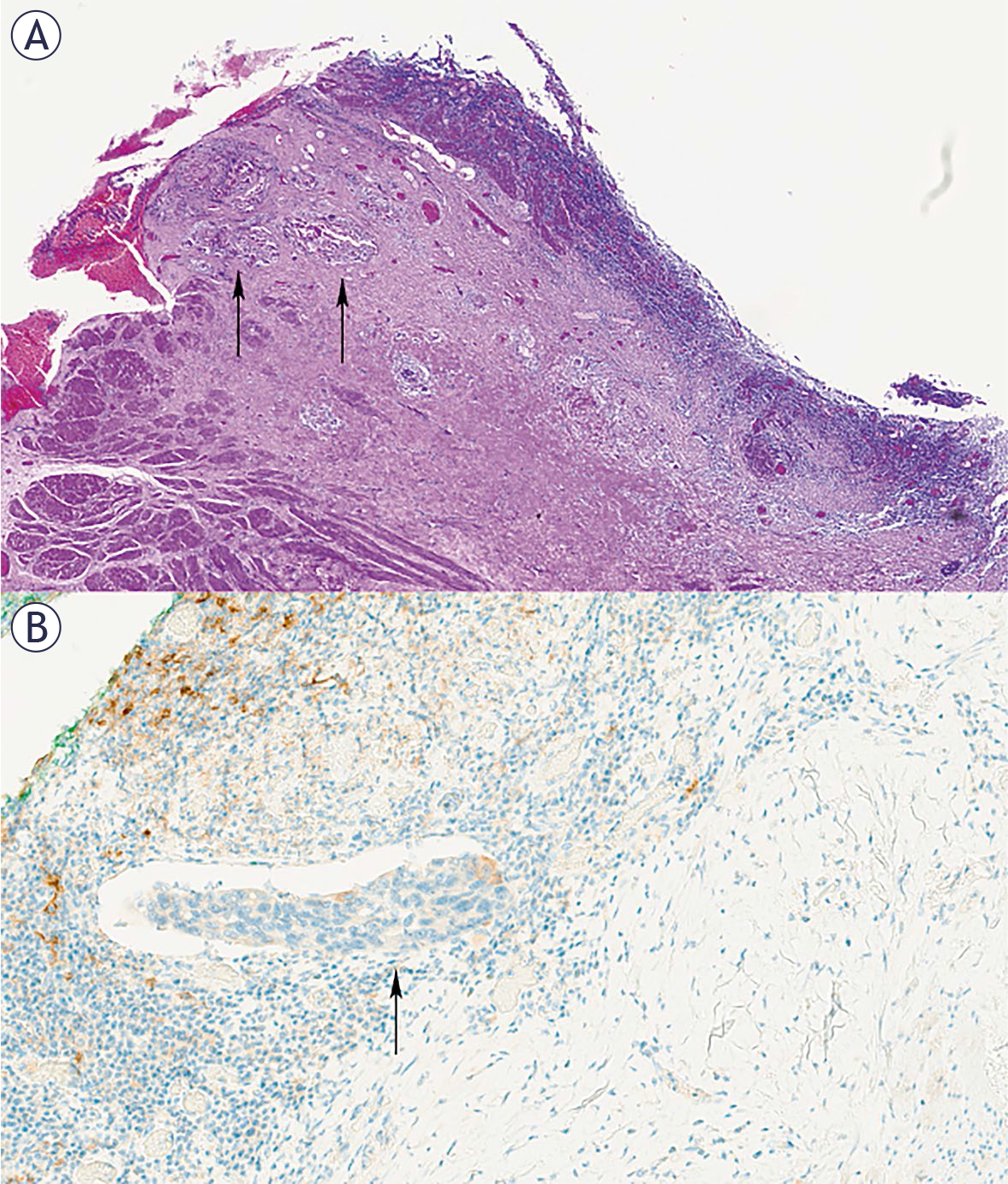
FIGURE 1.
Histopathological assessment of squamous cell carcinoma in a 75-year-old patient following neoadjuvant therapy. (A) Haematoxylin & eosin staining (magnification ×10) reveals partially regressive changes in squamous cell carcinoma, characterized by residual tumour architecture and treatment-induced stromal alterations. (B) PD-L1 expression was evaluated via 22C3 immunohistochemistry (magnification ×40): tumor cells are predominantly PD-L1 negative (arrow), whereas scattered mononuclear inflammatory cells exhibit positive membranous staining (magnification ×20).
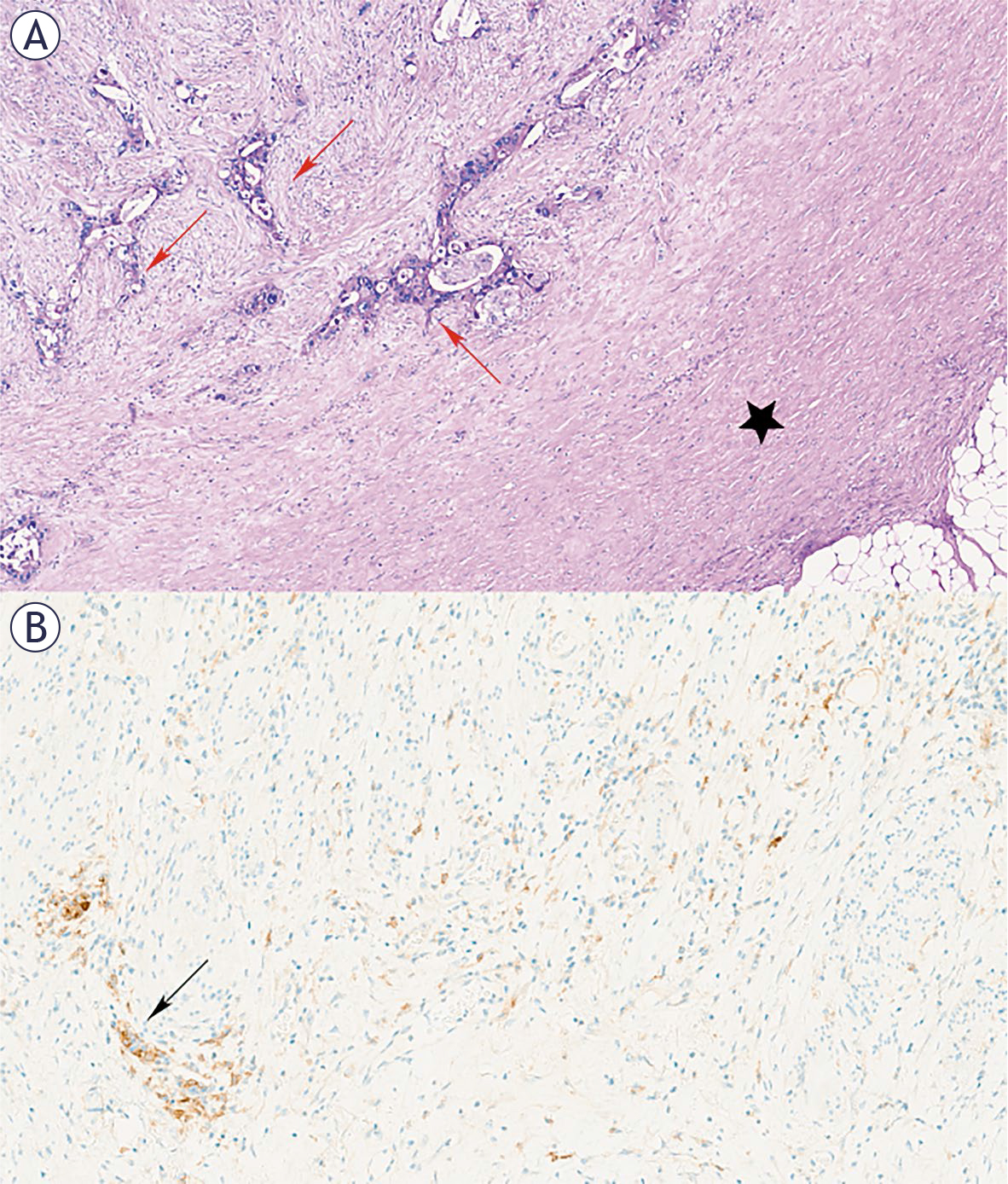
FIGURE 2.
Histopathological evaluation of gastroesophageal junction adenocarcinoma in a 54-year-old patient after neoadjuvant therapy. (A) Lymph node metastasis showing partial regression following neoadjuvant chemoradiotherapy. Residual viable adenocarcinoma cells are indicated by arrows, whereas fibrotic areas are marked with an asterisk (hematoxylin & eosin stain, magnification ×20). (B) PD-L1 expression was assessed via 22C3 immunohistochemistry. Arrows highlight degeneratively altered tumor cells with weak membranous PD-L1 positivity. Scattered mononuclear inflammatory cells also exhibit PD-L1 expression (magnification ×20).
TABLE 2.
Immune-related adverse events
| Any grade | Grade 3 or higher | |
|---|---|---|
| Immune related adverse event | 11 (65) | 4 (24) |
| Thyroiditis | 5 (24) | 0 |
| Adrenal insufficiency | 2 (12) | 0 |
| Colitis | 4 (24) | 3 (18) |
| Rash | 3 (18) | 0 |
| Increase in AST and ALT level | 1 (6) | 0 |
| Pneumonitis | 1 (6) | 0 |
| Myocarditis | 1 (6) | 1 (6) |
The median disease-free survival (DFS) was 21.4 months (95% confidence interval [CI], 14.6–28.9).
Discussion
In our real-world cohort, 65% of patients discontinued adjuvant nivolumab prematurely – 29% due to disease progression and 35% due to immune-related adverse events (irAEs). This discontinuation rate is markedly higher than that reported in the CM577 trial, where only 9% of patients in the nivolumab arm discontinued treatment, reflecting a favourable safety profile and high treatment adherence.6,7
The proportion of patients in our cohort who discontinued treatment due to irAEs is particularly striking. A separate real-world study conducted within an integrated health system reported a 25% discontinuation rate due to irAEs, underscoring the discrepancy between clinical trial outcomes and real-world experience.8 These findings highlight the need for caution when extrapolating trial data to broader clinical practice, especially in settings with limited infrastructure and variable expertise.
Although some irAEs in our cohort were serious, no treatment-related deaths occurred. The elevated toxicity may be attributed to delayed recognition and suboptimal supportive care, particularly in remote healthcare facilities where immunotherapy remains unfamiliar. Unlike clinical trials, which benefit from structured monitoring and early intervention protocols, routine practice often lacks such safeguards. Patient-reported outcome measures (PROMs), which are now widely adopted in many oncology centres, have only recently been implemented at our institution.9,10
Nearly one-third of patients discontinued nivolumab due to disease progression. Kwak et al. reported an even higher rate of 59%, reinforcing the aggressive nature of oesophageal and gastroesophageal junction cancers. Despite multimodal treatment, many patients suffer locoregional or metastatic relapse. These findings underscore the urgent need for improved risk stratification and novel biomarkers. Future studies should incorporate minimal residual disease (MRD) assessment by circulating tumor DNA (ctDNA), which may help identify patients at highest risk of recurrence and guide adjuvant therapy decisions.11
An update presented at the ASCO 2025 meeting reported a numerically longer median overall survival (OS) with nivolumab than with placebo (51.7 v s. 35.3 months), although the difference did not reach statistical significance (HR 0.85; 95.87% CI 0.70-1.04).7 Notably, the benefit was more pronounced in patients with squamous cell carcinoma and PD-L1 expression ≥ 1, suggesting that histology and biomarker status should inform treatment selection. These findings reinforce the biological distinction between squamous cell carcinoma and adenocarcinoma, which should be reflected in future trial designs.
Since the initial publication of CheckMate 577 in 2021, new data have reshaped the treatment landscape. The ESOPEC trial demonstrated the superiority of perioperative FLOT chemotherapy over neoCRT for resectable OEC/GEJC, with improved OS (HR 0.70; 95% CI 0.51–0.92) and reduced distant relapse rates (HR 0.59; 95% CI 0.51–0.92).12 Surgical outcomes were comparable between regimens. The updated ESMO Clinical Practice Guideline now recommends perioperative FLOT as the preferred approach for locally advanced adenocarcinoma, reserving neoCRT only for patients unsuitable for chemotherapy.13,14 Accordingly, neoCRT is no longer used for adenocarcinoma histology in Slovenia.
Further paradigm shifts are anticipated following the positive results of the MATTERHORN trial, where perioperative durvalumab combined with FLOT significantly improved event-free survival in patients with resectable gastric or gastroesophageal adenocarcinoma.15 These findings suggest that immune checkpoint inhibitors may soon be integrated into the neoadjuvant setting for adenocarcinoma, echoing lessons from melanoma, where neoadjuvant immunotherapy has shown superior outcomes compared with adjuvant administration.16
Adjuvant nivolumab remains a guideline-endorsed standard for squamous cell carcinoma of the oesophagus, as per the ESMO and other international bodies. However, clinicians must carefully weigh its toxicity profile against individual patient factors, including social determinants of health. Delivering specialized oncologic care outside of trial settings remains challenging, particularly in regions with limited resources such as parts of Eastern and Central Europe.17 The absence of predictive biomarkers further complicates decision-making, underscoring the need for personalized approaches.
Limitations of our study include its retrospective design and small sample size. Importantly, due to the retrospective nature of our study, tumours were still classified into OEC or GEJC, as they were so classified on multidisciplinary tumour board meetings. Due to the small number of patients included in the study, the percentage of side effects appears to be more express than in comparable studies. Also, because of small number of patients we did not analyse disease-free survival data, but data on progression are available, which is very informative. Nonetheless, it provides valuable real-world insights that should not be overlooked. Most cancer patients are treated outside of clinical trials, and deviations from protocol-driven care – especially in middle-income countries – deserve attention. Reporting such data may serve as a reminder for improving clinical practice and resource allocation.
Conclusions
Real-world data from Slovenia reveal a high discontinuation rate of adjuvant nivolumab in patients with esophageal and gastroesophageal junction cancer, primarily due to disease progression and irAEs. These findings underscore refined patient selection, enhanced monitoring protocols when adjuvant immunotherapy is implemented and the need for biomarker-driven treatment strategies in the future.
Acknowledgment
The clinical study is supported by the Slovenian Research and Innovation Agency (ARIS), program P3-0321 of the Institute of Oncology Ljubljana,
The manuscript was edited by AJE Digital/Curie.