Have a personal or library account? Click to login
Human papillomavirus-related oropharyngeal squamous cell carcinoma exhibits enhanced radiosensitivity despite limited activation of cytosolic DNA sensing pathways and innate immune responses Cover

Human papillomavirus-related oropharyngeal squamous cell carcinoma exhibits enhanced radiosensitivity despite limited activation of cytosolic DNA sensing pathways and innate immune responses

Open Access
|Dec 2025

Figures & Tables

FIGURE 1.

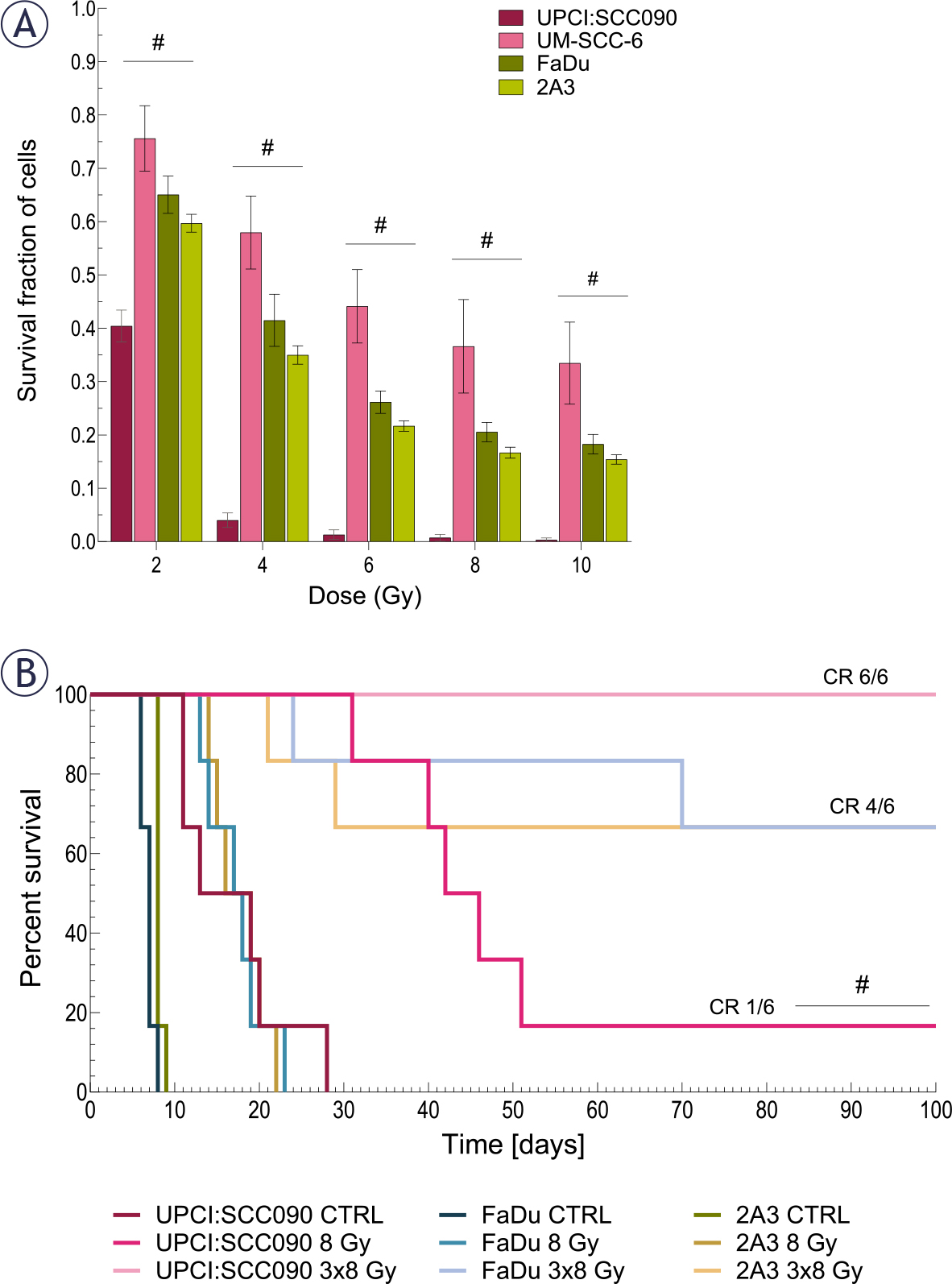
The effect of irradiation (IR) on cell survival and tumor growth. (A) Survival of cells after in vitro IR with 2, 4, 6, 8, and 10 Gy (n = 3). (B) Kaplan-Meier survival curve for mice bearing pharyngeal squamous cell carcinoma (PSCC) tumors treated with either a single dose of 8 Gy or 3×8 Gy, complete response (CR) (n = 6).
Data are presented as mean ± standard error of the mean (SEM); # = indicates p < 0.05 for comparisons between UPCI:SCC090 and other cell lines or tumor models; * = indicates p < 0.05 for comparisons between IR doses within the same cell line or tumor model.
The effect of irradiation (IR) on cell survival and tumor growth. (A) Survival of cells after in vitro IR with 2, 4, 6, 8, and 10 Gy (n = 3). (B) Kaplan-Meier survival curve for mice bearing pharyngeal squamous cell carcinoma (PSCC) tumors treated with either a single dose of 8 Gy or 3×8 Gy, complete response (CR) (n = 6). Data are presented as mean ± standard error of the mean (SEM); # = indicates p < 0.05 for comparisons between UPCI:SCC090 and other cell lines or tumor models; * = indicates p < 0.05 for comparisons between IR doses within the same cell line or tumor model.

FIGURE 2.

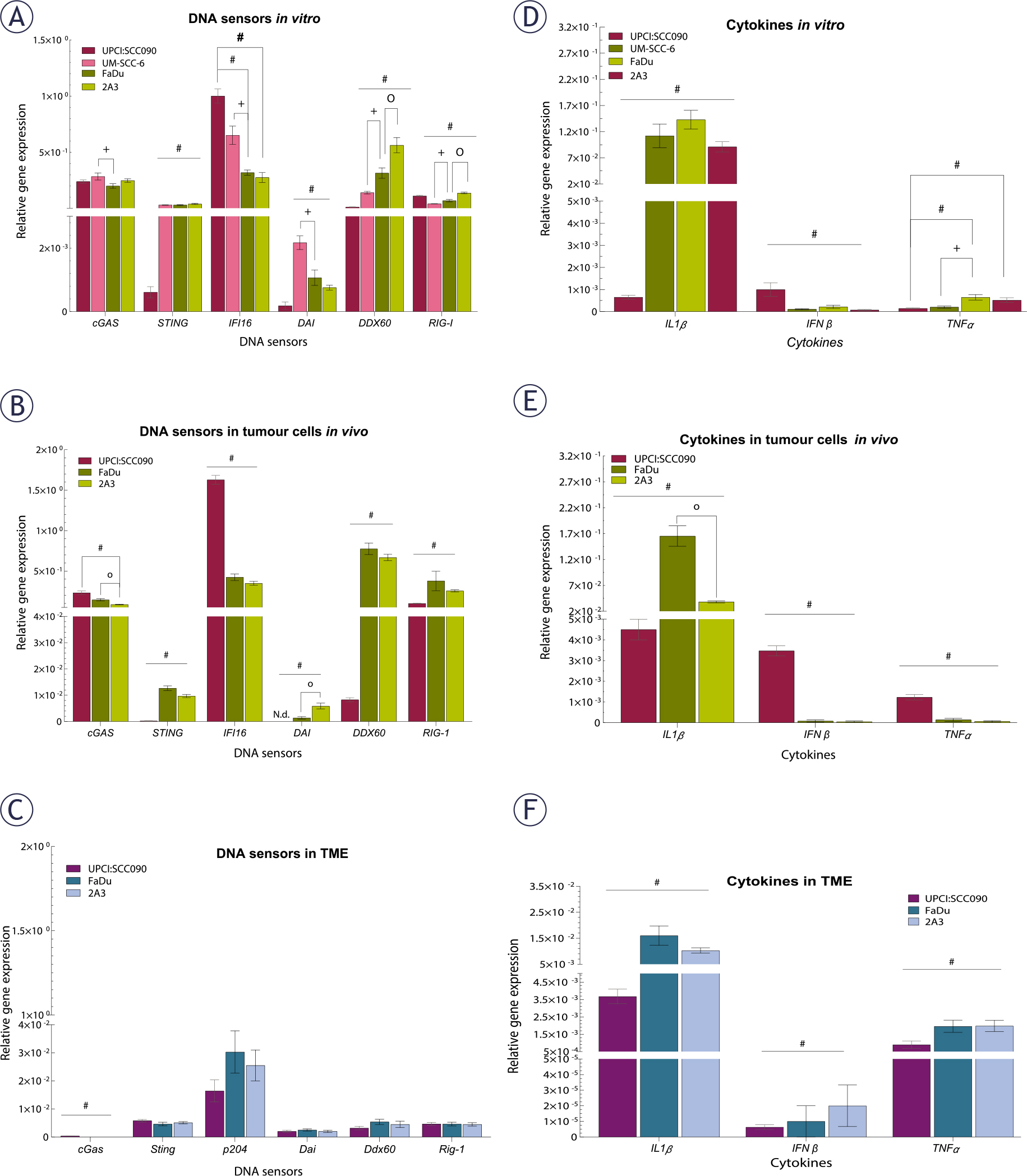
Baseline expression of cytosolic DNA sensors and cytokines in tumor cells and tumor microenvironment (TME) of pharyngeal squamous cell carcinomas (PSCCs). (A) Relative gene expression of cytosolic DNA sensors in cells in vitro, normalized to housekeeping genes (GUSB and B2M) (n = 3). (B) Relative gene expression of cytosolic DNA sensors in tumor cells in vivo, normalized to housekeeping genes (GUSB and B2M) (n = 5). (C) Relative gene expression of cytosolic DNA sensors in TME, normalized to housekeeping genes (BA and GADP) (n = 5). (D) Relative gene expression of cytokines in cells in vitro, normalized to housekeeping genes (GUSB and B2M) (n = 3). (E) Relative gene expression of cytokines in tumor cells in vivo, normalized to housekeeping genes (GUSB and B2M) (n = 5). (F) Relative gene expression of cytokines in TME, normalized to housekeeping genes (BA and GADP) (n = 5). Data is represented as mean ± standard error of the mean (SEM).
# = indicates p < 0.05 for comparisons between UPCI:SCC090 and other cell lines or tumor models; * = indicates p < 0.05 for comparisons between irradiation (IR) doses within the same cell line or tumor model; o = indicates p < 0.05 for comparisons between FaDu and 2A3 models; + = indicates p < 0.05 for comparisons between UM-SCC-6 and FaDu
Baseline expression of cytosolic DNA sensors and cytokines in tumor cells and tumor microenvironment (TME) of pharyngeal squamous cell carcinomas (PSCCs). (A) Relative gene expression of cytosolic DNA sensors in cells in vitro, normalized to housekeeping genes (GUSB and B2M) (n = 3). (B) Relative gene expression of cytosolic DNA sensors in tumor cells in vivo, normalized to housekeeping genes (GUSB and B2M) (n = 5). (C) Relative gene expression of cytosolic DNA sensors in TME, normalized to housekeeping genes (BA and GADP) (n = 5). (D) Relative gene expression of cytokines in cells in vitro, normalized to housekeeping genes (GUSB and B2M) (n = 3). (E) Relative gene expression of cytokines in tumor cells in vivo, normalized to housekeeping genes (GUSB and B2M) (n = 5). (F) Relative gene expression of cytokines in TME, normalized to housekeeping genes (BA and GADP) (n = 5). Data is represented as mean ± standard error of the mean (SEM). # = indicates p < 0.05 for comparisons between UPCI:SCC090 and other cell lines or tumor models; * = indicates p < 0.05 for comparisons between irradiation (IR) doses within the same cell line or tumor model; o = indicates p < 0.05 for comparisons between FaDu and 2A3 models; + = indicates p < 0.05 for comparisons between UM-SCC-6 and FaDu
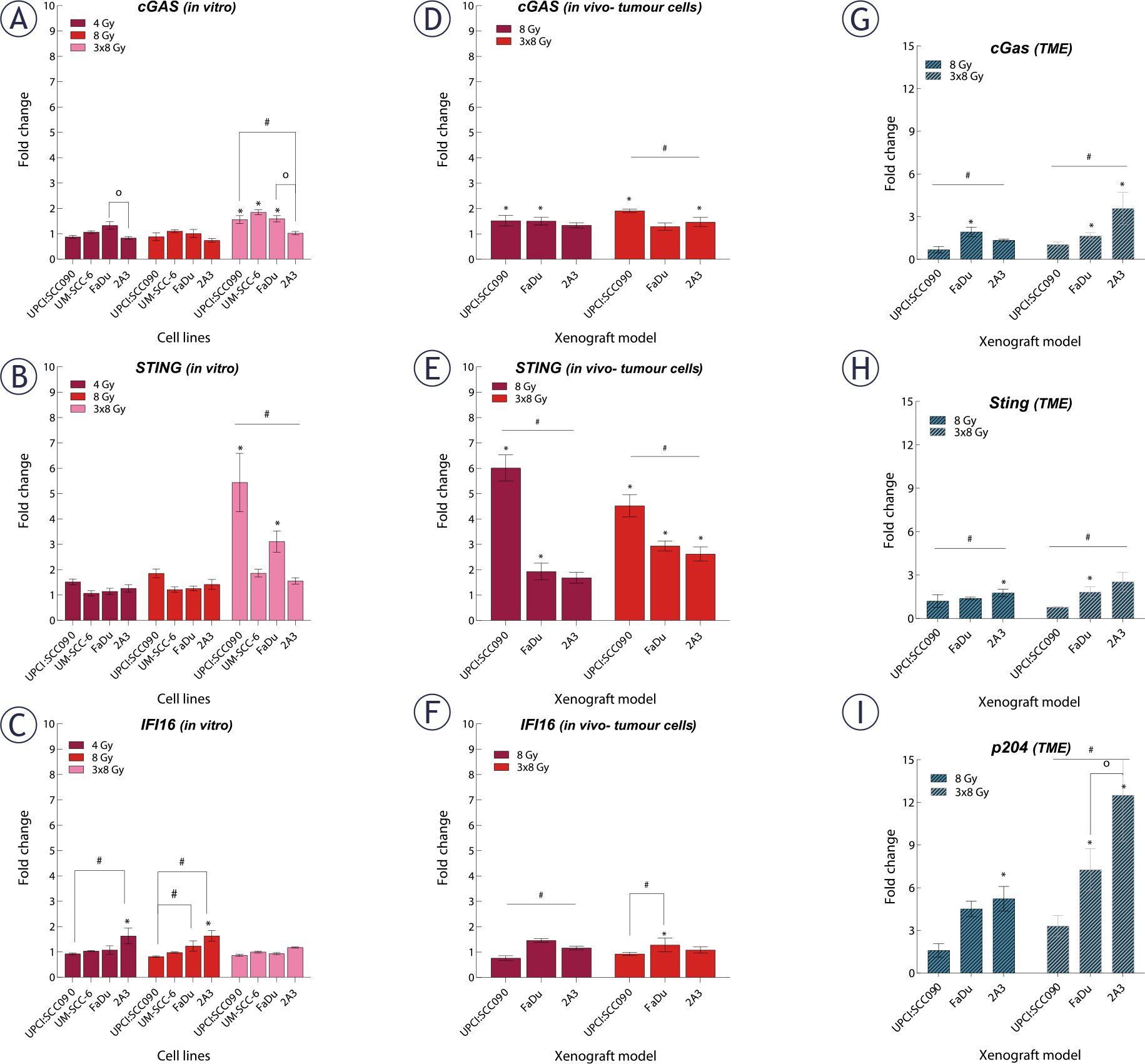
FIGURE 3.

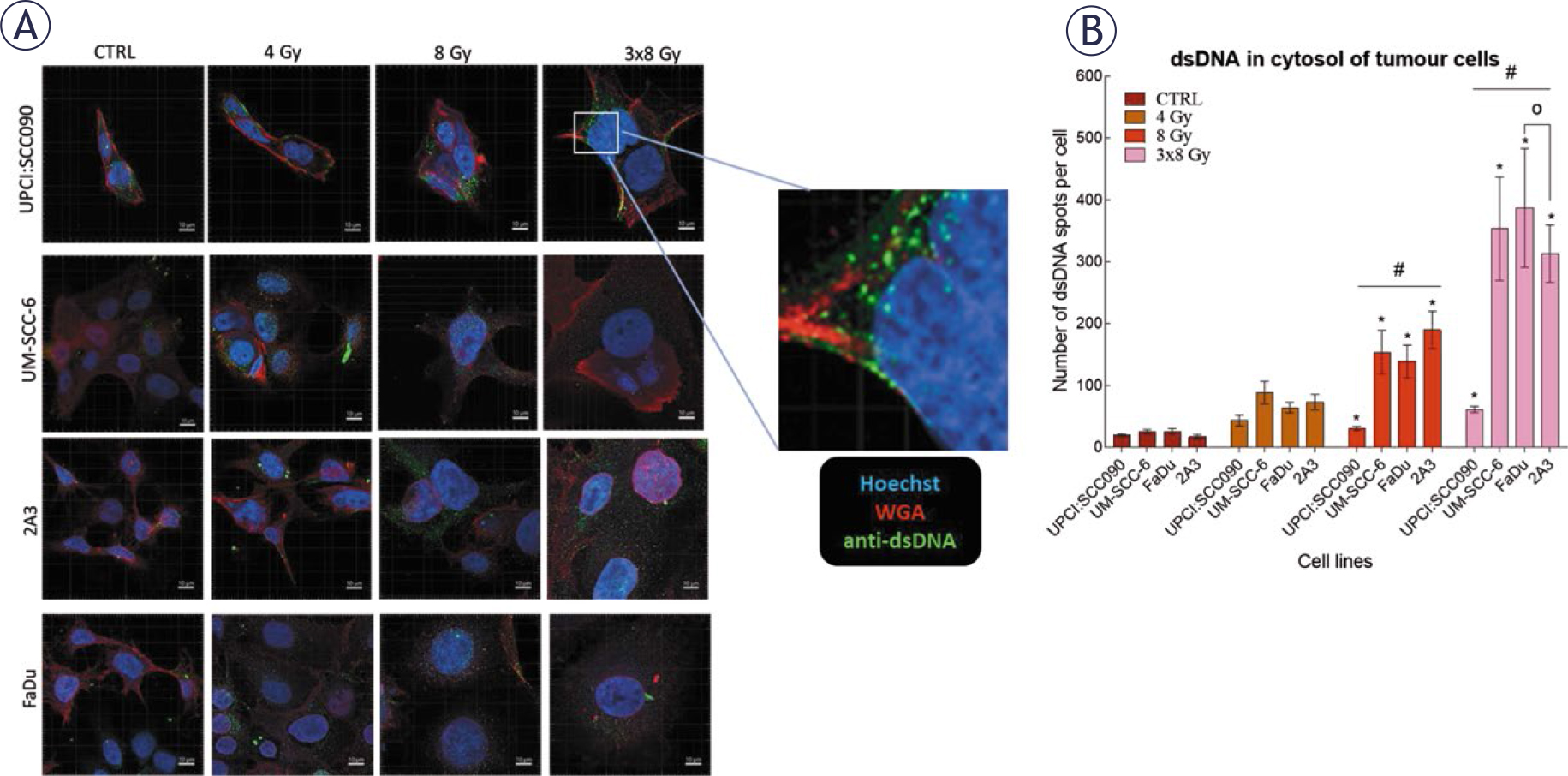
Irradiation (IR)-induced accumulation of dsDNA in the cytosol of pharyngeal squamous cell carcinoma (PSCC) cells. (A) Accumulation of dsDNA in the cytosol of cells 72 hours after IR. Green: dsDNA (anti-dsDNA), red: plasma membrane (WGA), blue: nucleus (Hoechst 33342), Scale bar = 10 μm. (B) Number of dsDNA spots per cell in cytosol 72 hours after IR with 4, 8, or 3x8 Gy (n = 8). Data is represented as mean ± standard error of the mean (SEM).
# = indicates p < 0.05 for comparisons between UPCI:SCC090 and other cell lines or tumor models; * = indicates p < 0.05 for comparisons between IR doses within the same cell line or tumor model; o = indicates p < 0.05 for comparisons between FaDu and 2A3 models; + = indicates p < 0.05 for comparisons between UM-SCC-6 and FaDu
Irradiation (IR)-induced accumulation of dsDNA in the cytosol of pharyngeal squamous cell carcinoma (PSCC) cells. (A) Accumulation of dsDNA in the cytosol of cells 72 hours after IR. Green: dsDNA (anti-dsDNA), red: plasma membrane (WGA), blue: nucleus (Hoechst 33342), Scale bar = 10 μm. (B) Number of dsDNA spots per cell in cytosol 72 hours after IR with 4, 8, or 3x8 Gy (n = 8). Data is represented as mean ± standard error of the mean (SEM). # = indicates p < 0.05 for comparisons between UPCI:SCC090 and other cell lines or tumor models; * = indicates p < 0.05 for comparisons between IR doses within the same cell line or tumor model; o = indicates p < 0.05 for comparisons between FaDu and 2A3 models; + = indicates p < 0.05 for comparisons between UM-SCC-6 and FaDu
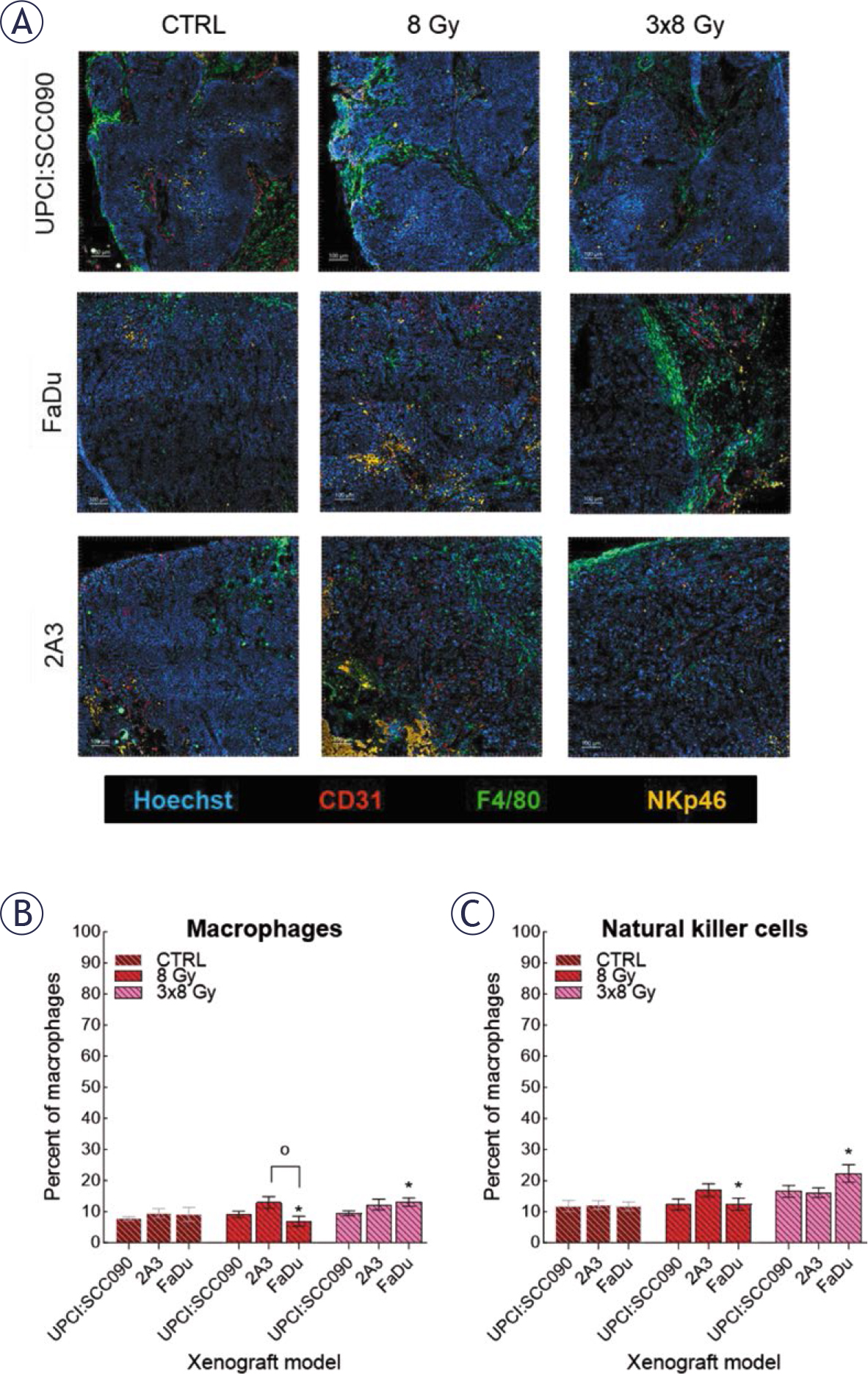
FIGURE 4.

Effect of irradiation (IR) on cytosolic DNA sensors gene expression in tumor cells and and tumor microenvironment (TME) of pharyngeal squamous cell carcinoma (PSCC). (A–C) Fold change in expression of cyclic GMP-AMP synthase (cGAS) (A), stimulator of interferon genes (STING) (B), and IFI16 (C) in vitro 72 hours after IR with 4, 8, or 3x8 Gy, normalized to housekeeping genes (GUSB and B2M) and respective controls (n = 3). (D–F) Fold change in expression of cGAS (D), STING (E), and IFI16 (F) in tumor cells in vivo 72 hours after IR with 8 or 3x8 Gy, normalized to housekeeping genes (GUSB and B2M) and respective controls (n = 5). (G–I) Fold change in expression of cG ing (H), and p204 (I) in tumor cells in vivo 72 hours after IR with 8 or 3x8 Gy, normalized to housekeeping genes (BA and GAPDH) and respective controls (n = 5). Data is represented as mean ± standard error of the mean (SEM).

FIGURE 5.

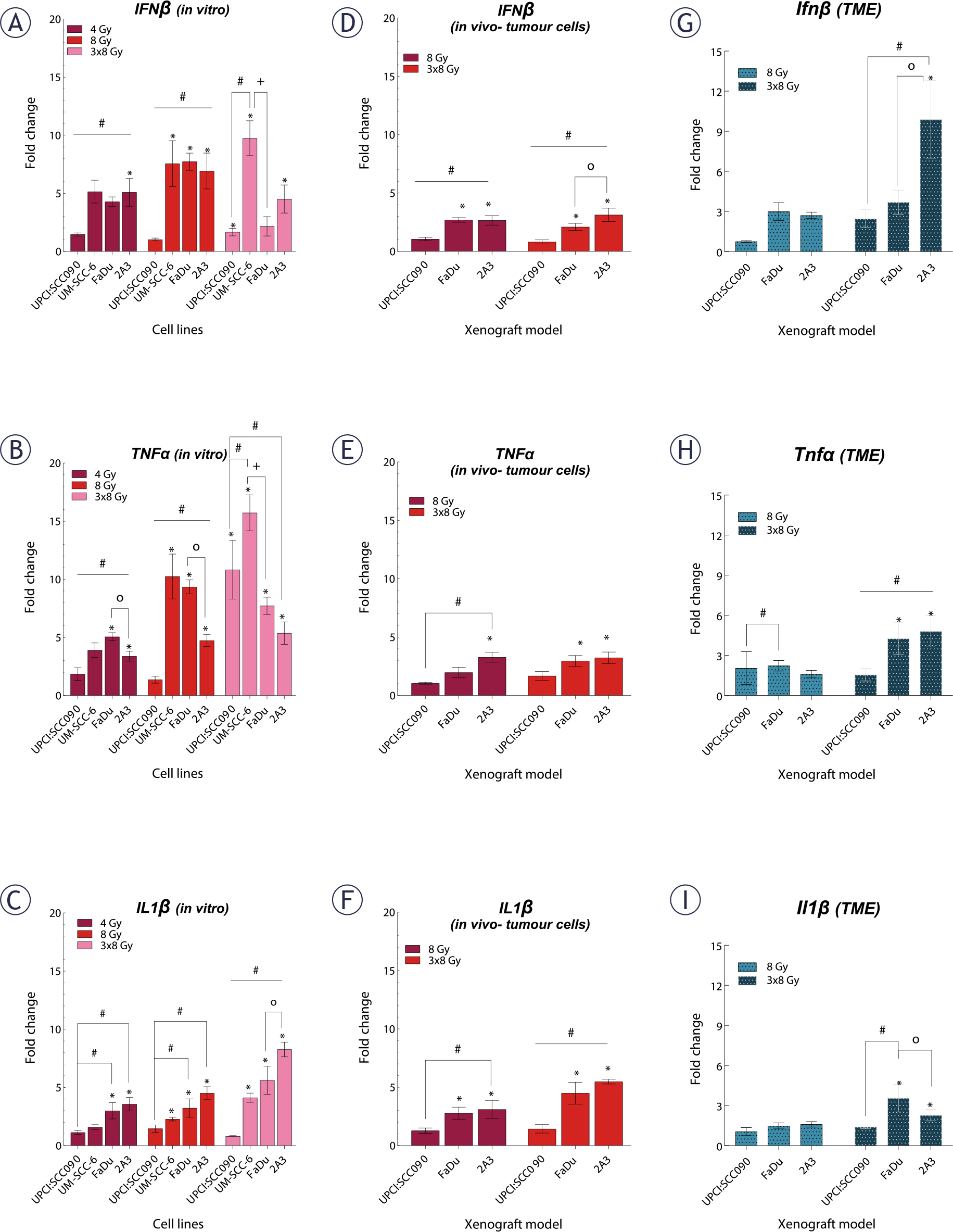
Effect of irradiation (IR) on cytokine gene expression in tumor cells and tumor microenvironment (TME) of pharyngeal squamous cell carcinoma (PSCC). (A–C) Fold change in expression of IFNβ (A), tumor necrosis factor (TNF)α (B), and IL1β (C) in vitro 72 hours after IR with 4, 8, or 3x8 Gy, normalized to housekeeping genes (GUSB and B2M) and respective controls (n = 3). (D–F) Fold change in expression of IFNβ (D), TNFa (E), and IL1 β (F) in tumor cells in vivo 72 hours after IR with 8 or 3×8 Gy, normalized to housekeeping genes (GUSB and B2M) and control (n = 5). (G–I) Fold change in expression of Ifnβ (G), TNFα (H), and Il1β (I) in the TME in vivo 72 hours after IR with 8 or 3–8 Gy, normalized to housekeeping genes (BA and GADPH) and control (n = 5). Data is represented as mean ± standard error of the mean (SEM).
# = indicates p < 0.05 for comparisons between UPCI:SCC090 and other cell lines or tumor models; * = indicates p < 0.05 for comparisons between IR doses within the same cell line or tumor model; o = indicates p < 0.05 for comparisons between FaDu and 2A3 models; + = indicates p < 0.05 for comparisons between UM-SCC-6 and FaDu
Effect of irradiation (IR) on cytokine gene expression in tumor cells and tumor microenvironment (TME) of pharyngeal squamous cell carcinoma (PSCC). (A–C) Fold change in expression of IFNβ (A), tumor necrosis factor (TNF)α (B), and IL1β (C) in vitro 72 hours after IR with 4, 8, or 3x8 Gy, normalized to housekeeping genes (GUSB and B2M) and respective controls (n = 3). (D–F) Fold change in expression of IFNβ (D), TNFa (E), and IL1 β (F) in tumor cells in vivo 72 hours after IR with 8 or 3×8 Gy, normalized to housekeeping genes (GUSB and B2M) and control (n = 5). (G–I) Fold change in expression of Ifnβ (G), TNFα (H), and Il1β (I) in the TME in vivo 72 hours after IR with 8 or 3–8 Gy, normalized to housekeeping genes (BA and GADPH) and control (n = 5). Data is represented as mean ± standard error of the mean (SEM). # = indicates p < 0.05 for comparisons between UPCI:SCC090 and other cell lines or tumor models; * = indicates p < 0.05 for comparisons between IR doses within the same cell line or tumor model; o = indicates p < 0.05 for comparisons between FaDu and 2A3 models; + = indicates p < 0.05 for comparisons between UM-SCC-6 and FaDu

FIGURE 6.

Response of the cellular innate immune system to irradiation (IR). (A) Frozen tumor sections were stained with anti-CD31 (red, Alexa 647), anti-F4/80 (green, Alexa 488), anti-natural killer cells (NK)p46 (orange, Cyanine 3), and Hoechst 33342 (blue). Scale bar: 100 μm. (B) Percentage of macrophages in tumor models before and after IR was determined by anti-F4/80 (calculated as the number of macrophages divided by the number of tumor cells). (C) Percentage NK cells in tumor models before and after IR was determined by anti-NKp46 (calculated as the number of NK divided by the number of tumor cells). Data are presented as mean ± standard error of the mean (SEM).
# = indicates p < 0.05 for comparisons between UPCI:SCC090 and other cell lines or tumor models; * = indicates p < 0.05 for comparisons between IR doses within the same cell line or tumor model; o = indicates p < 0.05 for comparisons between FaDu and 2A3 models
Response of the cellular innate immune system to irradiation (IR). (A) Frozen tumor sections were stained with anti-CD31 (red, Alexa 647), anti-F4/80 (green, Alexa 488), anti-natural killer cells (NK)p46 (orange, Cyanine 3), and Hoechst 33342 (blue). Scale bar: 100 μm. (B) Percentage of macrophages in tumor models before and after IR was determined by anti-F4/80 (calculated as the number of macrophages divided by the number of tumor cells). (C) Percentage NK cells in tumor models before and after IR was determined by anti-NKp46 (calculated as the number of NK divided by the number of tumor cells). Data are presented as mean ± standard error of the mean (SEM). # = indicates p < 0.05 for comparisons between UPCI:SCC090 and other cell lines or tumor models; * = indicates p < 0.05 for comparisons between IR doses within the same cell line or tumor model; o = indicates p < 0.05 for comparisons between FaDu and 2A3 models
DOI: https://doi.org/10.2478/raon-2025-0057 | Journal eISSN: 1581-3207 | Journal ISSN: 1318-2099
Language: English
Page range: 566 - 578
Submitted on: Aug 27, 2025
Accepted on: Sep 5, 2025
Published on: Dec 16, 2025
Published by: Association of Radiology and Oncology
In partnership with: Paradigm Publishing Services
Publication frequency: 4 issues per year

© 2025 Kristina Levpuscek, Tanja Jesenko, Tilen Komel, Simona Kranjc Brezar, Gregor Sersa, Maja Cemazar, Primoz Strojan, published by Association of Radiology and Oncology
This work is licensed under the Creative Commons Attribution 4.0 License.