
TABLE 1.
Characteristics of the patients and tumors
| Number (%) | |
|---|---|
| Patients | 156 |
| Lesions | 162 |
| Mean age, years (range) | 63.0 ± 10.2 (33–95) |
| Histology | |
| Invasive ductal | 125 (77.2) |
| Invasive lobular | 29 (17.9) |
| Others* | 8 (4.9) |
| Size of tumor, mm (range) | 16.2 ± 10.0 (2–60) |
| Grade | |
| 1 | 51 (31.5) |
| 2 | 87 (53.7) |
| 3 | 24 (14.8) |
| T-stage | |
| T1 | 122 (75.3) |
| T2 | 38 (23.5) |
| T3 | 2 (1.2) |
| N-stage | |
| N0 | 117 (72.2) |
| N1 | 39 (24.1) |
| N2 | 5 (3.1) |
| N3 | 1 (0.6) |
| ER status | |
| Positive | 149 (92.0) |
| Negative | 13 (8.0) |
| PR status | |
| Positive | 144 (88.9) |
| Negative | 18 (11.1) |
| HER-2 status | |
| Positive | 11 (6.8) |
| Negative | 151 (93.2) |
| Ki-67 status | |
| Lower (≤ 14 %) | 60 (37.0) |
| Higher (> 14 %) | 101 (62.3) |
| Data missing | 1 (0.6) |
TABLE 2.
Mammographic features of the tumors and the lesion descriptions according to Breast Imaging Reporting and Data System (BI-RADS) 5th
| Breast composition | Number (%) |
|---|---|
| A | 49 (30.2) |
| B | 84 (51.9) |
| C | 26 (16.0) |
| D | 3 (1.9) |
| Findings | |
| Mass | 128 (79.0) |
| Calcification | 25 (15.4) |
| Architectural distortion | 6 (3.7) |
| Asymmetry | 2 (1.2) |
| Invisible on mammography | 1 (0.6) |
| Mass shape | |
| Oval | 14 (10.9) |
| Round | 61 (47.7) |
| Irregular | 53 (41.4) |
| Mass margin | |
| Circumscribed | 3 (2.3) |
| Obscured | 3 (2.3) |
| Microlobulated | 31 (24.2) |
| Indistinct | 23 (18.0) |
| Spiculated | 68 (53.1) |
TABLE 3.
Presence and distribution of spicules in the pre- and intraoperative images
| Pre (%) | Intra (%) | P value (r*) | |
|---|---|---|---|
| Number of spicules | 12.2 ± 6.3 | 13.0 ± 6.2 | < 0.001 (0.577) |
| Maximum length of spicules (mm) | 7.3 ± 5.0 | 9.5 ± 5.1 | < 0.001 (0.564) |
| Presence of spicules | 0.648 | ||
| Yes | 97 (59.9) | 100 (61.7) | |
| No | 65 (40.1) | 62 (38.3) | |
| Radial distribution of spicules | 0.192 | ||
| < 25 % | 8 (8.2) | 7 (7.0) | |
| 25–50 % | 23 (23.7) | 22 (22.0) | |
| 50–75 % | 21 (21.6) | 18 (18.0) | |
| 75–100 % | 45 (46.4) | 53 (53.0) |
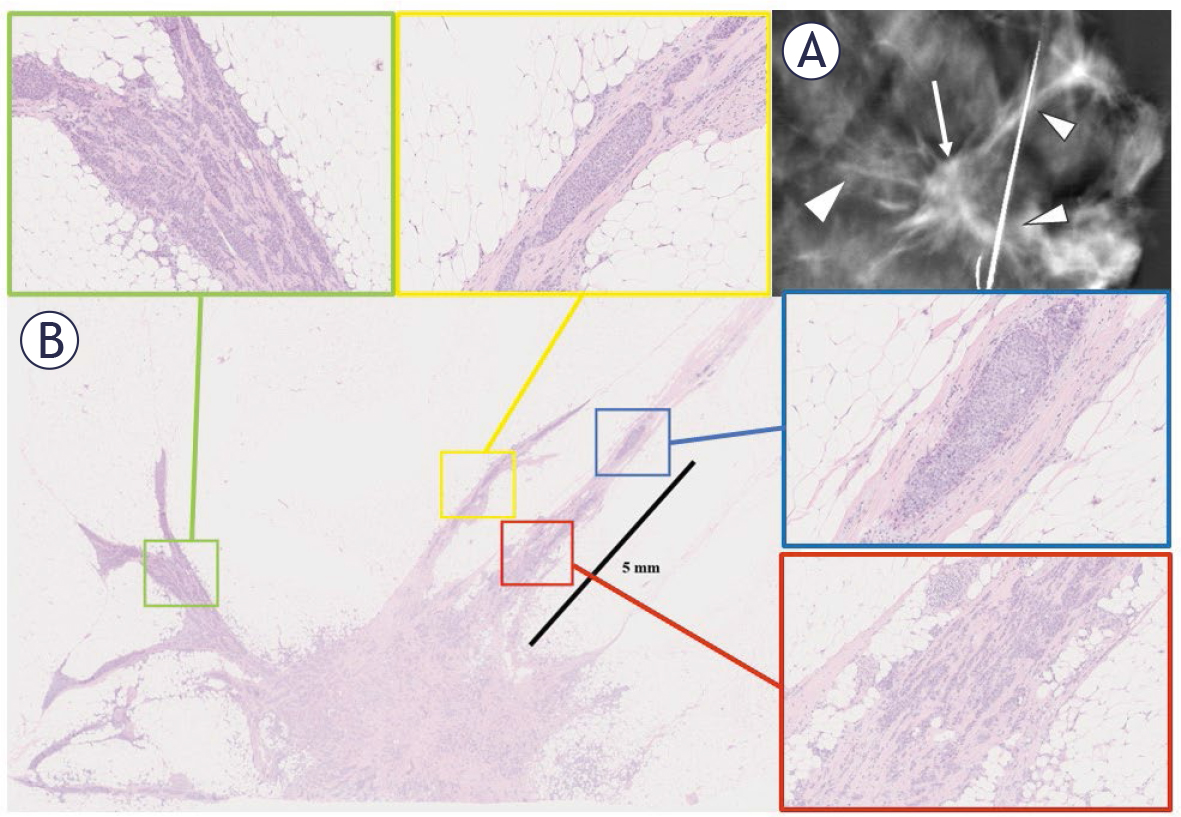
Figure 1.
A 14 mm spiculated invasive ductal carcinoma (IDC) excised en bloc with spiculations. A tomosynthesis specimen radiogram at the level of the tumor documents the total removal of both the guidewire localized tumor (A; arrow) and the associated spicules (arrowheads). The histopathological analysis (B, H&E; 10 × magnification) showed that all the spicules contained additional tumors: the spicule shown in the red box contained IDC (100 × magnification); one spicule contained ductal carcinoma in situ (DCIS) (blue box, 150 × magnification); other spicules contained both DCIS and IDC in green (100 × magnification) and yellow (150 × magnification) boxes.
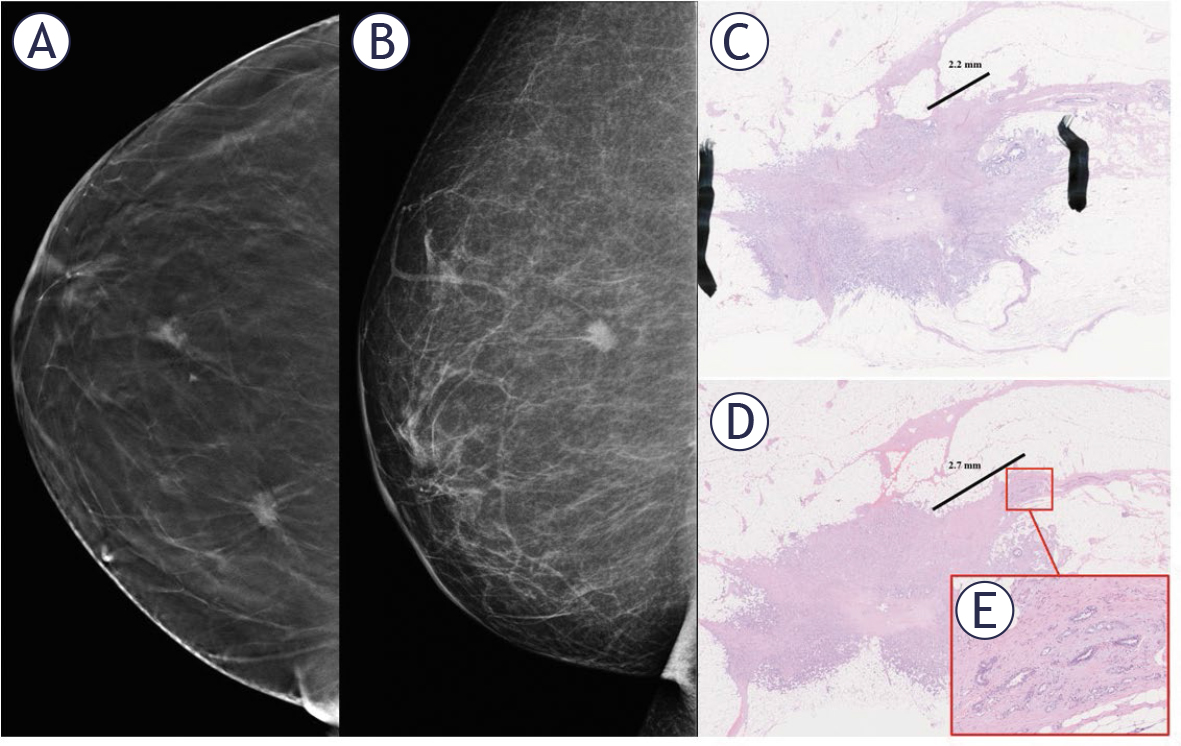
Figure 2.
A mammogram of a nonpalpable, spiculated 12 mm invasive ductal carcinoma: a craniocaudal-tomosynthesis view (A) demonstrates spiculations better than full-field digital mammography in mediolateral-projection (B). After breast conserving surgery, a more superficial axial section (C) the invasive additional cancer extends 2.2 mm from the tumor’s margin. In the deeper section (D) additional invasive cancer cells are visible further in the spicule extending up to 2.7 mm from the tumor’s margin highlighting that analyzing only one section of a spicule will underestimate the extent of the disease. (E) A magnified view of the base of the spicule.
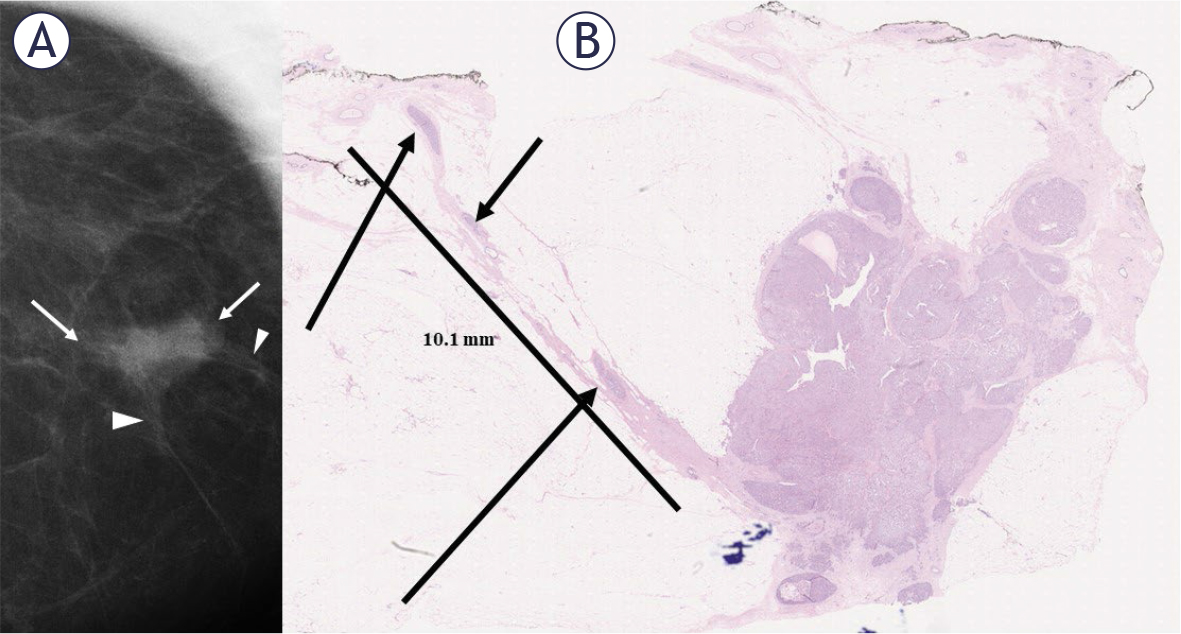
Figure 3.
(A) A mediolateraloblique spot magnification view of a 13 mm mainly circumscribed, mixed papillary and invasive ductal carcinoma (arrows) with a few spicules (arrowheads). The histopathologal analysis (B) showed a single solid spicule with multiple foci, likely representing a continuum of low-grade ductal carcinoma in situ (arrows) extending as far as 10.1 mm from the tumor’s edge and close to the resection margin.
Table 4.
Distribution of tumor subtypes and presence of additional tumor material in spicules in relation to spiculated mass
| Spiculated | (%) | Non-spiculated | (%) | P value | |
|---|---|---|---|---|---|
| Subtype | |||||
| Luminal A | 28 | 41.2 | 32 | 34.0 | 0.016 |
| Luminal B | 39 | 57.4 | 46 | 48.9 | |
| HER-2 enriched | 1 | 1.5 | 8 | 8.5 | |
| Basal | 0 | 0 | 8 | 8.5 | |
| Presence of additional tumor in spicules | |||||
| Yes | 46 | 67.6 | 46 | 48.9 | 0.018 |
| No | 22 | 32.4 | 48 | 51.1 | |