
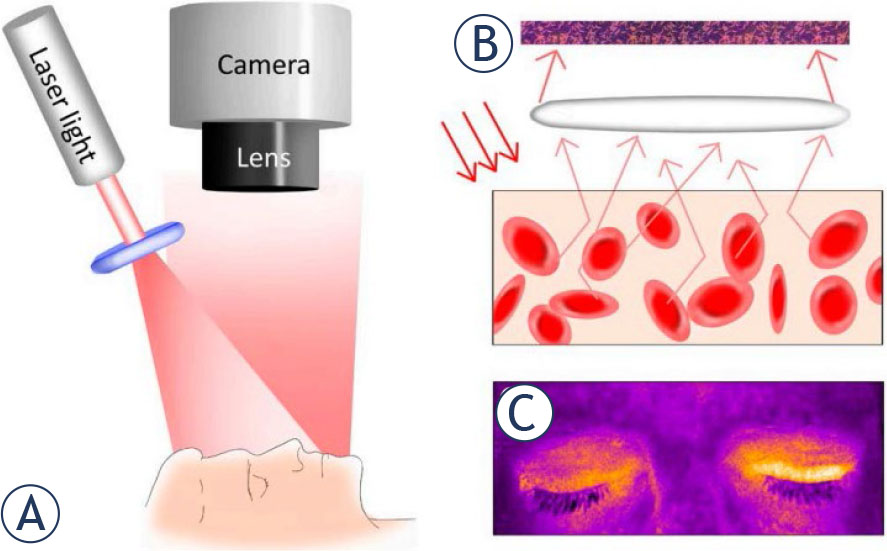
Figure 1.
Schematic representation of the laser speckle contrast imaging (LSCI) method. (A) The technique relies on the interference of light backscattered from moving particles, creating distinct dark and bright areas (speckle pattern) captured by a camera. (B) Variations in the speckle pattern are predominantly driven by the movement of red blood cells, enabling interpretation as perfusion. (C) Analysis of speckle-pattern variations yields an image displayed on the monitor, where white and yellow depict areas with high perfusion, contrasting with darker areas indicating lower perfusion areas. Taken from Berggren et al.19 and reprinted with permission from the publisher.
Table 1.
Included articles reporting the use of laser speckle contrast imaging (LSCI) to quantify perfusion in clinical applications in oncology
| Reference | Year of publication | Number of patients | Oncologic setting |
|---|---|---|---|
| Brain | |||
| Parthasarathy et al.21 | 2010 | 3 | Tumor resection |
| Richards et al.22 | 2014 | 10 | Tumor resection |
| Richards et al.27 | 2017 | 8 | Tumor resection |
| Klijn et al.25 | 2013 | 8 | Tumor resection |
| Ideguchi et al.28 | 2017 | 12 | Tumor resection |
| Breasts | |||
| Tesselaar et al.29 | 2017 | 15 | Adjuvant radiotherapy for stage I-II breast cancer |
| Zötterman et al.30 | 2020 | 23 | Deep inferior epigastric artery perforator (DIEP) flap surgery |
| Endocrine glands | |||
| de Paula et al.31 | 2021 | 42 | Non-functioning adrenal incidentaloma |
| Mannoh et al.32 | 2017 | 28 | Thyroidectomy/parathyroidectomy |
| Mannoh et al.33 | 2021 | 72 | Thyroidectomy |
| Mannoh et al.34 | 2023 | 21 | Thyroidectomy/parathyroidectomy |
| Skin | |||
| Tchvialeva et al.35 | 2012 | 214 lesions | Malignant melanoma, squamous cell carcinoma, basal cell carcinoma, melanocytic nevus, seborrheic keratosis |
| Reyal et al.36 | 2012 | 12 | Basal cell carcinoma |
| Zhang et al.37 | 2019 | 12 (total 143) | Facial nerve palsy due to nerve tumor (also including other etiology) |
| Zieger et al.38 | 2021 | 9 | Basal cell carcinoma |
| Tenland et al.39 | 2019 | 13 | Oculoplastic reconstructive surgery (tarsoconjunctival flaps) |
| Berggren et al.40 | 2019 | 9 | Oculoplastic reconstructive surgery (tarsoconjunctival flaps) |
| Tenland et al.41 | 2021 | 12 | Oculoplastic reconstructive surgery after squamous cell carcinoma, basal cell carcinoma, and intradermal nevus |
| Berggren et al.42 | 2021 | 7 | Oculoplastic reconstructive surgery after squamous cell carcinoma and basal cell carcinoma |
| Berggren et al.43 | 2021 | 7 | Oculoplastic reconstructive surgery after squamous cell carcinoma and basal cell carcinoma |
| Berggren et al.44 | 2021 | 1 | Oculoplastic reconstructive surgery |
| Berggren et al.45 | 2022 | 7 | Oculoplastic reconstructive surgery after squamous cell carcinoma and basal cell carcinoma |
| Stridh et al.46 | 2024 | 1 | Cutaneous angio-sarcoma |
| Gastrointestinal tract (open surgical setting) | |||
| Eriksson et al.47 | 2014 | 10 | Liver resection |
| Milstein et al.48 | 2016 | 11 | Esophagectomy |
| Ambrus et al.49 | 2017 | 45 | Esophagectomy |
| Ambrus et al.50 | 2017 | 25 | Ivor-Lewis esophagectomy |
| Di Maria et al.51 | 2017 | 2 | Colorectal resection |
| Jansen et al.52 | 2018 | 26 | Esophagectomy |
| Kojima et al.53 | 2019 | 8 | Colorectal resection |
| Kaneko et al.54 | 2020 | 36 | Colorectal resection (34 due to colorectal carcinoma) |
| Gastrointestinal tract (laparoscopic/thoracoscopic setting) | |||
| Heeman et al.55 | 2019 | 10 | Colorectal resection |
| Kojima et al.56 | 2020 | 27 | Colorectal resection |
| Slooter et al.57 | 2020 | 24 | Esophagectomy |
| Heeman et al.58 | 2023 | 67 | Hemicolectomy and sigmoid resection |
| Nwaiwu et al.59 | 2023 | 40 | Colectomy, also non-oncological interventions (Roux-en-Y gastric bypass and sleeve gastrectomy) |
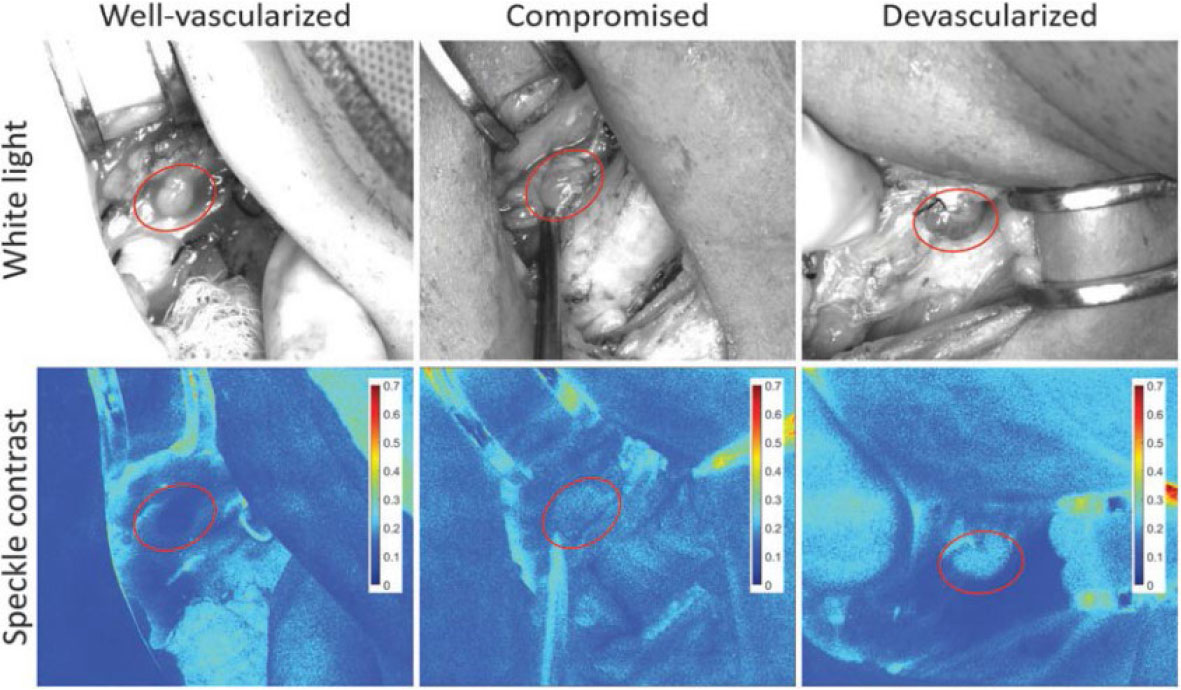
Figure 2.
Speckle contrast demonstrates lower values for well-vascularized parathyroid glands. Lower speckle contrast values indicate greater blood flow due to more blurring of the speckle pattern, while higher contrast values indicate less blood flow. The top row displays representative white light images, and the bottom row shows speckle contrast images of a well-vascularized (left), a compromised (middle), and a devascularized (right) parathyroid gland, with parathyroid glands marked with ellipses. The corresponding speckle contrast values were 0.11, 0.18, and 0.21, respectively. Taken from Mannoh et al.33 and reprinted with permission from the publisher.

Figure 3.
Representative examples of laser speckle contrast images, showing the blood perfusion in the free skin grafts, immediately postoperatively (0 weeks), and at follow-up after 1, 3, and 7 weeks. It can be seen that reperfusion occurred simultaneously in the center and periphery of the graft, and that complete reperfusion was achieved after 7 weeks. Taken from Berggren et al.43 and reprinted with permission from the publisher.
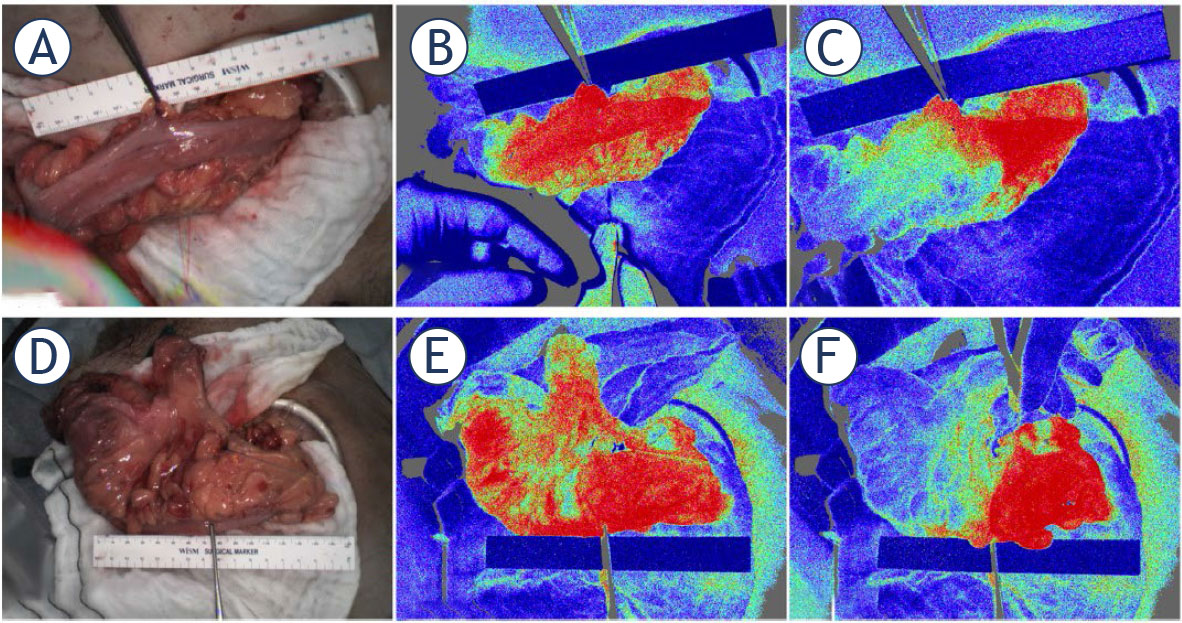
Figure 4.
Typical laser speckle images in two patients. High-resolution laser speckle contrast imaging (LSCI) can indicate the bowel demarcation line at the point of ligation of the marginal vessels. (A) Normal color image before ligating the marginal vessels. (B) LSCI image before ligating the marginal vessels. (C) LSCI image after ligating the marginal vessels. Taken from Kojima et al.56 and reprinted with permission from the publisher.