
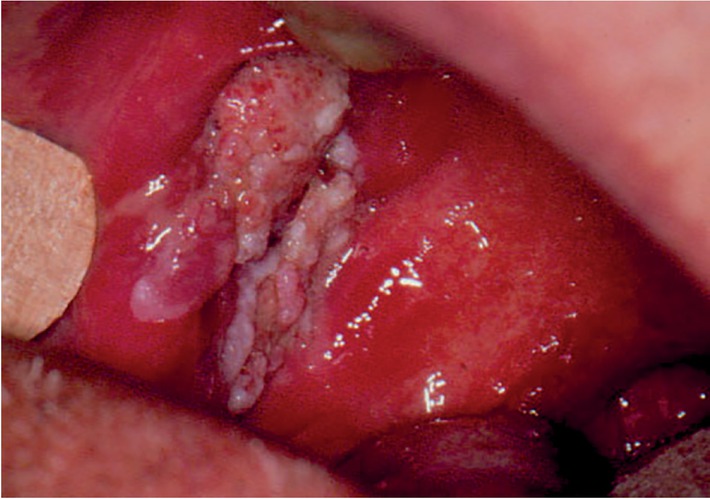
Figure 1
Verrucous carcinoma of the right buccal mucosa (clinical stage T2N0M0) in an 81-year-old male patient. He presented with a whitish exophytic tumour mass of the inner side of the right cheek and without suspicious lymph nodes on the neck. The lesion was noticed by the patient a month before initial examination, and it occasionally hurt, but he had no problems feeding. Due to associated diseases, he was treated with radiotherapy (55 Gy, 2.2 Gy/fraction) and concurrent intravenous chemotherapy (vinblastine 2 mg, day 1; methotrexate 50 mg, day 2; bleomycin 15 mg, days 2 and 3). The patient died of injury 5.5 years after completion of treatment for verrucous carcinoma with no evidence of malignant disease in oral cavity.
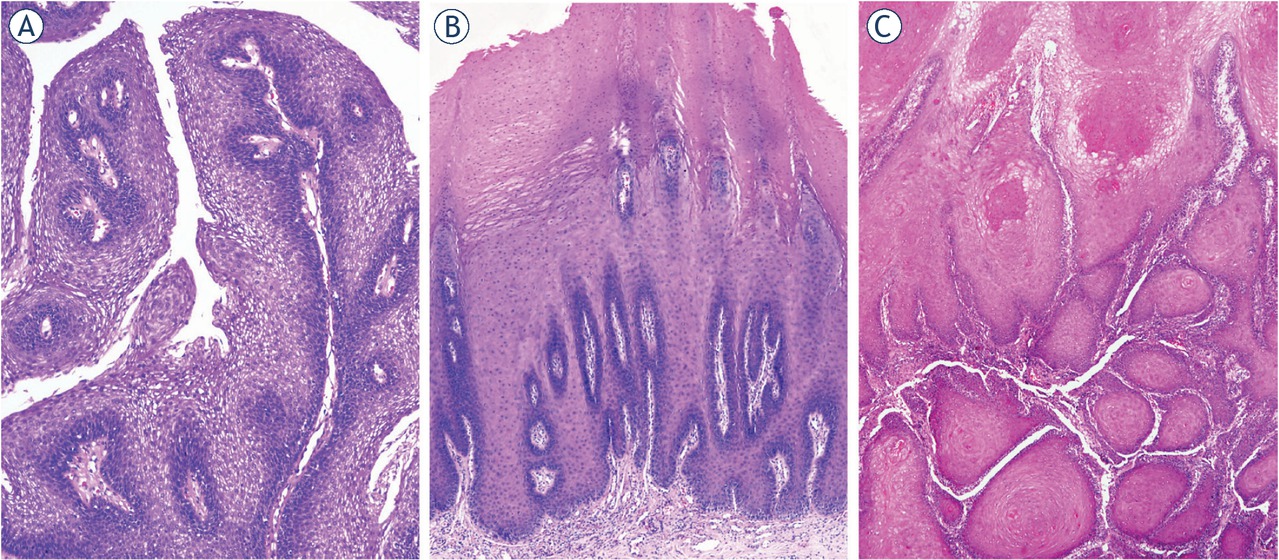
Figure 2
Histopathology images of oral verrucous lesions. Squamous cell papilloma (A) exophytic lesion, composed of finger-like projections, lined by non-keratinizing stratified squamous epithelium and a central connective tissue core. Verrucous hyperplasia (B) exophytic lesion, composed of hyperplastic keratinizing squamous epithelium with no invasion into the underlying stroma. Verrucous carcinoma (C) exophytic tumour, resembling verrucous hyperplasia, but with invasive growth, consisting of broad epithelial islands and processes, with no atypia, exhibiting a pushing-border into the underlying stroma.
Table 1
Primary surgery in the treatment of oral verrucous carcinoma - review of the literature series
| Authors and study year | Number patients of | Local control (%) | Survival | Follow-up time |
|---|---|---|---|---|
| Kraus 196674 and Perezmesa, | 64 | 55 (85.9) | N.S. | N.S. |
| Medina 198430 et al, | 90 | 74 (82.2) | N.S. | At least 2 years |
| Jyothirmayi 19978 et al, | 11 | N.S. | 5-year DFS 68% | Median (range 56 7months –110) |
| Koch 20013 et al, | 484 | N.S. | 5-year RSR 85.7% | N.S. |
| Kang 200338 et al, | 38 | 38 (100) at 3 years | 3-year OSR 94.7% | Median 37.5 13months –76) (range |
| Walvekar 200917 et al, | 101 | 80 (79.2) | 5-year DFS 77.6% | Median (range 4.61 0.5–years 14.3) |
| Huang et al, 200967 | 39 | 38 (97.4) | 5-year CSS 89.1% | Median 90 months (range, 13–171) |
| Candau-Alvarez et al, 201468 | 13 | 12 (92.3) | OSR 92.9% for a mean follow-up of 2 years | Mean 24.8 months (range 6–53) |
| Franklyn et al, 201710 | 22 | 21 (95.5) (recurrence in a patient with hybrid OVC) | N.S. | Median 24 months |
Table 2
Primary radiotherapy in the treatment of oral verrucous carcinoma - review of the literature series
| Authors and study year | Number of patients | Local control rate with primary radiotherapy (%) | Surgical salvage | Local control rate with primary radiotherapy and salvage surgery (%) | Survival | Follow-up time |
|---|---|---|---|---|---|---|
| Kraus 196674 and Perezmesa, | 13 | 0 (0) | 8/13 | 7 (53.8) | N.S. | N.S. |
| Memula 198075 et al, | 32 | 19 (59.4) | 6/13 | 25 (78.1) | 5-year 31% DFS | N.S. |
| Medina 198430 et al, | 12 | 7 (58.3) | 3/5 | 10 (83.3) | N.S. | At least 2 years |
| Nair 1988et 76 al, | 50 | 22 (44) at 3 years | 4/28 | N.S. | 3-year 44% DFS | At least 3 years |
| Vidysagar et al, 199236 | 107 | 55 (51.4) (residual disease in 19 patients, recurrence in 33 patients) | 20/52 | N.S. | 5-year DFS 49% | Range 6–60 months |
| Jyothirmayi et al, 19978 | 42 | 16 (38.1) (residual disease in 10 patients, recurrence in 16 patients) | 9/26 | N.S. | 5-year DFS 66% | Median 56 months (range 7–110) |
| Koch 20013 et al, | 33 | N.S. | N.S. | N.S. | 5-year 41.8% RSR | N.S. |