
Table 1
The basic data and predisposing/precipitating factors in isolated subarachnoid hemorrhage (iSAH) and haemorrhagic infarction groups of patients
| iSAH group N = 8 | Hem. inf. group N = 15 | |
|---|---|---|
| Age (mean ± SD) | 49.3 ± 16.2 | 47.9 ± 16.8 |
| Gender | 6 M, 2 W | 4 M, 11 W* |
| Genetic thrombophilia (%) | 4 (50.0%) | 2 (13.3%) |
| Acquired thrombophilia (%) | 0 (0%) | 4 (26.7%) |
| Autoimmune disorder (%) | 4 (50.0%) | 4 (26.7%) |
| Hypothyroid disorder (%) | 1 (12.5%) | 1 (6.7%) |
| Venous sinuses injury (%) | 1 (12.5%) | 0 (0%) |
| Malignancy (%) | 1 (12.5%) | 1 (6.7%) |
| Pregnancy (%) | 0 (0%) | 1 (6.7%) |
| Glucocorticoid/sex steroid therapy (%) | 1 (12.5%) | 6 (40.0%) |
Table 2
Clinical signs on admission in isolated subarachnoid hemorrhage (iSAH) and haemorrhagic infarction groups
| iSAH group N = 8 | Hem. Inf group N = 15 | |
|---|---|---|
| Headache (%) | 6 (75.0%) | 9 (60.0%) |
| Seizure (%) | 3 (37.5%) | 8 (53.3%) |
| Focal signs (%) | 2 (25.0%) | 5 (33.3%) |
| Nausea/vomiting (%) | 2 (25.0%) | 3 (20.0%) |
| Confusion (%) | 0 (0%) | 2 (13.3%) |
| Disturbed consciousness(%) | 0 (0%) | 4 (26.7%) |
Table 3
Comparison of thrombosed veins/sinuses (CVS), oedema formation, herniation, sulcal obliteration, modified Rankin Scores (mRs) at discharge and control examination in both groups of patients
| iSAH group N = 8 | Hem. Inf group N = 15 | |
|---|---|---|
| Average No. of thrombosed CVS (median, 25%, 75% percentiles) | 4 (25% 3.25, 75% 5.75) | 2 (25% 1, 75% 3)* |
| Sulcal obliteration | 0 (0.0%) | 13 (86.7%)* |
| Subfalcine/uncal herniation | 0 (0.0%) | 4 (26.7%) |
| Oedema formation | 2 (25.0%) | 8 (53.3%)* |
| Average mRS at discharge (median, 25% , 75% percentiles) | 1 (25% 0, 75% 1.75) | 2 (25% 0, 75% 3) |
| Average mRS at control (median, 25% , 75% percentiles) | 0 (25% 0, 75% 0) | 1 (25% 0, 75% 3)* |
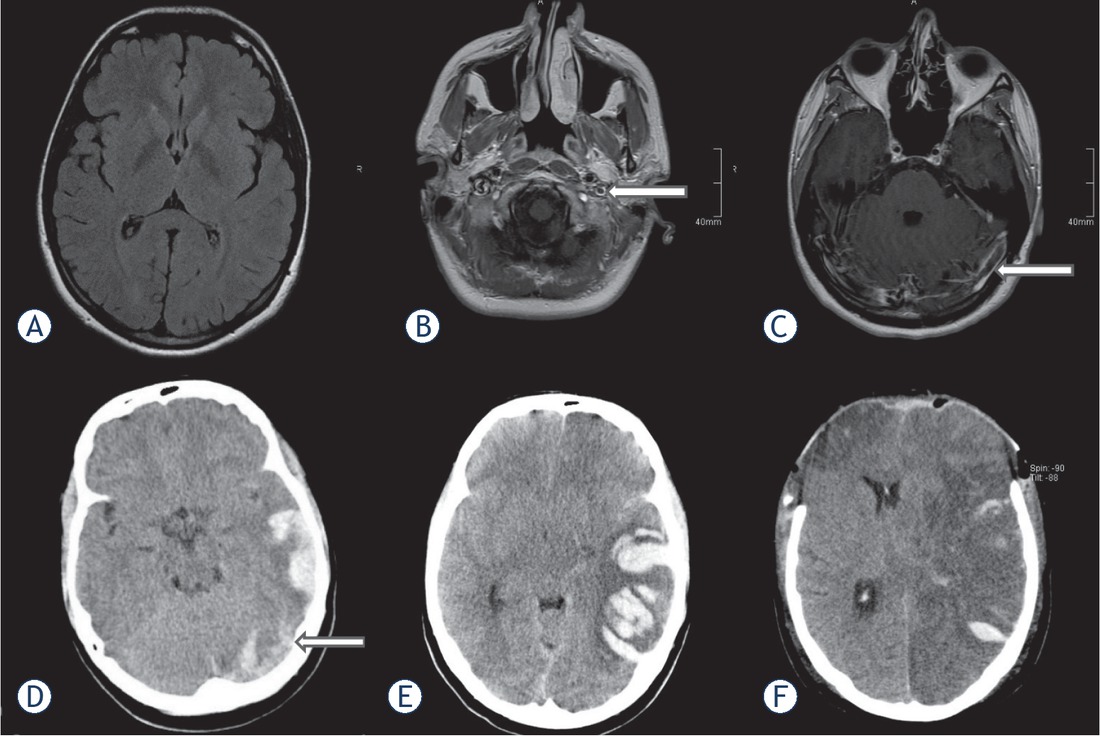
Figure 1
A 23-year old woman with headache followed by seizure and focal neurological deficit MRI on admission showed no focal lesions/oedema (A); contrast material-enhanced (CE) T1 and T2 showed occlusion of the left sigmoid sinus (B) and left transverse (C). Despite immediate anticoagulant treatment (fractioned heparin), the next day the patient became drowsy. CT revealed hemorrhagic infarction; in addition to the transverse sinus (arrow), the Labbe vein was suspected to be occluded due to the infarction territory (D). Decompressive craniotomy failed to prevent progression to irreversible coma (E,F).
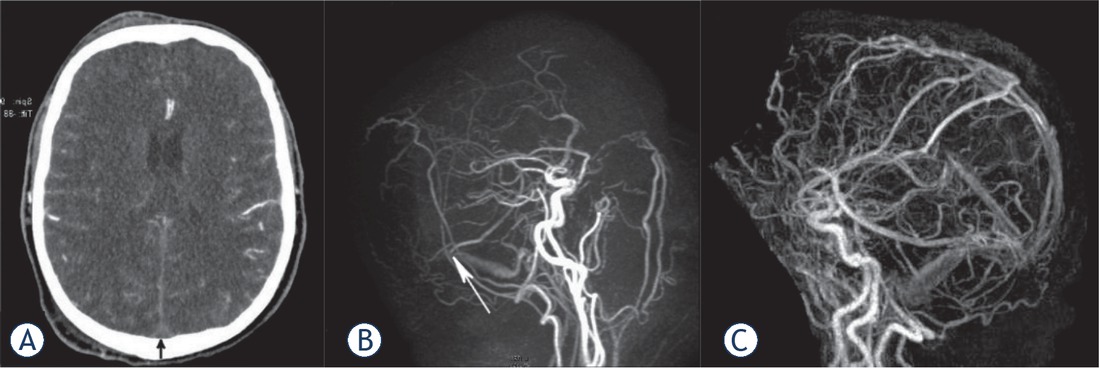
Figure 2
A 59-year old man was examined after 5 days of headaches and a seizure. CT revealed bilateral cortical subarachnoid hemorrhage (SAH) and moderate diffuse brain edema, but no hemorrhagic infarction was formed (A). An extensive thrombosis of cerebral sinuses/veins including the superior sagittal sinus, transversal sinuses, left sigmoid sinus and jugular bulb was observed. The right transversal sinus was occluded to the point of Labbe vein inflow (B), arrow showing confluence of vein to sinus). Fractured heparin and later warfarin were introduced; the patient scored 0 according modified Rankin Score (mRs) at control examination. Complete recanalization of the occluded sinuses occurred (C).