
Introduction
Currently, ~ 80% of children with cancer are long-term survivors with possible late sequelae.1,2 Treatment of childhood cancer depends on surgery, radiotherapy, and chemotherapy despite their potential toxicity. Late effects of cancer treatment are important causes of morbidity and mortality in survivors of childhood cancer.3 The burden of therapy was reduced, through clinical trials, in childhood cancers with good or excellent survival.4 However, for many children with cancer relapse of primary disease is still the leading cause of death.4 Death due to subsequent neoplasm (SN) is the most common non-relapse related event.5
Large population-based studies in childhood cancer survivors have been conducted in the Nordic countries and Britain with long and almost complete follow-up.6,7 Cancer registries generally have limited or no information on treatment variables. Multicentre studies conducted in Netherlands and US collect data through questionnaires or hospital registries, with up to one third of patients lost to follow up.8, 9, 10, 11, 12, 13, 14 However, detailed treatment data extracted from hospital registries provided important information about the risk factors for SN.8, 9, 10, 11, 12, 13, 14
Population based analysis of SN after treatment of childhood cancer in Slovenia was first published in 2004.15 The aims of present analysis were to assess long-term risk and spectrum of SN in Slovenia; identify how trends in therapy influenced cumulative incidence of SN.
Patients and methods
Cohort ascertainment and subsequent neoplasm ascertainment
The study cohort comprises patients in Slovenia aged ≤ 18 years with childhood cancer diagnosis between 1st January 1961 and 31st December 2013 and a follow-up through 31st December 2018.
The cohort was ascertained through the population-based Cancer Registry of Slovenia (CRS). The registry combines data from University Children Hospital Ljubljana and Institute of Oncology Ljubljana, representing all institutions where childhood cancer patients are treated and subjected to follow-up.16 Data coverage is estimated to be close to complete. CRS is linked to the Central population registry for information on vital status and causes of death.
Childhood cancers were coded according to International Classification of Diseases for Oncology (ICD, 3rd version).17 For every patient basic treatment information (use of surgery, chemotherapy, and radiation) and outcome (recurrence of primary cancer, subsequent neoplasms, cause of death) were reported.
Subsequent neoplasms (SNs) for the entire cohort were defined as a neoplasm on new location, which is not a direct spread or metastasis of the primary neoplasm, or neoplasm on the same location with a different histological type (18.). SNs were validated through pathology reports or in some cases with other means through a clinical diagnosis (e.g., meningioma). SN were classified as subsequent malignant neoplasm (SMN), having ICD-O behaviour code of 3, meningioma, non-melanoma skin cancer (NMSC).
As registration of neoplasms with ICD-O behaviour code 2 is close to complete in CRS, these were included in SMN (in situ cervical carcinoma, in situ carcinoma of bladder, ductal in situ carcinoma of breast and in situ melanoma). As registration of meningioma and NMSC is incomplete for general population, they were reported for our cohort but excluded from further statistical analysis.
Statistical analysis
Time at risk for SN was set at diagnosis of childhood cancer (at latest 31st December 2013) and ended at the earliest occurrence of loss of follow up, death or study exit date (31st December 2018). During this period 3350 children were diagnosed with cancer, 79 patients were excluded from analysis after reviewing diagnosis (histology missing, benign tumours or Langerhans cell histiocytosis).
Standardized incidence ratio (SIR) was calculated as the observed divided by expected number of SMN. The expected number of SMNs were calculated by multiplying the number of person-years at risk in the cohort within specific sex, five-year age strata and single calendar year interval by corresponding neoplasm incidence rates in Slovenian population extracted from CRS. Absolute excess risk (AER) was calculated as observed minus expected number of SMN divided by person-years at risk and multiplied by 1000, unless otherwise specified. AER is the number of extra SMN observed beyond that expected per 1000 persons per year. Meningioma and NMSC were excluded from SIR and AER calculations since their ascertainment is not complete in CRS.
SIRs and AERs were stratified by sex, age at diagnosis of primary cancer, attained age (age of the subjects at the study exit date, death or lost of follow up), primary neoplasm type, treatment period of childhood cancer, years from diagnosis of childhood cancer and childhood cancer therapy. A multivariable Poisson regression model was used to calculate relative risk (RR) and relative excess risk (RER) and analyse the potential simultaneous effect of this explanatory factors on the SIR and AER. Relative risk represents ratio of SIRs adjusted for explanatory factors and RER as ratio of AERs adjusted for explanatory factors (19.). Results relating to overall SIRs and AERs were only reported in text whenever there were at least 3 observed SMNs. For SIR, AER, RR and RER 95% confidence intervals were estimated (95% CI).
The cumulative incidence for the first occurrence of SN, SMN, NMSC and meningioma was computed as a function of time from childhood cancer diagnosis with death due to any other cause prior to developing SN considered as a competing event. Expected cumulative incidence for SMNs was calculated using the Ederer II method.20
Five-year relative survival following an SN was estimated using the Stata command strs.21All statistical analysis were conducted using Stata statistical software, version 17.0. All tests were 2-sided, with p value < 0.05 considered statistically significant.
Results
Cohort characteristics
In this retrospective cohort study 3,271 childhood cancer patients accrued a total of 46,464 person-years of follow-up, with median follow-up time of 21.5 years (range, 5.25–57.8 years) for 5-year survivors. The most common types of childhood cancer were leukaemia (26.6%), CNS tumours (19.1%), Hodgkin’s lymphoma (9.6%) and non-Hodgkin’s lymphoma (8.5%) (Table 1).
Table 1
Characteristics of all individuals in study and number of subsequent neoplasms
| Number (%) | Any subsequent malignant neoplasm | Non-melanoma skin cancer | Benign meningioma | ||
|---|---|---|---|---|---|
| All survivors | 3271 (100%) | 183 (100%) | 56 (100%) | 34 (100%) | |
| Gender | Male | 1830 (55.9%) | 77 (42.1%) | 30 (54%) | 14 (41%) |
| Female | 1441 (44.1%) | 106 (57.9%) | 26 (46%) | 20 (59%) | |
| Leukaemia | 870 (26.6%) | 23 (12.6%) | 11 (20%) | 14 (41%) | |
| Hodgkin’s lymphoma | 315 (9.6%) | 51 (27.9%) | 17 (30%) | 2 (6%) | |
| Non-Hodgkin’s lymphoma | 277 (8.5%) | 16 (8.7%) | 4 (7%) | 2 (6%) | |
| Central nervous system tumour | 625 (19.1%) | 25 (13.7%) | 12 (21%) | 15 (44%) | |
| Neuroblastoma | 124 (3.8%) | 6 (3.3%) | 1 (2%) | 0 (0%) | |
| Retinoblastoma | 60 (1.8%) | 0 (0%) | 0 (0%) | 0 (0%) | |
| Wilms’ tumour | 143 (4.4%) | 9 (4.9%) | 1 (2%) | 1 (3%) | |
| Childhood cancer | Bone tumour | 199 (6.1%) | 13 (7.1%) | 0 (0%) | 0 (0%) |
| type | Soft-tissue sarcoma | 224 (6.8%) | 14 (7.7%) | 4 (7%) | 0 (0%) |
| Germ cell | 168 (5.1%) | 8 (4.4%) | 3 (5%) | 0 (0%) | |
| Liver | 27 (0.8%) | 1 (0.5%) | 1 (2%) | 0 (0%) | |
| Thyroid | 86 (2.6%) | 8 (4.4%) | 1 (2%) | 0 (0%) | |
| Nasopharyngeal carcinoma | 13 (0.4%) | 4 (2.2%) | 1 (2%) | 0 (0%) | |
| Melanoma | 75 (2.3%) | 2 (1.1%) | 0 (0%) | 0 (0%) | |
| Carcinoma | 59 (1.8%) | 3 (1.6%) | 0 (0%) | 0 (0%) | |
| Other | 6 (0.2%) | 0 (%) | 0 (0%) | 0 (0%) | |
| Mean | 9.4 (6.0) | 11.2 (5.7) | 11.3(6.0) | 7.0 (4.1) | |
| Age at childhood | 0–4 | 1065 (32.6%) | 39 (21.3%) | 13 (23%) | 12 (35%) |
| cancer diagnosis (years) | 5–9 | 656 (20.1%) | 34 (18.6%) | 9 (16%) | 15 (44%) |
| 10–14 | 690 (21.1%) | 49 (26.8%) | 13 (23%) | 5 (15%) | |
| 15–19 | 860 (26.3%) | 61 (33.3%) | 21 (38%) | 2 (6%) | |
| < 1970 | 528 (16.1%) | 22 (12.0%) | 4 (7%) | 3 (9%) | |
| Decade of | 1970–79 | 560 (17.1%) | 50 (27.3%) | 18 (32%) | 11 (32%) |
| diagnosis of childhood cancer | 1980–89 | 651 (19.9%) | 63 (34.4%) | 22 (39%) | 16 (47%) |
| 1990–2000 | 679 (20.8%) | 32 (17.5%) | 9 (16%) | 3 (9%) | |
| 2000–2018 | 853 (26.1%) | 16 (8.7%) | 3 (5%) | 1 (3%) | |
| 0–19 | 1643 (50.2%) | 31 (16.9%) | 4 (7%) | 2 (6%) | |
| 20–29 | 550 (16.8%) | 33 (18.0%) | 4 (7%) | 7 (21%) | |
| Attained age | 30–39 | 494 (15.1%) | 59 (32.2%) | 20 (36%) | 19 (56%) |
| (years) | 40–49 | 353 (10.8%) | 33 (18.0%) | 19 (34%) | 5 (15%) |
| 50–59 | 151 (4.6%) | 19 (10.4%) | 7 (12%) | 0 (0%) | |
| 60+ | 80 (2.4%) | 8 (4.4%) | 2 (4%) | 1 (3%) | |
| No therapy | 527 (16.1%) | 4 (2.2%) | 9 (16%) | 2 (6%) | |
| Surgery only | 506 (15.5%) | 24 (13.1%) | 3 (5%) | 0 (0%) | |
| Treatment childhood of cancer | Chemotherapy | 1014 (31.0%) | 40 (21.9%) | 17 (30%) | 2 (6%) |
| Radiotherapy | 345 (10.5%) | 44 (24.0%) | 27 (48%) | 11 (32%) | |
| Radiotherapy and chemotherapy | 879 (26.9%) | 71 (38.8%) | 9 (16%) | 19 (56%) |
In total, 230 patients experienced 273 SN, including 183 SMN, 34 meningiomas and 56 NMSC. Of all individuals with an SN, 192 had one, 33 two and 5 three SNs. At the study exit date 53% (n = 1744) of patients were alive (Table 2). A total of 10.5% patients received radiotherapy only, 31% chemotherapy only, 26.9% a combination of chemotherapy and radiotherapy and 16.1% surgery only. The proportion of patients treated with radiotherapy was highest for those diagnosed from 1970 to 1989 (> 50%) and decreased over time (29.7% > 2000). Simultaneously, the number of patients treated with chemotherapy increased from 49.1% in 1970s to 75.2% after year 2000. In the cohort 16% (n = 527) patients had no therapy, of whom 75% were diagnosed before 1970 and majority died of childhood cancer. After 1980 there is approximately 4% of children with cancer undergoing observation only (e.g., low grade glioma, low risk neuroblastoma) (Table 3).
Table 2
Vital status by decade of childhood cancer diagnosis
| Dead | Alive | |
|---|---|---|
| < 1970 | 447 | 81 |
| 1970–1979 | 394 | 166 |
| 1980–1989 | 309 | 342 |
| 1990–2000 | 222 | 457 |
| 2000–2013 | 155 | 698 |
| Total | 1527 | 1744 |
Table 3
Treatment modality by decade of childhood cancer diagnosis
| Treatment | < 1970 | 1970–79 | 1980–89 | 1990–99 | 2000–2013 |
|---|---|---|---|---|---|
| No therapy | 399 (75.6%) | 38 (6.8%) | 27 (4.2%) | 30 (4.4%) | 33 (3.9%) |
| Surgery only | 41 (7.8%) | 102 (18.2%) | 85 (13.1%) | 116 (17.1%) | 162 (19.0%) |
| Chemotherapy only | 30 (5.7%) | 135 (24.1%) | 174 (26.7%) | 270 (39.8%) | 405 (47.5%) |
| Radiotherapy only | 49 (9.3%) | 145 (25.9%) | 88 (13.5%) | 46 (6.8%) | 17 (2.0%) |
| Radiotherapy and chemotherapy | 9 (1.7%) | 140 (25.0%) | 277 (42.6%) | 217 (32.0%) | 236 (27.7%) |
| Total | 528 (100%) | 560 (100%) | 651 (100%) | 679 (100%) | 853 (100%) |
The overall risk of developing an SNs and SMNs
The estimated cumulative incidence of developing an SMN in the cohort was 2.8% at 20 years and increased to 5.7% at 30 years after childhood cancer diagnosis. The cumulative incidence of SNs and SMNs increased with attained age without plateauing (Figure 1).
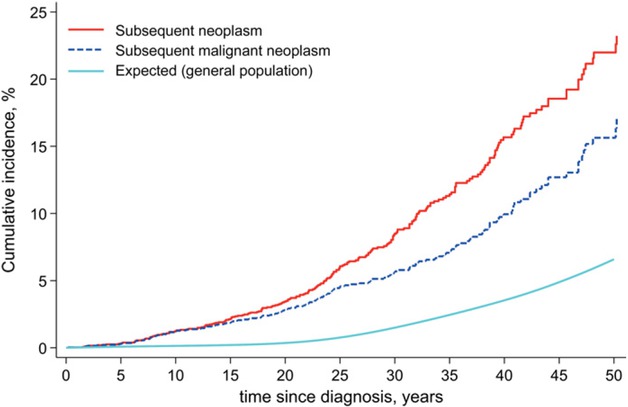
Figure 1
Cumulative incidence of all subsequent neoplasms and subsequent malignant neoplasms.
Cumulative incidence of developing an SMN at 40 years after childhood cancer diagnosis was significantly lower for patients having surgery only (Pheterogeneity < 0.001) (Figure 2). The observed cumulative incidence of SMN at 30 years after childhood cancer diagnosis was significantly lower for those diagnosed in 1960s (P heterogeneity < 0.001) (Figure 3). Despite reduced use of radiotherapy after 1995 difference in cumulative incidence of SMN for the first 15 years after diagnosis was not significant (Pepe Mori’s test for difference, p = 0.11).
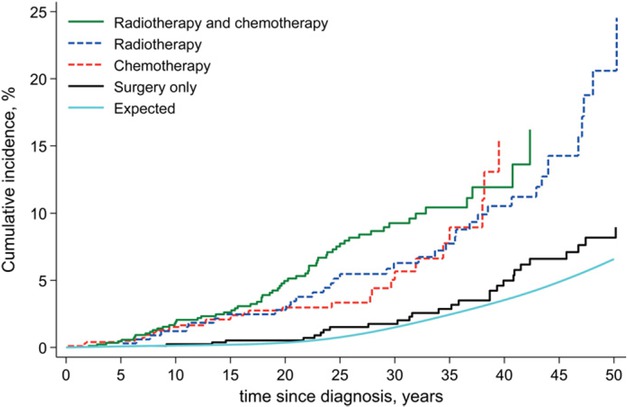
Figure 2
Cumulative incidence of subsequent malignant neoplasm by treatment modality of childhood cancer.
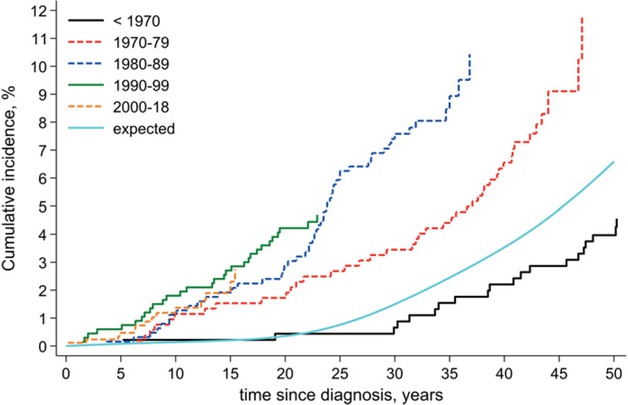
Figure 3
Cumulative incidence of subsequent malignant neoplasm by decade of diagnosis of childhood cancer.
The risk of developing any SMN was almost 3-fold (SIR 2.9; 95% CI: 2.5–3.3) in the cohort compared with the general population, corresponding to an absolute excess risk of 2.6 per 1000 person-years (95% CI: 2.1–3.2.). Males appeared to be at higher risk than females in terms of the SIR (P heterogeneity < 0.001). With increasing attained age, the SIR gradually decreased, and AER increased (Table 4), with survivors still at 2-fold increased risk after age 50 years (SIR = 2.0; 95% CI: 1.3–3.1). The risk of an SMN was highest among patients with nasopharyngeal carcinoma (SIR 7.5; 95% CI: 2.8–20.0), neuroblastoma (SIR 5.1; 95% CI: 2.3–11.3) and Hodgkin’s lymphoma (SIR 5.0; 95% CI: 3.8– 6.6) (Table 4).
Table 4
Standardized incidence ratios (SIR), absolute excess risks (AER), relative risk (RR) and relative excess risk (RER) for any subequent malignant neoplasm (SMN)
| O | SIR (95%CI) | RR (95%CI) | ||||
|---|---|---|---|---|---|---|
| Overall | All combined | 183 | 2.9 (2.5,3.3) | – | 2.6 (2.1,3.2) | -- |
| Male | 77 | 4.0 (3.2,5.0) | 1.0 (ref.) | 2.3 (1.7,3.1) | 1.0 (ref.) | |
| Sex | Female | 106 | 2.4 (2.0,2.9) | 0.7 (0.5-1.0) | 2.9 (2.1,4.0) | 1.4 (0.9-2.1) |
| Pheterogeneity* | <0.001 | 0.03 | 0.30 | 0.16 | ||
| Age at | 0–4 | 39 | 3.9 (2.8,5.3) | 1.0 (ref.) | 2.0 (1.3,3.1) | 1.0 (ref.) |
| diagnosis | 5–9 | 34 | 3.3 (2.3,4.6) | 0.9 (0.6-1.6) | 2.4 (1.5,4.0) | 0.8 (0.4-1.6) |
| of childhood | 10–14 | 49 | 3.1 (2.3,4.1) | 0.9 (0.5-1.5) | 3.2 (2.1,4.9) | 0.7 (0.4-1.5) |
| cancer | 15–19 | 61 | 2.3 (1.8,2.9) | 0.8 (0.5-1.3) | 2.7 (1.7,4.3) | 0.6 (0.3-1.2) |
| (years) | Ptrend* | 0.01 | 0.3 | 0.23 | 0.13 | |
| < 1970 | 22 | 1.4 (1.0,2.2) | 1.0 (ref.) | 1.2 (0.3,4.8) | 1.0 (ref.) | |
| Decade of | 1970–1979 | 50 | 3.4 (2.6,4.5) | 1.7 (1.0-3.0) | 4.1 (2.8,6.1) | 3.4 (1.0-11.9) |
| diagnosis of | 1980–1989 | 63 | 4.0 (3.1,5.1) | 1.7 (0.9-3.0) | 3.8 (2.7,5.3) | 3.5 (1.0-12.5) |
| childhood | 1990–2000 | 32 | 2.7 (1.9,3.8) | 1.1 (0.5-2.1) | 1.8 (1.0,3.1) | 2.6 (0.7-9.7) |
| cancer | 2000–2018 | 16 | 2.7 (1.7,4.4) | 0.9 (0.4-2.0) | 1.2 (0.5,2.5) | 2.5 (0.6-10.4) |
| Ptrend* | 0.07 | 0.3 | 0.02 | 0.61 | ||
| Era | < 1995 | 151 | 2.9 (2.5,3.4) | 1.0 (ref.) | 3.1 (2.4,3.9) | 1.0 (ref.) |
| diagnosis | > = 1995 Pheterogeneity* | 32 | 2.8 (2.0,4.0) 0.88 | 0.7 (0.5-1.1) 0.15 | 1.4 (0.8,2.5) 0.01 | 1.0 (0.6-1.8) 0.9 |
| < 20 | 31 | 10.6 (7.4,15.0) | 1.0 (ref.) | 1.5 (1.0,2.2) | 1.0 (ref.) | |
| 20–29 | 33 | 2.2 (1.6,3.1) | 0.2 (0.1-0.4) | 1.4 (0.7,2.5) | 1.0 (0.5-2.0) | |
| 30–39 | 59 | 3.5 (2.7,4.5) | 0.3 (0.2-0.5) | 5.1 (3.6,7.3) | 3.4 (1.9-6.1) | |
| Attained | 40–49 | 33 | 2.7 (1.9,3.8) | 0.2 (0.1-0.4) | 5.2 (3.0,9.0) | 3.4 (1.5-7.4) |
| Age (yrs) | 50–59 | 19 | 2.0 (1.3,3.1) | 0.2 (0.1-0.4) | 6.6 (2.7,16.3) | 7.5 (2.8-20.4) |
| 60+ | 8 | 1.3 (0.6,2.6) | 0.1 (0.1-0.4) | 3.7 (0.2,90.4) | 10.8 (1.6-74.0) | |
| Ptrend* | <0.001 | <0.001 | <0.001 | <0.001 | ||
| 0–9 | 38 | 6.0 (4.3,8.2) | 1.0 (ref.) | 1.6 (1.1,2.3) | 1.0 (ref.) | |
| Time diagnosis since | 10–19 | 37 | 2.6 (1.9,3.6) | 0.4 (0.3-0.7) | 1.7 (1.0,2.9) | 1.1 (0.6-2.0) |
| of | 20–29 | 51 | 3.1 (2.4,4.1) | 0.4 (0.2-0.6) | 4.3 (2.9,6.5) | 2.5 (1.4-4.4) |
| childhood | 20–39 | 36 | 2.6 (1.9,3.6) | 0.3 (0.2-0.6) | 5.7 (3.4,9.6) | 3.4 (1.7-6.9) |
| cancer (years) | 40+ | 21 | 1.7 (1.1,2.5) | 0.2 (0.1-0.4) | 5.3 (1.8,15.5) | 5.2 (2.1-12.4) |
| Ptrend* | <0.001 | <0.001 | <0.001 | <0.001 | ||
| Leukaemia | 23 | 2.7 (1.8,4.0) | 1.0 (ref.) | 1.6 (0.8,3.0) | 1.0 (ref.) | |
| Hodgkin’s lymphoma | 51 | 5.0 (3.8,6.6) | 2.5 (1.4-4.2) | 6.5 (4.6,9.1) | 2.8 (1.4-5.7) | |
| non-Hodgkin’s lymphoma | 16 | 4.3 (2.7,7.1) | 1.7 (0.9-3.3) | 3.3 (1.7,6.2) | 1.3 (0.5-3.6) | |
| Central nervous system tumour | 25 | 2.8 (1.9,4.2) | 1.2 (0.7-2.2) | 2.1 (1.1,3.8) | 1.1 (0.5-2.4) | |
| Neuroblastoma | 6 | 5.1 (2.3,11.3) | 1.8 (0.7-4.5) | 3.2 (1.2,8.6) | 1.8 (0.6-5.5) | |
| Retinoblastoma | 0 | 0 | - | 0 | - | |
| Wilms Tumour | 9 | 3.8 (2.0,7.3) | 1.4 (0.6-3.1) | 2.6 (1.1,6.3) | 1.0 (0.3-3.3) | |
| Type of | Bone sarcoma | 13 | 2.7 (1.6,4.6) | 1.6 (0.8-3.3) | 3.3 (1.4,7.8) | 1.8 (0.6-5.0) |
| childhood cancer | Soft-tissue sarcoma | 14 | 2.6 (1.5,4.4) | 1.2 (0.6-2.3) | 2.3 (1.0,5.4) | 1.1 (0.4-2.9) |
| Germ-cell | 8 | 1.6 (0.8,3.1) | 0.9 (0.4-2.1) | 1.0 (0.1,6.7) | 0.6 (0.1-3.0) | |
| Liver | 1 | 7.9 (1.1,56.1) | 2.2 (0.3-16.3) | 3.2 (0.3,30.4) | 2.1 (0.2-19.2) | |
| Thyroid | 8 | 2.0 (1.0,4.0) | 1.2 (0.5-2.7) | 2.3 (0.6,8.9) | 0.9 (0.2-4.0) | |
| Nasopharyngeal carcinoma | 4 | 7.5 (2.8,20.0) | 4.2 (1.4-12.8) | 12.6 (4.1,39.1) | 6.9 (1.9-24.6) | |
| Melanoma | 2 | 0.4 (0.1,1.8) | 0.3 (0.1-1.4) | 0.1 | 0 | |
| Carcinoma | 3 | 1.1 (0.4,3.4) | 0.8 (0.2-2.6) | 0.2 | 0 | |
| Pheterogeneity* | <0.001 | <0.001 | <0.001 | <0.001 | ||
| No therapy treatment of childhood | 4 | 0.4 (0.2,1.1) | 0.3 (0.1-0.8) | 0 | - | |
| Surgery only | 24 | 1.7 (1.1,2.5) | 1.0 (ref.) | 1.0 (0.4,2.7) | 1.0 (ref.) | |
| Treatment of | Chemotherapy | 40 | 3.3 (2.4,4.4) | 1.8 (1.1-3.1) | 2.2 (1.4,3.4) | 4.6 (1.0-20.9) |
| childhood cancer | Radiotherapy | 44 | 4.4 (3.3,5.9) | 2.6 (1.6-4.3) | 5.7 (3.9,8.4) | 7.3 (1.6-33.5) |
| Radio and chemotherapy | 71 | 4.3 (3.4,5.4) | 2.4 (1.5-3.9) | 3.8 (2.8,5.2) | 7.0 (1.6-30.8) | |
| Pheterogeneity* | <0.001 | <0.001 | <0.001 | <0.001 |
Elevated SIRs and AERs were evident for all childhood cancers, except for retinoblastomas, melanomas, and carcinomas. Not a single retinoblastoma patient in cohort developed SN.
Five-year overall survival was estimated for children with different solid tumours through decades to enable interpretation of results. Survival for patients with retinoblastoma was 50%, 56%, 88% and 100% for those diagnosed in 1960s, 1970s, 1980s and after 2000, respectively. Patients with central nervous system (CNS) tumours, sarcomas and Wilms tumours diagnosed in 1970s and 1990s experienced increase of five-year overall survival from 44% to 65%, 46% to 62% and 58% to 76%, respectively.
Risk of specific subsequent primary neoplasms
The most frequent SMNs were those of the thyroid (n = 37), genitourinary (n = 36; 15 cervical carcinoma in situ) and breast (n = 26) carcinoma. The majority of breast (n = 13) and thyroid (n = 19) carcinoma occurred in Hodgkin’s lymphoma. Most genitourinary cancers occurred among bone and soft tissue sarcoma survivors (n = 12). Seventy percent of SN occurred in patients with CNS tumours, leukaemia, and lymphoma (Table 5).
Table 5
Number and type of subsequent neoplasms (SN) by childhood cancer type
| Childhood type / SN cancer | ALL AML | HL | NHL | CNS | Neuroblastoma | Retinoblastoma | Wilms | Bone sarcoma | Soft tissue sarcoma | Germ cell | Liver | Thyroid | Nasopharyngeal carcinoma | Melanoma | Carcinoma | Total |
|---|---|---|---|---|---|---|---|---|---|---|---|---|---|---|---|---|
| Meningioma | 14 | 2 | 2 | 15 | 0 | 0 | 1 | 0 | 0 | 0 | 0 | 0 | 0 | 0 | 0 | 34 |
| NMSC | 11 | 17 | 4 | 12 | 1 | 0 | 1 | 0 | 4 | 3 | 1 | 1 | 1 | 0 | 0 | 56 |
| Breast (C50 D05) | 1 | 14 | 0 | 0 | 0 | 0 | 1 | 1 | 2 | 2 | 0 | 1 | 1 | 1 | 2 | 26 |
| CNS (C70-C72) | 6 | 0 | 0 | 11 | 1 | 0 | 0 | 0 | 0 | 0 | 0 | 0 | 0 | 0 | 0 | 18 |
| Digestive (C15-C26) | 1 | 3 | 4 | 0 | 1 | 0 | 0 | 2 | 1 | 0 | 0 | 1 | 0 | 0 | 0 | 13 |
| Genitourinary (C51-C68, D09, D06) | 3 | 3 | 2 | 4 | 0 | 0 | 2 | 5 | 7 | 3 | 1 | 5 | 0 | 1 | 0 | 36 |
| Leukaemia (C90-C93) | 3 | 2 | 1 | 1 | 0 | 0 | 0 | 1 | 1 | 0 | 0 | 0 | 0 | 0 | 0 | 9 |
| Lymphoma (C81-C85) | 3 | 0 | 0 | 0 | 0 | 0 | 0 | 0 | 0 | 0 | 0 | 0 | 0 | 0 | 0 | 3 |
| Melanoma (C43, D03) | 0 | 0 | 1 | 1 | 0 | 0 | 1 | 0 | 0 | 1 | 0 | 0 | 0 | 0 | 0 | 4 |
| Bone (C40-C41) | 1 | 0 | 0 | 0 | 0 | 0 | 0 | 1 | 0 | 0 | 0 | 0 | 0 | 0 | 0 | 2 |
| Head&Neck (C00-C14) | 2 | 1 | 1 | 1 | 0 | 0 | 0 | 2 | 0 | 0 | 0 | 0 | 1 | 0 | 1 | 9 |
| Other | 1 | 3 | 1 | 1 | 0 | 0 | 2 | 0 | 0 | 0 | 0 | 1 | 0 | 0 | 0 | 9 |
| Respiratory (C30-C39) | 0 | 4 | 3 | 0 | 1 | 0 | 0 | 0 | 2 | 1 | 0 | 0 | 1 | 0 | 0 | 12 |
| Soft-tissue (C49) | 0 | 2 | 0 | 0 | 2 | 0 | 0 | 0 | 0 | 1 | 0 | 0 | 0 | 0 | 0 | 5 |
| Thyroid (C73) | 2 | 19 | 3 | 6 | 1 | 0 | 3 | 1 | 1 | 0 | 0 | 0 | 1 | 0 | 0 | 37 |
| Total | 48 | 70 | 22 | 52 | 7 | 0 | 11 | 13 | 18 | 11 | 2 | 9 | 5 | 2 | 3 | 273 |
The greatest risk for SMN was observed for thyroid, (SIR 21.6; 95% CI: 15.2–29.7), CNS (SIR 13.4; 95% CI: 7.9–21.2), soft tissue sarcoma (SIR 9.5; 95% CI: 3.1–22.2) and head and neck carcinoma (SIR 6.4; 95% CI: 2.9–12.1). SMNs of the thyroid (AER 76), breast (AER 41) and CNS (AER 36) contributed together almost 60% to the total AER. The distribution of observed excess SMN changed with attained age. In patients up to 40 years of age thyroid (AER 71), breast (AER 35), CNS tumours (AER 30) and leukaemia (AER 17) represent the majority of SMNs. After 40 years of age thyroid (AER 109), genitourinary (AER 87), breast (AER 84), CNS (AER 78) and respiratory (AER 75) tumours were responsible for 80% of the total AER (Table 6).
Table 6
Standardized incidence ratios and absolute excess risks for specific subsequent malignant neoplasm overall and by attained age (0-39, 40+ years). Absolute excess risks are per 100,000 person-years
| SMN (ICD10) | All ages | 0-39 years | 40+ years | |||||||||
|---|---|---|---|---|---|---|---|---|---|---|---|---|
| Obs | Exp | SIR (95%CI) | AER (95%CI) | Obs | Exp | SIR (95%CI) | AER (95%CI) | Obs | Exp | SIR (95%CI) | AER (95%CI) | |
| All sites | 183 | 63.2 | 2.9 (2.5,3.3) | 257 (213,307) | 123 | 34.9 | 3.5 (2.9,4.2) | 216 (173,266) | 60 | 28.2 | 2.1 (1.6,2.7) | 545 (372,770) |
| Head & Neck (C00-C14) | 9 | 1.4 | 6.4 (2.9,12.1) | 16 (7,33) | 5 | 0.3 | (5.8,41.517.8 ) | 12 (4,28) | 4 | 1.1 | 3.5 (1.0,9.0) | 49 (10,147) |
| Digestive organs (C15-C26) | 13 | 5.5 | 2.4 (1.3,4.1) | 16 (7,32) | 7 | 1.0 | 6.8 (2.8,14.1) | 15 (5,32) | 6 | 4.4 | 1.4 (0.5,2.9) | 27 (2,112) |
| Respiratory organs (C30-C39) | 12 | 2.9 | 4.2 (2.2,7.4) | 20 (9,37) | 5 | 0.2 | (7.6,54.523.3 ) | 12 (4,28) | 7 | 2.6 | 2.7 (1.1,5.5) | 75 (22,185) |
| Bone (C40-C41) | 2 | 0.4 | 5.1 (0.6,18.3) | 3 (0,14) | 2 | 0.3 | 5.8 (0.7,21.0) | 4 (0,16) | 0 | 0.0 | 0.0 (.,73.9) | 0 |
| Melanoma of skin (C43, D03) | 4 | 4.2 | 1.0 (0.3,2.4) | 0 | 3 | 2.2 | 1.4 (0.3,4.0) | 2 (0,13) | 1 | 2.0 | 0.5 (0.0,2.8) | 0 |
| Soft tissue (C49) | 5 | 0.5 | 9.5 (3.1,22.2) | 10 (3,23) | 4 | 0.4 | (3.1,28.711.2 ) | 9 (2,24) | 1 | 0.2 | 5.9 (0.1,32.9) | 14 (0,90) |
| Breast (C50, D05) | 26 | 6.6 | 3.9 (2.6,5.7) | 41 (25,65) | 16 | 1.6 | (5.9,16.710.3 ) | 35 (20,59) | 10 | 5.1 | 2.0 (0.9,3.6) | 84 (27,198) |
| Genitourinary (C51-C68, D09, D06) | 36 | 32.2 | 1.1 (0.8,1.5) | 8 (2,21) | 22 | 23.3 | 0.9 (0.6,1.4) | 0 | 14 | 8.9 | 1.6 (0.9,2.6) | 87 (28,201) |
| Central nervous system (C70-C72) | 18 | 1.3 | (7.9,21.213.4 ) | 36 (21,57) | 13 | 0.9 | (7.6,24.414.3 ) | 30 (15,52) | 5 | 0.4 | (3.8,27.011.6 ) | 78 (24,190) |
| Thyroid gland (C73) | 37 | 1.7 | (15.2,29.721.6 ) | 76 (53,105) | 30 | 1.1 | (18.5,39.027.3 ) | 71 (47,102) | 7 | 0.6 | (4.6,23.411.3 ) | 109 (42,233) |
| Lymphoma (C81-C85) | 3 | 2.8 | 1.1 (0.2,3.2) | 0 (0,9) | 3 | 2.0 | 1.5 (0.3,4.4) | 3 (0,14) | 0 | 0.8 | 0.0 (.,4.6) | 0 |
| Leukemia (C90-C93) | 9 | 1.5 | 6.0 (2.8,11.4) | 16 (7,32) | 8 | 1.0 | 8.0 (3.5,15.8) | 17 (7,35) | 1 | 0.5 | 2.0 (0.1,11.2) | 9 (0,80) |
Because follow up commenced at the time of childhood cancer diagnosis all subsequent leukae mias (SL) were reported. There were 9 cases of subsequent leukaemia. Compared to general population, childhood cancer survivors had a 6-fold overall increased risk of leukaemia and an 8-fold (95% CI: 3.5–15.8) increased risk before age 40 (Table 6). Six patients developed SL within first 5 years of childhood cancer diagnosis. Only two out of nine patients survived the disease.
Mortality and survival following SMN
Fifty-nine patients out of 183 with SMN died within study period (1961 – 2018); 52 due to SMN and 7 of other causes. Five-year relative survival for patients with a SMN was 69 % (95% CI: 61–76). Most deaths were attributed to CNS tumours, SL, gastrointestinal, respiratory, head and neck carcinomas. Six patients developed lethal SMNs outside the radiotherapy field or without radiotherapy, two of them were with a known cancer predisposition syndrome.
Discussion
Main findings
Our study reports almost 3-fold increase in SMN among survivors of childhood cancer compared with general population. The SIRs reported by attained age are similar to other population-based studies, but somewhat lower than in non-population-based studies, particularly for those after age 40 years.22
For the first time we provided treatment data for our cohort. Intensive radiotherapy and chemotherapy started in 1970s, with highest proportion of patients having radiotherapy in 1980s. Low intensity treatment in 1960s consequently resulted in only sporadic survival. Childhood cancer patients diagnosed in 1980s had the most intensive cancer treatment (56% radiotherapy and 70% chemotherapy). In high income countries radiotherapy for childhood cancer was already declining from 75% before 1980 to 43% after 1980 and chemotherapy was given to more than 80% of patients after 1980.11,13,23 The maximum proportion of patients treated with radiotherapy and chemotherapy at any time was lower in our cohort and became comparable only recently, with approximately 30% of children with cancer having radiotherapy and 75% chemotherapy.11,13 The previous study on our cohort reported 48 SNs compared to 273 in current study, emphasizing need for continuous follow up despite lower risk.15 This is even more important since use of radiotherapy declined later. Namely, prophylactic cranial radiotherapy (CRT) in patients with acute lymphoblastic leukaemia (ALL) was gradually omitted in Slovenia after 1995 and for majority of patients after year 2002. Systematic review of randomized trials addressing prophylactic CRT in ALL patients conducted between the 1970s and 1990s showed that radiotherapy can generally be replaced by intrathecal therapy.24 There is substantial variation in percentage of irradiated patients between different childhood ALL treatment groups, however children from high income countries included in randomized trials had prophylactic CRT omitted a decade earlier then our patients.25 How different trends in treatment will correlate with cumulative incidence of SN in our cohort needs longer observation time.
Risk of SMNs in retinoblastoma survivors
In our cohort, no SNs were observed among retinoblastoma patients, which is likely related to the fact that less than 20% had external beam radiotherapy. In countries using external beam radiotherapy, five-year overall survival of retinoblastoma patients diagnosed in 1966–1970 and 1996–2000 increased from 86% to 96%.26 In Slovenia only half of patients with retinoblastoma survived the disease in the 1960s and 1970s. With the use of chemotherapy and modern local therapies, survival increased to 88% in the 1980s and is 100% nowadays.27 The risk for SMN in nonhereditary retinoblastoma patients treated with surgery only, is comparable to general population and only hereditary retinoblastoma patients treated with radiotherapy have higher risk for SMN.28 In our study only four long term survivors with probable hereditary retinoblastoma had radiotherapy.
Risk of subsequent sarcomas
In our study the risk of subsequent soft tissue (SIR 9.5, 95% CI: 3.1–22.2 vs. 15.7 95% CI: 14–17.6) and bone sarcomas (SIR 5.1, 95% CI: 0.6–18.3 vs. 21.65, 95% CI: 18.97–24.6) was significantly lower than in PanCareSurFup cohort, that comprises data from 12 European countries.29,30 The risk of subsequent soft tissue (SIR 12.1, 95% CI: 9.1–16) and bone sarcoma (SIR 10.1, 95% CI: 7.2–14) is more comparable to Nordic population-based cohort study then British, where highest overall SIR for any specific subsequent neoplasm was observed for subsequent bone neoplasms (SIR, 30.5; 95% CI, 24.9–37.3).6,7 Again, the greatest risk for subsequent primary sarcomas was observed in survivors of hereditary retinoblastoma treated with radiotherapy, but there are only few of such patients in our cohort. 29,30 Similar trends in survival are seen for other childhood cancers contributing to subsequent sarcomas, namely patients with CNS tumours, sarcomas, and Wilms tumours.7,29,30 Survival of children diagnosed with CNS tumours, sarcomas, and Wilms tumours in 1970s and 1990s increased from 44% to 65%, 46% to 62% and 58% to 76%, respectively. As radiotherapy and chemotherapy are known risk factors for subsequent sarcomas, we might never see such an increase as in British and PanCareSurFup studies, since less patients were exposed to high-dose, high-volume radiotherapy and chemotherapy at any time. 31,32 As the most intensive treatment in our cohort was implemented later, we might expect increased risk with continued follow up.
Risk of subsequent leukaemia (SL)
In our cohort risk of SL is somewhat higher (SIR 6.0, 95% CI 2.8–11.4) compared to PanCareSurFup cohort (SIR 3.7, 95% CI 3.1–4.5).33 The risk of SL is estimated for five-year survivors in published studies, making comparison difficult.6,33,34 By studying five-year survivors two thirds of SL in our cohort would be lost, with majority of patients dead due to high mortality of SL. Determining risk of SL before patients became 5-year survivors may have implications for other studies despite low numbers in our cohort.
Mortality and causes of death following SMNs
Recurrence of primary cancer is still the leading cause of death in childhood cancer patients up to 15 years after diagnosis, afterwards death due to SMN takes the lead.5,35 Ten percent of patients that died of SMN had either no radiotherapy or SMN outside radiotherapy field. One third had known genetic cancer predisposition syndrome. Even these small numbers could stress the importance of surveillance for patients after radiotherapy or with known genetic predisposition syndromes.22
Clinical implications
The fact that the risks of developing an SMN in this study are similar to other European population-based cohorts is important knowledge as it shows that follow-up guidelines for potential surveillance of SMNs developed for European survivors are relevant to the Slovenian childhood cancer survivor population. Follow up provided by a dedicated physician applying current guidelines, as in Slovenia, is probably the best care possible for long-term survivors.
Study limitations
Strength of our study is almost complete follow up in population-based setting with little heterogeneity in data collection and patient’s management. Potential limitations are the relatively small number of SPNs and unavailable detailed treatment information not allowing for investigations into the risks by specific cumulative radiotherapy and chemotherapy doses.
Conclusions
Within this population-based study with nearly complete follow we observed almost 3-fold increased risk for SMN among childhood cancer survivors. What is new, are treatment data for our cohort, showing that most intensive treatment with radiotherapy and chemotherapy was implemented later in practice and radiotherapy also declined slower compared to high income countries. The evidence assembled in this study stresses the importance of continuous surveillance according to European guidelines and further studies to assess whether risk of SMNs in childhood cancers survivors in Slovenia will be different in the future.